India 3D Animation Market Size & Growth Rate (2026-2032)
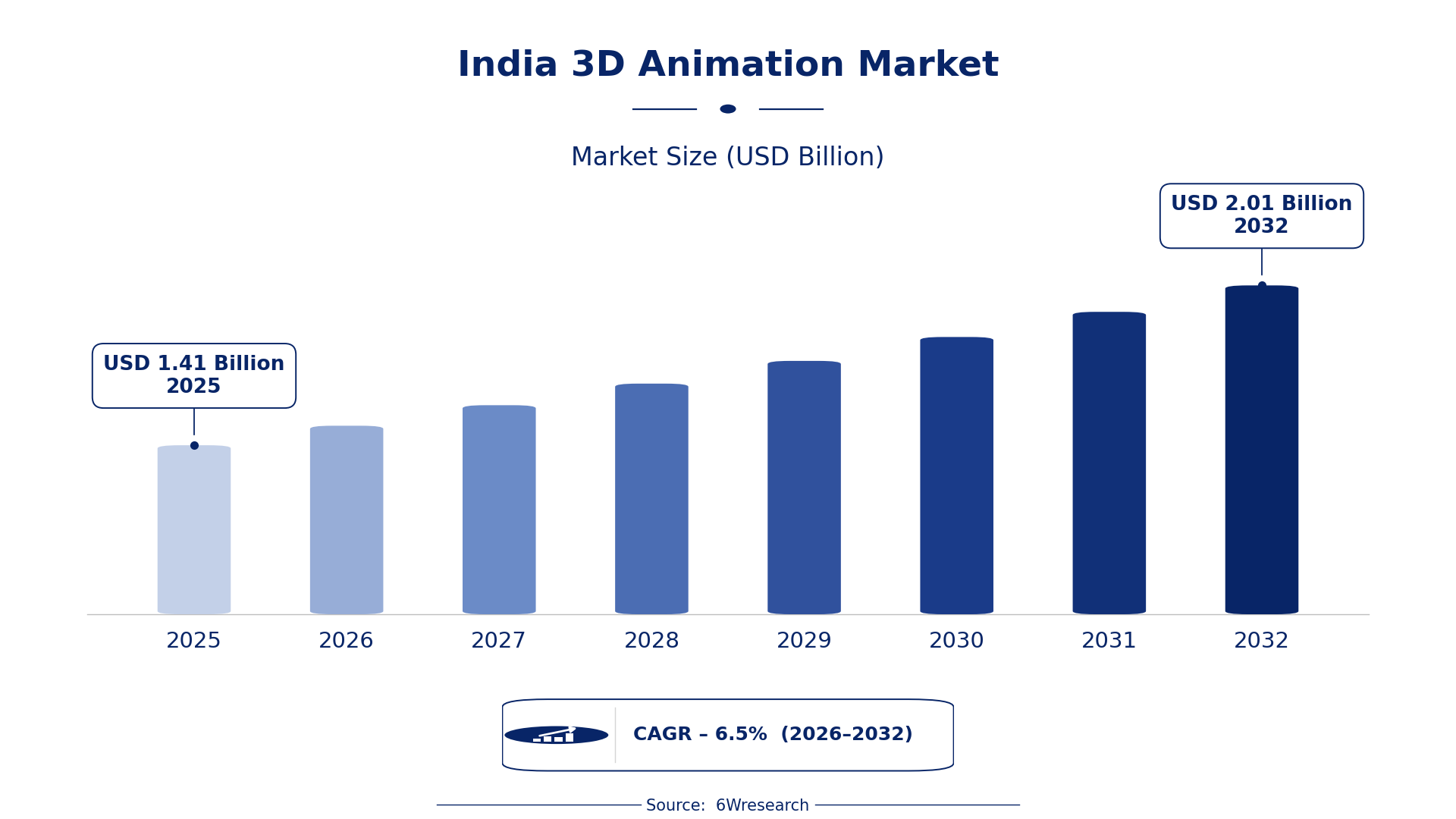
The India 3D Animation Market was estimated at USD 1412 Million in 2025 and is projected to reach USD 2013 Million by 2032, growing at a CAGR of 6.5% from 2026 to 2032.
India 3D Animation Market Synopsis
The demand for engaging visual content is the strongest force shaping the India 3D Animation Market. As industries like entertainment, gaming, and advertising increasingly rely on compelling 3D animations to capture audiences, the market is experiencing significant growth.
Technological advancements are also fueling this expansion, with innovative software tools and improved production techniques enhancing the quality and efficiency of animation projects. This dynamic environment is driving competition and pushing animators to continually refine their skills to meet evolving demands.
India 3D Animation Market Year-wise Growth Rate and Key Drivers
This graph illustrates the annual growth rates of the India 3D Animation Market from 2021 to 2032, highlighting a steady upward trajectory and projected expansion over the forecast period.
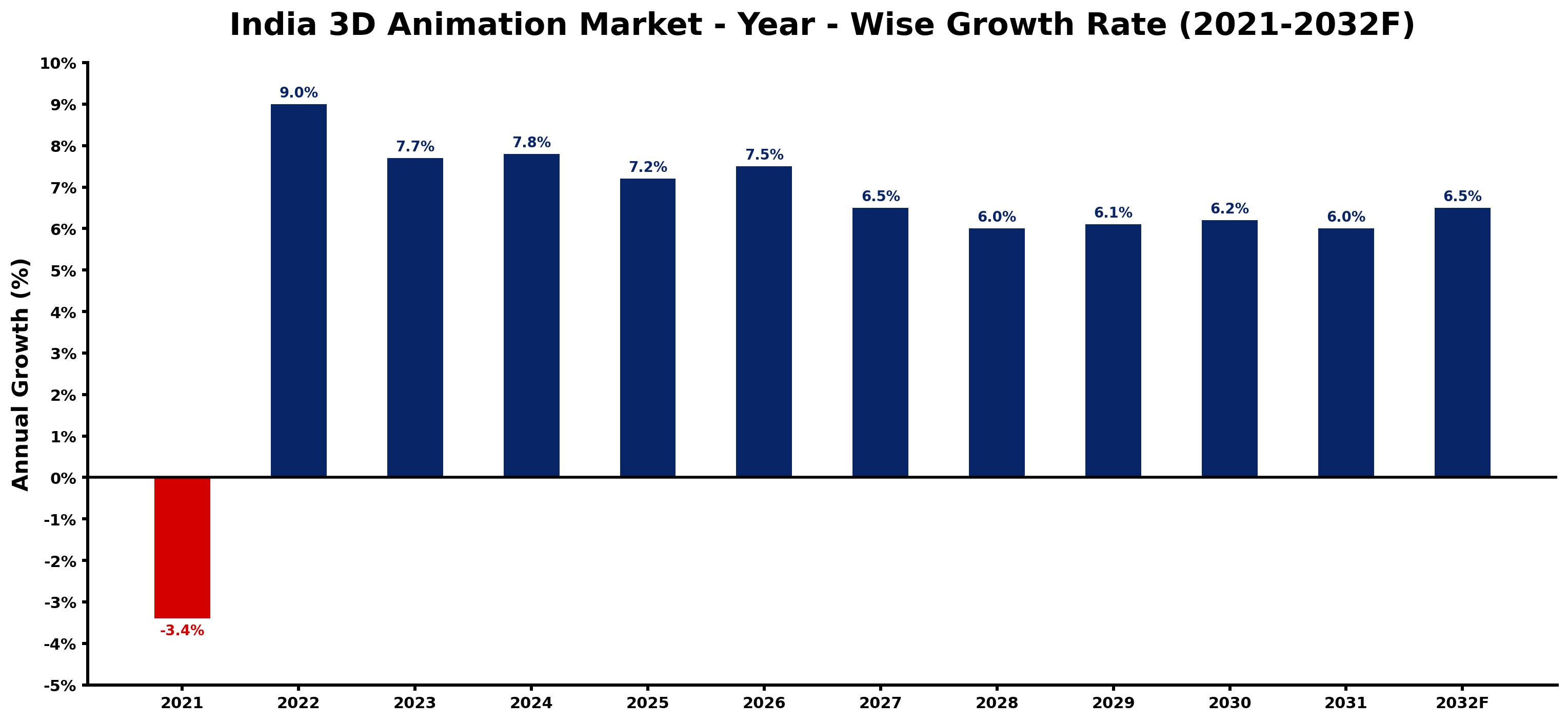
The table below presents the year‑wise growth rates along with the key drivers influencing the market
| Year | Growth Rate | Major Drivers |
| 2021 | -3.4% | Post-COVID budget cuts in Indian entertainment sector |
| 2022 | 9.0% | Increased demand for local animation in Bollywood films. |
| 2023 | 7.7% | Government initiatives promoting digital content creation skills. |
| 2024 | 7.8% | Rising interest in 3D gaming among Indian youth. |
| 2025 | 7.2% | Expanding advertising budgets for digital marketing campaigns. |
| 2026 | 7.5% | Growth of online educational platforms using 3D animation. |
| 2027 | 6.5% | Collaboration with international studios for animated projects. |
| 2028 | 6.0% | Surge in augmented reality applications in retail sectors. |
| 2029 | 6.1% | Increased usage of 3D models in e-commerce platforms. |
| 2030 | 6.2% | Government support for start-ups in creative industries. |
| 2031 | 6.0% | Adoption of 3D animation in television serials production. |
| 2032 | 6.5% | Boost in animated content for children's educational programs. |
Note: Market size estimations and growth projections presented in this report are based on 6Wresearch's proprietary forecasting methodology, utilizing the latest available industry data, government publications, and primary research inputs.
India 3D Animation Market Key Takeaways
Below are some of the specific key takeaways from the market, including:
- The increasing demand for 3D animation in various sectors is significantly influencing market growth.
- Technological innovations in animation software are enhancing production quality and efficiency.
- A shortage of skilled animators is presenting challenges for studios aiming to meet rising demand.
- Government initiatives are actively supporting the development of the animation sector in India.
- Digital content consumption trends are shaping the types of animations being produced.
Evaluation of Restraints in India 3D Animation Market
Several real restraints are holding back the India 3D Animation Market. The persistent shortage of skilled talent remains a significant hurdle, as high-quality animation requires professionals with specialized training and experience. This talent gap is particularly challenging for smaller studios that may struggle to attract qualified animators.
Additionally, the costs associated with high-end software and hardware pose a barrier for independent creators and smaller companies. The ongoing issues of piracy and copyright infringement further complicate the landscape, as they threaten the revenues and sustainability of the industry.
India 3D Animation Market Trends
Several current and emerging trends are shaping the India 3D Animation Market. The rise of virtual reality (VR) and augmented reality (AR) applications is driving demand for more immersive animations. As businesses across various sectors adopt these technologies, the need for high-quality 3D animation becomes even more critical.
on top of that, the increasing integration of animation in educational content reflects a growing trend towards gamification in learning environments. Educational institutions are leveraging 3D animations to create engaging learning experiences, further expanding the market's reach.
India 3D Animation Market Opportunities
Opportunities for growth in the India 3D Animation Market are plentiful. The burgeoning gaming industry presents a substantial avenue for development, as game developers seek high-quality animations to enhance gameplay experiences. Additionally, the increasing demand for animated content in digital marketing campaigns offers a rich area for expansion.
on top of that, as companies invest in building their own content studios, there is a growing need for partnerships between animation firms and technology providers, paving the way for innovative collaborations that can drive future growth.
Government Initiatives in the India 3D Animation Market
Government policies and initiatives are playing a crucial role in shaping the India 3D Animation Market. The public sector is increasingly prioritizing the media and entertainment industry, recognizing its potential for economic growth and job creation. Supportive regulations and funding programs are essential for fostering innovation and encouraging investment in this sector.
- A recently completed initiative focused on enhancing digital infrastructure in urban areas has improved access to high-speed internet, benefiting animation studios.
- A current policy framework aimed at promoting skill development in digital arts is underway, addressing the talent shortage in the animation industry.
- A planned public-private partnership expected to launch in 2026 aims to establish a national animation training institute to boost educational resources.
- Ongoing regulatory efforts are being made to strengthen copyright laws, thereby protecting intellectual property rights in the animation sector.
Future Insights of the India 3D Animation Market
Looking ahead to 2026-2032, the India 3D Animation Market is set for continued growth fueled by technological advancements and a diverse range of applications. The increasing integration of animation in emerging technologies such as AI and machine learning will further enhance production capabilities and creative possibilities.
As demand for high-quality animated content rises across various sectors, firms that adapt quickly to these trends will find themselves at a competitive advantage. The ongoing emphasis on skill development and innovation will also contribute to a more vibrant and sustainable animation ecosystem.
India 3D Animation Market Latest Developments
Recent activity in the India 3D Animation Market has been marked by significant developments as companies adapt to evolving consumer preferences and technological advancements. The industry is witnessing a surge in collaborations between animation studios and tech companies, aiming to create cutting-edge content that resonates with audiences.
- A major technology vendor launched a new animation software suite in early 2025, enhancing tools available for animators.
- A partnership between a leading animation studio and a gaming company began in mid-2025, focusing on developing immersive gaming experiences.
- A new training program was introduced in late 2025 to address the skills gap by offering specialized courses in 3D animation and visual effects.
- An initiative to promote animated content in advertising is currently underway, with several brands collaborating to create engaging campaigns.
India 3D Animation Market - Key Attractiveness of the Report
- 10 Years of Market Numbers
- Historical Data Starting from 2022 to 2025
- Base Year: 2025
- Forecast Data until 2032
- Key Performance Indicators Impacting the Market
- Major Upcoming Developments and Projects
Key Highlights of the Report:
- India 3D Animation Market Outlook
- Market Size of India 3D Animation Market, 2025
- Forecast of India 3D Animation Market, 2032
- Historical Data and Forecast of India 3D Animation Revenues & Volume for the Period 2022-2032F
- India 3D Animation Market Trend Evolution
- India 3D Animation Market Drivers and Challenges
- India 3D Animation Price Trends
- India 3D Animation Porter's Five Forces
- India 3D Animation Industry Life Cycle
- Historical Data and Forecast of India 3D Animation Market Revenues & Volume By Technology for the Period 2022-2032F
- Historical Data and Forecast of India 3D Animation Market Revenues & Volume By 3D Modeling for the Period 2022-2032F
- Historical Data and Forecast of India 3D Animation Market Revenues & Volume By Motion Graphics for the Period 2022-2032F
- Historical Data and Forecast of India 3D Animation Market Revenues & Volume By 3D Rendering for the Period 2022-2032F
- Historical Data and Forecast of India 3D Animation Market Revenues & Volume By Visual Effects for the Period 2022-2032F
- Historical Data and Forecast of India 3D Animation Market Revenues & Volume By Service for the Period 2022-2032F
- Historical Data and Forecast of India 3D Animation Market Revenues & Volume By Consulting for the Period 2022-2032F
- Historical Data and Forecast of India 3D Animation Market Revenues & Volume By Support and Maintenance for the Period 2022-2032F
- Historical Data and Forecast of India 3D Animation Market Revenues & Volume By Integration and Deployment for the Period 2022-2032F
- Historical Data and Forecast of India 3D Animation Market Revenues & Volume By Education and Training for the Period 2022-2032F
- Historical Data and Forecast of India 3D Animation Market Revenues & Volume By Vertical for the Period 2022-2032F
- Historical Data and Forecast of India 3D Animation Market Revenues & Volume By Media and Entertainment for the Period 2022-2032F
- Historical Data and Forecast of India 3D Animation Market Revenues & Volume By Construction and Architecture for the Period 2022-2032F
- Historical Data and Forecast of India 3D Animation Market Revenues & Volume By Healthcare and Lifesciences for the Period 2022-2032F
- Historical Data and Forecast of India 3D Animation Market Revenues & Volume By Manufacturing for the Period 2022-2032F
- Historical Data and Forecast of India 3D Animation Market Revenues & Volume By Education and Academia for the Period 2022-2032F
- Historical Data and Forecast of India 3D Animation Market Revenues & Volume By Others for the Period 2022-2032F
- Historical Data and Forecast of India 3D Animation Market Revenues & Volume By Deployment for the Period 2022-2032F
- Historical Data and Forecast of India 3D Animation Market Revenues & Volume By On-Premises for the Period 2022-2032F
- Historical Data and Forecast of India 3D Animation Market Revenues & Volume By On-Demand for the Period 2022-2032F
- India 3D Animation Import Export Trade Statistics
- Market Opportunity Assessment By Technology
- Market Opportunity Assessment By Service
- Market Opportunity Assessment By Vertical
- Market Opportunity Assessment By Deployment
- India 3D Animation Top Companies Market Share
- India 3D Animation Competitive Benchmarking By Technical and Operational Parameters
- India 3D Animation Company Profiles
- India 3D Animation Key Strategic Recommendations






































