India Acute Intermittent Porphyria Market (2026-2032) | Forecast, Size & Revenue, Value, Growth, Segmentation, Analysis, Companies, Competitive Landscape, Trends, Outlook, Industry, Share
Market Forecast By Diagnosis (Blood Test, Urine Test, DNA Test, Serum Test), By Treatment (Gonadotropin-Releasing Hormone Analogues, Prophylactic Hematin Infusions), By End Users (Hospitals, Clinics, Research Centers) And Competitive Landscape
| Product Code: ETC7536004 | Publication Date: Sep 2024 | Updated Date: Jul 2026 | Product Type: Market Research Report | |
| Publisher: 6Wresearch | Author: Sumit Sagar | No. of Pages: 70 | No. of Figures: 35 | No. of Tables: 5 |
India Acute Intermittent Porphyria Market Growth Rate
According to 6Wresearch internal database and industry insights, the India Acute Intermittent Porphyria Market is projected to grow at a substantial compound annual growth rate (CAGR) of 9.4% during the forecast period of 2026–2032.
India Acute Intermittent Porphyria Market Year-wise Growth Rate and Key Drivers (2022–2032)
This graph illustrates the annual growth rates of the India Acute Intermittent Porphyria Market from 2022 to 2032, highlighting market expansion supported by increasing awareness of rare diseases, improvements in diagnostic capabilities, growing access to specialized healthcare services, and rising adoption of advanced treatment options for rare metabolic disorders.
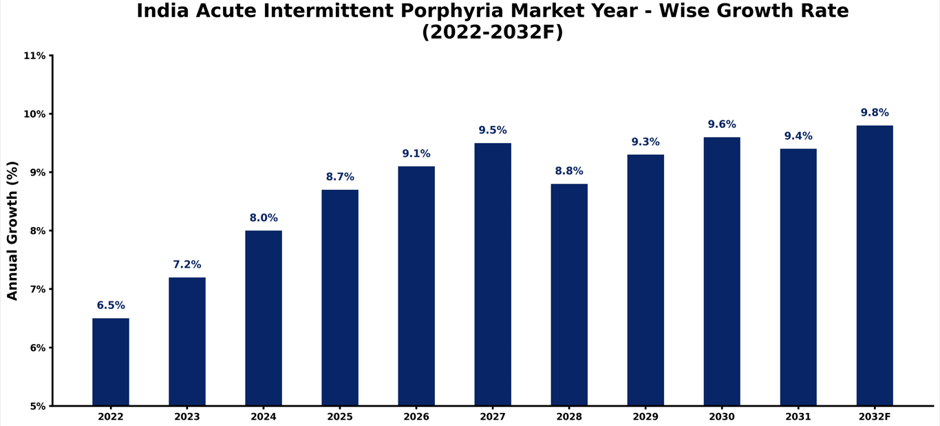
The table below provides a summary of the historical and forecasted growth rates of the India Acute Intermittent Porphyria Market, along with the rationale behind the performance of each year.
| Year | Est. Annual Growth (%) | Market Rationale |
| 2022 | 6.5% | Increasing awareness regarding rare metabolic disorders and gradual improvement in disease identification. |
| 2023 | 7.2% | Rising physician awareness and improved availability of specialized diagnostic facilities. |
| 2024 | 8% | Growing adoption of advanced diagnostic testing and increasing focus on rare disease detection. |
| 2025 | 8.7% | Expanding healthcare infrastructure and increased attention toward rare disease management programs. |
| 2026 | 9.1% | Improved diagnosis rates and increasing access to specialized treatment options for acute intermittent porphyria patients. |
| 2027 | 9.5% | Rising adoption of targeted therapies and greater involvement of specialty hospitals in rare disease care. |
| 2028 | 8.8% | Temporary moderation due to high treatment costs and limited availability of specialized therapies outside major cities. |
| 2029 | 9.3% | Recovery supported by improved healthcare accessibility and growing awareness among patients and healthcare providers. |
| 2030 | 9.6% | Increasing adoption of precision medicine approaches and advancements in rare disease treatment. |
| 2031 | 9.4% | Growing investments in rare disease research and expansion of specialized healthcare networks. |
| 2032 | 9.8% | Continued improvement in diagnosis, treatment availability, and development of India’s rare disease ecosystem. |
Topics Covered in the India Acute Intermittent Porphyria Market Report
The India Acute Intermittent Porphyria Market report covers the market by diagnosis, treatment, and end users. The report provides a detailed analysis of ongoing market trends, opportunities/high-growth areas, and market drivers that will help stakeholders align strategies based on current and future market dynamics.
India Acute Intermittent Porphyria Market Highlights
| Report Name | India Acute Intermittent Porphyria Market |
| Forecast period | 2026–2032 |
| CAGR | 9.4% |
| Growing Sector | Healthcare |
India Acute Intermittent Porphyria Market Synopsis
The India Acute Intermittent Porphyria Market is anticipated to witness steady growth during the forecast period on account of increase in awareness regarding rare genetic disorders, improvement in diagnostic capabilities, and growth in availability of advanced therapies. The rise in healthcare expenditure, specialized treatment centers, and government initiatives for rare diseases are contributing to the market growth.
Evaluation of Growth Drivers in India Acute Intermittent Porphyria Market (2026–2032)
Below are some major drivers and their influence on the market dynamics:
| Drivers | Primary Segment Affected | Why It Matters (Evidence) |
| Increasing Awareness of Rare Diseases | Healthcare Providers | Rising awareness campaigns improve the early diagnosis, and treatment rates of the acute intermittent porphyria. |
| Advancements in Genetic Diagnostics | Diagnostic Centers | Improved genetic testing technologies enable the accurate, and timely diagnosis, supporting the effective disease management. |
| Availability of Innovative Therapies | Pharmaceutical Industry | Introduction of RNA interference therapies enhances the patient outcomes, and expands treatment options. |
| Government Support for Rare Diseases | Public Healthcare | National policies, and financial assistance programs for rare diseases improve the patient access to treatment. |
| Healthcare Infrastructure | Hospitals & Specialty Clinics | The expansion of specialized healthcare facilities, and improved access to advanced medical services drive the market growth. |
The India Acute Intermittent Porphyria Industry is projected to grow at a CAGR of 9.4% during 2026–2032 on account of increase in investments in rare disease research, improved diagnostic infrastructure, and rise in adoption of the innovative treatment approaches. Furthermore, collaborations between pharmaceutical companies, healthcare institutions, and research organizations are expected to accelerate the development of targeted therapies. Additionally, the advancements in genetic testing, and introduction of novel RNA-based therapies are expected to improve the disease management, and treatment outcomes for patients suffering from the acute intermittent porphyria.
Evaluation of Restraints in India Acute Intermittent Porphyria Market
Below are some major restraints and their influence on the market dynamics:
| Restraints | Primary Segment Affected | What This Means (Evidence) |
| High Treatment Cost | Patients & Healthcare Providers | The advanced therapies, and lifelong disease management increase the financial burden on patients. |
| Limited Awareness | General Population | Low awareness often results in delayed diagnosis of acute intermittent porphyria cases. |
| Scarcity of Specialized Healthcare Professionals | Hospitals & Clinics | Limited expertise in managing rare metabolic disorders affects the timely treatment. |
| Restricted Availability of Advanced Therapies | Pharmaceutical Distribution | Limited access to innovative drugs in certain regions may hinder the treatment adoption. |
| Regulatory Challenges | Pharmaceutical Companies | Lengthy approval process for orphan drugs may delay the commercialization of new treatment options. |
India Acute Intermittent Porphyria Market Challenges
Despite promising growth potential, India Acute Intermittent Porphyria Market is facing several challenges like high cost, limited access to specialized treatment, high dependence on import of orphan drugs, regulatory complexities, and inadequate reimbursement mechanisms. To overcome these challenges, stakeholders must focus on strengthening the rare disease awareness programs, expanding genetic testing capabilities, domestic pharmaceutical innovation, and improving patient access to affordable treatment through supportive healthcare policies.
India Acute Intermittent Porphyria Market Trends
Listed below are the major trends responsible for India Acute Intermittent Porphyria Market Growth:
- Rising Adoption of Genetic Testing: The increase in use of advanced DNA-based diagnostics is enabling more accurate identification of the acute intermittent porphyria cases across India.
- Shift Toward Targeted Therapies: The growth in preference for the RNA-based, and hemin therapies is improving the disease management, and reducing the frequency of acute attacks.
- Growth in Specialized Treatment Centers: The development of multi-specialty, and rare disease clinics is improving the access to expert care, and long-term patient monitoring.
Investment Opportunities in the India Acute Intermittent Porphyria Market
Given below are the investment opportunities available in India Acute Intermittent Porphyria Market:
- Development of Orphan Drugs: Strong investment opportunities are available for pharma companies to invest in the RNA-based, and novel therapies targeting the acute intermittent porphyria.
- Genetic Testing Labs: Investments made in affordable, and advanced diagnostic facilities can capture the growing demand for early, and accurate disease detection.
- Rare Disease Research Funding: Scope for funding is available in the clinical trials, and R&D collaborations to develop the innovative treatments, and improve disease understanding.
- Specialized Healthcare Infrastructure: Investments can be made in rare disease clinics, and hospital networks offering integrated diagnosis, and long-term patient management services.
Top Players in India Acute Intermittent Porphyria Market
Stated below are some of the leading companies holding majority of India Acute Intermittent Porphyria Market Share:
1. Takeda Pharmaceutical Company Limited
| Company Name | Takeda Pharmaceutical Company Limited |
|---|---|
| Established Year | 1781 |
| Headquarters | Tokyo, Japan |
| Official Website | Click Here |
Takeda Pharmaceutical Company Limited is a leading global orphan drug, and rare disease-focused company, developing advanced therapies for rare metabolic disorders, and aligning with India’s growing emphasis on rare disease management, and specialty care.
2. Alembic Pharmaceuticals Ltd.
| Company Name | Alembic Pharmaceuticals Ltd. |
|---|---|
| Established Year | 1907 |
| Headquarters | Vadodara, Gujarat, India |
| Official Website | Click Here |
Alembic Pharmaceuticals has a strong presence in specialty generics, and injectables, supporting hospital-based treatments, and potentially contributing to supportive care drugs used in managing AIP complications.
3. Recordati Rare Diseases (Recordati Group)
| Company Name | Recordati Rare Diseases (Recordati Group) |
|---|---|
| Established Year | 1926 |
| Headquarters | Milan, Italy |
| Official Website | Click Here |
Recordati Group is a major global player in orphan drugs, directly relevant through its involvement in hemin-based therapies used for acute porphyria management, making it a core participant in AIP treatment.
4. Sun Pharmaceutical Industries Ltd.
| Company Name | Sun Pharmaceutical Industries Ltd. |
|---|---|
| Established Year | 1983 |
| Headquarters | Mumbai, Maharashtra, India |
| Official Website | Click Here |
Sun Pharmaceutical is one of India’s largest pharmaceutical companies with a strong chronic therapy portfolio, supporting hospital supply chains, and potential expansion into rare disease, and metabolic disorder treatments.
5. Dr. Reddy's Laboratories Ltd.
| Company Name | Dr. Reddy's Laboratories Ltd. |
|---|---|
| Established Year | 1984 |
| Headquarters | Hyderabad, Telangana, India |
| Official Website | Click Here |
Dr. Reddy's Laboratories focus on affordable specialty medicines, plays a key role in improving access to supportive therapies, and cost-effective rare disease treatment solutions in India.
Government Initiatives being implemented in the India Acute Intermittent Porphyria Market
According to Indian government data, the authorities are supporting the acute intermittent porphyria market through rare disease frameworks, and financial assistance under national health programs. Key efforts include the National Policy for Rare Diseases 2021, which provides funding support up to ₹50 lakh for eligible treatments, along with Ayushman Bharat PM-JAY, which offers the insurance coverage for economically weaker sections. The National Health Mission enhances the healthcare infrastructure, while the ICMR Rare Disease Registry supports the research, and better disease understanding across the country.
Future Insights of the India Acute Intermittent Porphyria Market
The India Acute Intermittent Porphyria market is expected to witness steady growth on account of advancements in genetic diagnostics, increase in adoption of RNA-based therapies, and expanding awareness of rare diseases. The future improvements in healthcare infrastructure will enhance early diagnosis, and treatment. The growth in pharmaceutical R&D investment, and international collaborations are likely to accelerate the innovation, while rise in patient registries will improve the disease tracking, and support the effective long-term management strategies.
Market Segmentation Analysis
The report offers a comprehensive study of the following market segments and their leading categories in India Acute Intermittent Porphyria Market:
By Diagnosis - Market Dominated by Blood Test, DNA Test Set for Rapid Expansion
According to Sachin, Senior Research Analyst, 6Wresearch, till 2025, blood test segment dominated the market, accounting for an estimated 39% market share, driven by its wide availability, low cost, and use as a primary screening tool in suspected cases. However, during 2026–2032, DNA test segment is expected to dominate the market, projected to grow at a CAGR of around 12.2%, supported by rising adoption of precision diagnostics, improved genetic testing infrastructure, and emphasis on definitive disease identification.
By Treatment - Prophylactic Hematin Infusions will Dominate the Market
Till 2025, prophylactic hematin infusions dominated the market, holding an estimated 56% market share, due to its established role as the standard acute attack management therapy in AIP patients. For the forecast period of 2026–2032, prophylactic hematin infusions will continue to dominate the market, growing at a CAGR of around 6.8%, driven by continued clinical reliance, strong physician preference, and large-scale availability of curative alternatives, despite gradual emergence of novel RNA-based therapies.
By End Users - Hospitals will lead the Market
Hospitals dominated the market till 2025, accounting for an estimated 64% market share, as most diagnosis, and infusion therapies are administered in tertiary care settings. During 2026–2032, hospitals are expected to remain dominant, projected to grow at a CAGR of around 9.1%, supported by expansion of specialty care units, improved rare disease management infrastructure, and increase in patient inflow for advanced diagnostic, and therapeutic services.
Note: Market size estimations and growth projections presented in this report are based on 6Wresearch’s advanced forecasting approach, validated with industry datasets as of June 2026.
Key Attractiveness of the Report:
- 10 Years of Market Numbers
- Historical Data Starting from 2022 to 2025
- Base Year: 2025
- Forecast Data until 2032
- Key Performance Indicators Impacting the Market
- Major Upcoming Developments and Projects
Key Highlights of the Report:
- India Acute Intermittent Porphyria Market Outlook
- Market Size of India Acute Intermittent Porphyria Market, 2025
- Forecast of India Acute Intermittent Porphyria Market, 2032
- Historical Data and Forecast of India Acute Intermittent Porphyria Revenues & Volume for the Period 2022- 2032
- India Acute Intermittent Porphyria Market Trend Evolution
- India Acute Intermittent Porphyria Market Drivers and Challenges
- India Acute Intermittent Porphyria Price Trends
- India Acute Intermittent Porphyria Porter's Five Forces
- India Acute Intermittent Porphyria Industry Life Cycle
- Historical Data and Forecast of India Acute Intermittent Porphyria Market Revenues & Volume By Diagnosis for the Period 2022- 2032
- Historical Data and Forecast of India Acute Intermittent Porphyria Market Revenues & Volume By Blood Test for the Period 2022- 2032
- Historical Data and Forecast of India Acute Intermittent Porphyria Market Revenues & Volume By Urine Test for the Period 2022- 2032
- Historical Data and Forecast of India Acute Intermittent Porphyria Market Revenues & Volume By DNA Test for the Period 2022- 2032
- Historical Data and Forecast of India Acute Intermittent Porphyria Market Revenues & Volume By Serum Test for the Period 2022- 2032
- Historical Data and Forecast of India Acute Intermittent Porphyria Market Revenues & Volume By Treatment for the Period 2022- 2032
- Historical Data and Forecast of India Acute Intermittent Porphyria Market Revenues & Volume By Gonadotropin-Releasing Hormone Analogues for the Period 2022- 2032
- Historical Data and Forecast of India Acute Intermittent Porphyria Market Revenues & Volume By Prophylactic Hematin Infusions for the Period 2022- 2032
- Historical Data and Forecast of India Acute Intermittent Porphyria Market Revenues & Volume By End Users for the Period 2022- 2032
- Historical Data and Forecast of India Acute Intermittent Porphyria Market Revenues & Volume By Hospitals for the Period 2022- 2032
- Historical Data and Forecast of India Acute Intermittent Porphyria Market Revenues & Volume By Clinics for the Period 2022- 2032
- Historical Data and Forecast of India Acute Intermittent Porphyria Market Revenues & Volume By Research Centers for the Period 2022- 2032
- India Acute Intermittent Porphyria Import Export Trade Statistics
- Market Opportunity Assessment By Diagnosis
- Market Opportunity Assessment By Treatment
- Market Opportunity Assessment By End Users
- India Acute Intermittent Porphyria Top Companies Market Share
- India Acute Intermittent Porphyria Competitive Benchmarking By Technical and Operational Parameters
- India Acute Intermittent Porphyria Company Profiles
- India Acute Intermittent Porphyria Key Strategic Recommendations
Market Covered
The report offers an extensive study of the following market segments:
By Diagnosis
- Blood Test
- Urine Test
- DNA Test
- Serum Test
By Treatment
- Gonadotropin-Releasing Hormone Analogues
- Prophylactic Hematin Infusions
By End Users
- Hospitals
- Clinics
- Research Centers
India Acute Intermittent Porphyria Market (2026-2032): FAQs
India Acute Intermittent Porphyria Market is anticipated to grow at the compound annual growth rate (CAGR) of 9.4% during the forecast period (2026-2032).
Indian government supports the acute intermittent porphyria market through rare disease policies like the National Policy for Rare Diseases, Ayushman Bharat PMJAY, and NHM infrastructure.
India Acute Intermittent Porphyria Market is constrained by delayed diagnosis, limited specialized care, high treatment cost, reliance on imported orphan drugs, and weak reimbursement support.
The leading players in India Acute Intermittent Porphyria Market are Takeda Pharmaceutical Company, Alembic Pharmaceuticals., Sun Pharmaceuticals, and Dr. Reddy's Laboratories.
6Wresearch actively monitors the India Acute Intermittent Porphyria Market and publishes its comprehensive annual report, highlighting emerging trends, growth drivers, revenue analysis, and forecast outlook. Our insights help businesses to make data-backed strategic decisions with ongoing market dynamics. Our analysts track relevent industries related to the India Acute Intermittent Porphyria Market, allowing our clients with actionable intelligence and reliable forecasts tailored to emerging regional needs.
Yes, we provide customisation as per your requirements. To learn more, feel free to contact us on sales@6wresearch.com
| 1 Executive Summary |
| 2 Introduction |
| 2.1 Key Highlights of the Report |
| 2.2 Report Description |
| 2.3 Market Scope & Segmentation |
| 2.4 Research Methodology |
| 2.5 Assumptions |
| 3 India Acute Intermittent Porphyria Market Overview |
| 3.1 India Country Macro Economic Indicators |
| 3.2 India Acute Intermittent Porphyria Market Revenues & Volume, 2022 & 2032F |
| 3.3 India Acute Intermittent Porphyria Market - Industry Life Cycle |
| 3.4 India Acute Intermittent Porphyria Market - Porter's Five Forces |
| 3.5 India Acute Intermittent Porphyria Market Revenues & Volume Share, By Diagnosis, 2022 & 2032F |
| 3.6 India Acute Intermittent Porphyria Market Revenues & Volume Share, By Treatment, 2022 & 2032F |
| 3.7 India Acute Intermittent Porphyria Market Revenues & Volume Share, By End Users, 2022 & 2032F |
| 4 India Acute Intermittent Porphyria Market Dynamics |
| 4.1 Impact Analysis |
| 4.2 Market Drivers |
| 4.2.1 Increasing awareness and diagnosis of acute intermittent porphyria in India |
| 4.2.2 Advancements in medical research leading to improved treatment options |
| 4.2.3 Rising healthcare expenditure and infrastructure development in India |
| 4.3 Market Restraints |
| 4.3.1 Limited access to specialized healthcare facilities for diagnosis and treatment |
| 4.3.2 High cost of treatment and limited insurance coverage for acute intermittent porphyria |
| 4.3.3 Lack of trained healthcare professionals with expertise in managing acute intermittent porphyria |
| 5 India Acute Intermittent Porphyria Market Trends |
| 6 India Acute Intermittent Porphyria Market, By Types |
| 6.1 India Acute Intermittent Porphyria Market, By Diagnosis |
| 6.1.1 Overview and Analysis |
| 6.1.2 India Acute Intermittent Porphyria Market Revenues & Volume, By Diagnosis, 2022-2032F |
| 6.1.3 India Acute Intermittent Porphyria Market Revenues & Volume, By Blood Test, 2022-2032F |
| 6.1.4 India Acute Intermittent Porphyria Market Revenues & Volume, By Urine Test, 2022-2032F |
| 6.1.5 India Acute Intermittent Porphyria Market Revenues & Volume, By DNA Test, 2022-2032F |
| 6.1.6 India Acute Intermittent Porphyria Market Revenues & Volume, By Serum Test, 2022-2032F |
| 6.2 India Acute Intermittent Porphyria Market, By Treatment |
| 6.2.1 Overview and Analysis |
| 6.2.2 India Acute Intermittent Porphyria Market Revenues & Volume, By Gonadotropin-Releasing Hormone Analogues, 2022-2032F |
| 6.2.3 India Acute Intermittent Porphyria Market Revenues & Volume, By Prophylactic Hematin Infusions, 2022-2032F |
| 6.3 India Acute Intermittent Porphyria Market, By End Users |
| 6.3.1 Overview and Analysis |
| 6.3.2 India Acute Intermittent Porphyria Market Revenues & Volume, By Hospitals, 2022-2032F |
| 6.3.3 India Acute Intermittent Porphyria Market Revenues & Volume, By Clinics, 2022-2032F |
| 6.3.4 India Acute Intermittent Porphyria Market Revenues & Volume, By Research Centers, 2022-2032F |
| 7 India Acute Intermittent Porphyria Market Import-Export Trade Statistics |
| 7.1 India Acute Intermittent Porphyria Market Export to Major Countries |
| 7.2 India Acute Intermittent Porphyria Market Imports from Major Countries |
| 8 India Acute Intermittent Porphyria Market Key Performance Indicators |
| 8.1 Number of healthcare facilities offering specialized services for acute intermittent porphyria |
| 8.2 Percentage increase in the number of diagnosed cases annually |
| 8.3 Investment in research and development for new treatment options |
| 8.4 Patient satisfaction and quality of life improvements post-treatment |
| 8.5 Adoption rate of guidelines for the management of acute intermittent porphyria |
| 9 India Acute Intermittent Porphyria Market - Opportunity Assessment |
| 9.1 India Acute Intermittent Porphyria Market Opportunity Assessment, By Diagnosis, 2022 & 2032F |
| 9.2 India Acute Intermittent Porphyria Market Opportunity Assessment, By Treatment, 2022 & 2032F |
| 9.3 India Acute Intermittent Porphyria Market Opportunity Assessment, By End Users, 2022 & 2032F |
| 10 India Acute Intermittent Porphyria Market - Competitive Landscape |
| 10.1 India Acute Intermittent Porphyria Market Revenue Share, By Companies, 2025 |
| 10.2 India Acute Intermittent Porphyria Market Competitive Benchmarking, By Operating and Technical Parameters |
| 11 Company Profiles |
| 12 Recommendations |
| 13 Disclaimer |
Global Go To Market Strategy - 2030
Export potential enables firms to identify high-growth global markets with greater confidence by combining advanced trade intelligence with a structured quantitative methodology. The framework analyzes emerging demand trends and country-level import patterns while integrating macroeconomic and trade datasets such as GDP and population forecasts, bilateral import–export flows, tariff structures, elasticity differentials between developed and developing economies, geographic distance, and import demand projections. Using weighted trade values from 2020–2024 as the base period to project country-to-country export potential for 2030, these inputs are operationalized through calculated drivers such as gravity model parameters, tariff impact factors, and projected GDP per-capita growth. Through an analysis of hidden potentials, demand hotspots, and market conditions that are most favorable to success, this method enables firms to focus on target countries, maximize returns, and global expansion with data, backed by accuracy.
By factoring in the projected importer demand gap that is currently unmet and could be potential opportunity, it identifies the potential for the Exporter (Country) among 190 countries, against the general trade analysis, which identifies the biggest importer or exporter.
To discover high-growth global markets and optimize your business strategy:
Click Here
Pricing
- Single User License$ 1,995
- Department License$ 2,400
- Site License$ 3,120
- Global License$ 3,795

Leadership Perspectives from Industry Events
Search
Thought Leadership and Analyst Meet





Our Clients








6WResearch In News
- India Export Attractiveness Tracker 2026
- India Air Conditioner Market Set for Strong Rebound in 2026 After Weather-Led Correction and GST-Driven Recovery: 6Wresearch
- ADAS in India: How Automatic Emergency Braking, Blind Spot Detection & Driver Monitoring are Transforming Road Safety
- Doha a strategic location for EV manufacturing hub: IPA Qatar
- Demand for luxury TVs surging in the GCC, says Samsung
- Empowering Growth: The Thriving Journey of Bangladesh’s Cable Industry
Latest Reports
- Nicaragua RPG Gaming Market (2026-2032)
- New Zealand RPG Gaming Market (2026-2032)
- Netherlands RPG Gaming Market (2026-2032)
- Nauru RPG Gaming Market (2026-2032)
- Namibia RPG Gaming Market (2026-2032)
- Mozambique RPG Gaming Market (2026-2032)
- Montenegro RPG Gaming Market (2026-2032)
- Mongolia RPG Gaming Market (2026-2032)
- Monaco RPG Gaming Market (2026-2032)
- Micronesia RPG Gaming Market (2026-2032)
Industry Events and Analyst Meet

EV India Expo 2026

HIMTEX 2026

India Refining Summit 2026

India EV Show 2026

EV tech India Expo 2026
Whitepaper
- Middle East & Africa Commercial Security Market Click here to view more.
- Middle East & Africa Fire Safety Systems & Equipment Market Click here to view more.
- GCC Drone Market Click here to view more.
- Middle East Lighting Fixture Market Click here to view more.
- GCC Physical & Perimeter Security Market Click here to view more.


