India Aerospace Machining Market Size & Growth Rate
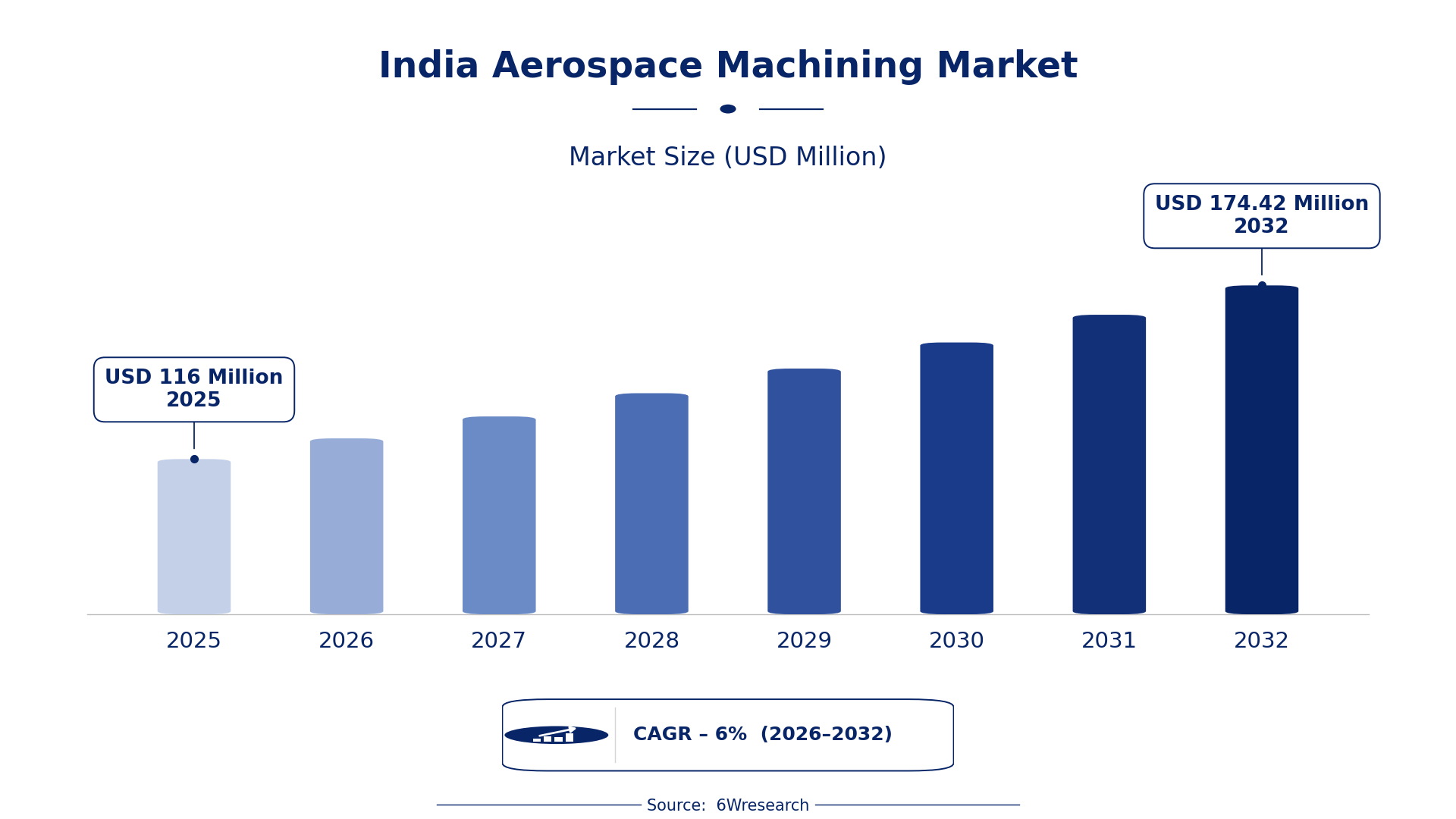
According to 6Wresearch internal database and industry insights, the India Aerospace Machining Market was valued at USD 116.0 million in 2025 and is projected to reach USD 174.42 million by 2032, growing at a CAGR of approximately 6% during 2026–2032.
India Aerospace Machining Market Highlights
| Report Metric | Details |
| Report Name | India Aerospace Machining Market |
| Market Size 2025 | USD 116.0 million |
| Market Size 2032 | USD 174.42 million |
| Absolute Growth 2025–2032 | USD 58.42 million |
| CAGR 2026–2032 | 6% |
| Peak Annual Growth | 8.1% in 2028 |
| Forecast Period | 2026–2032 |
| Historical Data | 2022–2025 |
| Base Year | 2025 |
| Leading Machining Type, 2025 | CNC Milling (48% share) |
| Leading Material Type, 2025 | Titanium Alloys (38% share) |
| Leading Distribution Channel, 2025 | Direct Sales (51% share) |
| Leading End User, 2025 | Aircraft Part Suppliers (37% share) |
| Fastest-Growing Machining Type | Electrical Discharge Machining (EDM) (8.0% CAGR) |
| Fastest-Growing Material Type | Composite Materials (8.3% CAGR) |
| Fastest-Growing Distribution Channel | Online Platforms (7.5% CAGR) |
| Fastest-Growing End User | Aerospace OEMs (8.7% CAGR) |
| Growing Sector | Aerospace Manufacturing |
| Key End Users | Aircraft Part Suppliers, Aerospace OEMs, Engine Manufacturers, Spacecraft Assemblers |
India Aerospace Machining Market Year-wise Growth Rate and Key Drivers (2022–2032)
This graph illustrates the annual growth rates of the market from 2022 to 2032, highlighting a steady upward trajectory and projected market expansion over the forecast period.
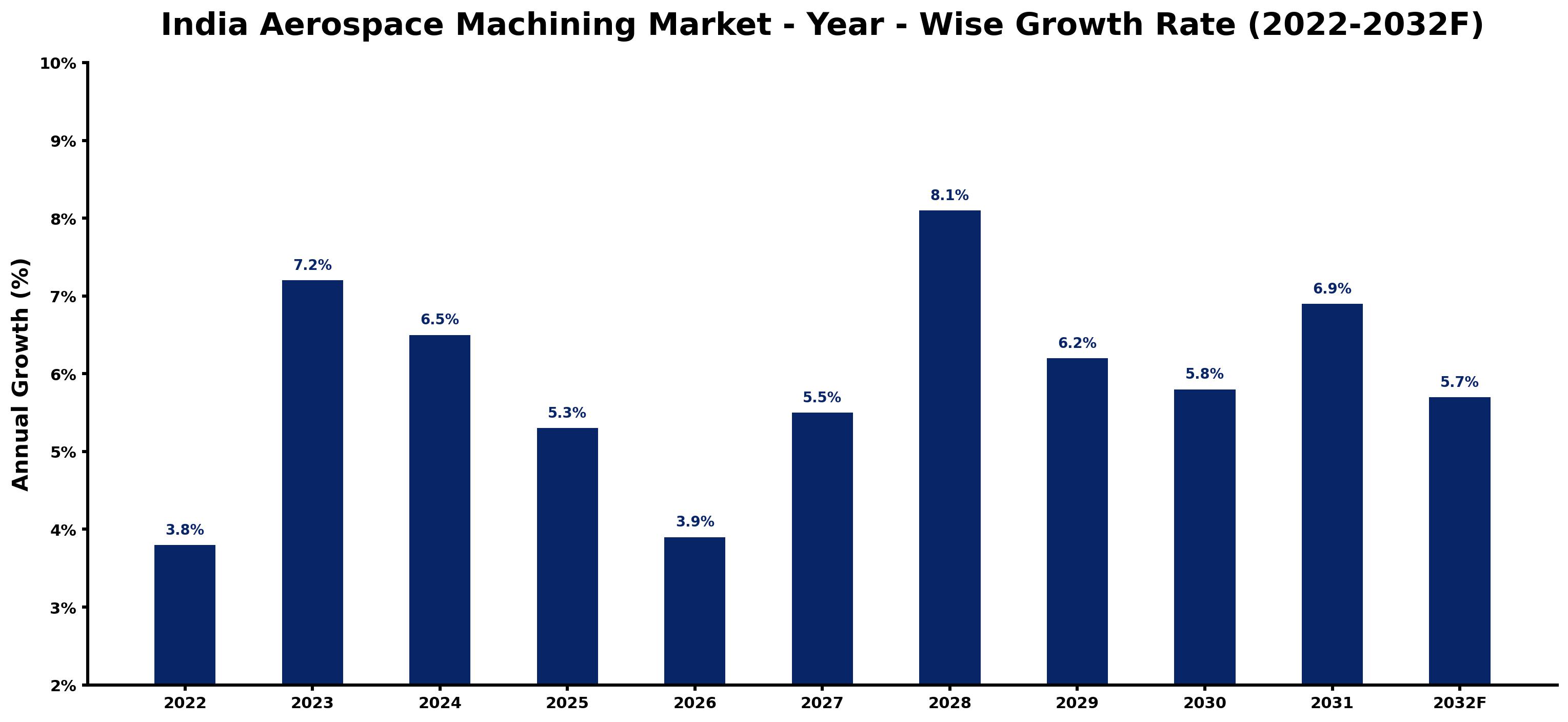
Year by year, the estimates below pair each growth rate with the development that shaped it.
| Year | Estimated Annual Growth (%) | Market Rationale |
| 2022 | 3.8 | The market showed steady growth supported by increased domestic manufacturing activities. |
| 2023 | 7.2 | Growth accelerated due to rising demand from aerospace OEMs and part suppliers. |
| 2024 | 6.5 | Growth slowed as manufacturers adjusted to supply chain challenges and production rates. |
| 2025 | 5.3 | Market growth continued to slow as competition increased among local manufacturers. |
| 2026 | 3.9 | A slowdown occurred as the market adjusted to new regulatory standards and policies. |
| 2027 | 5.5 | Demand increased as investments in aerospace technology began to yield results. |
| 2028 | 8.1 | Growth peaked due to heightened demand for precision components in military applications. |
| 2029 | 6.2 | The market experienced a slowdown as manufacturers faced rising material costs. |
| 2030 | 5.8 | Growth slowed as the market adjusted to evolving consumer preferences and standards. |
| 2031 | 6.9 | Demand rose again with increased government spending on aerospace projects. |
| 2032 | 5.7 | The market continued to grow, albeit at a slower pace, due to maturing industry dynamics. |
Note: Market size estimations and growth projections presented in this report are based on 6Wresearch's proprietary forecasting methodology, utilizing the latest available industry data, government publications, and primary research inputs.
India Aerospace Machining Market Synopsis
Aerospace Machining Market in India encompasses precision manufacturing processes for aircraft and spacecraft components. This sector primarily employs CNC technology to shape materials such as titanium and aluminium alloys. The market is expanding due to increasing domestic manufacturing and export activities, particularly in Maharashtra and Karnataka. In 2022, India exported aerospace products worth $1.5 billion, reflecting the rising demand from both commercial and military sectors. The National Aerospace Policy 2021 aims to boost domestic manufacturing, further driving growth in this market.
Market Dynamics Impact Analysis (2026–2032)
| Factor | Type | Impact | Primary Segment Affected |
| Increasing demand for precision components from aerospace OEMs | Driver | High | CNC Milling |
| Growing investments in aerospace technology and R&D | Driver | High | Electrical Discharge Machining (EDM) |
| Expansion of aerospace manufacturing units in key regions | Opportunity | High | Aircraft Part Suppliers |
| Development of aerospace clusters under government policies | Opportunity | High | Aerospace OEMs |
| High costs of advanced materials like titanium alloys | Restraint | High | Titanium Alloys |
| Limited access to skilled workforce for precision machining | Restraint | Medium | CNC Turning |
| Supply chain disruptions affecting material availability | Challenge | High | Laser Machining |
| Regulatory compliance costs impacting small manufacturers | Challenge | Medium | Electrical Discharge Machining (EDM) |
Evaluation of Drivers in India Aerospace Machining Market (2026–2032)
Below mentioned are some major drivers and their influence on market dynamics.
| Drivers | Primary Segment Affected | Why It Matters (Evidence) |
| Rising demand for commercial aircraft components | CNC Milling | This segment benefits from increased orders for new aircraft, leading to higher production rates, with a projected increase of 15% in orders by 2025. |
| Investment in advanced machining technologies | Electrical Discharge Machining (EDM) | Technological advancements attract more aerospace manufacturers to adopt EDM, with a projected growth of 8% in adoption rates by 2026. |
| Government initiatives promoting local manufacturing | Aerospace OEMs | Policies like the National Aerospace Policy 2021 encourage domestic production, boosting demand by an estimated 20% over the next five years. |
| Growing exports of aerospace products | Aerospace OEMs | Increased international orders for aerospace components drive local manufacturers to expand capacity, with exports expected to rise by 25% by 2025. |
| Technological advancements in machining processes | Laser Machining | Innovations lead to improved efficiency and precision, increasing demand from aerospace manufacturers by 30%. |
In 2022, India exported aerospace products worth $1.5 billion, boosting production rates. Technological advancements in machining processes improve efficiency, attracting more manufacturers to invest. As a result, the market is witnessing a shift towards sophisticated machining capabilities to meet evolving industry standards.
Evaluation of Restraints in India Aerospace Machining Market
The table below lists the restraints and the evidence behind each.
| Market Restraint | Primary Segment Affected | Why It Matters (Evidence) |
| High costs associated with advanced materials like titanium alloys | Titanium Alloys | These costs limit the ability of smaller manufacturers to compete effectively in the market. |
| Limited access to skilled workforce for precision machining | CNC Turning | A shortage of trained professionals hampers production capabilities and efficiency, with industry estimates indicating a gap of over 20,000 skilled workers. |
| Supply chain disruptions affecting material availability | Laser Machining | Delays in material supply can lead to production halts and unmet delivery schedules, impacting timelines by up to 30%. |
| Regulatory compliance costs impacting small manufacturers | Electrical Discharge Machining (EDM) | Small firms struggle to meet compliance, affecting their competitiveness in the market, with compliance costs rising by 10% annually. |
| Competition from established international manufacturers | CNC Milling | Local firms face challenges in pricing and technology compared to larger global players, leading to a market share decline of 5%. |
India Aerospace Machining Market Challenges
Buyers and suppliers in the India Aerospace Machining Market encounter intense competition, particularly from established players in Maharashtra and Karnataka, which compels many to lower prices and diminishes profit margins. Regulatory hurdles from the Directorate General of Civil Aviation create delays in project approvals, often extending timelines by six months, costing manufacturers both time and potential revenue. The rising costs of raw materials, especially titanium and aluminium alloys, have surged by 15% in the past year, significantly straining producers' budgets. Many local firms struggle to implement advanced CNC technology, limiting their competitiveness and risking obsolescence in a rapidly evolving market.
Trends in the India Aerospace Machining Market
The trends below show where the India Aerospace Machining Market is heading.
- Shift towards Composite Materials: The aerospace sector is increasingly adopting composite materials for their lightweight and strong properties. The National Aerospace Policy 2021 supports this shift, targeting a 25% reduction in imports by 2025.
- Increase in Direct Sales Channels: Direct Sales are becoming the primary distribution channel for aerospace machining products, accounting for 51% of the market in 2025. This trend is driven by manufacturers seeking closer relationships with Aircraft Part Suppliers.
- Growth in Online Procurement Platforms: Online Platforms are emerging as a significant channel for aerospace components, with a projected CAGR of 7.5% from 2026 to 2032. This shift reflects changing buyer preferences for convenience and efficiency.
- Expansion of Aerospace Clusters: Aerospace clusters are being established across India, driven by the Aerospace and Defence Manufacturing Policy 2020. This initiative aims to enhance collaboration among manufacturers and improve supply chain efficiency.
Investment Opportunities in the India Aerospace Machining Market
Some of the investment opportunities in the India Aerospace Machining Market are mentioned below.
- Maharashtra as a Manufacturing Hub: Maharashtra is becoming a key region for aerospace manufacturing, with over 30 operational units. Investment in this area is crucial as the Indian aerospace industry targets a $25 billion turnover by 2025.
- $1 billion Technology Development Fund: The Technology Development Fund (TDF) supports R&D in aerospace technologies with a budget of $1 billion. This presents opportunities for suppliers to collaborate on projects with local manufacturers.
- Supply of Advanced Machining Equipment: There is a growing demand for advanced machining equipment in the aerospace sector, particularly for CNC Milling. Suppliers can enter this market by partnering with Aircraft Part Suppliers in India.
- Timing with National Policy Goals: With the National Aerospace Policy 2021 aiming for a 70% domestic manufacturing share by 2030, now is the ideal time for investments in aerospace machining capabilities.
Government Initiatives in the India Aerospace Machining Market
The National Aerospace Policy 2021, launched by the Ministry of Defence, aims to increase the domestic aerospace manufacturing share to 70% by 2030. This policy builds on previous regulations by focusing on indigenous production and reducing reliance on imports. It sets clear targets for manufacturers to meet, encouraging investment in local capabilities. The Defence Production Policy 2020 also supports this initiative, aiming for a turnover of $25 billion in aerospace and defence goods by 2025, further driving the sector's growth.
The Directorate General of Civil Aviation (DGCA) oversees compliance with aerospace standards, ensuring safety and quality in manufacturing. The Technology Development Fund (TDF) scheme initiated by the Ministry of Defence in 2020 provides funding for R&D projects in aerospace technologies. This fund supports innovative developments, enabling manufacturers to enhance their product offerings and improve competitiveness in the global market.
Future Insight of the India Aerospace Machining Market
The India Aerospace Machining Market is set for transformative changes by 2032, driven by the National Aerospace Policy 2021, which aims to strengthen domestic manufacturing. The Indian Space Research Organisation will spearhead technological advancements, enabling local producers to innovate more effectively. The government's target to cut aerospace component imports by 25% by 2025 will spur local production efforts. The defence budget for aerospace projects is expected to rise to around $15 billion, facilitating significant investments in modern manufacturing processes.
Market Segmentation Analysis
Each segment group is reviewed below, with the leader by share and the fastest grower by CAGR.
By Machining Type – CNC Milling Dominated, Electrical Discharge Machining (EDM) Expected to Grow Fastest
According to Ravi Bhandari, Research Head at 6Wresearch, in 2025, CNC Milling led the machining type split with a 48% share. CNC Milling secures the largest share in the India Aerospace Machining Market because it is essential for creating complex aerospace components. This method is widely adopted in key manufacturing regions like Maharashtra and Karnataka, which are crucial for aerospace production. Electrical Discharge Machining (EDM) is set to record the highest CAGR in this split, 8.0% over 2026–2032. Electrical Discharge Machining (EDM) is experiencing rapid growth due to its critical role in precision machining of hard materials, which are increasingly required in aerospace applications. The rising demand for high-performance components is driving this sub-segment's swift expansion. Suppliers should focus on enhancing their CNC Milling capabilities while also considering EDM to meet the increasing demands in the aerospace sector.
By Material Type – Titanium Alloys Dominated, Composite Materials Expected to Grow Fastest
The largest material type category in 2025 was Titanium Alloys, with a 38% share of total revenue. Titanium Alloys dominate the market share in the India Aerospace Machining Market because of their exceptional strength-to-weight ratio, making them ideal for aerospace applications. Their extensive use in both commercial and military aircraft contributes to their leading position. Composite Materials are projected to grow fastest, at a CAGR of 8.3% during 2026–2032. Composite Materials are the fastest-growing segment as they are increasingly utilised for lightweight and strong aerospace components, responding to the industry's shift towards more efficient designs. This trend is expected to accelerate as manufacturers seek to reduce overall aircraft weight. Buyers should consider diversifying their material sourcing to include composite materials, which are becoming vital for modern aerospace applications.
By Distribution Channel – Direct Sales Dominated, Online Platforms Expected to Grow Fastest
Direct Sales took a 51% share of distribution channel in 2025, more than any other category. Direct Sales is the predominant distribution channel in the India Aerospace Machining Market, as it enables manufacturers to connect directly with end-users, ensuring effective communication and service. This method is particularly favoured by aerospace part suppliers who seek customised solutions. Over 2026–2032, Online Platforms are expected to post the fastest growth, at a CAGR of 7.5%. Online Platforms are rapidly emerging as a preferred distribution channel for aerospace components, driven by the convenience and efficiency they provide for procurement. The ongoing digital transformation in the aerospace sector is accelerating this growth. Suppliers need to invest in online platforms to broaden their market reach and align with the changing purchasing behaviours of aerospace clients.
By End User – Aircraft Part Suppliers Dominated, Aerospace OEMs Expected to Grow Fastest
Aircraft Part Suppliers held a 37% share of the India Aerospace Machining Market by end user in 2025. Aircraft Part Suppliers dominate the market share in the India Aerospace Machining Market as they are the primary consumers of aerospace machining services, depending on precise components for their products. Their significant position in the supply chain underscores their importance in the overall market. The quickest growth will come from Aerospace OEMs, forecast to expand at a CAGR of 8.7% between 2026 and 2032. Aerospace OEMs represent the fastest-growing end-user segment, largely due to their escalating need for precision machined parts in the production of advanced aircraft. As the aerospace industry continues to grow, the demand from OEMs is expected to increase substantially. Suppliers should strengthen their relationships with aerospace OEMs to capitalise on the rising need for precision components in aircraft manufacturing.
Key Attractiveness of the Report
- 10 Years of Market Numbers
- Historical Data Starting from 2022 to 2025
- Base Year 2025
- Forecast Data until 2032
- Key Performance Indicators Impacting the Market
- Major Upcoming Developments and Projects
Key Highlights of the Report:
- India Aerospace Machining Market Outlook
- Market Size of India Aerospace Machining Market, 2025
- Forecast of India Aerospace Machining Market, 2032
- Historical Data and Forecast of India Aerospace Machining Revenues & Volume for the Period 2022 - 2032F
- India Aerospace Machining Market Trend Evolution
- India Aerospace Machining Market Drivers and Challenges
- India Aerospace Machining Price Trends
- India Aerospace Machining Porter's Five Forces
- India Aerospace Machining Industry Life Cycle
- Historical Data and Forecast of India Aerospace Machining Market Revenues & Volume By Machining Type for the Period 2022 - 2032F
- Historical Data and Forecast of India Aerospace Machining Market Revenues & Volume By CNC Milling for the Period 2022 - 2032F
- Historical Data and Forecast of India Aerospace Machining Market Revenues & Volume By CNC Turning for the Period 2022 - 2032F
- Historical Data and Forecast of India Aerospace Machining Market Revenues & Volume By Electrical Discharge Machining (EDM) for the Period 2022 - 2032F
- Historical Data and Forecast of India Aerospace Machining Market Revenues & Volume By Laser Machining for the Period 2022 - 2032F
- Historical Data and Forecast of India Aerospace Machining Market Revenues & Volume By Material Type for the Period 2022 - 2032F
- Historical Data and Forecast of India Aerospace Machining Market Revenues & Volume By Titanium Alloys for the Period 2022 - 2032F
- Historical Data and Forecast of India Aerospace Machining Market Revenues & Volume By Aluminum Alloys for the Period 2022 - 2032F
- Historical Data and Forecast of India Aerospace Machining Market Revenues & Volume By Nickel Alloys for the Period 2022 - 2032F
- Historical Data and Forecast of India Aerospace Machining Market Revenues & Volume By Composite Materials for the Period 2022 - 2032F
- Historical Data and Forecast of India Aerospace Machining Market Revenues & Volume By Distribution Channel for the Period 2022 - 2032F
- Historical Data and Forecast of India Aerospace Machining Market Revenues & Volume By Direct Sales for the Period 2022 - 2032F
- Historical Data and Forecast of India Aerospace Machining Market Revenues & Volume By Industrial Suppliers for the Period 2022 - 2032F
- Historical Data and Forecast of India Aerospace Machining Market Revenues & Volume By Online Platforms for the Period 2022 - 2032F
- Historical Data and Forecast of India Aerospace Machining Market Revenues & Volume By Specialty Stores for the Period 2022 - 2032F
- Historical Data and Forecast of India Aerospace Machining Market Revenues & Volume By End User for the Period 2022 - 2032F
- Historical Data and Forecast of India Aerospace Machining Market Revenues & Volume By Aircraft Part Suppliers for the Period 2022 - 2032F
- Historical Data and Forecast of India Aerospace Machining Market Revenues & Volume By Aerospace OEMs for the Period 2022 - 2032F
- Historical Data and Forecast of India Aerospace Machining Market Revenues & Volume By Engine Manufacturers for the Period 2022 - 2032F
- Historical Data and Forecast of India Aerospace Machining Market Revenues & Volume By Spacecraft Assemblers for the Period 2022 - 2032F
- India Aerospace Machining Import Export Trade Statistics
- Market Opportunity Assessment By Machining Type
- Market Opportunity Assessment By Material Type
- Market Opportunity Assessment By Distribution Channel
- Market Opportunity Assessment By End User
- India Aerospace Machining Top Companies Market Share
- India Aerospace Machining Competitive Benchmarking By Technical and Operational Parameters
- India Aerospace Machining Company Profiles
- India Aerospace Machining Key Strategic Recommendations
Market Covered
The report offers an extensive study of the following market segments.
By Machining Type
- CNC Milling
- CNC Turning
- Electrical Discharge Machining (EDM)
- Laser Machining
By Material Type
- Titanium Alloys
- Aluminum Alloys
- Nickel Alloys
- Composite Materials
By Distribution Channel
- Direct Sales
- Industrial Suppliers
- Online Platforms
- Specialty Stores
By End User
- Aircraft Part Suppliers
- Aerospace OEMs
- Engine Manufacturers
- Spacecraft Assemblers































