India Aerospace Mechanical Components Market Size & Growth Rate

According to 6Wresearch internal database and industry insights, the India Aerospace Mechanical Components Market was valued at USD 92.0 million in 2025 and is projected to reach USD 139.25 million by 2032, growing at a CAGR of approximately 6.1% during 2026–2032.
India Aerospace Mechanical Components Market Highlights
| Report Metric | Details |
| Report Name | India Aerospace Mechanical Components Market |
| Market Size 2025 | USD 92.0 million |
| Market Size 2032 | USD 139.25 million |
| Absolute Growth 2025–2032 | USD 47.25 million |
| CAGR 2026–2032 | 6.1% |
| Peak Annual Growth | 8.4% in 2032 |
| Forecast Period | 2026–2032 |
| Historical Data | 2022–2025 |
| Base Year | 2025 |
| Leading Component Type, 2025 | Actuators (50% share) |
| Leading Material Type, 2025 | Steel Alloy (50% share) |
| Leading Distribution Channel, 2025 | Direct Sales (40% share) |
| Leading End User, 2025 | Jet Engine Manufacturers (42% share) |
| Fastest-Growing Component Type | Springs & Seals (8.0% CAGR) |
| Fastest-Growing Material Type | Titanium Alloy (8.6% CAGR) |
| Fastest-Growing Distribution Channel | Online Platforms (8.7% CAGR) |
| Fastest-Growing End User | Aerospace Assemblers (8.3% CAGR) |
| Growing Sector | Military Aviation |
| Key End Users | Jet Engine Manufacturers, Aerospace Assemblers, Aircraft Builders, Military Aviation Units |
India Aerospace Mechanical Components Market Year-wise Growth Rate and Key Drivers (2022–2032)
This graph illustrates the annual growth rates of the market from 2022 to 2032, highlighting a steady upward trajectory and projected market expansion over the forecast period.
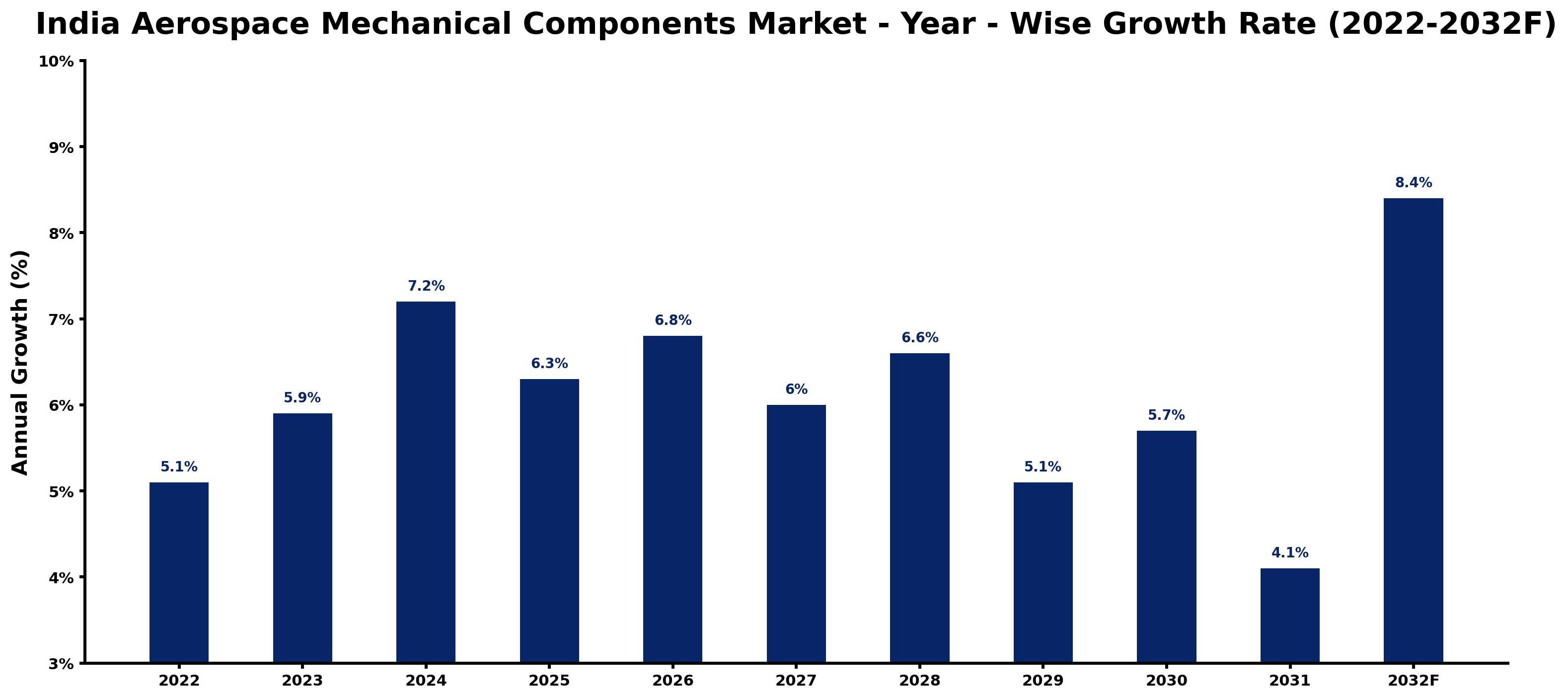
Below, each year's estimated growth is shown next to the factor that most influenced it.
| Year | Estimated Annual Growth (%) | Market Rationale |
| 2022 | 5.1 | The market showed steady growth due to the Aerospace and Defence Manufacturing Policy boosting local production. |
| 2023 | 5.9 | Demand rose as the Indian Air Force advanced procurement plans for indigenous aircraft components. |
| 2024 | 7.2 | Growth accelerated with new defense contracts increasing component requirements for military aviation. |
| 2025 | 6.3 | A slowdown occurred as some projects faced delays in approvals and funding from the Ministry of Defence. |
| 2026 | 6.8 | Production incentives are expected to stimulate further investment in manufacturing capabilities. |
| 2027 | 6.0 | Growth is projected to slow as manufacturers adjust to evolving supply chain requirements. |
| 2028 | 6.6 | Increased demand for lightweight components is expected to drive market expansion significantly. |
| 2029 | 5.1 | A slowdown is anticipated as global supply chain issues impact local production capabilities. |
| 2030 | 5.7 | Demand is expected to rise as aircraft registrations continue to increase substantially. |
| 2031 | 4.1 | Growth is projected to slow as the market adjusts to new regulatory standards and compliance. |
| 2032 | 8.4 | The market is expected to peak with strong demand from military aviation projects and procurement plans. |
Note: Market size estimations and growth projections presented in this report are based on 6Wresearch's proprietary forecasting methodology, utilizing the latest available industry data, government publications, and primary research inputs.
India Aerospace Mechanical Components Market Synopsis
The India Aerospace Mechanical Components Market encompasses critical parts used in aircraft and spacecraft, primarily made from high-strength alloys. These components ensure the functionality and safety of aircraft systems, such as propulsion and control mechanisms. The market is expanding due to rising domestic demand from manufacturers and defense projects, supported by a skilled workforce of approximately 100,000 professionals. Initiatives like the Aerospace and Defence Manufacturing Policy aim to boost local production, targeting $25 billion by 2025, further driving growth in this sector.
Market Dynamics Impact Analysis (2026–2032)
| Factor | Type | Impact | Primary Segment Affected |
| Growing domestic manufacturing capabilities driven by government initiatives | Driver | High | Actuators |
| Increased defense spending leading to higher procurement of aerospace components | Driver | High | Gear Systems |
| Rising demand for lightweight materials in aerospace applications | Opportunity | High | Titanium Alloy |
| Expansion of online sales channels catering to niche markets | Opportunity | Medium | Online Platforms |
| Supply chain disruptions affecting timely delivery of components | Restraint | High | Fasteners |
| High production costs limiting the competitiveness of local manufacturers | Restraint | Medium | Springs & Seals |
| Challenges in meeting stringent quality standards for aerospace components | Challenge | High | Steel Alloy |
| Limited access to advanced manufacturing technologies for small players | Challenge | Medium | Aluminum Alloy |
Evaluation of Drivers in India Aerospace Mechanical Components Market (2026–2032)
Below mentioned are some major drivers and their influence on market dynamics.
| Drivers | Primary Segment Affected | Why It Matters (Evidence) |
| Increased defense contracts for indigenous aircraft | Actuators | This demand drives purchases as manufacturers require more components to meet military specifications. |
| Rising aircraft registrations | Gear Systems | The increase in registrations leads to a greater need for reliable power transmission components in new aircraft. |
| Investments in manufacturing technologies | Fasteners | Enhanced production capabilities allow for the assembly of components with improved quality and efficiency. |
| Focus on lightweight materials for fuel efficiency | Springs & Seals | This trend encourages the use of advanced materials, increasing demand for components that maintain system integrity. |
| Government initiatives to boost local production | Steel Alloy | Policies like the Aerospace and Defence Manufacturing Policy stimulate local sourcing of structural components. |
The Aerospace Mechanical Components market in India is expanding as a result of increased defence contracts for indigenous aircraft, a rise in aircraft registrations, and investments in manufacturing technologies driving demand. A notable surge in aircraft registrations has led to a heightened need for components, particularly in military aviation. The workforce in the aerospace sector, estimated at 100,000 professionals, is boosting production capabilities. The emphasis on lightweight materials for fuel efficiency is also driving demand for advanced materials.
Evaluation of Restraints in India Aerospace Mechanical Components Market
The key brakes on demand, and where they bite hardest, are shown below.
| Market Restraint | Primary Segment Affected | Why It Matters (Evidence) |
| Supply chain disruptions affecting timely delivery of components | Fasteners | These disruptions have delayed projects, impacting manufacturers' ability to meet delivery schedules and increasing costs by 15%. |
| High production costs limiting the competitiveness of local manufacturers | Springs & Seals | Manufacturers face challenges in maintaining profitability due to rising raw material prices, which have increased by 10%. |
| Challenges in meeting stringent quality standards for aerospace components | Steel Alloy | Manufacturers must invest in quality assurance processes, increasing operational costs by approximately 12%. |
| Limited access to advanced manufacturing technologies for small players | Aluminum Alloy | Small manufacturers struggle to compete with larger firms that have better technology access, limiting their market share by 20%. |
| Regulatory compliance costs impacting small manufacturers | Titanium Alloy | Compliance with new regulations raises operational costs by 10%, disproportionately affecting smaller firms' profitability. |
India Aerospace Mechanical Components Market Challenges
In India, buyers and suppliers in the aerospace mechanical components market encounter substantial regulatory hurdles, as over 400 approved manufacturers must adhere to complex standards, which can delay production timelines by up to six months. The skills gap remains a pressing concern, with the current workforce struggling to meet the industry's growing demands, resulting in project delays for manufacturers. Local producers face intense competition from global firms, which pressures pricing and reduces contract opportunities. Additionally, buyers experience procurement delays due to reliance on imported advanced technologies, extending lead times by an average of four months.
Trends in the India Aerospace Mechanical Components Market
Several trends are reshaping the India Aerospace Mechanical Components Market; the most important are set out below.
- Shift towards Lightweight Materials: The aerospace sector is increasingly adopting lightweight materials to improve fuel efficiency. The use of titanium alloys is projected to grow at a CAGR of 8.6% as manufacturers seek to reduce aircraft weight.
- Expansion of Online Sales Channels: The rise of online platforms is transforming distribution channels, with an expected CAGR of 8.7% from 2026 to 2032. This shift allows niche suppliers to reach targeted buyers more effectively, enhancing market access.
- Focus on Indigenous Manufacturing: The Aerospace and Defence Manufacturing Policy 2020 aims to boost local production capabilities significantly. By 2025, the goal is to reach $25 billion in domestic aerospace production, enhancing self-reliance in the sector.
- Increased Defense Spending: India's military aviation projects are receiving heightened investment, with plans to procure 100 indigenous fighter jets by 2025. This initiative is expected to drive demand for various aerospace components, increasing local production.
Investment Opportunities in the India Aerospace Mechanical Components Market
Investors looking at the India Aerospace Mechanical Components Market should consider the following areas.
- Growing Demand for Lightweight Components: With a projected increase in demand for titanium alloys, there is an opportunity to supply these materials. Jet engine manufacturers are increasingly seeking lightweight components to enhance performance and efficiency, with a market growth forecast of 8.6%.
- Expansion of Online Sales Platforms: The rise of online platforms presents a chance to reach niche markets effectively. Suppliers can partner with industrial suppliers to tap into this growing distribution channel, which is expected to grow at a CAGR of 8.7%.
- Investment in Advanced Manufacturing Technologies: There is a gap in access to advanced manufacturing technologies, particularly for small players. Collaborating with technology providers can enhance production capabilities and competitiveness, addressing the 15% increase in production costs.
- Increased Focus on Local Content: The Aerospace and Defence Manufacturing Policy encourages local sourcing of materials and components. Suppliers can benefit by aligning with this initiative and targeting local manufacturers to meet the projected increase in demand.
Government Initiatives in the India Aerospace Mechanical Components Market
The Production-Linked Incentive Scheme for Aerospace and Defence, launched in 2021, offers financial incentives to manufacturers achieving specific production targets. This measure boosts the competitiveness of local firms and encourages investment in advanced manufacturing technologies, aiming to increase production by 20% by 2025. The Aerospace and Defence Manufacturing Policy 2020 focuses on indigenous technologies and capabilities, targeting $25 billion in domestic production by 2025, implemented by the Ministry of Defence.
The Ministry of Defence oversees various initiatives, including the Production-Linked Incentive Scheme, which funds manufacturers achieving set production targets. Additionally, the National Aerospace and Defence Policy 2021 focuses on enhancing indigenous capabilities and reducing reliance on imports, providing a framework for approvals and funding to support local manufacturers. This policy aims to significantly increase local content in production processes, with a target of 30% by 2025.
Future Insight of the India Aerospace Mechanical Components Market
By 2032, the India aerospace mechanical components market will experience a shift towards increased self-sufficiency, driven by the Aerospace and Defence Manufacturing Policy that aims to boost local production. The updated National Aerospace and Defense Policy will support indigenous capabilities, creating a more resilient supply chain. Workforce training initiatives from the Aerospace and Defence Skill Council will address skill shortages, equipping professionals for future demands. With aerospace exports reaching $1.5 billion in 2022, local manufacturers are poised to capture more opportunities in global markets.
Market Segmentation Analysis
Each segment group is reviewed below, with the leader by share and the fastest grower by CAGR.
By Component Type – Actuators Dominated, Springs & Seals Expected to Grow Fastest
According to Ravi Bhandari, Research Head at 6Wresearch, the largest component type category in 2025 was Actuators, with a 50% share of total revenue. Actuators hold the largest share in the India Aerospace Mechanical Components Market because they are essential for controlling aircraft systems. Their widespread use in both military and commercial aircraft underlines their critical role in ensuring operational safety and efficiency. The quickest growth will come from Springs & Seals, forecast to expand at a CAGR of 8.0% between 2026 and 2032. Springs & Seals are experiencing rapid growth, driven by the increasing need for maintaining system integrity in modern aircraft. The 10% rise in aircraft registrations in 2022 is a key factor propelling this segment's expansion. This trend indicates that suppliers should focus on developing advanced Springs & Seals to meet the growing demand in the aerospace sector.
By Material Type – Steel Alloy Dominated, Titanium Alloy Expected to Grow Fastest
In 2025, Steel Alloy led the material type split with a 50% share. Steel Alloy leads the market share as it is extensively utilised for structural components in aircraft, ensuring both safety and durability. Its broad application across various aircraft types reinforces its status as the preferred material in India. Titanium Alloy is projected to grow fastest, at a CAGR of 8.6% during 2026–2032. Titanium Alloy is the fastest-growing segment, favoured for its lightweight and strength properties, which are essential for modern aerospace applications. The increasing emphasis on fuel efficiency in aircraft design is driving the adoption of this material. Buyers should consider sourcing more Titanium Alloy components to align with the growing demand for lightweight solutions.
By Distribution Channel – Direct Sales Dominated, Online Platforms Expected to Grow Fastest
Direct Sales took a 40% share of distribution channel in 2025, more than any other category. Direct Sales is the leading distribution channel, serving as the primary method for B2B transactions in the aerospace sector. This channel's established relationships with manufacturers facilitate effective procurement processes, ensuring timely delivery of components. Online Platforms are set to record the highest CAGR in this split, 8.7% over 2026–2032. Online Platforms are rapidly gaining popularity, driven by the increasing need for niche market access and streamlined purchasing processes. The convenience and efficiency of online transactions are attracting more buyers within the aerospace industry. Suppliers must invest in online platforms to broaden their audience reach and strengthen their market presence.
By End User – Jet Engine Manufacturers Dominated, Aerospace Assemblers Expected to Grow Fastest
Jet Engine Manufacturers accounted for a 42% market share by end user in 2025. Jet Engine Manufacturers represent the largest share of the market as major consumers of mechanical components essential for engine performance. Their critical role in the aerospace supply chain ensures a consistent demand for high-quality components. Over 2026–2032, Aerospace Assemblers are expected to post the fastest growth, at a CAGR of 8.3%. Aerospace Assemblers are the fastest-growing end user segment, integrating components into aircraft and responding to rising production rates. The push for increased local content in aircraft production further accelerates this segment's growth. Suppliers should strengthen partnerships with Aerospace Assemblers to align with the increasing production demands in the market.
Key Attractiveness of the Report
- 10 Years of Market Numbers
- Historical Data Starting from 2022 to 2025
- Base Year 2025
- Forecast Data until 2032
- Key Performance Indicators Impacting the Market
- Major Upcoming Developments and Projects
Key Highlights of the Report:
- India Aerospace Mechanical Components Market Outlook
- Market Size of India Aerospace Mechanical Components Market, 2025
- Forecast of India Aerospace Mechanical Components Market, 2032
- Historical Data and Forecast of India Aerospace Mechanical Components Revenues & Volume for the Period 2022 - 2032F
- India Aerospace Mechanical Components Market Trend Evolution
- India Aerospace Mechanical Components Market Drivers and Challenges
- India Aerospace Mechanical Components Price Trends
- India Aerospace Mechanical Components Porter's Five Forces
- India Aerospace Mechanical Components Industry Life Cycle
- Historical Data and Forecast of India Aerospace Mechanical Components Market Revenues & Volume By Component Type for the Period 2022 - 2032F
- Historical Data and Forecast of India Aerospace Mechanical Components Market Revenues & Volume By Actuators for the Period 2022 - 2032F
- Historical Data and Forecast of India Aerospace Mechanical Components Market Revenues & Volume By Gear Systems for the Period 2022 - 2032F
- Historical Data and Forecast of India Aerospace Mechanical Components Market Revenues & Volume By Fasteners for the Period 2022 - 2032F
- Historical Data and Forecast of India Aerospace Mechanical Components Market Revenues & Volume By Springs & Seals for the Period 2022 - 2032F
- Historical Data and Forecast of India Aerospace Mechanical Components Market Revenues & Volume By Material Type for the Period 2022 - 2032F
- Historical Data and Forecast of India Aerospace Mechanical Components Market Revenues & Volume By Steel Alloy for the Period 2022 - 2032F
- Historical Data and Forecast of India Aerospace Mechanical Components Market Revenues & Volume By Titanium Alloy for the Period 2022 - 2032F
- Historical Data and Forecast of India Aerospace Mechanical Components Market Revenues & Volume By Aluminum Alloy for the Period 2022 - 2032F
- Historical Data and Forecast of India Aerospace Mechanical Components Market Revenues & Volume By Inconel for the Period 2022 - 2032F
- Historical Data and Forecast of India Aerospace Mechanical Components Market Revenues & Volume By Distribution Channel for the Period 2022 - 2032F
- Historical Data and Forecast of India Aerospace Mechanical Components Market Revenues & Volume By Direct Sales for the Period 2022 - 2032F
- Historical Data and Forecast of India Aerospace Mechanical Components Market Revenues & Volume By Online Platforms for the Period 2022 - 2032F
- Historical Data and Forecast of India Aerospace Mechanical Components Market Revenues & Volume By Industrial Suppliers for the Period 2022 - 2032F
- Historical Data and Forecast of India Aerospace Mechanical Components Market Revenues & Volume By Specialty Stores for the Period 2022 - 2032F
- Historical Data and Forecast of India Aerospace Mechanical Components Market Revenues & Volume By End User for the Period 2022 - 2032F
- Historical Data and Forecast of India Aerospace Mechanical Components Market Revenues & Volume By Jet Engine Manufacturers for the Period 2022 - 2032F
- Historical Data and Forecast of India Aerospace Mechanical Components Market Revenues & Volume By Aerospace Assemblers for the Period 2022 - 2032F
- Historical Data and Forecast of India Aerospace Mechanical Components Market Revenues & Volume By Aircraft Builders for the Period 2022 - 2032F
- Historical Data and Forecast of India Aerospace Mechanical Components Market Revenues & Volume By Military Aviation Units for the Period 2022 - 2032F
- India Aerospace Mechanical Components Import Export Trade Statistics
- Market Opportunity Assessment By Component Type
- Market Opportunity Assessment By Material Type
- Market Opportunity Assessment By Distribution Channel
- Market Opportunity Assessment By End User
- India Aerospace Mechanical Components Top Companies Market Share
- India Aerospace Mechanical Components Competitive Benchmarking By Technical and Operational Parameters
- India Aerospace Mechanical Components Company Profiles
- India Aerospace Mechanical Components Key Strategic Recommendations
Market Covered
The report offers an extensive study of the following market segments.
By Component Type
- Actuators
- Gear Systems
- Fasteners
- Springs & Seals
By Material Type
- Steel Alloy
- Titanium Alloy
- Aluminum Alloy
- Inconel
By Distribution Channel
- Direct Sales
- Online Platforms
- Industrial Suppliers
- Specialty Stores
By End User
- Jet Engine Manufacturers
- Aerospace Assemblers
- Aircraft Builders
- Military Aviation Units






































