India Aerospace Tooling Market Size & Growth Rate
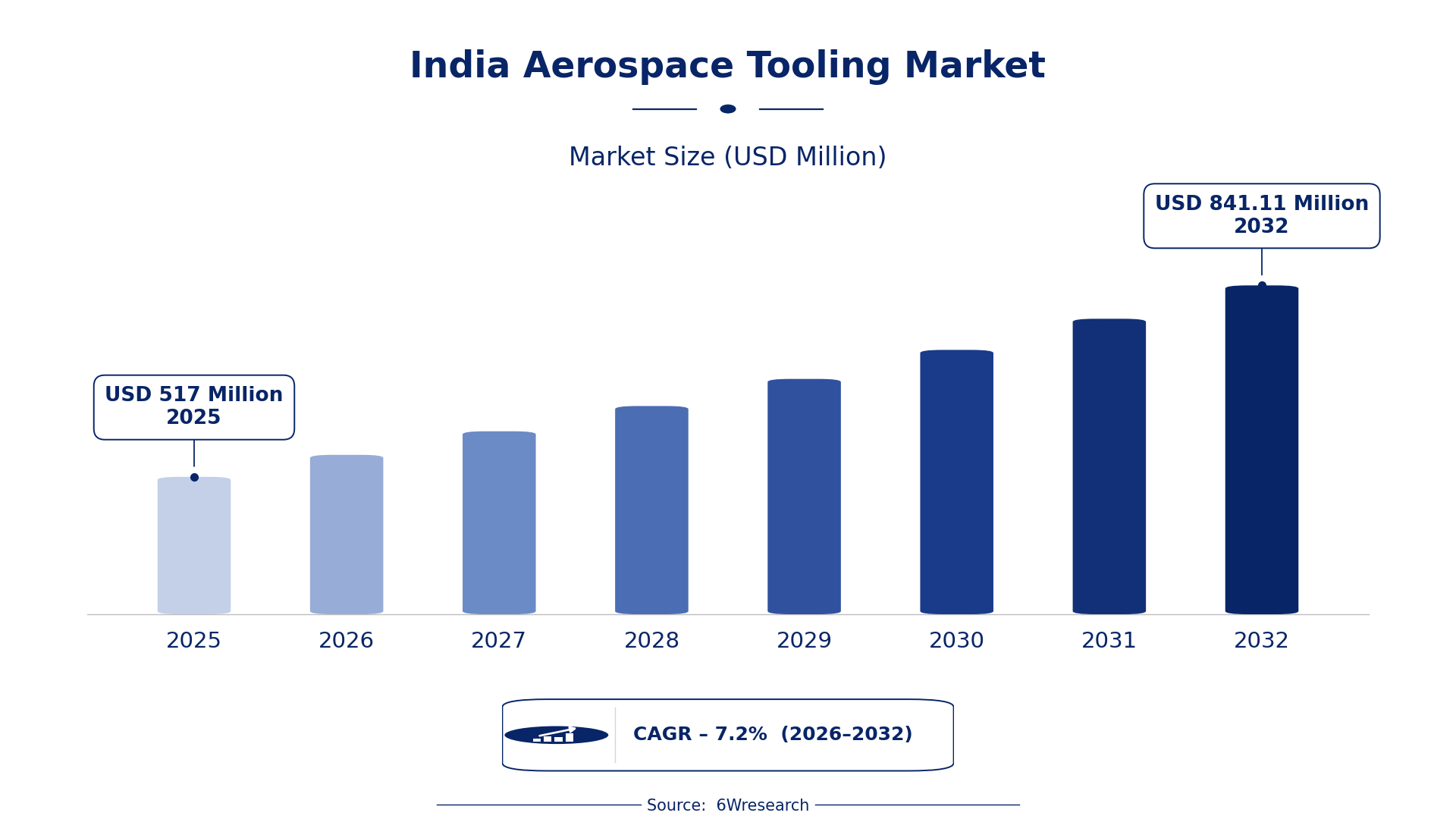
According to 6Wresearch internal database and industry insights, the India Aerospace Tooling Market was valued at USD 517.0 million in 2025 and is projected to reach USD 841.11 million by 2032, growing at a CAGR of approximately 7.2% during 2026–2032.
India Aerospace Tooling Market Highlights
| Report Metric | Details |
| Report Name | India Aerospace Tooling Market |
| Market Size 2025 | USD 517.0 million |
| Market Size 2032 | USD 841.11 million |
| Absolute Growth 2025–2032 | USD 324.11 million |
| CAGR 2026–2032 | 7.2% |
| Peak Annual Growth | 9.3% in 2029 |
| Forecast Period | 2026–2032 |
| Historical Data | 2022–2025 |
| Base Year | 2025 |
| Leading Aerospace Tooling, 2025 | Assembly Fixtures (42% share) |
| Leading Tool Type, 2025 | CNC Tools (50% share) |
| Leading Material Used, 2025 | Alloy Steel (34% share) |
| Leading Distribution Channel, 2025 | Direct Sales (35% share) |
| Leading End User, 2025 | Aircraft Assembly Plants (41% share) |
| Fastest-Growing Aerospace Tooling | Molding Tools (8.4% CAGR) |
| Fastest-Growing Material Used | Titanium (9.5% CAGR) |
| Fastest-Growing Distribution Channel | OEMs (9.4% CAGR) |
| Fastest-Growing End User | Aerospace Suppliers (9.3% CAGR) |
| Growing Sector | Aerospace Suppliers |
| Key End Users | Aircraft Assembly Plants, Engine Manufacturers, Aerospace Suppliers, QA/QC Teams |
India Aerospace Tooling Market Year-wise Growth Rate and Key Drivers (2022–2032)
This graph illustrates the annual growth rates of the market from 2022 to 2032, highlighting a steady upward trajectory and projected market expansion over the forecast period.
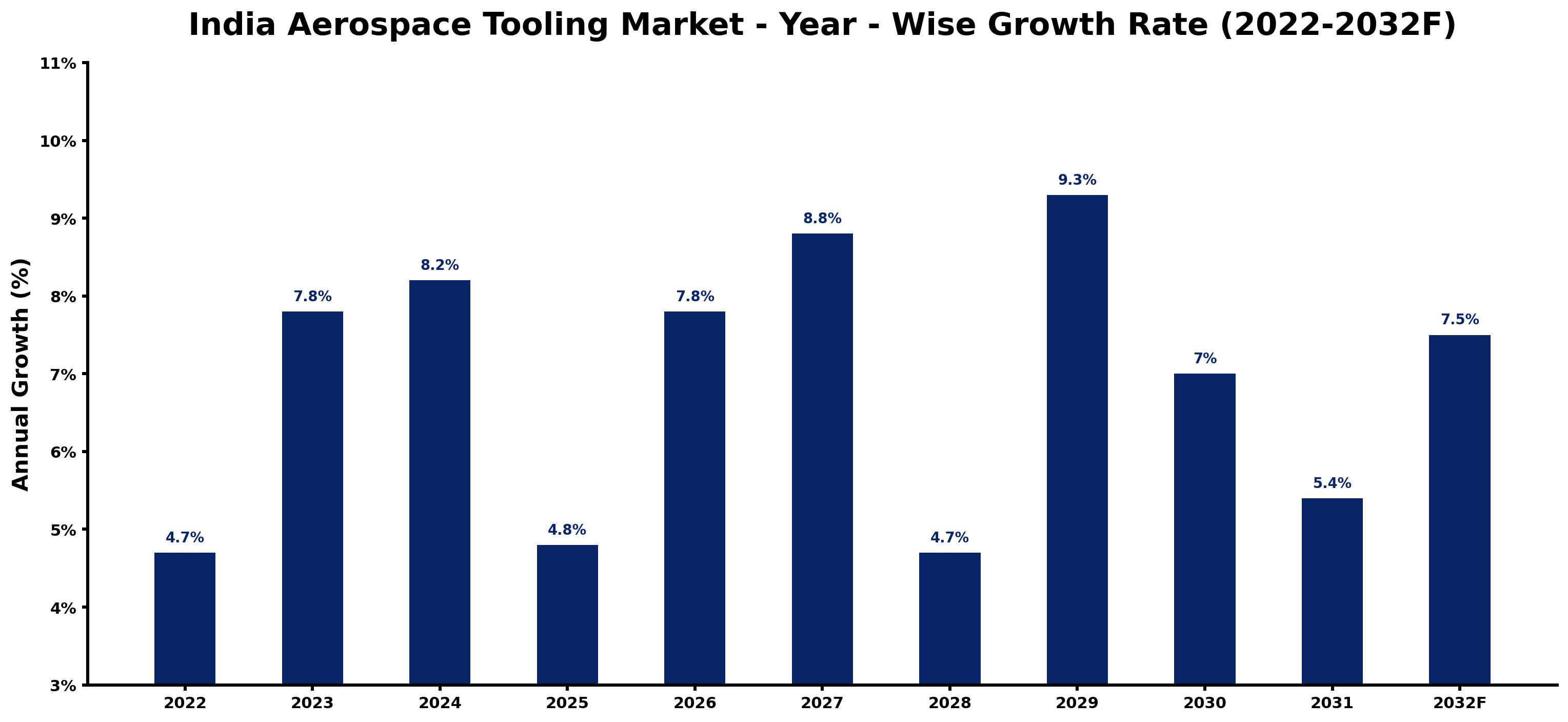
Below, each year's estimated growth is shown next to the factor that most influenced it.
| Year | Estimated Annual Growth (%) | Market Rationale |
| 2022 | 4.7 | The market experienced steady growth due to ongoing aerospace projects and demand from domestic manufacturers. |
| 2023 | 7.8 | Growth accelerated as the aerospace sector benefited from increased government initiatives and investments in local production. |
| 2024 | 8.2 | Demand surged further, driven by the completion of key aerospace projects and rising production rates from local manufacturers. |
| 2025 | 4.8 | Growth slowed slightly as the market adjusted to prior rapid expansions and project completions in the aerospace sector. |
| 2026 | 7.8 | The market is expected to rebound with renewed interest in advanced tooling technologies and increased production capabilities. |
| 2027 | 8.8 | Aerospace tooling demand is projected to rise as manufacturers expand their operations and upgrade equipment to meet new standards. |
| 2028 | 4.7 | Growth is anticipated to decelerate as the market faces temporary adjustments in production schedules and supply chains. |
| 2029 | 9.3 | The market is expected to peak with heightened demand from new aircraft programs and tooling innovations. |
| 2030 | 7.0 | Growth is projected to slow again as manufacturers focus on optimizing existing production processes and improving efficiency. |
| 2031 | 5.4 | Demand is expected to stabilise slightly as the market adjusts after previous peaks in production and investment. |
| 2032 | 7.5 | A resurgence in demand is anticipated as new aerospace projects are initiated and investments in tooling technologies increase. |
Note: Market size estimations and growth projections presented in this report are based on 6Wresearch's proprietary forecasting methodology, utilizing the latest available industry data, government publications, and primary research inputs.
India Aerospace Tooling Market Synopsis
Aerospace Tooling in India includes the specialised tools necessary for manufacturing and assembling aircraft components. Crafted from high-strength materials such as aluminium and steel, these tools ensure precision in production. The India Aerospace Tooling Market is growing due to increasing demand from local manufacturers and supportive government initiatives. With over 400 aerospace companies operating and a goal of 1,000 aircraft by 2030, the sector is poised for robust expansion. Investment in advanced tooling technologies is driving this growth, improving production capabilities throughout the industry.
Market Dynamics Impact Analysis (2026–2032)
| Factor | Type | Impact | Primary Segment Affected |
| Increasing domestic production capabilities | Driver | High | Machining Tools |
| Growing demand for precision components | Driver | High | Assembly Fixtures |
| Investment in advanced manufacturing technologies | Opportunity | High | CNC Tools |
| Expansion of aerospace manufacturing hubs | Opportunity | Medium | Aircraft Assembly Plants |
| High costs of advanced tooling technologies | Restraint | High | Molding Tools |
| Limited availability of skilled workforce | Restraint | Medium | Inspection Tools |
| Aerospace Tooling in India faces regulatory hurdles | Challenge | High | Assembly Fixtures |
| Supply chain disruptions impact production schedules | Challenge | Medium | Assembly Fixtures |
Evaluation of Drivers in India Aerospace Tooling Market (2026–2032)
Key forces behind demand, with the segment each one moves most, are listed below.
| Drivers | Primary Segment Affected | Why It Matters (Evidence) |
| Rising domestic production of aircraft components | Machining Tools | This trend has led to increased purchases of precision machining tools to meet production demands, with a 15% rise in orders reported in 2022. |
| Government initiatives promoting local manufacturing | Assembly Fixtures | Such initiatives have spurred demand for assembly fixtures, essential for efficient production processes, contributing to a 20% increase in local production capacity. |
| Technological advancements in tooling materials | CNC Tools | The adoption of advanced materials has driven demand for CNC tools, with a 10% increase in CNC tool orders noted in 2023. |
| Expansion of aerospace manufacturing facilities | Molding Tools | New facilities require significant tooling investments, increasing demand for molding tools, with a projected 30% growth in molding tool purchases by 2025. |
| Growth in the aerospace workforce | Inspection Tools | An expanding workforce necessitates more inspection tools for quality assurance in production, with a 25% increase in inspection tool orders expected by 2025. |
Market growth for Aerospace Tooling in India is underpinned by rising end-use demand from the aerospace sector, alongside a supply response to increased production capabilities. The ongoing expansion of aircraft manufacturing facilities, particularly in Bangalore, has led to increased investment in precision tooling, with a reported 20% rise in tooling purchases in 2023. The workforce in the aerospace sector is projected to exceed 1 million by 2025, necessitating more inspection tools for quality assurance, thereby boosting demand across various tooling categories.
Evaluation of Restraints in India Aerospace Tooling Market
The following restraints limit how fast demand can grow.
| Market Restraint | Primary Segment Affected | Why It Matters (Evidence) |
| Outdated technology hindering precision and efficiency | Machining Tools | Many domestic manufacturers rely on legacy systems, causing delays in production timelines and impacting quality assurance, leading to a 15% increase in production costs. |
| Regulatory hurdles slowing down approval processes | Assembly Fixtures | Complex compliance requirements from the Bureau of Indian Standards can delay the introduction of new tooling designs, resulting in a 20% increase in time to market. |
| Fluctuating material prices affecting budgets | CNC Tools | Unpredictable costs of raw materials lead to budget overruns and project delays for manufacturers, with an estimated 10% increase in overall project costs. |
| Competition from international suppliers | Molding Tools | Local producers face pressure from international competitors offering superior tooling solutions at competitive prices, impacting market share by approximately 15%. |
| Limited investment in advanced tooling technologies | Inspection Tools | A lack of funding for modernization restricts the ability of manufacturers to adopt new technologies, potentially reducing efficiency by 20%. |
India Aerospace Tooling Market Challenges
The India Aerospace Tooling Market encounters challenges, beginning with outdated technology, as many local manufacturers depend on legacy systems that limit precision and efficiency. This situation stems from insufficient investment in modern tooling, causing production delays for manufacturers. Competition from international suppliers poses another challenge, as they offer superior tooling solutions at lower prices, compelling local producers to reduce their margins by up to 15%. Regulatory complexities from the Bureau of Indian Standards can also prolong the approval process for new tooling designs, delaying product launches and hindering manufacturers' ability to meet production schedules.
Trends in the India Aerospace Tooling Market
Four trends stand out in the India Aerospace Tooling Market.
- Shift from Traditional to Advanced Tooling Techniques: India is moving towards advanced tooling techniques, driven by the need for precision in aerospace manufacturing. The National Aerospace and Defence Policy supports this shift, with a projected 30% increase in advanced tooling adoption by 2030.
- Increased Focus on Composite Materials: Aerospace suppliers are increasingly utilising composite materials for tooling applications, responding to the rise of lightweight aircraft designs. This trend is particularly noticeable in Bangalore, where composite tooling usage has grown by 25% since 2020.
- Growth in Direct Sales Channels: Investing in direct sales channels is becoming crucial as they are the preferred method for aerospace tooling distribution. This channel accounted for 35% of total sales in 2025, reflecting a strong market trend.
- Expansion of Aerospace Manufacturing Hubs: Bangalore is emerging as a key aerospace manufacturing hub, attracting investments and encouraging innovation. The region has experienced a 40% increase in aerospace tooling investments over the past three years.
Investment Opportunities in the India Aerospace Tooling Market
Investors looking at the India Aerospace Tooling Market should consider the following areas.
- Investment in Advanced Tooling Technologies: There is a growing opportunity to supply advanced tooling technologies, particularly in Bangalore, where demand is on the rise. The government's target of 1,000 aircraft by 2030 supports this growth, making it an ideal time to enter the market.
- Supply of Composite Tooling Solutions: With the increasing emphasis on composite materials, suppliers can target aerospace manufacturers in Bangalore. The projected 25% growth in composite tooling usage offers a strong incentive for investment.
- Expansion of Direct Sales Channels: Investing in direct sales channels is essential as they are becoming the preferred method for aerospace tooling distribution. Collaborating with local distributors in major hubs will facilitate market entry.
- Development of Inspection Tools: The demand for quality assurance tools is increasing, especially among aerospace suppliers. With a projected 25% rise in inspection tool demand, this presents an opportune moment for investment.
Government Initiatives in the India Aerospace Tooling Market
The 'Make in India' initiative, launched by the Government of India in 2014, aims to promote domestic manufacturing in the aerospace sector. This initiative has led to increased investments in local production capabilities and has encouraged companies to develop advanced tooling solutions. The updated 'National Civil Aviation Policy' in 2022 further streamlines regulations and provides incentives for local manufacturers, enhancing their ability to compete in the market.
In 2023, the government allocated ₹1,000 crore for aerospace and defence research through the Ministry of Defence. This funding supports the development of new technologies and tooling solutions, fostering innovation in the sector. The Defence Research and Development Organisation (DRDO) plays a key role in approving projects and ensuring compliance with industry standards, enabling manufacturers to meet regulatory requirements more efficiently.
Future Insight of the India Aerospace Tooling Market
Several forward-looking factors should support the India Aerospace Tooling Market over the coming years. The target of producing 1,000 aircraft by 2030 will drive demand for advanced tooling solutions, encouraging suppliers to innovate. The updated National Aerospace and Defence Policy will enhance local manufacturing capabilities, allowing domestic producers to capture more market share. With ₹1,000 crore allocated for aerospace and defence research in 2023, investments in new technologies will elevate production standards, ultimately benefiting manufacturers and fulfilling buyer requirements.
Market Segmentation Analysis
The analysis below covers each segmentation, its leading category in 2025 and its fastest-growing category through 2032.
By Aerospace Tooling – Assembly Fixtures Dominated, Molding Tools Expected to Grow Fastest
According to Ravi Bhandari, Research Head at 6Wresearch, the largest aerospace tooling category in 2025 was Assembly Fixtures, with a 42% share of total revenue. Assembly fixtures are crucial for the assembly process of aircraft components, ensuring high precision and efficiency. Their widespread use across India's 400 aerospace companies establishes them as the leading sub-segment in the aerospace tooling market. Molding Tools are set to record the highest CAGR in this split, 8.4% over 2026–2032. Molding tools are experiencing rapid growth due to increasing demand for creating complex parts through advanced molding techniques. This surge is driven by the government's target of producing 1,000 aircraft by 2030, underscoring the necessity for efficient tooling solutions. Suppliers should focus on expanding their offerings in molding tools to capture the rising market demand.
By Tool Type – CNC Tools Dominated and Is Expected to Record the Fastest Growth
With a 50% revenue share in 2025, CNC Tools was the largest tool type category. CNC tools dominate the market as they are essential for automated machining processes, which are vital for precision in aerospace production. Their extensive adoption across various aerospace companies solidifies their leading market share. Its lead should widen, with a projected CAGR of 8.3% during 2026–2032, the highest in this split. The consistent demand for CNC tools ensures their growth rate remains robust, as they are integral to modern manufacturing practices. Their simultaneous position as both the leader and fastest-growing segment indicates a widening lead in market share. Buyers should prioritise sourcing CNC tools to enhance their competitiveness in the aerospace sector.
By Material Used – Alloy Steel Dominated, Titanium Expected to Grow Fastest
Alloy Steel held a 34% share of the India Aerospace Tooling Market by material used in 2025. Alloy steel is the preferred material due to its strength and durability in tooling applications, making it the most widely used in the aerospace tooling market. Its broad application across various aerospace manufacturing processes reinforces its leading market share. Over 2026–2032, Titanium is expected to post the fastest growth, at a CAGR of 9.5%. Titanium, despite its higher cost, is gaining traction in specialised applications, contributing to its rapid growth. As aerospace companies seek advanced materials for specific projects, titanium's market presence is expected to rise significantly. Suppliers should consider diversifying their material offerings to include titanium to meet emerging demands.
By Distribution Channel – Direct Sales Dominated, OEMs Expected to Grow Fastest
Direct Sales took a 35% share of distribution channel in 2025, more than any other category. Direct sales are the primary channel for aerospace tooling, enabling manufacturers to build strong relationships with buyers. This direct engagement is essential for understanding customer needs and tailoring solutions effectively. The quickest growth will come from OEMs, forecast to expand at a CAGR of 9.4% between 2026 and 2032. OEMs are increasingly vital as distributors of aerospace tooling, driving their rapid growth in the market. Their role in supplying manufacturers with essential tooling solutions positions them for continued expansion. Suppliers must strengthen partnerships with OEMs to improve distribution effectiveness and reach.
By End User – Aircraft Assembly Plants Dominated, Aerospace Suppliers Expected to Grow Fastest
Aircraft Assembly Plants accounted for a 41% market share by end user in 2025. Aircraft assembly plants are the primary users of aerospace tooling, relying on these tools for efficient production processes. Their significant operational scale throughout India ensures a considerable market share for this segment. Aerospace Suppliers are set to record the highest CAGR in this split, 9.3% over 2026–2032. Aerospace suppliers are rapidly growing as they provide diverse tooling solutions for various applications, reflecting the industry's need for flexibility. This trend indicates a shift towards a more integrated supply chain in aerospace manufacturing. Buyers should engage with aerospace suppliers to access a broader range of tooling solutions and improve operational efficiency.
Key Attractiveness of the Report
- 10 Years of Market Numbers
- Historical Data Starting from 2022 to 2025
- Base Year 2025
- Forecast Data until 2032
- Key Performance Indicators Impacting the Market
- Major Upcoming Developments and Projects
Key Highlights of the Report:
- India Aerospace Tooling Market Outlook
- Market Size of India Aerospace Tooling Market, 2025
- Forecast of India Aerospace Tooling Market, 2032
- Historical Data and Forecast of India Aerospace Tooling Revenues & Volume for the Period 2022 - 2032F
- India Aerospace Tooling Market Trend Evolution
- India Aerospace Tooling Market Drivers and Challenges
- India Aerospace Tooling Price Trends
- India Aerospace Tooling Porter's Five Forces
- India Aerospace Tooling Industry Life Cycle
- Historical Data and Forecast of India Aerospace Tooling Market Revenues & Volume By Aerospace Tooling for the Period 2022 - 2032F
- Historical Data and Forecast of India Aerospace Tooling Market Revenues & Volume By Assembly Fixtures for the Period 2022 - 2032F
- Historical Data and Forecast of India Aerospace Tooling Market Revenues & Volume By Molding Tools for the Period 2022 - 2032F
- Historical Data and Forecast of India Aerospace Tooling Market Revenues & Volume By Machining Tools for the Period 2022 - 2032F
- Historical Data and Forecast of India Aerospace Tooling Market Revenues & Volume By Inspection Tools for the Period 2022 - 2032F
- Historical Data and Forecast of India Aerospace Tooling Market Revenues & Volume By Tool Type for the Period 2022 - 2032F
- Historical Data and Forecast of India Aerospace Tooling Market Revenues & Volume By Steel/Aluminum for the Period 2022 - 2032F
- Historical Data and Forecast of India Aerospace Tooling Market Revenues & Volume By Composite Molds for the Period 2022 - 2032F
- Historical Data and Forecast of India Aerospace Tooling Market Revenues & Volume By CNC Tools for the Period 2022 - 2032F
- Historical Data and Forecast of India Aerospace Tooling Market Revenues & Volume By Gauges, Templates for the Period 2022 - 2032F
- Historical Data and Forecast of India Aerospace Tooling Market Revenues & Volume By Material Used for the Period 2022 - 2032F
- Historical Data and Forecast of India Aerospace Tooling Market Revenues & Volume By Precision Jigs for the Period 2022 - 2032F
- Historical Data and Forecast of India Aerospace Tooling Market Revenues & Volume By Graphite, Resin for the Period 2022 - 2032F
- Historical Data and Forecast of India Aerospace Tooling Market Revenues & Volume By Carbide, Titanium for the Period 2022 - 2032F
- Historical Data and Forecast of India Aerospace Tooling Market Revenues & Volume By Alloy Steel for the Period 2022 - 2032F
- Historical Data and Forecast of India Aerospace Tooling Market Revenues & Volume By Distribution Channel for the Period 2022 - 2032F
- Historical Data and Forecast of India Aerospace Tooling Market Revenues & Volume By Direct Sales for the Period 2022 - 2032F
- Historical Data and Forecast of India Aerospace Tooling Market Revenues & Volume By OEMs for the Period 2022 - 2032F
- Historical Data and Forecast of India Aerospace Tooling Market Revenues & Volume By Online Platforms for the Period 2022 - 2032F
- Historical Data and Forecast of India Aerospace Tooling Market Revenues & Volume By Industrial Distributors for the Period 2022 - 2032F
- Historical Data and Forecast of India Aerospace Tooling Market Revenues & Volume By End User for the Period 2022 - 2032F
- Historical Data and Forecast of India Aerospace Tooling Market Revenues & Volume By Aircraft Assembly Plants for the Period 2022 - 2032F
- Historical Data and Forecast of India Aerospace Tooling Market Revenues & Volume By Engine Manufacturers for the Period 2022 - 2032F
- Historical Data and Forecast of India Aerospace Tooling Market Revenues & Volume By Aerospace Suppliers for the Period 2022 - 2032F
- Historical Data and Forecast of India Aerospace Tooling Market Revenues & Volume By QA/QC Teams for the Period 2022 - 2032F
- India Aerospace Tooling Import Export Trade Statistics
- Market Opportunity Assessment By Aerospace Tooling
- Market Opportunity Assessment By Tool Type
- Market Opportunity Assessment By Material Used
- Market Opportunity Assessment By Distribution Channel
- Market Opportunity Assessment By End User
- India Aerospace Tooling Top Companies Market Share
- India Aerospace Tooling Competitive Benchmarking By Technical and Operational Parameters
- India Aerospace Tooling Company Profiles
- India Aerospace Tooling Key Strategic Recommendations
Market Covered
Segments analysed in this report are listed below.
By Aerospace Tooling
- Assembly Fixtures
- Molding Tools
- Machining Tools
- Inspection Tools
By Tool Type
- Steel/Aluminum
- Composite Molds
- CNC Tools
- Gauges
- Templates
By Material Used
- Precision Jigs
- Graphite
- Resin
- Carbide
- Titanium
- Alloy Steel
By Distribution Channel
- Direct Sales
- OEMs
- Online Platforms
- Industrial Distributors
By End User
- Aircraft Assembly Plants
- Engine Manufacturers
- Aerospace Suppliers
- QA/QC Teams































