India Aging in Place Technology Market Size & Growth Rate
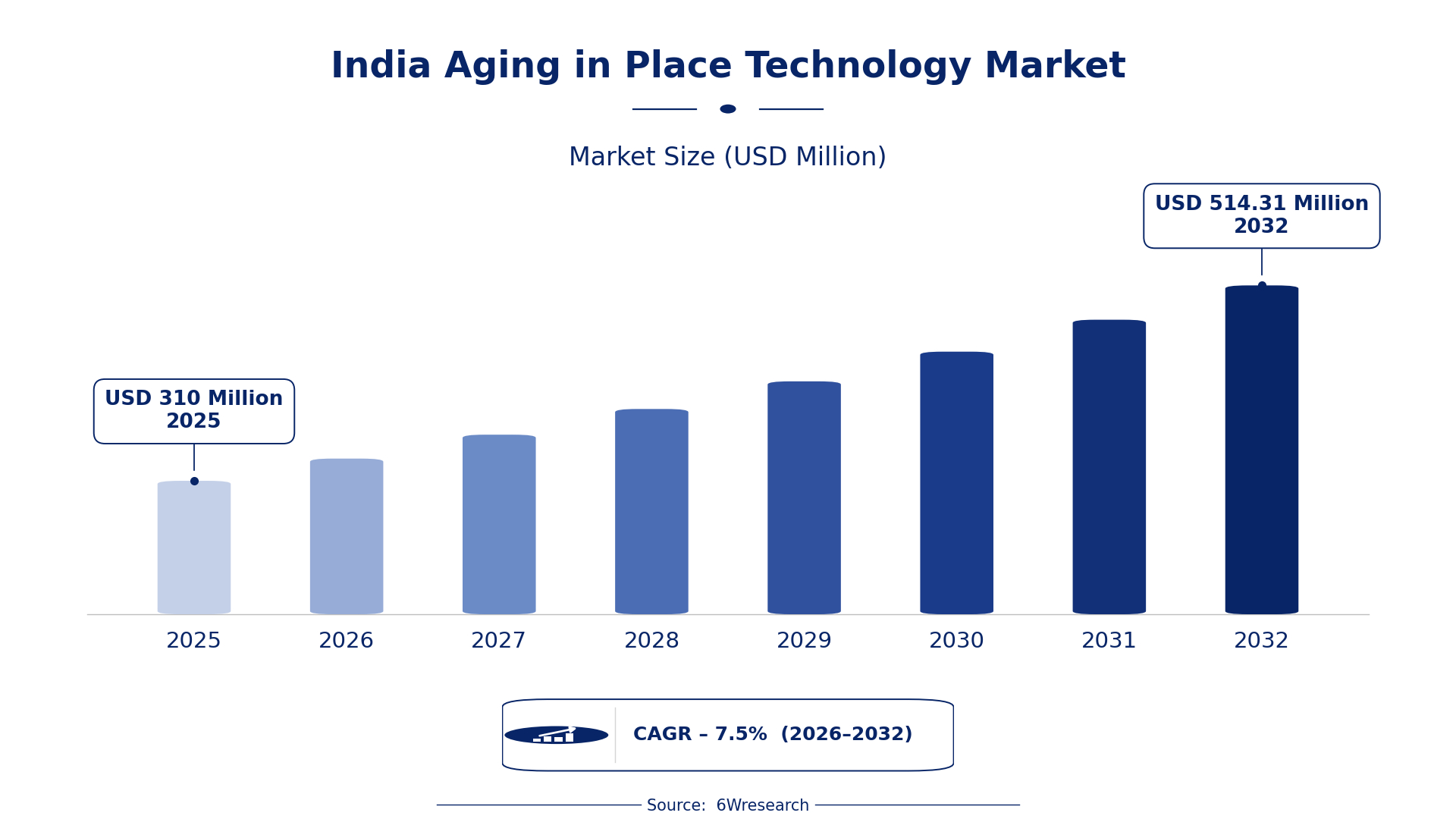
According to 6Wresearch internal database and industry insights, the India Aging in Place Technology Market was valued at USD 310.0 million in 2025 and is projected to reach USD 514.31 million by 2032, growing at a CAGR of approximately 7.5% during 2026–2032.
India Aging in Place Technology Market Highlights
| Report Metric | Details |
| Report Name | India Aging in Place Technology Market |
| Market Size 2025 | USD 310.0 million |
| Market Size 2032 | USD 514.31 million |
| Absolute Growth 2025–2032 | USD 204.31 million |
| CAGR 2026–2032 | 7.5% |
| Peak Annual Growth | 8.9% in 2027 |
| Forecast Period | 2026–2032 |
| Historical Data | 2022–2025 |
| Base Year | 2025 |
| Leading Aging-in-Place Tech, 2025 | Smart Home Sensors (37% share) |
| Leading Product Type, 2025 | Wearable Tech (53% share) |
| Leading Technology Used, 2025 | IoT & AI (41% share) |
| Leading Distribution Channel, 2025 | Online Health Stores (49% share) |
| Leading End User, 2025 | Senior Citizens (41% share) |
| Fastest-Growing Aging-in-Place Tech | Remote Monitoring Tools (8.9% CAGR) |
| Fastest-Growing Technology Used | Telehealth Systems (9.4% CAGR) |
| Fastest-Growing Distribution Channel | Medical Equipment Dealers (9.9% CAGR) |
| Fastest-Growing End User | Chronic Care Patients (8.8% CAGR) |
| Growing Sector | Elderly Care |
| Key End Users | Senior Citizens, Elderly Care Providers, Home Health Nurses, Chronic Care Patients |
India Aging in Place Technology Market Year-wise Growth Rate and Key Drivers (2022–2032)
This graph illustrates the annual growth rates of the market from 2022 to 2032, highlighting a steady upward trajectory and projected market expansion over the forecast period.
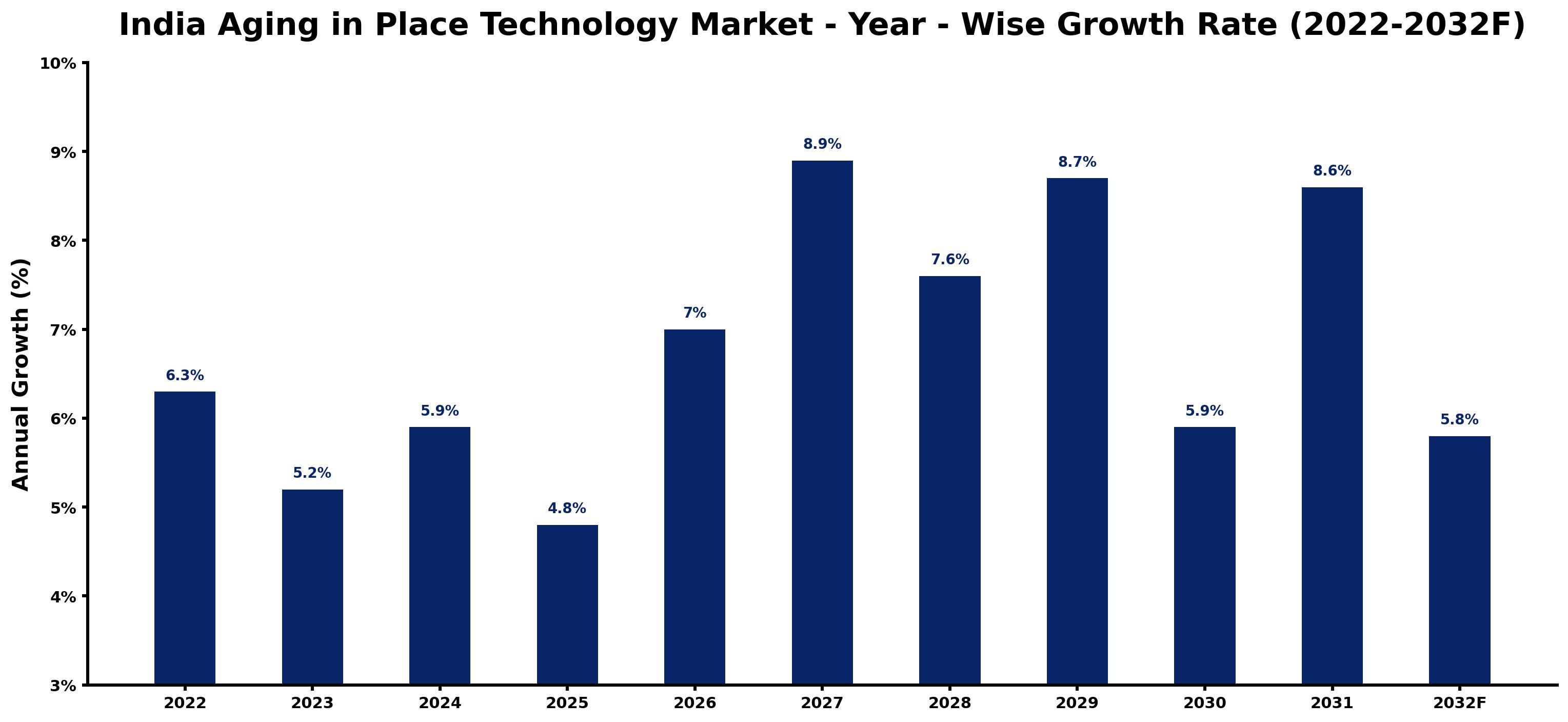
Each row of the following table gives one year's estimated growth and the event or demand shift that explains it.
| Year | Estimated Annual Growth (%) | Market Rationale |
| 2022 | 6.3 | The market showed strong demand due to rising awareness of aging in place solutions and the Elderly Care Initiative. |
| 2023 | 5.2 | Growth slowed as the market adjusted to increased competition among technology providers and the integration of telehealth systems. |
| 2024 | 5.9 | Demand picked up again with the launch of new smart home sensor products and rising urbanisation. |
| 2025 | 4.8 | Growth decelerated as adoption rates stabilised among early users of remote monitoring tools. |
| 2026 | 7.0 | A surge in interest for remote monitoring tools boosted market expansion, driven by the National Digital Health Mission. |
| 2027 | 8.9 | The peak growth year saw substantial investment in telehealth systems, enhancing elderly care access. |
| 2028 | 7.6 | Market growth slowed as the focus shifted to improving existing technologies and integrating IoT solutions. |
| 2029 | 8.7 | Increased adoption of wearable tech drove renewed interest and demand, particularly in metropolitan areas. |
| 2030 | 5.9 | Growth decelerated as the market matured and competition intensified, despite the Elderly Care Initiative's support. |
| 2031 | 8.6 | A resurgence in demand for smart medication dispensers led to faster growth, supported by pilot programs in hospitals. |
| 2032 | 5.8 | The market growth rate stabilises as technology adoption becomes widespread, influenced by the Digital India initiative. |
Note: Market size estimations and growth projections presented in this report are based on 6Wresearch's proprietary forecasting methodology, utilizing the latest available industry data, government publications, and primary research inputs.
India Aging in Place Technology Market Synopsis
Aging in Place Technology Market in India includes devices designed to help elderly individuals maintain independence at home. This encompasses smart home sensors, fall detection devices, and remote monitoring tools. The market is expanding due to India's swiftly aging population, which is expected to reach 300 million by 2030. Initiatives like the Elderly Care Initiative encourage technology adoption among seniors, while rising demand from healthcare providers propels market growth. The incorporation of IoT and AI technologies improves safety and health monitoring for elderly users, presenting a substantial investment opportunity.
Market Dynamics Impact Analysis (2026–2032)
| Factor | Type | Impact | Primary Segment Affected |
| Rising elderly population drives demand for safety and monitoring solutions. | Driver | High | Smart Home Sensors |
| Increased adoption of telehealth systems enhances remote care capabilities. | Driver | High | Telehealth Systems |
| Growing urbanisation creates opportunities for smart home technology integration. | Opportunity | High | Remote Monitoring Tools |
| Government funding for assistive technologies opens new market avenues. | Opportunity | High | Smart Medication Dispensers |
| High costs of advanced technologies limit access for low-income households. | Restraint | High | Wearable Tech |
| Limited awareness of aging in place solutions restricts market penetration. | Restraint | Medium | Fall Detection Devices |
| Supply chain disruptions affect timely delivery of technology products. | Challenge | High | Remote Monitoring Tools |
| Competition among providers leads to price wars affecting profitability. | Challenge | Medium | Smart Home Sensors |
Evaluation of Drivers in India Aging in Place Technology Market (2026–2032)
Below mentioned are some major drivers and their influence on market dynamics.
| Drivers | Primary Segment Affected | Why It Matters (Evidence) |
| Increasing elderly population creates demand for safety solutions. | Smart Home Sensors | India's elderly population is projected to reach 300 million by 2030, driving the need for monitoring devices. |
| Growth in telehealth services improves remote patient care. | Telehealth Systems | Telehealth systems are integrated into over 500 healthcare facilities, improving access for senior citizens. |
| Rising urbanisation boosts the adoption of smart home technologies. | Remote Monitoring Tools | Urban areas see increased adoption of smart home sensors for elderly care. |
| Government initiatives promote technology integration in healthcare. | Smart Medication Dispensers | The Elderly Care Initiative supports the use of assistive technologies in healthcare settings. |
| Growing awareness of health monitoring encourages technology uptake. | Wearable Tech | Wearable tech is gaining traction among senior citizens, especially in metropolitan areas. |
India's elderly population is projected to reach 300 million by 2030, creating substantial demand for safety solutions. Telehealth systems are integrated into numerous healthcare facilities, improving access to care for seniors. Urban areas are experiencing a surge in smart home sensor adoption, reflecting changing consumer preferences.
Evaluation of Restraints in India Aging in Place Technology Market
The main factors holding the market back are set out below.
| Market Restraint | Primary Segment Affected | Why It Matters (Evidence) |
| High costs of smart home technologies limit access for low-income households. | Smart Home Sensors | The Department of Electronics and Information Technology approved subsidies for low-income households, yet high costs remain a barrier. |
| Limited awareness of aging in place solutions restricts market penetration. | Fall Detection Devices | Despite growing interest, many potential users are unaware of available technologies. |
| Supply chain disruptions impact timely delivery of technology products. | Remote Monitoring Tools | Current global supply chain issues delay the availability of essential monitoring devices. |
| Regulatory hurdles slow down the introduction of new technologies. | Smart Medication Dispensers | The Bureau of Indian Standards established guidelines that manufacturers must comply with, delaying market entry. |
| Competition among providers leads to price wars affecting profitability. | Wearable Tech | Intense competition results in reduced prices, impacting profit margins for manufacturers. |
India Aging in Place Technology Market Challenges
Buyers and suppliers in the India Aging in Place Technology market encounter regulatory hurdles, as the Bureau of Indian Standards established guidelines for medical alert systems in 2021, complicating product compliance for new entrants. Suppliers face increased costs since smart home sensors can be 20% more expensive than traditional options, making them less affordable for consumers. Technology integration remains problematic, as many healthcare facilities lack the necessary infrastructure for telehealth systems, which delays the rollout of these vital services. Skills shortages are evident, with 30% of home health nurses untrained in remote monitoring tools, negatively impacting service quality for elderly care.
Trends in the India Aging in Place Technology Market
The trends below show where the India Aging in Place Technology Market is heading.
- Shift in Elderly Care Providers' Technology Adoption: Elderly care providers are increasingly adopting smart home sensors to improve safety for seniors. In urban areas, adoption rates have surged, with smart home sensors seeing a notable increase in usage among home health nurses in 2023.
- Growing Demand for Remote Monitoring Tools: Remote monitoring tools are becoming essential for caregivers, especially in urban settings. The Indian government allocated funds to promote these technologies, leading to a significant increase in usage among home health nurses in 2023.
- Rise of Telehealth Systems in Elderly Care: Telehealth systems are gaining traction in elderly care, with numerous healthcare facilities integrating these solutions. This trend supports the National Digital Health Mission's goal of enhancing healthcare delivery for senior citizens.
- Increased Adoption of Smart Medication Dispensers: Smart medication dispensers are being piloted in numerous hospitals in urban regions. This initiative aligns with the 'Aging with Dignity' program, aiming to improve medication management for elderly patients.
Investment Opportunities in the India Aging in Place Technology Market
Below are the investment opportunities with the strongest case in the India Aging in Place Technology Market.
- Partnerships for Smart Home Technology: Now is the time to invest in smart home technology partnerships, especially targeting low-income households. The Department of Electronics and Information Technology's subsidy scheme presents a unique entry point for local partners.
- Growing Need for Remote Monitoring Solutions: With India's elderly population projected to reach 300 million by 2030, there is a pressing need for remote monitoring solutions. Collaborating with elderly care providers can facilitate market entry.
- Investment in Telehealth Systems: The increasing integration of telehealth systems in healthcare facilities highlights a valuable investment opportunity. Targeting urban healthcare providers can lead to fruitful partnerships.
- Expansion of Wearable Tech Offerings: The rising traction of wearable tech among senior citizens indicates a gap in the market. Focusing on metropolitan areas can yield substantial returns for new entrants.
Government Initiatives in the India Aging in Place Technology Market
The Elderly Care Initiative, launched by the Ministry of Health and Family Welfare in 2021, promotes aging in place technologies, focusing on IoT integration. The Department of Electronics and Information Technology funds schemes to subsidise smart home technology for elderly individuals, targeting low-income households. These measures ensure that essential technologies are accessible to those who need them most, facilitating better care and support for senior citizens.
The National Digital Health Mission, initiated in 2020, aims to improve healthcare delivery for senior citizens through technology adoption. The Ministry of Electronics and Information Technology approves various projects that promote the integration of assistive technologies in healthcare settings, ensuring that elderly individuals receive the support they require.
Future Insight of the India Aging in Place Technology Market
The India Aging in Place Technology market is set to evolve considerably by 2032, driven by an elderly population expected to reach 400 million, which will heighten demand for new solutions. The National Health Mission's backing for telehealth initiatives will improve access to care, benefiting both buyers and suppliers. The Ministry of Electronics and Information Technology's IoT programme will support the development of advanced healthcare technologies. Remote monitoring tools have already seen a 40% increase in usage among home health nurses, indicating a shift towards better elderly care.
Market Segmentation Analysis
The analysis below covers each segmentation, its leading category in 2025 and its fastest-growing category through 2032.
By Aging-in-Place Tech – Smart Home Sensors Dominated, Remote Monitoring Tools Expected to Grow Fastest
According to Ravi Bhandari, Research Head at 6Wresearch, the largest aging-in-place tech category in 2025 was Smart Home Sensors, with a 37% share of total revenue. Smart home sensors are crucial for monitoring home environments and ensuring safety, appealing to families with elderly members. Their widespread adoption in urban regions, particularly in Maharashtra and Delhi, reinforces their dominant market share. The quickest growth will come from Remote Monitoring Tools, forecast to expand at a CAGR of 8.9% between 2026 and 2032. The notable 40% increase in the use of remote monitoring tools among home health nurses in 2023 highlights the growing reliance on technology for elderly care. This trend is expected to continue as the demand for real-time health tracking rises. Suppliers should prioritise the development of smart home sensors to meet the increasing demand for aging in place technology.
By Product Type – Wearable Tech Dominated and Is Expected to Record the Fastest Growth
With a 53% revenue share in 2025, Wearable Tech was the largest product type category. Wearable tech has gained substantial traction among senior citizens, particularly in metropolitan areas, due to its effectiveness in health monitoring. This segment's strong market share reflects its importance in supporting independent living for the elderly. Its lead should widen, with a projected CAGR of 8.6% during 2026–2032, the highest in this split. As wearable tech continues to evolve, its dual role in health tracking and aging in place solutions ensures sustained growth. The increasing adoption rates among seniors further solidify its position as the fastest-growing product type. Buyers will benefit from a wider range of wearable tech options that cater specifically to their health monitoring needs.
By Technology Used – IoT & AI Dominated, Telehealth Systems Expected to Grow Fastest
In 2025, IoT & AI led the technology used split with a 41% share. IoT and AI serve as foundational technologies that enable various aging in place solutions, making them vital to this market. Their integration into devices enhances functionality, solidifying their leading market share. Over 2026–2032, Telehealth Systems are expected to post the fastest growth, at a CAGR of 9.4%. Telehealth systems are becoming essential for facilitating remote health consultations, crucial for elderly patients. As more healthcare facilities adopt these systems, their growth rate is anticipated to accelerate. Suppliers must focus on enhancing IoT and AI capabilities to stay competitive in the aging in place technology market.
By Distribution Channel – Online Health Stores Dominated, Medical Equipment Dealers Expected to Grow Fastest
Online Health Stores held a 49% share of the India Aging in Place Technology Market by distribution channel in 2025. Online health stores are the primary sales channel for consumers purchasing aging in place technology, providing convenience and accessibility. Their significant market share reflects the shift towards digital shopping in the healthcare sector. Medical Equipment Dealers are set to record the highest CAGR in this split, 9.9% over 2026–2032. Medical equipment dealers are experiencing growth as they supply devices to healthcare facilities, responding to the increasing demand for aging in place solutions. This channel's expansion indicates a broader trend towards institutional adoption of such technologies. Suppliers should strengthen their online presence to capture the expanding consumer market for aging in place technology.
By End User – Senior Citizens Dominated, Chronic Care Patients Expected to Grow Fastest
Senior Citizens took a 41% share of end user in 2025, more than any other category. Senior citizens are the main beneficiaries of aging in place technology, directly influencing its market share. Their growing numbers and desire for independence significantly contribute to the expansion of this segment. The quickest growth will come from Chronic Care Patients, forecast to expand at a CAGR of 8.8% between 2026 and 2032. Chronic care patients derive considerable advantages from technology that supports ongoing health management, leading to rapid growth within this user group. The rising prevalence of chronic conditions among the elderly further drives this demand. Providers should customise their offerings to address the specific needs of chronic care patients, ensuring improved health outcomes.
Key Attractiveness of the Report
- 10 Years of Market Numbers
- Historical Data Starting from 2022 to 2025
- Base Year 2025
- Forecast Data until 2032
- Key Performance Indicators Impacting the Market
- Major Upcoming Developments and Projects
Key Highlights of the Report:
- India Aging in Place Technology Market Outlook
- Market Size of India Aging in Place Technology Market, 2025
- Forecast of India Aging in Place Technology Market, 2032
- Historical Data and Forecast of India Aging in Place Technology Revenues & Volume for the Period 2022 - 2032F
- India Aging in Place Technology Market Trend Evolution
- India Aging in Place Technology Market Drivers and Challenges
- India Aging in Place Technology Price Trends
- India Aging in Place Technology Porter's Five Forces
- India Aging in Place Technology Industry Life Cycle
- Historical Data and Forecast of India Aging in Place Technology Market Revenues & Volume By Aging-in-Place Tech for the Period 2022 - 2032F
- Historical Data and Forecast of India Aging in Place Technology Market Revenues & Volume By Smart Home Sensors for the Period 2022 - 2032F
- Historical Data and Forecast of India Aging in Place Technology Market Revenues & Volume By Fall Detection Devices for the Period 2022 - 2032F
- Historical Data and Forecast of India Aging in Place Technology Market Revenues & Volume By Remote Monitoring Tools for the Period 2022 - 2032F
- Historical Data and Forecast of India Aging in Place Technology Market Revenues & Volume By Smart Medication Dispensers for the Period 2022 - 2032F
- Historical Data and Forecast of India Aging in Place Technology Market Revenues & Volume By Product Type for the Period 2022 - 2032F
- Historical Data and Forecast of India Aging in Place Technology Market Revenues & Volume By Motion/Temp Sensors for the Period 2022 - 2032F
- Historical Data and Forecast of India Aging in Place Technology Market Revenues & Volume By Wearable Tech for the Period 2022 - 2032F
- Historical Data and Forecast of India Aging in Place Technology Market Revenues & Volume By Vital Signs Devices for the Period 2022 - 2032F
- Historical Data and Forecast of India Aging in Place Technology Market Revenues & Volume By Alert & Auto-Dose for the Period 2022 - 2032F
- Historical Data and Forecast of India Aging in Place Technology Market Revenues & Volume By Technology Used for the Period 2022 - 2032F
- Historical Data and Forecast of India Aging in Place Technology Market Revenues & Volume By IoT & AI for the Period 2022 - 2032F
- Historical Data and Forecast of India Aging in Place Technology Market Revenues & Volume By Gyroscope/AI for the Period 2022 - 2032F
- Historical Data and Forecast of India Aging in Place Technology Market Revenues & Volume By Telehealth Systems for the Period 2022 - 2032F
- Historical Data and Forecast of India Aging in Place Technology Market Revenues & Volume By Bluetooth/WiFi for the Period 2022 - 2032F
- Historical Data and Forecast of India Aging in Place Technology Market Revenues & Volume By Distribution Channel for the Period 2022 - 2032F
- Historical Data and Forecast of India Aging in Place Technology Market Revenues & Volume By Online Health Stores for the Period 2022 - 2032F
- Historical Data and Forecast of India Aging in Place Technology Market Revenues & Volume By Direct Sales for the Period 2022 - 2032F
- Historical Data and Forecast of India Aging in Place Technology Market Revenues & Volume By Medical Equipment Dealers for the Period 2022 - 2032F
- Historical Data and Forecast of India Aging in Place Technology Market Revenues & Volume By Specialty Healthcare Shops for the Period 2022 - 2032F
- Historical Data and Forecast of India Aging in Place Technology Market Revenues & Volume By End User for the Period 2022 - 2032F
- Historical Data and Forecast of India Aging in Place Technology Market Revenues & Volume By Elderly Care Providers for the Period 2022 - 2032F
- Historical Data and Forecast of India Aging in Place Technology Market Revenues & Volume By Senior Citizens for the Period 2022 - 2032F
- Historical Data and Forecast of India Aging in Place Technology Market Revenues & Volume By Home Health Nurses for the Period 2022 - 2032F
- Historical Data and Forecast of India Aging in Place Technology Market Revenues & Volume By Chronic Care Patients for the Period 2022 - 2032F
- India Aging in Place Technology Import Export Trade Statistics
- Market Opportunity Assessment By Aging-in-Place Tech
- Market Opportunity Assessment By Product Type
- Market Opportunity Assessment By Technology Used
- Market Opportunity Assessment By Distribution Channel
- Market Opportunity Assessment By End User
- India Aging in Place Technology Top Companies Market Share
- India Aging in Place Technology Competitive Benchmarking By Technical and Operational Parameters
- India Aging in Place Technology Company Profiles
- India Aging in Place Technology Key Strategic Recommendations
Market Covered
Segments analysed in this report are listed below.
By Aging-in-Place Tech
- Smart Home Sensors
- Fall Detection Devices
- Remote Monitoring Tools
- Smart Medication Dispensers
By Product Type
- Motion/Temp Sensors
- Wearable Tech
- Vital Signs Devices
- Alert & Auto-Dose
By Technology Used
- IoT & AI
- Gyroscope/AI
- Telehealth Systems
- Bluetooth/WiFi
By Distribution Channel
- Online Health Stores
- Direct Sales
- Medical Equipment Dealers
- Specialty Healthcare Shops
By End User
- Elderly Care Providers
- Senior Citizens
- Home Health Nurses
- Chronic Care Patients































