India Aircraft Surveillance Systems Market Size & Growth Rate
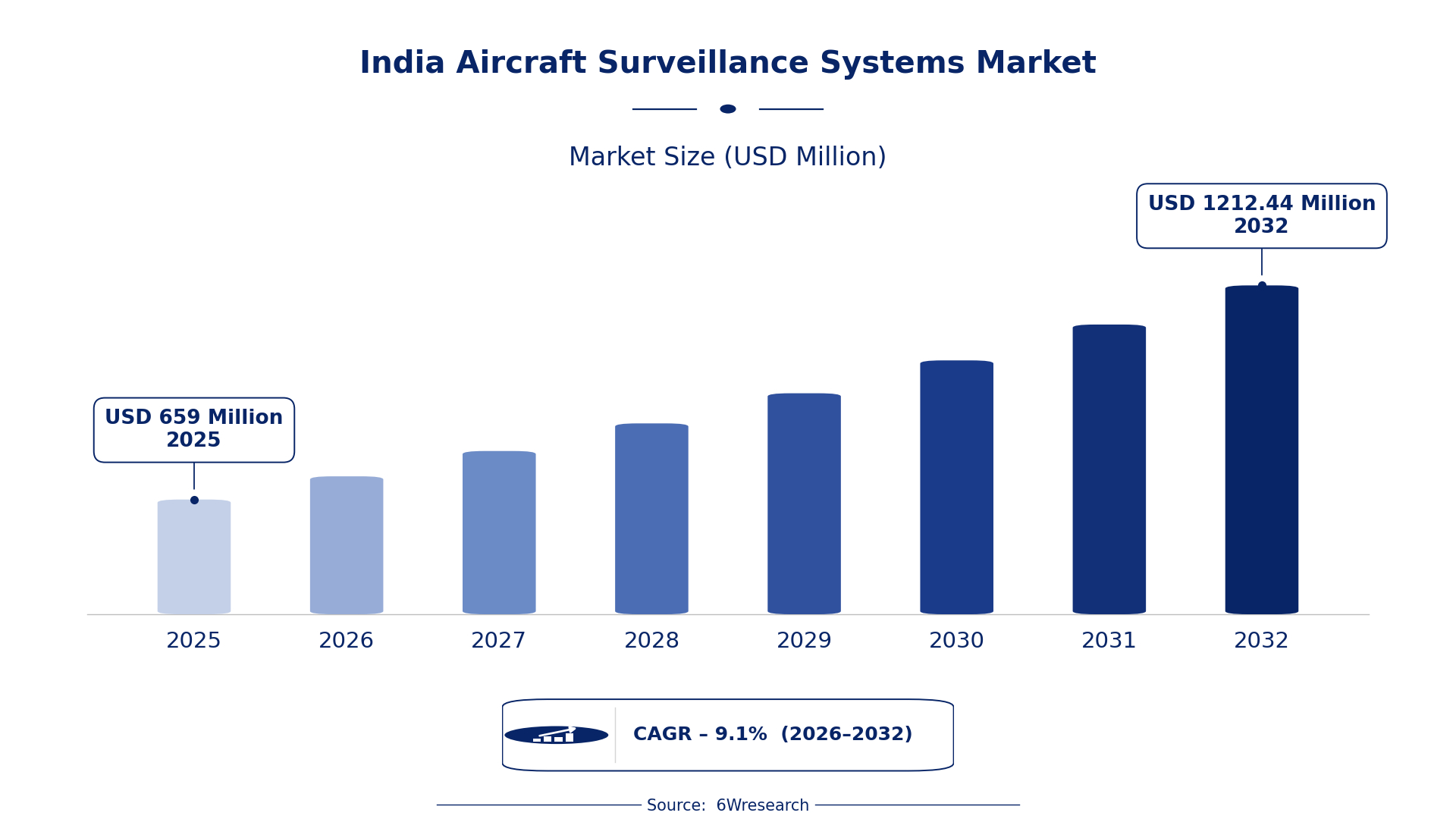
According to 6Wresearch internal database and industry insights, the India Aircraft Surveillance Systems Market was valued at USD 659.0 million in 2025 and is projected to reach USD 1,212.44 million by 2032, growing at a CAGR of approximately 9.1% during 2026–2032.
India Aircraft Surveillance Systems Market Highlights
| Report Metric | Details |
| Report Name | India Aircraft Surveillance Systems Market |
| Market Size 2025 | USD 659.0 million |
| Market Size 2032 | USD 1,212.44 million |
| Absolute Growth 2025–2032 | USD 553.44 million |
| CAGR 2026–2032 | 9.1% |
| Peak Annual Growth | 11.5% in 2027 |
| Forecast Period | 2026–2032 |
| Historical Data | 2022–2025 |
| Base Year | 2025 |
| Leading System Type, 2025 | Radar Systems (41% share) |
| Leading Technology Type, 2025 | AESA Radar (49% share) |
| Leading Distribution Channel, 2025 | Direct Sales (47% share) |
| Leading End User, 2025 | Fighter Jets (46% share) |
| Fastest-Growing System Type | Electro-Optical Sensors (10.8% CAGR) |
| Fastest-Growing Technology Type | Satellite-Based (11.8% CAGR) |
| Fastest-Growing Distribution Channel | Online Platforms (10.7% CAGR) |
| Fastest-Growing End User | UAVs (11.6% CAGR) |
| Growing Sector | UAVs |
| Key End Users | Fighter Jets, Military Aircraft, Commercial Airlines, UAVs |
India Aircraft Surveillance Systems Market Year-wise Growth Rate and Key Drivers (2022–2032)
This graph illustrates the annual growth rates of the market from 2022 to 2032, highlighting a steady upward trajectory and projected market expansion over the forecast period.
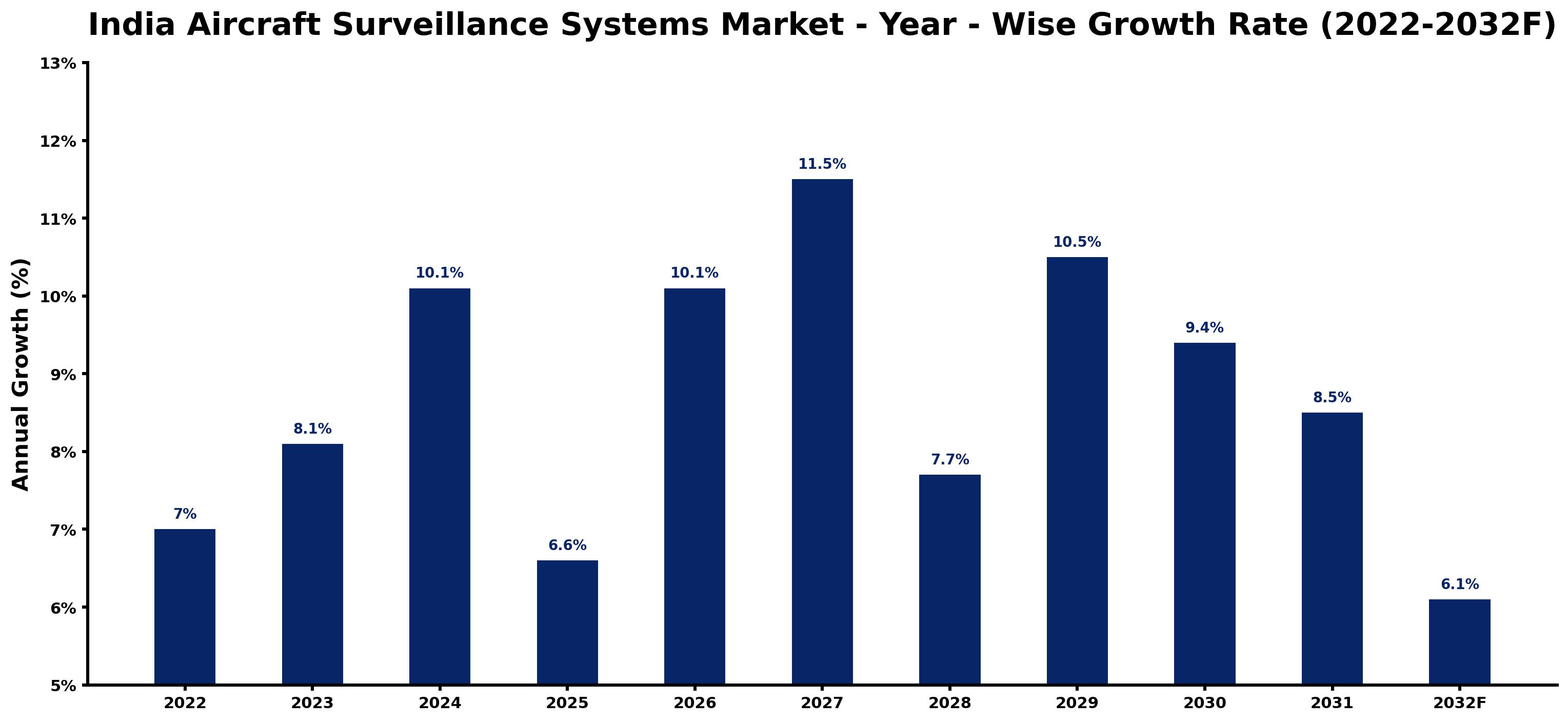
Below, each year's estimated growth is shown next to the factor that most influenced it.
| Year | Estimated Annual Growth (%) | Market Rationale |
| 2022 | 7.0 | The market exhibited steady growth, driven by increasing demand from the military sector. |
| 2023 | 8.1 | Growth accelerated as the Indian Air Force expanded its fleet of fighter jets requiring advanced systems. |
| 2024 | 10.1 | Demand surged due to the implementation of ICAO standards for ADS-B, enhancing air traffic management. |
| 2025 | 6.6 | Growth slowed as the market adjusted to previous high demand levels, yet military applications remained strong. |
| 2026 | 10.1 | The market rebounded with increased investments in indigenous surveillance technologies boosting procurement. |
| 2027 | 11.5 | A peak in growth occurred as advanced radar systems were developed under national initiatives. |
| 2028 | 7.7 | Growth moderated as the market stabilised following the peak demand for military applications. |
| 2029 | 10.5 | Demand rose again, supported by the increasing adoption of UAVs for surveillance. |
| 2030 | 9.4 | Growth decelerated as the market matured, with a focus on upgrading existing systems. |
| 2031 | 8.5 | The market continued to grow, driven by ongoing military upgrades and safety enhancements in commercial aviation. |
| 2032 | 6.1 | Growth slowed as the market reached a more stable phase, focusing on efficiency and safety. |
Note: Market size estimations and growth projections presented in this report are based on 6Wresearch's proprietary forecasting methodology, utilizing the latest available industry data, government publications, and primary research inputs.
India Aircraft Surveillance Systems Market Synopsis
Aircraft Surveillance Systems in India encompass advanced technologies for monitoring aircraft movements, primarily through radar, electro-optical sensors, and satellite systems. These systems are essential for air traffic control, military surveillance, and flight safety. The India Aircraft Surveillance Systems Market is growing due to rising demand from the military and aviation sectors, driven by initiatives like the 'Digital Sky' programme and increasing investments in indigenous manufacturing.
Market Dynamics Impact Analysis (2026–2032)
| Factor | Type | Impact | Primary Segment Affected |
| Increasing military fleet size requiring advanced tracking capabilities | Driver | High | Radar Systems |
| Growth in UAV operations enhancing surveillance needs | Driver | High | Electro-Optical Sensors |
| Investment in indigenous manufacturing of surveillance technologies | Opportunity | High | ADS-B Systems |
| Expansion of air traffic management systems across airports | Opportunity | Medium | AESA Radar |
| High costs associated with advanced surveillance system procurement | Restraint | High | Military Aircraft |
| Regulatory compliance requirements for new systems | Restraint | Medium | Commercial Airlines |
| Limited integration of new technologies into existing systems | Challenge | High | UAVs |
| Dependence on government funding for military upgrades | Challenge | Medium | Fighter Jets |
Evaluation of Drivers in India Aircraft Surveillance Systems Market (2026–2032)
Key forces behind demand, with the segment each one moves most, are listed below.
| Drivers | Primary Segment Affected | Why It Matters (Evidence) |
| Growing military expenditure on advanced surveillance systems | Radar Systems | The Indian Air Force operates over 600 fighter jets, necessitating advanced tracking capabilities. |
| Increased UAV deployment for surveillance and reconnaissance | Electro-Optical Sensors | The 'Digital Sky' initiative promotes UAV operations, driving demand for surveillance systems. |
| Implementation of ICAO standards for ADS-B by 2025 | ADS-B Systems | This standardisation improves air traffic management, increasing system procurement by commercial airlines. |
| Government funding for military surveillance upgrades | AESA Radar | The Indian government allocated ₹1,000 crore for military surveillance capabilities in 2023. |
| Rising safety standards in commercial aviation | Commercial Airlines | The Airports Authority of India manages over 100 airports, necessitating advanced surveillance systems for safety. |
Market growth for Aircraft Surveillance Systems in India is underpinned by increasing military expenditure, expanding UAV operations, and the implementation of ICAO standards. The Indian Air Force operates over 600 fighter jets, necessitating advanced tracking capabilities. The management of over 100 airports by the Airports Authority of India necessitates advanced surveillance systems for safety and efficiency.
Evaluation of Restraints in India Aircraft Surveillance Systems Market
The key brakes on demand, and where they bite hardest, are shown below.
| Market Restraint | Primary Segment Affected | Why It Matters (Evidence) |
| High costs associated with advanced surveillance system procurement | Military Aircraft | The substantial investment required for advanced systems limits procurement by smaller military units. |
| Regulatory compliance requirements for new systems | Commercial Airlines | Strict regulations from the Bureau of Civil Aviation Security increase costs and complexity for airlines. |
| Limited integration of new technologies into existing systems | UAVs | Challenges in integrating advanced surveillance technologies delay operational readiness and efficiency. |
| Dependence on government funding for military upgrades | Fighter Jets | Budget constraints can limit the speed of upgrades and new system acquisitions. |
| Shortage of skilled personnel for installation and maintenance | Electro-Optical Sensors | A lack of trained technicians affects the implementation of advanced surveillance systems. |
India Aircraft Surveillance Systems Market Challenges
The India Aircraft Surveillance Systems market still has to solve a few problems, starting with buyers facing difficulties in accessing advanced technologies. High import costs hinder timely upgrades for military and civil aviation users, impacting operational readiness. Next, the implementation costs for these systems are substantial, with the Indian government allocating ₹1,000 crore for military upgrades in 2023, yet this often proves inadequate for comprehensive coverage. Technological challenges also persist, as adopting ICAO standards for ADS-B by 2025 requires significant investment in new infrastructure. Regulatory hurdles follow, with the Bureau of Civil Aviation Security enforcing strict surveillance regulations that can delay the deployment of essential technologies.
Trends in the India Aircraft Surveillance Systems Market
Four trends stand out in the India Aircraft Surveillance Systems Market.
- Shift to Enhanced UAV Surveillance: India is increasingly adopting UAVs for surveillance, driven by the 'Digital Sky' initiative. This shift is reflected in the projected growth of UAV applications, with an 11.6% CAGR expected in this segment.
- Transition from Traditional to Advanced Radar Systems: The Indian military is progressing towards advanced AESA radar systems, which offer superior tracking capabilities. The government approved a ₹1,500 crore project in 2021 to develop these technologies.
- Growing Adoption of ADS-B Systems: The implementation of ICAO standards for ADS-B systems is transforming air traffic management in India. By 2025, this initiative is anticipated to improve safety and efficiency across commercial airlines.
- Increase in Indigenous Manufacturing Initiatives: The 'Make in India' initiative launched in 2020 is promoting local production of surveillance technologies. This policy aims to boost domestic capabilities and reduce reliance on imports.
Investment Opportunities in the India Aircraft Surveillance Systems Market
Several openings in the India Aircraft Surveillance Systems Market merit attention from investors.
- Military Aircraft Upgrades: With the Indian Air Force operating over 600 fighter jets, there is a significant opportunity for suppliers to provide advanced surveillance systems. The government allocated ₹1,500 crore for military upgrades, encouraging local partnerships for procurement.
- UAV Market Expansion: The growing demand for UAVs in surveillance applications presents a promising opportunity for technology providers. The 'Digital Sky' initiative aims to enhance UAV operations, creating a need for advanced systems.
- Commercial Aviation Safety Enhancements: As the Airports Authority of India manages over 100 airports, the demand for advanced surveillance systems is increasing. Suppliers can enter this market by forming joint ventures with local partners.
- Indigenous Manufacturing Growth: The emphasis on indigenous manufacturing in the Defence Procurement Procedure 2020 creates opportunities for local production of surveillance technologies. Suppliers should consider certification and collaboration with local firms.
Government Initiatives in the India Aircraft Surveillance Systems Market
The 'Make in India' initiative launched in 2020 aims to boost domestic production of surveillance systems. This initiative encourages local manufacturers to develop advanced technologies, reducing reliance on imports. Additionally, the Defence Acquisition Procedure 2020 promotes the procurement of indigenous surveillance technologies to strengthen self-reliance. This policy framework aims to enhance the domestic industry and improve the overall capabilities of the Indian military. In 2021, a ₹1,500 crore project was approved to develop advanced radar systems for military use, further supporting local production.
The Bureau of Civil Aviation Security oversees the development of regulations for surveillance systems, ensuring compliance with safety standards. Their oversight is vital for maintaining the integrity of air traffic management in India. The agency also approves new technologies, facilitating smoother integration into existing systems. Additionally, the Ministry of Defence allocates funds for military upgrades, which are essential for enhancing operational capabilities. The collaboration between these agencies ensures that the latest technologies are effectively implemented in the aviation sector.
Future Insight of the India Aircraft Surveillance Systems Market
The India Aircraft Surveillance Systems market is expected to evolve significantly by 2032, driven by several key factors. The 'Digital Sky' initiative will streamline UAV operations, increasing the demand for sophisticated monitoring technologies. The focus on indigenous manufacturing, as outlined in the Defence Procurement Procedure 2020, will enhance local production capabilities. By 2025, the implementation of ICAO standards for ADS-B will improve operational efficiency and safety in air traffic management.
Market Segmentation Analysis
Each segment group is reviewed below, with the leader by share and the fastest grower by CAGR.
By System Type – Radar Systems Dominated, Electro-Optical Sensors Expected to Grow Fastest
According to Shubham Padhi, Research Analyst at 6Wresearch, in 2025, Radar Systems led the system type split with a 41% share. Radar Systems dominate the market due to their crucial function in tracking aircraft movements, essential for both military and civil aviation. The Indian Air Force's operation of over 600 fighter jets exemplifies the strong demand for these systems. Over 2026–2032, Electro-Optical Sensors are expected to post the fastest growth, at a CAGR of 10.8%. Electro-Optical Sensors are rapidly gaining traction as they are increasingly employed for surveillance and reconnaissance, especially in military contexts. The government's initiatives to enhance UAV capabilities, such as the 'Digital Sky', are propelling this segment's growth. This suggests that suppliers should focus on advancing Electro-Optical Sensors to cater to the rising demand in the UAV sector.
By Technology Type – AESA Radar Dominated, Satellite-Based Expected to Grow Fastest
The largest technology type category in 2025 was AESA Radar, with a 49% share of total revenue. AESA Radar leads the market owing to its superior tracking capabilities, which are essential for contemporary air traffic control and military operations. Its precision and reliability in monitoring aircraft movements make it the preferred choice in the defence and aviation sectors. Satellite-Based is projected to grow fastest, at a CAGR of 11.8% during 2026–2032. Satellite-Based technology is experiencing swift growth as it offers critical global coverage and tracking for both civil and military applications. The escalating demand for comprehensive surveillance solutions is a key factor driving this segment's rapid expansion. Buyers should consider investing in Satellite-Based technologies to ensure comprehensive and reliable surveillance capabilities.
By Distribution Channel – Direct Sales Dominated, Online Platforms Expected to Grow Fastest
Direct Sales accounted for a 47% market share by distribution channel in 2025. Direct Sales is the primary procurement method for surveillance systems, enabling tailored solutions and direct engagement with manufacturers. This approach is particularly effective in the defence sector, where specific requirements can vary significantly. Online Platforms are set to record the highest CAGR in this split, 10.7% over 2026–2032. Online Platforms are witnessing accelerated growth as buyers increasingly opt for convenient procurement options for advanced surveillance systems. The trend towards digitalisation in purchasing processes is significantly shaping this segment's expansion. Suppliers need to strengthen their online presence to capture the growing segment of buyers who prefer digital procurement channels.
By End User – Fighter Jets Dominated, UAVs Expected to Grow Fastest
With a 46% revenue share in 2025, Fighter Jets was the largest end user category. Fighter Jets represent the largest user group of advanced surveillance systems, driven by their operational needs for enhanced situational awareness and tactical advantage. The extensive fleet of fighter jets in the Indian Air Force highlights the substantial demand for these systems. The quickest growth will come from UAVs, forecast to expand at a CAGR of 11.6% between 2026 and 2032. UAVs are experiencing the fastest growth in demand for surveillance applications, fueled by increasing military and civilian use cases. Government initiatives aimed at promoting UAV operations are significantly contributing to this trend. Suppliers should focus on developing tailored solutions for UAVs to capitalise on the expanding market opportunities.
Key Attractiveness of the Report
- 10 Years of Market Numbers
- Historical Data Starting from 2022 to 2025
- Base Year 2025
- Forecast Data until 2032
- Key Performance Indicators Impacting the Market
- Major Upcoming Developments and Projects
Key Highlights of the Report:
- India Aircraft Surveillance Systems Market Outlook
- Market Size of India Aircraft Surveillance Systems Market, 2025
- Forecast of India Aircraft Surveillance Systems Market, 2032
- Historical Data and Forecast of India Aircraft Surveillance Systems Revenues & Volume for the Period 2022 - 2032F
- India Aircraft Surveillance Systems Market Trend Evolution
- India Aircraft Surveillance Systems Market Drivers and Challenges
- India Aircraft Surveillance Systems Price Trends
- India Aircraft Surveillance Systems Porter's Five Forces
- India Aircraft Surveillance Systems Industry Life Cycle
- Historical Data and Forecast of India Aircraft Surveillance Systems Market Revenues & Volume By System Type for the Period 2022 - 2032F
- Historical Data and Forecast of India Aircraft Surveillance Systems Market Revenues & Volume By Radar Systems for the Period 2022 - 2032F
- Historical Data and Forecast of India Aircraft Surveillance Systems Market Revenues & Volume By ADS-B Systems for the Period 2022 - 2032F
- Historical Data and Forecast of India Aircraft Surveillance Systems Market Revenues & Volume By Electro-Optical Sensors for the Period 2022 - 2032F
- Historical Data and Forecast of India Aircraft Surveillance Systems Market Revenues & Volume By Signal Intelligence Pods for the Period 2022 - 2032F
- Historical Data and Forecast of India Aircraft Surveillance Systems Market Revenues & Volume By Technology Type for the Period 2022 - 2032F
- Historical Data and Forecast of India Aircraft Surveillance Systems Market Revenues & Volume By AESA Radar for the Period 2022 - 2032F
- Historical Data and Forecast of India Aircraft Surveillance Systems Market Revenues & Volume By Satellite-Based for the Period 2022 - 2032F
- Historical Data and Forecast of India Aircraft Surveillance Systems Market Revenues & Volume By Infrared Imaging for the Period 2022 - 2032F
- Historical Data and Forecast of India Aircraft Surveillance Systems Market Revenues & Volume By RF Detection for the Period 2022 - 2032F
- Historical Data and Forecast of India Aircraft Surveillance Systems Market Revenues & Volume By Distribution Channel for the Period 2022 - 2032F
- Historical Data and Forecast of India Aircraft Surveillance Systems Market Revenues & Volume By Direct Sales for the Period 2022 - 2032F
- Historical Data and Forecast of India Aircraft Surveillance Systems Market Revenues & Volume By Industrial Suppliers for the Period 2022 - 2032F
- Historical Data and Forecast of India Aircraft Surveillance Systems Market Revenues & Volume By Online Platforms for the Period 2022 - 2032F
- Historical Data and Forecast of India Aircraft Surveillance Systems Market Revenues & Volume By Specialty Stores for the Period 2022 - 2032F
- Historical Data and Forecast of India Aircraft Surveillance Systems Market Revenues & Volume By End User for the Period 2022 - 2032F
- Historical Data and Forecast of India Aircraft Surveillance Systems Market Revenues & Volume By Fighter Jets for the Period 2022 - 2032F
- Historical Data and Forecast of India Aircraft Surveillance Systems Market Revenues & Volume By Commercial Airlines for the Period 2022 - 2032F
- Historical Data and Forecast of India Aircraft Surveillance Systems Market Revenues & Volume By UAVs for the Period 2022 - 2032F
- Historical Data and Forecast of India Aircraft Surveillance Systems Market Revenues & Volume By Military Aircraft for the Period 2022 - 2032F
- India Aircraft Surveillance Systems Import Export Trade Statistics
- Market Opportunity Assessment By System Type
- Market Opportunity Assessment By Technology Type
- Market Opportunity Assessment By Distribution Channel
- Market Opportunity Assessment By End User
- India Aircraft Surveillance Systems Top Companies Market Share
- India Aircraft Surveillance Systems Competitive Benchmarking By Technical and Operational Parameters
- India Aircraft Surveillance Systems Company Profiles
- India Aircraft Surveillance Systems Key Strategic Recommendations
Market Covered
Segments analysed in this report are listed below.
By System Type
- Radar Systems
- ADS-B Systems
- Electro-Optical Sensors
- Signal Intelligence Pods
By Technology Type
- AESA Radar
- Satellite-Based
- Infrared Imaging
- RF Detection
By Distribution Channel
- Direct Sales
- Industrial Suppliers
- Online Platforms
- Specialty Stores
By End User
- Fighter Jets
- Commercial Airlines
- UAVs
- Military Aircraft






































