India Airport Automation Systems Market Size & Growth Rate
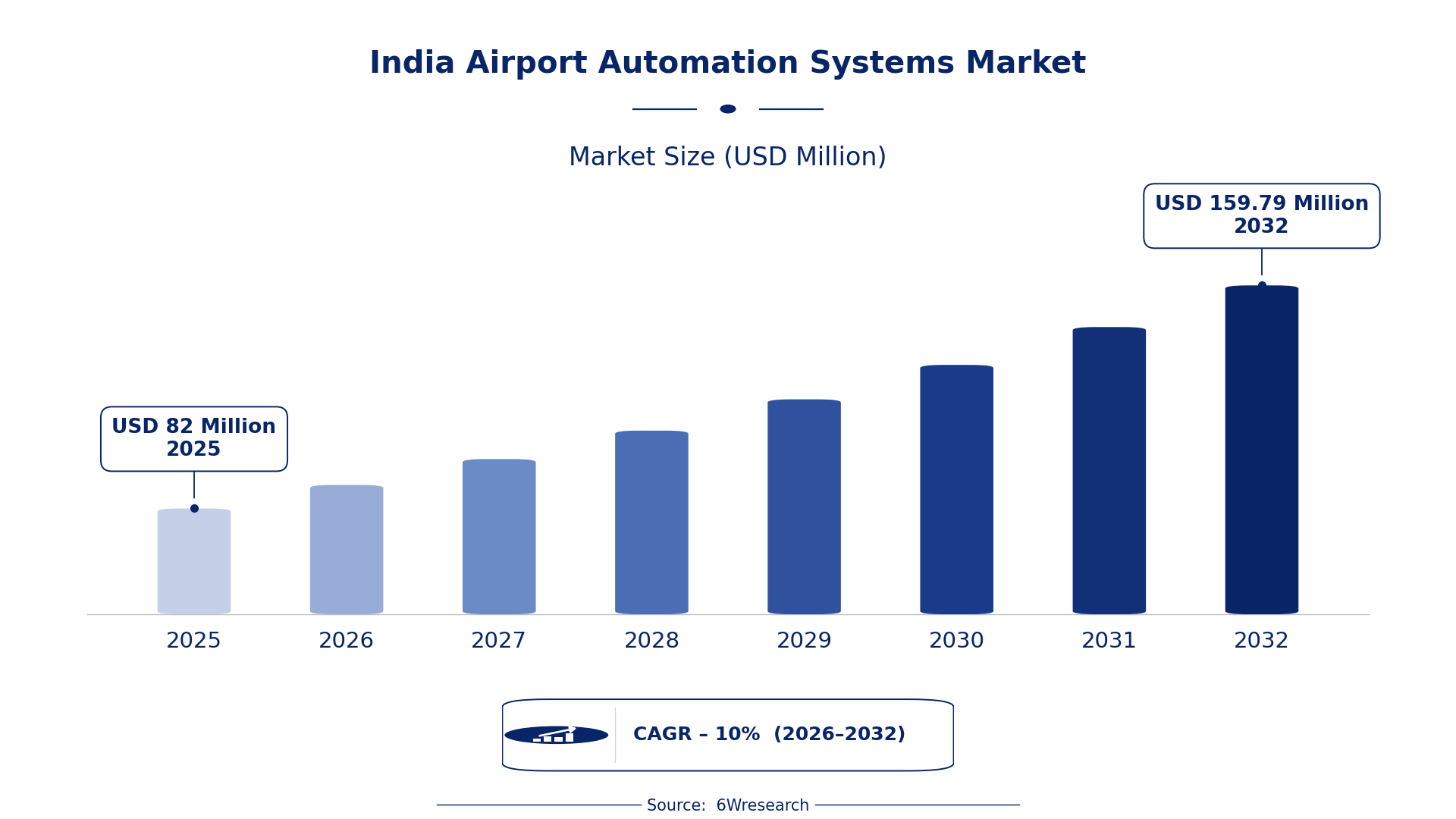
According to 6Wresearch internal database and industry insights, the India Airport Automation Systems Market was valued at USD 82.0 million in 2025 and is projected to reach USD 159.79 million by 2032, growing at a CAGR of approximately 10% during 2026–2032.
India Airport Automation Systems Market Highlights
| Report Metric | Details |
| Report Name | India Airport Automation Systems Market |
| Market Size 2025 | USD 82.0 million |
| Market Size 2032 | USD 159.79 million |
| Absolute Growth 2025–2032 | USD 77.79 million |
| CAGR 2026–2032 | 10% |
| Peak Annual Growth | 12.0% in 2031 |
| Forecast Period | 2026–2032 |
| Historical Data | 2022–2025 |
| Base Year | 2025 |
| Leading System Type, 2025 | Baggage Handling (47% share) |
| Leading Automation Level, 2025 | Fully Automated (41% share) |
| Leading Distribution Channel, 2025 | Industrial Suppliers (42% share) |
| Leading End User, 2025 | International Airports (35% share) |
| Fastest-Growing System Type | Check-in Kiosks (12.0% CAGR) |
| Fastest-Growing Automation Level | Self-Service (12.2% CAGR) |
| Fastest-Growing Distribution Channel | Direct Sales (11.9% CAGR) |
| Fastest-Growing End User | Domestic Airports (11.5% CAGR) |
| Growing Sector | airport operations |
| Key End Users | airport authorities, international airports, domestic airports, customs terminals |
India Airport Automation Systems Market Year-wise Growth Rate and Key Drivers (2022–2032)
This graph illustrates the annual growth rates of the market from 2022 to 2032, highlighting a steady upward trajectory and projected market expansion over the forecast period.
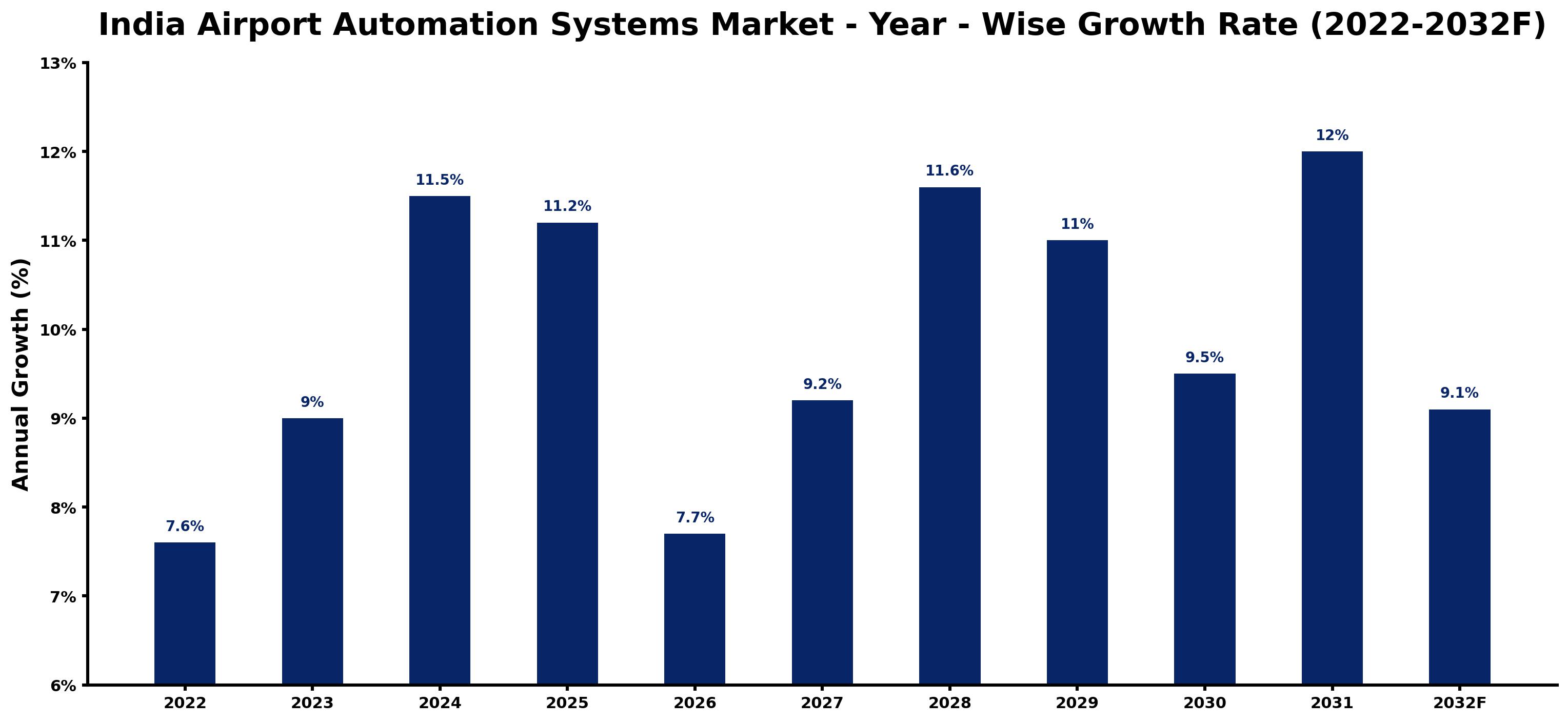
Each row of the following table gives one year's estimated growth and the event or demand shift that explains it.
| Year | Estimated Annual Growth (%) | Market Rationale |
| 2022 | 7.6 | Air passenger traffic reached 341 million, driving the need for automation systems. |
| 2023 | 9.0 | The Gati Shakti National Master Plan initiated infrastructure enhancements, boosting demand for automation. |
| 2024 | 11.5 | Increased investments in airport modernization projects led to heightened automation requirements. |
| 2025 | 11.2 | The market saw a slowdown due to the completion of several large-scale projects. |
| 2026 | 7.7 | Demand remained strong as international airports continued upgrading their systems. |
| 2027 | 9.2 | The adoption of self-service check-in kiosks expanded, increasing market growth. |
| 2028 | 11.6 | Technological advancements in AI integration further stimulated demand for automation. |
| 2029 | 11.0 | The market experienced a slowdown as growth rates adjusted after rapid expansion. |
| 2030 | 9.5 | The Ministry of Civil Aviation's initiatives continued to drive automation adoption. |
| 2031 | 12.0 | A peak in growth occurred as major airports implemented advanced systems. |
| 2032 | 9.1 | The market stabilised as demand for automation systems remained consistent. |
Note: Market size estimations and growth projections presented in this report are based on 6Wresearch's proprietary forecasting methodology, utilizing the latest available industry data, government publications, and primary research inputs.
India Airport Automation Systems Market Synopsis
Airport Automation Systems in India encompass technologies that streamline operations, improve passenger experience, and enhance security. These systems include baggage handling, self-check-in, and security screening, developed through advanced engineering. The India Airport Automation Systems Market is expanding due to rising air passenger traffic, which reached 341 million in 2022, alongside ongoing modernization efforts. The Ministry of Civil Aviation aims to increase airport capacity to accommodate 1 billion passengers by 2030, further driving demand for automation solutions. As airports upgrade their facilities, investments in automation technologies are expected to rise significantly.
Market Dynamics Impact Analysis (2026–2032)
| Factor | Type | Impact | Primary Segment Affected |
| Rising air passenger traffic necessitates improved operational efficiency in airports. | Driver | High | Baggage Handling |
| Increased investments in airport infrastructure modernization are driving demand for automation. | Driver | High | Check-in Kiosks |
| The Indian government's ₹3,000 crore investment plan for airport upgrades creates opportunities. | Opportunity | High | Security Screening |
| The growing trend of self-service check-in kiosks presents a significant market opportunity. | Opportunity | Medium | Self-Service |
| High costs associated with implementing advanced systems can deter smaller airports. | Restraint | High | Biometric-Based |
| Limited awareness of automation benefits among airport authorities can slow adoption. | Restraint | Medium | Immigration Gates |
| The complexity of integrating new technologies can delay project timelines. | Challenge | High | Fully Automated |
| Regulatory compliance requirements may extend approval processes for new systems. | Challenge | Medium | Direct Sales |
Evaluation of Drivers in India Airport Automation Systems Market (2026–2032)
The main growth drivers and the segments they affect most are set out below.
| Drivers | Primary Segment Affected | Why It Matters (Evidence) |
| Increasing air passenger traffic drives demand for efficient baggage handling systems. | Baggage Handling | India's air passenger traffic reached 341 million in 2022, necessitating improved luggage management. |
| Government investments in airport infrastructure fuel demand for check-in kiosks. | Check-in Kiosks | The Airports Authority of India oversees 125 airports, many of which are upgrading automation. |
| The push for improved security measures boosts demand for security screening systems. | Security Screening | The Bureau of Civil Aviation Security sets standards for security screening systems in airports. |
| The rise of self-service options increases the need for automated check-in solutions. | Self-Service | Self-service check-in kiosks are now present in over 70% of major airports in India. |
| The implementation of biometric technologies improves security and processing speed. | Biometric-Based | The use of biometric-based systems is mandated by the Bureau of Civil Aviation Security. |
Market growth in India for Airport Automation Systems relies on increasing air passenger traffic, heightened investments in airport infrastructure, and the adoption of self-service technologies. In 2022, air passenger traffic reached 341 million, necessitating efficient baggage handling systems. Many airports are modernising their facilities, creating demand for check-in kiosks. The Bureau of Civil Aviation Security mandates the implementation of biometric technologies, which improve security and processing efficiency. With self-service check-in kiosks now present in over 70% of major airports, this reflects a marked shift towards automation.
Evaluation of Restraints in India Airport Automation Systems Market
The table below lists the restraints and the evidence behind each.
| Market Restraint | Primary Segment Affected | Why It Matters (Evidence) |
| High implementation costs can deter smaller airports from upgrading their systems. | Biometric-Based | Advanced biometric systems require substantial investment, which may not be feasible for all airports. |
| Limited understanding of automation benefits among airport authorities slows adoption rates. | Immigration Gates | Some airport authorities remain hesitant to invest in automation due to a lack of awareness. |
| Integration complexities can lead to delays in project timelines for automation systems. | Fully Automated | The complexity of new technologies can extend the time required for full implementation. |
| Regulatory compliance requirements can prolong approval processes for new systems. | Direct Sales | Navigating compliance with security standards can delay system acquisitions. |
| Budget constraints may limit the scope of automation projects at some airports. | Self-Service | Smaller airports may struggle to allocate sufficient funds for automation upgrades. |
India Airport Automation Systems Market Challenges
Buyers in the India Airport Automation Systems market encounter delays due to regulatory approvals, which can extend project timelines by up to six months. Compliance with the Bureau of Civil Aviation Security's standards for security screening complicates implementation, as systems must meet strict requirements before becoming operational. The cost of integrating advanced technologies can exceed ₹100 crores, placing financial strain on airports and limiting their ability to invest in necessary upgrades. Rapid technological advancements can render existing solutions obsolete within a few years, forcing buyers to allocate additional budgets for frequent system upgrades to remain competitive.
Trends in the India Airport Automation Systems Market
The trends below show where the India Airport Automation Systems Market is heading.
- Shift towards Self-Service Technologies: Since 2022, there has been a notable shift towards self-service technologies in Indian airports. Over 70% of major airports now feature self-service check-in kiosks, improving passenger convenience and reducing wait times.
- Integration of Biometric Technologies: The Bureau of Civil Aviation Security updated guidelines in 2023 to include advanced biometric technologies. This change mandates their use for international flights, improving security and processing efficiency.
- Investment in Airport Infrastructure: The Indian government allocated ₹1,500 crores for airport infrastructure development in 2022. This funding aims to modernise facilities and enhance automation capabilities across various airports.
- Adoption of AI-Integrated Systems: AI-integrated systems are being piloted in select airports to improve efficiency. These systems are expected to enhance passenger flow management, reflecting a growing trend in automation.
Investment Opportunities in the India Airport Automation Systems Market
Several openings in the India Airport Automation Systems Market merit attention from investors.
- Investment in Domestic Airports: With the Indian aviation market projected to become the third largest by 2030, there is a strong opportunity for investment in domestic airports. Upgrading automation systems will be essential to accommodate increased passenger traffic.
- Partnerships for Automation Solutions: Now is an opportune time to partner with local airport authorities to supply automation solutions. Collaborating with regional players can facilitate market entry and enhance service offerings.
- Supply of Advanced Baggage Handling Systems: The Delhi International Airport serves as a leading example of advanced baggage handling systems. Suppliers can invest in similar technologies to meet the growing demand for efficient luggage management.
- Expansion of Security Screening Technologies: The need for improved security screening systems presents an opportunity for suppliers. Engaging with customs terminals can lead to substantial contracts as airports upgrade their security measures.
Government Initiatives in the India Airport Automation Systems Market
The National Civil Aviation Policy, launched in 2021, promotes airport modernisation and automation, improving operational efficiency. This policy encourages airports to adopt advanced technologies, ensuring compliance with international standards. In 2022, the Airports Authority of India approved a ₹3,000 crore investment plan for upgrading airport infrastructure, including automation systems. This funding aims to improve operational efficiency and passenger experience across the country. The Bureau of Civil Aviation Security updated its security guidelines in 2023 to include advanced biometric technologies for passenger processing, mandating their integration for international flights.
The Gati Shakti National Master Plan, initiated in 2023, aims to streamline logistics and infrastructure development, positively impacting airport automation. The Ministry of Civil Aviation is responsible for overseeing this plan, which includes significant investments in airport upgrades and modernisation projects. This initiative will enhance the overall efficiency of airport operations and support the adoption of automation technologies.
Future Insight of the India Airport Automation Systems Market
By 2032, the India Airport Automation Systems market will undergo substantial changes driven by initiatives such as the Gati Shakti National Master Plan, aimed at modernising airport infrastructure. The Ministry of Civil Aviation's target to increase airport capacity to handle 1 billion passengers will significantly boost demand for automation solutions. The implementation of biometric systems will become mandatory, streamlining security processes and improving passenger flow. With the Indian aviation market projected to become the third largest by 2030, suppliers will find new opportunities in this expanding landscape.
Market Segmentation Analysis
The report offers a comprehensive study of the following market segments and their leading categories in the market.
By System Type – Baggage Handling Dominated, Check-in Kiosks Expected to Grow Fastest
According to Shubham Padhi, Research Analyst at 6Wresearch, the largest system type category in 2025 was Baggage Handling, with a 47% share of total revenue. Baggage Handling systems capture the largest market share due to their critical role in efficiently managing the high volumes of luggage from India's 341 million air passengers in 2022. Facilities like the Delhi International Airport exemplify the advanced baggage handling systems that significantly enhance operational efficiency and passenger satisfaction. Check-in Kiosks are set to record the highest CAGR in this split, 12.0% over 2026–2032. Check-in Kiosks are rapidly gaining traction, with over 70% of major airports in India now implementing these systems, which greatly enhance passenger self-service capabilities. This trend is reinforced by ongoing government initiatives aimed at modernising and streamlining airport operations. Suppliers should prioritise the development of advanced baggage handling solutions while also investing in self-service technologies to meet the evolving demands of airports.
By Automation Level – Fully Automated Dominated, Self-Service Expected to Grow Fastest
In 2025, Fully Automated led the automation level split with a 41% share. Fully Automated systems lead the market share as they significantly improve operational efficiency, although their adoption is not uniform across all airports. The Airports Authority of India oversees 125 airports, many of which are transitioning to fully automated solutions to optimise their operations and enhance service delivery. Over 2026–2032, Self-Service is expected to post the fastest growth, at a CAGR of 12.2%. Self-Service systems are witnessing rapid growth, as they greatly enhance passenger convenience and reduce wait times, thereby improving the overall travel experience. This aligns with the Ministry of Civil Aviation's initiatives to modernise airport operations and increase capacity by 2030. Buyers should invest in self-service technologies to enhance passenger experience and operational efficiency in their facilities.
By Distribution Channel – Industrial Suppliers Dominated, Direct Sales Expected to Grow Fastest
Industrial Suppliers held a 42% share of the India Airport Automation Systems Market by distribution channel in 2025. Industrial Suppliers hold the largest market share as they provide essential components for airport automation systems, although they are not the primary users of these systems. Their role is vital in supporting the infrastructure necessary for the increasing automation demands of the airport sector. Direct Sales is projected to grow fastest, at a CAGR of 11.9% during 2026–2032. Direct Sales are becoming the preferred method for acquiring airport automation systems, indicating a shift towards more streamlined procurement processes. This trend is expected to persist as airports seek quicker and more efficient acquisition methods. Suppliers must enhance their direct sales strategies to effectively address the rising demand from airports for automation systems.
By End User – International Airports Dominated, Domestic Airports Expected to Grow Fastest
With a 35% revenue share in 2025, International Airports was the largest end user category. International Airports command the largest market share as they are the primary users of advanced airport automation systems, driven by the high volume of international traffic. The push for modernisation at these airports is evident through their adoption of cutting-edge technologies to elevate passenger experience and operational efficiency. The quickest growth will come from Domestic Airports, forecast to expand at a CAGR of 11.5% between 2026 and 2032. Domestic Airports are experiencing the fastest growth in automation adoption, as they increasingly recognise the importance of streamlining operations and enhancing passenger services. This shift is supported by government initiatives aimed at expanding airport capacity and improving efficiency. Suppliers should focus on domestic airports as a growing segment for automation solutions, capitalising on the rising demand for modernisation.
Key Attractiveness of the Report
- 10 Years of Market Numbers
- Historical Data Starting from 2022 to 2025
- Base Year 2025
- Forecast Data until 2032
- Key Performance Indicators Impacting the Market
- Major Upcoming Developments and Projects
Key Highlights of the Report:
- India Airport Automation Systems Market Outlook
- Market Size of India Airport Automation Systems Market, 2025
- Forecast of India Airport Automation Systems Market, 2032
- Historical Data and Forecast of India Airport Automation Systems Revenues & Volume for the Period 2022 - 2032F
- India Airport Automation Systems Market Trend Evolution
- India Airport Automation Systems Market Drivers and Challenges
- India Airport Automation Systems Price Trends
- India Airport Automation Systems Porter's Five Forces
- India Airport Automation Systems Industry Life Cycle
- Historical Data and Forecast of India Airport Automation Systems Market Revenues & Volume By System Type for the Period 2022 - 2032F
- Historical Data and Forecast of India Airport Automation Systems Market Revenues & Volume By Baggage Handling for the Period 2022 - 2032F
- Historical Data and Forecast of India Airport Automation Systems Market Revenues & Volume By Check-in Kiosks for the Period 2022 - 2032F
- Historical Data and Forecast of India Airport Automation Systems Market Revenues & Volume By Security Screening for the Period 2022 - 2032F
- Historical Data and Forecast of India Airport Automation Systems Market Revenues & Volume By Immigration Gates for the Period 2022 - 2032F
- Historical Data and Forecast of India Airport Automation Systems Market Revenues & Volume By Automation Level for the Period 2022 - 2032F
- Historical Data and Forecast of India Airport Automation Systems Market Revenues & Volume By Fully Automated for the Period 2022 - 2032F
- Historical Data and Forecast of India Airport Automation Systems Market Revenues & Volume By Self-Service for the Period 2022 - 2032F
- Historical Data and Forecast of India Airport Automation Systems Market Revenues & Volume By AI-Integrated for the Period 2022 - 2032F
- Historical Data and Forecast of India Airport Automation Systems Market Revenues & Volume By Biometric-Based for the Period 2022 - 2032F
- Historical Data and Forecast of India Airport Automation Systems Market Revenues & Volume By Distribution Channel for the Period 2022 - 2032F
- Historical Data and Forecast of India Airport Automation Systems Market Revenues & Volume By Industrial Suppliers for the Period 2022 - 2032F
- Historical Data and Forecast of India Airport Automation Systems Market Revenues & Volume By Direct Sales for the Period 2022 - 2032F
- Historical Data and Forecast of India Airport Automation Systems Market Revenues & Volume By Online Platforms for the Period 2022 - 2032F
- Historical Data and Forecast of India Airport Automation Systems Market Revenues & Volume By Specialty Stores for the Period 2022 - 2032F
- Historical Data and Forecast of India Airport Automation Systems Market Revenues & Volume By End User for the Period 2022 - 2032F
- Historical Data and Forecast of India Airport Automation Systems Market Revenues & Volume By International Airports for the Period 2022 - 2032F
- Historical Data and Forecast of India Airport Automation Systems Market Revenues & Volume By Domestic Airports for the Period 2022 - 2032F
- Historical Data and Forecast of India Airport Automation Systems Market Revenues & Volume By Airport Authorities for the Period 2022 - 2032F
- Historical Data and Forecast of India Airport Automation Systems Market Revenues & Volume By Customs Terminals for the Period 2022 - 2032F
- India Airport Automation Systems Import Export Trade Statistics
- Market Opportunity Assessment By System Type
- Market Opportunity Assessment By Automation Level
- Market Opportunity Assessment By Distribution Channel
- Market Opportunity Assessment By End User
- India Airport Automation Systems Top Companies Market Share
- India Airport Automation Systems Competitive Benchmarking By Technical and Operational Parameters
- India Airport Automation Systems Company Profiles
- India Airport Automation Systems Key Strategic Recommendations
Market Covered
Segments analysed in this report are listed below.
By System Type
- Baggage Handling
- Check-in Kiosks
- Security Screening
- Immigration Gates
By Automation Level
- Fully Automated
- Self-Service
- AI-Integrated
- Biometric-Based
By Distribution Channel
- Industrial Suppliers
- Direct Sales
- Online Platforms
- Specialty Stores
By End User
- International Airports
- Domestic Airports
- Airport Authorities
- Customs Terminals































