India Artificial Intelligence (AI) Market Size & Growth Rate (2026-2032)
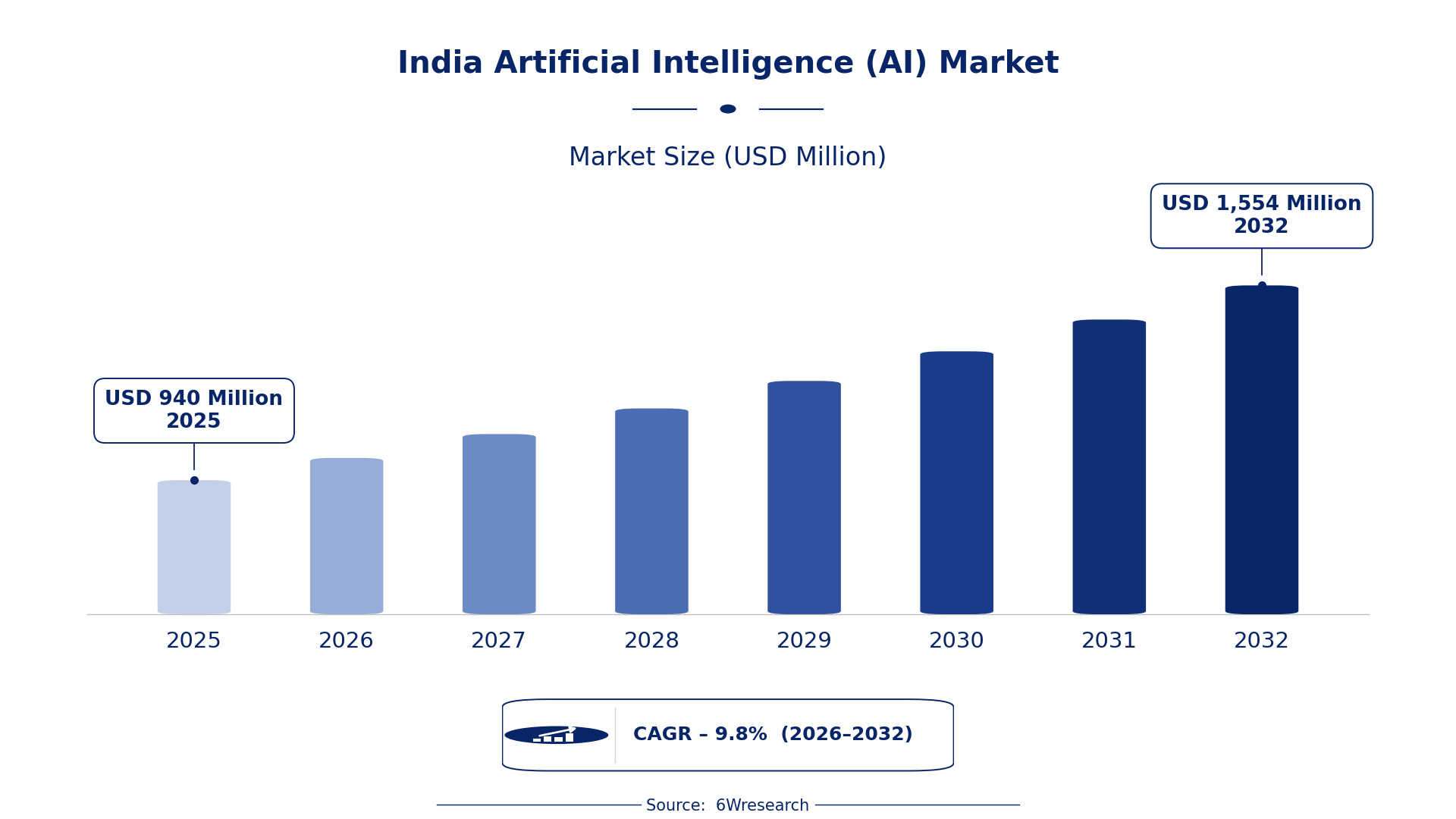
The India Artificial Intelligence (AI) Market was estimated at USD 940 Million in 2025 and is projected to reach USD 1554 Million by 2032, growing at a CAGR of 9.8% from 2026 to 2032.
India Artificial Intelligence (AI) Market Synopsis
The India Artificial Intelligence (AI) Market is witnessing a surge in adoption as organizations recognize the transformative potential of AI technologies. In recent years, sectors such as healthcare, finance, and retail have increasingly integrated AI for operational efficiency and enhanced customer engagement.
Looking ahead, the market is set to evolve as emerging technologies like machine learning and natural language processing take center stage. Businesses are gearing up to utilize AI not only for automation but also for data-driven insights, positioning themselves for competitive advantage in a rapidly changing environment.
India Artificial Intelligence (AI) Market Year-wise Growth Rate and Key Drivers
This graph illustrates the annual growth rates of the India Artificial Intelligence (AI) Market from 2021 to 2032, highlighting a steady upward trajectory and projected expansion over the forecast period.
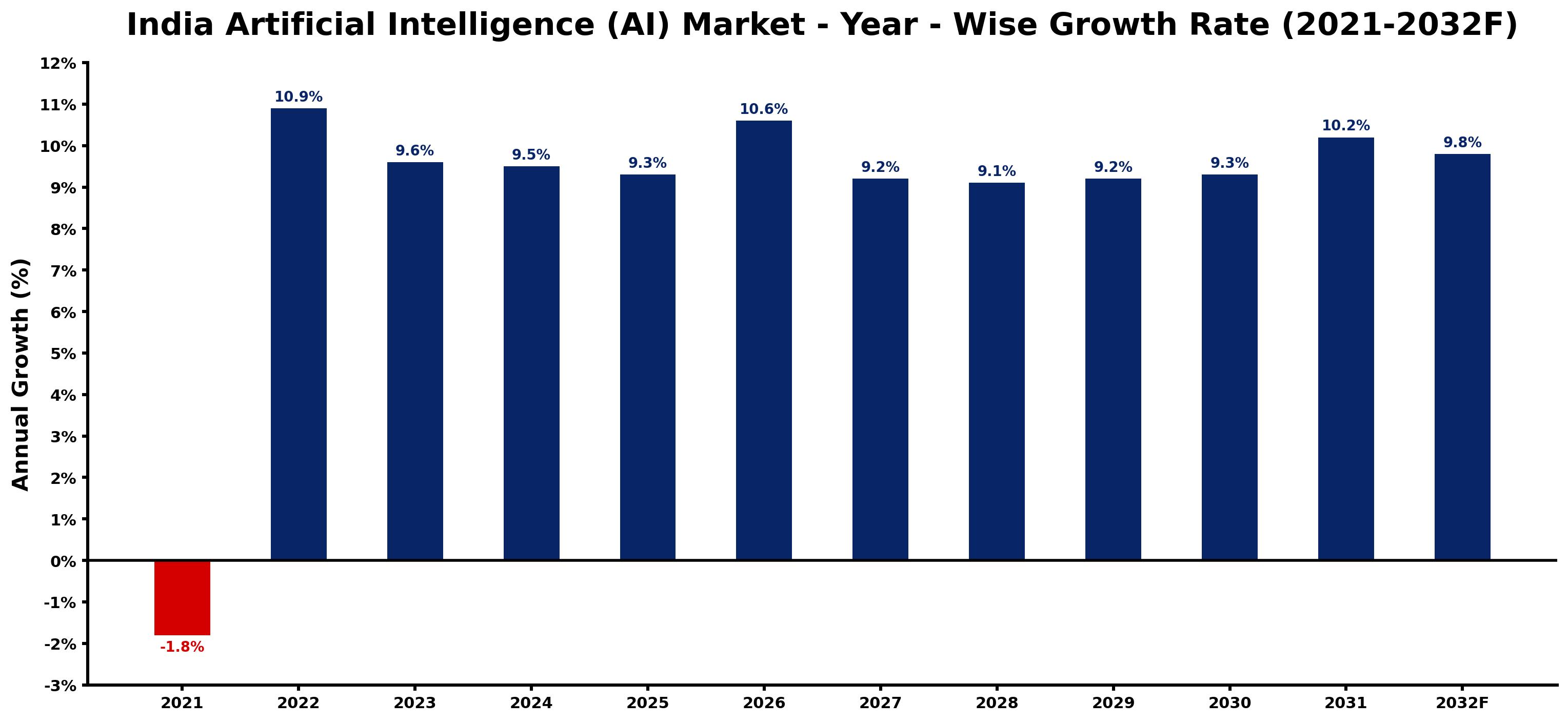
The table below presents the year‑wise growth rates along with the key drivers influencing the market
| Year | Growth Rate | Major Drivers |
| 2021 | -1.8% | Strict data protection regulations from the Personal Data Protection Bill |
| 2022 | 10.9% | Boost from Digital India initiatives promoting tech adoption. |
| 2023 | 9.6% | Rising investment in AI startups in Bengaluru tech hub. |
| 2024 | 9.5% | Government push for AI in agriculture through subsidies. |
| 2025 | 9.3% | Increased smartphone penetration driving AI app usage. |
| 2026 | 10.6% | Emerging AI policies from NITI Aayog enhancing innovation. |
| 2027 | 9.2% | AI integration in e-governance improving public service delivery. |
| 2028 | 9.1% | VMware's increased focus on AI solutions in India. |
| 2029 | 9.2% | Growing tech-savvy youth demographics fueling AI demand. |
| 2030 | 9.3% | Partnerships between Indian firms and global AI leaders. |
| 2031 | 10.2% | Digital skilling initiatives boosting local AI workforce talent. |
| 2032 | 9.8% | Regulatory frameworks supporting AI ethics and governance. |
Note: Market size estimations and growth projections presented in this report are based on 6Wresearch's proprietary forecasting methodology, utilizing the latest available industry data, government publications, and primary research inputs.
India Artificial Intelligence (AI) Market Key Takeaways
Below are some of the specific key takeaways from the market, including:
- The market is projected to reach USD 1554 Million by 2032, reflecting growing confidence in AI technologies.
- Healthcare and finance sectors are leading in AI adoption, utilizing the technology for improved diagnostics and personalized services.
- Government initiatives are crucial in fostering innovation and supporting AI research across various industries.
- Data quality remains a significant challenge, impacting the efficacy of AI models and applications.
- Growing awareness of ethical AI practices is reshaping how organizations approach AI implementation.
Evaluation of Restraints in India Artificial Intelligence (AI) Market
Despite the optimistic outlook, the India Artificial Intelligence (AI) Market faces notable constraints that could hinder its trajectory. A primary concern is the quality and quantity of data, which are essential for training effective AI models. Poor data can lead to inaccurate predictions and subpar outcomes, creating skepticism around AI initiatives.
on top of that, the opacity of AI decision-making processes raises ethical concerns regarding bias and fairness. Companies must prioritize transparency in their AI solutions, ensuring that stakeholders understand how decisions are made. Without addressing these issues, growth could be stunted as consumer trust wanes.
India Artificial Intelligence (AI) Market Trends
AI is becoming a cornerstone for businesses aiming to optimize operations and deliver tailored customer experiences. There is a noticeable shift towards adopting machine learning algorithms to enhance predictive analytics capabilities. In the healthcare sector, AI-driven diagnostics are revolutionizing patient care, while finance firms leverage AI for fraud detection and risk assessment.
Another key trend is the growing emphasis on ethical AI, as businesses seek to build trust with consumers. This trend is driving the development of frameworks for fair and unbiased AI applications, ensuring compliance with regulatory standards. As these trends continue to develop, they will significantly shape the market's future.
India Artificial Intelligence (AI) Market Opportunities
The India Artificial Intelligence (AI) Market presents numerous growth opportunities for companies ready to innovate. Industries such as agriculture and logistics are beginning to harness AI for improved efficiency and productivity. AI-driven solutions can optimize supply chains and enhance crop yields, directly impacting economic growth.
Additionally, as more organizations adopt cloud-based AI services, there is potential for startups to emerge with novel AI applications tailored to specific industry needs. The expanding digital infrastructure will further support these initiatives, creating a fertile ground for investment and growth.
Government Initiatives in the India Artificial Intelligence (AI) Market
Government policy is playing an instrumental role in shaping the India Artificial Intelligence (AI) Market. With a focus on fostering innovation and supporting research, the government is creating an environment conducive to AI growth. Public-private partnerships are becoming increasingly common, as collaboration is essential for advancing AI technologies in various sectors.
- A national digital infrastructure upgrade programme is currently underway, aimed at enhancing data accessibility and processing capabilities for AI initiatives.
- A regulatory framework introduced in 2025 mandates transparency in AI applications, addressing ethical concerns around bias and decision-making processes.
- The government has launched an AI research fund to support startups focused on developing innovative solutions that cater to local industry needs.
- Ongoing initiatives include collaboration with educational institutions to incorporate AI training in curricula, preparing a skilled workforce for future demands.
- A planned public-private initiative expected to expand AI deployment in rural healthcare settings is set to launch by late 2026.
Future Insights of the India Artificial Intelligence (AI) Market
From 2026 to 2032, the India Artificial Intelligence (AI) Market is likely to experience robust growth driven by technological advancements and increased investment across various sectors. As organizations continue to adapt to new AI capabilities, we can expect a surge in demand for AI-powered solutions tailored to specific industry challenges.
The emphasis on ethical AI and data privacy will also shape market dynamics, leading to stricter regulations and a more cautious approach to implementation. However, those who navigate these challenges effectively will find ample opportunities to innovate and excel in this rapidly evolving field.
India Artificial Intelligence (AI) Market Latest Developments
The past 12-14 months have seen a flurry of activity in the India Artificial Intelligence (AI) Market, as organizations increasingly recognize the need to integrate AI solutions into their operations. The push for automation and data-driven decision-making has accelerated, particularly in sectors like healthcare and finance.
- A major technology vendor launched an AI-driven analytics platform in Q2 2025, aimed at optimizing supply chain management for retail businesses.
- An initiative that began in early 2025 focuses on developing AI applications for personalized customer experiences in e-commerce, currently underway.
- In early 2025, a leading regional operator completed the rollout of AI chatbots to enhance customer service across various sectors.
- Upcoming in late 2026 is a planned partnership between several universities and tech companies to establish an AI research hub, fostering collaboration in innovation.
- By mid-2026, a prominent player is expected to launch a cloud-based AI tool tailored for small and medium enterprises, enhancing accessibility to advanced technologies.
India Artificial Intelligence (AI) Market - Key Attractiveness of the Report
- 10 Years of Market Numbers
- Historical Data Starting from 2022 to 2025
- Base Year: 2025
- Forecast Data until 2032
- Key Performance Indicators Impacting the Market
- Major Upcoming Developments and Projects
Key Highlights of the Report:
- India Artificial Intelligence (AI) Market Outlook
- Market Size of India Artificial Intelligence (AI) Market, 2025
- Forecast of India Artificial Intelligence (AI) Market, 2032
- Historical Data and Forecast of India Artificial Intelligence (AI) Revenues & Volume for the Period 2022-2032F
- India Artificial Intelligence (AI) Market Trend Evolution
- India Artificial Intelligence (AI) Market Drivers and Challenges
- India Artificial Intelligence (AI) Price Trends
- India Artificial Intelligence (AI) Porter's Five Forces
- India Artificial Intelligence (AI) Industry Life Cycle
- Historical Data and Forecast of India Artificial Intelligence (AI) Market Revenues & Volume By Offering for the Period 2022-2032F
- Historical Data and Forecast of India Artificial Intelligence (AI) Market Revenues & Volume By Hardware for the Period 2022-2032F
- Historical Data and Forecast of India Artificial Intelligence (AI) Market Revenues & Volume By Software for the Period 2022-2032F
- Historical Data and Forecast of India Artificial Intelligence (AI) Market Revenues & Volume By Services for the Period 2022-2032F
- Historical Data and Forecast of India Artificial Intelligence (AI) Market Revenues & Volume By Technology for the Period 2022-2032F
- Historical Data and Forecast of India Artificial Intelligence (AI) Market Revenues & Volume By Machine Learning for the Period 2022-2032F
- Historical Data and Forecast of India Artificial Intelligence (AI) Market Revenues & Volume By Natural Language Processing for the Period 2022-2032F
- Historical Data and Forecast of India Artificial Intelligence (AI) Market Revenues & Volume By Context-Aware Computing for the Period 2022-2032F
- Historical Data and Forecast of India Artificial Intelligence (AI) Market Revenues & Volume By Computer Vision for the Period 2022-2032F
- Historical Data and Forecast of India Artificial Intelligence (AI) Market Revenues & Volume By Business Function for the Period 2022-2032F
- Historical Data and Forecast of India Artificial Intelligence (AI) Market Revenues & Volume By Finance for the Period 2022-2032F
- Historical Data and Forecast of India Artificial Intelligence (AI) Market Revenues & Volume By Security for the Period 2022-2032F
- Historical Data and Forecast of India Artificial Intelligence (AI) Market Revenues & Volume By Human Resources for the Period 2022-2032F
- Historical Data and Forecast of India Artificial Intelligence (AI) Market Revenues & Volume By Law for the Period 2022-2032F
- Historical Data and Forecast of India Artificial Intelligence (AI) Market Revenues & Volume By Marketing and Sales for the Period 2022-2032F
- Historical Data and Forecast of India Artificial Intelligence (AI) Market Revenues & Volume By Other Business Function (IT operations) for the Period 2022-2032F
- Historical Data and Forecast of India Artificial Intelligence (AI) Market Revenues & Volume By Deployment Mode for the Period 2022-2032F
- Historical Data and Forecast of India Artificial Intelligence (AI) Market Revenues & Volume By On-premises for the Period 2022-2032F
- Historical Data and Forecast of India Artificial Intelligence (AI) Market Revenues & Volume By Cloud for the Period 2022-2032F
- Historical Data and Forecast of India Artificial Intelligence (AI) Market Revenues & Volume By Organization Size for the Period 2022-2032F
- Historical Data and Forecast of India Artificial Intelligence (AI) Market Revenues & Volume By Large Enterprises for the Period 2022-2032F
- Historical Data and Forecast of India Artificial Intelligence (AI) Market Revenues & Volume By SMEs for the Period 2022-2032F
- Historical Data and Forecast of India Artificial Intelligence (AI) Market Revenues & Volume By Verticals for the Period 2022-2032F
- Historical Data and Forecast of India Artificial Intelligence (AI) Market Revenues & Volume By BFSI for the Period 2022-2032F
- Historical Data and Forecast of India Artificial Intelligence (AI) Market Revenues & Volume By IT/ ITES for the Period 2022-2032F
- Historical Data and Forecast of India Artificial Intelligence (AI) Market Revenues & Volume By Telecommunication for the Period 2022-2032F
- Historical Data and Forecast of India Artificial Intelligence (AI) Market Revenues & Volume By Government and Defense for the Period 2022-2032F
- Historical Data and Forecast of India Artificial Intelligence (AI) Market Revenues & Volume By Manufacturing for the Period 2022-2032F
- Historical Data and Forecast of India Artificial Intelligence (AI) Market Revenues & Volume By Healthcare and Lifesciences for the Period 2022-2032F
- Historical Data and Forecast of India Artificial Intelligence (AI) Market Revenues & Volume By Retail and Ecommerce for the Period 2022-2032F
- Historical Data and Forecast of India Artificial Intelligence (AI) Market Revenues & Volume By Automotive, Transportation & Logistics for the Period 2022-2032F
- India Artificial Intelligence (AI) Import Export Trade Statistics
- Market Opportunity Assessment By Offering
- Market Opportunity Assessment By Technology
- Market Opportunity Assessment By Business Function
- Market Opportunity Assessment By Deployment Mode
- Market Opportunity Assessment By Organization Size
- Market Opportunity Assessment By Verticals
- India Artificial Intelligence (AI) Top Companies Market Share
- India Artificial Intelligence (AI) Competitive Benchmarking By Technical and Operational Parameters
- India Artificial Intelligence (AI) Company Profiles
- India Artificial Intelligence (AI) Key Strategic Recommendations






































