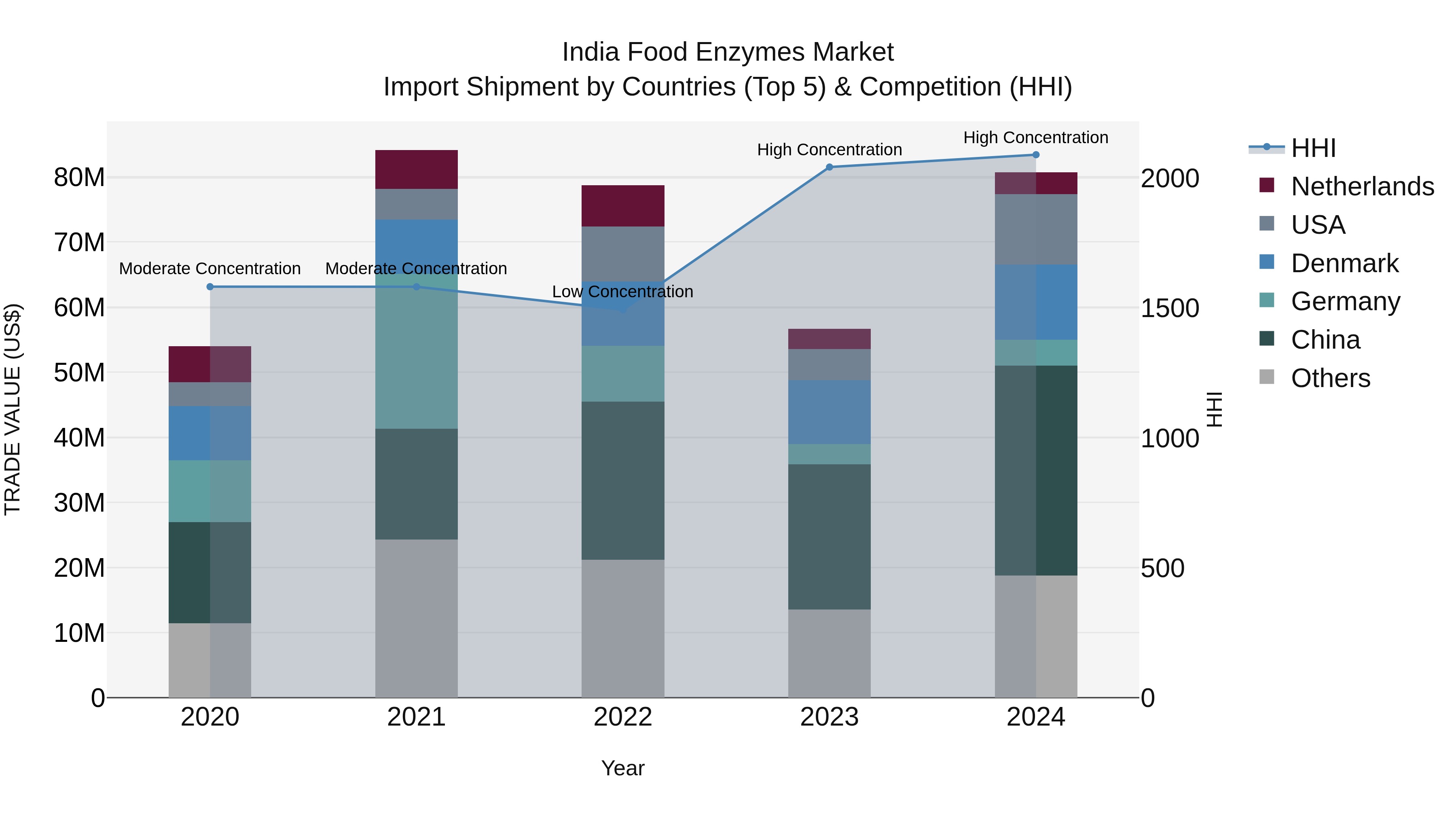
India Food Enzymes Market Top 5 Importing Countries and Market Competition (HHI) Analysis
India`s food enzymes import market in 2024 saw significant contributions from top exporting countries like China, Denmark, USA, Germany, and Austria. Despite high concentration with a high Herfindahl-Hirschman Index (HHI), the market exhibited strong growth with a Compound Annual Growth Rate (CAGR) of 10.57% from 2020 to 2024. The growth momentum was particularly impressive in 2024, with a growth rate of 42.46% compared to the previous year, indicating a robust demand for food enzymes in the Indian market.
India Food Enzymes Market Growth Rate
According to 6Wresearch internal database and industry insights,
India Food Enzymes Market Highlights
| Report Name | India Food Enzymes Market |
| Forecast period | 2025-2031 |
| CAGR | 7.4% |
| Growing Sector | Food Processing & Biotechnology |
Topics Covered in the India Food Enzymes Market Report
The India Food Enzymes Market report thoroughly covers the market by source, type, form, and application. The market report provides an unbiased and detailed analysis of ongoing market trends, opportunities/high growth areas, and market drivers, which would help stakeholders devise and align their market strategies according to the current and future market dynamics.
India Food Enzymes Market Synopsis
The India Food Enzymes Market continues to grow steadily, supported by rapid advancements in food processing, a surge in health-conscious consumer behavior, and the popularity of clean-label, plant-based formulations. Expanding consumption of dairy, bakery, and beverage products is increasing enzyme application for improved product stability and sensory appeal. However, government policies promoting modernization of processing facilities and investments in enzyme-based biotechnology are accelerating industry innovation and efficiency.
Evaluation of Growth Drivers in the India Food Enzymes Market
Below mentioned are some prominent drivers and their influence on the market dynamics:
| Drivers | Primary Segments Affected | Why it matters (evidence) |
| Rising Demand for Processed and Functional Foods | Bakery; Dairy; Beverages | Increasing urbanization and convenience-driven consumption are boosting the use of enzymes for improving product consistency and nutrition. |
| Technological Advancements in Enzyme Production | All Types | Enhanced fermentation and immobilization techniques are increasing enzyme efficiency, operational stability, and production scalability, encouraging mass utilization. |
| Shift Toward Clean-Label and Natural Ingredients | Bakery; Beverages | Consumers rising shift toward chemical-free and plant-based formulations is accelerating the use of enzymes as eco-friendly and natural processing solutions. |
| Government Support for Food Processing Sector | Dairy; Meat & Fish Processing | Through initiatives such as the PM Kisan Sampada Yojana and PLI Scheme, the government is fostering R&D and enzyme adoption to enhance value addition in meat and fish processing. |
| Increased Health Awareness and Nutritional Demand | Supplements & Functional Foods | Enhanced focus on gut health and protein intake is promoting the integration of enzymes into fortified and functional food segments. |
India Food Enzymes Market is anticipated to witness significant expansion, registering a CAGR of 7.4% during the forecast period of 2025–2031. The market expansion is fueled by the continuous advancement of India Food Processing Market, innovation in enzyme formulations, and growing demand for nutrient-rich products. Furthermore, India Food Enzymes Market Growth is reinforced by continuous R&D in microbial enzyme development and precision fermentation technologies that improve efficiency, reduce costs, and enhance environmental sustainability across food applications, thereby positioning the market for steady and sustainable growth.
Evaluation of Restraints in the India Food Enzymes Market
Below mentioned are some major restraints and their influence on the market dynamics:
| Restraints | Primary Segments Affected | What this means (evidence) |
| High Production Costs | All Forms | Complex downstream processing and purification increase manufacturing expenses, impacting small-scale producers. |
| Stringent Regulatory Frameworks | Dairy; Bakery | Compliance with FSSAI and global safety standards raises approval timelines for new enzyme formulations. |
| Temperature & pH Sensitivity | Liquid Enzymes | Variability in food processing conditions affects enzyme activity and shelf stability. |
| Competition from Synthetic Additives | Bakery; Beverages | Artificial emulsifiers and stabilizers still offer cost advantages in certain formulations. |
| Limited Awareness Among Small Processors | All Segments | Lack of technical knowledge about enzyme benefits restricts adoption in smaller food enterprises. |
India Food Enzymes Market Challenges
The India Food Enzymes Industry encounters several obstacles, such as high costs of production, low levels of awareness among small-scale processors, and strict regulatory approvals. Along with stability of product form with temperature fluctuations, consistent enzyme utilization continues to pose significant technical challenges. The use of low-cost chemical additives continues to inhibit enzyme penetration in traditional food areas. These factors will guide choices for investment capital, timeliness of innovation, and absorption of technology in domestic manufacturers.
India Food Enzymes Market Trends
There are several emerging trends shaping the India Food Enzymes Market landscape:
- Microbial Enzyme Preeminence: Microbial fermentation is becoming increasingly favourable due to its low cost, higher yields, and more sustainable principles than animal-based enzymes.
- Clean label formulations: A expanding market preference for natural products without additives has manufacturers strengthening claims to replace synthetic ingredients with enzyme-based options.
- Precision fermentation: Cutting-edge biotech tools allow for precision customization of enzymes for targeted and unique food process applications, optimizing value and function.
- Enzyme blends for texture improvement: Blended enzyme systems are being commercially adopted in bakery and dairy sectors to enhance softness, volume, or product stability.
Investment Opportunities in the India Food Enzymes Industry
There are several potential investment opportunities in the industry which continue to open new avenues:
- Units for Microbial Enzyme Production - Create enzyme production facilities based on fermentation to meet sustainability objectives and industry demand in the bakery, dairy, and brewing industries.
- Clean Label Product Development - Investing in enzyme innovation supports the creation of natural, clean-label food products tailored to the needs of health-conscious consumers.
- Research and Development in Precision Enzyme Engineering - Our focus will be on developing genetic modification and immobilization techniques that allow us to synthesize enzymes with improved precision, durability, and efficency of performance.
- Opportunities in Distribution and Export - Expanding export potential through improved engagement with current distributors in order to capitalize on growing opportunities in Asia and Middle East.
Top 5 Leading Players in the India Food Enzymes Market
Some leading players operating in the India Food Enzymes Market Share include:
1. Novozymes South Asia Pvt. Ltd.
| CompanyName | Novozymes South Asia Pvt. Ltd. |
|---|---|
| Established Year | 2000 |
| Headquarters | Bangalore, India |
| Official Website | Click Here |
Novozymes is a biotechnology leader specializing in enzyme and microbial solutions. Its portfolio spans bakery, brewing, and dairy applications, emphasizing innovation and sustainability.
2. Advanced Enzyme Technologies Ltd.
| CompanyName | Advanced Enzyme Technologies Ltd. |
|---|---|
| Established Year | 1989 |
| Headquarters | Thane, India |
| Official Website | Click Here |
Advanced Enzymes develops industrial enzymes for food and nutraceutical applications. Its expertise in fermentation and R&D helps deliver high-efficiency enzyme formulations.
3. DSM Nutritional Products India Pvt. Ltd.
| CompanyName | DSM Nutritional Products India Pvt. Ltd. |
|---|---|
| Established Year | 2003 |
| Headquarters | Gurgaon, India |
| Official Website | Click Here |
DSM is a global bioscience company offering enzymes for dairy, beverages, and bakery segments, focusing on nutritional quality and sustainability.
4. Aumgene Biosciences Pvt. Ltd.
| CompanyName | Aumgene Biosciences Pvt. Ltd. |
|---|---|
| Established Year | 2004 |
| Headquarters | Vadodara, India |
| Official Website | - |
Aumgene specializes in microbial fermentation and custom enzyme manufacturing, with a strong focus on food, pharmaceutical, and feed-grade enzyme solutions.
5. Maps Enzymes Ltd.
| CompanyName | Maps Enzymes Ltd. |
|---|---|
| Established Year | 1975 |
| Headquarters | Ahmedabad, India |
| Official Website | Click Here |
Maps Enzymes offers a wide range of enzymes catering to food processing, baking, and beverage industries. Its focus on export-oriented growth and R&D innovation strengthens its market presence.
Government Regulations & Initiatives Introduced in the India Food Enzymes Market
According to the Indian Government data, several initiatives have supported enzyme adoption in the food sector. Programs such as the Pradhan Mantri Kisan Sampada Yojana, PLI Scheme for Food Processing, and National Biotechnology Development Strategy promote investment in bioprocessing and fermentation technologies. The Make in India initiative encourages domestic enzyme manufacturing, while the Food Safety and Standards Authority of India (FSSAI) continues to streamline enzyme approvals for safer food production. For instance, projects under the Mega Food Parks Scheme and Startup India are boosting innovation and R&D in the enzyme sector.
Future Insights of the India Food Enzymes Market
India Food Enzymes Market is anticipated to move forward steadily owing to advancements in biotechnology, increased demand for functional foods, and the continuous trend of industrial automation. Manufacturers are expected to focus on efficiency, temperature tolerance, and processing formulations that are developed for each process. The market will see more and more genetically engineered enzymes that can improve yield and sustainability. In addition, the rise in export potential, along with investments and development of precision fermentation, will position India as a regional center for food enzymes innovation and production.
Market Segmentation Analysis
The report offers a comprehensive study of the subsequent market segments and their leading categories.
Microorganisms to Dominate the Market- By Source
According to Ritika Kalra, Senior Research Analyst, 6Wresearch, microbial enzymes dominate the India Food Enzymes Market Share owing to their superior stability, scalability, and lower production costs. The extensive use of microbial fermentation for enzyme synthesis in bakery, dairy, and brewing processes ensures consistent quality and enhanced activity across applications.
Carbohydrase to Dominate the Market- By Type
Carbohydrase enzymes lead the market due to their wide application in bakery, beverage, and grain processing industries. Their efficiency in improving dough texture, sweetness, and fermentation processes contributes significantly to overall demand.
Liquid Enzymes to Dominate the Market- By Form
Liquid enzymes hold the majority share, favored for their ease of handling, uniform mixing, and effectiveness in large-scale food production systems, especially in brewing and beverage industries.
Bakery Segment to Dominate the Market- By Application
The bakery application segment dominates the India Food Enzymes Market due to the increasing consumption of bread, biscuits, and confectionery items. Enzymes are used to enhance texture, shelf life, and dough stability, driving widespread adoption among manufacturers.
Key Attractiveness of the Report
- 10 Years of Market Numbers.
- Historical Data Starting from 2021 to 2024.
- Base Year: 2024
- Forecast Data until 2031.
- Key Performance Indicators Impacting the Market.
- Major Upcoming Developments and Projects.
Key Highlights of the Report:
- India Food Enzymes Market Outlook
- Market Size of India Food Enzymes Market, 2024
- Forecast of India Food Enzymes Market, 2031
- Historical Data and Forecast of India Food Enzymes Revenues & Volume for the Period 2021-2031
- India Food Enzymes Market Trend Evolution
- India Food Enzymes Market Drivers and Challenges
- India Food Enzymes Price Trends
- India Food Enzymes Porter's Five Forces
- India Food Enzymes Industry Life Cycle
- Historical Data and Forecast of India Food Enzymes Market Revenues & Volume By Source for the Period 2021-2031
- Historical Data and Forecast of India Food Enzymes Market Revenues & Volume By Microorganisms for the Period 2021-2031
- Historical Data and Forecast of India Food Enzymes Market Revenues & Volume By Animal for the Period 2021-2031
- Historical Data and Forecast of India Food Enzymes Market Revenues & Volume By Plant for the Period 2021-2031
- Historical Data and Forecast of India Food Enzymes Market Revenues & Volume By Type for the Period 2021-2031
- Historical Data and Forecast of India Food Enzymes Market Revenues & Volume By Carbohydarse for the Period 2021-2031
- Historical Data and Forecast of India Food Enzymes Market Revenues & Volume By Protease for the Period 2021-2031
- Historical Data and Forecast of India Food Enzymes Market Revenues & Volume By Lipase for the Period 2021-2031
- Historical Data and Forecast of India Food Enzymes Market Revenues & Volume By Others for the Period 2021-2031
- Historical Data and Forecast of India Food Enzymes Market Revenues & Volume By Form for the Period 2021-2031
- Historical Data and Forecast of India Food Enzymes Market Revenues & Volume By Liquid for the Period 2021-2031
- Historical Data and Forecast of India Food Enzymes Market Revenues & Volume By Solid for the Period 2021-2031
- Historical Data and Forecast of India Food Enzymes Market Revenues & Volume By Application for the Period 2021-2031
- Historical Data and Forecast of India Food Enzymes Market Revenues & Volume By Bakery for the Period 2021-2031
- Historical Data and Forecast of India Food Enzymes Market Revenues & Volume By Dairy for the Period 2021-2031
- Historical Data and Forecast of India Food Enzymes Market Revenues & Volume By Beverage for the Period 2021-2031
- Historical Data and Forecast of India Food Enzymes Market Revenues & Volume By Meat, Fish, and Egg Processing for the Period 2021-2031
- Historical Data and Forecast of India Food Enzymes Market Revenues & Volume By Grain and Oilseed Processing for the Period 2021-2031
- Historical Data and Forecast of India Food Enzymes Market Revenues & Volume By Others for the Period 2021-2031
- India Food Enzymes Import Export Trade Statistics
- Market Opportunity Assessment By Source
- Market Opportunity Assessment By Type
- Market Opportunity Assessment By Form
- Market Opportunity Assessment By Application
- India Food Enzymes Top Companies Market Share
- India Food Enzymes Competitive Benchmarking By Technical and Operational Parameters
- India Food Enzymes Company Profiles
- India Food Enzymes Key Strategic Recommendations
Market Covered
The report offers a comprehensive study of the subsequent market segments:
By Source
- Microorganisms
- Animal
- Plant
By Type
- Carbohydrase
- Protease
- Lipase
- Others
By Form
- Liquid
- Solid
By Application
- Bakery
- Dairy
- Beverage
- Meat
- Fish
- Egg Processing
- Grain and Oilseed Processing
- Others






































