India Glass Fibre Reinforced Plastic Market Size, Share & Growth Rate
The India Glass Fibre Reinforced Plastic Market was estimated at USD 1272 Million in 2025 and is projected to reach USD 1830 Million by 2032, growing at a CAGR of 5.3% from 2026 to 2032. This growth trajectory is fueled by the rising demand for lightweight materials that possess superior mechanical properties, particularly in sectors such as automotive and aerospace. As industries increasingly pivot to cost-effective and sustainable materials, GFRP is well-positioned to fill this role, given its remarkable performance characteristics.
India Glass Fibre Reinforced Plastic Market Year-wise Growth Rate and Key Drivers
This graph highlights how the India Glass Fibre Reinforced Plastic Market has steadily grown over the years, supported by major growth factors.
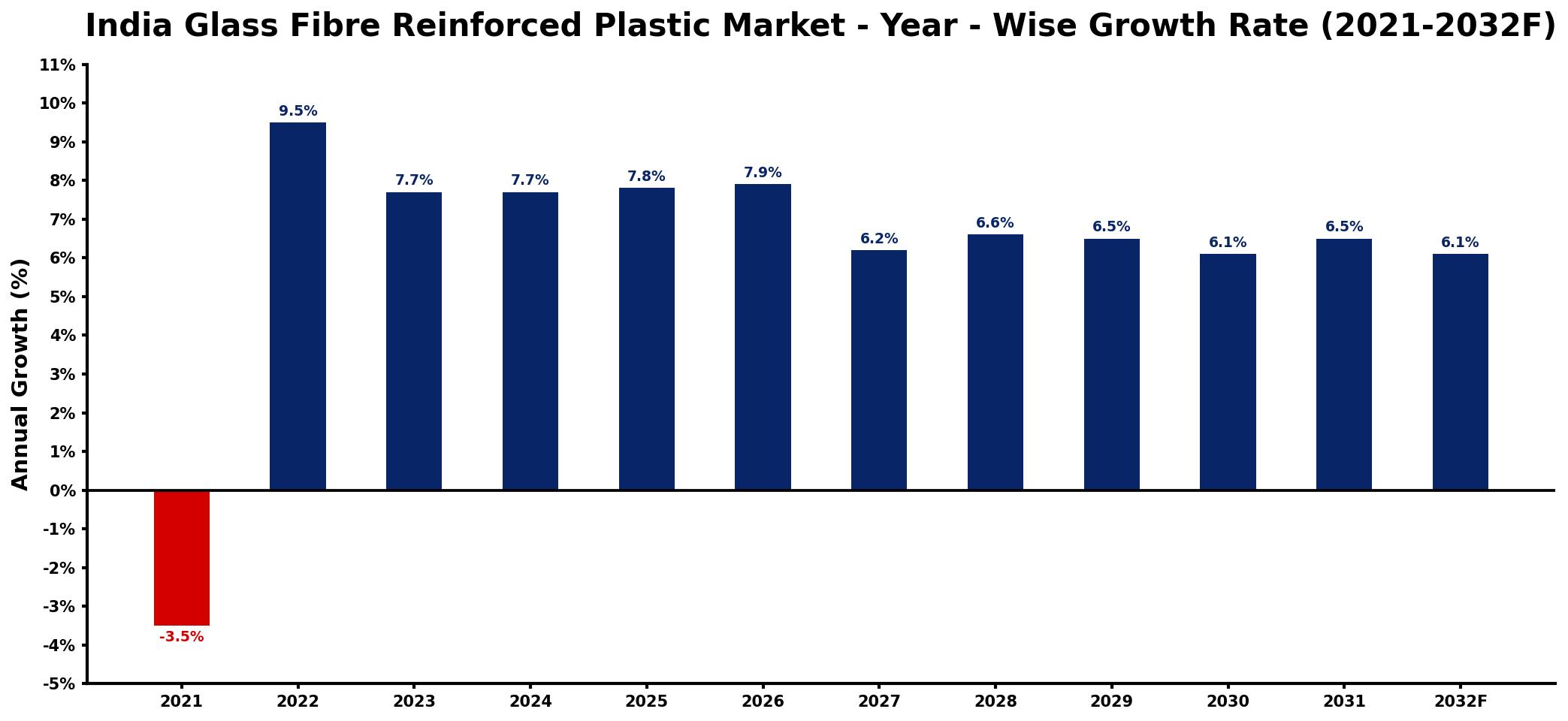
The table below presents the year‑wise growth rates along with the key drivers influencing the market
| Year | Growth Rate | Major Drivers |
| 2021 | -3.5% | Decreased construction activity levels |
| 2022 | 9.5% | Rising demand from automotive sector |
| 2023 | 7.7% | Growth in renewable energy projects |
| 2024 | 7.7% | Increased investments in infrastructure |
| 2025 | 7.8% | Expansion of transportation networks |
| 2026 | 7.9% | Surge in consumer goods production |
| 2027 | 6.2% | Demand from aerospace applications |
| 2028 | 6.6% | improved raw material availability |
| 2029 | 6.5% | Rising popularity of lightweight materials |
| 2030 | 6.1% | Increased focus on sustainability initiatives |
| 2031 | 6.5% | improved processing technologies adoption |
| 2032 | 6.1% | growing automotive sector requirements |
Note: Market size estimations and growth projections presented in this report are based on 6Wresearch's proprietary forecasting methodology, utilizing the latest available industry data, government publications, and primary research inputs.
India Glass Fibre Reinforced Plastic Market Synopsis
The India glass fibre reinforced plastic (GFRP) market is witnessing a transformative period, shifting from post-pandemic recovery to robust growth. As the construction and automotive sectors rebound, the demand for GFRP as a viable alternative to traditional materials like metals continues to gain momentum.
Despite the previous disruptions caused by the pandemic, the future outlook is promising. With ongoing innovations in GFRP production processes and an increase in government infrastructure projects, industry stakeholders are optimistic about capturing emerging opportunities. These trends suggest that the market is not just recovering but is poised for a significant leap forward.
India Glass Fibre Reinforced Plastic Market Key Takeaways
- Strong projected growth driven by demand for lightweight, durable materials across various industries.
- Government initiatives in infrastructure development are set to bolster market opportunities.
- Technological advancements are enhancing GFRP production efficiency and product performance.
- The automotive and aerospace sectors are the primary growth drivers for GFRP applications.
- Increasing sustainability concerns are making GFRP an attractive option due to its low environmental impact.
Evaluation of Restraints in India Glass Fibre Reinforced Plastic Market
The India glass fibre reinforced plastic market faces several restraints that may hinder its growth potential. Chief among these is the challenge related to material sourcing, where ensuring a consistent supply of quality raw materials can be difficult in a rapidly evolving market landscape. Furthermore, adherence to regulatory standards poses an additional challenge, as companies must navigate a complex web of compliance requirements that can vary significantly across regions and applications. These factors can affect both production timelines and overall market stability.
India Glass Fibre Reinforced Plastic Market Trends
Several trends are currently shaping the India GFRP market. Increasing investments in renewable energy, particularly wind energy, have led to greater demand for GFRP in wind turbine blades. Additionally, advancements in manufacturing technologies such as automation and 3D printing are enhancing product development speed and reducing costs, making GFRP solutions even more appealing.
Sustainability is a crucial trend, as businesses and consumers alike become more environmentally conscious. This push towards greener alternatives is driving the adoption of GFRP materials, recognized for their low environmental impact compared to conventional materials.
India Glass Fibre Reinforced Plastic Market Opportunities
The growth of the India GFRP market presents numerous opportunities for investors and businesses alike. The ongoing infrastructural development, bolstered by government initiatives, offers a fertile ground for the introduction of innovative GFRP applications. Sectors such as automotive, aerospace, and even marine construction stand to benefit significantly from the lightweight, corrosion-resistant properties of GFRP. Additionally, the rise of smart manufacturing processes and recycling technologies may open new avenues for GFRP applications, creating an even broader landscape for future growth.
Government Initiatives in the India Glass Fibre Reinforced Plastic Market
The Indian government is increasingly focused on enhancing infrastructure development through various initiatives that directly impact the GFRP market. Programs aimed at promoting sustainable practices and innovations in manufacturing are becoming more prevalent. Initiatives to encourage investments in renewable energy and infrastructure, as well as regulatory frameworks to support the use of advanced materials, are critical in paving the way for the GFRP markets growth. Such public spending creates a conducive environment for the proliferation of GFRP applications across sectors.
Future Insights of the India Glass Fibre Reinforced Plastic Market
Looking ahead to the period from 2026 to 2032, the India GFRP market is poised for substantial growth. As industries adapt to changing market dynamics, the demand for lightweight, durable materials is expected to escalate, particularly in automotive and renewable energy sectors. Innovations in GFRP technology and sustainable production methods will enhance product appeal, while government infrastructure initiatives will serve as a catalyst for broader adoption. The future landscape will likely be defined by increased collaboration between manufacturers and technology providers to maximize efficiency and performance.
India Glass Fibre Reinforced Plastic Market Latest Developments (2025 - 2026)
Recent developments within the India GFRP market indicate a significant focus on sustainability and technological innovation. Industry leaders are increasingly integrating advanced manufacturing techniques to streamline production and improve product quality. Simultaneously, collaborations between companies and research institutions are yielding breakthroughs in GFRP applications, particularly in emerging sectors such as renewable energy. This proactive approach aims to align with evolving market demands and regulatory frameworks.
India Glass Fibre Reinforced Plastic Market - Key Attractiveness of the Report
- 10 Years of Market Numbers
- Historical Data Starting from 2022 to 2025
- Base Year: 2025
- Forecast Data until 2032
- Key Performance Indicators Impacting the Market
- Major Upcoming Developments and Projects
Key Highlights of the Report:
- India Glass Fibre Reinforced Plastic Market Outlook
- Market Size of India Glass Fibre Reinforced Plastic Market, 2025
- Forecast of India Glass Fibre Reinforced Plastic Market, 2032
- Historical Data and Forecast of India Glass Fibre Reinforced Plastic Revenues & Volume for the Period 2022-2032F
- India Glass Fibre Reinforced Plastic Market Trend Evolution
- India Glass Fibre Reinforced Plastic Market Drivers and Challenges
- India Glass Fibre Reinforced Plastic Price Trends
- India Glass Fibre Reinforced Plastic Porter's Five Forces
- India Glass Fibre Reinforced Plastic Industry Life Cycle
- Historical Data and Forecast of India Glass Fibre Reinforced Plastic Market Revenues & Volume By Type for the Period 2022-2032F
- Historical Data and Forecast of India Glass Fibre Reinforced Plastic Market Revenues & Volume By Polyester for the Period 2022-2032F
- Historical Data and Forecast of India Glass Fibre Reinforced Plastic Market Revenues & Volume By Vinyl Ester for the Period 2022-2032F
- Historical Data and Forecast of India Glass Fibre Reinforced Plastic Market Revenues & Volume By Epoxy for the Period 2022-2032F
- Historical Data and Forecast of India Glass Fibre Reinforced Plastic Market Revenues & Volume By Polyurethane for the Period 2022-2032F
- Historical Data and Forecast of India Glass Fibre Reinforced Plastic Market Revenues & Volume By Peek Resin for the Period 2022-2032F
- Historical Data and Forecast of India Glass Fibre Reinforced Plastic Market Revenues & Volume By Others for the Period 2022-2032F
- Historical Data and Forecast of India Glass Fibre Reinforced Plastic Market Revenues & Volume By Application for the Period 2022-2032F
- Historical Data and Forecast of India Glass Fibre Reinforced Plastic Market Revenues & Volume By Wind Energy for the Period 2022-2032F
- Historical Data and Forecast of India Glass Fibre Reinforced Plastic Market Revenues & Volume By Transportation for the Period 2022-2032F
- Historical Data and Forecast of India Glass Fibre Reinforced Plastic Market Revenues & Volume By Marine for the Period 2022-2032F
- Historical Data and Forecast of India Glass Fibre Reinforced Plastic Market Revenues & Volume By Pipe & Tanks for the Period 2022-2032F
- Historical Data and Forecast of India Glass Fibre Reinforced Plastic Market Revenues & Volume By Others for the Period 2022-2032F
- India Glass Fibre Reinforced Plastic Import Export Trade Statistics
- Market Opportunity Assessment By Type
- Market Opportunity Assessment By Application
- India Glass Fibre Reinforced Plastic Top Companies Market Share
- India Glass Fibre Reinforced Plastic Competitive Benchmarking By Technical and Operational Parameters
- India Glass Fibre Reinforced Plastic Company Profiles
- India Glass Fibre Reinforced Plastic Key Strategic Recommendations






































