India Hair Oil Market Top 5 Importing Countries and Market Competition (HHI) Analysis
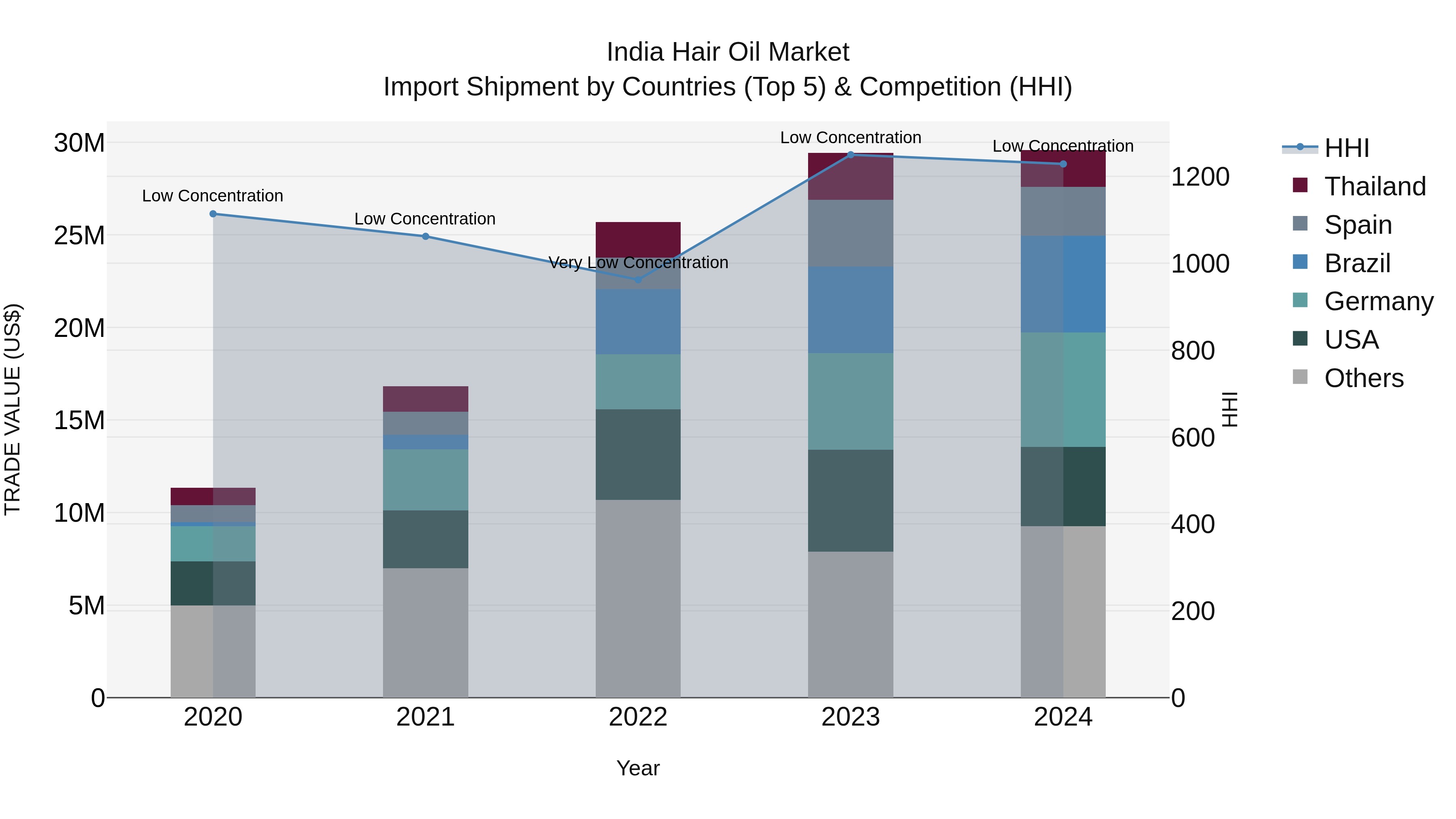
India`s hair oil import market in 2024 saw significant growth with a CAGR of 27.11% from 2020 to 2024. The top exporting countries to India were Germany, Brazil, USA, Spain, and China. Despite the influx of imports, the market remained competitive with a low Herfindahl-Hirschman Index (HHI) concentration. The growth rate from 2023 to 2024 stood at 0.47%, indicating a steady increase in demand for hair oil products in India.
India Hair Oil Market Growth Rate
According to 6Wresearch internal database and industry insights, the India Hair Oil Market is projected to grow at a CAGR of 6.3% during the forecast period from 2026 to 2032.
Topics Covered in the India Hair Oil Market Report
The India Hair Oil Market report covers the market comprehensively by product type and distribution channel. The report provides a detailed and unbiased analysis of the ongoing market trends, opportunities, challenges, and market drivers, assisting stakeholders in aligning strategies with current and future market dynamics.
India Hair Oil Market Highlights
| Report Name | India Hair Oil Market |
| Forecast period | 2026–2032 |
| CAGR | 6.3% |
| Growing Sector | Personal Care |
India Hair Oil Market Synopsis
The India Hair Oil Market is expected to expand strongly in the coming years on account of sustained consumer preference toward natural and herbal hair care solutions. Traditional hair oils such as coconut, almond, and olive oils continue to see high demand due to cultural acceptance and holistic perception for hair nourishment. Other than that, online retail growth and wider availability through supermarkets & convenience stores are major growth enablers.
Evaluation of Growth Drivers in the India Hair Oil Market
Some prominent drivers and their impact on the India Hair Oil Market dynamics:
| Drivers | Primary Segments Affected | Why it matters (evidence) |
| Increasing Disposable Income | By Type (Hair Oils) | Rising disposable income boosts consumer spending on high-quality, premium hair oils. |
| Focus on Hair Health | By Product Type (Hair Oils) | Growing awareness about the importance of hair health results in a higher demand for therapeutic oils. |
| Demand for Natural Products | By Product Type (Hair Oils, Hair Serums) | Consumers are shifting towards herbal and organic hair oils due to concerns about chemicals in traditional hair care products. |
| E-commerce Growth | By Distribution Channel (Online Stores) | E-commerce platforms make hair oils more accessible, which leads to increased distribution and sales. |
| Innovation in Hair Care Products | By Product Type (Hair Oils, Hair Serums) | New product formulations with improved benefits, such as oils for specific hair concerns, are gaining popularity. |
The India Hair Oil Market is expected to grow at a CAGR of 6.3% during the forecast period from 2026–2032. Rising disposable income, a preference for natural and organic hair oils, and the expansion of online shopping channels are expected to continue driving demand. Also, increasing consumer awareness about hair health and wellness is likely to sustain the demand for premium hair oils, especially in urban areas. Along with that, the expanding e-commerce sector in the country makes these products more accessible to a wider audience, especially in rural and remote areas. There is a rising focus on self-care and wellness, as well as, the rising influence of social media and celebrity endorsements, which further increases the demand for high-quality hair oils in the country.
Restraints in the India Hair Oil Market
Below mentioned are some major restraints and their influence on the India Hair Oil Market dynamics:
| Restraints | Primary Segments Affected | What this means (evidence) |
| High Competition from Domestic and International Brands | By Product Type (Hair Oils) | The market faces intense competition from both established domestic and international brands, which may lead to pricing pressure. |
| Changes in Raw Material Prices | By Product Type (Hair Oils) | The prices of natural ingredients like essential oils and herbs fluctuate, raising production costs. |
| Regulatory Limitations on Ingredients | By Product Type (Hair Oils) | There are strict rules around the use of certain herbal ingredients, which may limit innovation and product differentiation. |
| Consumer Price Sensitivity | By Product Type (Hair Oils) | The economic sensitivity of Indian consumers makes them more likely to opt for cheaper alternatives or foreign products. |
| Supply Chain and Distribution Obstacles | By Distribution Channel (Online Stores, Retail Stores) | Supply chain challenges can lead to product shortages, which affect product availability and competition. |
Challenges in the India Hair Oil Market
Here are numerous challenges that could impact the India Hair Oil Market growth. These challenges are high competition from cheaper international brands, price sensitivity among consumers, and regulatory hurdles. Along with that, fluctuations in the raw material price and the complexity of the regulatory environment surrounding ingredients pose challenges for manufacturers. Moreover, as the demand for natural and organic oils rises, sourcing high-quality raw materials sustainably can also prove to be difficult.
Trends Shaping the India Hair Oil Market
Key trends in the Germany Hair Care Market include:
- Natural and Organic Hair Oils: Due to the growing health awareness, consumers are turning towards natural and organic oils, such as coconut, argan, and olive oil, in response to concerns about synthetic chemicals.
- Hair Care for Men: There's an increase in the demand for specialized hair oils for men, particularly in urban centers. Men are becoming more conscious of their grooming routines, looking for products that promote hair strength, health, and growth.
- Ayurvedic and Herbal Hair Oils: Traditional Indian hair oils based on Ayurveda are gaining popularity owing to their perceived health benefits and organic composition. Brands that use Ayurvedic ingredients such as bhringraj, amla, and hibiscus are increasing their market share.
Major Investment Opportunities in the India Hair Oil Market
Below mentioned are some major investment opportunities in the market:
- Sustainable and Eco-Friendly Hair Oils: As consumers prioritize sustainability, there is a significant opportunity to invest in environmentally friendly, biodegradable packaging and sustainable hair oil ingredients.
- Increasing E-commerce and Direct-to-Consumer Sales: E-commerce platform's expansion is rapidly growing and making investment in digital sales channels and e-commerce websites creates an opportunity to reach a more tech-savvy audience.
- Innovative Product Formulations: Investing in the development of novel and effective hair oil formulas that target specific problems such as dandruff, hair thinning, and scalp irritation is a growing opportunity.
Top 5 Leading Players in the India Hair Oil Market
Here are some top companies contributing to the India Hair Oil Market share:
1. Marico Limited
| Company Name | Marico Limited |
| Headquarters | Mumbai, Maharashtra |
| Established Year | 1990 |
| Official Website | Click Here |
Marico is the undisputed leader in the coconut oil segment with its iconic Parachute brand. They hold over 50% volume share in the category and have expanded into the value-added hair oil (VAHO) segment with brands like Hair & Care and Nihar.
2. Dabur India Ltd
| Company Name | Dabur India Ltd |
| Headquarters | Ghaziabad, Uttar Pradesh |
| Established Year | 1884 |
| Official Website | Click Here |
Dabur is a powerhouse in the Ayurvedic and herbal space. Its Dabur Amla Hair Oil is one of the largest hair oil brands globally by volume. The company focuses heavily on traditional ingredients like amla, brahmi, and hibiscus, catering to consumers seeking natural nourishment.
3. Emami Group
| Company Name | Emami Group |
| Headquarters | Kolkata, West Bengal |
| Established Year | 1974 |
| Official Website | Click Here |
Emami specializes in the therapeutic and cooling oil segments. Their flagship brand Navratna dominates the cooling oil market, while Kesh King is a leading player in the medicinal/anti-hair fall category, bridging the gap between FMCG and Ayurveda.
4. Bajaj Consumer Care Ltd
| Company Name | Bajaj Consumer Care Ltd |
| Headquarters | Mumbai, Maharashtra |
| Established Year | 1930 |
| Official Website | Click Here |
Bajaj is the market leader in the light hair oil segment with Bajaj Almond Drops. They have successfully targeted urban consumers who prefer non-sticky, Vitamin E-enriched oils for daily styling and protection rather than heavy traditional treatments.
5. Hindustan Unilever Limited (HUL)
| Company Name | Hindustan Unilever Limited (HUL) |
| Headquarters | Mumbai, Maharashtra |
| Established Year | 1933 |
| Official Website | Click Here |
HUL competes primarily through high-growth niche acquisitions and premium brands. Their portfolio includes Indulekha, a premium Ayurvedic brand known for its "selfie comb" applicator, and Dove Elixir, focusing on the premiumization trend and D2C (Direct-to-Consumer) growth.
Government Regulations in the India Hair Oil Market
According to Indian government data, here are various rules that are set by agencies like the Central Drugs Standard Control Organization (CDSCO) and Food Safety and Standards Authority of India (FSSAI), which ensure the safety and efficacy of hair care products. These rules enforce strict standards on the formulation and labeling of products, especially for natural and Ayurvedic oils. For instance, FSSAI mandates clear labeling of ingredients, expiry dates, and usage instructions. Other than that, certain herbal ingredients used in Ayurvedic oils are controlled under the Drugs and Cosmetics Act, which controls their quality and efficacy.
Future Insights of the India Hair Oil Market
The India Hair Oil Market share is set to increase, which is backed by an increasing consumer shift toward natural, organic, and personalized products, especially among the growing urban middle class. The market is expected to benefit from innovations in product formulations, including solutions tailored to specific concerns like scalp health, hair loss, and dandruff. Furthermore, as sustainability gains importance, eco-friendly packaging and sustainable ingredient sourcing will become key differentiators for brands.
Segmentation Analysis
The report offers a comprehensive study of the following market segments and their leading categories:
By Product Type - Coconut Oil to Lead the Market
According to Ashutosh, Senior Research Analyst at 6Wresearch, Coconut Oil is anticipated to increase the market revenue owing to its longstanding cultural and functional importance in India, where it is traditionally used for hair care.
By Distribution Channel - Online Retail Stores to Lead the Market
Online Retail Stores are expected to lead the distribution channel segment on account of the rising trend of e-commerce shopping in India, which provides consumers with convenient access to a wide range of hair oil brands.
Key Attractiveness of the Report
- 10 Years of Market Numbers.
- Historical Data Starting from 2022 to 2025.
- Base Year: 2025.
- Forecast Data until 2032.
- Key Performance Indicators Impacting the Market.
- Major Upcoming Developments and Projects.
Key Highlights of the Report:
- India Hair Oil Market Outlook
- Market Size of India Hair Oil Market, 2025
- Forecast of India Hair Oil Market, 2032
- Historical Data and Forecast of India Hair Oil Revenues & Volume for the Period 2022 - 2032
- India Hair Oil Market Trend Evolution
- India Hair Oil Market Drivers and Challenges
- India Hair Oil Price Trends
- India Hair Oil Porter's Five Forces
- India Hair Oil Industry Life Cycle
- Historical Data and Forecast of India Hair Oil Market Revenues & Volume By Product Type for the Period 2022 - 2032
- Historical Data and Forecast of India Hair Oil Market Revenues & Volume By Almond Oil for the Period 2022 - 2032
- Historical Data and Forecast of India Hair Oil Market Revenues & Volume By Coconut Oil for the Period 2022 - 2032
- Historical Data and Forecast of India Hair Oil Market Revenues & Volume By Olive Oil for the Period 2022 - 2032
- Historical Data and Forecast of India Hair Oil Market Revenues & Volume By Others for the Period 2022 - 2032
- Historical Data and Forecast of India Hair Oil Market Revenues & Volume By Distribution Channel for the Period 2022 - 2032
- Historical Data and Forecast of India Hair Oil Market Revenues & Volume By Supermarket/Hypermarket for the Period 2022 - 2032
- Historical Data and Forecast of India Hair Oil Market Revenues & Volume By Convenience Store for the Period 2022 - 2032
- Historical Data and Forecast of India Hair Oil Market Revenues & Volume By Online Retail Stores for the Period 2022 - 2032
- Historical Data and Forecast of India Hair Oil Market Revenues & Volume By Others for the Period 2022 - 2032
- India Hair Oil Import Export Trade Statistics
- Market Opportunity Assessment By Product Type
- Market Opportunity Assessment By Distribution Channel
- India Hair Oil Top Companies Market Share
- India Hair Oil Competitive Benchmarking By Technical and Operational Parameters
- India Hair Oil Company Profiles
- India Hair Oil Key Strategic Recommendations






































