India Industrial Humidity Control Market Size & Growth Rate
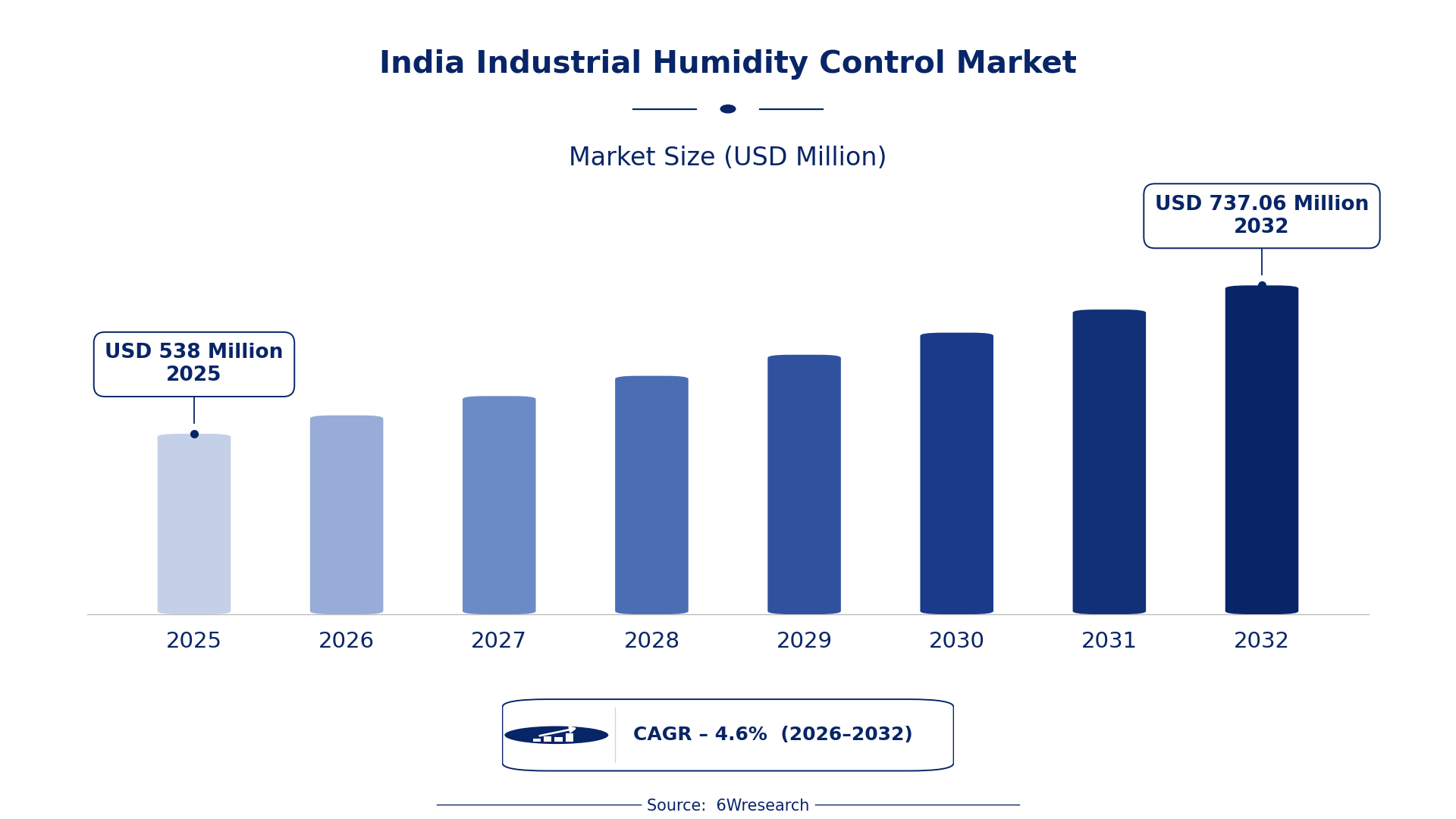
According to 6Wresearch internal database and industry insights, the India Industrial Humidity Control Market was valued at USD 538.0 million in 2025 and is projected to reach USD 737.06 million by 2032, growing at a CAGR of approximately 4.6% during 2026–2032.
India Industrial Humidity Control Market Highlights
| Report Metric | Details |
| Report Name | India Industrial Humidity Control Market |
| Market Size 2025 | USD 538.0 million |
| Market Size 2032 | USD 737.06 million |
| Absolute Growth 2025–2032 | USD 199.06 million |
| CAGR 2026–2032 | 4.6% |
| Peak Annual Growth | 6.3% in 2032 |
| Forecast Period | 2026–2032 |
| Historical Data | 2022–2025 |
| Base Year | 2025 |
| Leading System Type, 2025 | Dehumidifiers (39% share) |
| Leading Control Technology, 2025 | Refrigerant / Desiccant (41% share) |
| Leading Installation Type, 2025 | Central / Console (37% share) |
| Leading End User, 2025 | Electronics Manufacturing (42% share) |
| Fastest-Growing System Type | Hybrid Systems (5.8% CAGR) |
| Fastest-Growing Control Technology | IoT Enabled (7.3% CAGR) |
| Fastest-Growing Installation Type | Portable / Ducted (6.9% CAGR) |
| Fastest-Growing End User | Data Centers (6.4% CAGR) |
| Growing Sector | Pharmaceutical Plants |
| Key End Users | Electronics Manufacturers, Pharmaceutical Companies, Data Center Operators, Cleanroom Facilities |
India Industrial Humidity Control Market Year-wise Growth Rate and Key Drivers (2022–2032)
This graph illustrates the annual growth rates of the market from 2022 to 2032, highlighting a steady upward trajectory and projected market expansion over the forecast period.
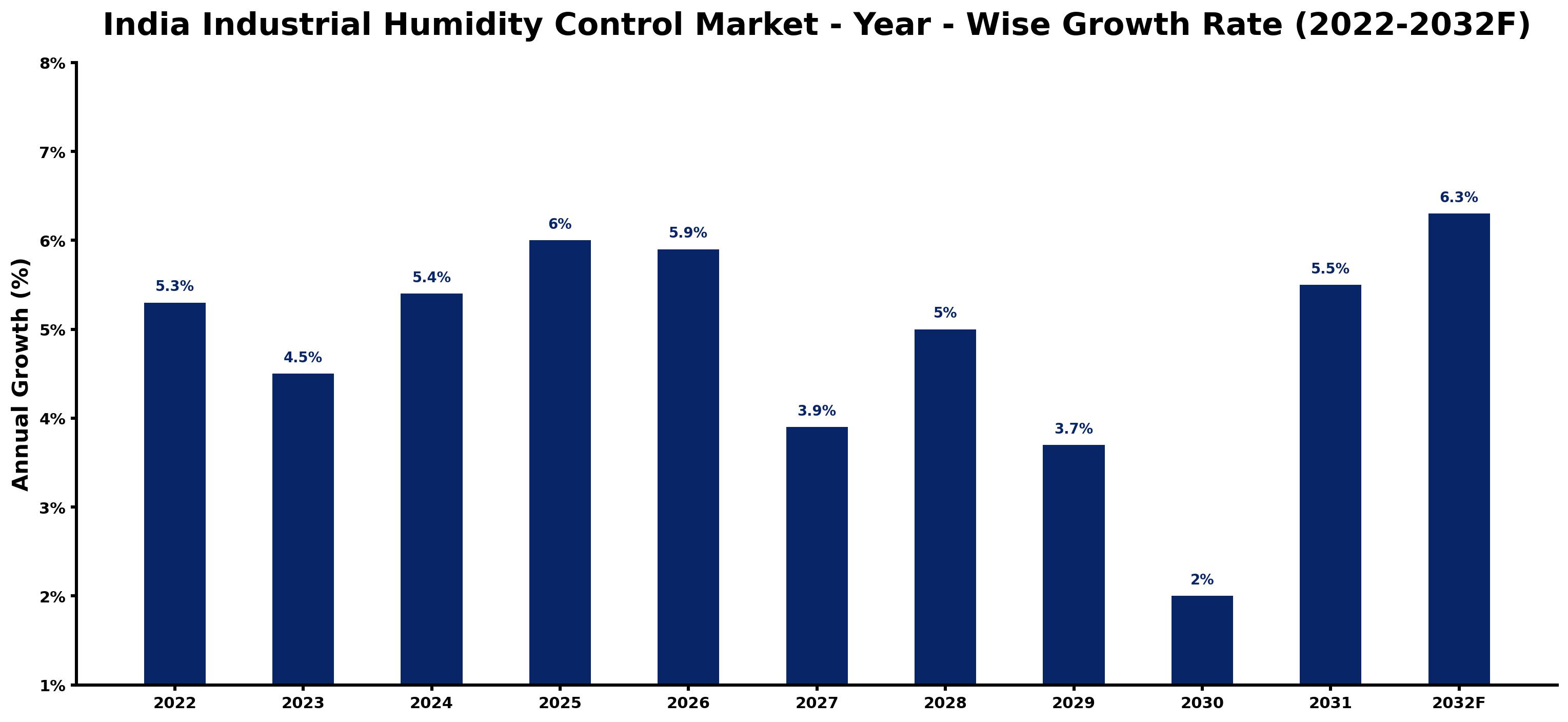
Year by year, the estimates below pair each growth rate with the development that shaped it.
| Year | Estimated Annual Growth (%) | Market Rationale |
| 2022 | 5.3 | The market experienced steady growth due to increasing demand from the electronics manufacturing sector. |
| 2023 | 4.5 | The industry adjusted to new humidity control standards set by the Bureau of Indian Standards, slowing growth. |
| 2024 | 5.4 | A rise in pharmaceutical manufacturing boosted humidity control needs, reflecting the sector's expansion. |
| 2025 | 6.0 | Data centers increased their humidity control investments for optimal performance, leading to peak growth. |
| 2026 | 5.9 | Demand is expected to slow due to market saturation in certain industrial applications requiring humidity control. |
| 2027 | 3.9 | A further slowdown is projected as competition intensifies among suppliers of humidity control systems. |
| 2028 | 5.0 | Demand is expected to pick up as the electronics sector seeks advanced humidity control solutions for production. |
| 2029 | 3.7 | The market is projected to face another slowdown as buyers become more price-sensitive amid economic fluctuations. |
| 2030 | 2.0 | Growth is expected to slow as the focus shifts towards cost-effective humidity management technologies. |
| 2031 | 5.5 | New investments in data centers will revitalise the need for humidity control systems, driving demand. |
| 2032 | 6.3 | The pharmaceutical sector's expansion will drive increased humidity control investments, leading to market growth. |
Note: Market size estimations and growth projections presented in this report are based on 6Wresearch's proprietary forecasting methodology, utilizing the latest available industry data, government publications, and primary research inputs.
India Industrial Humidity Control Market Synopsis
Industrial Humidity Control in India encompasses systems designed to manage moisture levels in industrial environments, primarily through dehumidifiers and humidifiers. These systems are essential for maintaining optimal conditions in sectors such as electronics manufacturing and pharmaceuticals. The India Industrial Humidity Control Market is growing due to rising demand from the pharmaceutical industry, projected to reach $65 billion by 2024, and the increasing need for humidity control in data centers. Government initiatives, such as the 'Pharma Vision 2024', further drive the focus on effective humidity management, leading to increased purchases across various sectors.
Market Dynamics Impact Analysis (2026–2032)
| Factor | Type | Impact | Primary Segment Affected |
| Rising demand from the electronics manufacturing sector | Driver | High | Electronics Manufacturing |
| Increased investments in data centers for optimal performance | Driver | High | Data Centers |
| Growing need for compliance in pharmaceutical manufacturing | Opportunity | High | Pharmaceutical Plants |
| Expansion of cleanroom operations in various industries | Opportunity | Medium | Cleanroom Operations |
| High initial investment costs for advanced systems | Restraint | High | Dehumidifiers |
| Limited awareness of humidity control technologies among smaller manufacturers | Restraint | Medium | Humidifiers |
| Competition from low-cost alternatives in the market | Challenge | High | Hybrid Systems |
| Technological advancements requiring continuous upgrades | Challenge | Medium | Sensor-Driven Controllers |
Evaluation of Drivers in India Industrial Humidity Control Market (2026–2032)
The table below links each growth driver to the segment it affects and the evidence for it.
| Drivers | Primary Segment Affected | Why It Matters (Evidence) |
| Increased production capacities in electronics manufacturing | Electronics Manufacturing | The electronics sector is projected to expand, increasing demand for humidity control systems to maintain product integrity. |
| Growing data center infrastructure investments | Data Centers | In 2022, a $1 billion plan was approved to improve data center infrastructure, driving humidity control needs. |
| Expansion of the pharmaceutical industry | Pharmaceutical Plants | The pharmaceutical industry in India is expected to reach $65 billion by 2024, necessitating strict humidity control. |
| Implementation of cleanroom standards | Cleanroom Operations | ISO 14644-1 outlines cleanroom standards, requiring stringent humidity control measures for compliance. |
| Rising awareness of environmental controls in manufacturing | Integrated HVAC | The 'Make in India' initiative encourages local manufacturers to adopt efficient humidity management systems. |
Market growth in India for Industrial Humidity Control rests on rising end-use demand from sectors like electronics manufacturing and pharmaceuticals. The electronics sector is projected to expand, increasing the need for humidity control systems to maintain product integrity. In 2022, a $1 billion plan was approved to improve data center infrastructure, further driving humidity control needs. The pharmaceutical industry is expected to reach $65 billion by 2024, necessitating strict humidity control measures. Implementation of cleanroom standards requires stringent humidity control for compliance, pushing manufacturers to invest in advanced systems.
Evaluation of Restraints in India Industrial Humidity Control Market
The key brakes on demand, and where they bite hardest, are shown below.
| Market Restraint | Primary Segment Affected | Why It Matters (Evidence) |
| High initial investment costs for advanced humidity control systems | Dehumidifiers | The high costs deter smaller manufacturers from investing in necessary humidity control technologies. |
| Limited awareness of humidity control technologies among smaller manufacturers | Humidifiers | Many smaller manufacturers lack knowledge about the benefits of humidity control, hindering market growth. |
| Competition from low-cost alternatives in the market | Hybrid Systems | Budget-conscious buyers are attracted to low-cost alternatives, impacting the sales of advanced systems. |
| Technological advancements requiring continuous upgrades | Sensor-Driven Controllers | Manufacturers face challenges in keeping up with rapid technological changes, causing potential delays. |
| Regulatory compliance costs for humidity control systems | Integrated HVAC | Meeting compliance with standards increases operational costs for manufacturers, affecting profitability. |
India Industrial Humidity Control Market Challenges
The India Industrial Humidity Control Market still has to solve a few problems, and the first is technology limitations. Many producers depend on outdated systems that fail to meet the rigorous standards of the pharmaceutical industry, risking compliance and product quality. Buyers face potential losses of up to 20% in product yield due to inefficient moisture management. Importers experience delays in acquiring advanced humidity control technologies, which can extend project timelines by several months. Competition intensifies as local manufacturers, driven by initiatives like 'Make in India', increase their market presence, compelling existing players to innovate rapidly.
Trends in the India Industrial Humidity Control Market
Several trends are reshaping the India Industrial Humidity Control Market; the most important are set out below.
- Shift from Traditional to Smart Humidity Control Systems: Since 2023, the adoption of IoT-enabled humidity control systems has surged, enabling real-time monitoring and management. This shift is particularly noticeable in data centres, which require precise humidity levels for optimal performance, with 45-55% humidity being the ideal range.
- Transition from Manual to Automated Control Systems: Electronics manufacturers are increasingly embracing automated humidity control systems to boost efficiency. The Electronics Sector Skills Council of India supports training for these technologies, highlighting a growing trend towards automation in manufacturing processes.
- Emergence of Hybrid Systems in Specific Applications: Hybrid systems are gaining popularity in niche applications, especially in pharmaceuticals where precise humidity control is essential. This trend aligns with the pharmaceutical industry's expected growth to $65 billion by 2024, driving demand for advanced solutions.
- Prioritisation of Environmental Controls in Manufacturing: The 'Make in India' initiative has resulted in a heightened focus on environmental controls, including humidity management. With the Indian government investing $1 billion in data centre infrastructure, the demand for efficient humidity control systems is anticipated to increase.
Investment Opportunities in the India Industrial Humidity Control Market
The following opportunities in the India Industrial Humidity Control Market pair current demand with a clear way in.
- Partner with Local Manufacturers for Humidity Control Solutions: Local manufacturers in Maharashtra require advanced humidity control systems to meet new standards. With the electronics sector projected to grow, there is an opportunity to supply these systems.
- Invest in Training Programs for Humidity Control Technologies: The Electronics Sector Skills Council of India promotes training for humidity control technologies. With the industry's growth, investing in training can bridge the skills gap and boost system adoption.
- Capitalize on the Growing Pharmaceutical Sector: The pharmaceutical industry, expected to reach $65 billion by 2024, presents a promising opportunity for humidity control suppliers. Engaging with pharmaceutical plants can lead to substantial contracts for advanced systems.
- Focus on Data Center Infrastructure Development: With a $1 billion investment in data centre infrastructure, there is a pressing need for effective humidity control solutions. Suppliers should explore partnerships with data centre operators to address this demand.
Government Initiatives in the India Industrial Humidity Control Market
The Ministry of Electronics and Information Technology launched the 'Electronics Manufacturing Policy' in 2021, promoting humidity control technologies with a budget of $1 billion. This policy aims to improve the manufacturing capabilities of the electronics sector, ensuring compliance with humidity control standards. In 2022, the Bureau of Indian Standards updated the IS 14787:2000 standard, establishing specific humidity control requirements for pharmaceutical manufacturing. This update mandates that manufacturers adhere to strict guidelines to maintain product quality and safety. Additionally, the National Clean Air Programme, initiated in 2020, emphasises the importance of humidity control in reducing industrial emissions, indirectly benefiting manufacturers.
The Bureau of Indian Standards plays a critical role in regulating humidity control measures in industrial applications. It approves standards that manufacturers must comply with, ensuring product quality and safety. The 'Pharmaceutical Technology Upgradation Programme', launched in 2023 by the Department of Pharmaceuticals, supports manufacturers in implementing advanced humidity control systems. This programme provides funding and resources to improve production processes. Furthermore, the Ministry of Environment, Forest and Climate Change introduced guidelines for humidity control in data centers as part of the 'Digital India' initiative in 2022, facilitating better environmental management.
Future Insight of the India Industrial Humidity Control Market
The India Industrial Humidity Control Market will experience notable changes by 2032, primarily due to advancements in technology and updated regulatory standards. The 'Pharma Vision 2024' initiative will improve moisture management systems in pharmaceutical manufacturing, while the National Policy on Electronics will highlight the importance of effective environmental controls. By 2024, a $1 billion investment will enhance data centre infrastructure, creating a demand for superior humidity solutions. Training programmes from the Electronics Sector Skills Council will equip professionals to implement these advanced systems effectively.
Market Segmentation Analysis
The analysis below covers each segmentation, its leading category in 2025 and its fastest-growing category through 2032.
By System Type – Dehumidifiers Dominated, Hybrid Systems Expected to Grow Fastest
According to Sachin Kumar Rai, Senior Research Analyst at 6Wresearch, Dehumidifiers held a 39% share of the India Industrial Humidity Control Market by system type in 2025. Dehumidifiers hold the largest share in the India Industrial Humidity Control Market due to their essential role in moisture reduction, particularly in electronics manufacturing. Their widespread application in the pharmaceutical sector further underscores their importance in maintaining product quality and operational efficiency. Over 2026–2032, Hybrid Systems are expected to post the fastest growth, at a CAGR of 5.8%. Hybrid Systems are experiencing rapid growth as they meet specific moisture control needs, with initiatives like 'Make in India' promoting local manufacturing. This trend is likely to continue as industries increasingly seek efficient humidity management solutions. Suppliers should prioritise the development of hybrid systems to capture the expanding market share.
By Control Technology – Refrigerant / Desiccant Dominated, IoT Enabled Expected to Grow Fastest
Refrigerant / Desiccant accounted for a 41% market share by control technology in 2025. Refrigerant / Desiccant technology leads the market due to its prevalent use in dehumidification systems, providing reliable moisture control vital for sectors like electronics manufacturing. Compliance with guidelines from the Bureau of Indian Standards reinforces its strong market position. The quickest growth will come from IoT Enabled, forecast to expand at a CAGR of 7.3% between 2026 and 2032. IoT Enabled control technology is growing quickly, driven by the rising demand for smart monitoring solutions in industrial environments. This trend aligns with the National Policy on Electronics, highlighting the need for advanced environmental controls. Buyers should invest in IoT Enabled solutions to improve operational efficiency and meet industry standards.
By Installation Type – Central / Console Dominated, Portable / Ducted Expected to Grow Fastest
The largest installation type category in 2025 was Central / Console, with a 37% share of total revenue. Central / Console installations dominate the market as they are crucial for larger facilities that require comprehensive humidity control solutions. Their effectiveness in managing moisture in extensive manufacturing environments makes them the preferred choice among industrial users. Portable / Ducted is projected to grow fastest, at a CAGR of 6.9% during 2026–2032. Portable / Ducted systems are seeing the fastest growth due to their flexibility and adaptability in various settings, catering to smaller operations and temporary installations. This growth is driven by the increasing demand for efficient humidity management across diverse industrial applications. Suppliers should expand their range of portable solutions to meet the rising demand for flexible installation options.
By End User – Electronics Manufacturing Dominated, Data Centers Expected to Grow Fastest
Electronics Manufacturing took a 42% share of end user in 2025, more than any other category. Electronics Manufacturing commands the largest market share, as humidity control is vital for maintaining product integrity and operational efficiency in this sector. The concentration of electronics manufacturing facilities in regions like Maharashtra reinforces this segment's dominance. Data Centers are set to record the highest CAGR in this split, 6.4% over 2026–2032. Data Centers represent the fastest-growing end user segment, propelled by the necessity for optimal humidity levels to ensure equipment reliability and performance. Government investments in data center infrastructure further highlight the critical role of effective humidity control in this area. Suppliers must tailor their solutions to meet the specific humidity control needs of data centers to capitalise on this growth opportunity.
Key Attractiveness of the Report
- 10 Years of Market Numbers
- Historical Data Starting from 2022 to 2025
- Base Year 2025
- Forecast Data until 2032
- Key Performance Indicators Impacting the Market
- Major Upcoming Developments and Projects
Key Highlights of the Report:
- India Industrial Humidity Control Market Outlook
- Market Size of India Industrial Humidity Control Market, 2025
- Forecast of India Industrial Humidity Control Market, 2032
- Historical Data and Forecast of India Industrial Humidity Control Revenues & Volume for the Period 2022 - 2032F
- India Industrial Humidity Control Market Trend Evolution
- India Industrial Humidity Control Market Drivers and Challenges
- India Industrial Humidity Control Price Trends
- India Industrial Humidity Control Porter's Five Forces
- India Industrial Humidity Control Industry Life Cycle
- Historical Data and Forecast of India Industrial Humidity Control Market Revenues & Volume By System Type for the Period 2022 - 2032F
- Historical Data and Forecast of India Industrial Humidity Control Market Revenues & Volume By Dehumidifiers for the Period 2022 - 2032F
- Historical Data and Forecast of India Industrial Humidity Control Market Revenues & Volume By Humidifiers for the Period 2022 - 2032F
- Historical Data and Forecast of India Industrial Humidity Control Market Revenues & Volume By Hybrid Systems for the Period 2022 - 2032F
- Historical Data and Forecast of India Industrial Humidity Control Market Revenues & Volume By Sensor-Driven Controllers for the Period 2022 - 2032F
- Historical Data and Forecast of India Industrial Humidity Control Market Revenues & Volume By Control Technology for the Period 2022 - 2032F
- Historical Data and Forecast of India Industrial Humidity Control Market Revenues & Volume By Refrigerant / Desiccant for the Period 2022 - 2032F
- Historical Data and Forecast of India Industrial Humidity Control Market Revenues & Volume By Ultrasonic / Steam-Based for the Period 2022 - 2032F
- Historical Data and Forecast of India Industrial Humidity Control Market Revenues & Volume By Integrated HVAC for the Period 2022 - 2032F
- Historical Data and Forecast of India Industrial Humidity Control Market Revenues & Volume By IoT Enabled for the Period 2022 - 2032F
- Historical Data and Forecast of India Industrial Humidity Control Market Revenues & Volume By Installation Type for the Period 2022 - 2032F
- Historical Data and Forecast of India Industrial Humidity Control Market Revenues & Volume By Portable / Ducted for the Period 2022 - 2032F
- Historical Data and Forecast of India Industrial Humidity Control Market Revenues & Volume By Central / Console for the Period 2022 - 2032F
- Historical Data and Forecast of India Industrial Humidity Control Market Revenues & Volume By In-Line for the Period 2022 - 2032F
- Historical Data and Forecast of India Industrial Humidity Control Market Revenues & Volume By Wall-Mount / Modular for the Period 2022 - 2032F
- Historical Data and Forecast of India Industrial Humidity Control Market Revenues & Volume By End User for the Period 2022 - 2032F
- Historical Data and Forecast of India Industrial Humidity Control Market Revenues & Volume By Electronics Manufacturing for the Period 2022 - 2032F
- Historical Data and Forecast of India Industrial Humidity Control Market Revenues & Volume By Data Centers for the Period 2022 - 2032F
- Historical Data and Forecast of India Industrial Humidity Control Market Revenues & Volume By Pharmaceutical Plants for the Period 2022 - 2032F
- Historical Data and Forecast of India Industrial Humidity Control Market Revenues & Volume By Cleanroom Operations for the Period 2022 - 2032F
- India Industrial Humidity Control Import Export Trade Statistics
- Market Opportunity Assessment By System Type
- Market Opportunity Assessment By Control Technology
- Market Opportunity Assessment By Installation Type
- Market Opportunity Assessment By End User
- India Industrial Humidity Control Top Companies Market Share
- India Industrial Humidity Control Competitive Benchmarking By Technical and Operational Parameters
- India Industrial Humidity Control Company Profiles
- India Industrial Humidity Control Key Strategic Recommendations
Market Covered
Segments analysed in this report are listed below.
By System Type
- Dehumidifiers
- Humidifiers
- Hybrid Systems
- Sensor-Driven Controllers
By Control Technology
- Refrigerant / Desiccant
- Ultrasonic / Steam-Based
- Integrated HVAC
- IoT Enabled
By Installation Type
- Portable / Ducted
- Central / Console
- In-Line
- Wall-Mount / Modular
By End User
- Electronics Manufacturing
- Data Centers
- Pharmaceutical Plants
- Cleanroom Operations































