India Organic Shampoo Market Top 5 Importing Countries and Market Competition (HHI) Analysis
India`s organic shampoo import market saw significant growth in 2024, with key exporting countries being Germany, Brazil, USA, Spain, and China. Despite the increase in imports, the market concentration, as measured by the Herfindahl-Hirschman Index (HHI), remained low. The compound annual growth rate (CAGR) from 2020 to 2024 was an impressive 27.11%, indicating a strong upward trend in demand for organic shampoo products. The marginal growth rate from 2023 to 2024 was 0.47%, pointing towards a steady expansion in the market. This data suggests a promising outlook for the organic shampoo import market in India.
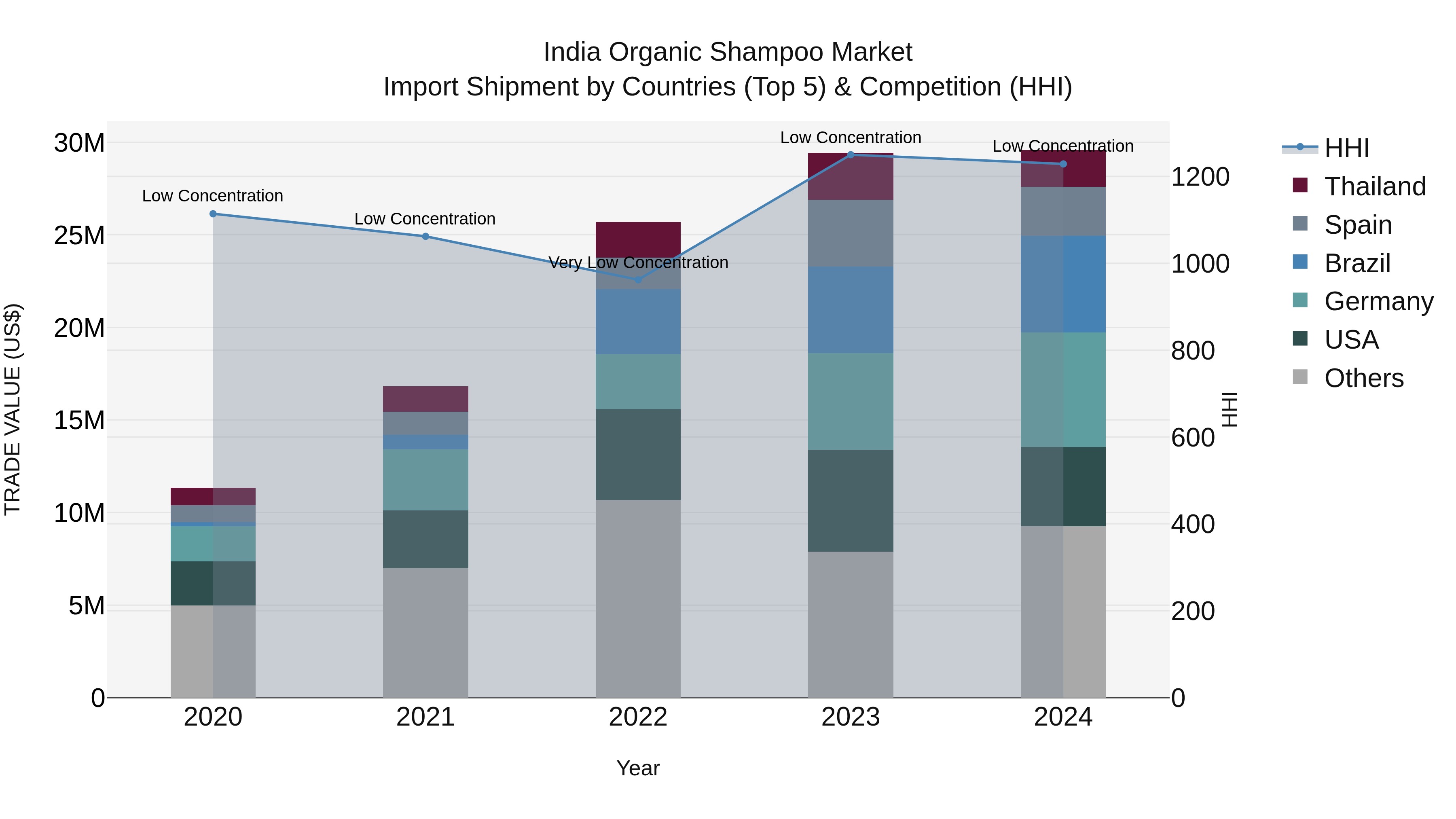
India Organic Shampoo Market Overview
The India Organic Shampoo Market has been experiencing steady growth in recent years due to increasing consumer awareness about the benefits of organic products and shifting preferences towards natural and chemical-free hair care solutions. Factors such as rising disposable income, a growing trend towards sustainability, and concerns about the environment have also contributed to the market expansion. Key players in the market are focusing on product innovation, incorporating organic and natural ingredients, and adopting eco-friendly packaging to attract environmentally-conscious consumers. With a rising demand for safer and healthier hair care options, the India Organic Shampoo Market is expected to continue its growth trajectory in the coming years, presenting opportunities for both existing and new entrants in the market.
India Organic Shampoo Market Trends and Opportunities
The India Organic Shampoo Market is experiencing a significant growth trend driven by increasing consumer awareness about the benefits of natural and organic ingredients. Consumers are becoming more conscious of the potential harmful effects of chemical-laden products and are seeking safer and sustainable alternatives. Key opportunities in the market include the rising demand for eco-friendly and cruelty-free products, the growing popularity of Ayurvedic and herbal formulations, and the expanding distribution channels through e-commerce platforms. Brands that focus on transparency in sourcing, environmentally friendly packaging, and innovative product formulations are likely to thrive in this market. Overall, the India Organic Shampoo Market presents a promising landscape for companies to capitalize on the shifting consumer preferences towards clean beauty products.
India Organic Shampoo Market Challenges
In the India Organic Shampoo Market, there are several challenges that companies face. These include the relatively low consumer awareness and understanding of organic products compared to conventional ones, leading to a smaller target market. Additionally, the higher cost of producing organic shampoos due to the use of natural ingredients and sustainable practices can result in pricing challenges and limited scalability. Distribution and availability can also be problematic, as organic shampoos may not be as widely accessible in rural areas or smaller towns. Furthermore, the presence of counterfeit or falsely labeled products in the market can undermine consumer trust and hinder the growth of authentic organic shampoo brands. Overall, navigating these challenges requires strategic marketing efforts, education initiatives, and a commitment to quality and transparency in order to succeed in the competitive India Organic Shampoo Market.
India Organic Shampoo Market Drivers
The India Organic Shampoo Market is being driven by several key factors, including increasing consumer awareness and preference for natural and chemical-free products, rising concerns about the harmful effects of synthetic chemicals on hair and scalp health, and growing demand for sustainable and eco-friendly personal care products. Additionally, the shift towards organic and herbal ingredients in hair care products, coupled with the influence of social media and beauty influencers promoting organic shampoos, is further fueling market growth. The emphasis on product quality, transparency in ingredients, and the overall trend towards wellness and clean beauty are also significant drivers shaping the India Organic Shampoo Market landscape.
India Organic Shampoo Market Government Policies
The Indian government has implemented various policies to promote the use and production of organic shampoos in the country. The National Programme for Organic Production (NPOP) regulates the certification of organic products, including shampoos, ensuring they meet the required standards. Additionally, the Ministry of Micro, Small, and Medium Enterprises (MSME) provides support and incentives to small-scale organic shampoo producers through schemes like the Credit Guarantee Fund Trust for Micro and Small Enterprises (CGTMSE). The government`s emphasis on sustainable agriculture and environmentally friendly practices has led to increased awareness and demand for organic shampoos, driving growth in the market. Overall, these policies aim to boost the organic shampoo market in India by promoting quality standards, supporting small businesses, and encouraging consumer adoption of organic products.
India Organic Shampoo Market Future Outlook
The future outlook for the India Organic Shampoo Market appears promising, with increasing consumer awareness and demand for natural and chemical-free hair care products. Factors such as growing health and environmental concerns, along with rising disposable income levels, are driving the adoption of organic shampoos in the country. The market is expected to witness steady growth as more players enter the segment and existing brands expand their organic product offerings. Innovative product formulations, attractive packaging, and aggressive marketing strategies are likely to further boost market growth. Additionally, the government`s focus on promoting organic farming practices and sustainability could create a conducive environment for the organic shampoo market to flourish in India.
Key Highlights of the Report:
- India Organic Shampoo Market Outlook
- Market Size of India Organic Shampoo Market, 2024
- Forecast of India Organic Shampoo Market, 2031
- Historical Data and Forecast of India Organic Shampoo Revenues & Volume for the Period 2021- 2031
- India Organic Shampoo Market Trend Evolution
- India Organic Shampoo Market Drivers and Challenges
- India Organic Shampoo Price Trends
- India Organic Shampoo Porter's Five Forces
- India Organic Shampoo Industry Life Cycle
- Historical Data and Forecast of India Organic Shampoo Market Revenues & Volume By Distribution Channel for the Period 2021- 2031
- Historical Data and Forecast of India Organic Shampoo Market Revenues & Volume By Supermarkets/hypermarkets for the Period 2021- 2031
- Historical Data and Forecast of India Organic Shampoo Market Revenues & Volume By Specialty stores for the Period 2021- 2031
- Historical Data and Forecast of India Organic Shampoo Market Revenues & Volume By Online for the Period 2021- 2031
- India Organic Shampoo Import Export Trade Statistics
- Market Opportunity Assessment By Distribution Channel
- India Organic Shampoo Top Companies Market Share
- India Organic Shampoo Competitive Benchmarking By Technical and Operational Parameters
- India Organic Shampoo Company Profiles
- India Organic Shampoo Key Strategic Recommendations






































