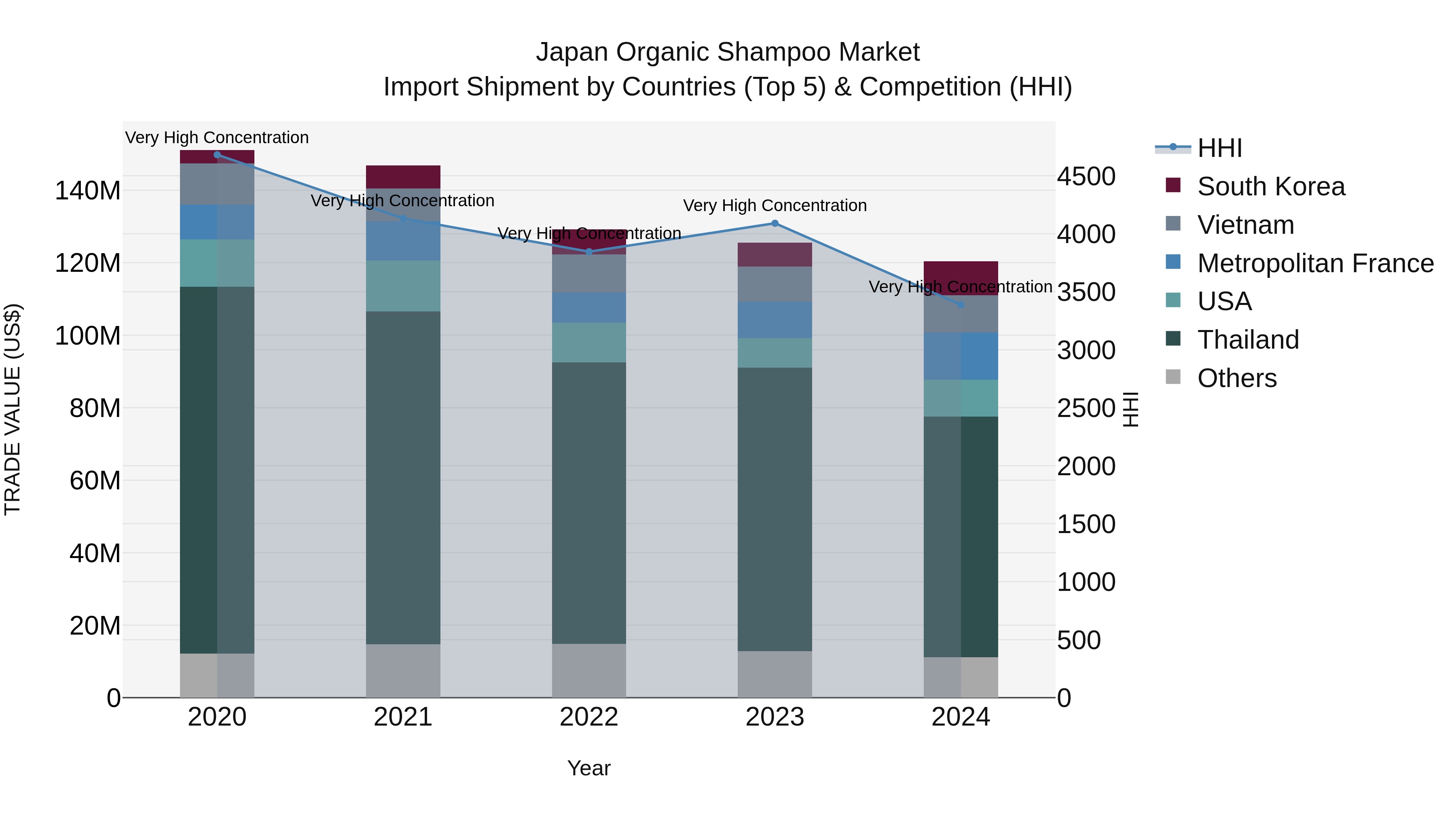
Japan Organic Shampoo Market Import Shipment by Countries (Top 5) & Competition (HHI)
Despite the declining CAGR from 2020 to 2024 and a negative growth rate in 2023-24, Japan continues to import significant quantities of organic shampoo. The top exporters to Japan in 2024 include Thailand, Metropolitan France, Vietnam, USA, and South Korea. The high Herfindahl-Hirschman Index (HHI) indicates a concentrated market, suggesting that these top exporting countries hold a significant share in Japan's organic shampoo import market. It will be interesting to monitor how these trends evolve in the coming years and if any new players enter the market to diversify the supply chain.
Japan Organic Shampoo Market Overview
The Japan Organic Shampoo Market is experiencing steady growth driven by increasing consumer awareness of the benefits of organic products and a growing preference for natural ingredients. With concerns about harmful chemicals in traditional shampoos, consumers are increasingly seeking safer and environmentally friendly alternatives. Key players in the market are focusing on innovative formulations using organic ingredients such as plant extracts, essential oils, and herbs to cater to this demand. The market also benefits from the Japanese culture`s emphasis on health and wellness, further driving the adoption of organic hair care products. As consumers prioritize sustainability and eco-conscious choices, the Japan Organic Shampoo Market is poised for continued expansion, with opportunities for new entrants and product diversification.
Japan Organic Shampoo Market Trends and Opportunities
The Japan Organic Shampoo Market is experiencing a surge in demand due to increasing consumer awareness about the benefits of using natural and organic products. Key trends in the market include a growing preference for plant-based ingredients, sustainable packaging, and cruelty-free formulations. Opportunities lie in the development of innovative products to cater to specific hair care needs, such as anti-aging, color protection, and scalp health. With the rising popularity of clean beauty trends, there is a potential for market expansion through online sales channels and collaborations with beauty influencers to reach a wider audience. Overall, the Japan Organic Shampoo Market is poised for growth driven by consumer preferences for eco-friendly, non-toxic hair care solutions.
Japan Organic Shampoo Market Challenges
In the Japan Organic Shampoo Market, some key challenges include consumer perception and awareness. While there is a growing interest in organic and natural products in Japan, the concept of organic hair care may still be relatively new to some consumers. This lack of awareness can hinder the adoption of organic shampoos, as consumers may be skeptical about their efficacy compared to traditional products. Additionally, the premium pricing of organic shampoos can be a barrier for price-sensitive consumers in a market where cost-effectiveness is highly valued. Furthermore, competition from well-established mainstream shampoo brands poses a challenge for organic shampoo manufacturers to differentiate their products and gain market share. Overall, educating consumers about the benefits of organic shampoos, addressing pricing concerns, and effectively positioning products in a competitive market are key challenges in the Japan Organic Shampoo Market.
Japan Organic Shampoo Market Drivers
The Japan Organic Shampoo Market is being driven by several key factors, including increasing consumer awareness and concern about the potential harmful effects of chemicals in traditional hair care products. Consumers are becoming more health-conscious and eco-friendly, leading to a growing demand for organic and natural hair care products. The trend towards sustainable living and ethical consumption is also influencing purchasing decisions, with many consumers opting for organic shampoos that are free of harmful ingredients and are produced using environmentally friendly practices. Additionally, the availability of a wide range of organic shampoo products in the market, along with effective marketing and promotional strategies by manufacturers, is further fueling the growth of the organic shampoo market in Japan.
Japan Organic Shampoo Market Government Policies
The Japanese government has been promoting the organic shampoo market through various policies to ensure consumer safety and environmental sustainability. The Ministry of Agriculture, Forestry and Fisheries (MAFF) provides certification and labeling standards for organic products, including shampoos, under the Japanese Agricultural Standards (JAS). Additionally, the Ministry of Health, Labour and Welfare (MHLW) enforces regulations on the ingredients used in cosmetics, including shampoos, to protect consumers from harmful substances. The government also supports research and development efforts in the organic shampoo sector through grants and subsidies, encouraging innovation and product quality. Overall, these policies aim to boost consumer confidence in organic shampoos, promote sustainable practices in the beauty industry, and contribute to the growth of the organic shampoo market in Japan.
Japan Organic Shampoo Market Future Outlook
The Japan Organic Shampoo Market is expected to experience steady growth in the coming years, driven by increasing consumer awareness of the benefits of organic personal care products. Factors such as rising disposable income, growing concerns about the environment and health, and a shift towards natural ingredients are likely to fuel the demand for organic shampoos in Japan. Additionally, the trend towards clean beauty and sustainability is expected to further drive market growth. Key players in the industry are anticipated to focus on product innovation, expanding distribution channels, and marketing strategies to capitalize on the growing demand for organic shampoos in Japan. Overall, the market is poised for expansion and is likely to present opportunities for both existing and new entrants in the organic hair care segment.
Key Highlights of the Report:
- Japan Organic Shampoo Market Outlook
- Market Size of Japan Organic Shampoo Market, 2024
- Forecast of Japan Organic Shampoo Market, 2031
- Historical Data and Forecast of Japan Organic Shampoo Revenues & Volume for the Period 2021- 2031
- Japan Organic Shampoo Market Trend Evolution
- Japan Organic Shampoo Market Drivers and Challenges
- Japan Organic Shampoo Price Trends
- Japan Organic Shampoo Porter's Five Forces
- Japan Organic Shampoo Industry Life Cycle
- Historical Data and Forecast of Japan Organic Shampoo Market Revenues & Volume By Distribution Channel for the Period 2021- 2031
- Historical Data and Forecast of Japan Organic Shampoo Market Revenues & Volume By Supermarkets/hypermarkets for the Period 2021- 2031
- Historical Data and Forecast of Japan Organic Shampoo Market Revenues & Volume By Specialty stores for the Period 2021- 2031
- Historical Data and Forecast of Japan Organic Shampoo Market Revenues & Volume By Online for the Period 2021- 2031
- Japan Organic Shampoo Import Export Trade Statistics
- Market Opportunity Assessment By Distribution Channel
- Japan Organic Shampoo Top Companies Market Share
- Japan Organic Shampoo Competitive Benchmarking By Technical and Operational Parameters
- Japan Organic Shampoo Company Profiles
- Japan Organic Shampoo Key Strategic Recommendations






































