India Peas Market Size, Share & Growth Rate
The India Peas Market was estimated at USD 868 Million in 2025 and is projected to reach USD 1242 Million by 2032, growing at a CAGR of 5.3% from 2026 to 2032. This upward trajectory is primarily driven by increasing consumer preference for frozen and canned peas, as well as a surging interest in pea-based protein products. With rising health consciousness and a shift toward plant-based diets, the market is poised for substantial growth, supported by higher disposable incomes and evolving lifestyle choices.
India Peas Market Growth Rate Analysis (2021-2032)
The India peas market experienced a dramatic shift over the past few years, starting with a decline of 3.0% in 2021, primarily due to supply chain disruptions exacerbated by the pandemic. However, 2022 marked a significant recovery, with growth rebounding to 9.1%, driven by increased consumer demand for protein-rich diets and government initiatives to bolster agricultural productivity. This upward trend continued into 2023 and is projected to remain strong, with growth rates of 7.4% in 2024 and 7.8% in 2026, reflecting ongoing investments in sustainable farming technologies and improved infrastructure. By 2032, growth is expected to stabilize around 6.4%, as the market adjusts to evolving consumer preferences and economic conditions.
India Peas Market Year-wise Growth Rate and Key Drivers
This graph highlights how the India Peas Market has steadily grown over the past five years, supported by major growth factors.
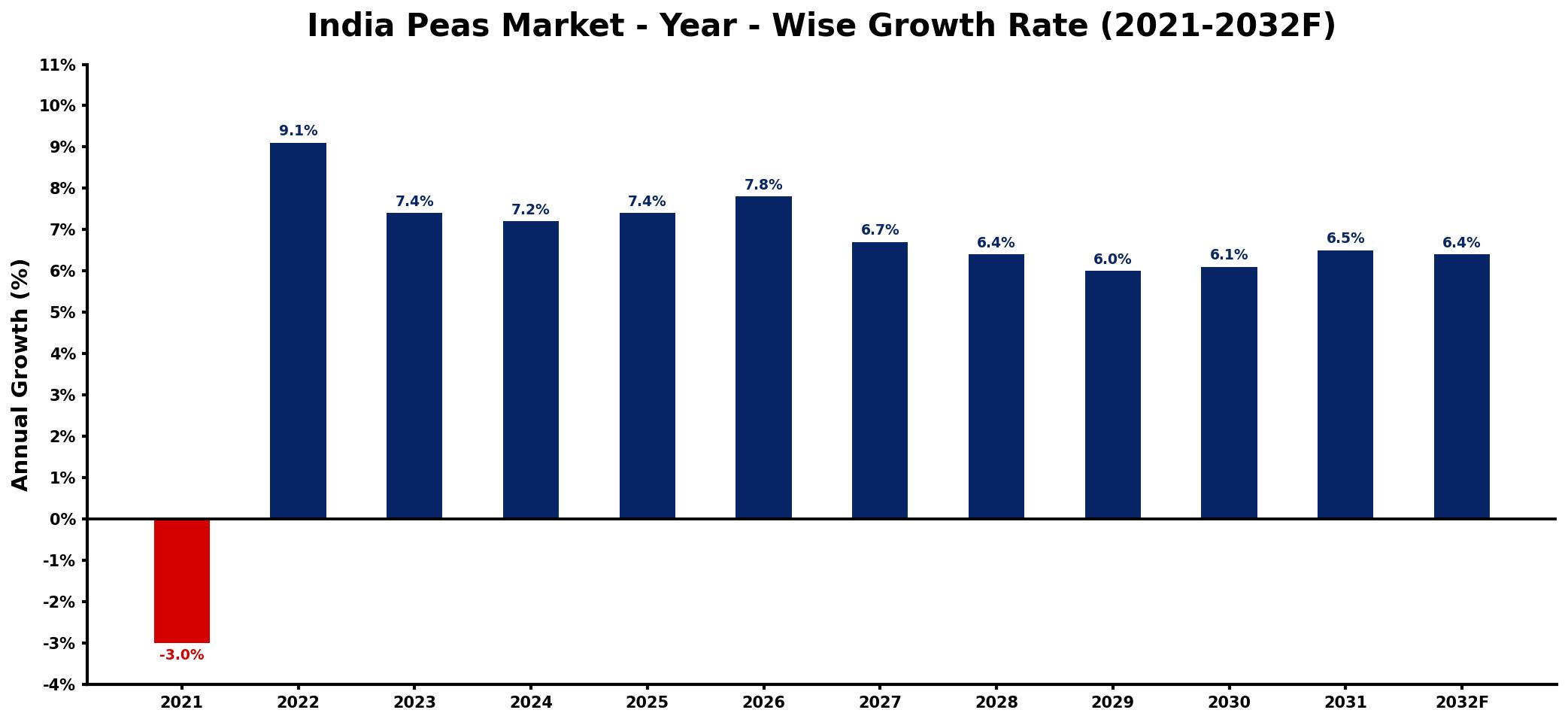
The table below presents the year‑wise growth rates along with the key drivers influencing the market
| Year | Growth Rate | Major Drivers |
| 2021 | -3.0% | Supply chain disruptions affecting availability |
| 2022 | 9.1% | Rising health awareness among consumers |
| 2023 | 7.4% | Increased demand for plant-based protein |
| 2024 | 7.2% | Expansion of processing facilities |
| 2025 | 7.4% | Growing export opportunities emerging |
| 2026 | 7.8% | Innovative farming techniques adopted widely |
| 2027 | 6.7% | Rising popularity of vegetarian diets |
| 2028 | 6.4% | Increased investment in agritech solutions |
| 2029 | 6.0% | Sustainable farming practices gaining traction |
| 2030 | 6.1% | Enhanced distribution networks established |
| 2031 | 6.5% | Growing awareness of nutritional benefits |
| 2032 | 6.4% | enhanced product quality standards |
Note: Market size estimations and growth projections presented in this report are based on 6Wresearch's proprietary forecasting methodology, utilizing the latest available industry data, government publications, and primary research inputs.
India Peas Market Synopsis
Currently, the Indian market for peas is witnessing a noteworthy transformation, largely influenced by changing dietary habits among consumers. The inclination towards nutritious, plant-based proteins is creating new avenues for growth, notably in the frozen and canned segments.
Moreover, as urbanization continues to rise, the demand for convenient food options, including ready-to-cook and packaged peas, is also on the rise. These factors, combined with increased purchasing power, are setting the stage for a vibrant future in the India Peas Market.
India Peas Market Key Takeaways
- The market is experiencing a growing trend towards convenience foods such as frozen and canned peas.
- Heightened health awareness is driving consumers to prefer plant-based protein sources.
- Increasing disposable incomes are influencing purchasing decisions and expanding market reach.
- Climate change and government regulations remain significant challenges affecting supply stability.
- Intense competition from alternative vegetable crops is reshaping market dynamics.
Evaluation of Restraints in India Peas Market
Despite its promising growth trajectory, the India Peas Market faces several restraints that could impede its progress. Strict government regulations surrounding agricultural practices and food safety standards can limit market entrants and impose operational challenges. Additionally, fluctuating prices due to climatic fluctuations significantly impact farmers' profitability, which can, in turn, affect the overall supply chain. Moreover, competition from other high-yield vegetable crops like beans and corn can create further pressure, diverting consumer attention and investment away from peas.
India Peas Market Trends
Several trends are currently shaping the India Peas Market landscape. The burgeoning popularity of plant-based diets is leading to a notable increase in pea-based protein products, such as protein powders and meat alternatives, gaining traction among health-conscious consumers. Furthermore, advancements in preservation techniques are enhancing the quality and shelf-life of frozen and canned peas, making them more attractive to consumers seeking convenience.
Additionally, the rise of online grocery shopping and direct-to-consumer models is transforming the distribution of peas, enabling greater market access and consumer engagement. These trends signal a dynamic shift in how peas are perceived and consumed, opening avenues for innovation in product offerings.
India Peas Market Opportunities
The India Peas Market presents various growth and investment opportunities, particularly in the realm of product diversification. Expanding the range of pea-based food items, including snacks and meal components, can cater to evolving consumer tastes. Additionally, investments in sustainable agricultural practices and technology can enhance yield and quality, addressing supply challenges while improving profitability for growers. There is also potential for partnerships with health and wellness brands to co-create products that appeal to health-focused consumers.
Government Initiatives in the India Peas Market
The Indian government has implemented various initiatives to support agricultural growth, which indirectly benefit the peas market. Programs aimed at enhancing irrigation facilities, providing subsidies for modern farming equipment, and promoting sustainable agricultural practices are crucial for improving crop yield. Furthermore, government incentives to promote plant-based protein sources align with the increasing demand for nutritious food products, helping to stimulate growth in the peas sector.
Future Insights of the India Peas Market
Looking ahead to the period between 2026 and 2032, the India Peas Market is expected to evolve significantly. The demand for plant-based proteins is likely to continue its upward trend, bolstered by increasing health awareness and dietary shifts. As technological advancements enhance farming practices, growers will likely be better positioned to meet consumer demand while navigating the challenges posed by climate change. Overall, a focus on sustainability and innovation will be critical for stakeholders aiming to capitalize on the market's potential.
India Peas Market Latest Developments (2025 - 2026)
Recent developments in the India Peas Market highlight a growing emphasis on sustainability and consumer preference for eco-friendly products. Companies are increasingly investing in R&D to develop innovative processing methods that enhance quality and reduce waste. Additionally, there is a marked shift towards building strong online retail channels, making it easier for consumers to access a variety of pea products. Partnerships between growers and distributors are also emerging, aiming to streamline the supply chain and improve market efficiency.
India Peas Market - Key Attractiveness of the Report
- 10 Years of Market Numbers
- Historical Data Starting from 2022 to 2025
- Base Year: 2025
- Forecast Data until 2032
- Key Performance Indicators Impacting the Market
- Major Upcoming Developments and Projects
Key Highlights of the Report:
- India Peas Market Outlook
- Market Size of India Peas Market, 2025
- Forecast of India Peas Market, 2032
- Historical Data and Forecast of India Peas Revenues & Volume for the Period 2022-2032F
- India Peas Market Trend Evolution
- India Peas Market Drivers and Challenges
- India Peas Price Trends
- India Peas Porter's Five Forces
- India Peas Industry Life Cycle
- Historical Data and Forecast of India Peas Market Revenues & Volume By Type for the Period 2022-2032F
- Historical Data and Forecast of India Peas Market Revenues & Volume By Field Peas for the Period 2022-2032F
- Historical Data and Forecast of India Peas Market Revenues & Volume By Garden Peas for the Period 2022-2032F
- Historical Data and Forecast of India Peas Market Revenues & Volume By Others for the Period 2022-2032F
- Historical Data and Forecast of India Peas Market Revenues & Volume By Application for the Period 2022-2032F
- Historical Data and Forecast of India Peas Market Revenues & Volume By Food for the Period 2022-2032F
- Historical Data and Forecast of India Peas Market Revenues & Volume By Others for the Period 2022-2032F
- Historical Data and Forecast of India Peas Market Revenues & Volume By Distribution Channel for the Period 2022-2032F
- Historical Data and Forecast of India Peas Market Revenues & Volume By Online for the Period 2022-2032F
- Historical Data and Forecast of India Peas Market Revenues & Volume By Offline for the Period 2022-2032F
- Historical Data and Forecast of India Peas Market Revenues & Volume By Others for the Period 2022-2032F
- India Peas Import Export Trade Statistics
- Market Opportunity Assessment By Type
- Market Opportunity Assessment By Application
- Market Opportunity Assessment By Distribution Channel
- India Peas Top Companies Market Share
- India Peas Competitive Benchmarking By Technical and Operational Parameters
- India Peas Company Profiles
- India Peas Key Strategic Recommendations






































