India Policy Management in Telecom Market Size & Growth Rate (2026-2032)
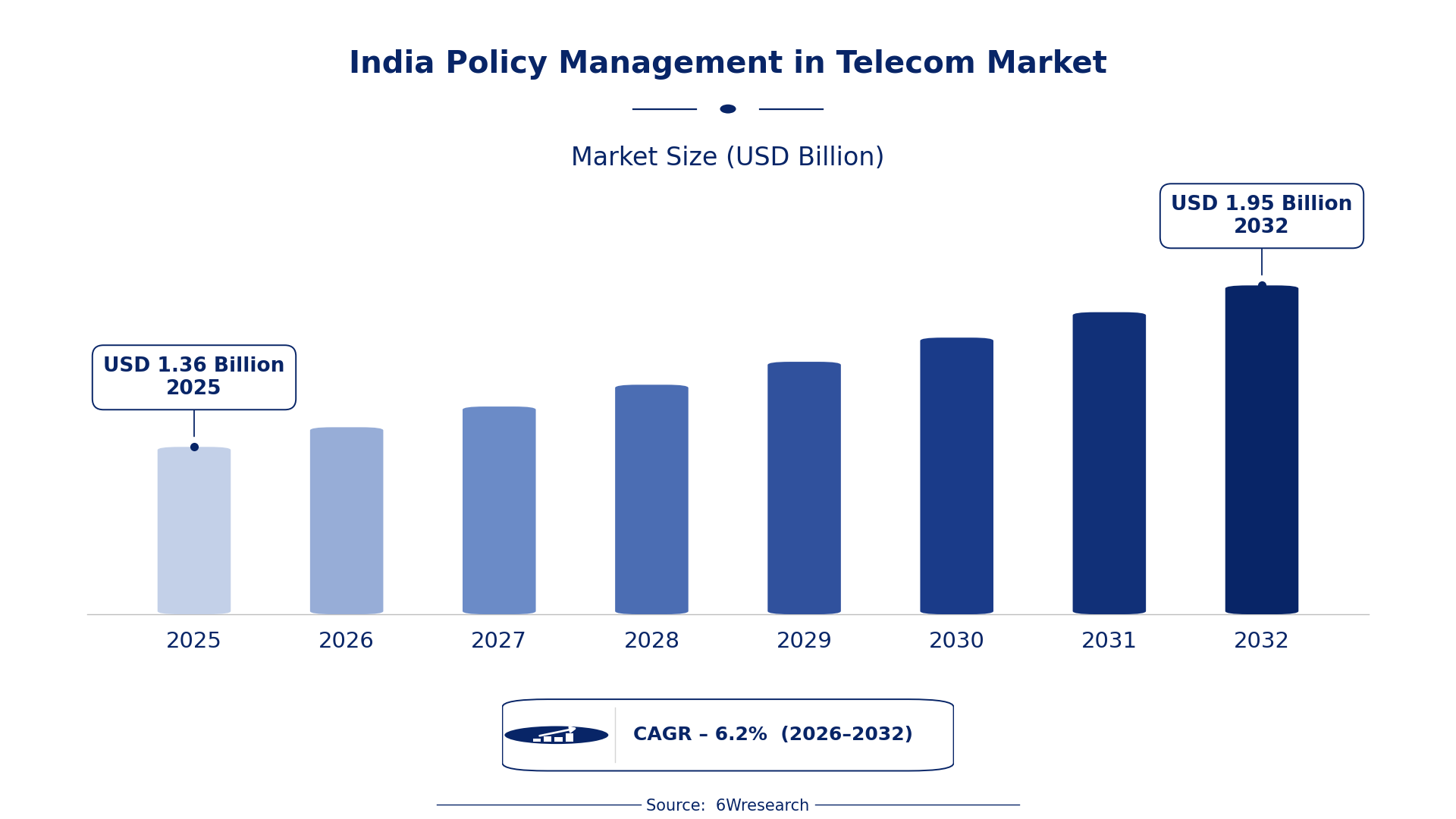
The India Policy Management in Telecom Market was estimated at USD 1361 Million in 2025 and is projected to reach USD 1952 Million by 2032, growing at a CAGR of 6.2% from 2026 to 2032.
India Policy Management in Telecom Market Synopsis
With the surge in data consumption and the advent of 5G technology, the need for advanced policy management systems is more pressing than ever in India. Telecom operators are prioritizing solutions that not only enhance service quality but also effectively manage network congestion.
The complexity of network services is evolving, compelling telecom companies to adopt sophisticated policy management tools. This transition is not merely driven by competition but also by regulatory demands that shape how telecom services are delivered and consumed.
India Policy Management in Telecom Market Year-wise Growth Rate and Key Drivers
This graph illustrates the annual growth rates of the India Policy Management in Telecom Market from 2021 to 2032, highlighting a steady upward trajectory and projected expansion over the forecast period.
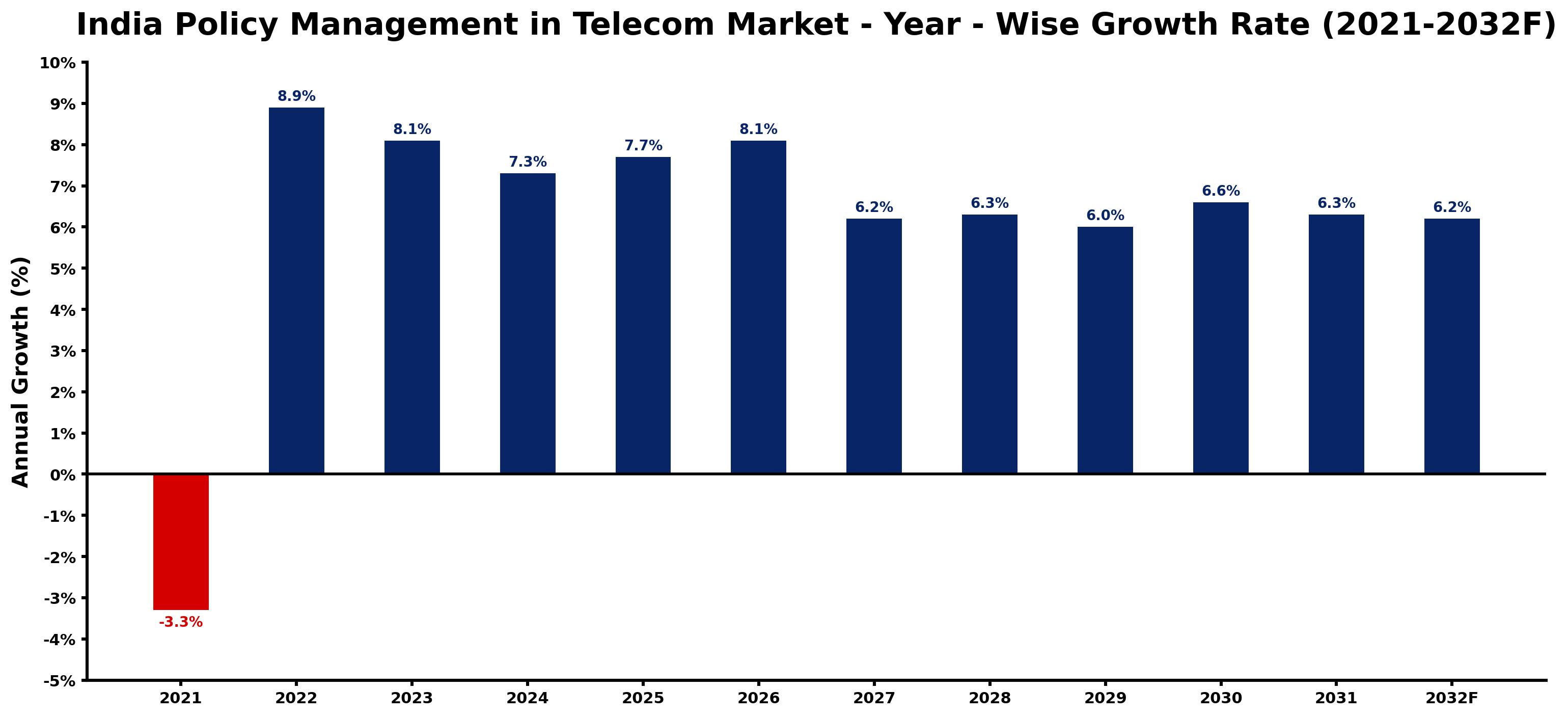
The table below presents the year‑wise growth rates along with the key drivers influencing the market
| Year | Growth Rate | Major Drivers |
| 2021 | -3.3% | Department of Telecom delayed regulatory reforms stifled innovation. |
| 2022 | 8.9% | National Digital Communications Policy driving policy innovation. |
| 2023 | 8.1% | Rural connectivity initiatives necessitating updated regulatory frameworks. |
| 2024 | 7.3% | Telecom sector reforms enhancing compliance and adaptability. |
| 2025 | 7.7% | Tightening of telecom licensing regulations improving competition. |
| 2026 | 8.1% | Public-private partnerships advancing infrastructural policy reforms. |
| 2027 | 6.2% | Increased cybersecurity threats pushing for stricter regulations. |
| 2028 | 6.3% | Emerging technologies requiring agile policy adjustments. |
| 2029 | 6.0% | Government initiatives promoting digital literacy influencing telecom management. |
| 2030 | 6.6% | Smart city projects necessitating tailored telecom policy management. |
| 2031 | 6.3% | Enhancements in broadband access prompting regulatory reviews. |
| 2032 | 6.2% | Market demand for IoT solutions shaping telecom guidelines. |
Note: Market size estimations and growth projections presented in this report are based on 6Wresearch's proprietary forecasting methodology, utilizing the latest available industry data, government publications, and primary research inputs.
India Policy Management in Telecom Market Key Takeaways
Below are some of the specific key takeaways from the market, including:
- The market is witnessing a marked increase in the adoption of personalized service offerings driven by advanced policy management systems.
- Regulatory compliance continues to be a vital driver for telecom operators in the deployment of policy management solutions.
- Rising data usage and the proliferation of mobile applications are creating new demands for effective policy management.
- Challenges surrounding data privacy and user preferences are influencing the design and implementation of policy solutions.
- The shift towards 5G technology necessitates a reevaluation of existing policy management frameworks for optimal network performance.
Evaluation of Restraints in India Policy Management in Telecom Market
Several constraints hinder the full potential of the policy management market in India. Foremost among these is the challenge of balancing personalized customer experiences with stringent data privacy laws. Telecom operators often find themselves at a crossroads, needing to innovate while simultaneously adhering to evolving regulations. The complexity of compliance can slow down the adoption of advanced policy management systems, limiting their effectiveness. Furthermore, legacy systems in place at many operators act as roadblocks, hampering efforts to integrate modern solutions.
India Policy Management in Telecom Market Trends
A noticeable trend in the market is the shift towards AI-driven policy management solutions that facilitate real-time decision-making and enhanced customer engagement. Operators are increasingly utilizing analytics to offer tailored services that meet specific consumer needs. Another trend is the focus on network slicing as telecom companies explore innovative ways to optimize 5G resources while maintaining service quality. The convergence of telecom and IT sectors is also driving the integration of advanced policy management capabilities across various platforms.
India Policy Management in Telecom Market Opportunities
Investors and telecom operators can find ample opportunities in the development of next-generation policy management solutions. With the anticipated expansion of 5G services, there is a growing need for solutions that can efficiently manage increased data traffic and provide seamless service delivery. Collaboration with technology partners to enhance capabilities in AI and machine learning can also unlock new avenues for service innovation. Additionally, tapping into underserved markets with tailored policy management solutions could yield significant returns.
Government Initiatives in the India Policy Management in Telecom Market
Government policies are significantly influencing the India Policy Management in Telecom Market. Regulatory frameworks are being established to ensure transparency, enhance competition, and promote innovation within the sector. These policies are essential as they aim to streamline operations while protecting consumer rights.
- A recently completed regulatory framework introduced in 2025 mandates increased transparency in data management practices among telecom operators.
- Currently ongoing is a national digital infrastructure upgrade programme, aimed at enhancing connectivity and service quality across rural regions.
- A planned public-private initiative is expected to launch in 2026 to further expand telecom infrastructure, particularly focusing on underserved urban areas.
- The Telecom Regulatory Authority of India (TRAI) is revising existing policies to better align with the demands posed by emerging technologies like 5G and IoT.
- Upcoming initiatives include proposed standards for data privacy that are expected to be rolled out by late 2026, aiming to address consumer concerns around data protection.
Future Insights of the India Policy Management in Telecom Market
Looking ahead to 2026-2032, the India Policy Management in Telecom Market is likely to evolve in tandem with technological advancements and user expectations. The emphasis will be on integrating policy management systems with AI-driven analytics, allowing telecom operators to deliver highly customized services while ensuring regulatory compliance. As data traffic continues to grow, the focus will shift towards solutions that not only optimize network performance but also enhance customer satisfaction. The interplay of regulatory requirements and consumer demand will shape the roadmap for future innovations.
India Policy Management in Telecom Market Latest Developments
Over the past year, the India Policy Management in Telecom Market has seen an uptick in activity as telecom operators strive to enhance their service offerings in the face of rising consumer demand. Increased collaborations between telecom companies and technology providers have resulted in noteworthy advancements in policy management solutions.
- A major telecom operator launched an advanced policy management solution in Q1 2025, enhancing real-time data analytics capabilities.
- An ongoing partnership between a leading regional operator and a technology vendor aims to upgrade network management systems, which is expected to conclude by mid-2026.
- A new initiative to integrate AI capabilities into existing policy management frameworks is scheduled for launch in late 2025.
- A recent expansion into underserved markets was executed in early 2025, with positive feedback on service uptake.
- A project aimed at enhancing mobile application data management started in early 2025 and is still underway.
India Policy Management in Telecom Market - Key Attractiveness of the Report
- 10 Years of Market Numbers
- Historical Data Starting from 2022 to 2025
- Base Year: 2025
- Forecast Data until 2032
- Key Performance Indicators Impacting the Market
- Major Upcoming Developments and Projects
Key Highlights of the Report:
- India Policy Management in Telecom Market Outlook
- Market Size of India Policy Management in Telecom Market, 2025
- Forecast of India Policy Management in Telecom Market, 2032
- Historical Data and Forecast of India Policy Management in Telecom Revenues & Volume for the Period 2022-2032F
- India Policy Management in Telecom Market Trend Evolution
- India Policy Management in Telecom Market Drivers and Challenges
- India Policy Management in Telecom Price Trends
- India Policy Management in Telecom Porter's Five Forces
- India Policy Management in Telecom Industry Life Cycle
- Historical Data and Forecast of India Policy Management in Telecom Market Revenues & Volume By Network for the Period 2022-2032F
- Historical Data and Forecast of India Policy Management in Telecom Market Revenues & Volume By Fixed for the Period 2022-2032F
- Historical Data and Forecast of India Policy Management in Telecom Market Revenues & Volume By Wireless for the Period 2022-2032F
- Historical Data and Forecast of India Policy Management in Telecom Market Revenues & Volume By Component for the Period 2022-2032F
- Historical Data and Forecast of India Policy Management in Telecom Market Revenues & Volume By Solutions for the Period 2022-2032F
- Historical Data and Forecast of India Policy Management in Telecom Market Revenues & Volume By Services for the Period 2022-2032F
- Historical Data and Forecast of India Policy Management in Telecom Market Revenues & Volume By Deployment for the Period 2022-2032F
- Historical Data and Forecast of India Policy Management in Telecom Market Revenues & Volume By Cloud for the Period 2022-2032F
- Historical Data and Forecast of India Policy Management in Telecom Market Revenues & Volume By On-Premises for the Period 2022-2032F
- India Policy Management in Telecom Import Export Trade Statistics
- Market Opportunity Assessment By Network
- Market Opportunity Assessment By Component
- Market Opportunity Assessment By Deployment
- India Policy Management in Telecom Top Companies Market Share
- India Policy Management in Telecom Competitive Benchmarking By Technical and Operational Parameters
- India Policy Management in Telecom Company Profiles
- India Policy Management in Telecom Key Strategic Recommendations






































