India Ready‑to‑Eat Meal Packaging Market Size & Growth Rate
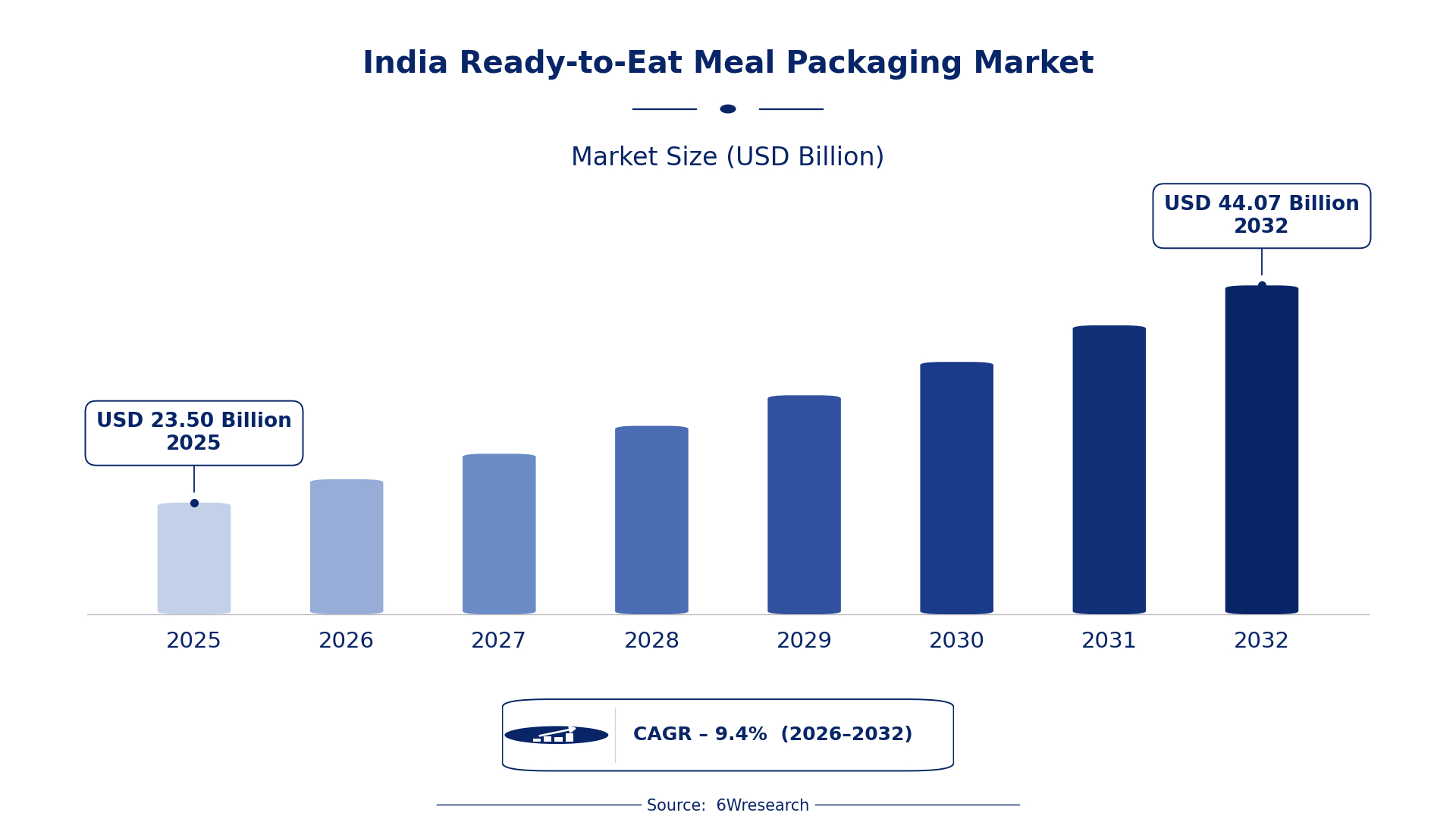
According to 6Wresearch internal database and industry insights, the India Ready‑to‑Eat Meal Packaging Market was valued at USD 23.50 billion in 2025 and is projected to reach USD 44.07 billion by 2032, growing at a CAGR of approximately 9.4% during 2026–2032.
India Ready‑to‑Eat Meal Packaging Market Highlights
| Report Metric | Details |
| Report Name | India Ready‑to‑Eat Meal Packaging Market |
| Market Size 2025 | USD 23.50 billion |
| Market Size 2032 | USD 44.07 billion |
| Absolute Growth 2025–2032 | USD 20.57 billion |
| CAGR 2026–2032 | 9.4% |
| Peak Annual Growth | 11.0% in 2026 |
| Forecast Period | 2026–2032 |
| Historical Data | 2022–2025 |
| Base Year | 2025 |
| Leading Meal Type, 2025 | Fresh Meals (44% share) |
| Leading Cuisine Style, 2025 | International (Asian, Mediterranean) (49% share) |
| Leading Packaging Format, 2025 | Vacuum-sealed Trays (48% share) |
| Leading End User, 2025 | Office Professionals (47% share) |
| Fastest-Growing Meal Type | Frozen Meals (10.8% CAGR) |
| Fastest-Growing Cuisine Style | Low-Calorie/Gluten-Free (12.0% CAGR) |
| Fastest-Growing Packaging Format | Freezer Bags/Trays (11.8% CAGR) |
| Fastest-Growing End User | Busy Families (11.5% CAGR) |
| Growing Sector | Food Processing |
| Key End Users | Office Professionals, Busy Families, Outdoor Enthusiasts, Elderly Consumers |
India Ready‑to‑Eat Meal Packaging Market Year-wise Growth Rate and Key Drivers (2022–2032)
This graph illustrates the annual growth rates of the market from 2022 to 2032, highlighting a steady upward trajectory and projected market expansion over the forecast period.
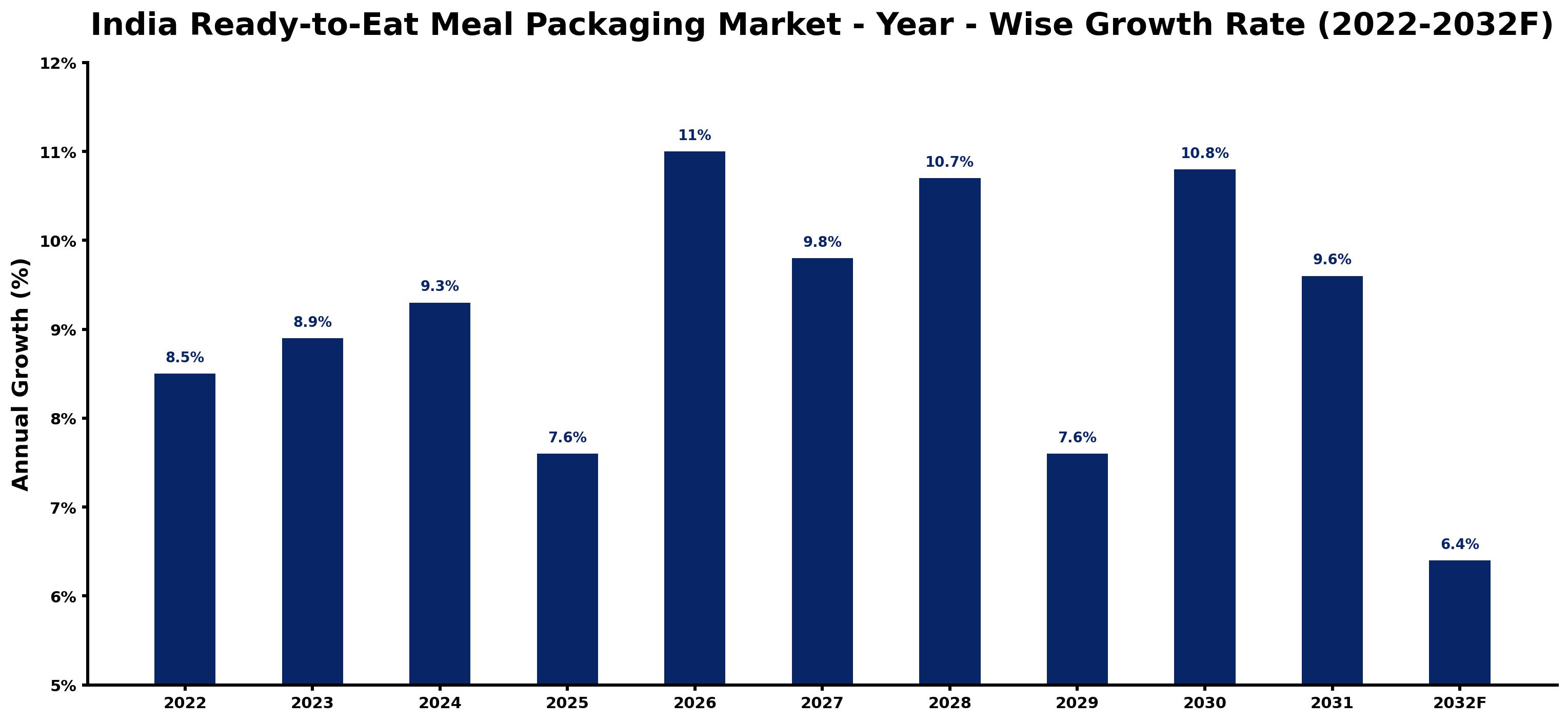
Each row of the following table gives one year's estimated growth and the event or demand shift that explains it.
| Year | Estimated Annual Growth (%) | Market Rationale |
| 2022 | 8.5 | The market experienced steady growth as urbanisation continued to influence consumer habits. |
| 2023 | 8.9 | Demand surged due to a 30% increase in frozen meals in urban areas. |
| 2024 | 9.3 | Growth was driven by rising consumer preference for convenience in meal options. |
| 2025 | 7.6 | The market growth slowed as consumers became more price-sensitive amid economic pressures. |
| 2026 | 11.0 | A peak in growth occurred due to heightened demand for ready-to-eat meals and packaging. |
| 2027 | 9.8 | Demand slowed as the market adjusted to previous rapid growth rates and consumer preferences. |
| 2028 | 10.7 | Growth accelerated again with increasing interest in diverse meal options and convenience. |
| 2029 | 7.6 | The market experienced a slowdown as consumer spending stabilised after previous increases. |
| 2030 | 10.8 | Growth picked up as the population reached 1.5 billion, boosting meal packaging demand. |
| 2031 | 9.6 | A slowdown in growth occurred as market saturation began to affect purchasing behaviour. |
| 2032 | 6.4 | Growth slowed further as the market stabilised after years of rapid expansion. |
Note: Market size estimations and growth projections presented in this report are based on 6Wresearch's proprietary forecasting methodology, utilizing the latest available industry data, government publications, and primary research inputs.
India Ready‑to‑Eat Meal Packaging Market Synopsis
Ready-to-Eat Meal Packaging in India encompasses materials designed to preserve food products for convenience and safety. This packaging includes plastics, aluminum, and paperboard, catering primarily to busy lifestyles. The India Ready-to-Eat Meal Packaging Market is valued at approximately INR 1,500 crore in 2023, driven by urbanisation and changing consumer preferences. Over 60% of Indian households prefer ready-to-eat meals for their convenience, further boosting demand. The thriving food processing industry supports this growth, particularly in urban areas.
Market Dynamics Impact Analysis (2026–2032)
| Factor | Type | Impact | Primary Segment Affected |
| Increasing urbanisation drives demand for convenient meal options. | Driver | High | Fresh Meals |
| Growing health consciousness among consumers promotes demand for low-calorie options. | Driver | High | Low-Calorie/Gluten-Free |
| The rise of e-commerce creates new distribution channels for meal packaging. | Opportunity | High | Frozen Meals |
| Expansion of food processing facilities enhances local production capabilities. | Opportunity | Medium | Heat-and-Eat Casseroles |
| Regulatory compliance costs can burden small producers in the market. | Restraint | High | Shelf-Stable Meals |
| Consumer price sensitivity may limit spending on premium packaging options. | Restraint | Medium | Vacuum-sealed Trays |
| Approval delays for new packaging materials can hinder market entry. | Challenge | High | Retort Pouches |
| Supply chain disruptions can affect the availability of packaging materials. | Challenge | Medium | Microwavable Trays |
Evaluation of Drivers in India Ready‑to‑Eat Meal Packaging Market (2026–2032)
Below mentioned are some major drivers and their influence on market dynamics.
| Drivers | Primary Segment Affected | Why It Matters (Evidence) |
| Rising urbanisation increases the demand for convenient meal solutions. | Fresh Meals | Over 60% of Indian households prefer ready-to-eat meals for convenience. |
| Health-conscious consumers are shifting towards low-calorie meal options. | Low-Calorie/Gluten-Free | Recommendations for balanced meals influence packaging trends. |
| The growth of e-commerce boosts demand for ready-to-eat meal packaging. | Frozen Meals | E-commerce has increased demand for ready-to-eat meal packaging by 25%. |
| Government initiatives promote local food packaging production. | Heat-and-Eat Casseroles | The 'Make in India' initiative encourages local production in the food processing sector. |
| The increasing population drives the need for diverse meal options. | Shelf-Stable Meals | The Indian population is projected to reach 1.5 billion by 2030, increasing meal packaging demand. |
Growth across the Ready‑to‑Eat Meal Packaging market in India is anchored in rising urbanisation, increasing health consciousness and the expansion of e-commerce. Over 60% of Indian households prefer ready-to-eat meals for convenience, leading to heightened demand for meal packaging. Recommendations for balanced meals are influencing trends, particularly for low-calorie options. E-commerce has increased demand for meal packaging, creating new distribution channels.
Evaluation of Restraints in India Ready‑to‑Eat Meal Packaging Market
The main factors holding the market back are set out below.
| Market Restraint | Primary Segment Affected | Why It Matters (Evidence) |
| Regulatory compliance costs can burden small producers in the market. | Shelf-Stable Meals | The Food Safety and Standards Authority of India regulates food packaging standards, increasing compliance costs. |
| Consumer price sensitivity may limit spending on premium packaging options. | Vacuum-sealed Trays | The average Indian consumer spends around INR 500 per month on ready-to-eat meals, affecting premium purchases. |
| Approval delays for new packaging materials can hinder market entry. | Retort Pouches | The updated Food Safety and Standards Act requires thorough testing and certification for new materials. |
| Supply chain disruptions can affect the availability of packaging materials. | Microwavable Trays | Recent global supply chain issues have delayed material availability, impacting production timelines. |
| Market saturation may limit growth potential for existing products. | Frozen Meals | The demand for frozen meals has increased by 30% in urban areas, but competition is intensifying. |
India Ready‑to‑Eat Meal Packaging Market Challenges
Producers in the India Ready-to-Eat Meal Packaging Market encounter delays from stringent food packaging regulations, which can extend approval times to six months, costing them approximately INR 50 crore annually. Buyers face increased costs as compliance with the updated Food Safety and Standards Act necessitates additional investments in training and certification, diverting funds from production. Skills shortages in packaging technology limit innovation, preventing suppliers from meeting the rising demand for convenient meal options. Complicated inventory management due to fluctuating consumer preferences forces buyers to overstock or risk shortages, potentially resulting in monthly losses of INR 10 crore.
Trends in the India Ready‑to‑Eat Meal Packaging Market
Below mentioned are some of the trends shaping the India Ready‑to‑Eat Meal Packaging Market growth.
- Shift in Consumer Preferences towards Healthier Options: Health-conscious consumers are increasingly opting for low-calorie and gluten-free meal packaging. This trend is reflected in the growing demand for low-calorie meal options, which is expected to grow at a CAGR of 12.0% from 2026 to 2032.
- Increase in E-commerce Distribution Channels: The rise of e-commerce has transformed the distribution of ready-to-eat meal packaging, with a notable increase in demand. This shift allows consumers to access a wider variety of meal options conveniently.
- Growing Demand for International Cuisine Packaging: International (Asian, Mediterranean) meal packaging is gaining popularity, with a projected market share of 49% in 2025. This trend caters to the diverse culinary preferences of Indian consumers.
- Expansion of Food Processing Facilities: The Pradhan Mantri Kisan Sampada Yojana, launched in 2020, aims to develop food processing facilities. This initiative improves packaging capabilities for ready-to-eat meals, supporting market growth.
Investment Opportunities in the India Ready‑to‑Eat Meal Packaging Market
Investors looking at the India Ready‑to‑Eat Meal Packaging Market should consider the following areas.
- Expansion of Food Processing Units: With a budget of INR 10,000 crore, the PMFME Scheme supports micro food processing units. This initiative presents an opportunity for local partnerships to improve production capabilities.
- Growth in Urban Areas: The demand for frozen meals has surged by 30% in urban areas, indicating a market gap. Suppliers can target urban households to meet this rising demand.
- Investment in Health-Conscious Meal Options: Health-conscious consumers are driving demand for low-calorie meal packaging. Suppliers can invest in gluten-free options to cater to this growing buyer group.
- Development of E-commerce Platforms: The rise of e-commerce presents opportunities for suppliers to enter the market. Collaborating with local platforms can facilitate distribution and reach a wider audience.
Government Initiatives in the India Ready‑to‑Eat Meal Packaging Market
The PMFME Scheme, initiated by the Ministry of Food Processing Industries in 2020, aims to support 2 lakh micro food processing units with a budget of INR 10,000 crore. This initiative improves local production capabilities and encourages innovation in meal packaging. Additionally, the Food Safety and Standards Authority of India updated packaging regulations in 2021 to streamline compliance for producers, ensuring food safety and consumer protection. These measures strengthen the regulatory framework for ready-to-eat meal packaging.
The Ministry of Food Processing Industries funds the development of food processing facilities, supporting the establishment of packaging units. The Ministry of Health and Family Welfare's 'Eat Right India' initiative promotes healthy meal packaging standards, guiding producers in developing compliant products. These government efforts facilitate access to safer, high-quality meal options for consumers.
Future Insight of the India Ready‑to‑Eat Meal Packaging Market
The India Ready-to-Eat Meal Packaging Market will undergo transformative changes by 2032, driven by urban population growth and evolving consumer lifestyles. The population is set to reach 1.5 billion, which will substantially boost the demand for convenient meal solutions and encourage advancements in packaging materials and techniques. Government initiatives like the PMFME Scheme will enhance support for local producers, streamlining supply chains. The rise of e-commerce is anticipated to elevate demand for ready-to-eat meal packaging by 30%, offering suppliers new avenues to expand their market reach.
Market Segmentation Analysis
Each segment group is reviewed below, with the leader by share and the fastest grower by CAGR.
By Meal Type – Fresh Meals Dominated, Frozen Meals Expected to Grow Fastest
According to Ravi Bhandari, Research Head at 6Wresearch, in 2025, Fresh Meals led the meal type split with a 44% share. Fresh meals dominate the market as they provide quick meal solutions for consumers, particularly in urban areas. With over 60% of Indian households preferring ready-to-eat meals for convenience, this segment effectively caters to their needs. The quickest growth will come from Frozen Meals, forecast to expand at a CAGR of 10.8% between 2026 and 2032. The frozen meals segment is experiencing rapid growth, evidenced by a 30% rise in demand in urban areas in 2023. This trend highlights consumers' increasing preference for long shelf life and convenience in their meal choices, suggesting that fresh meals will maintain their lead. Suppliers should focus on enhancing their frozen meal offerings to meet the growing consumer interest in convenient meal solutions.
By Cuisine Style – International (Asian, Mediterranean) Dominated, Low-Calorie/Gluten-Free Expected to Grow Fastest
International (Asian, Mediterranean) took a 49% share of cuisine style in 2025, more than any other category. International cuisine, particularly Asian and Mediterranean, holds a significant share as it caters to the diverse culinary preferences of Indian consumers. The availability of a wide variety of ready-to-eat options in urban centres underscores this segment's popularity. Low-Calorie/Gluten-Free is projected to grow fastest, at a CAGR of 12.0% during 2026–2032. The low-calorie and gluten-free segment is rapidly gaining traction among health-conscious consumers prioritising nutritional value. This shift is evident as more brands introduce healthier meal options, indicating that the international cuisine segment will continue to thrive. Buyers can anticipate a broader selection of health-focused meal options as suppliers adapt to changing dietary preferences.
By Packaging Format – Vacuum-sealed Trays Dominated, Freezer Bags/Trays Expected to Grow Fastest
The largest packaging format category in 2025 was Vacuum-sealed Trays, with a 48% share of total revenue. Vacuum-sealed trays are the preferred packaging format, ensuring freshness and extended shelf life for ready-to-eat meals. This format is particularly popular among consumers who value quality and convenience in their meal choices. Freezer Bags/Trays are set to record the highest CAGR in this split, 11.8% over 2026–2032. Freezer bags and trays are gaining traction due to their ease of storage and reheating, making them ideal for busy lifestyles. As more families seek practical solutions for meal preparation, this segment is set to grow rapidly. Suppliers should consider expanding their product lines to include more freezer-friendly packaging options to meet consumer needs.
By End User – Office Professionals Dominated, Busy Families Expected to Grow Fastest
Office Professionals accounted for a 47% market share by end user in 2025. Office professionals represent the largest end-user segment, driven by their demand for convenient lunch options that fit into their busy schedules. This group's significant preference for ready-to-eat meals greatly contributes to the overall market share. Over 2026–2032, Busy Families are expected to post the fastest growth, at a CAGR of 11.5%. Busy families are the fastest-growing end-user group, as they seek quick meal solutions that accommodate their hectic lifestyles. As the population continues to grow, this segment's demand for ready-to-eat meals is expected to increase, allowing office professionals to maintain their lead. Suppliers should tailor their marketing strategies to effectively address the specific needs of busy families to capture this expanding market.
Key Attractiveness of the Report
- 10 Years of Market Numbers
- Historical Data Starting from 2022 to 2025
- Base Year 2025
- Forecast Data until 2032
- Key Performance Indicators Impacting the Market
- Major Upcoming Developments and Projects
Key Highlights of the Report:
- India Ready‑to‑Eat Meal Packaging Market Outlook
- Market Size of India Ready‑to‑Eat Meal Packaging Market, 2025
- Forecast of India Ready‑to‑Eat Meal Packaging Market, 2032
- Historical Data and Forecast of India Ready‑to‑Eat Meal Packaging Revenues & Volume for the Period 2022 - 2032F
- India Ready‑to‑Eat Meal Packaging Market Trend Evolution
- India Ready‑to‑Eat Meal Packaging Market Drivers and Challenges
- India Ready‑to‑Eat Meal Packaging Price Trends
- India Ready‑to‑Eat Meal Packaging Porter's Five Forces
- India Ready‑to‑Eat Meal Packaging Industry Life Cycle
- Historical Data and Forecast of India Ready‑to‑Eat Meal Packaging Market Revenues & Volume By Meal Type for the Period 2022 - 2032F
- Historical Data and Forecast of India Ready‑to‑Eat Meal Packaging Market Revenues & Volume By Fresh Meals for the Period 2022 - 2032F
- Historical Data and Forecast of India Ready‑to‑Eat Meal Packaging Market Revenues & Volume By Frozen Meals for the Period 2022 - 2032F
- Historical Data and Forecast of India Ready‑to‑Eat Meal Packaging Market Revenues & Volume By Shelf-Stable Meals for the Period 2022 - 2032F
- Historical Data and Forecast of India Ready‑to‑Eat Meal Packaging Market Revenues & Volume By Heat-and-Eat Casseroles for the Period 2022 - 2032F
- Historical Data and Forecast of India Ready‑to‑Eat Meal Packaging Market Revenues & Volume By Cuisine Style for the Period 2022 - 2032F
- Historical Data and Forecast of India Ready‑to‑Eat Meal Packaging Market Revenues & Volume By International (Asian, Mediterranean) for the Period 2022 - 2032F
- Historical Data and Forecast of India Ready‑to‑Eat Meal Packaging Market Revenues & Volume By Low-Calorie/Gluten-Free for the Period 2022 - 2032F
- Historical Data and Forecast of India Ready‑to‑Eat Meal Packaging Market Revenues & Volume By High-Protein/Keto for the Period 2022 - 2032F
- Historical Data and Forecast of India Ready‑to‑Eat Meal Packaging Market Revenues & Volume By Comfort Foods for the Period 2022 - 2032F
- Historical Data and Forecast of India Ready‑to‑Eat Meal Packaging Market Revenues & Volume By Packaging Format for the Period 2022 - 2032F
- Historical Data and Forecast of India Ready‑to‑Eat Meal Packaging Market Revenues & Volume By Vacuum-sealed Trays for the Period 2022 - 2032F
- Historical Data and Forecast of India Ready‑to‑Eat Meal Packaging Market Revenues & Volume By Freezer Bags/Trays for the Period 2022 - 2032F
- Historical Data and Forecast of India Ready‑to‑Eat Meal Packaging Market Revenues & Volume By Retort Pouches for the Period 2022 - 2032F
- Historical Data and Forecast of India Ready‑to‑Eat Meal Packaging Market Revenues & Volume By Microwavable Trays for the Period 2022 - 2032F
- Historical Data and Forecast of India Ready‑to‑Eat Meal Packaging Market Revenues & Volume By End User for the Period 2022 - 2032F
- Historical Data and Forecast of India Ready‑to‑Eat Meal Packaging Market Revenues & Volume By Office Professionals for the Period 2022 - 2032F
- Historical Data and Forecast of India Ready‑to‑Eat Meal Packaging Market Revenues & Volume By Busy Families for the Period 2022 - 2032F
- Historical Data and Forecast of India Ready‑to‑Eat Meal Packaging Market Revenues & Volume By Outdoor Enthusiasts for the Period 2022 - 2032F
- Historical Data and Forecast of India Ready‑to‑Eat Meal Packaging Market Revenues & Volume By Elderly Consumers for the Period 2022 - 2032F
- India Ready‑to‑Eat Meal Packaging Import Export Trade Statistics
- Market Opportunity Assessment By Meal Type
- Market Opportunity Assessment By Cuisine Style
- Market Opportunity Assessment By Packaging Format
- Market Opportunity Assessment By End User
- India Ready‑to‑Eat Meal Packaging Top Companies Market Share
- India Ready‑to‑Eat Meal Packaging Competitive Benchmarking By Technical and Operational Parameters
- India Ready‑to‑Eat Meal Packaging Company Profiles
- India Ready‑to‑Eat Meal Packaging Key Strategic Recommendations
Market Covered
Segments analysed in this report are listed below.
By Meal Type
- Fresh Meals
- Frozen Meals
- Shelf-Stable Meals
- Heat-and-Eat Casseroles
By Cuisine Style
- International (Asian, Mediterranean)
- Low-Calorie/Gluten-Free
- High-Protein/Keto
- Comfort Foods
By Packaging Format
- Vacuum-sealed Trays
- Freezer Bags/Trays
- Retort Pouches
- Microwavable Trays
By End User
- Office Professionals
- Busy Families
- Outdoor Enthusiasts
- Elderly Consumers































