India Real‑Time Data Warehousing Market Size & Growth Rate
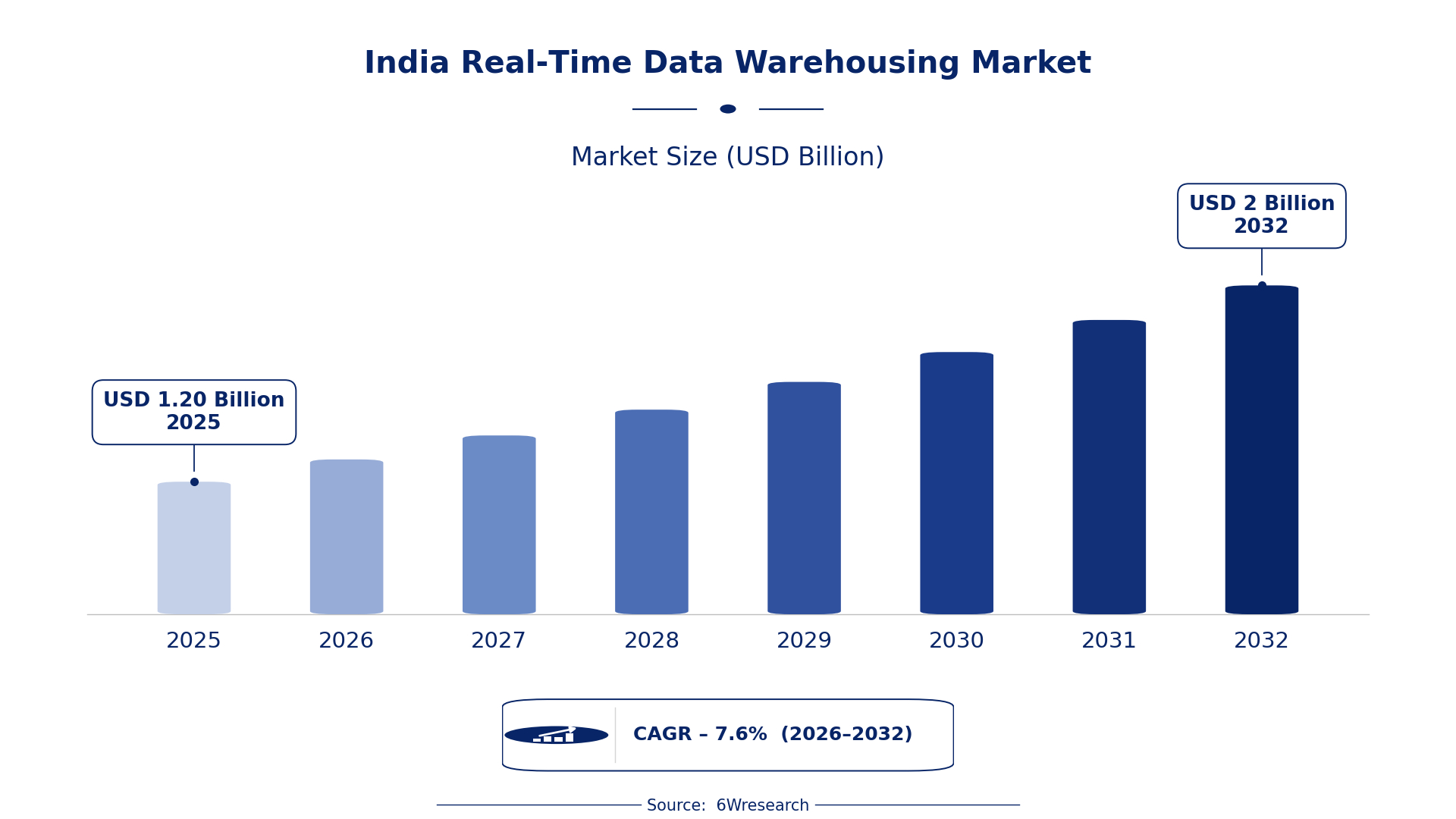
According to 6Wresearch internal database and industry insights, the India Real‑Time Data Warehousing Market was valued at USD 1.20 billion in 2025 and is projected to reach USD 2 billion by 2032, growing at a CAGR of approximately 7.6% during 2026–2032.
India Real‑Time Data Warehousing Market Highlights
| Report Metric | Details |
| Report Name | India Real‑Time Data Warehousing Market |
| Market Size 2025 | USD 1.20 billion |
| Market Size 2032 | USD 2 billion |
| Absolute Growth 2025–2032 | USD 0.80 billion |
| CAGR 2026–2032 | 7.6% |
| Peak Annual Growth | 10.1% in 2029 |
| Forecast Period | 2026–2032 |
| Historical Data | 2022–2025 |
| Base Year | 2025 |
| Leading Warehouse Type, 2025 | Streaming Data Warehouse (39% share) |
| Leading Load Type, 2025 | CDC/Upserts (45% share) |
| Leading Deployment Location, 2025 | Cloud-Based (53% share) |
| Leading End User, 2025 | E-commerce Data Teams (51% share) |
| Fastest-Growing Warehouse Type | Hybrid Data Warehouse (8.8% CAGR) |
| Fastest-Growing Load Type | Real-Time Ingestion (9.1% CAGR) |
| Fastest-Growing Deployment Location | Multi-Cloud Environments (10.1% CAGR) |
| Fastest-Growing End User | Retail Analytics Teams (9.5% CAGR) |
| Growing Sector | E-commerce |
| Key End Users | E-commerce Data Teams, Retail Analytics Teams, Media Streaming Companies, IoT Platform Providers |
India Real‑Time Data Warehousing Market Year-wise Growth Rate and Key Drivers (2022–2032)
This graph illustrates the annual growth rates of the market from 2022 to 2032, highlighting a steady upward trajectory and projected market expansion over the forecast period.
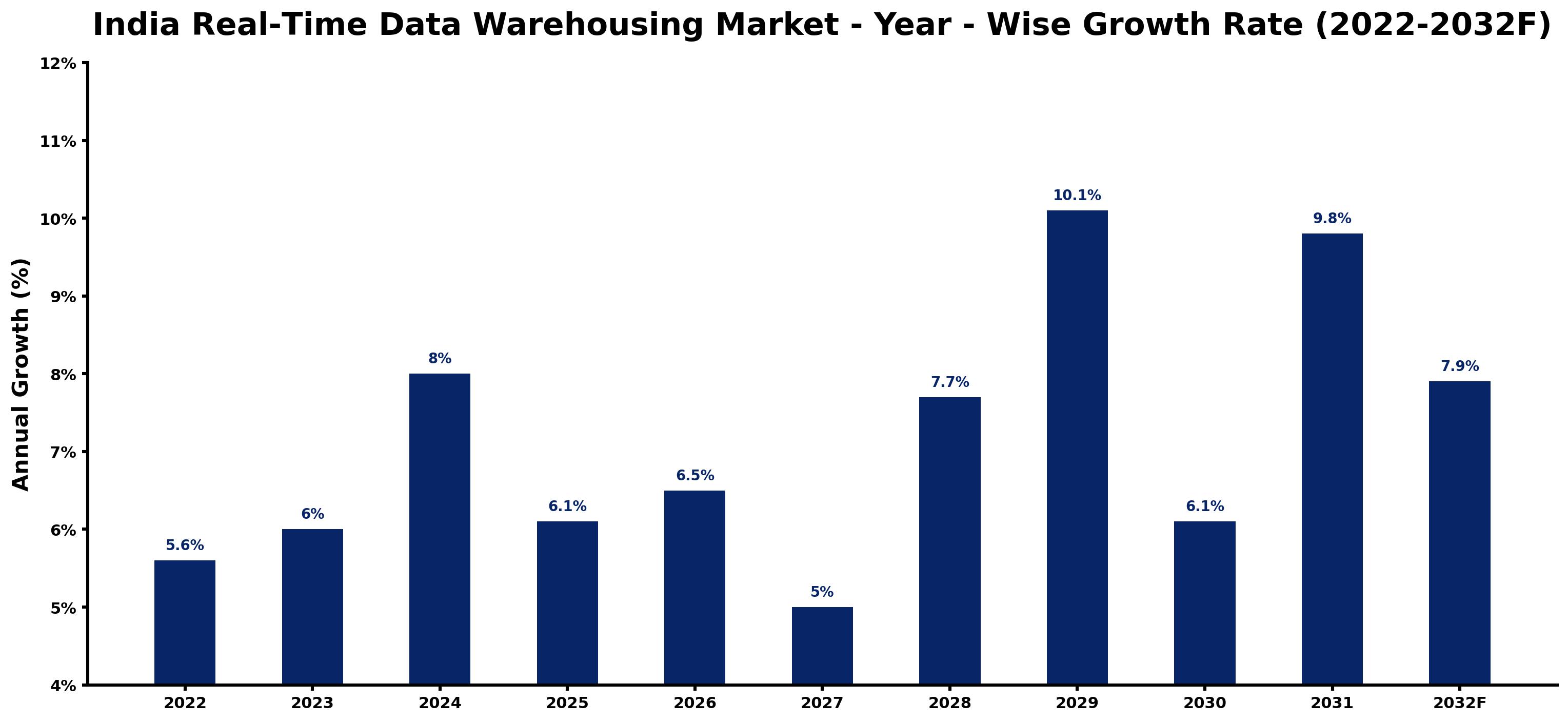
Each row of the following table gives one year's estimated growth and the event or demand shift that explains it.
| Year | Estimated Annual Growth (%) | Market Rationale |
| 2022 | 5.6 | The market experienced steady growth as demand for real-time analytics increased. |
| 2023 | 6.0 | Growth continued as more businesses adopted data-driven decision-making practices. |
| 2024 | 8.0 | The market saw significant expansion due to rising investments in data infrastructure. |
| 2025 | 6.1 | Growth slowed slightly as companies adjusted to evolving data management needs. |
| 2026 | 6.5 | Demand increased again as cloud adoption accelerated across various sectors. |
| 2027 | 5.0 | Growth slowed due to market saturation in some urban areas. |
| 2028 | 7.7 | A resurgence in demand occurred as new technologies emerged in data processing. |
| 2029 | 10.1 | The market peaked as major investments in digital infrastructure were realised. |
| 2030 | 6.1 | Growth decelerated as companies focused on optimising existing systems. |
| 2031 | 9.8 | Demand surged again as e-commerce and retail analytics expanded significantly. |
| 2032 | 7.9 | Growth moderated as the market stabilised after rapid expansions. |
Note: Market size estimations and growth projections presented in this report are based on 6Wresearch's proprietary forecasting methodology, utilizing the latest available industry data, government publications, and primary research inputs.
India Real‑Time Data Warehousing Market Synopsis
Real-Time Data Warehousing in India encompasses technologies that enable immediate data access and analysis. This market is primarily driven by sectors like e-commerce and retail, which rely on timely insights from large datasets. The Digital India initiative and increasing internet penetration are key contributors to market growth. Urban centres such as Bangalore and Hyderabad serve as crucial hubs for data analytics development. As the digital economy expands, the demand for real-time data warehousing continues to rise, reflecting the need for improved data processing capabilities.
Market Dynamics Impact Analysis (2026–2032)
| Factor | Type | Impact | Primary Segment Affected |
| Growing demand for real-time analytics in e-commerce drives investments in data warehousing solutions. | Driver | High | E-commerce Data Teams |
| The rise of cloud-based solutions enhances scalability and flexibility for data storage. | Driver | High | Cloud-Based |
| The increasing number of internet users creates a larger market for data warehousing solutions. | Opportunity | High | E-commerce Data Teams |
| Investments in hybrid cloud technologies present opportunities for data warehousing providers. | Opportunity | Medium | Hybrid Data Warehouse |
| Limited awareness of data warehousing benefits restrains adoption among smaller enterprises. | Restraint | High | Retail Analytics Teams |
| High initial setup costs can deter businesses from investing in real-time data warehousing. | Restraint | Medium | Media Streaming Companies |
| Talent shortages in data analytics can hinder project implementation and growth. | Challenge | High | IoT Platform Providers |
| Rapid technological changes require continuous investment in updates and training. | Challenge | Medium | Hybrid Data Warehouse |
Evaluation of Drivers in India Real‑Time Data Warehousing Market (2026–2032)
Key forces behind demand, with the segment each one moves most, are listed below.
| Drivers | Primary Segment Affected | Why It Matters (Evidence) |
| Increasing investments in data analytics technologies drive demand for real-time data warehousing. | E-commerce Data Teams | The Indian IT services industry is projected to reach $350 billion by 2025, boosting investments in data analytics solutions. |
| The shift towards cloud-based solutions allows for more scalable data storage options. | Cloud-Based | The average internet penetration in India is around 50%, increasing the demand for real-time data processing capabilities. |
| The Digital India initiative promotes the adoption of data-driven technologies across various sectors. | Hybrid Data Warehouse | The Indian government allocated ₹1,500 crores for the Digital India initiative in 2021, supporting data infrastructure development. |
| The growing number of internet users necessitates efficient data management solutions. | Media Streaming Companies | Real-time data processing is critical for over 500 million internet users in India as of 2023, driving demand for analytics. |
| The rise of hybrid cloud strategies allows businesses to combine on-premise and cloud solutions. | Multi-Cloud Environments | The hybrid cloud market in India is expected to grow, impacting data warehousing strategies and deployment. |
Growth in the Real‑Time Data Warehousing market in India stems from rising investments in data analytics technologies, with the Indian IT services industry projected to reach $350 billion by 2025. The shift towards cloud-based solutions is propelled by an average internet penetration of around 50%, which heightens the need for real-time data processing. The growing number of internet users calls for efficient data management solutions, particularly for over 500 million users as of 2023. The rise of hybrid cloud strategies enables businesses to combine on-premise and cloud solutions, further enhancing data warehousing capabilities.
Evaluation of Restraints in India Real‑Time Data Warehousing Market
Below mentioned are some major restraints and their influence on market dynamics.
| Market Restraint | Primary Segment Affected | Why It Matters (Evidence) |
| Limited awareness of data warehousing benefits can hinder adoption among smaller enterprises. | Retail Analytics Teams | Many small businesses lack understanding of how data warehousing can improve their operations, leading to missed opportunities. |
| High initial setup costs can deter businesses from investing in real-time data warehousing. | Media Streaming Companies | The financial burden of implementing advanced data solutions can be prohibitive for smaller firms, limiting their competitiveness. |
| Talent shortages in data analytics can hinder project implementation and growth. | IoT Platform Providers | A lack of skilled professionals can delay the deployment of data warehousing solutions, affecting operational timelines. |
| Rapid technological changes require continuous investment in updates and training. | Hybrid Data Warehouse | Companies must frequently adapt to new technologies, increasing operational costs and impacting budgets. |
| Data security concerns can limit the willingness to adopt cloud-based solutions. | Cloud-Based | Fears of data breaches may prevent businesses from fully utilising cloud technologies, restricting growth. |
India Real‑Time Data Warehousing Market Challenges
The India Real-Time Data Warehousing market still has to solve a few problems, starting with skills shortages. A lack of trained professionals in data analytics limits project execution, delaying implementations for producers by up to six months. Rising costs challenge buyers, as the average investment in data warehousing solutions has increased by 20% over the past year, making it harder for smaller firms to compete. Supply chain issues stem from inconsistent data infrastructure, which can cause processing delays of up to 30% for importers. Lastly, technology adoption lags, with only 50% of companies having integrated real-time capabilities, restricting competitive advantage for buyers.
Trends in the India Real‑Time Data Warehousing Market
The trends below show where the India Real‑Time Data Warehousing Market is heading.
- E-commerce Data Teams Increasingly Depend on Real-Time Insights: E-commerce data teams are adopting real-time data warehousing for improved operational efficiency. In 2023, over 500 million internet users in India necessitated immediate data processing for better customer engagement and insights.
- Shift Towards Hybrid Data Warehousing Solutions: Businesses are increasingly adopting hybrid data warehousing solutions to balance on-premise and cloud capabilities. The hybrid cloud market in India is projected to grow significantly, influencing data warehousing strategies and investments.
- Growing Demand for Real-Time Analytics in Retail: Retail analytics teams are increasingly utilising real-time data for customer behaviour analysis. This trend is reflected in the projected growth of retail analytics, with a CAGR of 9.5% expected by 2032, driven by consumer insights.
- Expansion of Multi-Cloud Environments: The adoption of multi-cloud environments is rising as businesses seek redundancy and flexibility. This shift is supported by a projected CAGR of 10.1% for multi-cloud solutions through 2032, enhancing operational capabilities.
Investment Opportunities in the India Real‑Time Data Warehousing Market
Below are the investment opportunities with the strongest case in the India Real‑Time Data Warehousing Market.
- Partnerships with Local Firms: Now is an ideal time for foreign firms to collaborate with local data analytics companies to enter the Indian market. The Digital India initiative has allocated ₹1,500 crores to support infrastructure development, creating opportunities for partnerships.
- E-commerce Sector Investment: E-commerce data teams require advanced data warehousing solutions to improve analytics capabilities. Investing in tailored solutions for this sector can yield substantial returns as online retail continues to grow, particularly in urban areas.
- Supply of Hybrid Data Warehousing Solutions: The demand for hybrid data warehousing solutions is increasing as businesses seek flexibility. Focusing on this segment can attract clients looking to optimise their data strategies, particularly in the IT sector.
- Timing for Cloud-Based Solutions: With the average internet penetration at around 50%, the timing is ripe for cloud-based data warehousing solutions. Targeting urban centres like Bangalore can facilitate market entry and growth.
Government Initiatives in the India Real‑Time Data Warehousing Market
The National Digital Communications Policy 2020, implemented by the Department of Telecommunications, aims to enhance data connectivity and infrastructure by 2025. This policy directly impacts data warehousing by improving the overall data environment. Additionally, the Digital India initiative, launched by the Ministry of Electronics and Information Technology in 2020, seeks to boost data analytics capabilities across various sectors. This initiative has allocated ₹1,500 crores to support the development of digital infrastructure, further promoting data-driven technologies.
The Ministry of Electronics and Information Technology oversees the implementation of the Digital India initiative, which funds various projects to enhance data infrastructure. The National Artificial Intelligence Mission, established in 2021, promotes AI and data analytics, influencing data warehousing practices. Furthermore, the Ministry of Information Technology's 2021 budget includes provisions for enhancing data analytics capabilities, which directly benefits data warehousing efforts across sectors.
Future Insight of the India Real‑Time Data Warehousing Market
The India Real-Time Data Warehousing market is set for notable changes by 2032, driven by several key factors. The National Digital Communications Policy aims to improve data infrastructure by 2025, enhancing accessibility for buyers. The Digital India initiative, with an allocation of ₹1,500 crores, will further accelerate technology adoption. The hybrid cloud market is expected to expand, reshaping data warehousing strategies. With over 500 million internet users in India as of 2023, the demand for real-time data processing will continue to rise, creating opportunities for suppliers.
Market Segmentation Analysis
Each segment group is reviewed below, with the leader by share and the fastest grower by CAGR.
By Warehouse Type – Streaming Data Warehouse Dominated, Hybrid Data Warehouse Expected to Grow Fastest
According to Ravi Bhandari, Research Head at 6Wresearch, Streaming Data Warehouse held a 39% share of the India Real‑Time Data Warehousing Market by warehouse type in 2025. Streaming Data Warehouses lead the market due to their critical function in real-time analytics, particularly in high-demand sectors like e-commerce. The substantial installed base in tech hubs such as Bangalore reinforces their dominant market share. Hybrid Data Warehouse is set to record the highest CAGR in this split, 8.8% over 2026–2032. The Hybrid Data Warehouse segment is rapidly expanding as organisations seek adaptable solutions that merge on-premise and cloud capabilities. This growth is illustrated by the increasing number of businesses in India embracing hybrid strategies to address complex data requirements. Suppliers should prioritise the development of hybrid solutions to align with the rising demand for flexible data warehousing options.
By Load Type – CDC/Upserts Dominated, Real-Time Ingestion Expected to Grow Fastest
In 2025, CDC/Upserts led the load type split with a 45% share. CDC/Upserts lead the Load Type segment as they are critical for maintaining up-to-date data in warehouses, which is vital for real-time analytics. This method is particularly favoured by sectors that require immediate data accuracy, such as finance and e-commerce. Over 2026–2032, Real-Time Ingestion is expected to post the fastest growth, at a CAGR of 9.1%. Real-Time Ingestion is rapidly gaining traction due to the urgent need for immediate data processing, especially among businesses that rely on timely insights for decision-making. The increasing number of internet users in India amplifies the demand for this capability. Buyers should prioritise solutions that offer real-time ingestion capabilities to stay competitive in the digital economy.
By Deployment Location – Cloud-Based Dominated, Multi-Cloud Environments Expected to Grow Fastest
With a 53% revenue share in 2025, Cloud-Based was the largest deployment location category. Cloud-Based deployment holds the largest market share due to its scalability and cost-effectiveness, making it an attractive option for businesses in urban centres like Bangalore. This model allows companies to efficiently manage their data warehousing needs while minimising infrastructure costs. Multi-Cloud Environments are projected to grow fastest, at a CAGR of 10.1% during 2026–2032. Multi-Cloud Environments are experiencing rapid growth as organisations seek redundancy and flexibility in their data management strategies. The increasing adoption of multi-cloud approaches reflects the need for enhanced data warehousing capabilities across various sectors. Suppliers should prioritise the development of multi-cloud solutions to align with the evolving preferences of businesses in India.
By End User – E-commerce Data Teams Dominated, Retail Analytics Teams Expected to Grow Fastest
E-commerce Data Teams accounted for a 51% market share by end user in 2025. E-commerce Data Teams represent the largest share of end users, as they depend on real-time insights to optimise operations and enhance customer experiences. This trend is particularly pronounced in India's booming e-commerce sector, where timely data access is crucial for success. The quickest growth will come from Retail Analytics Teams, forecast to expand at a CAGR of 9.5% between 2026 and 2032. Retail Analytics Teams are growing the fastest, utilising data warehousing to analyse customer behaviour and improve service delivery. The rising focus on personalisation in retail is a key factor driving this segment's growth. Suppliers must tailor their offerings to meet the specific needs of retail analytics teams to capitalise on this expanding market segment.
Key Attractiveness of the Report
- 10 Years of Market Numbers
- Historical Data Starting from 2022 to 2025
- Base Year 2025
- Forecast Data until 2032
- Key Performance Indicators Impacting the Market
- Major Upcoming Developments and Projects
Key Highlights of the Report:
- India Real‑Time Data Warehousing Market Outlook
- Market Size of India Real‑Time Data Warehousing Market, 2025
- Forecast of India Real‑Time Data Warehousing Market, 2032
- Historical Data and Forecast of India Real‑Time Data Warehousing Revenues & Volume for the Period 2022 - 2032F
- India Real‑Time Data Warehousing Market Trend Evolution
- India Real‑Time Data Warehousing Market Drivers and Challenges
- India Real‑Time Data Warehousing Price Trends
- India Real‑Time Data Warehousing Porter's Five Forces
- India Real‑Time Data Warehousing Industry Life Cycle
- Historical Data and Forecast of India Real‑Time Data Warehousing Market Revenues & Volume By Warehouse Type for the Period 2022 - 2032F
- Historical Data and Forecast of India Real‑Time Data Warehousing Market Revenues & Volume By Streaming Data Warehouse for the Period 2022 - 2032F
- Historical Data and Forecast of India Real‑Time Data Warehousing Market Revenues & Volume By In-Memory Warehouse for the Period 2022 - 2032F
- Historical Data and Forecast of India Real‑Time Data Warehousing Market Revenues & Volume By Hybrid Data Warehouse for the Period 2022 - 2032F
- Historical Data and Forecast of India Real‑Time Data Warehousing Market Revenues & Volume By Edge Data Warehouse for the Period 2022 - 2032F
- Historical Data and Forecast of India Real‑Time Data Warehousing Market Revenues & Volume By Load Type for the Period 2022 - 2032F
- Historical Data and Forecast of India Real‑Time Data Warehousing Market Revenues & Volume By CDC/Upserts for the Period 2022 - 2032F
- Historical Data and Forecast of India Real‑Time Data Warehousing Market Revenues & Volume By Batch+Streaming for the Period 2022 - 2032F
- Historical Data and Forecast of India Real‑Time Data Warehousing Market Revenues & Volume By Real-Time Ingestion for the Period 2022 - 2032F
- Historical Data and Forecast of India Real‑Time Data Warehousing Market Revenues & Volume By Local Cache + Streaming for the Period 2022 - 2032F
- Historical Data and Forecast of India Real‑Time Data Warehousing Market Revenues & Volume By Deployment Location for the Period 2022 - 2032F
- Historical Data and Forecast of India Real‑Time Data Warehousing Market Revenues & Volume By Cloud-Based for the Period 2022 - 2032F
- Historical Data and Forecast of India Real‑Time Data Warehousing Market Revenues & Volume By On-Premise/Cloud for the Period 2022 - 2032F
- Historical Data and Forecast of India Real‑Time Data Warehousing Market Revenues & Volume By Multi-Cloud Environments for the Period 2022 - 2032F
- Historical Data and Forecast of India Real‑Time Data Warehousing Market Revenues & Volume By Edge Nodes for the Period 2022 - 2032F
- Historical Data and Forecast of India Real‑Time Data Warehousing Market Revenues & Volume By End User for the Period 2022 - 2032F
- Historical Data and Forecast of India Real‑Time Data Warehousing Market Revenues & Volume By E-commerce Data Teams for the Period 2022 - 2032F
- Historical Data and Forecast of India Real‑Time Data Warehousing Market Revenues & Volume By Retail Analytics Teams for the Period 2022 - 2032F
- Historical Data and Forecast of India Real‑Time Data Warehousing Market Revenues & Volume By Media Streaming Companies for the Period 2022 - 2032F
- Historical Data and Forecast of India Real‑Time Data Warehousing Market Revenues & Volume By IoT Platform Providers for the Period 2022 - 2032F
- India Real‑Time Data Warehousing Import Export Trade Statistics
- Market Opportunity Assessment By Warehouse Type
- Market Opportunity Assessment By Load Type
- Market Opportunity Assessment By Deployment Location
- Market Opportunity Assessment By End User
- India Real‑Time Data Warehousing Top Companies Market Share
- India Real‑Time Data Warehousing Competitive Benchmarking By Technical and Operational Parameters
- India Real‑Time Data Warehousing Company Profiles
- India Real‑Time Data Warehousing Key Strategic Recommendations
Market Covered
Segments analysed in this report are listed below.
By Warehouse Type
- Streaming Data Warehouse
- In-Memory Warehouse
- Hybrid Data Warehouse
- Edge Data Warehouse
By Load Type
- CDC/Upserts
- Batch+Streaming
- Real-Time Ingestion
- Local Cache + Streaming
By Deployment Location
- Cloud-Based
- On-Premise/Cloud
- Multi-Cloud Environments
- Edge Nodes
By End User
- E-commerce Data Teams
- Retail Analytics Teams
- Media Streaming Companies
- IoT Platform Providers































