India Real‑Time Passenger Monitoring Market Size & Growth Rate
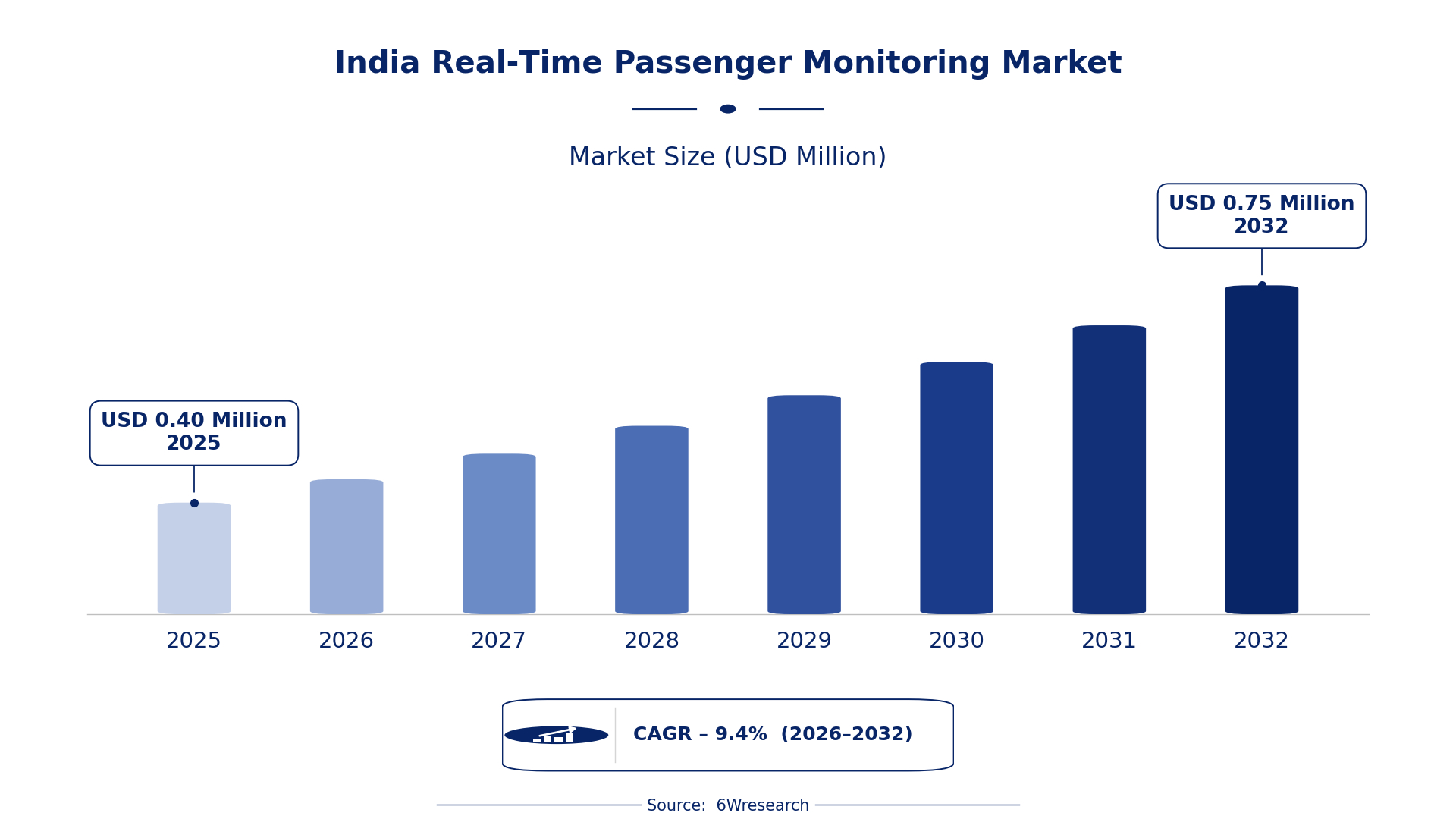
According to 6Wresearch internal database and industry insights, the India Real‑Time Passenger Monitoring Market was valued at USD 0.40 million in 2025 and is projected to reach USD 0.75 million by 2032, growing at a CAGR of approximately 9.4% during 2026–2032.
India Real‑Time Passenger Monitoring Market Highlights
| Report Metric | Details |
| Report Name | India Real‑Time Passenger Monitoring Market |
| Market Size 2025 | USD 0.40 million |
| Market Size 2032 | USD 0.75 million |
| Absolute Growth 2025–2032 | USD 0.35 million |
| CAGR 2026–2032 | 9.4% |
| Peak Annual Growth | 11.6% in 2028 |
| Forecast Period | 2026–2032 |
| Historical Data | 2022–2025 |
| Base Year | 2025 |
| Leading Monitoring Type, 2025 | Facial Recognition (41% share) |
| Leading Technology Used, 2025 | Camera + AI Analytics (44% share) |
| Leading Deployment Mode, 2025 | Onboard/Depot (45% share) |
| Leading End User, 2025 | Rail & Bus Operators (41% share) |
| Fastest-Growing Monitoring Type | Occupancy Sensors (12.0% CAGR) |
| Fastest-Growing Deployment Mode | In-Vehicle (10.5% CAGR) |
| Fastest-Growing End User | Airport Authorities (11.9% CAGR) |
| Growing Sector | Airport Authorities |
| Key End Users | Rail & Bus Operators, Airport Authorities, Fleet Managers, Smart Transit Providers |
India Real‑Time Passenger Monitoring Market Year-wise Growth Rate and Key Drivers (2022–2032)
This graph illustrates the annual growth rates of the market from 2022 to 2032, highlighting a steady upward trajectory and projected market expansion over the forecast period.
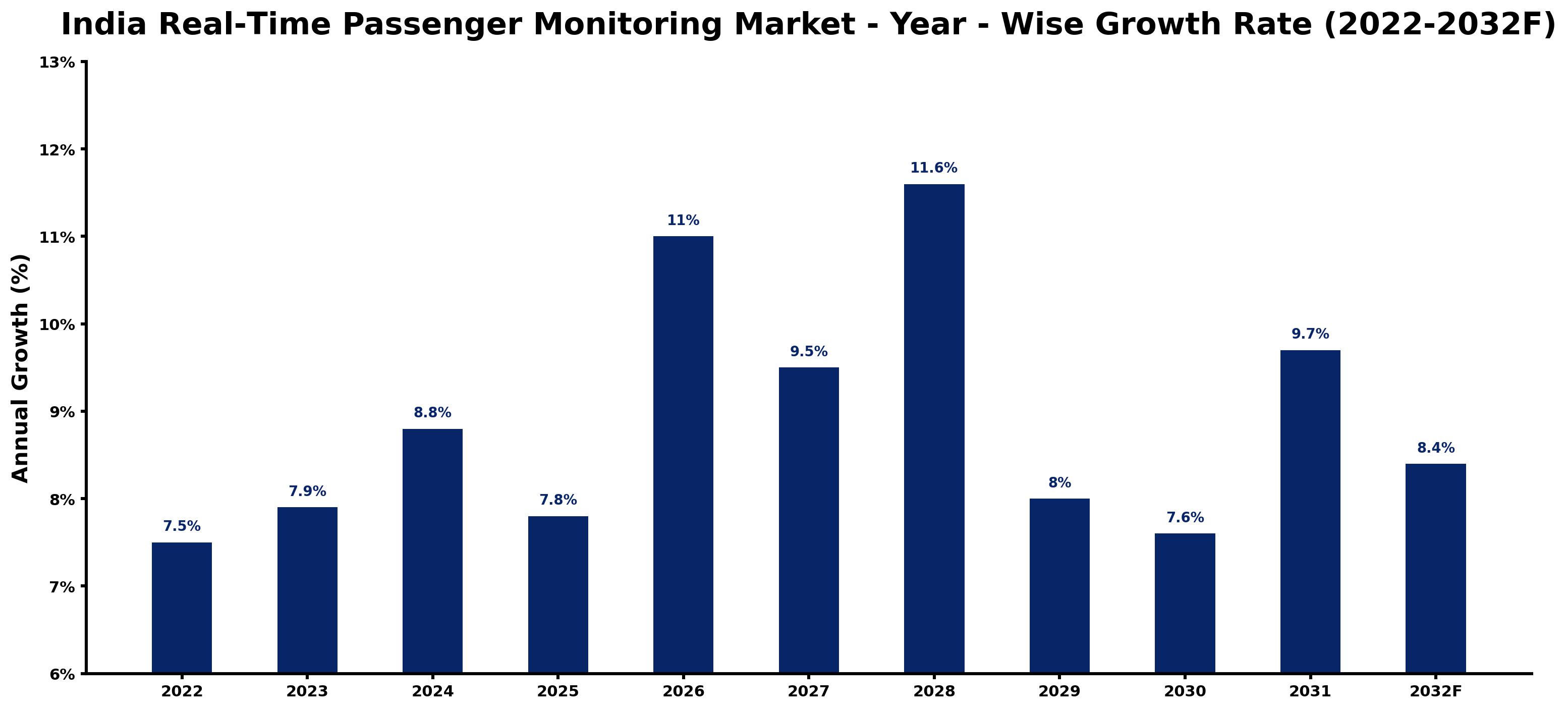
The following table presents the estimated annual growth rate for each year together with the principal factor influencing market performance.
| Year | Estimated Annual Growth (%) | Market Rationale |
| 2022 | 7.5 | The market showed steady growth as urban transport systems expanded in India, driven by the Smart Cities Mission. |
| 2023 | 7.9 | Demand increased due to the ongoing implementation of smart monitoring technologies in urban areas. |
| 2024 | 8.8 | Growth accelerated as passenger safety measures improved through real-time monitoring systems. |
| 2025 | 7.8 | The market experienced a slowdown as infrastructure upgrades faced delays in several regions. |
| 2026 | 11.0 | A surge in investment for public transport modernization is expected to drive faster growth. |
| 2027 | 9.5 | Growth will slow as some projects face regulatory hurdles and approval delays. |
| 2028 | 11.6 | Demand is projected to spike with the introduction of advanced monitoring technologies in transit systems. |
| 2029 | 8.0 | The market will slow as the focus shifts towards integrating existing systems and technologies. |
| 2030 | 7.6 | Growth is expected to decelerate due to the maturation of the initial wave of technology adoption. |
| 2031 | 9.7 | Demand will increase as urban population growth necessitates improved transit solutions. |
| 2032 | 8.4 | The market is projected to grow slower as competition intensifies among service providers. |
Note: Market size estimations and growth projections presented in this report are based on 6Wresearch's proprietary forecasting methodology, utilizing the latest available industry data, government publications, and primary research inputs.
India Real‑Time Passenger Monitoring Market Synopsis
The India Real-Time Passenger Monitoring Market encompasses technologies that improve safety and efficiency in public transport systems. This technology integrates hardware and software to monitor passenger behavior and optimize operations. The market is expanding due to rising urban populations and government initiatives like the Smart Cities Mission. With India's urban population projected to reach 600 million by 2031, demand for efficient transit solutions is increasing. The implementation of advanced monitoring technologies is further driving market growth.
Market Dynamics Impact Analysis (2026–2032)
| Factor | Type | Impact | Primary Segment Affected |
| Increasing urban population driving demand for efficient transit solutions | Driver | High | Rail & Bus Operators |
| Investment in smart technologies under the Smart Cities Mission | Driver | High | Smart Transit Providers |
| Growing need for safety and efficiency in public transport | Opportunity | High | Airport Authorities |
| Implementation of facial recognition technology at railway stations | Opportunity | Medium | Rail & Bus Operators |
| Delays in infrastructure upgrades affecting deployment | Restraint | High | Camera + AI Analytics |
| Regulatory hurdles in adopting new technologies | Restraint | Medium | Occupancy Sensors |
| High costs associated with technology integration | Challenge | High | Fleet Managers |
| Supply chain disruptions affecting hardware availability | Challenge | Medium | Smart Transit Providers |
Evaluation of Drivers in India Real‑Time Passenger Monitoring Market (2026–2032)
Below mentioned are some major drivers and their influence on market dynamics.
| Drivers | Primary Segment Affected | Why It Matters (Evidence) |
| Urban population growth necessitating improved transit solutions | Rail & Bus Operators | India's urban population is expected to reach 600 million by 2031, increasing demand for efficient transit solutions. |
| Government investment in public transport infrastructure upgrades | Smart Transit Providers | In 2023, the Indian government allocated ₹10,000 crores for upgrading public transport infrastructure, including monitoring systems. |
| Implementation of advanced monitoring technologies for safety | Airport Authorities | The Ministry of Railways aims to implement facial recognition technology at 1,200 stations by 2025, improving safety measures. |
| Pilot projects for occupancy sensors in metro systems | Occupancy Sensors | Delhi Metro is piloting occupancy sensors to optimize train frequency and capacity management, improving efficiency. |
| Adoption of AI analytics for operational insights | Camera + AI Analytics | The Ministry of Transport is developing a framework for integrating AI analytics in public transport by 2024, optimizing transit operations. |
The urban population is projected to reach 600 million by 2031, driving demand for efficient transit solutions. In 2023, ₹10,000 crores were allocated for public transport upgrades, including monitoring systems. Pilot projects for occupancy sensors in metro systems are optimizing train frequency, enhancing operational efficiency.
Evaluation of Restraints in India Real‑Time Passenger Monitoring Market
The following restraints limit how fast demand can grow.
| Market Restraint | Primary Segment Affected | Why It Matters (Evidence) |
| Delays in infrastructure upgrades affecting deployment | Camera + AI Analytics | Infrastructure upgrades faced delays in some regions, slowing the adoption of monitoring technologies. |
| Regulatory hurdles in adopting new technologies | Occupancy Sensors | Regulatory challenges have delayed the implementation of advanced monitoring systems, affecting deployment timelines. |
| High costs associated with technology integration | Fleet Managers | The costs of integrating new monitoring technologies can be prohibitive for some fleet managers, limiting adoption. |
| Supply chain disruptions affecting hardware availability | Smart Transit Providers | Supply chain issues have led to delays in acquiring necessary hardware for monitoring systems, affecting project timelines. |
| Limited awareness among smaller operators about benefits | Rail & Bus Operators | Smaller rail and bus operators often lack awareness of the advantages of real-time monitoring, hindering market growth. |
India Real‑Time Passenger Monitoring Market Challenges
The Real-Time Passenger Monitoring market in India encounters several challenges that impede its growth. Urban transport systems are under pressure as India's urban population is anticipated to exceed 500 million by 2031, resulting in delays for users who depend on timely transit solutions. Producers face skills shortages in integrating advanced monitoring technologies, which can extend project timelines by up to six months. Regulatory changes from the Bureau of Indian Standards concerning thermal imaging systems may raise compliance costs for importers by around 15%. Additionally, intense competition among suppliers for smart transit solutions forces buyers to navigate fluctuating prices, complicating budget management for public transport upgrades.
Trends in the India Real‑Time Passenger Monitoring Market
The trends below show where the India Real‑Time Passenger Monitoring Market is heading.
- Shift towards Smart Transit Solutions: The Smart Cities Mission is driving the integration of smart monitoring solutions in urban transport systems. In 2023, the Indian government allocated ₹10,000 crores for these upgrades, improving efficiency for public transport operators.
- Increased Adoption of AI Analytics: Rail & Bus Operators are increasingly adopting AI analytics for operational insights. By 2024, the Ministry of Transport aims to integrate AI analytics in public transport, improving service delivery and efficiency.
- Growing Use of Facial Recognition Technology: The implementation of facial recognition technology is expanding in public transport. The Ministry of Railways plans to deploy this technology at 1,200 stations by 2025, improving security measures.
- Expansion of Occupancy Sensors in Metro Systems: Occupancy sensors are being piloted in Delhi Metro to optimize train frequency. This initiative is expected to improve capacity management, with a projected 20% increase in operational efficiency.
Investment Opportunities in the India Real‑Time Passenger Monitoring Market
The following opportunities in the India Real‑Time Passenger Monitoring Market pair current demand with a clear way in.
- Timing for Infrastructure Upgrades: With the Indian government allocating ₹10,000 crores for public transport upgrades in 2023, there is a strong opportunity for investment in monitoring systems. Rail & Bus Operators can improve their services by adopting these technologies.
- Focus on Smart Transit Solutions: The Smart Cities Mission provides a timely opportunity for investment in smart monitoring solutions. Urban areas are prioritizing these technologies to improve transit efficiency and safety.
- Partnerships for Technology Integration: Collaboration with local partners can facilitate the integration of advanced monitoring technologies. Smart Transit Providers can benefit from joint ventures to improve service offerings.
- Growing Demand from Airport Authorities: Airport Authorities are increasingly seeking advanced monitoring solutions for passenger safety. With a projected growth in air travel, there is a need for efficient monitoring systems.
Government Initiatives in the India Real‑Time Passenger Monitoring Market
The National Urban Transport Policy, updated in 2021, encourages the adoption of real-time monitoring technologies in public transport. This policy promotes sustainable urban transport solutions, ensuring that public transport systems are equipped with the latest monitoring technologies. The Smart Cities Mission, initiated by the Ministry of Housing and Urban Affairs in 2015, aims to implement smart monitoring solutions in urban transport systems, improving safety and efficiency. The Ministry of Railways has also launched the National Rail Plan in 2020, targeting the integration of advanced monitoring technologies by 2030, ensuring a modernised transit system.
Airport Authorities utilise the Smart Cities Mission to enhance their monitoring capabilities. This initiative supports projects that integrate advanced technologies, ensuring improved passenger safety and operational efficiency. The Ministry of Transport oversees the implementation of these projects, providing funding and guidelines to facilitate the adoption of smart monitoring solutions in urban transport systems.
Future Insight of the India Real‑Time Passenger Monitoring Market
The Real-Time Passenger Monitoring market in India is set for transformation as urban transport initiatives gain momentum. The government is expected to invest substantially in public transport infrastructure, with ₹10,000 crores earmarked for upgrades in 2023. By 2025, the implementation of AI analytics in transit operations will optimise resource management and improve efficiency. The ongoing Smart Cities Mission will drive the adoption of advanced monitoring technologies, resulting in improved safety and operational insights for both buyers and suppliers.
Market Segmentation Analysis
The analysis below covers each segmentation, its leading category in 2025 and its fastest-growing category through 2032.
By Monitoring Type – Facial Recognition Dominated, Occupancy Sensors Expected to Grow Fastest
According to Ravi Bhandari, Research Head at 6Wresearch, Facial Recognition accounted for a 41% market share by monitoring type in 2025. Facial recognition technology leads the India Real-Time Passenger Monitoring Market due to its essential role in enhancing security within crowded transport environments. The Ministry of Railways' initiative to implement this technology at 1,200 stations by 2025 underscores its significance in improving safety measures. Occupancy Sensors are projected to grow fastest, at a CAGR of 12.0% during 2026–2032. Occupancy sensors are witnessing rapid growth as they effectively manage passenger loads, which is crucial for optimizing transit operations. The pilot project in Delhi Metro demonstrates their potential to adjust train frequency in response to real-time demand, addressing the needs of a growing urban population. This trend indicates that suppliers should focus on developing advanced monitoring solutions to cater to the increasing demand from public transport operators.
By Technology Used – Camera + AI Analytics Dominated and Is Expected to Record the Fastest Growth
The largest technology used category in 2025 was Camera + AI Analytics, with a 44% share of total revenue. The integration of cameras with analytics holds the largest market share, as it is vital for processing real-time data and monitoring in transit systems. This combination enhances operational efficiency and safety across public transport networks. Camera + AI Analytics is also forecast to expand faster than any other category, at a CAGR of 12.0% over 2026–2032. The growth of camera and analytics is propelled by the rising demand for monitoring solutions that deliver actionable insights. As transit authorities increasingly adopt these technologies, their market share will continue to expand, solidifying their position. Suppliers must prioritise advancements in camera and analytics to meet the evolving requirements of public transport systems.
By Deployment Mode – Onboard/Depot Dominated, In-Vehicle Expected to Grow Fastest
With a 45% revenue share in 2025, Onboard/Depot was the largest deployment mode category. The onboard and depot deployment mode captures the largest share due to its effectiveness in monitoring conditions within vehicles and depots, essential for ensuring safety and operational efficiency. This approach is particularly critical for managing the extensive fleet of passenger trains and buses operating daily in India. The quickest growth will come from In-Vehicle, forecast to expand at a CAGR of 10.5% between 2026 and 2032. In-vehicle deployment is rapidly gaining traction as it facilitates real-time monitoring during transit, which is essential for enhancing passenger safety and experience. As urban transport systems expand, this mode is expected to see increased adoption. Suppliers should invest in in-vehicle monitoring solutions to align with the growing emphasis on real-time passenger safety.
By End User – Rail & Bus Operators Dominated, Airport Authorities Expected to Grow Fastest
Rail & Bus Operators took a 41% share of end user in 2025, more than any other category. Rail and bus operators represent the largest share in the market, being the primary users of real-time monitoring systems crucial for ensuring passenger safety and operational efficiency. Their extensive operations across the country necessitate robust monitoring technologies to support their needs effectively. Over 2026–2032, Airport Authorities are expected to post the fastest growth, at a CAGR of 11.9%. Airport authorities are increasingly adopting real-time monitoring solutions to enhance passenger experience and security, reflecting a shift towards smarter airport operations. This trend is likely to accelerate as air travel continues to grow in India. This shift suggests that suppliers should tailor their offerings to meet the specific requirements of airport authorities alongside traditional transport operators.
Key Attractiveness of the Report
- 10 Years of Market Numbers
- Historical Data Starting from 2022 to 2025
- Base Year 2025
- Forecast Data until 2032
- Key Performance Indicators Impacting the Market
- Major Upcoming Developments and Projects
Key Highlights of the Report:
- India Real Time Passenger Monitoring Market Outlook
- Market Size of India Real Time Passenger Monitoring Market, 2025
- Forecast of India Real Time Passenger Monitoring Market, 2032
- Historical Data and Forecast of India Real Time Passenger Monitoring Revenues & Volume for the Period 2022 - 2032F
- India Real Time Passenger Monitoring Market Trend Evolution
- India Real Time Passenger Monitoring Market Drivers and Challenges
- India Real Time Passenger Monitoring Price Trends
- India Real Time Passenger Monitoring Porter's Five Forces
- India Real Time Passenger Monitoring Industry Life Cycle
- Historical Data and Forecast of India Real Time Passenger Monitoring Market Revenues & Volume By Monitoring Type for the Period 2022 - 2032F
- Historical Data and Forecast of India Real Time Passenger Monitoring Market Revenues & Volume By Facial Recognition for the Period 2022 - 2032F
- Historical Data and Forecast of India Real Time Passenger Monitoring Market Revenues & Volume By Occupancy Sensors for the Period 2022 - 2032F
- Historical Data and Forecast of India Real Time Passenger Monitoring Market Revenues & Volume By Temperature Monitoring for the Period 2022 - 2032F
- Historical Data and Forecast of India Real Time Passenger Monitoring Market Revenues & Volume By Behavior Analysis for the Period 2022 - 2032F
- Historical Data and Forecast of India Real Time Passenger Monitoring Market Revenues & Volume By Technology Used for the Period 2022 - 2032F
- Historical Data and Forecast of India Real Time Passenger Monitoring Market Revenues & Volume By Camera AI Analytics for the Period 2022 - 2032F
- Historical Data and Forecast of India Real Time Passenger Monitoring Market Revenues & Volume By Infrared/Lidar for the Period 2022 - 2032F
- Historical Data and Forecast of India Real Time Passenger Monitoring Market Revenues & Volume By Thermal Imaging for the Period 2022 - 2032F
- Historical Data and Forecast of India Real Time Passenger Monitoring Market Revenues & Volume By Video Analytics for the Period 2022 - 2032F
- Historical Data and Forecast of India Real Time Passenger Monitoring Market Revenues & Volume By Deployment Mode for the Period 2022 - 2032F
- Historical Data and Forecast of India Real Time Passenger Monitoring Market Revenues & Volume By Onboard/Depot for the Period 2022 - 2032F
- Historical Data and Forecast of India Real Time Passenger Monitoring Market Revenues & Volume By In-Vehicle for the Period 2022 - 2032F
- Historical Data and Forecast of India Real Time Passenger Monitoring Market Revenues & Volume By Gates/Entrance Points for the Period 2022 - 2032F
- Historical Data and Forecast of India Real Time Passenger Monitoring Market Revenues & Volume By Hybrid Edge Cloud for the Period 2022 - 2032F
- Historical Data and Forecast of India Real Time Passenger Monitoring Market Revenues & Volume By End User for the Period 2022 - 2032F
- Historical Data and Forecast of India Real Time Passenger Monitoring Market Revenues & Volume By Rail & Bus Operators for the Period 2022 - 2032F
- Historical Data and Forecast of India Real Time Passenger Monitoring Market Revenues & Volume By Fleet Managers for the Period 2022 - 2032F
- Historical Data and Forecast of India Real Time Passenger Monitoring Market Revenues & Volume By Airport Authorities for the Period 2022 - 2032F
- Historical Data and Forecast of India Real Time Passenger Monitoring Market Revenues & Volume By Smart Transit Providers for the Period 2022 - 2032F
- India Real Time Passenger Monitoring Import Export Trade Statistics
- Market Opportunity Assessment By Monitoring Type
- Market Opportunity Assessment By Technology Used
- Market Opportunity Assessment By Deployment Mode
- Market Opportunity Assessment By End User
- India Real Time Passenger Monitoring Top Companies Market Share
- India Real Time Passenger Monitoring Competitive Benchmarking By Technical and Operational Parameters
- India Real Time Passenger Monitoring Company Profiles
- India Real Time Passenger Monitoring Key Strategic Recommendations
Market Covered
The report offers an extensive study of the following market segments.
By Monitoring Type
- Facial Recognition
- Occupancy Sensors
- Temperature Monitoring
- Behavior Analysis
By Technology Used
- Camera + AI Analytics
- Infrared/Lidar
- Thermal Imaging
- Video Analytics
By Deployment Mode
- Onboard/Depot
- In-Vehicle
- Gates/Entrance Points
- Hybrid Edge–Cloud
By End User
- Rail & Bus Operators
- Fleet Managers
- Airport Authorities
- Smart Transit Providers































