India Redundant Ignition Unit Market Size & Growth Rate
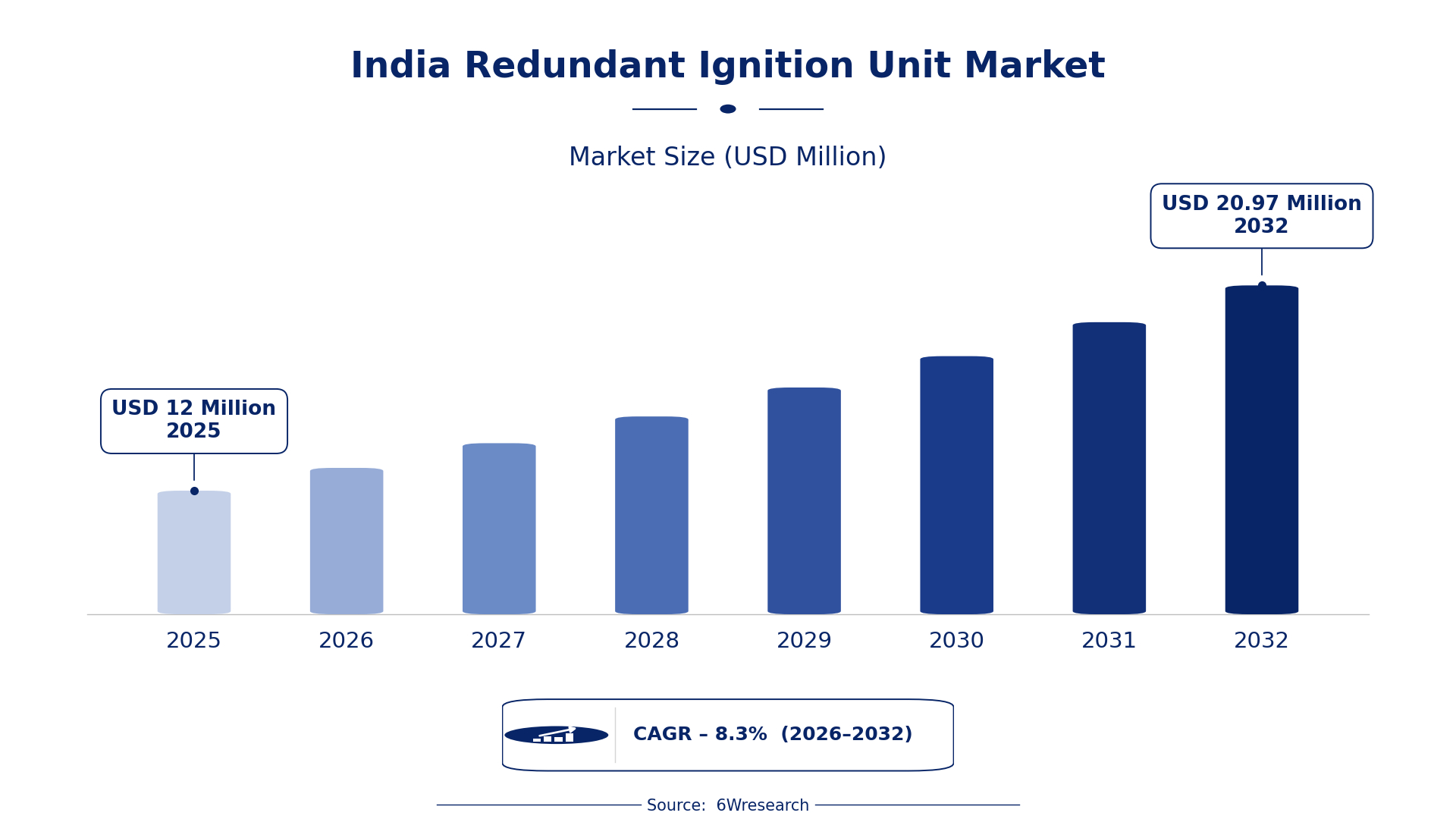
According to 6Wresearch internal database and industry insights, the India Redundant Ignition Unit Market was valued at USD 12 million in 2025 and is projected to reach USD 20.97 million by 2032, growing at a CAGR of approximately 8.3% during 2026–2032.
India Redundant Ignition Unit Market Highlights
| Report Metric | Details |
| Report Name | India Redundant Ignition Unit Market |
| Market Size 2025 | USD 12 million |
| Market Size 2032 | USD 20.97 million |
| Absolute Growth 2025–2032 | USD 8.97 million |
| CAGR 2026–2032 | 8.3% |
| Peak Annual Growth | 9.9% in 2028 |
| Forecast Period | 2026–2032 |
| Historical Data | 2022–2025 |
| Base Year | 2025 |
| Leading Unit Type, 2025 | Redundant Ignition Systems (46% share) |
| Leading Redundancy Mode, 2025 | Hot Standby (40% share) |
| Leading Ignition Type, 2025 | Electronic Control (35% share) |
| Leading End User, 2025 | Aircraft & Engine OEMs (42% share) |
| Fastest-Growing Unit Type | Backup Ignition Modules (10.4% CAGR) |
| Fastest-Growing Ignition Type | Spark/Igniter (10.1% CAGR) |
| Fastest-Growing End User | Military Engines (10.7% CAGR) |
| Growing Sector | Aerospace and Defense |
| Key End Users | Aircraft & Engine OEMs, Military Engines, Space Launch Vehicles, Rotary-Wing Aircraft |
India Redundant Ignition Unit Market Year-wise Growth Rate and Key Drivers (2022–2032)
This graph illustrates the annual growth rates of the market from 2022 to 2032, highlighting a steady upward trajectory and projected market expansion over the forecast period.
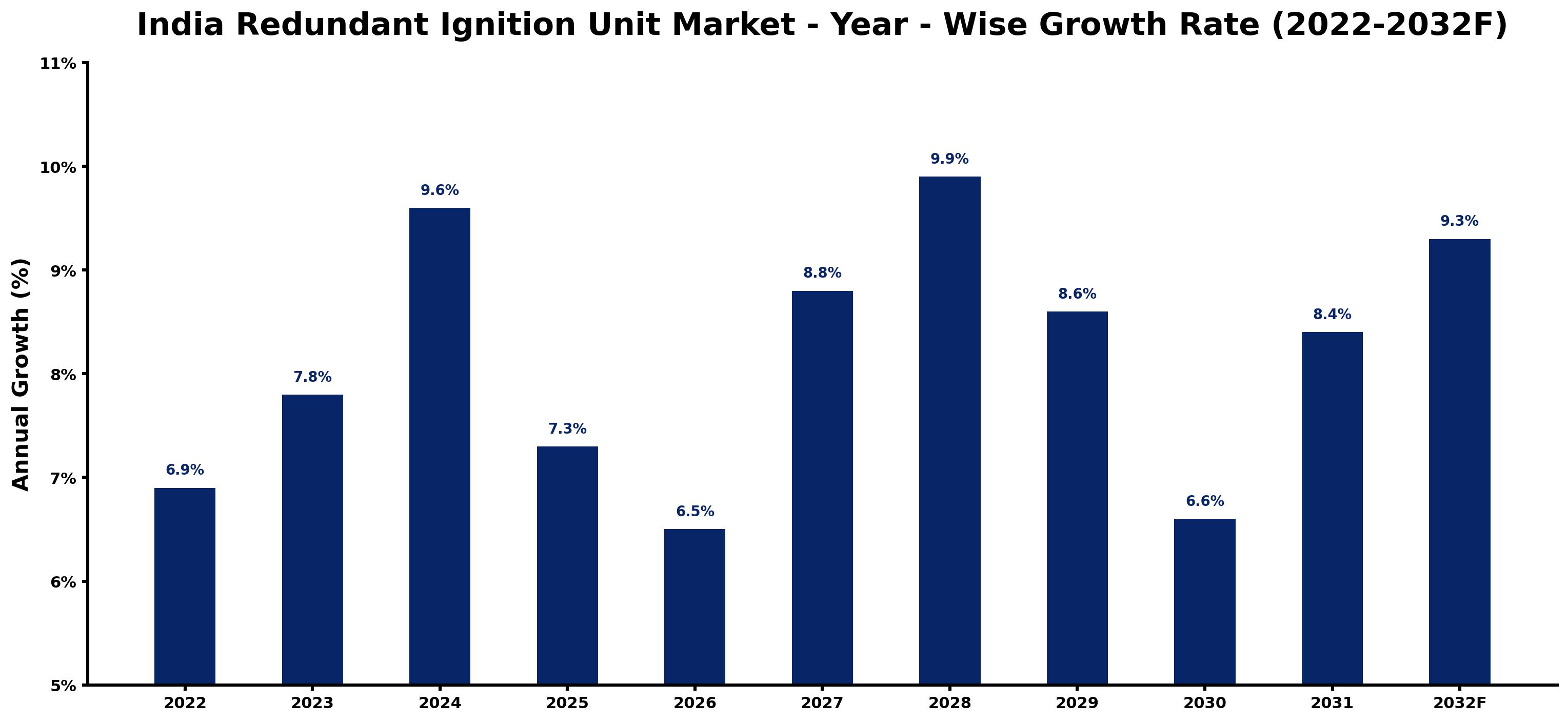
Annual growth estimates for each year appear below with the principal reason behind them, explaining the shifts that set the pace of the market.
| Year | Estimated Annual Growth (%) | Market Rationale |
| 2022 | 6.9 | The market experienced steady growth due to increasing demand for reliable ignition systems. |
| 2023 | 7.8 | Demand rose as the Indian government focused on indigenous aircraft manufacturing initiatives. |
| 2024 | 9.6 | Growth accelerated with heightened military procurement and modernization efforts. |
| 2025 | 7.3 | A slowdown occurred as the market adjusted to previous high growth rates. |
| 2026 | 6.5 | Growth continued at a slower pace, influenced by ongoing supply chain challenges. |
| 2027 | 8.8 | Demand increased as military engines required more reliable ignition solutions. |
| 2028 | 9.9 | The market peaked with significant investments in aerospace and defense manufacturing. |
| 2029 | 8.6 | A slight slowdown followed as growth stabilised after the peak. |
| 2030 | 6.6 | Continued growth was supported by the aging aircraft fleet in need of upgrades. |
| 2031 | 8.4 | Demand rose again due to increased defense budget allocations for modernization. |
| 2032 | 9.3 | Growth remained strong as the focus on indigenous capabilities continued. |
Note: Market size estimations and growth projections presented in this report are based on 6Wresearch's proprietary forecasting methodology, utilizing the latest available industry data, government publications, and primary research inputs.
India Redundant Ignition Unit Market Synopsis
The Redundant Ignition Unit Market in India encompasses critical safety components used in aerospace applications, ensuring reliable ignition in aircraft engines. These units are manufactured using advanced electronic systems and materials designed for extreme conditions. The market is driven by a growing aerospace sector, with strong demand from domestic manufacturers and military applications. The Indian government's focus on boosting indigenous capabilities and increasing defense production to $25 billion by 2025 further propels growth. As the average age of aircraft rises, the need for dependable ignition systems becomes increasingly pressing.
Market Dynamics Impact Analysis (2026–2032)
| Factor | Type | Impact | Primary Segment Affected |
| Increased focus on indigenous manufacturing | Driver | High | Redundant Ignition Systems |
| Growing military procurement for modernization | Driver | High | Military Engines |
| Investment in aerospace manufacturing capabilities | Opportunity | High | Backup Ignition Modules |
| Rising demand for reliable ignition in space missions | Opportunity | Medium | Space Launch Vehicles |
| Supply chain disruptions affecting production timelines | Restraint | High | Redundant Dual Inverters |
| High costs associated with advanced technology adoption | Restraint | Medium | Electronic Control |
| Limited availability of skilled workforce in aerospace | Challenge | High | Dual Igniters |
| Regulatory hurdles in defense procurement processes | Challenge | Medium | Hot Standby |
Evaluation of Drivers in India Redundant Ignition Unit Market (2026–2032)
Below mentioned are some major drivers and their influence on market dynamics.
| Drivers | Primary Segment Affected | Why It Matters (Evidence) |
| Growing demand for reliable ignition systems in military applications | Military Engines | The Indian Air Force operates over 1,500 aircraft, necessitating dependable ignition solutions for operational readiness. |
| Increased investment in indigenous aircraft manufacturing | Redundant Ignition Systems | The Indian government aims to boost defense production to $25 billion by 2025, driving demand for advanced ignition units. |
| Rising average age of aircraft requiring upgrades | Backup Ignition Modules | With the average age of aircraft in India around 15 years, manufacturers are compelled to improve their ignition systems. |
| Support from the Aerospace and Defence Manufacturing Competitiveness Scheme | Redundant Dual Inverters | This initiative provides funding to support innovation in ignition technologies, promoting local manufacturing capabilities. |
| Focus on enhancing indigenous capabilities in aerospace manufacturing | Electronic Control | The National Aerospace Policy aims for 70% self-reliance by 2030, encouraging local production of ignition units. |
Growth in the Redundant Ignition Unit market in India comes from rising demand for reliable ignition systems, particularly in military applications. The Indian Air Force's operation of over 1,500 aircraft necessitates dependable ignition solutions for operational readiness. As the average age of aircraft reaches around 15 years, manufacturers are compelled to upgrade their ignition systems. Support from the Aerospace and Defence Manufacturing Competitiveness Scheme, which funds innovation in ignition technologies, further drives market potential.
Evaluation of Restraints in India Redundant Ignition Unit Market
The table below lists the restraints and the evidence behind each.
| Market Restraint | Primary Segment Affected | Why It Matters (Evidence) |
| Supply chain disruptions affecting production timelines | Redundant Dual Inverters | Manufacturers face delays in sourcing critical components, impacting delivery schedules. |
| High costs associated with advanced technology adoption | Electronic Control | Investments in cutting-edge technologies can strain budgets for smaller manufacturers. |
| Limited availability of skilled workforce in aerospace | Dual Igniters | A shortage of trained professionals can hinder production efficiency and quality. |
| Regulatory hurdles in defense procurement processes | Hot Standby | Complex approval processes can delay the introduction of new ignition systems. |
| Competition from established international suppliers | Backup Ignition Modules | Local manufacturers struggle to compete with well-established global players. |
India Redundant Ignition Unit Market Challenges
The India Redundant Ignition Unit market faces practical issues, starting with cost. High manufacturing expenses, driven by the need for advanced electronic systems, can inflate prices by up to 20%, affecting domestic manufacturers' competitiveness. Supply chain disruptions present another hurdle, as delays in sourcing materials can extend lead times by 30%, complicating procurement schedules for military buyers. A shortage of skilled aerospace engineers exacerbates the situation, with around 15% of positions unfilled, leading to project delays for producers. Regulatory compliance with defence procurement standards can also impede innovation, slowing the introduction of new ignition solutions to buyers.
Trends in the India Redundant Ignition Unit Market
Buyers and suppliers in the India Redundant Ignition Unit Market are adjusting to the following trends.
- Shift from Traditional to Advanced Ignition Technologies: Since 2021, the Indian aerospace sector has increasingly embraced advanced ignition technologies, such as electronic control systems. This shift is evidenced by the Aerospace and Defence Manufacturing Competitiveness Scheme, which allocated $1 billion to support innovation.
- Transition from Single to Dual Ignition Systems: Aircraft & Engine OEMs are opting for dual ignition systems to improve safety. This trend is reflected in the growing demand for redundant ignition systems, with a projected market share of 46% by 2025.
- Emergence of Indigenous Manufacturing Standards: The National Aerospace and Defense Policy 2021 promotes indigenous technologies, impacting the production of ignition units. This policy targets 70% self-reliance by 2030, encouraging local manufacturers to meet new standards.
- Increased Focus on Military Applications: Military Engines are driving demand for redundant ignition units, particularly since 2022. The Indian government's defense budget for 2023-24 is approximately $73 billion, significantly boosting procurement efforts.
Investment Opportunities in the India Redundant Ignition Unit Market
The following opportunities in the India Redundant Ignition Unit Market pair current demand with a clear way in.
- Investment in Redundant Ignition Systems: With the Indian government aiming for $25 billion in defense production by 2025, there is a substantial opportunity to invest in redundant ignition systems. Aircraft & Engine OEMs are seeking reliable solutions to meet growing demands.
- Supply of Backup Ignition Modules: Now is an ideal time to supply backup ignition modules, given the increasing focus on safety in military applications. The military sector is actively seeking reliable ignition solutions to enhance operational readiness.
- Development of Electronic Control Systems: The push for indigenous manufacturing creates an opportunity to develop electronic control systems for ignition units. The National Policy on Electronics 2019 aims to boost electronics manufacturing, positively impacting this segment.
- Enhancement of Hot Standby Systems: The demand for hot standby systems is rising due to the need for immediate backup in military engines. Investing in this area can cater to the growing requirements of the Indian Air Force.
Government Initiatives in the India Redundant Ignition Unit Market
The Defence Production Policy 2020 aims to achieve a turnover of $26 billion in defense manufacturing by 2025, enhancing local production of ignition systems. This policy encourages manufacturers to invest in advanced technologies and expand their capabilities, ensuring a more robust domestic supply chain for ignition units.
The Ministry of Defence oversees the implementation of various schemes, including the Aerospace and Defence Manufacturing Competitiveness Scheme launched in 2021. This scheme provides funding to support innovation in ignition technologies, helping local manufacturers improve their products and compete in the global market.
Future Insight of the India Redundant Ignition Unit Market
Several forward-looking factors should support the India Redundant Ignition Unit market over the coming years. The government's goal to increase defence production to $25 billion by 2025 will drive demand for reliable ignition systems. The Aerospace and Defence Manufacturing Competitiveness Scheme will support innovation, allowing suppliers to develop new technologies. The National Aerospace Policy aims to enhance indigenous capabilities, ensuring a steady supply of advanced ignition solutions. With India's defence budget for 2023-24 at approximately $73 billion, procurement for robust ignition systems will remain a priority.
Market Segmentation Analysis
Each segment group is reviewed below, with the leader by share and the fastest grower by CAGR.
By Unit Type – Redundant Ignition Systems Dominated, Backup Ignition Modules Expected to Grow Fastest
According to Ravi Bhandari, Research Head at 6Wresearch, the largest unit type category in 2025 was Redundant Ignition Systems, with a 46% share of total revenue. Redundant Ignition Systems hold the largest share due to their essential function in ensuring safety and reliability across various aerospace applications. These systems are particularly critical for military aircraft, which require dependable ignition solutions for effective operational performance. Backup Ignition Modules are projected to grow fastest, at a CAGR of 10.4% during 2026–2032. Backup Ignition Modules are experiencing rapid growth because they provide necessary redundancy to prevent ignition failures in high-stakes environments. The increasing focus on safety enhancements in aerospace applications is a key factor driving this segment's expansion. Suppliers should prioritise the development of Backup Ignition Modules to align with the rising safety standards in the aerospace sector.
By Redundancy Mode – Hot Standby Dominated and Is Expected to Record the Fastest Growth
With a 40% revenue share in 2025, Hot Standby was the largest redundancy mode category. Hot Standby commands the largest share as it offers immediate backup in the event of primary system failure, making it vital for aviation safety. Its widespread application in both military and commercial aircraft underscores its importance in maintaining operational integrity. The same category is also set to grow fastest, at a CAGR of 10.1% during 2026–2032. Hot Standby is also the fastest-growing segment, as its reliability in providing immediate backup corresponds with the tightening safety regulations in the aerospace industry. This dual role as both leader and fastest highlights its critical position in the market. Suppliers must ensure robust Hot Standby solutions to satisfy the increasing safety requirements in aerospace applications.
By Ignition Type – Electronic Control Dominated, Spark/Igniter Expected to Grow Fastest
Electronic Control took a 35% share of ignition type in 2025, more than any other category. Electronic Control leads the market due to its vital function in managing ignition timing and performance in contemporary engines. Its integration into advanced aircraft systems underscores its necessity for optimal engine operation and reliability. The quickest growth will come from Spark/Igniter, forecast to expand at a CAGR of 10.1% between 2026 and 2032. Spark/Igniter is the fastest-growing segment, propelled by its fundamental role in ignition for combustion engines, especially in new aircraft designs. As manufacturers innovate, the demand for efficient ignition solutions continues to surge. Buyers should prioritise sourcing advanced Spark/Igniter technologies to improve engine performance and reliability.
By End User – Aircraft & Engine OEMs Dominated, Military Engines Expected to Grow Fastest
Aircraft & Engine OEMs accounted for a 42% market share by end user in 2025. Aircraft & Engine OEMs dominate the market share as the main users of redundant ignition systems in their manufacturing processes. Their significant investments in safety and reliability drive the demand for these crucial components. Military Engines are set to record the highest CAGR in this split, 10.7% over 2026–2032. Military Engines represent the fastest-growing segment, reflecting the urgent need for reliable ignition systems in defense applications. The rising defense budget and focus on operational readiness are major factors contributing to this growth. Suppliers should customise their offerings to address the specific needs of military applications to capture this expanding market.
Key Attractiveness of the Report
- 10 Years of Market Numbers
- Historical Data Starting from 2022 to 2025
- Base Year 2025
- Forecast Data until 2032
- Key Performance Indicators Impacting the Market
- Major Upcoming Developments and Projects
Key Highlights of the Report:
- India Redundant Ignition Unit Market Outlook
- Market Size of India Redundant Ignition Unit Market, 2025
- Forecast of India Redundant Ignition Unit Market, 2032
- Historical Data and Forecast of India Redundant Ignition Unit Revenues & Volume for the Period 2022 - 2032F
- India Redundant Ignition Unit Market Trend Evolution
- India Redundant Ignition Unit Market Drivers and Challenges
- India Redundant Ignition Unit Price Trends
- India Redundant Ignition Unit Porter's Five Forces
- India Redundant Ignition Unit Industry Life Cycle
- Historical Data and Forecast of India Redundant Ignition Unit Market Revenues & Volume By Unit Type for the Period 2022 - 2032F
- Historical Data and Forecast of India Redundant Ignition Unit Market Revenues & Volume By Dual Igniters for the Period 2022 - 2032F
- Historical Data and Forecast of India Redundant Ignition Unit Market Revenues & Volume By Backup Ignition Modules for the Period 2022 - 2032F
- Historical Data and Forecast of India Redundant Ignition Unit Market Revenues & Volume By Redundant Ignition Systems for the Period 2022 - 2032F
- Historical Data and Forecast of India Redundant Ignition Unit Market Revenues & Volume By Redundant Dual Inverters for the Period 2022 - 2032F
- Historical Data and Forecast of India Redundant Ignition Unit Market Revenues & Volume By Redundancy Mode for the Period 2022 - 2032F
- Historical Data and Forecast of India Redundant Ignition Unit Market Revenues & Volume By Twin-Plug Configuration for the Period 2022 - 2032F
- Historical Data and Forecast of India Redundant Ignition Unit Market Revenues & Volume By Hot Standby for the Period 2022 - 2032F
- Historical Data and Forecast of India Redundant Ignition Unit Market Revenues & Volume By Multi-Chamber Engines for the Period 2022 - 2032F
- Historical Data and Forecast of India Redundant Ignition Unit Market Revenues & Volume By Parallel Units for the Period 2022 - 2032F
- Historical Data and Forecast of India Redundant Ignition Unit Market Revenues & Volume By Ignition Type for the Period 2022 - 2032F
- Historical Data and Forecast of India Redundant Ignition Unit Market Revenues & Volume By Spark/Igniter for the Period 2022 - 2032F
- Historical Data and Forecast of India Redundant Ignition Unit Market Revenues & Volume By Electronic Control for the Period 2022 - 2032F
- Historical Data and Forecast of India Redundant Ignition Unit Market Revenues & Volume By Plasma Ignitors for the Period 2022 - 2032F
- Historical Data and Forecast of India Redundant Ignition Unit Market Revenues & Volume By DC High-Power for the Period 2022 - 2032F
- Historical Data and Forecast of India Redundant Ignition Unit Market Revenues & Volume By End User for the Period 2022 - 2032F
- Historical Data and Forecast of India Redundant Ignition Unit Market Revenues & Volume By Aircraft & Engine OEMs for the Period 2022 - 2032F
- Historical Data and Forecast of India Redundant Ignition Unit Market Revenues & Volume By Military Engines for the Period 2022 - 2032F
- Historical Data and Forecast of India Redundant Ignition Unit Market Revenues & Volume By Space Launch Vehicles for the Period 2022 - 2032F
- Historical Data and Forecast of India Redundant Ignition Unit Market Revenues & Volume By Rotary-Wing Aircraft for the Period 2022 - 2032F
- India Redundant Ignition Unit Import Export Trade Statistics
- Market Opportunity Assessment By Unit Type
- Market Opportunity Assessment By Redundancy Mode
- Market Opportunity Assessment By Ignition Type
- Market Opportunity Assessment By End User
- India Redundant Ignition Unit Top Companies Market Share
- India Redundant Ignition Unit Competitive Benchmarking By Technical and Operational Parameters
- India Redundant Ignition Unit Company Profiles
- India Redundant Ignition Unit Key Strategic Recommendations
Market Covered
This report examines the market across the segments below.
By Unit Type
- Dual Igniters
- Backup Ignition Modules
- Redundant Ignition Systems
- Redundant Dual Inverters
By Redundancy Mode
- Twin-Plug Configuration
- Hot Standby
- Multi-Chamber Engines
- Parallel Units
By Ignition Type
- Spark/Igniter
- Electronic Control
- Plasma Ignitors
- DC High-Power
By End User
- Aircraft & Engine OEMs
- Military Engines
- Space Launch Vehicles
- Rotary-Wing Aircraft






































