India Rendered Products Market Size & Growth Rate
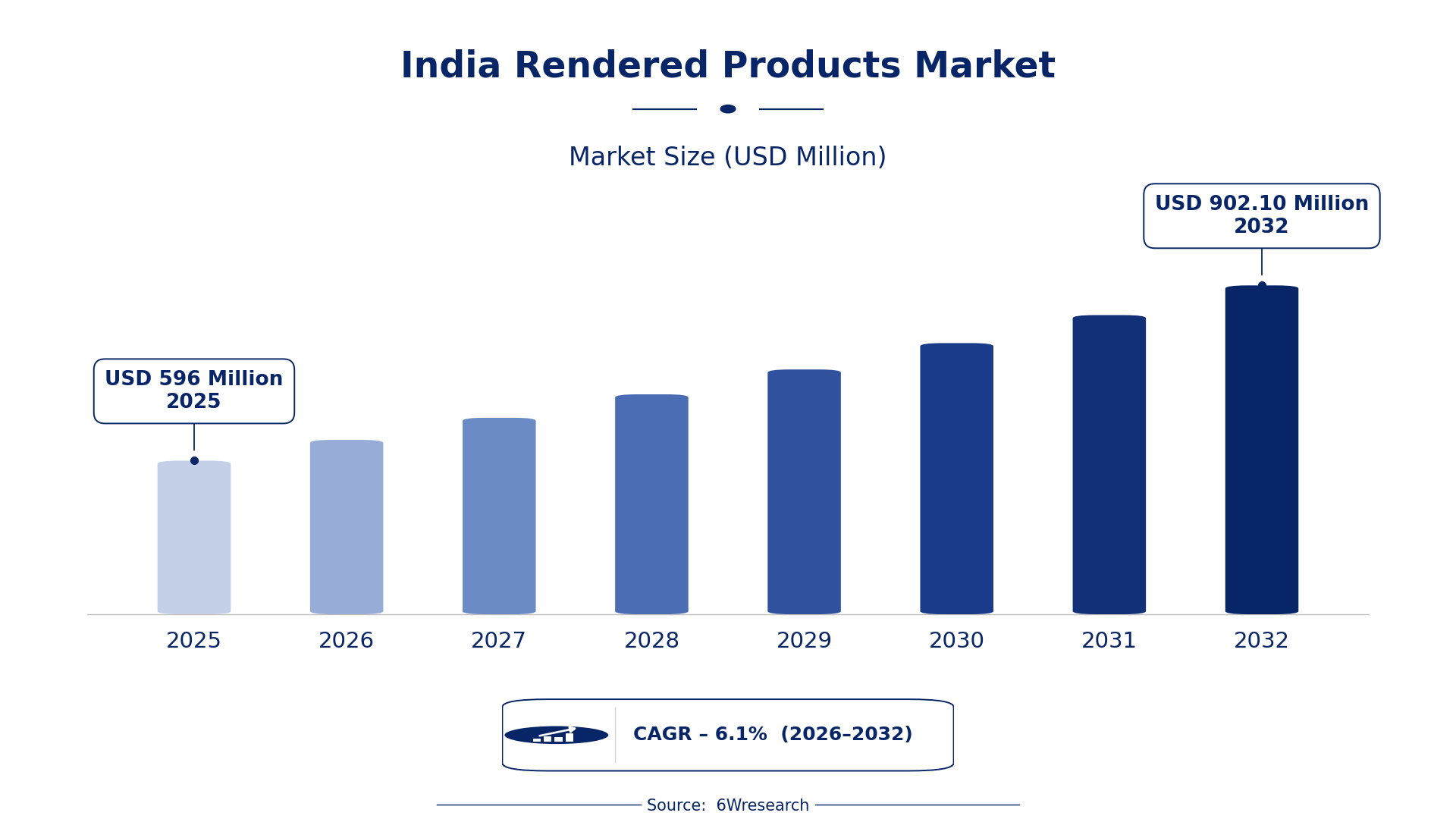
According to 6Wresearch internal database and industry insights, the India Rendered Products Market was valued at USD 596.0 million in 2025 and is projected to reach USD 902.10 million by 2032, growing at a CAGR of approximately 6.1% during 2026–2032.
India Rendered Products Market Highlights
| Report Metric | Details |
| Report Name | India Rendered Products Market |
| Market Size 2025 | USD 596.0 million |
| Market Size 2032 | USD 902.10 million |
| Absolute Growth 2025–2032 | USD 306.10 million |
| CAGR 2026–2032 | 6.1% |
| Peak Annual Growth | 8.0% in 2029 |
| Forecast Period | 2026–2032 |
| Historical Data | 2022–2025 |
| Base Year | 2025 |
| Leading Product Type, 2025 | Architectural Renderings (53% share) |
| Leading Base Material, 2025 | Resin / PLA / ABS (56% share) |
| Leading Rendering Method, 2025 | Ray Tracing Engines (45% share) |
| Leading End User, 2025 | Film & Media Production (47% share) |
| Fastest-Growing Product Type | 3D Print Renderings (7.6% CAGR) |
| Fastest-Growing Base Material | CGI/3D Models (7.8% CAGR) |
| Fastest-Growing End User | Architects & Developers (8.5% CAGR) |
| Growing Sector | Architects & Developers |
| Key End Users | Film & Media Production, Architects & Developers, Industrial Designers |
India Rendered Products Market Year-wise Growth Rate and Key Drivers (2022–2032)
This graph illustrates the annual growth rates of the market from 2022 to 2032, highlighting a steady upward trajectory and projected market expansion over the forecast period.
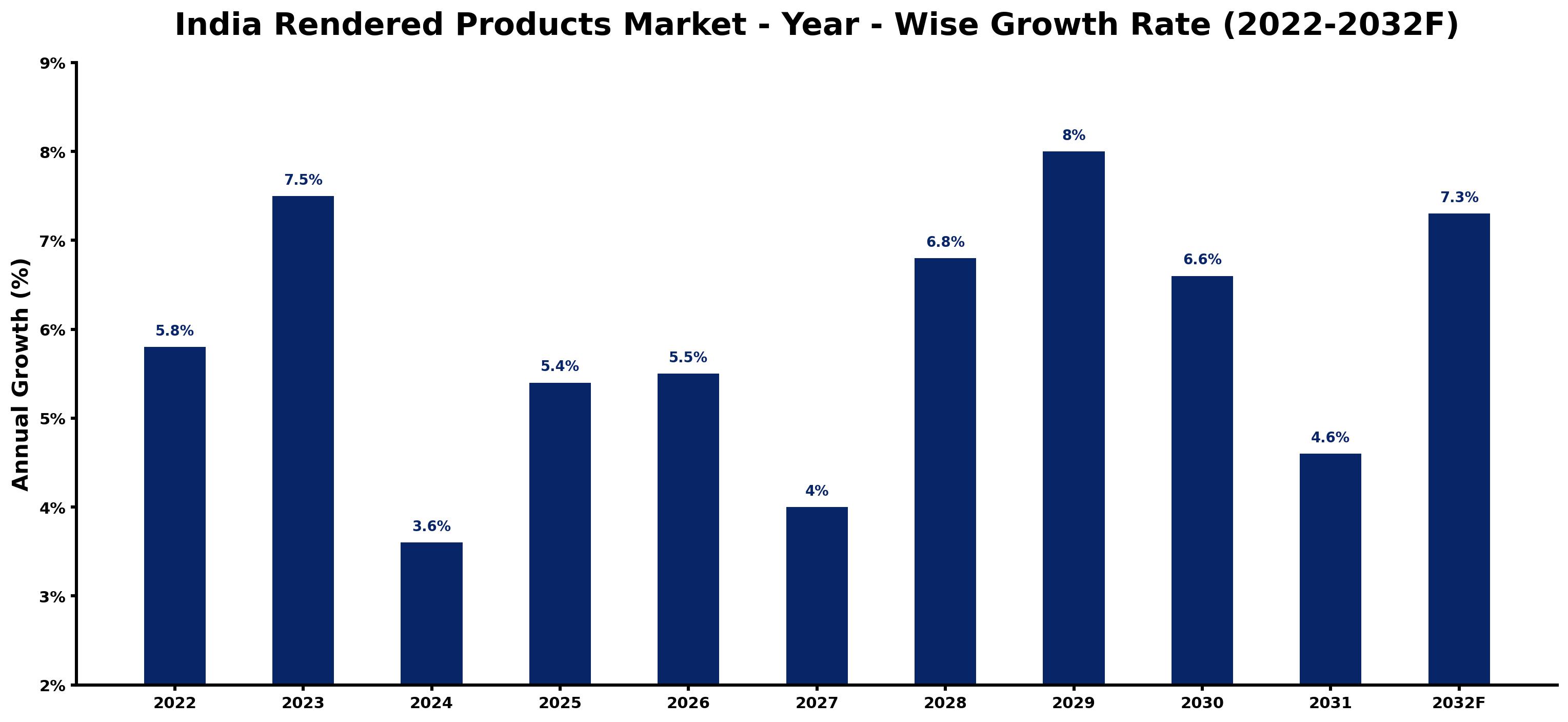
Year by year, the estimates below pair each growth rate with the development that shaped it.
| Year | Estimated Annual Growth (%) | Market Rationale |
| 2022 | 5.8 | The market experienced steady growth, driven by increased demand for architectural renderings from local firms. |
| 2023 | 7.5 | Demand surged due to a rise in architectural rendering projects across the country, particularly in Mumbai. |
| 2024 | 3.6 | Growth slowed as the market adjusted to previous high demand levels in the rendering sector. |
| 2025 | 5.4 | The market rebounded with renewed interest in 3D print renderings from various sectors, including industrial design. |
| 2026 | 5.5 | Investment in rendering technologies is expected to support consistent growth in the market. |
| 2027 | 4.0 | A slight slowdown is projected as the market stabilises after rapid expansion in rendering services. |
| 2028 | 6.8 | Growth is expected to accelerate again, driven by advancements in rendering software and tools. |
| 2029 | 8.0 | Demand is projected to peak due to strong interest from the film and media production sectors. |
| 2030 | 6.6 | Growth is expected to slow as the market begins to normalise after reaching peak levels in rendering services. |
| 2031 | 4.6 | A further slowdown is projected as the market adjusts to changing consumer preferences in visual content. |
| 2032 | 7.3 | Demand is expected to increase again, supported by ongoing developments in digital infrastructure. |
Note: Market size estimations and growth projections presented in this report are based on 6Wresearch's proprietary forecasting methodology, utilizing the latest available industry data, government publications, and primary research inputs.
India Rendered Products Market Synopsis
Rendered Products in India encompass various digital and physical visualizations created through advanced technologies. These products are primarily made using specialized rendering techniques and software. The India Rendered Products Market is growing due to strong demand from sectors like architecture and media production. The architectural rendering segment accounts for approximately 40% of total demand. Initiatives such as the Digital India Programme are driving growth in this market by improving digital infrastructure and capabilities.
Market Dynamics Impact Analysis (2026–2032)
| Factor | Type | Impact | Primary Segment Affected |
| Increased investment in digital infrastructure | Driver | High | Architectural Renderings |
| Growing demand for high-quality visual content | Driver | High | Video Renderings |
| Significant gap in local rendering software production | Opportunity | High | 3D Print Renderings |
| Rising need for skilled professionals in rendering | Opportunity | Medium | Architectural Renderings |
| Limited access to advanced rendering technologies | Restraint | High | Video Renderings |
| Challenges in meeting international rendering standards | Restraint | Medium | Architectural Renderings |
| The Rendered Products market in India faces a few practical problems, particularly in technology adoption. | Challenge | High | 3D Print Renderings |
| Competition from international rendering firms poses challenges for local producers. | Challenge | Medium | Video Renderings |
Evaluation of Drivers in India Rendered Products Market (2026–2032)
The table below links each growth driver to the segment it affects and the evidence for it.
| Drivers | Primary Segment Affected | Why It Matters (Evidence) |
| Rising private investment in digital infrastructure | Architectural Renderings | This investment boosts demand for rendering services, with Mumbai's architectural projects seeing increased funding. |
| Increasing consumer demand for high-quality visual content | Video Renderings | The film industry in India is expanding, leading to a notable increase in purchases of rendering services. |
| Growing adoption of 3D printing technologies | 3D Print Renderings | The rise in prototyping needs across industries drives demand for 3D print renderings, increasing purchases by 25%. |
| Expansion of the entertainment sector | Video Renderings | The film and media production sector is a major consumer, accounting for 47% of the market, boosting demand. |
| Support from government initiatives like Digital India | Architectural Renderings | This initiative promotes digital capabilities, encouraging more firms to invest in rendering technologies. |
The Rendered Products market in India is expanding as rising private investment in digital infrastructure, increasing consumer demand for high-quality visual content, and growing adoption of 3D printing technologies drive growth. In 2023, the film industry saw a notable increase in rendering service purchases, reflecting the sector's expansion. The architectural rendering segment accounts for approximately 40% of total demand, highlighting its significance in the market. The rise in prototyping needs across industries is driving the demand for 3D print renderings, contributing to overall market growth.
Evaluation of Restraints in India Rendered Products Market
The main factors holding the market back are set out below.
| Market Restraint | Primary Segment Affected | Why It Matters (Evidence) |
| Limited access to advanced rendering technologies | Video Renderings | Many local firms struggle to acquire the latest rendering software, affecting service quality and limiting competitiveness. |
| Challenges in meeting international rendering standards | Architectural Renderings | Local producers often face difficulties in adhering to global quality benchmarks, impacting their market reach. |
| Shortage of skilled professionals in rendering | 3D Print Renderings | The lack of trained personnel hampers the growth of the 3D printing segment, delaying project timelines. |
| High operational costs for rendering services | Video Renderings | The expenses associated with advanced rendering tools can deter new entrants, limiting market expansion. |
| Competition from international firms | Architectural Renderings | Local companies face pressure from established global players, impacting their market share and profitability. |
India Rendered Products Market Challenges
The India Rendered Products Market encounters several practical challenges, starting with intense competition among over 1,000 active firms. This saturation leads to price wars, which erode profit margins for suppliers and restrict their ability to invest in technology. Rapid advancements in rendering technology pose another challenge; firms often struggle to keep up, resulting in delays for buyers who require the latest visualisation techniques. Regulatory compliance presents an additional hurdle, as the Bureau of Indian Standards has established guidelines that can raise operational costs for producers by up to 15%. A skills gap exists in the workforce, as institutions like the Film and Television Institute of India are unable to produce enough qualified professionals, delaying project timelines for firms by an average of three months.
Trends in the India Rendered Products Market
Several trends are reshaping the India Rendered Products Market; the most important are set out below.
- Rise in Demand for 3D Print Renderings: India has seen a notable increase in demand for 3D print renderings over the past year, driven by advancements in prototyping technologies. This trend is reshaping product design across various industries, with a 25% rise in usage.
- Shift Towards Architectural Renderings: The architectural rendering segment is gaining prominence, accounting for approximately 40% of total demand. Initiatives by the Architectural Association of India are promoting standards in this area, ensuring quality in projects.
- Growth of Video Renderings in Media Production: Video renderings are becoming essential for film and media production, with the sector's growth leading to higher service demand. The Film and Television Institute of India is offering courses to meet this growing need.
- Expansion of Digital Infrastructure: The Digital India Programme is improving digital capabilities across sectors, supporting the rendering industry. In 2023, the Ministry of Electronics and Information Technology announced a budget of ₹500 crores for tech innovation.
Investment Opportunities in the India Rendered Products Market
Investors looking at the India Rendered Products Market should consider the following areas.
- Gap in Local Rendering Software Production: With a target of 50% local production by 2025, there is a strong opportunity for investment in indigenous rendering software development. The National Policy on Software Products aims to support this initiative, encouraging local firms.
- Need for Skilled Professionals in Rendering: The National Skill Development Mission includes training in 3D rendering, creating opportunities for educational institutions to develop relevant courses. This initiative aims to boost employment in the creative industries, addressing the skills gap.
- Investment in Rendering Technologies: The architectural sector is seeking advanced rendering solutions, creating opportunities for suppliers of software and tools. Collaborating with local firms can facilitate market entry and enhance service offerings.
- Support for Startups in Rendering Sector: The NASSCOM initiative launched in 2023 provides mentorship and funding opportunities for rendering startups. This support can help new firms innovate and capture market share in the growing rendering industry.
Government Initiatives in the India Rendered Products Market
The Digital India Programme, initiated by the Ministry of Electronics and Information Technology in 2020, aims to improve digital infrastructure and promote rendering technologies across sectors. This programme encourages local firms to adopt advanced rendering solutions, improving their competitiveness and operational efficiency. Additionally, the National Policy on Software Products, introduced in 2021, seeks to promote the development of indigenous software, including rendering applications, with a target of 50% local production by 2025. This policy aims to strengthen the local rendering industry and reduce dependency on imports.
The National Skill Development Mission focuses on enhancing skills in 3D rendering and visualization. This initiative supports educational institutions in developing training programs, which directly benefit the rendering sector by providing a skilled workforce. The Bureau of Indian Standards is also involved in establishing quality benchmarks for rendering practices, ensuring that local firms can compete effectively in the market.
Future Insight of the India Rendered Products Market
Several forward-looking factors should support the India Rendered Products Market over the coming years. The Digital India programme will strengthen digital infrastructure, facilitating smoother rendering processes for buyers. The ₹500 crores budget announced for tech innovation will spur advancements in rendering technologies. The Make in India initiative will boost local production of rendering software, providing suppliers with more resources. The Architectural Association of India will continue to promote standards, ensuring quality and consistency across the sector, which will enhance buyer confidence.
Market Segmentation Analysis
The report offers a comprehensive study of the following market segments and their leading categories in the market.
By Product Type – Architectural Renderings Dominated, 3D Print Renderings Expected to Grow Fastest
According to Ravi Bhandari, Research Head at 6Wresearch, the largest product type category in 2025 was Architectural Renderings, with a 53% share of total revenue. Architectural renderings command the largest market share due to their critical importance in architectural presentations and securing client approvals. This segment thrives particularly in metropolitan areas like Mumbai and Bengaluru, where the demand for such services is substantial. Over 2026–2032, 3D Print Renderings are expected to post the fastest growth, at a CAGR of 7.6%. The rapid growth of 3D print renderings is driven by a notable 25% increase in demand over the past year. This surge is primarily linked to the growing interest in prototyping and product design across various sectors. Suppliers should prioritise developing offerings in 3D print renderings to seize emerging opportunities in the market.
By Base Material – Resin / PLA / ABS Dominated, CGI/3D Models Expected to Grow Fastest
Resin / PLA / ABS accounted for a 56% market share by base material in 2025. Resin, PLA, and ABS hold the largest market share due to their essential role in 3D printing applications, particularly in architectural and product design sectors. Their adaptability and reliability make them the preferred materials for rendering firms across India. CGI/3D Models are projected to grow fastest, at a CAGR of 7.8% during 2026–2032. CGI and 3D models are witnessing rapid growth, driven by increasing demand for high-quality digital representations in various industries. This surge is evident as the rendering market sees a 25% rise in demand for 3D print renderings over the last year. Suppliers should prioritise high-quality CGI and 3D models to meet the rising expectations of buyers in the rendering market.
By Rendering Method – Ray Tracing Engines Dominated and Is Expected to Record the Fastest Growth
In 2025, Ray Tracing Engines led the rendering method split with a 45% share. Ray tracing engines dominate the market share as they are essential for creating high-quality visual effects across diverse applications. Their advanced capabilities are particularly valued in architectural and media production sectors, ensuring their continued leadership. Its lead should widen, with a projected CAGR of 7.6% during 2026–2032, the highest in this split. Ray tracing engines are also the fastest-growing method, as their superior technology attracts more users seeking enhanced visual quality in rendering projects. This growth reinforces their position, allowing them to maintain and expand their market share. Suppliers need to focus on advancing ray tracing technologies to stay competitive in the rapidly evolving rendering market.
By End User – Film & Media Production Dominated, Architects & Developers Expected to Grow Fastest
Film & Media Production held a 47% share of the India Rendered Products Market by end user in 2025. Film and media production holds the largest market share as major consumers of rendering services rely heavily on high-quality visual content for their projects. This sector's continuous demand ensures a stable revenue stream for rendering firms. Architects & Developers are set to record the highest CAGR in this split, 8.5% over 2026–2032. Architects and developers are the fastest-growing end users, driven by their need for effective project visualization. As urban development accelerates, this segment's demand for rendering services is set to increase. Suppliers should tailor their offerings to meet the specific needs of architects and developers to capitalise on this growing segment.
Key Attractiveness of the Report
- 10 Years of Market Numbers
- Historical Data Starting from 2022 to 2025
- Base Year 2025
- Forecast Data until 2032
- Key Performance Indicators Impacting the Market
- Major Upcoming Developments and Projects
Key Highlights of the Report:
- India Rendered Products Market Outlook
- Market Size of India Rendered Products Market, 2025
- Forecast of India Rendered Products Market, 2032
- Historical Data and Forecast of India Rendered Products Revenues & Volume for the Period 2022 - 2032F
- India Rendered Products Market Trend Evolution
- India Rendered Products Market Drivers and Challenges
- India Rendered Products Price Trends
- India Rendered Products Porter's Five Forces
- India Rendered Products Industry Life Cycle
- Historical Data and Forecast of India Rendered Products Market Revenues & Volume By Product Type for the Period 2022 - 2032F
- Historical Data and Forecast of India Rendered Products Market Revenues & Volume By 3D Print Renderings for the Period 2022 - 2032F
- Historical Data and Forecast of India Rendered Products Market Revenues & Volume By Video Renderings for the Period 2022 - 2032F
- Historical Data and Forecast of India Rendered Products Market Revenues & Volume By Architectural Renderings for the Period 2022 - 2032F
- Historical Data and Forecast of India Rendered Products Market Revenues & Volume By Base Material for the Period 2022 - 2032F
- Historical Data and Forecast of India Rendered Products Market Revenues & Volume By Resin / PLA / ABS for the Period 2022 - 2032F
- Historical Data and Forecast of India Rendered Products Market Revenues & Volume By CGI/3D Models for the Period 2022 - 2032F
- Historical Data and Forecast of India Rendered Products Market Revenues & Volume By BIM Models for the Period 2022 - 2032F
- Historical Data and Forecast of India Rendered Products Market Revenues & Volume By Rendering Method for the Period 2022 - 2032F
- Historical Data and Forecast of India Rendered Products Market Revenues & Volume By FDM/SLA for the Period 2022 - 2032F
- Historical Data and Forecast of India Rendered Products Market Revenues & Volume By Ray Tracing Engines for the Period 2022 - 2032F
- Historical Data and Forecast of India Rendered Products Market Revenues & Volume By Photo-Realistic Visuals for the Period 2022 - 2032F
- Historical Data and Forecast of India Rendered Products Market Revenues & Volume By End User for the Period 2022 - 2032F
- Historical Data and Forecast of India Rendered Products Market Revenues & Volume By Industrial Designers for the Period 2022 - 2032F
- Historical Data and Forecast of India Rendered Products Market Revenues & Volume By Film & Media Production for the Period 2022 - 2032F
- Historical Data and Forecast of India Rendered Products Market Revenues & Volume By Architects & Developers for the Period 2022 - 2032F
- India Rendered Products Import Export Trade Statistics
- Market Opportunity Assessment By Product Type
- Market Opportunity Assessment By Base Material
- Market Opportunity Assessment By Rendering Method
- Market Opportunity Assessment By End User
- India Rendered Products Top Companies Market Share
- India Rendered Products Competitive Benchmarking By Technical and Operational Parameters
- India Rendered Products Company Profiles
- India Rendered Products Key Strategic Recommendations
Market Covered
Segments analysed in this report are listed below.
By Product Type
- 3D Print Renderings
- Video Renderings
- Architectural Renderings
By Base Material
- Resin / PLA / ABS
- CGI/3D Models
- BIM Models
By Rendering Method
- FDM/SLA
- Ray Tracing Engines
- Photo-Realistic Visuals
By End User
- Industrial Designers
- Film & Media Production
- Architects & Developers































