India Renewable Airborne Power Market Size & Growth Rate
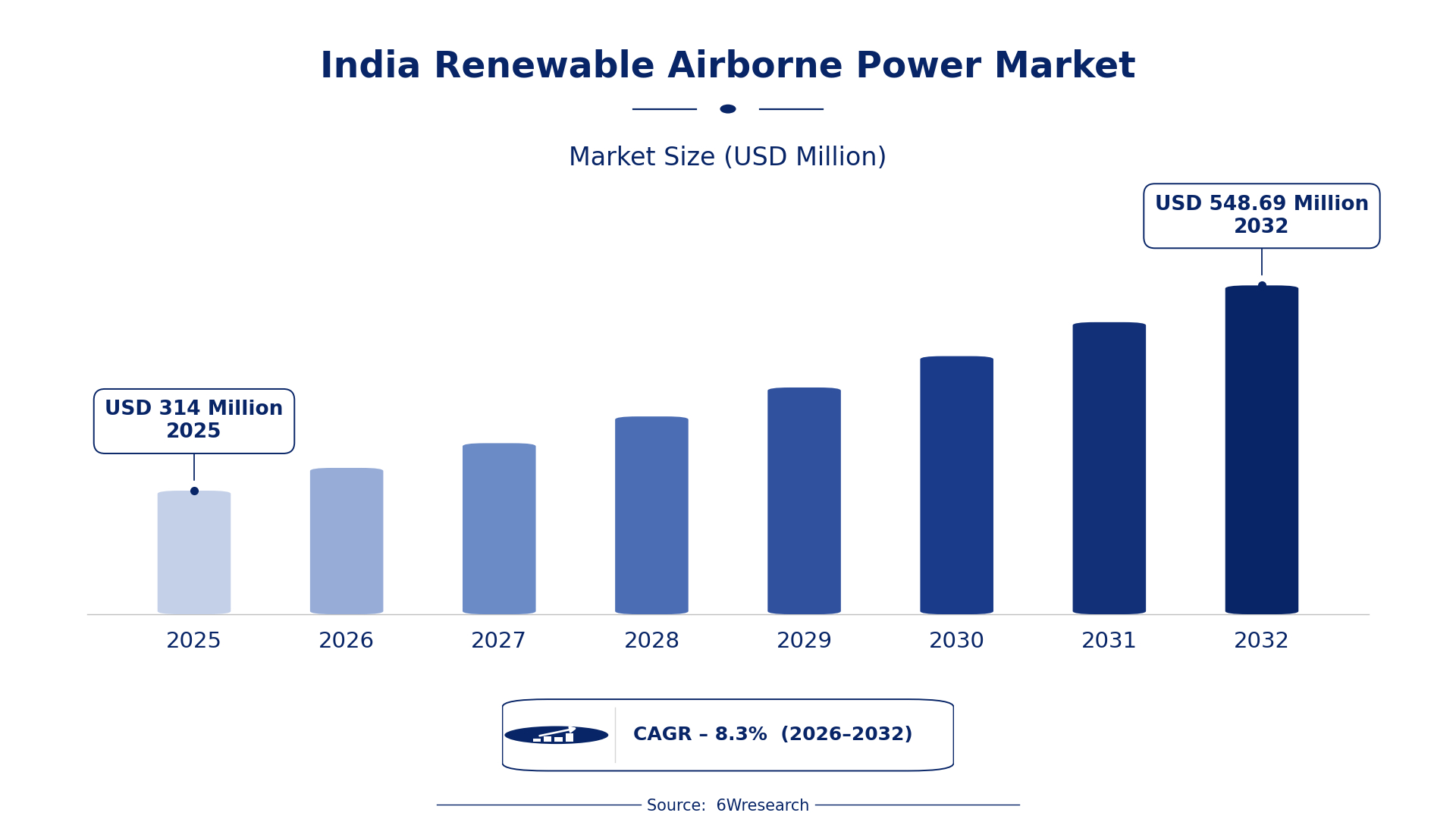
According to 6Wresearch internal database and industry insights, the India Renewable Airborne Power Market was valued at USD 314.0 million in 2025 and is projected to reach USD 548.69 million by 2032, growing at a CAGR of approximately 8.3% during 2026–2032.
India Renewable Airborne Power Market Highlights
| Report Metric | Details |
| Report Name | India Renewable Airborne Power Market |
| Market Size 2025 | USD 314.0 million |
| Market Size 2032 | USD 548.69 million |
| Absolute Growth 2025–2032 | USD 234.69 million |
| CAGR 2026–2032 | 8.3% |
| Peak Annual Growth | 10.5% in 2027 |
| Forecast Period | 2026–2032 |
| Historical Data | 2022–2025 |
| Base Year | 2025 |
| Leading Platform, 2025 | Kite Power Systems (53% share) |
| Leading Energy Type, 2025 | Wind (47% share) |
| Leading Application Mode, 2025 | Ground Tethered (48% share) |
| Leading End User, 2025 | Utility-Scale Pilot Projects (48% share) |
| Fastest-Growing Platform | Drone-Based Solar UAVs (10.5% CAGR) |
| Fastest-Growing Energy Type | Solar Panels (10.8% CAGR) |
| Fastest-Growing Application Mode | Solar Survey/Power (10.2% CAGR) |
| Fastest-Growing End User | Remote Site Operators (10.8% CAGR) |
| Growing Sector | Solar Survey/Power |
| Key End Users | Ground Tethered, Solar Survey/Power, Tethered Aerostats |
India Renewable Airborne Power Market Year-wise Growth Rate and Key Drivers (2022–2032)
This graph illustrates the annual growth rates of the market from 2022 to 2032, highlighting a steady upward trajectory and projected market expansion over the forecast period.
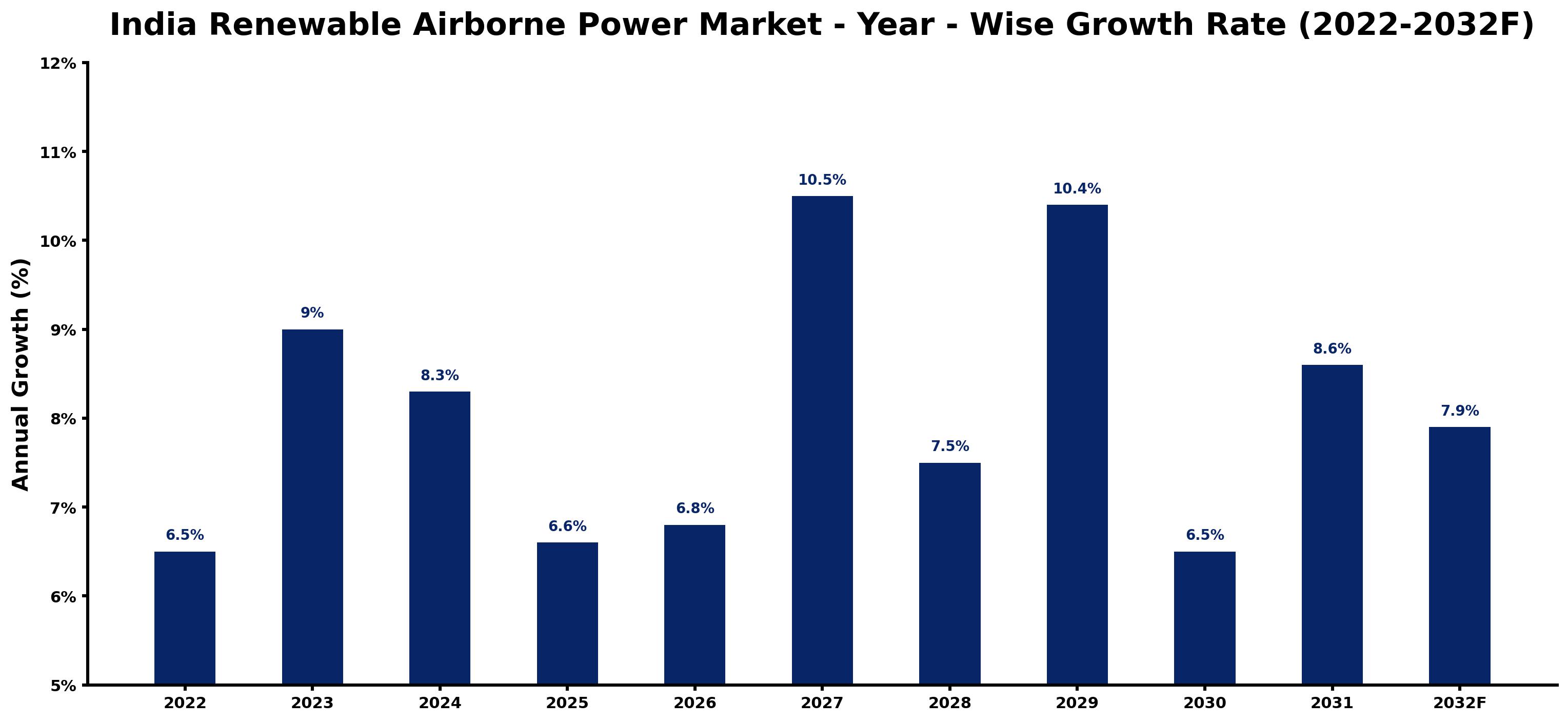
Below, each year's estimated growth is shown next to the factor that most influenced it.
| Year | Estimated Annual Growth (%) | Market Rationale |
| 2022 | 6.5 | The market experienced steady growth due to ongoing investments in renewable energy technologies. |
| 2023 | 9.0 | Increased focus on innovative technologies led to faster growth compared to the previous year. |
| 2024 | 8.3 | Growth slowed as projects faced delays in regulatory approvals and implementation. |
| 2025 | 6.6 | Market growth continued to decelerate as competition intensified among emerging technologies. |
| 2026 | 6.8 | Growth picked up again as new projects were initiated under supportive government policies. |
| 2027 | 10.5 | The market peaked with the introduction of advanced airborne power systems and pilot projects. |
| 2028 | 7.5 | Growth slowed as the market matured and competition became more pronounced. |
| 2029 | 10.4 | Increased investments in remote site energy solutions spurred faster growth once again. |
| 2030 | 6.5 | Growth decelerated as the market began to stabilise with established technologies. |
| 2031 | 8.6 | A resurgence in demand for utility-scale projects led to a faster growth rate. |
| 2032 | 7.9 | The market experienced a slowdown as it reached a more stable growth phase. |
Note: Market size estimations and growth projections presented in this report are based on 6Wresearch's proprietary forecasting methodology, utilizing the latest available industry data, government publications, and primary research inputs.
India Renewable Airborne Power Market Synopsis
Renewable Airborne Power in India includes energy generation systems that utilise airborne platforms such as kites and drones. These systems capture wind and solar energy to supply power for remote regions and large-scale projects. The India Renewable Airborne Power Market is expanding due to substantial investments in new technologies and government backing. With India's renewable energy capacity reaching 150 GW in 2023, the emphasis on airborne power solutions is clear. Initiatives like the National Wind-Solar Hybrid Policy are further stimulating demand and investment in this sector.
Market Dynamics Impact Analysis (2026–2032)
| Factor | Type | Impact | Primary Segment Affected |
| Support from government initiatives and policies | Driver | High | Utility-Scale Pilot Projects |
| Growing demand for off-grid energy solutions | Driver | High | Remote Site Operators |
| Investment in pilot projects for airborne technologies | Opportunity | High | Utility-Scale Pilot Projects |
| Need for sustainable energy solutions in remote areas | Opportunity | High | Off-Grid Research Stations |
| Regulatory delays in project approvals | Restraint | High | Drone-Based Solar UAVs |
| High initial investment costs for airborne systems | Restraint | Medium | Kite Power Systems |
| Limited awareness among potential buyers | Challenge | Medium | Atmospheric Turbines |
| Competition from established renewable energy sources | Challenge | High | Wind |
Evaluation of Drivers in India Renewable Airborne Power Market (2026–2032)
Key forces behind demand, with the segment each one moves most, are listed below.
| Drivers | Primary Segment Affected | Why It Matters (Evidence) |
| Government initiatives promoting renewable technologies | Utility-Scale Pilot Projects | The National Wind-Solar Hybrid Policy aims for 10 GW by 2025, encouraging investment in pilot projects. |
| Increasing demand for energy in remote areas | Remote Site Operators | Off-grid research stations in Uttarakhand are adopting airborne power solutions for energy needs. |
| Technological advancements in airborne systems | Drone-Based Solar UAVs | Drone-based solar UAVs in Himachal Pradesh improve solar energy collection capabilities. |
| Growing focus on sustainability in energy generation | Kite Power Systems | Kite power systems are being tested in Rajasthan, showcasing potential for wind energy generation. |
| Investment in research and development of airborne technologies | Atmospheric Turbines | An investment of INR 1,000 crores was allocated for renewable energy innovations, including airborne power. |
Off-grid research stations in Uttarakhand are increasingly adopting renewable airborne power solutions, improving energy access for remote communities. Funding of INR 1,000 crores for renewable energy innovations supports ongoing research and development in airborne technologies, enhancing overall market prospects.
Evaluation of Restraints in India Renewable Airborne Power Market
The key brakes on demand, and where they bite hardest, are shown below.
| Market Restraint | Primary Segment Affected | Why It Matters (Evidence) |
| Regulatory delays in project approvals | Drone-Based Solar UAVs | Delays in approvals hinder the deployment of drone-based solar UAVs in remote areas, affecting energy access. |
| High initial investment costs for airborne systems | Kite Power Systems | The high capital required for kite power systems limits adoption among smaller operators, with costs often exceeding INR 10 crores. |
| Limited awareness among potential buyers | Atmospheric Turbines | Many potential users lack knowledge about the benefits and applications of atmospheric turbines, hindering market growth. |
| Competition from established renewable energy sources | Wind | Wind energy remains a dominant player, making it challenging for airborne systems to gain market share against established technologies. |
| Technological challenges in system integration | Utility-Scale Pilot Projects | Integrating airborne technologies into existing energy systems presents technical hurdles for large-scale projects, delaying implementation. |
India Renewable Airborne Power Market Challenges
High initial investment costs in the India Renewable Airborne Power market exceed INR 10 crores for project setup, deterring many operators in remote areas from embracing these technologies. Suppliers encounter limited domestic production of advanced materials, resulting in reliance on imports that can delay project timelines for developers by as much as six months. A skills gap of around 30% in trained personnel hampers the effective operation of airborne technologies, leading to operational inefficiencies for producers. Rising operational costs, driven by fluctuating energy prices, squeeze profit margins, prompting buyers to reconsider their financial commitments to renewable projects.
Trends in the India Renewable Airborne Power Market
The trends below show where the India Renewable Airborne Power Market is heading.
- Shift Towards Utility-Scale Pilot Projects: India is increasingly concentrating on utility-scale pilot projects for airborne power technologies. In 2023, several pilot projects were initiated under the National Solar Mission, showcasing the feasibility of these systems.
- Transition from Traditional to Airborne Energy Solutions: The year 2022 marked a transition as traditional energy sources began to be supplanted by airborne solutions. In Rajasthan, kite power systems are being trialled to effectively harness wind energy.
- Emergence of Drone-Based Solar Solutions: Drone-based solar solutions are gaining popularity in India, especially in remote regions. In Himachal Pradesh, these UAVs are being deployed for solar energy collection, enhancing energy access.
- Increased Focus on Off-Grid Energy Solutions: Remote site operators are prioritising off-grid energy solutions, particularly in challenging terrains. Off-grid research stations in Uttarakhand are increasingly implementing renewable airborne power technologies.
Investment Opportunities in the India Renewable Airborne Power Market
Investors looking at the India Renewable Airborne Power Market should consider the following areas.
- Investment in Utility-Scale Projects: India's renewable energy capacity reached 150 GW in 2023, highlighting the need for utility-scale projects. Utility-scale pilot projects can attract investment from government initiatives, ensuring long-term growth.
- Expansion of Off-Grid Solutions: With a growing demand for energy in remote areas, there is a gap for off-grid solutions. Remote site operators require reliable energy sources, presenting opportunities for airborne power suppliers.
- Development of Standards for Airborne Technologies: The Bureau of Indian Standards is developing standards for airborne energy systems, ensuring quality and safety. Suppliers can engage with the standards development process to build market credibility.
- Collaboration with Research Institutions: Collaboration with research institutions can drive innovation in airborne technologies. Joint ventures can access funding, such as the INR 1,000 crores allocated for renewable energy innovations.
Government Initiatives in the India Renewable Airborne Power Market
The National Wind-Solar Hybrid Policy, launched by the Ministry of New and Renewable Energy in 2022, aims to promote hybrid systems that include airborne technologies with a target of 10 GW by 2025. This policy encourages investment in advanced energy solutions, facilitating the integration of airborne power technologies into the renewable energy sector.
The Renewable Energy Management Centre, initiated by the Ministry of New and Renewable Energy in 2021, oversees the integration of new technologies in renewable energy. It funds various projects, including those focused on airborne power systems, ensuring that these technologies are effectively implemented and supported in the market.
Future Insight of the India Renewable Airborne Power Market
Several promising factors should support the India Renewable Airborne Power market in the coming years. The government's ambitious target of 500 GW renewable energy capacity by 2030 will drive substantial investments in airborne technologies. Collaborative research initiatives with the Indian Space Research Organisation will advance technological developments in energy capture systems. The Bureau of Indian Standards is poised to establish quality standards, encouraging wider adoption among buyers and suppliers, ultimately propelling market growth.
Market Segmentation Analysis
Each segment group is reviewed below, with the leader by share and the fastest grower by CAGR.
By Platform – Kite Power Systems Dominated, Drone-Based Solar UAVs Expected to Grow Fastest
According to Ravi Bhandari, Research Head at 6Wresearch, Kite Power Systems accounted for a 53% market share by platform in 2025. Kite power systems hold the largest market share in India due to their effectiveness in generating wind energy at altitude. The ongoing tests in Rajasthan demonstrate their potential to significantly enhance the renewable energy landscape. Over 2026–2032, Drone-Based Solar UAVs are expected to post the fastest growth, at a CAGR of 10.5%. Drone-based solar UAVs are experiencing rapid growth as they efficiently collect solar energy in remote areas, addressing crucial energy access challenges. Their increasing deployment in Himachal Pradesh showcases their vital role in expanding renewable energy solutions. This means suppliers should focus on advancing drone-based solar technologies to meet the rising demand.
By Energy Type – Wind Dominated, Solar Panels Expected to Grow Fastest
With a 47% revenue share in 2025, Wind was the largest energy type category. Wind energy commands the largest market share in the renewable airborne power sector, serving as a core component of various airborne power systems. Its established infrastructure and widespread adoption make it a dependable choice for energy generation. Solar Panels are projected to grow fastest, at a CAGR of 10.8% during 2026–2032. Solar panels are witnessing the fastest growth as they complement airborne systems, particularly in utility-scale projects. Their integration with advanced technologies is driving increased adoption across the country. This suggests that buyers should consider investments in solar panel technologies alongside wind systems to improve energy efficiency.
By Application Mode – Ground Tethered Dominated, Solar Survey/Power Expected to Grow Fastest
In 2025, Ground Tethered led the application mode split with a 48% share. Ground tethered systems lead the market share as they are crucial for stability and effective energy transmission in airborne power applications. Their widespread use ensures reliable energy generation across numerous projects. Solar Survey/Power is set to record the highest CAGR in this split, 10.2% over 2026–2032. Solar survey/power applications are rapidly expanding due to their dual function in energy generation and site assessment, enhancing project feasibility. This growth is supported by rising investments in solar technologies. This indicates that suppliers need to improve their offerings in solar survey technologies to capture the growing market interest.
By End User – Utility-Scale Pilot Projects Dominated, Remote Site Operators Expected to Grow Fastest
Utility-Scale Pilot Projects took a 48% share of end user in 2025, more than any other category. Utility-scale pilot projects capture the largest market share, demonstrating the viability of airborne power technologies on a larger scale. These projects are essential for validating the effectiveness of new energy solutions in practical applications. The quickest growth will come from Remote Site Operators, forecast to expand at a CAGR of 10.8% between 2026 and 2032. Remote site operators are experiencing the fastest growth as they increasingly rely on off-grid energy solutions for their operations. The demand for sustainable energy in isolated regions is propelling this trend. This highlights the need for suppliers to customise their products to meet the specific needs of remote site operators.
Key Attractiveness of the Report
- 10 Years of Market Numbers
- Historical Data Starting from 2022 to 2025
- Base Year 2025
- Forecast Data until 2032
- Key Performance Indicators Impacting the Market
- Major Upcoming Developments and Projects
Key Highlights of the Report:
- India Renewable Airborne Power Market Outlook
- Market Size of India Renewable Airborne Power Market, 2025
- Forecast of India Renewable Airborne Power Market, 2032
- Historical Data and Forecast of India Renewable Airborne Power Revenues & Volume for the Period 2022 - 2032F
- India Renewable Airborne Power Market Trend Evolution
- India Renewable Airborne Power Market Drivers and Challenges
- India Renewable Airborne Power Price Trends
- India Renewable Airborne Power Porter's Five Forces
- India Renewable Airborne Power Industry Life Cycle
- Historical Data and Forecast of India Renewable Airborne Power Market Revenues & Volume By Platform for the Period 2022 - 2032F
- Historical Data and Forecast of India Renewable Airborne Power Market Revenues & Volume By Kite Power Systems for the Period 2022 - 2032F
- Historical Data and Forecast of India Renewable Airborne Power Market Revenues & Volume By Drone-Based Solar UAVs for the Period 2022 - 2032F
- Historical Data and Forecast of India Renewable Airborne Power Market Revenues & Volume By Atmospheric Turbines for the Period 2022 - 2032F
- Historical Data and Forecast of India Renewable Airborne Power Market Revenues & Volume By Energy Type for the Period 2022 - 2032F
- Historical Data and Forecast of India Renewable Airborne Power Market Revenues & Volume By Wind for the Period 2022 - 2032F
- Historical Data and Forecast of India Renewable Airborne Power Market Revenues & Volume By Solar Panels for the Period 2022 - 2032F
- Historical Data and Forecast of India Renewable Airborne Power Market Revenues & Volume By High-Altitude Wind for the Period 2022 - 2032F
- Historical Data and Forecast of India Renewable Airborne Power Market Revenues & Volume By Application Mode for the Period 2022 - 2032F
- Historical Data and Forecast of India Renewable Airborne Power Market Revenues & Volume By Ground Tethered for the Period 2022 - 2032F
- Historical Data and Forecast of India Renewable Airborne Power Market Revenues & Volume By Solar Survey/Power for the Period 2022 - 2032F
- Historical Data and Forecast of India Renewable Airborne Power Market Revenues & Volume By Tethered Aerostats for the Period 2022 - 2032F
- Historical Data and Forecast of India Renewable Airborne Power Market Revenues & Volume By End User for the Period 2022 - 2032F
- Historical Data and Forecast of India Renewable Airborne Power Market Revenues & Volume By Utility-Scale Pilot Projects for the Period 2022 - 2032F
- Historical Data and Forecast of India Renewable Airborne Power Market Revenues & Volume By Remote Site Operators for the Period 2022 - 2032F
- Historical Data and Forecast of India Renewable Airborne Power Market Revenues & Volume By Off-Grid Research Stations for the Period 2022 - 2032F
- India Renewable Airborne Power Import Export Trade Statistics
- Market Opportunity Assessment By Platform
- Market Opportunity Assessment By Energy Type
- Market Opportunity Assessment By Application Mode
- Market Opportunity Assessment By End User
- India Renewable Airborne Power Top Companies Market Share
- India Renewable Airborne Power Competitive Benchmarking By Technical and Operational Parameters
- India Renewable Airborne Power Company Profiles
- India Renewable Airborne Power Key Strategic Recommendations
Market Covered
This report examines the market across the segments below.
By Platform
- Kite Power Systems
- Drone-Based Solar UAVs
- Atmospheric Turbines
By Energy Type
- Wind
- Solar Panels
- High-Altitude Wind
By Application Mode
- Ground Tethered
- Solar Survey/Power
- Tethered Aerostats
By End User
- Utility-Scale Pilot Projects
- Remote Site Operators
- Off-Grid Research Stations































