India Renewable Energy From Waste Market Size & Growth Rate
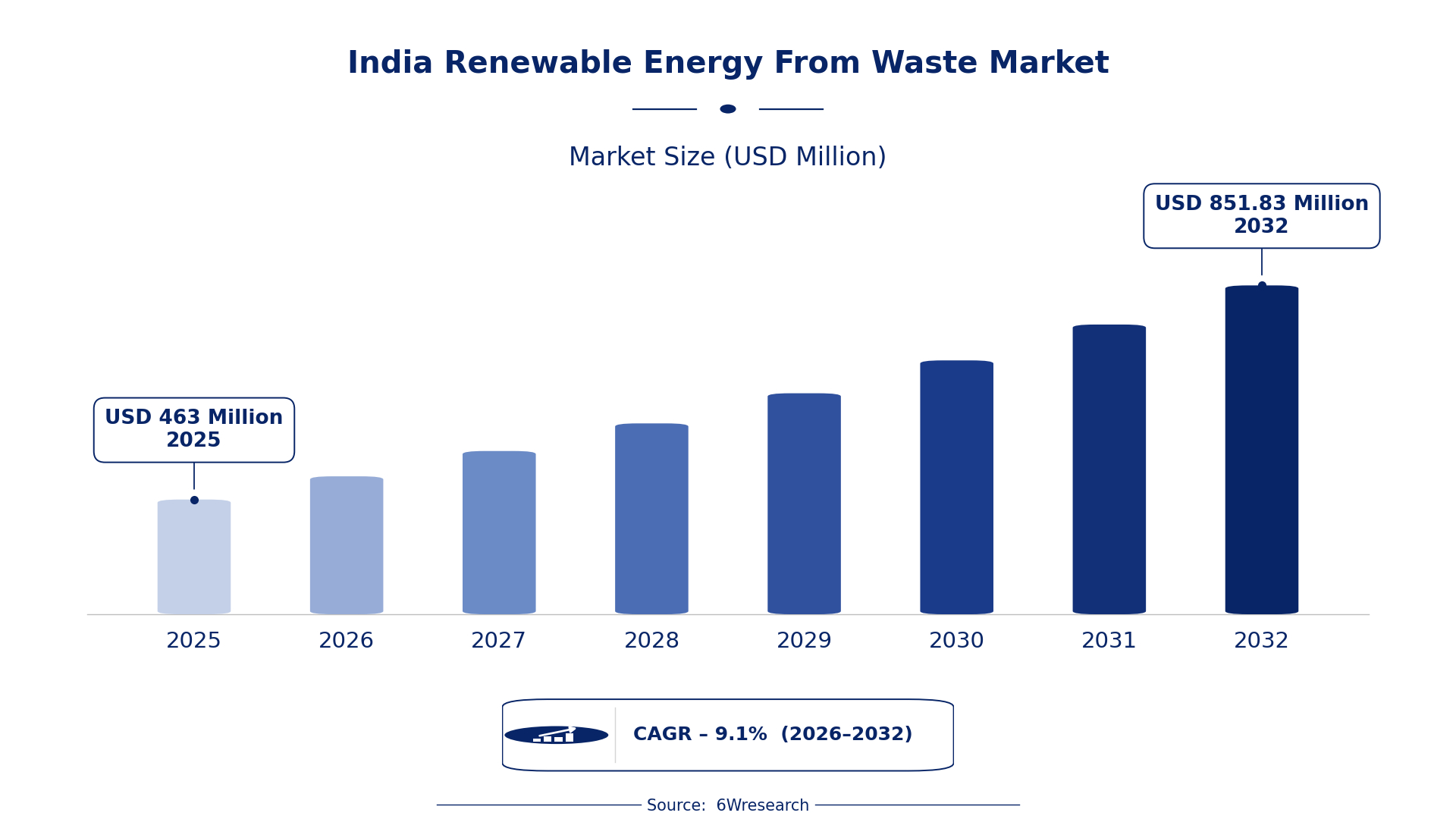
According to 6Wresearch internal database and industry insights, the India Renewable Energy From Waste Market was valued at USD 463.0 million in 2025 and is projected to reach USD 851.83 million by 2032, growing at a CAGR of approximately 9.1% during 2026–2032.
India Renewable Energy From Waste Market Highlights
| Report Metric | Details |
| Report Name | India Renewable Energy From Waste Market |
| Market Size 2025 | USD 463.0 million |
| Market Size 2032 | USD 851.83 million |
| Absolute Growth 2025–2032 | USD 388.83 million |
| CAGR 2026–2032 | 9.1% |
| Peak Annual Growth | 11.4% in 2030 |
| Forecast Period | 2026–2032 |
| Historical Data | 2022–2025 |
| Base Year | 2025 |
| Leading Waste Type, 2025 | Municipal Solid Waste (50% share) |
| Leading Energy Output, 2025 | Electricity (40% share) |
| Leading Technology Used, 2025 | Anaerobic Digestion (47% share) |
| Leading End User, 2025 | Urban Utilities (36% share) |
| Fastest-Growing Waste Type | Food & Organic Waste (10.6% CAGR) |
| Fastest-Growing Energy Output | Biogas (11.2% CAGR) |
| Fastest-Growing End User | Rural Energy Projects (11.1% CAGR) |
| Growing Sector | Urban Utilities |
| Key End Users | Municipalities, Industrial Biogas Plants, Urban Utilities, Rural Energy Projects |
India Renewable Energy From Waste Market Year-wise Growth Rate and Key Drivers (2022–2032)
This graph illustrates the annual growth rates of the market from 2022 to 2032, highlighting a steady upward trajectory and projected market expansion over the forecast period.
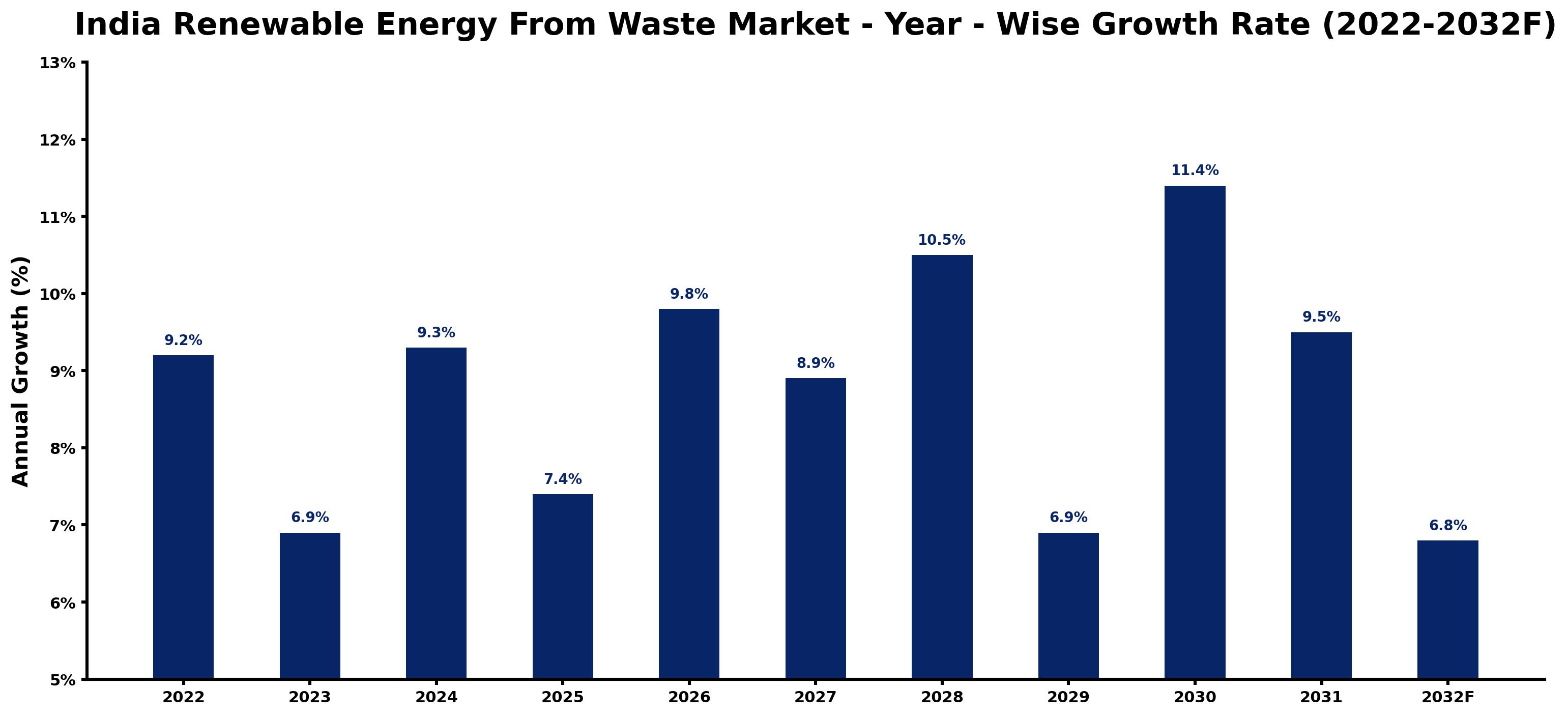
The table below sets out the estimated growth rate for each year and the main factor behind it.
| Year | Estimated Annual Growth (%) | Market Rationale |
| 2022 | 9.2 | The market showed strong performance due to increased urban waste generation driven by the growing population. |
| 2023 | 6.9 | Growth slowed as municipalities faced challenges in implementing waste management initiatives effectively. |
| 2024 | 9.3 | Demand surged with the implementation of the Swachh Bharat Mission promoting waste-to-energy projects. |
| 2025 | 7.4 | Growth decelerated as some projects faced regulatory delays in approvals and implementation. |
| 2026 | 9.8 | Investment in biogas plants increased, driving demand for energy from waste solutions across urban areas. |
| 2027 | 8.9 | Market growth slowed as competition intensified among waste-to-energy producers in urban utilities. |
| 2028 | 10.5 | Demand accelerated with rising energy needs and ongoing waste management efforts in cities. |
| 2029 | 6.9 | Growth slowed as regulatory frameworks took longer to adapt to new waste management standards. |
| 2030 | 11.4 | The market peaked with substantial investments in renewable energy initiatives from urban municipalities. |
| 2031 | 9.5 | Growth decelerated as the market approached maturity and faced saturation in urban energy solutions. |
| 2032 | 6.8 | The market continues to grow, driven by ongoing urbanisation and increasing energy demands from urban utilities. |
Note: Market size estimations and growth projections presented in this report are based on 6Wresearch's proprietary forecasting methodology, utilizing the latest available industry data, government publications, and primary research inputs.
India Renewable Energy From Waste Market Synopsis
This process employs technologies such as anaerobic digestion and gasification. The market is growing due to increasing urban waste generation and initiatives like the Swachh Bharat Mission, which advocates for effective waste management and energy recovery. With an annual generation of around 62 million tons of municipal solid waste, the demand for energy from waste is expected to rise in the coming years.
Market Dynamics Impact Analysis (2026–2032)
| Factor | Type | Impact | Primary Segment Affected |
| Increasing urban population driving waste generation and energy needs | Driver | High | Municipal Solid Waste |
| Government initiatives promoting waste-to-energy projects | Driver | High | Biogas |
| Rising demand for clean energy solutions in urban areas | Opportunity | High | Urban Utilities |
| Growing interest in biogas as a renewable energy source | Opportunity | High | Industrial Biogas Plants |
| Regulatory challenges delaying project approvals | Restraint | High | Municipal Solid Waste |
| High initial investment costs for waste-to-energy plants | Restraint | Medium | Anaerobic Digestion |
| Limited infrastructure for waste segregation and collection | Challenge | High | Municipal Solid Waste |
| Competition from alternative renewable energy sources | Challenge | Medium | Biogas |
Evaluation of Drivers in India Renewable Energy From Waste Market (2026–2032)
Key forces behind demand, with the segment each one moves most, are listed below.
| Drivers | Primary Segment Affected | Why It Matters (Evidence) |
| Urban waste generation increases demand for energy from waste | Municipal Solid Waste | India generates approximately 62 million tons of municipal solid waste annually, prompting urban utilities to seek renewable energy solutions. |
| Government initiatives support renewable energy projects | Biogas | The National Biofuel Policy aims for 10% blending of biofuels by 2022, encouraging biogas production from organic waste. |
| Investment in waste-to-energy technologies is rising | Anaerobic Digestion | Over 200 biogas plants using anaerobic digestion are operational, increasing energy output from organic waste. |
| Rising energy needs in urban areas drive demand | Urban Utilities | With over 460 million urban residents, energy demand from urban utilities is increasing, necessitating waste-to-energy solutions. |
| Support from the National Clean Energy Fund boosts projects | Municipal Solid Waste | The National Clean Energy Fund allocates ₹1,000 crores annually for renewable energy projects, including waste-to-energy initiatives. |
The urban population surpasses 460 million, driving the need for renewable energy solutions. More than 200 biogas plants are currently operational, boosting energy output from organic waste. The National Clean Energy Fund allocates ₹1,000 crores each year for renewable energy projects, stimulating interest in waste-to-energy solutions. Urban utilities are increasingly adopting these technologies to satisfy their energy requirements, reflecting a growing trend in the market.
Evaluation of Restraints in India Renewable Energy From Waste Market
The table below lists the restraints and the evidence behind each.
| Market Restraint | Primary Segment Affected | Why It Matters (Evidence) |
| Regulatory challenges delay project approvals | Municipal Solid Waste | Complex approval processes hinder the timely implementation of waste-to-energy projects, affecting overall market growth. |
| High initial investment costs deter new projects | Anaerobic Digestion | The substantial capital required for setting up biogas plants limits participation from smaller investors. |
| Limited infrastructure for waste segregation affects efficiency | Municipal Solid Waste | Inadequate waste management infrastructure leads to inefficiencies in waste collection and processing, impacting energy recovery. |
| Competition from alternative renewable energy sources | Biogas | The presence of cheaper renewable energy options can divert investments away from waste-to-energy projects. |
| Public awareness of waste-to-energy benefits is low | Urban Utilities | Limited understanding of the advantages of waste-to-energy solutions slows adoption among urban utilities. |
India Renewable Energy From Waste Market Challenges
India's urban population generates over 62 million tons of municipal solid waste annually, creating a pressing need for skilled workers in the renewable energy from waste sector. The shortage of trained professionals hampers project implementation for producers, leading to operational costs that can rise by 20%. Fierce competition among waste-to-energy plants results in price wars that squeeze margins for operators, complicating quality maintenance. Buyers face escalating energy costs, as urban municipalities grapple with waste management, which can push energy prices up by as much as 15%. Regulatory challenges, including emissions standards from the Central Pollution Control Board, make compliance difficult for producers, risking project delays and fines that may reach ₹50 lakhs.
Trends in the India Renewable Energy From Waste Market
Buyers and suppliers in the India Renewable Energy From Waste Market are adjusting to the following trends.
- Shift from Traditional a leading supplier to a leading supplier: Maharashtra is at the forefront of the transition towards energy recovery from waste, with 11 operational waste-to-energy plants, highlighting a growing trend in urban waste management. In 2021, the installed capacity for waste-to-energy plants was approximately 1,200 MW.
- Transition from Landfill to Biogas Production: Since 2021, urban areas have made a notable shift from landfill disposal to biogas production, driven by the National Biofuel Policy. This transition aims to enhance waste management while generating renewable energy.
- Emergence of Urban Utilities as Key End Users: Urban utilities are increasingly prioritising waste-to-energy solutions, projected to account for a share of 36% in 2025, as they seek sustainable energy sources to meet rising demands in cities.
- Growing Focus on Anaerobic Digestion Technology: Anaerobic digestion has become the leading technology for waste-to-energy conversion, holding a 47% share in 2025, due to its effectiveness in producing biogas from organic waste.
Investment Opportunities in the India Renewable Energy From Waste Market
Several openings in the India Renewable Energy From Waste Market merit attention from investors.
- Investment Gap in Waste-to-Energy Projects: With the National Clean Energy Fund allocating substantial resources each year, a notable investment gap exists in waste-to-energy projects. Urban utilities can collaborate with local firms to develop new facilities.
- Supply of Biogas Technology Solutions: The growing demand for biogas as a renewable energy source creates an opportunity to provide advanced biogas technology solutions. Industrial biogas plants are expanding, necessitating technology to boost efficiency.
- Timing for Rural Energy Projects: With the Indian government targeting 175 GW of renewable energy capacity by 2022, rural energy projects present a prime opportunity. Partnerships with local governments can facilitate project implementation.
- Expansion of Waste-to-Energy Facilities in Maharashtra: Maharashtra, home to the highest number of waste-to-energy plants, represents a burgeoning market for facility expansion. Investment in new plants can address the increasing energy demands of urban areas.
Government Initiatives in the India Renewable Energy From Waste Market
The National Biofuel Policy 2018, issued by the Ministry of Petroleum and Natural Gas, promotes biofuels from waste with a target of 10% blending by 2022. This policy encourages the development of biogas projects, boosting the viability of renewable energy initiatives. The Swachh Bharat Mission, initiated by the Ministry of Housing and Urban Affairs, aims to eliminate open defecation and promote waste management, including energy recovery, by 2024. This initiative supports the establishment of waste-to-energy facilities across India.
The Central Pollution Control Board sets emissions standards for waste-to-energy plants, ensuring adherence to environmental regulations. The National Clean Energy Fund allocates substantial resources annually to support renewable energy projects, including waste-to-energy initiatives, facilitating funding for new projects. The Ministry of Environment, Forest and Climate Change oversees waste management regulations, ensuring that producers comply with environmental standards.
Future Insight of the India Renewable Energy From Waste Market
The renewable energy from waste market in India is set to undergo transformative changes by 2032, primarily due to advancements in waste-to-energy technologies. The National Biofuel Policy aims to boost biogas production, potentially adding 1,200 MW to the installed capacity. Urban municipalities will increasingly implement waste-to-energy solutions, supported by the Swachh Bharat Mission, which focuses on energy recovery from waste. The Indian Energy Exchange will enable more efficient trading of renewable energy certificates, improving market access for suppliers. These shifts will create a more dynamic environment for renewable energy from waste, benefiting both buyers and producers.
Market Segmentation Analysis
Each segment group is reviewed below, with the leader by share and the fastest grower by CAGR.
By Waste Type – Municipal Solid Waste Dominated, Food & Organic Waste Expected to Grow Fastest
According to Ravi Bhandari, Research Head at 6Wresearch, the largest waste type category in 2025 was Municipal Solid Waste, with a 50% share of total revenue. Municipal solid waste constitutes the largest share of waste generated in India, with approximately 62 million tons produced annually. This high volume serves as the main feedstock for energy production, particularly in urban areas where waste management is critical. Food & Organic Waste is projected to grow fastest, at a CAGR of 10.6% during 2026–2032. Food and organic waste is rapidly gaining traction, driven by the growing urban population exceeding 460 million. This demographic shift increases the demand for efficient biogas production, making it a key area for growth in the renewable energy from waste market. Suppliers should focus on enhancing technologies for processing food and organic waste to capitalise on this burgeoning market share.
By Energy Output – Electricity Dominated, Biogas Expected to Grow Fastest
With a 40% revenue share in 2025, Electricity was the largest energy output category. Electricity generated from waste-to-energy processes holds the largest market share, powering crucial urban utilities and industrial applications across India. With an installed capacity of around 1,200 MW, this output plays a vital role in meeting the country's increasing energy demands. Biogas are set to record the highest CAGR in this split, 11.2% over 2026–2032. Biogas is emerging as the fastest-growing energy output, particularly for rural energy projects, due to the rising emphasis on sustainable energy solutions. The proliferation of biogas plants throughout the nation significantly contributes to this rapid growth. Buyers in rural areas should consider biogas as a viable energy source, while suppliers can explore opportunities in biogas production technologies.
By Technology Used – Anaerobic Digestion Dominated and Is Expected to Record the Fastest Growth
Anaerobic Digestion held a 47% share of the India Renewable Energy From Waste Market by technology used in 2025. Anaerobic digestion is the leading technology in the market, extensively utilised for converting organic waste into energy. Its presence in over 200 biogas plants across India underscores its effectiveness and reliability in waste-to-energy applications. The same category is also set to grow fastest, at a CAGR of 11.0% during 2026–2032. Anaerobic digestion is also the fastest-growing technology segment, as its efficiency in processing organic waste meets the rising demand for renewable energy solutions. This dual role as both leader and fastest will likely further strengthen its market position. Suppliers should invest in advancing anaerobic digestion technologies to maintain a competitive edge and address growing energy needs.
By End User – Urban Utilities Dominated, Rural Energy Projects Expected to Grow Fastest
In 2025, Urban Utilities led the end user split with a 36% share. Urban utilities are the primary end-users of energy generated from waste, significantly impacting the market share. The ongoing urbanisation in India necessitates reliable energy sources for these utilities to support the growing urban population. The quickest growth will come from Rural Energy Projects, forecast to expand at a CAGR of 11.1% between 2026 and 2032. Rural energy projects are quickly becoming the fastest-growing segment, driven by efforts to provide sustainable energy solutions in remote areas. The increasing focus on energy access for rural communities is expected to propel this segment forward. Suppliers should tailor their offerings to meet the specific energy needs of rural projects while maintaining strong relationships with urban utilities.
Key Attractiveness of the Report
- 10 Years of Market Numbers
- Historical Data Starting from 2022 to 2025
- Base Year 2025
- Forecast Data until 2032
- Key Performance Indicators Impacting the Market
- Major Upcoming Developments and Projects
Key Highlights of the Report:
- India Renewable Energy From Waste Market Outlook
- Market Size of India Renewable Energy From Waste Market, 2025
- Forecast of India Renewable Energy From Waste Market, 2032
- Historical Data and Forecast of India Renewable Energy From Waste Revenues & Volume for the Period 2022 - 2032F
- India Renewable Energy From Waste Market Trend Evolution
- India Renewable Energy From Waste Market Drivers and Challenges
- India Renewable Energy From Waste Price Trends
- India Renewable Energy From Waste Porter's Five Forces
- India Renewable Energy From Waste Industry Life Cycle
- Historical Data and Forecast of India Renewable Energy From Waste Market Revenues & Volume By Waste Type for the Period 2022 - 2032F
- Historical Data and Forecast of India Renewable Energy From Waste Market Revenues & Volume By Municipal Solid Waste for the Period 2022 - 2032F
- Historical Data and Forecast of India Renewable Energy From Waste Market Revenues & Volume By Food & Organic Waste for the Period 2022 - 2032F
- Historical Data and Forecast of India Renewable Energy From Waste Market Revenues & Volume By Industrial Waste for the Period 2022 - 2032F
- Historical Data and Forecast of India Renewable Energy From Waste Market Revenues & Volume By Agricultural Waste for the Period 2022 - 2032F
- Historical Data and Forecast of India Renewable Energy From Waste Market Revenues & Volume By Energy Output for the Period 2022 - 2032F
- Historical Data and Forecast of India Renewable Energy From Waste Market Revenues & Volume By Electricity for the Period 2022 - 2032F
- Historical Data and Forecast of India Renewable Energy From Waste Market Revenues & Volume By Biogas for the Period 2022 - 2032F
- Historical Data and Forecast of India Renewable Energy From Waste Market Revenues & Volume By Bio-oil/Gas for the Period 2022 - 2032F
- Historical Data and Forecast of India Renewable Energy From Waste Market Revenues & Volume By Biomass for the Period 2022 - 2032F
- Historical Data and Forecast of India Renewable Energy From Waste Market Revenues & Volume By Technology Used for the Period 2022 - 2032F
- Historical Data and Forecast of India Renewable Energy From Waste Market Revenues & Volume By Incineration/CHP for the Period 2022 - 2032F
- Historical Data and Forecast of India Renewable Energy From Waste Market Revenues & Volume By Anaerobic Digestion for the Period 2022 - 2032F
- Historical Data and Forecast of India Renewable Energy From Waste Market Revenues & Volume By Pyrolysis for the Period 2022 - 2032F
- Historical Data and Forecast of India Renewable Energy From Waste Market Revenues & Volume By Gasification for the Period 2022 - 2032F
- Historical Data and Forecast of India Renewable Energy From Waste Market Revenues & Volume By End User for the Period 2022 - 2032F
- Historical Data and Forecast of India Renewable Energy From Waste Market Revenues & Volume By Urban Utilities for the Period 2022 - 2032F
- Historical Data and Forecast of India Renewable Energy From Waste Market Revenues & Volume By Industrial Biogas Plants for the Period 2022 - 2032F
- Historical Data and Forecast of India Renewable Energy From Waste Market Revenues & Volume By Cement & Process Industries for the Period 2022 - 2032F
- Historical Data and Forecast of India Renewable Energy From Waste Market Revenues & Volume By Rural Energy Projects for the Period 2022 - 2032F
- India Renewable Energy From Waste Import Export Trade Statistics
- Market Opportunity Assessment By Waste Type
- Market Opportunity Assessment By Energy Output
- Market Opportunity Assessment By Technology Used
- Market Opportunity Assessment By End User
- India Renewable Energy From Waste Top Companies Market Share
- India Renewable Energy From Waste Competitive Benchmarking By Technical and Operational Parameters
- India Renewable Energy From Waste Company Profiles
- India Renewable Energy From Waste Key Strategic Recommendations
Market Covered
Segments analysed in this report are listed below.
By Waste Type
- Municipal Solid Waste
- Food & Organic Waste
- Industrial Waste
- Agricultural Waste
By Energy Output
- Electricity
- Biogas
- Bio-oil/Gas
- Biomass
By Technology Used
- Incineration/CHP
- Anaerobic Digestion
- Pyrolysis
- Gasification
By End User
- Urban Utilities
- Industrial Biogas Plants
- Cement & Process Industries
- Rural Energy Projects































