India Renewable Energy Generation Market Size & Growth Rate
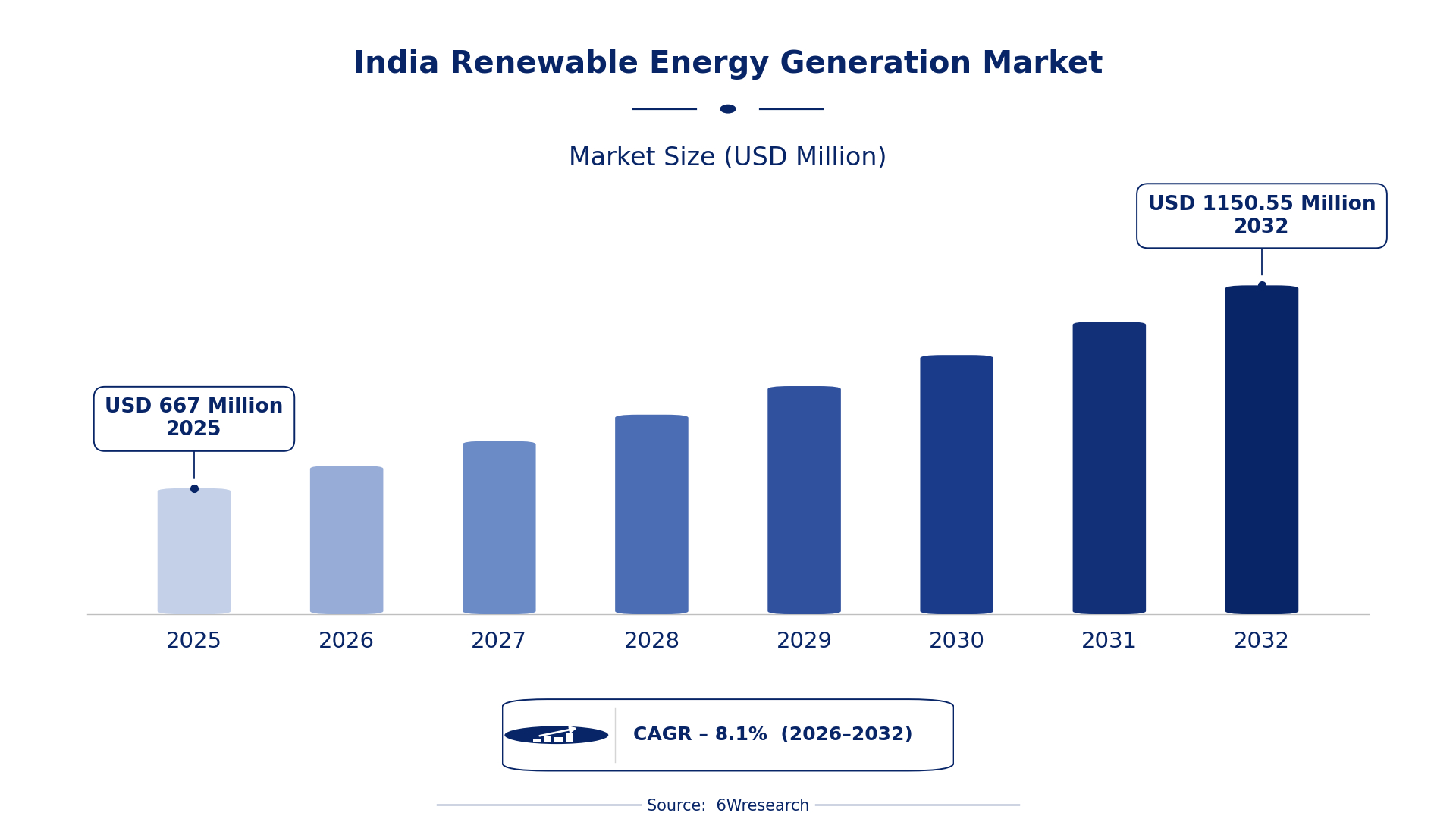
According to 6Wresearch internal database and industry insights, the India Renewable Energy Generation Market was valued at USD 667.0 million in 2025 and is projected to reach USD 1,150.55 million by 2032, growing at a CAGR of approximately 8.1% during 2026–2032.
India Renewable Energy Generation Market Highlights
| Report Metric | Details |
| Report Name | India Renewable Energy Generation Market |
| Market Size 2025 | USD 667.0 million |
| Market Size 2032 | USD 1,150.55 million |
| Absolute Growth 2025–2032 | USD 483.55 million |
| CAGR 2026–2032 | 8.1% |
| Peak Annual Growth | 9.4% in 2028 |
| Forecast Period | 2026–2032 |
| Historical Data | 2022–2025 |
| Base Year | 2025 |
| Leading Source Type, 2025 | Solar (52% share) |
| Leading Generation Technology, 2025 | Photovoltaic (PV) (51% share) |
| Leading Scale, 2025 | Utility-Scale (43% share) |
| Leading End User, 2025 | Renewable Utilities (47% share) |
| Fastest-Growing Source Type | Bioenergy (10.8% CAGR) |
| Fastest-Growing Scale | Community/Industrial (10.6% CAGR) |
| Fastest-Growing End User | Solar Energy Providers (10.9% CAGR) |
| Growing Sector | Solar Energy Providers |
| Key End Users | Renewable Utilities, Solar Energy Providers, Wind Farm Operators, Small Hydro Operators |
India Renewable Energy Generation Market Year-wise Growth Rate and Key Drivers (2022–2032)
This graph illustrates the annual growth rates of the market from 2022 to 2032, highlighting a steady upward trajectory and projected market expansion over the forecast period.
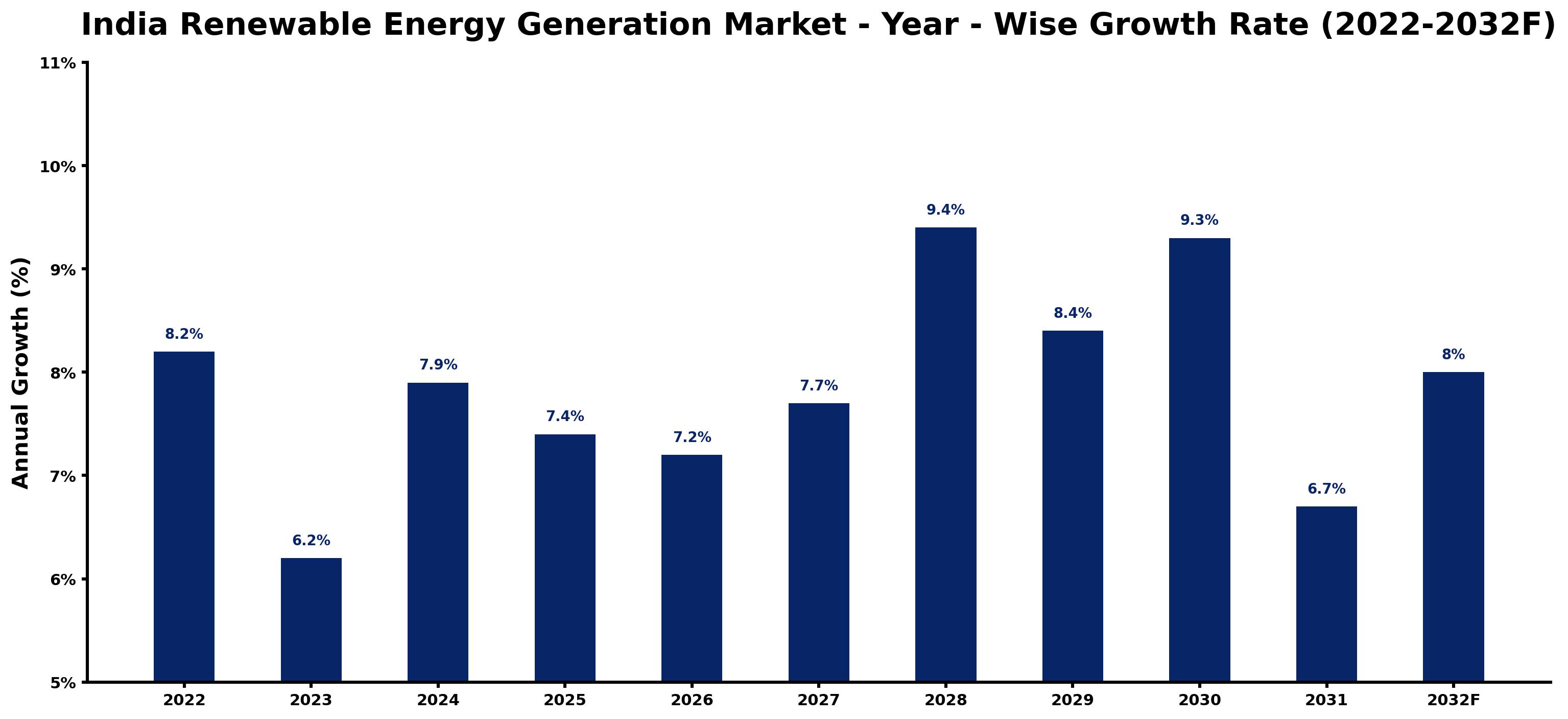
Annual growth estimates for each year appear below with the principal reason behind them, explaining the shifts that set the pace of the market.
| Year | Estimated Annual Growth (%) | Market Rationale |
| 2022 | 8.2 | The market experienced strong activity due to significant investments and government initiatives. |
| 2023 | 6.2 | Growth slowed as the market adjusted to previous high levels of investment and demand. |
| 2024 | 7.9 | Demand increased with the continuation of large-scale solar projects and supportive policies. |
| 2025 | 7.4 | Growth moderated as the market stabilised following rapid expansions in prior years. |
| 2026 | 7.2 | The market continued to grow, supported by ongoing investments in renewable technologies. |
| 2027 | 7.7 | Demand rose as new projects came online and energy security became a priority. |
| 2028 | 9.4 | The market peaked with heightened investments and ambitious capacity targets being pursued. |
| 2029 | 8.4 | Growth slowed as the market began to adjust to the peak demand levels of the previous year. |
| 2030 | 9.3 | Demand surged again as India aimed for 500 GW of renewable energy capacity by 2030. |
| 2031 | 6.7 | Growth slowed due to market maturation and the need for infrastructure upgrades. |
| 2032 | 8.0 | Demand is expected to rise again as new technologies and projects are implemented. |
Note: Market size estimations and growth projections presented in this report are based on 6Wresearch's proprietary forecasting methodology, utilizing the latest available industry data, government publications, and primary research inputs.
India Renewable Energy Generation Market Synopsis
The India Renewable Energy Generation Market includes technologies that harness natural resources for electricity production, such as solar panels, wind turbines, and hydroelectric plants. This sector serves residential, commercial, and industrial applications, contributing to energy security and carbon reduction. The market is expanding due to rising investments, government support, and ambitious targets. In 2023, the sector attracted $10 billion in investments, reflecting strong interest from various stakeholders. The National Solar Mission aims for 100 GW of solar capacity, further driving growth in this market.
Market Dynamics Impact Analysis (2026–2032)
| Factor | Type | Impact | Primary Segment Affected |
| Significant investments in solar and wind energy technologies are driving demand. | Driver | High | Solar |
| The increasing focus on energy security and sustainability is creating opportunities. | Driver | High | Wind |
| The growing demand for biomass energy presents a unique investment opportunity. | Opportunity | Medium | Bioenergy |
| The need for skilled workforce development in renewable energy creates openings. | Opportunity | Medium | Renewable Utilities |
| High initial capital costs for renewable energy projects can deter investment. | Restraint | High | Hydro |
| Regulatory hurdles can slow down project approvals and implementation. | Restraint | Medium | Solar |
| Limited grid infrastructure can hinder the integration of renewable sources. | Challenge | High | Wind |
| Competition from traditional energy sources can affect market share. | Challenge | Medium | Bioenergy |
Evaluation of Drivers in India Renewable Energy Generation Market (2026–2032)
The main growth drivers and the segments they affect most are set out below.
| Drivers | Primary Segment Affected | Why It Matters (Evidence) |
| Government initiatives promoting renewable energy investments are increasing capacity. | Solar | India aims to achieve 500 GW of renewable energy capacity by 2030, attracting substantial investments. |
| The National Solar Mission is driving solar energy adoption across the country. | Solar | The mission targets 100 GW of solar capacity, encouraging widespread project development. |
| Growing energy demand from India's population is necessitating renewable solutions. | Hydro | With a population of approximately 1.4 billion, energy demand continues to rise, necessitating renewable solutions. |
| Technological advancements are reducing costs for solar and wind energy systems. | Wind | As technology improves, the cost of renewable energy generation decreases, attracting more buyers. |
| International collaborations and alliances are facilitating resource sharing and expertise. | Renewable Utilities | The International Solar Alliance promotes solar energy globally, facilitating knowledge transfer. |
In 2023, the sector attracted $10 billion in investments, leading to new projects and capacity expansions. With a population of approximately 1.4 billion, energy demand continues to rise, necessitating renewable solutions. Technological advancements are lowering costs for solar and wind systems, encouraging broader adoption among various sectors.
Evaluation of Restraints in India Renewable Energy Generation Market
The following restraints limit how fast demand can grow.
| Market Restraint | Primary Segment Affected | Why It Matters (Evidence) |
| High initial capital costs for renewable energy projects can deter investment. | Hydro | The substantial upfront costs associated with hydro projects can limit participation from smaller investors. |
| Regulatory hurdles can slow down project approvals and implementation. | Solar | Complex approval processes can delay project timelines, impacting overall market growth by increasing costs by 15%. |
| Limited grid infrastructure can hinder the integration of renewable sources. | Wind | Insufficient grid capacity can restrict the ability to connect new wind projects to the energy network. |
| Competition from traditional energy sources can affect market share. | Bioenergy | Established fossil fuel sources often have lower costs, making it challenging for bioenergy to compete effectively. |
| Market volatility can create uncertainty for investors in renewable energy. | Renewable Utilities | Fluctuating energy prices can deter long-term investments in renewable projects, affecting planning and financing. |
India Renewable Energy Generation Market Challenges
The India Renewable Energy Generation Market faces a few practical problems, and the first is intense competition. Numerous players vie for market share, resulting in price wars that can erode margins for suppliers. High initial costs are another barrier; for example, the capital needed for solar panels and wind turbines can exceed $1 million per megawatt, which deters smaller buyers from entering the market. A shortage of skilled workers in renewable energy technologies hampers project execution, causing delays that can extend timelines by up to six months for developers. Regulatory hurdles complicate compliance, increasing project costs by 15% for new entrants, discouraging investment.
Trends in the India Renewable Energy Generation Market
Several trends are reshaping the India Renewable Energy Generation Market; the most important are set out below.
- Renewable Utilities Prioritising Solar Energy: Renewable Utilities are increasingly focusing on solar energy projects to meet rising demand. In 2023, solar energy capacity reached over 60 GW, reflecting a shift towards cleaner energy sources.
- Shift Towards Hybrid Energy Solutions: The National Wind-Solar Hybrid Policy encourages projects that combine wind and solar energy. This policy aims to optimise land use and improve energy generation efficiency, with hybrid projects gaining traction and increasing capacity.
- Tamil Nadu Leading in Wind Energy Generation: Tamil Nadu has emerged as a leader in wind energy generation, boasting an installed capacity of 10,500 MW. This trend underscores the state's commitment to renewable energy development and its role in national targets.
- Increased Focus on Bioenergy: The National Bioenergy Mission promotes the use of biomass energy, targeting a 20% blending of biofuels by 2025. This initiative highlights the growing importance of bioenergy in India's renewable energy strategy.
Investment Opportunities in the India Renewable Energy Generation Market
Some of the investment opportunities in the India Renewable Energy Generation Market are mentioned below.
- Tamil Nadu's Wind Farms: Tamil Nadu's wind farms present a substantial opportunity for investment, with an installed capacity of 10,500 MW. Investors can enter through partnerships with local operators to enhance project development and meet energy demands.
- Joint Ventures in Solar Projects: Joint ventures in solar energy projects are gaining traction, driven by the need for local expertise. With a target of 100 GW by 2022, collaboration is essential for meeting ambitious goals and driving growth.
- Growing Demand for Biomass Energy: The biomass energy sector is projected to grow significantly, with a focus on sustainable practices. Investors can target renewable utilities looking to diversify their energy sources and enhance their offerings.
- Skill Development in Renewable Energy: The Renewable Energy Sector Skill Council aims to train 1 million individuals by 2025. This initiative opens opportunities for training providers to engage with the growing workforce in the renewable sector.
Government Initiatives in the India Renewable Energy Generation Market
The National Policy on Biofuels, established in 2021, aims to promote biofuel production and usage in India. This policy targets a 20% blending of biofuels by 2025, encouraging the adoption of renewable energy sources. The Renewable Energy Sector Skill Council was established in 2020 to support skill development in the renewable energy sector, focusing on training 1 million individuals by 2025. These measures collectively support the growth of renewable energy generation across the country and enhance workforce capabilities.
In 2021, the Ministry of New and Renewable Energy (MNRE) launched the National Wind-Solar Hybrid Policy, which encourages hybrid projects to optimise land use and improve energy generation efficiency. The Atmanirbhar Bharat initiative, launched in 2020, supports domestic manufacturing of renewable energy components with a budget of INR 1,500 crores for 2021-2022. These initiatives are designed to support the growth of Renewable Energy Generation in India and ensure sustainable development.
Future Insight of the India Renewable Energy Generation Market
By 2032, the India Renewable Energy Generation Market will undergo significant transformations driven by key factors. The government’s goal of achieving 500 GW of renewable energy capacity by 2030 will spur investments and infrastructure development. Enhanced technology in solar and wind systems will improve efficiency and reduce costs. The National Bioenergy Mission will encourage greater biomass utilization, diversifying energy sources. Furthermore, the International Solar Alliance will promote global collaboration, strengthening India's renewable energy initiatives and positioning it as a leader in sustainable energy.
Market Segmentation Analysis
The report offers a comprehensive study of the following market segments and their leading categories in the market.
By Source Type – Solar Dominated, Bioenergy Expected to Grow Fastest
According to Ravi Bhandari, Research Head at 6Wresearch, in 2025, Solar led the source type split with a 52% share. Solar energy holds the largest share in India's renewable energy generation market due to its extensive applications in residential and utility-scale electricity generation. With over 60 GW of installed capacity, solar energy is a cornerstone of India's energy strategy, supported by initiatives like the National Solar Mission. The quickest growth will come from Bioenergy, forecast to expand at a CAGR of 10.8% between 2026 and 2032. Bioenergy is experiencing rapid growth as the National Bioenergy Mission promotes its utilization, targeting specific applications that cater to local energy needs. This focus on biomass energy is expected to accelerate its adoption, contributing to a more diverse energy mix in India. Suppliers should prioritise solar technologies while exploring bioenergy opportunities to meet the growing demand in India's renewable energy market.
By Generation Technology – Photovoltaic (PV) Dominated and Is Expected to Record the Fastest Growth
The largest generation technology category in 2025 was Photovoltaic (PV), with a 51% share of total revenue. Photovoltaic (PV) technology leads the market share in India's renewable energy generation due to its affordability and widespread implementation across various applications. This technology is essential for meeting ambitious solar energy targets, such as the National Solar Mission aiming for 100 GW capacity. Photovoltaic (PV) is also forecast to expand faster than any other category, at a CAGR of 9.3% over 2026–2032. The rapid growth of Photovoltaic (PV) technology is fuelled by continuous advancements and significant reductions in costs, ensuring its sustained dominance in the sector. As new projects emerge, PV's market share is likely to expand further, reinforcing its leadership. Stakeholders should prioritise investments in PV technology to capitalise on the growing renewable energy generation landscape in India.
By Scale – Utility-Scale Dominated, Community/Industrial Expected to Grow Fastest
With a 43% revenue share in 2025, Utility-Scale was the largest scale category. Utility-scale projects hold the largest market share in India's renewable energy generation, driven by substantial investments and their capacity to produce energy efficiently. These projects are crucial for meeting the nation's rising energy demands and achieving renewable capacity goals. Over 2026–2032, Community/Industrial is expected to post the fastest growth, at a CAGR of 10.6%. Community-scale projects are experiencing rapid growth as they cater to specific local energy requirements, indicating a shift towards decentralised energy solutions. This growth complements utility-scale initiatives, reflecting a broader trend in energy production. Suppliers must engage with both utility-scale and community projects to strengthen their position in India's evolving renewable energy market.
By End User – Renewable Utilities Dominated, Solar Energy Providers Expected to Grow Fastest
Renewable Utilities held a 47% share of the India Renewable Energy Generation Market by end user in 2025. Renewable utilities dominate the market share in India's renewable energy generation sector, playing a critical role in managing and distributing energy from various sources. Their established infrastructure and operational expertise make them vital players in the transition to renewable energy. Solar Energy Providers are projected to grow fastest, at a CAGR of 10.9% during 2026–2032. Solar energy providers are experiencing rapid growth as the demand for solar technologies increases, driven by government initiatives and public interest. This segment's expansion highlights the increasing reliance on solar energy as a primary source of power. For buyers, aligning with renewable utilities and solar energy providers is essential to ensure access to reliable and sustainable energy solutions.
Key Attractiveness of the Report
- 10 Years of Market Numbers
- Historical Data Starting from 2022 to 2025
- Base Year 2025
- Forecast Data until 2032
- Key Performance Indicators Impacting the Market
- Major Upcoming Developments and Projects
Key Highlights of the Report:
- India Renewable Energy Generation Market Outlook
- Market Size of India Renewable Energy Generation Market, 2025
- Forecast of India Renewable Energy Generation Market, 2032
- Historical Data and Forecast of India Renewable Energy Generation Revenues & Volume for the Period 2022 - 2032F
- India Renewable Energy Generation Market Trend Evolution
- India Renewable Energy Generation Market Drivers and Challenges
- India Renewable Energy Generation Price Trends
- India Renewable Energy Generation Porter's Five Forces
- India Renewable Energy Generation Industry Life Cycle
- Historical Data and Forecast of India Renewable Energy Generation Market Revenues & Volume By Source Type for the Period 2022 - 2032F
- Historical Data and Forecast of India Renewable Energy Generation Market Revenues & Volume By Solar for the Period 2022 - 2032F
- Historical Data and Forecast of India Renewable Energy Generation Market Revenues & Volume By Wind for the Period 2022 - 2032F
- Historical Data and Forecast of India Renewable Energy Generation Market Revenues & Volume By Hydro for the Period 2022 - 2032F
- Historical Data and Forecast of India Renewable Energy Generation Market Revenues & Volume By Bioenergy for the Period 2022 - 2032F
- Historical Data and Forecast of India Renewable Energy Generation Market Revenues & Volume By Generation Technology for the Period 2022 - 2032F
- Historical Data and Forecast of India Renewable Energy Generation Market Revenues & Volume By Photovoltaic (PV) for the Period 2022 - 2032F
- Historical Data and Forecast of India Renewable Energy Generation Market Revenues & Volume By Onshore/Offshore for the Period 2022 - 2032F
- Historical Data and Forecast of India Renewable Energy Generation Market Revenues & Volume By Micro/Run-of-River for the Period 2022 - 2032F
- Historical Data and Forecast of India Renewable Energy Generation Market Revenues & Volume By CHP/Biomass for the Period 2022 - 2032F
- Historical Data and Forecast of India Renewable Energy Generation Market Revenues & Volume By Scale for the Period 2022 - 2032F
- Historical Data and Forecast of India Renewable Energy Generation Market Revenues & Volume By Residential to Utility for the Period 2022 - 2032F
- Historical Data and Forecast of India Renewable Energy Generation Market Revenues & Volume By Utility-Scale for the Period 2022 - 2032F
- Historical Data and Forecast of India Renewable Energy Generation Market Revenues & Volume By Community/Industrial for the Period 2022 - 2032F
- Historical Data and Forecast of India Renewable Energy Generation Market Revenues & Volume By Industrial for the Period 2022 - 2032F
- Historical Data and Forecast of India Renewable Energy Generation Market Revenues & Volume By End User for the Period 2022 - 2032F
- Historical Data and Forecast of India Renewable Energy Generation Market Revenues & Volume By Solar Energy Providers for the Period 2022 - 2032F
- Historical Data and Forecast of India Renewable Energy Generation Market Revenues & Volume By Wind Farm Operators for the Period 2022 - 2032F
- Historical Data and Forecast of India Renewable Energy Generation Market Revenues & Volume By Small Hydro Operators for the Period 2022 - 2032F
- Historical Data and Forecast of India Renewable Energy Generation Market Revenues & Volume By Renewable Utilities for the Period 2022 - 2032F
- India Renewable Energy Generation Import Export Trade Statistics
- Market Opportunity Assessment By Source Type
- Market Opportunity Assessment By Generation Technology
- Market Opportunity Assessment By Scale
- Market Opportunity Assessment By End User
- India Renewable Energy Generation Top Companies Market Share
- India Renewable Energy Generation Competitive Benchmarking By Technical and Operational Parameters
- India Renewable Energy Generation Company Profiles
- India Renewable Energy Generation Key Strategic Recommendations
Market Covered
Segments analysed in this report are listed below.
By Source Type
- Solar
- Wind
- Hydro
- Bioenergy
By Generation Technology
- Photovoltaic (PV)
- Onshore/Offshore
- Micro/Run-of-River
- CHP/Biomass
By Scale
- Residential to Utility
- Utility-Scale
- Community/Industrial
- Industrial
By End User
- Solar Energy Providers
- Wind Farm Operators
- Small Hydro Operators
- Renewable Utilities































