India Renewable Energy Motor Market Size & Growth Rate
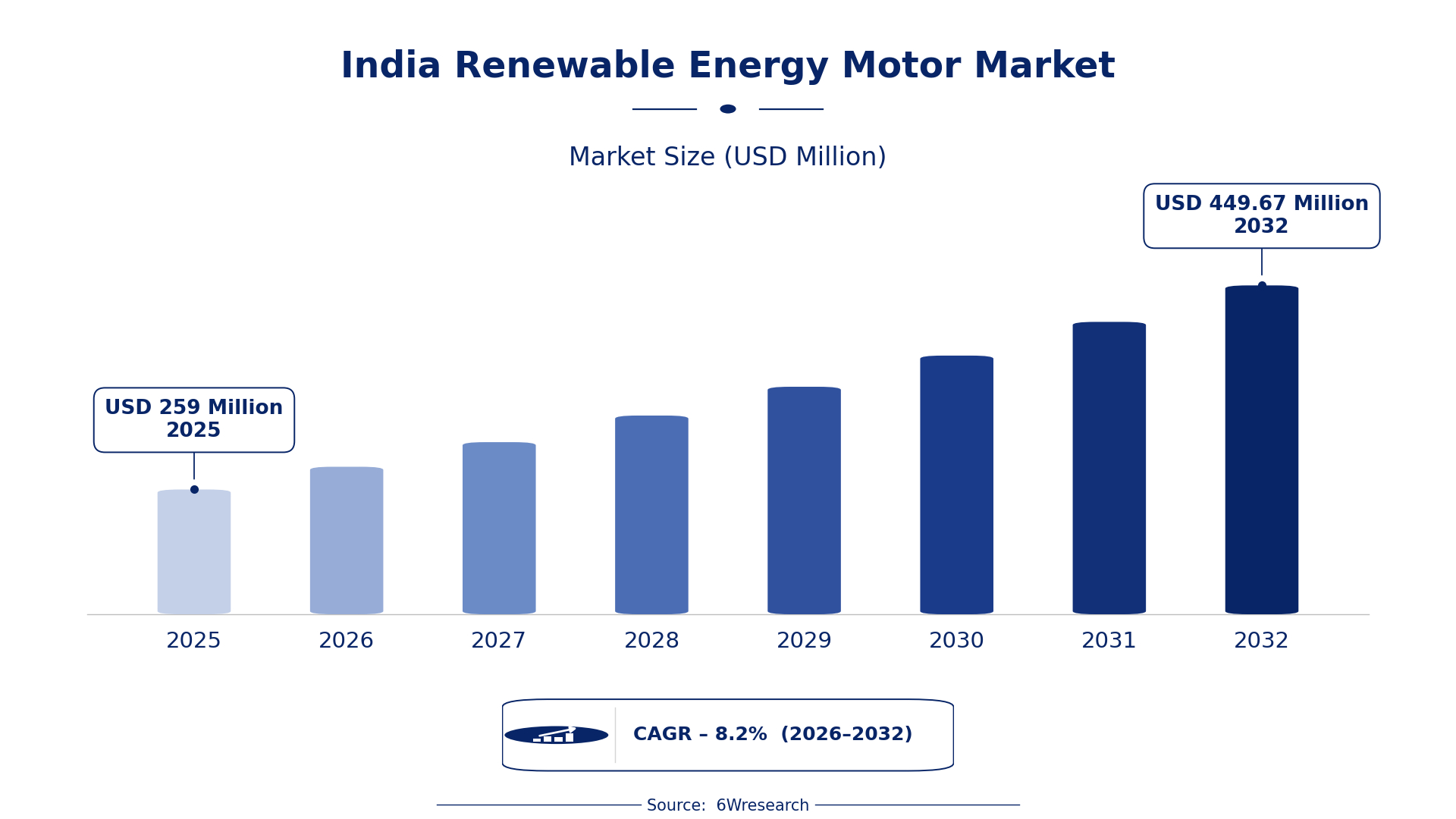
According to 6Wresearch internal database and industry insights, the India Renewable Energy Motor Market was valued at USD 259.0 million in 2025 and is projected to reach USD 449.67 million by 2032, growing at a CAGR of approximately 8.2% during 2026–2032.
India Renewable Energy Motor Market Highlights
| Report Metric | Details |
| Report Name | India Renewable Energy Motor Market |
| Market Size 2025 | USD 259.0 million |
| Market Size 2032 | USD 449.67 million |
| Absolute Growth 2025–2032 | USD 190.67 million |
| CAGR 2026–2032 | 8.2% |
| Peak Annual Growth | 11.1% in 2032 |
| Forecast Period | 2026–2032 |
| Historical Data | 2022–2025 |
| Base Year | 2025 |
| Leading Motor Type, 2025 | Brushless DC Motor (41% share) |
| Leading Application Area, 2025 | Wind Turbines (47% share) |
| Leading Power Rating, 2025 | 5kW–100kW+ (44% share) |
| Leading End User, 2025 | Turbine OEMs (48% share) |
| Fastest-Growing Motor Type | Permanent Magnet Motor (9.5% CAGR) |
| Fastest-Growing Application Area | Solar Pumps (10.9% CAGR) |
| Fastest-Growing Power Rating | 1kW–50kW (10.1% CAGR) |
| Fastest-Growing End User | Irrigation and Microgrids (9.3% CAGR) |
| Growing Sector | Solar Pumps |
| Key End Users | Wind Turbines, Solar Pumps, Hydroelectric Plants, Tracking Systems |
India Renewable Energy Motor Market Year-wise Growth Rate and Key Drivers (2022–2032)
This graph illustrates the annual growth rates of the market from 2022 to 2032, highlighting a steady upward trajectory and projected market expansion over the forecast period.
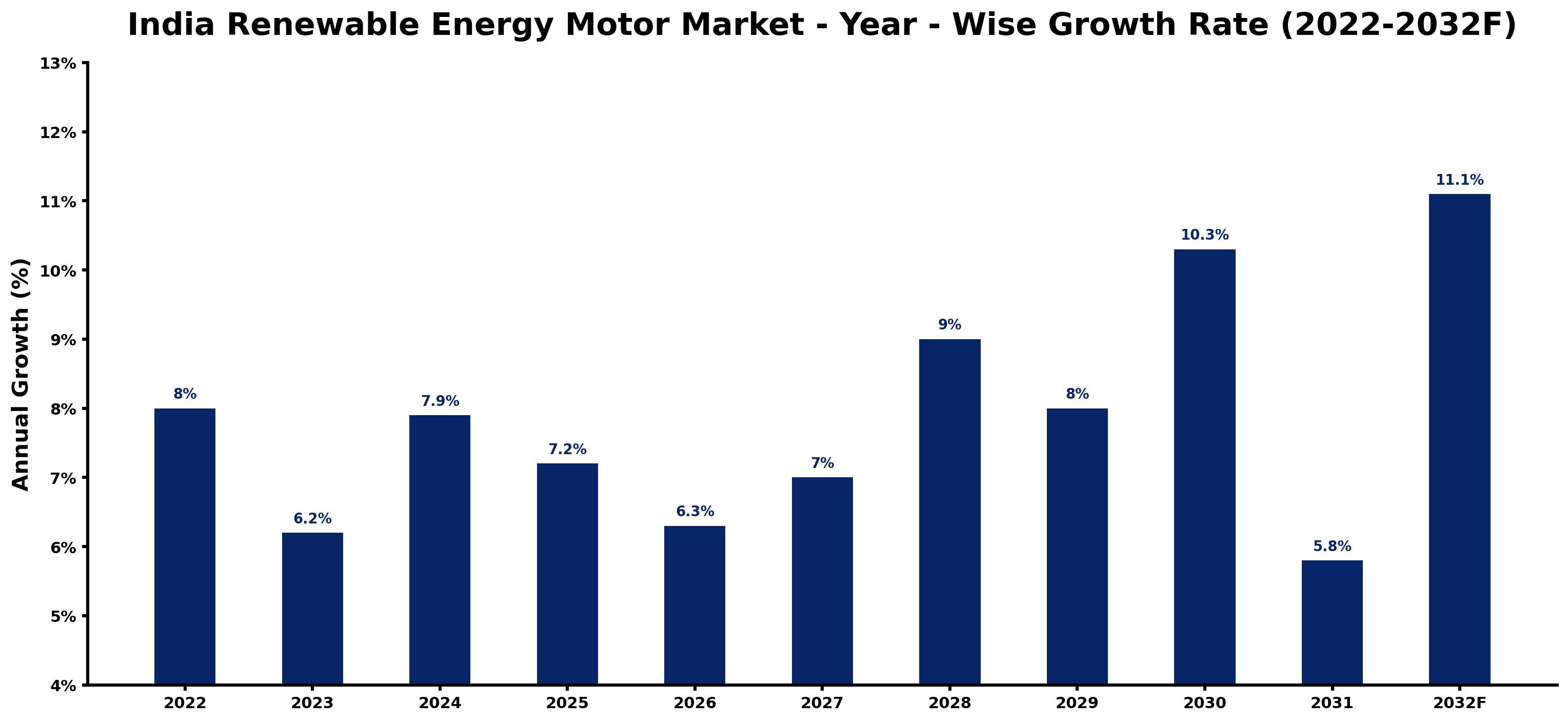
Year by year, the estimates below pair each growth rate with the development that shaped it.
| Year | Estimated Annual Growth (%) | Market Rationale |
| 2022 | 8.0 | The market experienced strong growth due to rising investments in renewable energy projects. |
| 2023 | 6.2 | Growth slowed as the market adjusted to regulatory changes and supply chain challenges. |
| 2024 | 7.9 | Demand increased with the expansion of solar pump installations under government initiatives. |
| 2025 | 7.2 | Market growth decelerated as competition intensified among motor manufacturers. |
| 2026 | 6.3 | Growth slowed due to challenges in sourcing raw materials for motor production. |
| 2027 | 7.0 | Demand rose as the adoption of electric vehicles indirectly boosted motor needs. |
| 2028 | 9.0 | The market accelerated with increased investments in solar energy infrastructure. |
| 2029 | 8.0 | Growth slowed as the market faced saturation in certain segments. |
| 2030 | 10.3 | Demand surged with the government's ambitious solar capacity targets for 2025. |
| 2031 | 5.8 | Growth decelerated as market dynamics stabilised after previous peaks. |
| 2032 | 11.1 | The market is expected to peak as hybrid renewable energy projects gain traction. |
Note: Market size estimations and growth projections presented in this report are based on 6Wresearch's proprietary forecasting methodology, utilizing the latest available industry data, government publications, and primary research inputs.
India Renewable Energy Motor Market Synopsis
The Renewable Energy Motor Market in India encompasses electric motors specifically designed for renewable applications, including wind and solar power. These motors are manufactured using advanced materials to enhance efficiency and durability. The market is growing significantly, driven by investments in green energy projects and government initiatives. India's renewable energy capacity reached 175 GW in 2023, with substantial contributions from wind and solar sectors. The demand for renewable energy motors is expected to rise as domestic users increasingly adopt these technologies.
Market Dynamics Impact Analysis (2026–2032)
| Factor | Type | Impact | Primary Segment Affected |
| Rising investments in renewable energy projects | Driver | High | Wind Turbines |
| Growing adoption of solar pumps in agriculture | Driver | High | Solar Pumps |
| Increasing demand for solar motors in residential installations | Opportunity | Medium | Solar Pumps |
| Expansion of wind energy capacity in Tamil Nadu | Opportunity | Medium | Wind Turbines |
| Regulatory hurdles from the Bureau of Indian Standards | Restraint | High | Brushless DC Motor |
| Shortage of skilled technicians in the renewable sector | Restraint | Medium | Brushless DC Motor |
| Rising material costs affecting production | Challenge | High | Brushless DC Motor |
| Technological advancements requiring significant investment | Challenge | Medium | Brushless DC Motor |
Evaluation of Drivers in India Renewable Energy Motor Market (2026–2032)
The main growth drivers and the segments they affect most are set out below.
| Drivers | Primary Segment Affected | Why It Matters (Evidence) |
| Increased investments in renewable energy projects | Wind Turbines | This trend is evident as India's renewable energy capacity reached 175 GW in 2023, leading to higher motor demand from turbine OEMs. |
| Expansion of solar pump installations | Solar Pumps | Over 1 million solar pumps have been installed under the PM-KUSUM scheme since 2019, driving demand for renewable energy motors. |
| Government initiatives promoting local manufacturing | Brushless DC Motor | The 'Make in India' initiative aims to enhance local manufacturing, encouraging suppliers to invest in production capabilities. |
| Growth in electric vehicle adoption | Brushless DC Motor | The updated 'National Electric Mobility Mission Plan' is expected to indirectly boost motor demand as electric vehicles become more prevalent. |
| Rising capacity of wind energy projects | Wind Turbines | The 'National Wind Energy Mission' aims for 60 GW of wind energy capacity, increasing the need for motors in turbine applications. |
Growth in the Renewable Energy Motor market in India stems from rising investments in renewable energy projects, which reached 175 GW in 2023. The expansion of solar pump installations under the PM-KUSUM scheme has spurred demand, with over 1 million units installed since 2019. The updated 'National Electric Mobility Mission Plan' is likely to increase motor demand as electric vehicles become more popular. Additionally, the 'National Wind Energy Mission' aims for 60 GW of wind energy capacity, greatly amplifying the need for motors in turbine applications.
Evaluation of Restraints in India Renewable Energy Motor Market
Below mentioned are some major restraints and their influence on market dynamics.
| Market Restraint | Primary Segment Affected | Why It Matters (Evidence) |
| Strict quality benchmarks from the Bureau of Indian Standards | Brushless DC Motor | These regulations can extend product approval timelines by up to six months, delaying market entry for manufacturers. |
| Shortage of skilled technicians in the renewable sector | Brushless DC Motor | This shortage hampers project execution, leading to delays and additional costs for manufacturers. |
| Rising material costs impacting production | Brushless DC Motor | Global supply chain issues have inflated production expenses by around 15%, affecting pricing strategies. |
| Technological advancements requiring substantial investment | Brushless DC Motor | Smaller manufacturers struggle to keep up with industry innovations, limiting their competitiveness. |
| Regulatory compliance costs | Brushless DC Motor | Meeting stringent standards increases operational costs, which can deter new entrants into the market. |
India Renewable Energy Motor Market Challenges
Buyers and suppliers in the India Renewable Energy Motor Market face regulatory hurdles, as the Bureau of Indian Standards enforces quality standards that can delay product approvals by up to six months. A lack of skilled technicians in the renewable energy sector complicates project implementation, resulting in increased costs and extended timelines for producers. Rising material costs, driven by global supply chain disruptions, have led to production expenses climbing by approximately 15%, which pressures pricing for suppliers. Rapid technological advancements in motor efficiency require substantial investments, creating challenges for smaller manufacturers who struggle to keep pace with these innovations.
Trends in the India Renewable Energy Motor Market
Buyers and suppliers in the India Renewable Energy Motor Market are adjusting to the following trends.
- Shift Towards Solar Pump Applications: India is experiencing a notable shift towards solar pump applications, driven by the PM-KUSUM scheme. This initiative aims to install 1.5 million solar pumps by 2024, boosting agricultural productivity and increasing motor demand.
- Growth in Wind Energy Capacity: The emphasis on expanding wind energy capacity is clear as the 'National Wind Energy Mission' targets 60 GW by 2022. This growth is anticipated to drive demand for renewable energy motors in turbine applications.
- Increased Local Manufacturing Initiatives: The 'Make in India' initiative is encouraging local manufacturing of renewable energy technologies. This shift is expected to improve production capabilities and reduce reliance on imports for motors.
- Technological Advancements in Motor Efficiency: The market is seeing advancements in motor efficiency, driven by the 'National Policy on Energy Storage'. These innovations are expected to enhance performance and lower costs for buyers.
Investment Opportunities in the India Renewable Energy Motor Market
Several openings in the India Renewable Energy Motor Market merit attention from investors.
- Investment in Solar Pump Manufacturing: There is a rising opportunity to invest in solar pump manufacturing, with over 1 million units installed under the PM-KUSUM scheme. Collaborating with local manufacturers can facilitate market entry and expansion.
- Expansion of Wind Turbine Production: Investing in wind turbine production facilities offers a significant opportunity, particularly in Tamil Nadu. Partnering with local turbine OEMs can strengthen market presence and drive sales.
- Development of Advanced Motor Technologies: Investing in advanced motor technologies is essential as the market evolves. Collaborating with research institutions can spur innovation and enhance product offerings.
- Enhancing Local Manufacturing Capabilities: The 'Make in India' initiative presents an opportunity to improve local manufacturing capabilities. Establishing joint ventures with local firms can ease entry into the market.
Government Initiatives in the India Renewable Energy Motor Market
The 'National Wind-Solar Hybrid Policy', launched in 2021, promotes hybrid renewable energy projects, increasing motor demand for integrated systems. This policy complements existing frameworks, such as the 'Make in India' initiative, which aims to boost local manufacturing of renewable energy technologies. Together, these measures support the growth of the renewable energy motor market by encouraging innovation and reducing reliance on imports.
The Ministry of New and Renewable Energy oversees the implementation of various schemes, including the PM-KUSUM initiative, which funds the installation of solar pumps. This scheme directly benefits farmers by providing access to renewable energy solutions, thereby increasing the demand for renewable energy motors. Additionally, the Bureau of Indian Standards ensures compliance with quality benchmarks, further supporting the market's growth.
Future Insight of the India Renewable Energy Motor Market
The India Renewable Energy Motor Market is set to evolve by 2032, driven by the National Wind-Solar Hybrid Policy that aims to enhance project integration and boost motor demand. The solar market is expected to reach 100 GW by 2025, creating opportunities for suppliers, particularly in solar pump applications. The Atmanirbhar Bharat initiative will strengthen local manufacturing capabilities, reducing import reliance. The National Policy on Energy Storage will encourage advancements in motor technology, aligning with the growing adoption of renewable energy solutions.
Market Segmentation Analysis
The analysis below covers each segmentation, its leading category in 2025 and its fastest-growing category through 2032.
By Motor Type – Brushless DC Motor Dominated, Permanent Magnet Motor Expected to Grow Fastest
According to Ravi Bhandari, Research Head at 6Wresearch, the largest motor type category in 2025 was Brushless DC Motor, with a 41% share of total revenue. Brushless DC Motors hold the largest market share due to their high efficiency and reliability in renewable applications, particularly in wind and solar systems. Their widespread adoption is evident in various projects across India, reflecting the country's commitment to enhancing its renewable energy capacity. Permanent Magnet Motor is projected to grow fastest, at a CAGR of 9.5% during 2026–2032. Permanent Magnet Motors are witnessing rapid growth, especially in wind turbines, which are projected to reach a capacity of 60 GW under the National Wind Energy Mission. This trend indicates a strong demand for high-performance motors, ensuring that Brushless DC Motors will maintain their leading position. Suppliers should focus on improving Brushless DC Motor technologies while also considering innovations in Permanent Magnet Motors to meet the increasing demand.
By Application Area – Wind Turbines Dominated, Solar Pumps Expected to Grow Fastest
Wind Turbines accounted for a 47% market share by application area in 2025. Wind Turbines dominate the market as the primary application area for renewable energy motors, bolstered by India's installed capacity exceeding 40 GW. The concentration of wind energy projects in states like Tamil Nadu and Gujarat underscores the significance of this segment in the renewable energy sector. The quickest growth will come from Solar Pumps, forecast to expand at a CAGR of 10.9% between 2026 and 2032. Solar Pumps are experiencing the fastest growth, driven by the installation of over 1 million units under the PM-KUSUM scheme since 2019, which has significantly enhanced agricultural irrigation. This surge indicates a sustained increase in demand for motors specifically designed for solar applications. Buyers in agriculture should invest in solar pump technologies to leverage the expanding market and enhance irrigation efficiency.
By Power Rating – 5kW–100kW+ Dominated, 1kW–50kW Expected to Grow Fastest
In 2025, 5kW–100kW+ led the power rating split with a 44% share. The 5kW–100kW+ power rating segment leads the market as it is ideal for large-scale renewable energy applications, catering to the needs of industries and utility-scale projects. This segment's strong performance is driven by the increasing capacity of wind and solar installations across India. Over 2026–2032, 1kW–50kW is expected to post the fastest growth, at a CAGR of 10.1%. The 1kW–50kW segment is growing rapidly, as it is particularly suited for small to medium renewable installations, which are becoming more popular among residential and commercial users. This growth is supported by government initiatives promoting smaller renewable projects. Suppliers should target the 1kW–50kW segment to capture the rising demand from small and medium scale renewable energy projects.
By End User – Turbine OEMs Dominated, Irrigation and Microgrids Expected to Grow Fastest
Turbine OEMs took a 48% share of end user in 2025, more than any other category. Turbine OEMs represent the largest market share as they are the primary consumers of renewable energy motors, essential for wind turbine production. Their crucial role in the supply chain ensures a steady demand for specialised motors tailored for turbine applications. Irrigation and Microgrids are set to record the highest CAGR in this split, 9.3% over 2026–2032. Irrigation and Microgrids are the fastest-growing end-user segment, driven by the increasing need for reliable energy solutions in rural areas. This growth is further supported by government initiatives aimed at improving renewable energy access in agriculture and rural electrification. Suppliers should develop targeted solutions for irrigation and microgrid applications to capitalise on the growing opportunities in these sectors.
Key Attractiveness of the Report
- 10 Years of Market Numbers
- Historical Data Starting from 2022 to 2025
- Base Year 2025
- Forecast Data until 2032
- Key Performance Indicators Impacting the Market
- Major Upcoming Developments and Projects
Key Highlights of the Report:
- India Renewable Energy Motor Market Outlook
- Market Size of India Renewable Energy Motor Market, 2025
- Forecast of India Renewable Energy Motor Market, 2032
- Historical Data and Forecast of India Renewable Energy Motor Revenues & Volume for the Period 2022 - 2032F
- India Renewable Energy Motor Market Trend Evolution
- India Renewable Energy Motor Market Drivers and Challenges
- India Renewable Energy Motor Price Trends
- India Renewable Energy Motor Porter's Five Forces
- India Renewable Energy Motor Industry Life Cycle
- Historical Data and Forecast of India Renewable Energy Motor Market Revenues & Volume By Motor Type for the Period 2022 - 2032F
- Historical Data and Forecast of India Renewable Energy Motor Market Revenues & Volume By Brushless DC Motor for the Period 2022 - 2032F
- Historical Data and Forecast of India Renewable Energy Motor Market Revenues & Volume By Permanent Magnet Motor for the Period 2022 - 2032F
- Historical Data and Forecast of India Renewable Energy Motor Market Revenues & Volume By Synchronous Motors for the Period 2022 - 2032F
- Historical Data and Forecast of India Renewable Energy Motor Market Revenues & Volume By Stepper Motors for the Period 2022 - 2032F
- Historical Data and Forecast of India Renewable Energy Motor Market Revenues & Volume By Application Area for the Period 2022 - 2032F
- Historical Data and Forecast of India Renewable Energy Motor Market Revenues & Volume By Wind Turbines for the Period 2022 - 2032F
- Historical Data and Forecast of India Renewable Energy Motor Market Revenues & Volume By Solar Pumps for the Period 2022 - 2032F
- Historical Data and Forecast of India Renewable Energy Motor Market Revenues & Volume By Hydroelectric Plants for the Period 2022 - 2032F
- Historical Data and Forecast of India Renewable Energy Motor Market Revenues & Volume By Tracking Systems for the Period 2022 - 2032F
- Historical Data and Forecast of India Renewable Energy Motor Market Revenues & Volume By Power Rating for the Period 2022 - 2032F
- Historical Data and Forecast of India Renewable Energy Motor Market Revenues & Volume By 5kW 100kW for the Period 2022 - 2032F
- Historical Data and Forecast of India Renewable Energy Motor Market Revenues & Volume By 1kW 50kW for the Period 2022 - 2032F
- Historical Data and Forecast of India Renewable Energy Motor Market Revenues & Volume By 50kW 500kW for the Period 2022 - 2032F
- Historical Data and Forecast of India Renewable Energy Motor Market Revenues & Volume By 1kW for the Period 2022 - 2032F
- Historical Data and Forecast of India Renewable Energy Motor Market Revenues & Volume By End User for the Period 2022 - 2032F
- Historical Data and Forecast of India Renewable Energy Motor Market Revenues & Volume By Turbine OEMs for the Period 2022 - 2032F
- Historical Data and Forecast of India Renewable Energy Motor Market Revenues & Volume By Irrigation and Microgrids for the Period 2022 - 2032F
- Historical Data and Forecast of India Renewable Energy Motor Market Revenues & Volume By Renewable Energy Equipment for the Period 2022 - 2032F
- Historical Data and Forecast of India Renewable Energy Motor Market Revenues & Volume By Solar Tracker Manufacturers for the Period 2022 - 2032F
- India Renewable Energy Motor Import Export Trade Statistics
- Market Opportunity Assessment By Motor Type
- Market Opportunity Assessment By Application Area
- Market Opportunity Assessment By Power Rating
- Market Opportunity Assessment By End User
- India Renewable Energy Motor Top Companies Market Share
- India Renewable Energy Motor Competitive Benchmarking By Technical and Operational Parameters
- India Renewable Energy Motor Company Profiles
- India Renewable Energy Motor Key Strategic Recommendations
Market Covered
This report examines the market across the segments below.
By Motor Type
- Brushless DC Motor
- Permanent Magnet Motor
- Synchronous Motors
- Stepper Motors
By Application Area
- Wind Turbines
- Solar Pumps
- Hydroelectric Plants
- Tracking Systems
By Power Rating
- 5kW–100kW+
- 1kW–50kW
- 50kW–500kW
- <1kW
By End User
- Turbine OEMs
- Irrigation and Microgrids
- Renewable Energy Equipment
- Solar Tracker Manufacturers































