India Renewable Heat Market Size & Growth Rate
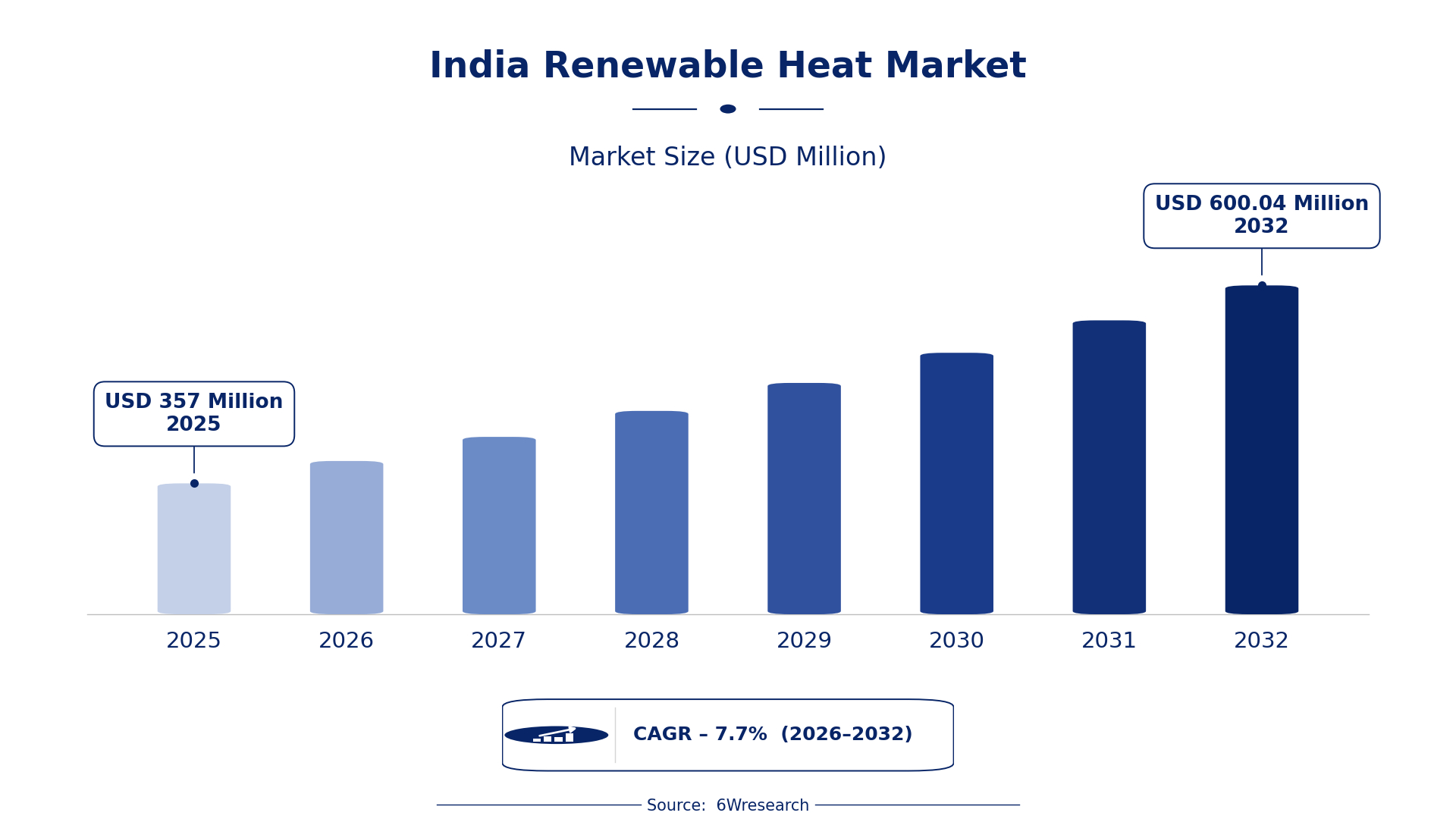
According to 6Wresearch internal database and industry insights, the India Renewable Heat Market was valued at USD 357.0 million in 2025 and is projected to reach USD 600.04 million by 2032, growing at a CAGR of approximately 7.7% during 2026–2032.
India Renewable Heat Market Highlights
| Report Metric | Details |
| Report Name | India Renewable Heat Market |
| Market Size 2025 | USD 357.0 million |
| Market Size 2032 | USD 600.04 million |
| Absolute Growth 2025–2032 | USD 243.04 million |
| CAGR 2026–2032 | 7.7% |
| Peak Annual Growth | 10.0% in 2027 |
| Forecast Period | 2026–2032 |
| Historical Data | 2022–2025 |
| Base Year | 2025 |
| Leading Heat Source, 2025 | Solar Heat (39% share) |
| Leading Delivery Medium, 2025 | Hot Water / Steam (46% share) |
| Leading Sector, 2025 | Residential & Commercial (48% share) |
| Leading End User, 2025 | Property Developers (39% share) |
| Fastest-Growing Heat Source | Heat Pumps (9.4% CAGR) |
| Fastest-Growing Sector | Urban/Smart Homes (10.3% CAGR) |
| Fastest-Growing End User | Eco-Friendly Developers (9.9% CAGR) |
| Growing Sector | Urban/Smart Homes |
| Key End Users | Residential & Commercial, Public Buildings, Community, Urban/Smart Homes |
India Renewable Heat Market Year-wise Growth Rate and Key Drivers (2022–2032)
This graph illustrates the annual growth rates of the market from 2022 to 2032, highlighting a steady upward trajectory and projected market expansion over the forecast period.
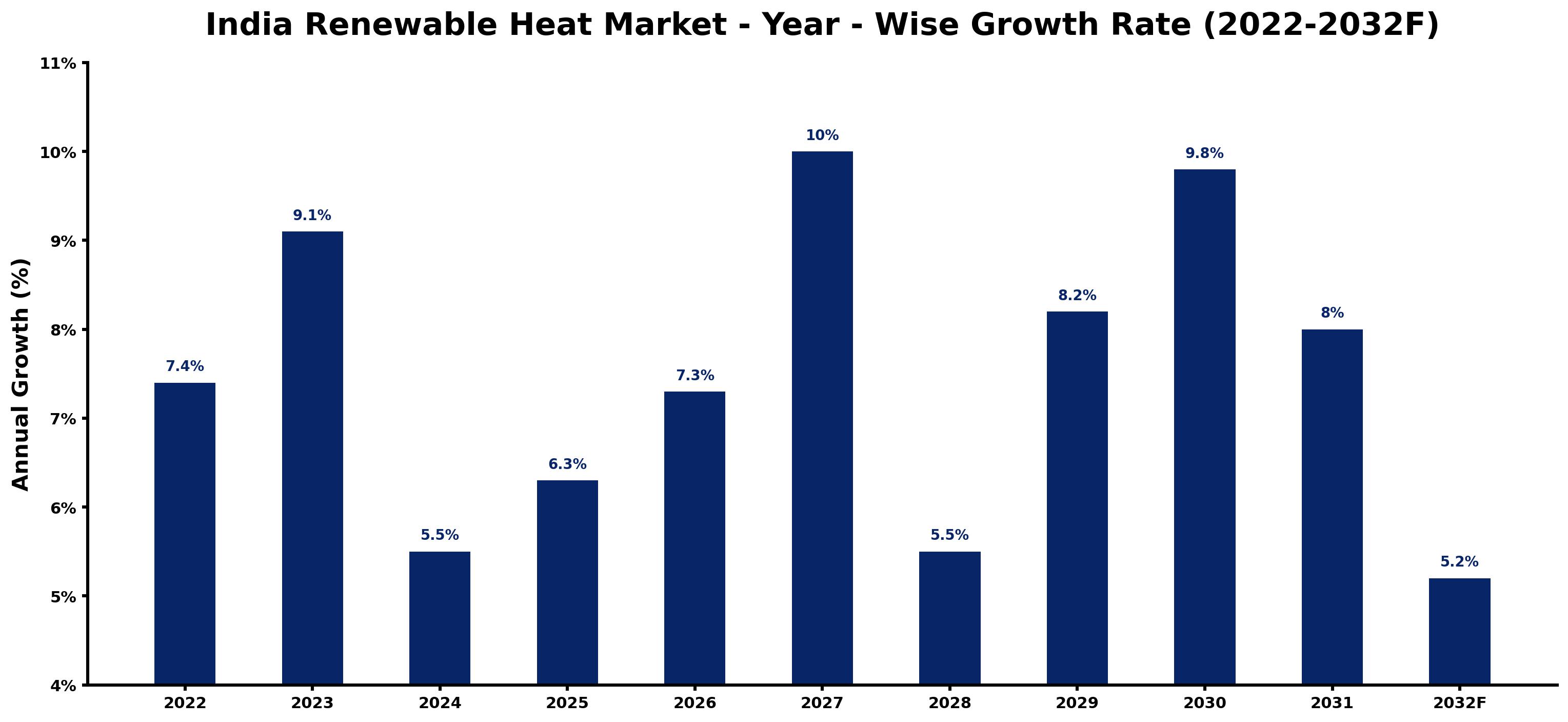
The table below sets out the estimated growth rate for each year and the main factor behind it.
| Year | Estimated Annual Growth (%) | Market Rationale |
| 2022 | 7.4 | The market experienced steady growth due to increased adoption of renewable heating solutions promoted by the Solar Cities Programme. |
| 2023 | 9.1 | Demand surged as urban households began integrating heat pumps into their systems, supported by the National Bioenergy Mission. |
| 2024 | 5.5 | Growth slowed as the Bioheat segment faced challenges in awareness and market penetration. |
| 2025 | 6.3 | Renewable heat adoption accelerated with new government initiatives promoting solar water heating under the Solar Cities Programme. |
| 2026 | 7.3 | Investment in biomass energy generation is expected to increase, driven by the National Bioenergy Mission. |
| 2027 | 10.0 | Peak growth is projected as urban areas expand district heating systems significantly, enhancing energy efficiency in cities. |
| 2028 | 5.5 | A slowdown is anticipated as the market adjusts to the previous year's rapid growth in the Heat Pumps sector. |
| 2029 | 8.2 | Demand is expected to rise as eco-friendly developers increasingly adopt renewable heat solutions in urban developments. |
| 2030 | 9.8 | Growth will continue as public buildings are mandated to use renewable heat under updated energy codes, enhancing sustainability. |
| 2031 | 8.0 | The market will experience a slowdown as competition intensifies among heating technologies, particularly in the Public Buildings segment. |
| 2032 | 5.2 | Growth is projected to slow further as the market stabilises after a period of rapid expansion, particularly in the Solar Heat segment. |
Note: Market size estimations and growth projections presented in this report are based on 6Wresearch's proprietary forecasting methodology, utilizing the latest available industry data, government publications, and primary research inputs.
India Renewable Heat Market Synopsis
The Renewable Heat Market in India encompasses the use of renewable energy sources like solar and biomass for heating applications. Technologies such as solar thermal collectors and biomass combustion systems are essential in generating heat for residential and industrial needs. The market is growing due to rising demand from urban households and government initiatives promoting clean energy solutions.
Market Dynamics Impact Analysis (2026–2032)
| Factor | Type | Impact | Primary Segment Affected |
| Increased adoption of solar thermal collectors for residential heating | Driver | High | Solar Heat |
| Growing demand for energy-efficient solutions in urban areas | Driver | High | Heat Pumps |
| Rising investments in biomass energy generation | Opportunity | High | Bioheat |
| Government incentives for renewable energy projects | Opportunity | High | District Heating |
| High initial costs of renewable heating systems | Restraint | High | Heat Pumps |
| Limited awareness about renewable heat technologies | Restraint | Medium | Solar Heat |
| Supply chain disruptions affecting equipment availability | Challenge | High | Bioheat |
| Regulatory delays in project approvals | Challenge | Medium | District Heating |
Evaluation of Drivers in India Renewable Heat Market (2026–2032)
Below mentioned are some major drivers and their influence on market dynamics.
| Drivers | Primary Segment Affected | Why It Matters (Evidence) |
| Growing adoption of solar thermal collectors | Solar Heat | This technology is widely used for heating water in residential and commercial applications, with India's solar heat capacity reaching 50 million square meters in 2022, driving demand from households and businesses. |
| Increased investment in heat pump technology | Heat Pumps | The Bureau of Energy Efficiency has established standards for energy-efficient heat pumps, with over 60% of urban households expected to adopt them by 2025, enhancing energy efficiency in heating. |
| Expansion of district heating systems | District Heating | Development in major cities like Delhi and Mumbai is improving energy access, with district heating systems serving multiple buildings from a centralized source, increasing demand for renewable heat. |
| Government mandates for renewable heat in public buildings | Public Buildings | The Energy Conservation Building Code requires new public buildings to use renewable heat sources, promoting sustainability and driving demand for renewable heating solutions. |
| Support from the National Bioenergy Mission | Bioheat | This initiative aims to generate 10,000 MW of power from biomass by 2025, encouraging the adoption of bioheat technologies across various industries. |
The National Bioenergy Mission aims to generate 10,000 MW of power from biomass by 2025, encouraging biomass adoption in various sectors. Urban households are projected to adopt heat pumps at over 60% by 2025, improving energy efficiency in heating. Development of district heating systems in urban areas is expected to improve energy access. Public buildings are mandated to use renewable heat, aligning with sustainability goals and driving further demand.
Evaluation of Restraints in India Renewable Heat Market
Below mentioned are some major restraints and their influence on market dynamics.
| Market Restraint | Primary Segment Affected | Why It Matters (Evidence) |
| High initial costs of renewable heating systems | Heat Pumps | The average installation cost for heat pumps can exceed USD 2,000, deterring some buyers. |
| Limited awareness about renewable heat technologies | Solar Heat | Many consumers remain unaware of the benefits of solar heating, impacting adoption rates. |
| Supply chain disruptions affecting equipment availability | Bioheat | Recent supply chain issues have delayed the availability of biomass heating systems, affecting project timelines. |
| Regulatory delays in project approvals | District Heating | Approval processes for new district heating projects can extend beyond six months, causing project delays. |
| Competition from conventional heating sources | Public Buildings | Traditional heating systems remain more familiar and accessible for many public buildings, hindering renewable adoption. |
India Renewable Heat Market Challenges
The cost of adopting renewable heat technologies in India can deter many residential users, with installation expenses reaching up to 30% of their annual energy budget. Limited access to advanced solar thermal collectors restricts efficiency, as over 40% of producers struggle to meet the growing demand for renewable heat. Increased competition from traditional heating sources, such as fossil fuels, pressures suppliers to reduce prices, impacting their profit margins by approximately 15%. A shortage of skilled technicians in renewable heat installation complicates project execution, leading to delays of up to six months and higher costs for developers.
Trends in the India Renewable Heat Market
Four trends stand out in the India Renewable Heat Market.
- Shift from Traditional to Renewable Heating Solutions: Since 2021, there has been a shift towards renewable heating solutions in urban areas. The Solar Cities Programme encourages local governments to adopt solar heat, with over 60% of urban households expected to use heat pumps by 2025.
- Increased Adoption of Heat Pumps: The trend towards heat pumps has gained momentum, particularly in urban households. By 2025, over 60% of urban households are projected to adopt heat pumps, supported by energy efficiency mandates and government incentives.
- Focus on Sustainable Urban Development: The Smart Cities Mission has prioritised integrating renewable heat in urban planning. In 2023, allocated funds are supporting projects that improve energy efficiency in urban areas, benefiting local communities.
- Growing Demand for Biomass Solutions: The National Bioenergy Mission, launched in 2020, has accelerated the adoption of biomass heating solutions. The mission targets generating 10,000 MW of power from biomass by 2025, promoting sustainable energy practices.
Investment Opportunities in the India Renewable Heat Market
Several openings in the India Renewable Heat Market merit attention from investors.
- Investment in Solar Thermal Projects: With India's solar heat capacity at 50 million square meters, there exists a considerable opportunity for investment in solar thermal projects, especially in urban areas. The National Bioenergy Mission aims to generate 10,000 MW of power from biomass by 2025, creating a demand for solar heating solutions.
- Partnerships for Heat Pump Technology: Now is an opportune moment to invest in heat pump technology, as over 60% of urban households are projected to adopt them by 2025. Collaborating with local installers can facilitate market entry and improve service delivery.
- Development of District Heating Systems: The ongoing development of district heating systems in cities like Delhi and Mumbai offers suppliers a chance to engage with municipal utilities. These projects are crucial for enhancing energy access and are supported by government initiatives.
- Focus on Eco-Friendly Developments: The increasing trend of eco-friendly developments in India presents an opportunity to supply renewable heat solutions to property developers. This sector is expected to grow significantly, driven by sustainability goals and government support.
Government Initiatives in the India Renewable Heat Market
The National Bioenergy Mission, launched by the Ministry of New and Renewable Energy in 2020, promotes biomass-based energy generation with a target of 10,000 MW by 2025. This initiative strengthens the market for bioheat technologies by providing funding and support for projects that effectively utilise biomass resources. The Solar Cities Programme, initiated in 2021, encourages local governments to adopt renewable energy solutions, including solar heat, to improve energy efficiency in urban settings.
The Bureau of Energy Efficiency plays a key role in approving and funding projects that meet energy efficiency standards. It supports the implementation of the Energy Conservation Building Code, which mandates the use of renewable heat sources in new public buildings, ensuring compliance and promoting sustainable energy practices.
Future Insight of the India Renewable Heat Market
The renewable heat market in India is set for substantial changes by 2032, driven by increased adoption of solar thermal technology and biomass systems. By 2025, urban planning initiatives under the Smart Cities Mission will prioritise renewable heat integration, enhancing infrastructure in major cities. The Bureau of Energy Efficiency's standards for heat pumps will optimise performance, benefiting both buyers and suppliers. Additionally, the National Bioenergy Mission aims to generate 10,000 MW of power from biomass, further supporting market growth.
Market Segmentation Analysis
The report offers a comprehensive study of the following market segments and their leading categories in the market.
By Heat Source – Solar Heat Dominated, Heat Pumps Expected to Grow Fastest
According to Ravi Bhandari, Research Head at 6Wresearch, Solar Heat held a 39% share of the India Renewable Heat Market by heat source in 2025. Solar heat holds the largest share in India, largely due to its widespread application for heating water in both residential and commercial settings. The substantial daily hot water consumption of around 200 litres per household drives the demand for solar heat technologies. The quickest growth will come from Heat Pumps, forecast to expand at a CAGR of 9.4% between 2026 and 2032. Heat pumps are experiencing rapid growth as urban households increasingly adopt them for their efficient heating and cooling capabilities, with over 60% expected to implement these systems by 2025. This trend suggests that solar heat will maintain its lead as the market expands. Suppliers should focus on solar heat technologies to cater to the growing demand from residential and commercial users.
By Delivery Medium – Hot Water / Steam Dominated and Is Expected to Record the Fastest Growth
Hot Water / Steam took a 46% share of delivery medium in 2025, more than any other category. Hot water and steam are the leading delivery mediums, essential for fulfilling the heating requirements of residential and industrial applications throughout India. Their critical role in various heating solutions ensures a consistent demand in the market. Its lead should widen, with a projected CAGR of 9.6% during 2026–2032, the highest in this split. Hot water and steam are also the fastest-growing delivery mediums, driven by the increasing need for efficient heating solutions across sectors. This concurrent growth allows suppliers to achieve economies of scale and strengthen their market position. Buyers and suppliers should enhance the efficiency of hot water and steam delivery systems to capitalise on this expanding market.
By Sector – Residential & Commercial Dominated, Urban/Smart Homes Expected to Grow Fastest
The largest sector category in 2025 was Residential & Commercial, with a 48% share of total revenue. The residential and commercial sector captures the largest share, primarily due to the high demand for heating solutions from households and businesses. Government initiatives promoting renewable energy further support the growth of this sector. Urban/Smart Homes are set to record the highest CAGR in this split, 10.3% over 2026–2032. Urban and smart homes are the fastest-growing segment, fuelled by a rising trend towards sustainable living in urban environments. As cities evolve, the emphasis on eco-friendly solutions is likely to accelerate this growth even more. Suppliers must adapt their offerings to meet the specific needs of urban and smart home developers to seize this emerging opportunity.
By End User – Property Developers Dominated, Eco-Friendly Developers Expected to Grow Fastest
With a 39% revenue share in 2025, Property Developers was the largest end user category. Property developers lead the market by increasingly integrating renewable heat solutions into new projects, responding to consumer demand and regulatory requirements. This trend is reflected in the growing number of developments that prioritise sustainability. Over 2026–2032, Eco-Friendly Developers are expected to post the fastest growth, at a CAGR of 9.9%. Eco-friendly developers are the fastest-growing end-user group, as their commitment to sustainability drives demand for renewable heat solutions. This focus on eco-friendliness is likely to continue expanding their market share. Suppliers should customise their products to align with the specific needs of eco-friendly developers to maximise opportunities in this segment.
Key Attractiveness of the Report
- 10 Years of Market Numbers
- Historical Data Starting from 2022 to 2025
- Base Year 2025
- Forecast Data until 2032
- Key Performance Indicators Impacting the Market
- Major Upcoming Developments and Projects
Key Highlights of the Report:
- India Renewable Heat Market Outlook
- Market Size of India Renewable Heat Market, 2025
- Forecast of India Renewable Heat Market, 2032
- Historical Data and Forecast of India Renewable Heat Revenues & Volume for the Period 2022 - 2032F
- India Renewable Heat Market Trend Evolution
- India Renewable Heat Market Drivers and Challenges
- India Renewable Heat Price Trends
- India Renewable Heat Porter's Five Forces
- India Renewable Heat Industry Life Cycle
- Historical Data and Forecast of India Renewable Heat Market Revenues & Volume By Heat Source for the Period 2022 - 2032F
- Historical Data and Forecast of India Renewable Heat Market Revenues & Volume By Solar Heat for the Period 2022 - 2032F
- Historical Data and Forecast of India Renewable Heat Market Revenues & Volume By Bioheat for the Period 2022 - 2032F
- Historical Data and Forecast of India Renewable Heat Market Revenues & Volume By District Heating for the Period 2022 - 2032F
- Historical Data and Forecast of India Renewable Heat Market Revenues & Volume By Heat Pumps for the Period 2022 - 2032F
- Historical Data and Forecast of India Renewable Heat Market Revenues & Volume By Delivery Medium for the Period 2022 - 2032F
- Historical Data and Forecast of India Renewable Heat Market Revenues & Volume By Hot Water / Steam for the Period 2022 - 2032F
- Historical Data and Forecast of India Renewable Heat Market Revenues & Volume By Pellet-Based for the Period 2022 - 2032F
- Historical Data and Forecast of India Renewable Heat Market Revenues & Volume By CHP Biomass for the Period 2022 - 2032F
- Historical Data and Forecast of India Renewable Heat Market Revenues & Volume By Ground & Air Source for the Period 2022 - 2032F
- Historical Data and Forecast of India Renewable Heat Market Revenues & Volume By Sector for the Period 2022 - 2032F
- Historical Data and Forecast of India Renewable Heat Market Revenues & Volume By Residential & Commercial for the Period 2022 - 2032F
- Historical Data and Forecast of India Renewable Heat Market Revenues & Volume By Public Buildings for the Period 2022 - 2032F
- Historical Data and Forecast of India Renewable Heat Market Revenues & Volume By Community for the Period 2022 - 2032F
- Historical Data and Forecast of India Renewable Heat Market Revenues & Volume By Urban/Smart Homes for the Period 2022 - 2032F
- Historical Data and Forecast of India Renewable Heat Market Revenues & Volume By End User for the Period 2022 - 2032F
- Historical Data and Forecast of India Renewable Heat Market Revenues & Volume By Property Developers for the Period 2022 - 2032F
- Historical Data and Forecast of India Renewable Heat Market Revenues & Volume By Schools, Govt Buildings for the Period 2022 - 2032F
- Historical Data and Forecast of India Renewable Heat Market Revenues & Volume By Municipal Utilities for the Period 2022 - 2032F
- Historical Data and Forecast of India Renewable Heat Market Revenues & Volume By Eco-Friendly Developers for the Period 2022 - 2032F
- India Renewable Heat Import Export Trade Statistics
- Market Opportunity Assessment By Heat Source
- Market Opportunity Assessment By Delivery Medium
- Market Opportunity Assessment By Sector
- Market Opportunity Assessment By End User
- India Renewable Heat Top Companies Market Share
- India Renewable Heat Competitive Benchmarking By Technical and Operational Parameters
- India Renewable Heat Company Profiles
- India Renewable Heat Key Strategic Recommendations
Market Covered
The report offers an extensive study of the following market segments.
By Heat Source
- Solar Heat
- Bioheat
- District Heating
- Heat Pumps
By Delivery Medium
- Hot Water / Steam
- Pellet-Based
- CHP Biomass
- Ground & Air Source
By Sector
- Residential & Commercial
- Public Buildings
- Community
- Urban/Smart Homes
By End User
- Property Developers
- Schools
- Govt Buildings
- Municipal Utilities
- Eco-Friendly Developers































