India Reproductive Hormones in Animals Market Size & Growth Rate
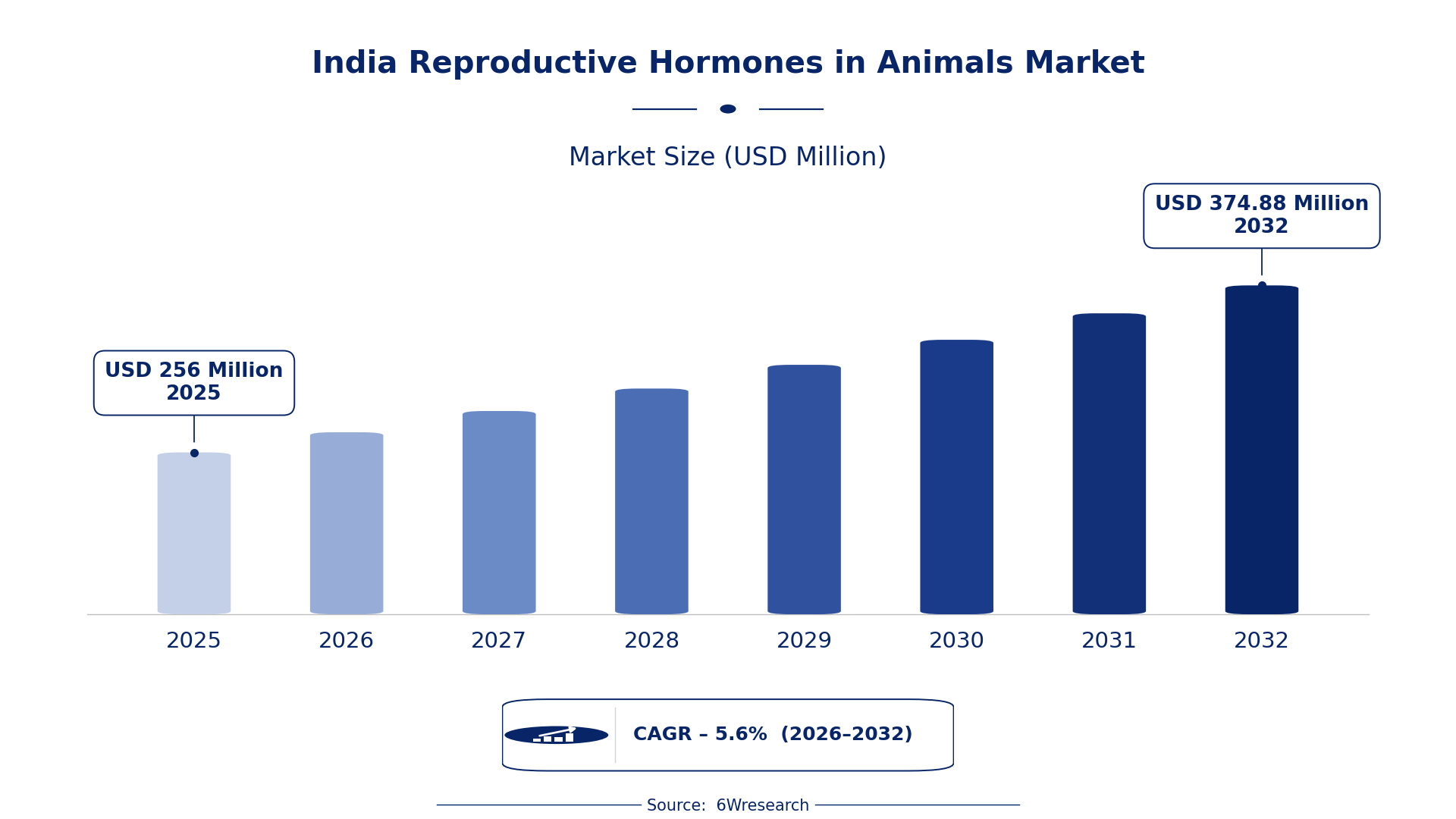
According to 6Wresearch internal database and industry insights, the India Reproductive Hormones in Animals Market was valued at USD 256.0 million in 2025 and is projected to reach USD 374.88 million by 2032, growing at a CAGR of approximately 5.6% during 2026–2032.
India Reproductive Hormones in Animals Market Highlights
| Report Metric | Details |
| Report Name | India Reproductive Hormones in Animals Market |
| Market Size 2025 | USD 256.0 million |
| Market Size 2032 | USD 374.88 million |
| Absolute Growth 2025–2032 | USD 118.88 million |
| CAGR 2026–2032 | 5.6% |
| Peak Annual Growth | 7.3% in 2029 |
| Forecast Period | 2026–2032 |
| Historical Data | 2022–2025 |
| Base Year | 2025 |
| Leading Hormone Type, 2025 | Gonadotropins (38% share) |
| Leading Application Use, 2025 | Estrus Synchronization (44% share) |
| Leading Animal Category, 2025 | Cattle (35% share) |
| Leading End User, 2025 | Veterinary Clinics (40% share) |
| Fastest-Growing Hormone Type | Progesterone Sponges (8.1% CAGR) |
| Fastest-Growing Application Use | Breeding Control (8.0% CAGR) |
| Fastest-Growing Animal Category | Sheep (7.1% CAGR) |
| Fastest-Growing End User | Livestock Farms (6.9% CAGR) |
| Growing Sector | Dairy Farming |
| Key End Users | Veterinary Clinics, Livestock Farms, Artificial Insemination Units, Breeding Centers |
India Reproductive Hormones in Animals Market Year-wise Growth Rate and Key Drivers (2022–2032)
This graph illustrates the annual growth rates of the market from 2022 to 2032, highlighting a steady upward trajectory and projected market expansion over the forecast period.
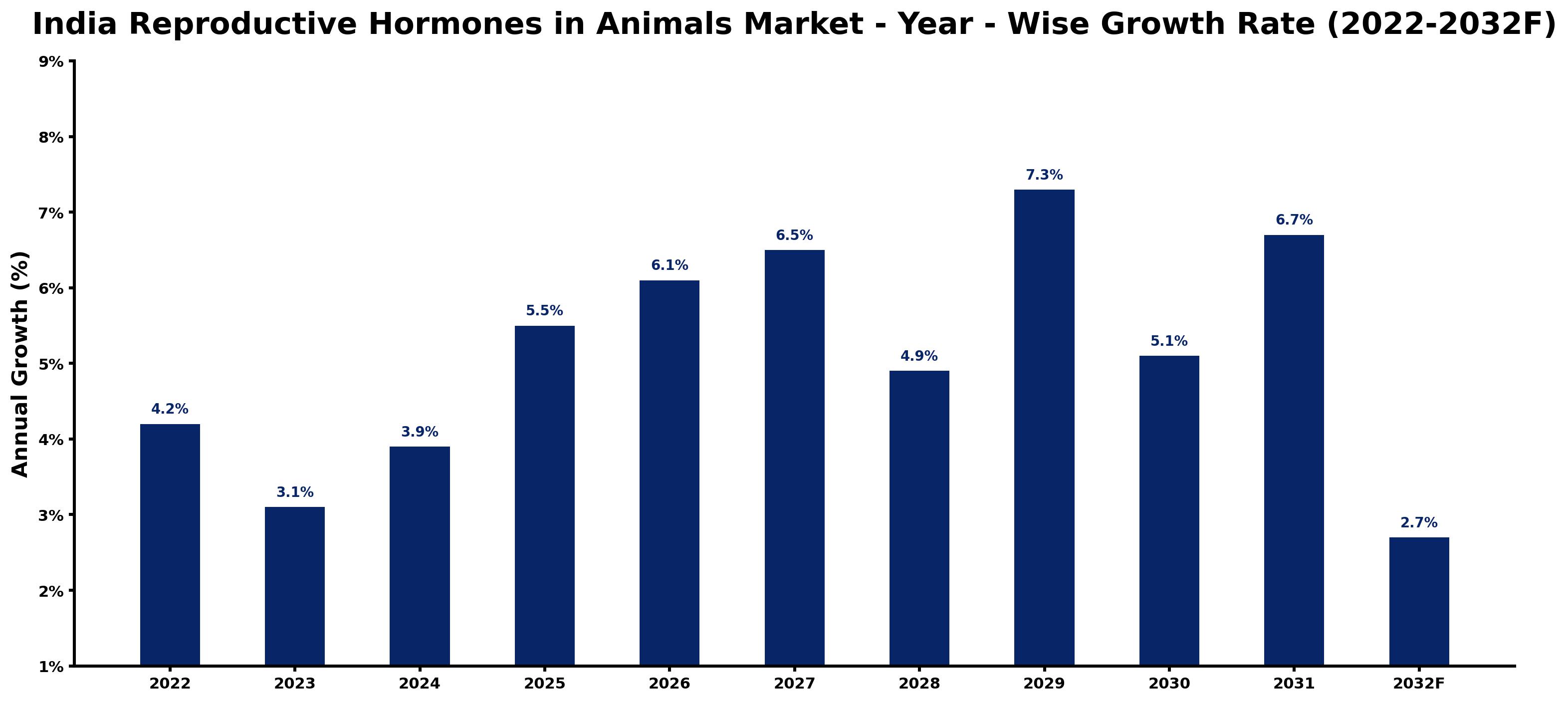
Below, each year's estimated growth is shown next to the factor that most influenced it.
| Year | Estimated Annual Growth (%) | Market Rationale |
| 2022 | 4.2 | The market showed steady growth due to the adoption of reproductive hormones in livestock management, supported by veterinary clinics. |
| 2023 | 3.1 | Growth slowed as some dairy farms faced challenges in hormone application efficiency and training programs. |
| 2024 | 3.9 | An increase in the use of estrus synchronization techniques led to faster growth than the previous year, particularly in dairy farms. |
| 2025 | 5.5 | The market peaked as dairy production surged, driven by improved reproductive hormone applications and veterinary practices. |
| 2026 | 6.1 | Demand is expected to rise as veterinary clinics expand services related to reproductive health management. |
| 2027 | 6.5 | Increased demand for breeding control methods will contribute to a rise in hormone utilization across the sector. |
| 2028 | 4.9 | A slight slowdown is projected as some regions face logistical challenges in hormone distribution and supply chains. |
| 2029 | 7.3 | The market will see a surge due to heightened focus on breeding efficiency in cattle, driven by the National Livestock Mission. |
| 2030 | 5.1 | Growth is expected to slow as the market adjusts to new regulatory standards for hormone use and compliance. |
| 2031 | 6.7 | An increase in veterinary education programs will boost the application of reproductive hormones in livestock management. |
| 2032 | 2.7 | Growth is projected to moderate as the market stabilizes after several years of rapid expansion and increased adoption. |
Note: Market size estimations and growth projections presented in this report are based on 6Wresearch's proprietary forecasting methodology, utilizing the latest available industry data, government publications, and primary research inputs.
India Reproductive Hormones in Animals Market Synopsis
The India Reproductive Hormones in Animals Market encompasses biologically active substances used to regulate livestock reproduction processes. These hormones facilitate estrus synchronization and ovulation induction, essential for improving breeding efficiency. The market is growing due to a thriving livestock industry, with over 300 million cattle driving demand. Veterinary clinics are administering these hormones, supported by initiatives like the National Livestock Mission, which aims to improve livestock productivity and reproductive health management.
Market Dynamics Impact Analysis (2026–2032)
| Factor | Type | Impact | Primary Segment Affected |
| Increasing cattle population driving hormone demand | Driver | High | Estrus Synchronization |
| Expansion of veterinary clinics providing hormone treatments | Driver | High | Veterinary Clinics |
| Growing dairy sector requiring enhanced reproductive management | Opportunity | High | Dairy Cows |
| Investment in breeding technologies to improve livestock quality | Opportunity | High | Livestock Farms |
| Regulatory challenges affecting hormone approval processes | Restraint | Medium | Gonadotropins |
| Limited awareness among farmers regarding hormone benefits | Restraint | Medium | Progesterone Sponges |
| Supply chain disruptions impacting hormone availability | Challenge | High | Artificial Insemination Units |
| Cost pressures on farmers affecting hormone adoption | Challenge | Medium | Breeding Centers |
Evaluation of Drivers in India Reproductive Hormones in Animals Market (2026–2032)
The main growth drivers and the segments they affect most are set out below.
| Drivers | Primary Segment Affected | Why It Matters (Evidence) |
| Rising cattle population | Cattle | With over 300 million cattle, demand for reproductive hormones increases to manage breeding effectively. |
| Growth of veterinary clinics | Veterinary Clinics | The expansion of veterinary clinics nationwide leads to increased hormone administration and application. |
| Dairy sector contribution to GDP | Dairy Cows | The dairy sector contributes approximately 4.6% to India's GDP, driving investments in reproductive health management and hormone use. |
| Adoption of estrus synchronization techniques | Estrus Synchronization | The widespread use of estrus synchronization techniques necessitates hormone applications for improved breeding efficiency. |
| Government initiatives promoting livestock productivity | Livestock Farms | The National Livestock Mission encourages hormone use to improve breeding and productivity across livestock farms. |
Market growth for Reproductive Hormones in Animals in India is underpinned by rising cattle population, expanding veterinary clinics, and the dairy sector's contribution to GDP. The demand for reproductive hormones is increasing as more than 300 million cattle require effective breeding management. The expansion of veterinary clinics across India leads to greater hormone administration, improving reproductive health. The dairy sector's contribution to GDP drives investments in reproductive health management. Adoption of estrus synchronization techniques in over 50% of dairy farms necessitates hormone applications for efficiency, further boosting demand.
Evaluation of Restraints in India Reproductive Hormones in Animals Market
The key brakes on demand, and where they bite hardest, are shown below.
| Market Restraint | Primary Segment Affected | Why It Matters (Evidence) |
| Regulatory challenges affecting hormone approval processes | Gonadotropins | Regulatory hurdles delay the approval of new hormone products, impacting availability for farmers and clinics. |
| Limited awareness among farmers regarding hormone benefits | Progesterone Sponges | Many farmers lack knowledge about the advantages of hormone treatments, hindering adoption and effective use. |
| Supply chain disruptions impacting hormone availability | Artificial Insemination Units | Logistical issues in distribution lead to inconsistent hormone supply for breeding programs, affecting productivity. |
| Cost pressures on farmers affecting hormone adoption | Breeding Centers | Rising costs of hormone treatments deter farmers from implementing reproductive management practices effectively. |
| Inconsistent quality of hormone products in the market | PGF₂α Analogues | Variability in product quality can undermine farmer confidence and reduce usage rates, affecting overall demand. |
India Reproductive Hormones in Animals Market Challenges
Buyers and suppliers in the India Reproductive Hormones in Animals market face rising costs due to fluctuating raw material prices, which can increase production expenses by up to 15%. Compliance with the Drugs and Cosmetics Act complicates operations, leading to delays in product approvals that can extend timelines for veterinary clinics by several months. A shortage of skilled professionals in veterinary education limits effective hormone application, resulting in reduced fertility rates for farmers, who may experience a 20% drop in productivity. Intense competition among suppliers drives down prices, squeezing margins for producers and restricting their ability to invest in quality improvements.
Trends in the India Reproductive Hormones in Animals Market
Buyers and suppliers in the India Reproductive Hormones in Animals Market are adjusting to the following trends.
- Increase in Estrus Synchronization Adoption: Over 50% of dairy farms in India now employ estrus synchronization techniques, which enhance breeding efficiency. This trend demonstrates a growing awareness of the benefits of reproductive hormones, contributing to higher productivity in the sector.
- Shift Towards Advanced Breeding Technologies: The adoption of advanced breeding technologies is on the rise, with a focus on improving genetic quality in livestock. The National Dairy Plan aims to increase milk production by 30% by 2025, which is driving demand for reproductive hormones.
- Growth in Veterinary Education Programs: Veterinary education programs are increasingly integrating training on reproductive hormone applications. This shift began in 2020 and is expected to enhance the application of reproductive technologies throughout the country.
- Expansion of Dairy Entrepreneurship Development Scheme: The Dairy Entrepreneurship Development Scheme promotes investments in dairy farming, including reproductive health initiatives. Launched in 2021, it aims to boost productivity and hormone use in the sector.
Investment Opportunities in the India Reproductive Hormones in Animals Market
Investors looking at the India Reproductive Hormones in Animals Market should consider the following areas.
- Gap in Hormone Application Training: With over 300 million cattle, there is a notable gap in hormone application training for farmers. Investing in training programs can improve adoption rates, particularly in regions like Gujarat, a major dairy hub.
- Investment in Dairy Processing Facilities: The Dairy Processing and Infrastructure Development Fund established in 2021 allocates funds for improving dairy production. This presents an opportunity for suppliers to provide reproductive hormones to processing facilities.
- Partnerships with Veterinary Clinics: Collaborating with veterinary clinics can facilitate better distribution of reproductive hormones. This approach can be particularly effective in states with high dairy farm concentrations, such as Maharashtra.
- Focus on Breeding Centers: The increasing demand for high-quality livestock presents an opportunity to supply reproductive hormones to breeding centers. Establishing partnerships with these centers can improve market penetration.
Government Initiatives in the India Reproductive Hormones in Animals Market
The Drugs and Cosmetics Act regulates reproductive hormones in India, ensuring safety and efficacy for users. The National Livestock Mission, launched in 2020, aims to boost livestock productivity through improved breeding techniques and hormone use. Additionally, the Dairy Processing and Infrastructure Development Fund, established in 2021, allocates funds to enhance dairy production, including reproductive health initiatives. The National Animal Disease Control Programme, initiated in 2020, includes provisions for improving reproductive health in livestock through hormone treatments. These policies support the growth of the reproductive hormones market by ensuring quality and encouraging adoption.
Veterinary clinics play a key role in implementing government schemes aimed at improving reproductive health. The Integrated Sample Collection and Disease Surveillance Programme by the Department of Animal Husbandry monitors reproductive health in livestock, refining hormone application strategies. Additionally, the Pradhan Mantri Matsya Sampada Yojana supports fisheries and livestock sectors, promoting reproductive health management. These initiatives provide funding and resources for clinics, empowering them to offer better hormone treatments and enhance overall livestock productivity.
Future Insight of the India Reproductive Hormones in Animals Market
The India Reproductive Hormones in Animals market will evolve by 2032, driven by the National Livestock Mission, which aims to increase livestock productivity. The adoption of artificial insemination techniques is set to rise, with over 70% of dairy farms currently practising this method. The average dairy cow's milk production is projected to improve, with hormonal treatments expected to raise yields by 10 litres per day. Advancements in veterinary education will equip practitioners with enhanced skills for hormone application, ultimately benefiting both buyers and suppliers.
Market Segmentation Analysis
The analysis below covers each segmentation, its leading category in 2025 and its fastest-growing category through 2032.
By Hormone Type – Gonadotropins Dominated, Progesterone Sponges Expected to Grow Fastest
According to Ravi Bhandari, Research Head at 6Wresearch, in 2025, Gonadotropins led the hormone type split with a 38% share. Gonadotropins hold the largest market share due to their critical role in ovulation induction and breeding control, extensively utilised in veterinary practices across India. Their significance is underscored by their application in over 80% of cattle farms, demonstrating a strong dependency on these hormones. Over 2026–2032, Progesterone Sponges are expected to post the fastest growth, at a CAGR of 8.1%. The rapid adoption of Progesterone Sponges for estrus synchronization is attributed to their effectiveness in improving fertility rates, with evidence suggesting a 20% enhancement in dairy cow fertility. This trend indicates that as breeding efficiency becomes increasingly vital, Gonadotropins will maintain their leadership position. Suppliers should focus on promoting Gonadotropins and providing training to veterinary clinics to meet the rising demand from livestock operations.
By Application Use – Estrus Synchronization Dominated, Breeding Control Expected to Grow Fastest
Estrus Synchronization accounted for a 44% market share by application use in 2025. Estrus Synchronization commands a substantial market share as it is essential for improving breeding efficiency in livestock. This technique is implemented in over 50% of dairy farms in India, highlighting its importance in reproductive management. Breeding Control is set to record the highest CAGR in this split, 8.0% over 2026–2032. Breeding Control is rapidly gaining traction due to its crucial role in effective livestock reproduction management. With the dairy sector aiming for a 30% increase in milk production by 2025, the demand for robust breeding control solutions is projected to rise significantly. Suppliers should prioritise the development of advanced breeding control solutions to address the growing needs of livestock operations.
By Animal Category – Cattle Dominated, Sheep Expected to Grow Fastest
Cattle took a 35% share of animal category in 2025, more than any other category. Cattle dominate the market share for reproductive hormones, primarily due to their status as the leading livestock category in India. With a cattle population exceeding 300 million, the demand for reproductive hormones is heavily influenced by this sector's requirements. Sheep is projected to grow fastest, at a CAGR of 7.1% during 2026–2032. Sheep represent the fastest-growing category for hormone use, driven by an increasing focus on enhancing breeding and production efficiency. As livestock farmers strive to optimise their operations, the demand for reproductive hormones in sheep is expected to surge. Suppliers should tailor their offerings to meet the specific needs of sheep farmers to capture this expanding market segment.
By End User – Veterinary Clinics Dominated, Livestock Farms Expected to Grow Fastest
The largest end user category in 2025 was Veterinary Clinics, with a 40% share of total revenue. Veterinary Clinics maintain the largest market share as they serve as the primary providers for administering reproductive hormones. Their extensive presence across India ensures that livestock farmers have access to essential treatments, reinforcing their dominant role. The quickest growth will come from Livestock Farms, forecast to expand at a CAGR of 6.9% between 2026 and 2032. Livestock Farms are experiencing the fastest growth in hormone use, propelled by their direct need for reproductive management solutions. As these farms increasingly embrace advanced breeding practices, the demand for reproductive hormones is anticipated to rise sharply. This presents an opportunity for suppliers to strengthen their engagement with livestock farms to fulfil the growing demand for reproductive hormone applications.
Key Attractiveness of the Report
- 10 Years of Market Numbers
- Historical Data Starting from 2022 to 2025
- Base Year 2025
- Forecast Data until 2032
- Key Performance Indicators Impacting the Market
- Major Upcoming Developments and Projects
Key Highlights of the Report:
- India Reproductive Hormones in Animals Market Outlook
- Market Size of India Reproductive Hormones in Animals Market, 2025
- Forecast of India Reproductive Hormones in Animals Market, 2032
- Historical Data and Forecast of India Reproductive Hormones in Animals Revenues & Volume for the Period 2022 - 2032F
- India Reproductive Hormones in Animals Market Trend Evolution
- India Reproductive Hormones in Animals Market Drivers and Challenges
- India Reproductive Hormones in Animals Price Trends
- India Reproductive Hormones in Animals Porter's Five Forces
- India Reproductive Hormones in Animals Industry Life Cycle
- Historical Data and Forecast of India Reproductive Hormones in Animals Market Revenues & Volume By Hormone Type for the Period 2022 - 2032F
- Historical Data and Forecast of India Reproductive Hormones in Animals Market Revenues & Volume By Gonadotropins for the Period 2022 - 2032F
- Historical Data and Forecast of India Reproductive Hormones in Animals Market Revenues & Volume By Progesterone Sponges for the Period 2022 - 2032F
- Historical Data and Forecast of India Reproductive Hormones in Animals Market Revenues & Volume By PGF Analogues for the Period 2022 - 2032F
- Historical Data and Forecast of India Reproductive Hormones in Animals Market Revenues & Volume By GnRH Analogs for the Period 2022 - 2032F
- Historical Data and Forecast of India Reproductive Hormones in Animals Market Revenues & Volume By Application Use for the Period 2022 - 2032F
- Historical Data and Forecast of India Reproductive Hormones in Animals Market Revenues & Volume By Estrus Synchronization for the Period 2022 - 2032F
- Historical Data and Forecast of India Reproductive Hormones in Animals Market Revenues & Volume By Breeding Control for the Period 2022 - 2032F
- Historical Data and Forecast of India Reproductive Hormones in Animals Market Revenues & Volume By Luteolysis Induction for the Period 2022 - 2032F
- Historical Data and Forecast of India Reproductive Hormones in Animals Market Revenues & Volume By Ovulation Induction for the Period 2022 - 2032F
- Historical Data and Forecast of India Reproductive Hormones in Animals Market Revenues & Volume By Animal Category for the Period 2022 - 2032F
- Historical Data and Forecast of India Reproductive Hormones in Animals Market Revenues & Volume By Cattle, Sheep for the Period 2022 - 2032F
- Historical Data and Forecast of India Reproductive Hormones in Animals Market Revenues & Volume By Cattle/Swine for the Period 2022 - 2032F
- Historical Data and Forecast of India Reproductive Hormones in Animals Market Revenues & Volume By Dairy Cows for the Period 2022 - 2032F
- Historical Data and Forecast of India Reproductive Hormones in Animals Market Revenues & Volume By Equine/Porcine for the Period 2022 - 2032F
- Historical Data and Forecast of India Reproductive Hormones in Animals Market Revenues & Volume By End User for the Period 2022 - 2032F
- Historical Data and Forecast of India Reproductive Hormones in Animals Market Revenues & Volume By Veterinary Clinics for the Period 2022 - 2032F
- Historical Data and Forecast of India Reproductive Hormones in Animals Market Revenues & Volume By Livestock Farms for the Period 2022 - 2032F
- Historical Data and Forecast of India Reproductive Hormones in Animals Market Revenues & Volume By Artificial Insemination Units for the Period 2022 - 2032F
- Historical Data and Forecast of India Reproductive Hormones in Animals Market Revenues & Volume By Breeding Centers for the Period 2022 - 2032F
- India Reproductive Hormones in Animals Import Export Trade Statistics
- Market Opportunity Assessment By Hormone Type
- Market Opportunity Assessment By Application Use
- Market Opportunity Assessment By Animal Category
- Market Opportunity Assessment By End User
- India Reproductive Hormones in Animals Top Companies Market Share
- India Reproductive Hormones in Animals Competitive Benchmarking By Technical and Operational Parameters
- India Reproductive Hormones in Animals Company Profiles
- India Reproductive Hormones in Animals Key Strategic Recommendations
Market Covered
Segments analysed in this report are listed below.
By Hormone Type
- Gonadotropins
- Progesterone Sponges
- PGF₂α Analogues
- GnRH Analogs
By Application Use
- Estrus Synchronization
- Breeding Control
- Luteolysis Induction
- Ovulation Induction
By Animal Category
- Cattle
- Sheep
- Cattle/Swine
- Dairy Cows
- Equine/Porcine
By End User
- Veterinary Clinics
- Livestock Farms
- Artificial Insemination Units
- Breeding Centers































