India Residential Alarm System Market Size & Growth Rate
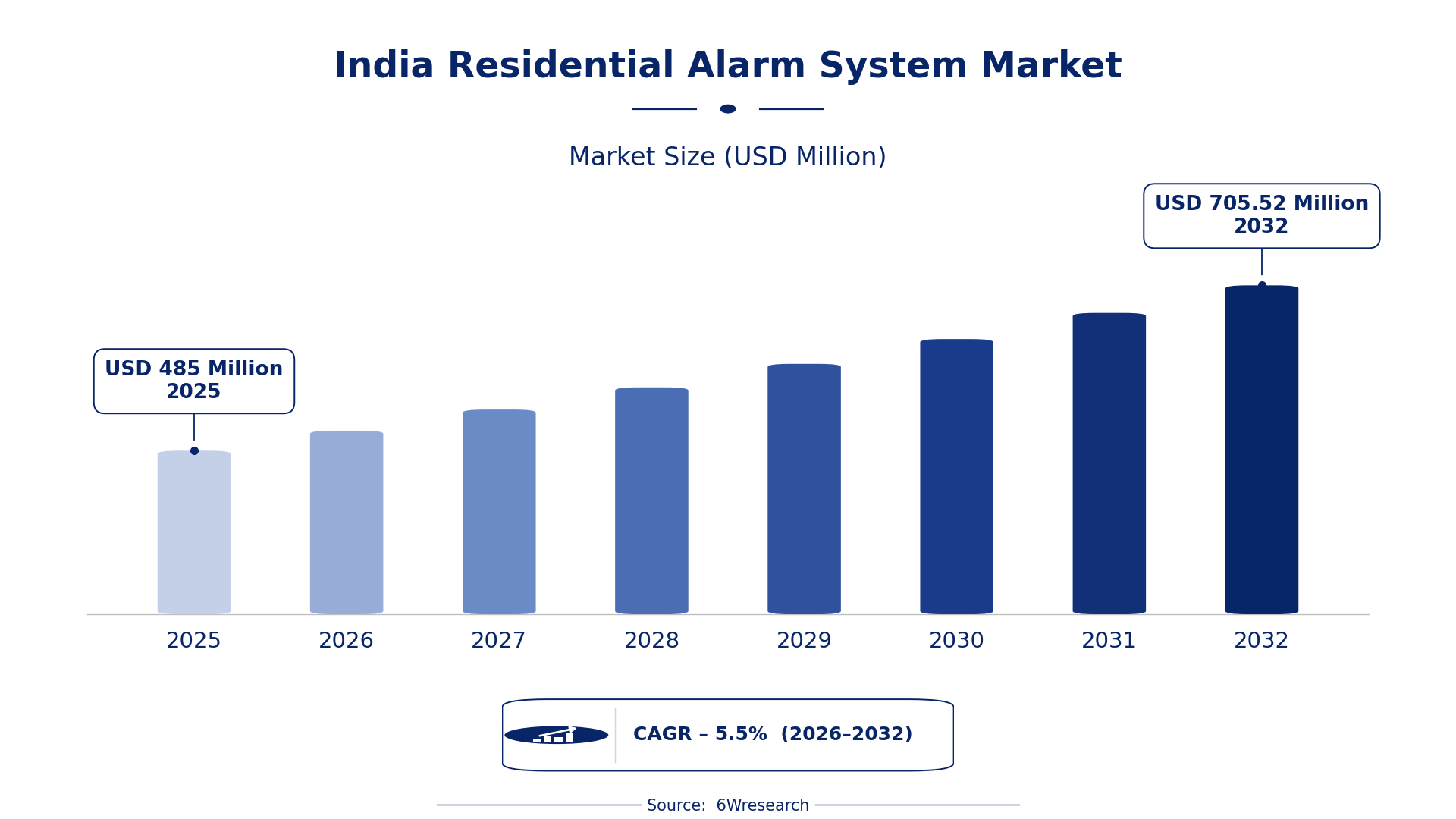
According to 6Wresearch internal database and industry insights, the India Residential Alarm System Market was valued at USD 485.0 million in 2025 and is projected to reach USD 705.52 million by 2032, growing at a CAGR of approximately 5.5% during 2026–2032.
India Residential Alarm System Market Highlights
| Report Metric | Details |
| Report Name | India Residential Alarm System Market |
| Market Size 2025 | USD 485.0 million |
| Market Size 2032 | USD 705.52 million |
| Absolute Growth 2025–2032 | USD 220.52 million |
| CAGR 2026–2032 | 5.5% |
| Peak Annual Growth | 7.8% in 2031 |
| Forecast Period | 2026–2032 |
| Historical Data | 2022–2025 |
| Base Year | 2025 |
| Leading System Type, 2025 | Intrusion Systems (42% share) |
| Leading Sensor Type, 2025 | Door (34% share) |
| Leading Connectivity, 2025 | Cellular/Wi‑Fi (47% share) |
| Leading End User, 2025 | Homeowners & Renters (43% share) |
| Fastest-Growing System Type | Fire & CO Systems (8.2% CAGR) |
| Fastest-Growing Sensor Type | Window (8.1% CAGR) |
| Fastest-Growing Connectivity | Z-Wave/Zigbee Connect (7.4% CAGR) |
| Fastest-Growing End User | Housing Communities (7.5% CAGR) |
| Growing Sector | Residential Security Solutions |
| Key End Users | Homeowners & Renters, Housing Communities, Smart Home Enthusiasts |
India Residential Alarm System Market Year-wise Growth Rate and Key Drivers (2022–2032)
This graph illustrates the annual growth rates of the market from 2022 to 2032, highlighting a steady upward trajectory and projected market expansion over the forecast period.
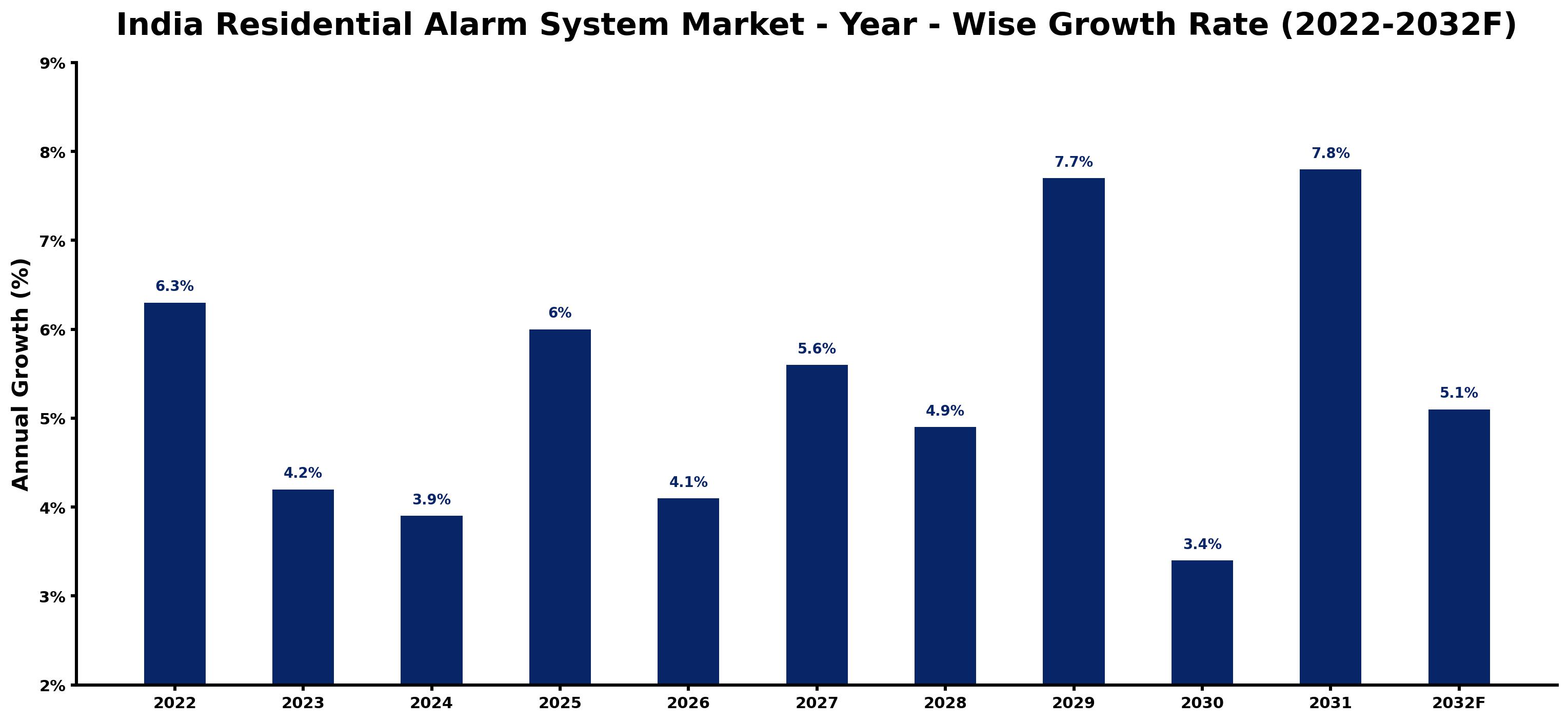
Below, each year's estimated growth is shown next to the factor that most influenced it.
| Year | Estimated Annual Growth (%) | Market Rationale |
| 2022 | 6.3 | The market showed strong growth due to rising urbanisation and increased security awareness among homeowners. |
| 2023 | 4.2 | Demand growth slowed as inflationary pressures affected consumer spending on residential security systems. |
| 2024 | 3.9 | The Smart Cities Mission continued to promote urban security, influencing demand for residential alarm systems. |
| 2025 | 6.0 | New residential developments increasingly included security systems as standard features, driving a resurgence in growth. |
| 2026 | 4.1 | Growth is expected to slow as supply chain disruptions challenge product availability and increase costs. |
| 2027 | 5.6 | An uptick in growth is projected as homeowners prioritise security in response to rising crime rates. |
| 2028 | 4.9 | Economic uncertainties are expected to impact consumer investments in residential security solutions. |
| 2029 | 7.7 | Growth is anticipated to accelerate as housing communities adopt integrated security solutions in urban areas. |
| 2030 | 3.4 | Market saturation is expected to slow growth as new installations become less frequent. |
| 2031 | 7.8 | The market is projected to peak with high growth driven by advancements in smart home technology and integration. |
| 2032 | 5.1 | Growth is expected to slow as the market stabilises, reflecting a mature phase with established consumer preferences. |
Note: Market size estimations and growth projections presented in this report are based on 6Wresearch's proprietary forecasting methodology, utilizing the latest available industry data, government publications, and primary research inputs.
India Residential Alarm System Market Synopsis
The India Residential Alarm System Market encompasses technologies designed to detect unauthorized entry and alert homeowners. These systems include sensors, control panels, and alarms, serving purposes such as intrusion detection and fire safety. The market is expanding due to a growing urban population exceeding 460 million, with increasing demand from homeowners and new residential developments. Government initiatives, including the Smart Cities Mission, aim to improve urban security through technology, further driving market growth. By 2025, security system installations in the residential sector are expected to increase by 10%.
Market Dynamics Impact Analysis (2026–2032)
| Factor | Type | Impact | Primary Segment Affected |
| Rising urbanisation and security concerns drive demand for residential alarm systems. | Driver | High | Intrusion Systems |
| New residential developments increasingly include integrated security measures as standard. | Driver | High | Integrated Smart Security |
| Growing urban population creates a larger base of potential buyers for residential security systems. | Opportunity | High | Homeowners & Renters |
| Increasing adoption of smart home technologies presents opportunities for advanced alarm systems. | Opportunity | High | Smart Home Enthusiasts |
| High costs of advanced alarm systems may deter budget-conscious consumers. | Restraint | Medium | Fire & CO Systems |
| Competition among suppliers can lead to price wars, affecting profit margins. | Restraint | Medium | Video Doorbells |
| Buyers face challenges in choosing the right technology amidst a wide range of options available. | Challenge | Medium | Integrated Smart Security |
| Suppliers struggle with supply chain disruptions that delay product availability and installations. | Challenge | Medium | Intrusion Systems |
Evaluation of Drivers in India Residential Alarm System Market (2026–2032)
The factors lifting demand, and the evidence behind each, are summarised below.
| Drivers | Primary Segment Affected | Why It Matters (Evidence) |
| Rising urbanisation increases the need for security solutions in residential areas. | Homeowners & Renters | India's urban population exceeds 460 million, driving demand for residential security systems. |
| New residential developments often include security systems as standard features. | Integrated Smart Security | As of 2022, over 30% of new homes in urban areas include integrated security systems. |
| Government initiatives promote smart home technology adoption, boosting market demand. | Smart Home Enthusiasts | The Ministry of Electronics and Information Technology supports smart home technology adoption. |
| Increasing crime rates prompt homeowners to invest in security systems for peace of mind. | Intrusion Systems | Delhi, Maharashtra, and Karnataka are leading states in residential alarm system adoption. |
| Technological advancements in alarm systems attract tech-savvy consumers. | Fire & CO Systems | The National Fire Protection Association standards are referenced for fire safety systems. |
With an urban population surpassing 460 million, the demand for security solutions in residential areas is on the rise. In 2022, over 30% of new homes featured integrated security systems, indicating a shift in buyer preferences. The push for smart home technology further amplifies market potential, while the adoption of fire safety standards encourages more installations. These elements drive heightened demand from homeowners and renters seeking better security measures.
Evaluation of Restraints in India Residential Alarm System Market
The key brakes on demand, and where they bite hardest, are shown below.
| Market Restraint | Primary Segment Affected | Why It Matters (Evidence) |
| High costs of advanced alarm systems limit access for budget-conscious consumers. | Fire & CO Systems | The average cost of a basic residential alarm system is approximately ₹15,000. |
| Intense competition among suppliers can lead to price wars, impacting profitability. | Video Doorbells | Increased competition affects pricing strategies and profit margins for suppliers. |
| Buyers face difficulties in selecting the right technology due to numerous options available. | Integrated Smart Security | The variety of features and technologies can overwhelm consumers during the purchasing process. |
| Supply chain disruptions can delay product availability and installations for consumers. | Intrusion Systems | Global supply chain issues have affected timely delivery of security components. |
| Economic uncertainties may hinder consumer willingness to invest in security solutions. | Homeowners & Renters | Inflationary pressures impact disposable income and spending on non-essential items. |
India Residential Alarm System Market Challenges
Buyers in the India residential alarm system market encounter high supply costs, with basic systems averaging ₹15,000, limiting accessibility for many homeowners. A shortage of skilled technicians for installation and maintenance leads to service delays, frustrating customers and impacting supplier reputations. Rising component costs due to inflation and global supply chain disruptions inflate overall production expenses, compelling producers to pass these costs onto buyers. Intense competition among suppliers results in aggressive pricing strategies, which can compromise product quality and stifle innovation in the market.
Trends in the India Residential Alarm System Market
Four trends stand out in the India Residential Alarm System Market.
- Shift Towards Integrated Smart Security Solutions: In 2023, the trend towards integrated smart security solutions is on the rise as housing communities adopt shared security measures. Over 30% of new homes now incorporate these systems, enhancing overall safety and convenience.
- Rise of Fire Safety Systems in Residential Buildings: Since 2021, fire safety regulations in Maharashtra require smoke detectors in new residential buildings. This mandate has spurred demand for fire and CO systems, bolstering overall safety.
- Growth of Housing Communities Adopting Security Solutions: Housing communities are increasingly embracing shared security solutions, with a projected 7.5% CAGR from 2026 to 2032. This trend reflects a collective effort to improve residential safety.
- Increased Demand for Smart Home Technologies: The Indian Smart Home Market is set for substantial growth, with an anticipated rise in smart home technology adoption. This expansion supports the demand for advanced residential alarm systems.
Investment Opportunities in the India Residential Alarm System Market
Below are the investment opportunities with the strongest case in the India Residential Alarm System Market.
- Timing is Right for Smart Home Technology Investments: With the projected growth of the Indian Smart Home Market, investing in smart alarm systems now presents a strong opportunity. Housing communities are increasingly adopting these technologies, improving security.
- Focus on Urban Areas for Security Solutions: Urban areas are experiencing rapid growth, creating a demand for residential alarm systems. Entering through partnerships with local developers can facilitate access to new housing projects.
- Supply of Advanced Fire Safety Systems: The revision of fire safety codes creates a demand for advanced fire safety systems in residential buildings. Suppliers can target new residential developments to meet these regulatory requirements.
- Entry through Certification and Compliance: Obtaining necessary certifications can open doors for suppliers in the residential alarm system market. Collaborating with local agencies ensures compliance with safety standards.
Government Initiatives in the India Residential Alarm System Market
In 2023, the Smart Cities Mission allocated ₹1,000 crores for improving urban security through technology, building on previous efforts to enhance safety in residential areas. The revised National Fire Safety Code in 2021 mandates the installation of smoke alarms in residential properties, ensuring compliance with safety standards. These measures collectively improve the safety of alarm systems, benefiting both producers and buyers by promoting adherence to updated regulations.
The Ministry of Home Affairs oversees the implementation of safety standards for alarm systems, ensuring compliance with regulations. Additionally, the Ministry of Housing and Urban Affairs approves projects aimed at improving urban safety. These agencies play a vital role in funding and approving initiatives that strengthen residential security, supporting the growth of the market.
Future Insight of the India Residential Alarm System Market
The India residential alarm system market will experience notable changes by 2032, propelled by urbanisation and government initiatives. The Smart Cities Mission aims to bolster urban security through advanced technologies, encouraging homeowners to adopt integrated systems. By 2025, security system installations in urban homes are expected to rise by 10%, reflecting an increasing focus on safety. Compliance with the National Building Code will ensure consistent quality and safety standards across new residential developments, benefiting both buyers and suppliers.
Market Segmentation Analysis
The analysis below covers each segmentation, its leading category in 2025 and its fastest-growing category through 2032.
By System Type – Intrusion Systems Dominated, Fire & CO Systems Expected to Grow Fastest
According to Ravi Bhandari, Research Head at 6Wresearch, in 2025, Intrusion Systems led the system type split with a 42% share. Intrusion systems hold the largest market share as they are essential for protecting homes from unauthorized access. With urban areas like Delhi and Maharashtra showing significant adoption rates, these systems are increasingly seen as a necessity for homeowners. Fire & CO Systems are projected to grow fastest, at a CAGR of 8.2% during 2026–2032. Fire and CO systems are experiencing rapid growth due to regulations such as the Fire and Life Safety Code, which mandates smoke and carbon monoxide detectors in residential buildings. This regulatory focus is expected to drive a surge in installations in the coming years. Suppliers should focus on enhancing fire and CO systems to meet regulatory demands and capture a larger share of the market.
By Sensor Type – Door Dominated, Window Expected to Grow Fastest
Door took a 34% share of sensor type in 2025, more than any other category. Door sensors dominate the market share as they are critical for securing entry points in residential properties. Given that the average household size in India is 4.8, the demand for robust door security solutions is particularly strong. Over 2026–2032, Window is expected to post the fastest growth, at a CAGR of 8.1%. Window sensors are witnessing significant growth as they protect vulnerable areas of homes, especially in urban settings where break-ins are common. This heightened awareness of security needs is likely to further boost their adoption. Buyers should consider integrating window sensors into their existing security systems to strengthen overall home protection.
By Connectivity – Cellular/Wi‑Fi Dominated, Z-Wave/Zigbee Connect Expected to Grow Fastest
Cellular/Wi‑Fi accounted for a 47% market share by connectivity in 2025. Cellular/Wi-Fi connectivity leads the market share as it allows homeowners to monitor and control their alarm systems remotely, appealing to the tech-savvy urban population. This connectivity is crucial for addressing the growing demand for smart home solutions. The quickest growth will come from Z-Wave/Zigbee Connect, forecast to expand at a CAGR of 7.4% between 2026 and 2032. Z-Wave/Zigbee connect is rapidly gaining popularity as it facilitates the connection of multiple smart devices, enhancing the capabilities of residential alarm systems. This trend aligns with the increasing integration of smart technologies in homes across India. Suppliers must ensure their products are compatible with Z-Wave/Zigbee to meet the rising demand for interconnected smart home security solutions.
By End User – Homeowners & Renters Dominated, Housing Communities Expected to Grow Fastest
With a 43% revenue share in 2025, Homeowners & Renters was the largest end user category. Homeowners and renters represent the largest share of the market as they are the primary users of residential alarm systems. With the urban population expanding, the need for effective security solutions among this group continues to rise. Housing Communities are set to record the highest CAGR in this split, 7.5% over 2026–2032. Housing communities are increasingly adopting shared security solutions, driven by the need for collective safety measures in densely populated areas. This trend is expected to accelerate as urban developments continue to grow. Suppliers should tailor offerings to meet the specific needs of housing communities to capture this growing segment.
Key Attractiveness of the Report
- 10 Years of Market Numbers
- Historical Data Starting from 2022 to 2025
- Base Year 2025
- Forecast Data until 2032
- Key Performance Indicators Impacting the Market
- Major Upcoming Developments and Projects
Key Highlights of the Report:
- India Residential Alarm System Market Outlook
- Market Size of India Residential Alarm System Market, 2025
- Forecast of India Residential Alarm System Market, 2032
- Historical Data and Forecast of India Residential Alarm System Revenues & Volume for the Period 2022 - 2032F
- India Residential Alarm System Market Trend Evolution
- India Residential Alarm System Market Drivers and Challenges
- India Residential Alarm System Price Trends
- India Residential Alarm System Porter's Five Forces
- India Residential Alarm System Industry Life Cycle
- Historical Data and Forecast of India Residential Alarm System Market Revenues & Volume By System Type for the Period 2022 - 2032F
- Historical Data and Forecast of India Residential Alarm System Market Revenues & Volume By Intrusion Systems for the Period 2022 - 2032F
- Historical Data and Forecast of India Residential Alarm System Market Revenues & Volume By Fire & CO Systems for the Period 2022 - 2032F
- Historical Data and Forecast of India Residential Alarm System Market Revenues & Volume By Video Doorbells for the Period 2022 - 2032F
- Historical Data and Forecast of India Residential Alarm System Market Revenues & Volume By Integrated Smart Security for the Period 2022 - 2032F
- Historical Data and Forecast of India Residential Alarm System Market Revenues & Volume By Sensor Type for the Period 2022 - 2032F
- Historical Data and Forecast of India Residential Alarm System Market Revenues & Volume By Door, Window, Motion for the Period 2022 - 2032F
- Historical Data and Forecast of India Residential Alarm System Market Revenues & Volume By Smoke/CO Sensors for the Period 2022 - 2032F
- Historical Data and Forecast of India Residential Alarm System Market Revenues & Volume By HD Video Audio for the Period 2022 - 2032F
- Historical Data and Forecast of India Residential Alarm System Market Revenues & Volume By Full Smart Suite for the Period 2022 - 2032F
- Historical Data and Forecast of India Residential Alarm System Market Revenues & Volume By Connectivity for the Period 2022 - 2032F
- Historical Data and Forecast of India Residential Alarm System Market Revenues & Volume By Cellular/Wi Fi for the Period 2022 - 2032F
- Historical Data and Forecast of India Residential Alarm System Market Revenues & Volume By Z-Wave/Zigbee Connect for the Period 2022 - 2032F
- Historical Data and Forecast of India Residential Alarm System Market Revenues & Volume By Cloud Storage for the Period 2022 - 2032F
- Historical Data and Forecast of India Residential Alarm System Market Revenues & Volume By App-Controlled Panels for the Period 2022 - 2032F
- Historical Data and Forecast of India Residential Alarm System Market Revenues & Volume By End User for the Period 2022 - 2032F
- Historical Data and Forecast of India Residential Alarm System Market Revenues & Volume By Homeowners & Renters for the Period 2022 - 2032F
- Historical Data and Forecast of India Residential Alarm System Market Revenues & Volume By Housing Communities for the Period 2022 - 2032F
- Historical Data and Forecast of India Residential Alarm System Market Revenues & Volume By Smart Home Enthusiasts for the Period 2022 - 2032F
- Historical Data and Forecast of India Residential Alarm System Market Revenues & Volume By New Residential Developments for the Period 2022 - 2032F
- India Residential Alarm System Import Export Trade Statistics
- Market Opportunity Assessment By System Type
- Market Opportunity Assessment By Sensor Type
- Market Opportunity Assessment By Connectivity
- Market Opportunity Assessment By End User
- India Residential Alarm System Top Companies Market Share
- India Residential Alarm System Competitive Benchmarking By Technical and Operational Parameters
- India Residential Alarm System Company Profiles
- India Residential Alarm System Key Strategic Recommendations
Market Covered
The report offers an extensive study of the following market segments.
By System Type
- Intrusion Systems
- Fire & CO Systems
- Video Doorbells
- Integrated Smart Security
By Sensor Type
- Door
- Window
- Motion
- Smoke/CO Sensors
- HD Video + Audio
- Full Smart Suite
By Connectivity
- Cellular/Wi‑Fi
- Z-Wave/Zigbee Connect
- Cloud Storage
- App-Controlled Panels
By End User
- Homeowners & Renters
- Housing Communities
- Smart Home Enthusiasts
- New Residential Developments































