India Retirement Housing Market Size & Growth Rate
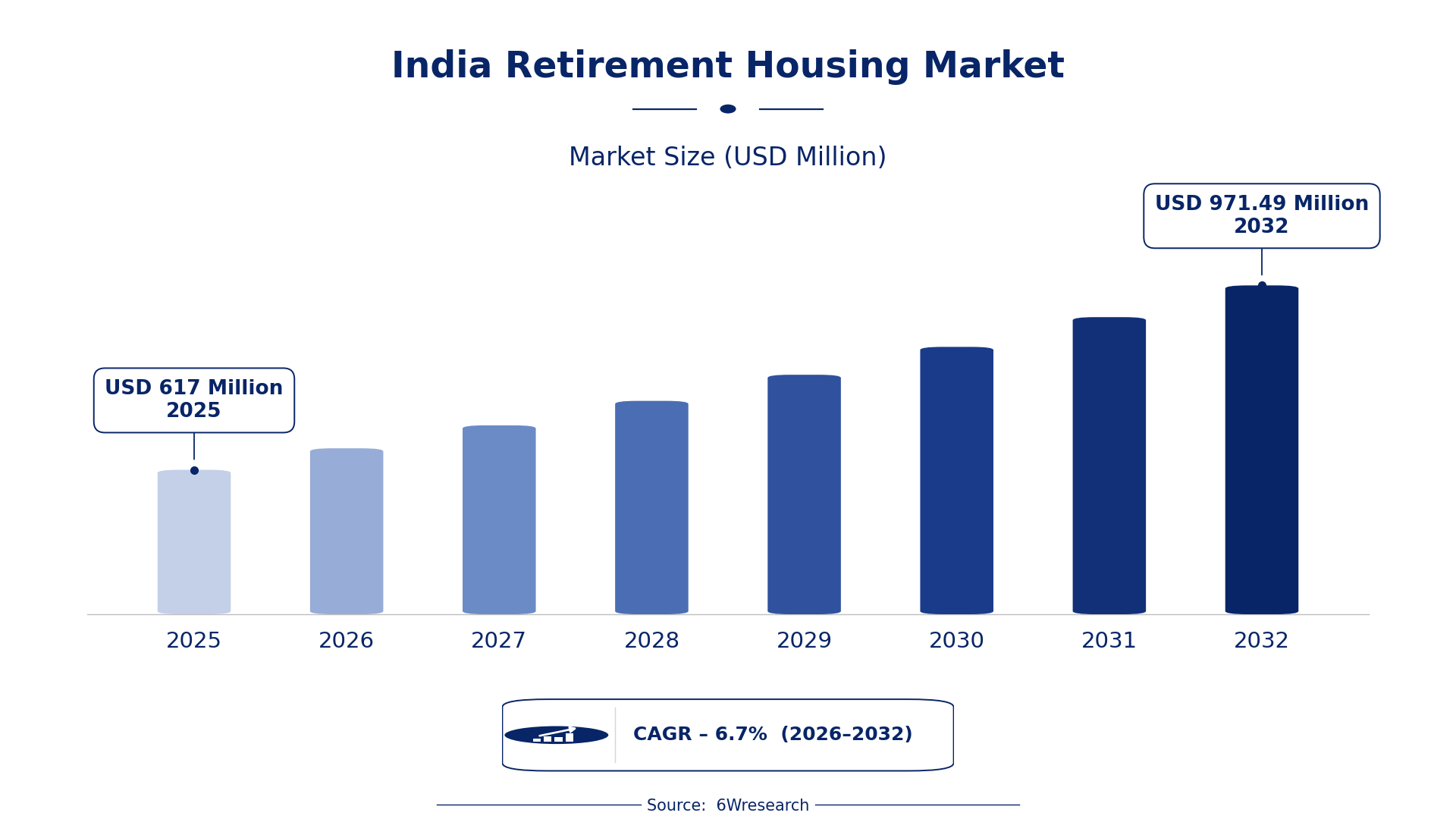
According to 6Wresearch internal database and industry insights, the India Retirement Housing Market was valued at USD 617.0 million in 2025 and is projected to reach USD 971.49 million by 2032, growing at a CAGR of approximately 6.7% during 2026–2032.
India Retirement Housing Market Highlights
| Report Metric | Details |
| Report Name | India Retirement Housing Market |
| Market Size 2025 | USD 617.0 million |
| Market Size 2032 | USD 971.49 million |
| Absolute Growth 2025–2032 | USD 354.49 million |
| CAGR 2026–2032 | 6.7% |
| Peak Annual Growth | 9.1% in 2030 |
| Forecast Period | 2026–2032 |
| Historical Data | 2022–2025 |
| Base Year | 2025 |
| Leading Housing Type, 2025 | Condominium-Style Units (50% share) |
| Leading Ownership Model, 2025 | Private Ownership (42% share) |
| Leading Facility Style, 2025 | Multistory Communities (43% share) |
| Leading End User, 2025 | Affluent Retirees (40% share) |
| Fastest-Growing Housing Type | Subsidized Housing (9.2% CAGR) |
| Fastest-Growing Ownership Model | Public / Non-Profit (8.5% CAGR) |
| Fastest-Growing Facility Style | Low-Income Style (8.5% CAGR) |
| Fastest-Growing End User | Community-Oriented Seniors (9.3% CAGR) |
| Growing Sector | Affluent Retirees |
| Key End Users | Affluent Retirees, Community-Oriented Seniors, Low-Income Seniors |
India Retirement Housing Market Year-wise Growth Rate and Key Drivers (2022–2032)
This graph illustrates the annual growth rates of the market from 2022 to 2032, highlighting a steady upward trajectory and projected market expansion over the forecast period.
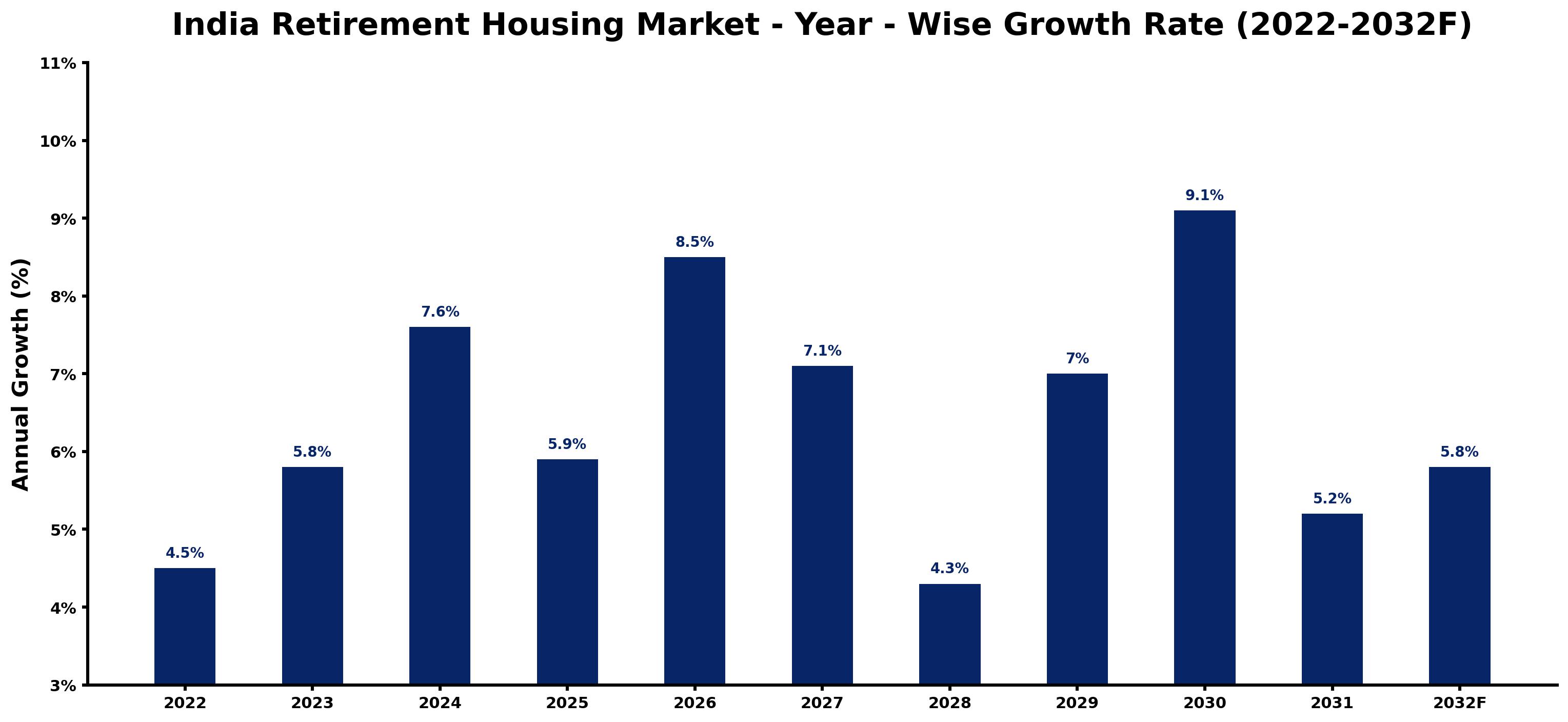
The following table presents the estimated annual growth rate for each year together with the principal factor influencing market performance.
| Year | Estimated Annual Growth (%) | Market Rationale |
| 2022 | 4.5 | The market experienced steady demand from affluent retirees seeking quality housing options. |
| 2023 | 5.8 | Urban migration increased the need for retirement housing in metropolitan areas like Delhi. |
| 2024 | 7.6 | The rise in the elderly population heightened demand for community-oriented living arrangements. |
| 2025 | 5.9 | A slowdown occurred as some buyers hesitated due to rising living costs. |
| 2026 | 8.5 | Investment in senior housing projects is expected to surge, driven by government incentives and policies. |
| 2027 | 7.1 | Growth is projected to slow as developers face challenges in meeting rising construction costs. |
| 2028 | 4.3 | Demand is expected to stabilise as buyers adapt to new housing options and financial plans. |
| 2029 | 7.0 | Interest in affordable housing options is anticipated to increase, particularly among low-income seniors. |
| 2030 | 9.1 | A peak in growth will be driven by the successful implementation of new housing schemes. |
| 2031 | 5.2 | Growth is projected to slow as market adjustments occur following the peak demand. |
| 2032 | 5.8 | Demand is expected to rise again as urbanisation continues and more projects are initiated. |
Note: Market size estimations and growth projections presented in this report are based on 6Wresearch's proprietary forecasting methodology, utilizing the latest available industry data, government publications, and primary research inputs.
India Retirement Housing Market Synopsis
Retirement Housing in India includes various living arrangements tailored for seniors, such as condominiums and cooperative housing. These facilities offer supportive communities that enable retirees to maintain their independence while accessing essential services. The India Retirement Housing Market is growing due to an increasing elderly population and rising demand from affluent retirees. By 2050, India's elderly population is expected to reach 300 million, creating a greater need for diverse retirement housing options. Government initiatives and urban migration are further propelling this market's expansion.
Market Dynamics Impact Analysis (2026–2032)
| Factor | Type | Impact | Primary Segment Affected |
| Rising elderly population driving demand for supportive housing. | Driver | High | Affluent Retirees |
| Government incentives for developers to create senior housing projects. | Driver | High | Private Ownership |
| Increasing urban migration creating demand for retirement housing in cities. | Opportunity | High | Multistory Communities |
| Growing interest in affordable housing options for low-income seniors. | Opportunity | Medium | Subsidized Housing |
| High construction costs impacting project feasibility for developers. | Restraint | High | Cooperative Housing |
| Limited awareness among seniors about available retirement housing options. | Restraint | Medium | Flexible Lease Housing |
| The Retirement Housing market in India faces a few practical problems, including rising construction costs. | Challenge | High | Private Ownership |
| Developers struggle to meet the increasing demand for senior-friendly housing. | Challenge | Medium | Multistory Communities |
Evaluation of Drivers in India Retirement Housing Market (2026–2032)
Key forces behind demand, with the segment each one moves most, are listed below.
| Drivers | Primary Segment Affected | Why It Matters (Evidence) |
| Rising elderly population | Affluent Retirees | India's elderly population is projected to reach 300 million by 2050, increasing the need for retirement housing. |
| Government incentives for developers | Private Ownership | The National Housing Policy 2021 promotes affordable housing, encouraging developers to invest in senior housing. |
| Urban migration trends | Multistory Communities | The average monthly rent for retirement housing in urban areas ranges from INR 15,000 to INR 30,000, reflecting increased demand. |
| Increased disposable income among seniors | Cooperative Housing | Affluent retirees are seeking community-oriented living arrangements, driving demand for cooperative housing options. |
| Focus on senior-friendly designs | Subsidized Housing | The National Building Code of India includes guidelines for senior-friendly housing, improving market appeal. |
The Retirement Housing market in India is expanding as rising elderly population, urban migration trends, and incentives for developers drive demand. By 2050, the elderly population is expected to reach 300 million, which will increase the need for supportive living arrangements. Urban migration has led to a rise in demand for retirement housing options, particularly in metropolitan areas. Increased disposable income among seniors is further boosting the market's potential.
Evaluation of Restraints in India Retirement Housing Market
The following restraints limit how fast demand can grow.
| Market Restraint | Primary Segment Affected | Why It Matters (Evidence) |
| High construction costs impacting project feasibility. | Cooperative Housing | Construction costs have risen, making it challenging for developers to maintain project viability. |
| Limited awareness among seniors about available options. | Flexible Lease Housing | Many seniors are unaware of the benefits and availability of retirement housing options. |
| Regulatory hurdles delaying project approvals. | Private Ownership | Developers face lengthy approval processes, hindering timely project launches. |
| Competition from traditional housing options. | Multistory Communities | Seniors often prefer traditional housing, limiting the market for retirement communities. |
| Inadequate financing options for developers. | Subsidized Housing | Developers struggle to secure funding for affordable housing projects targeting low-income seniors. |
India Retirement Housing Market Challenges
The India Retirement Housing Market faces several practical issues, starting with a shortage of skilled labour. This challenge arises from limited training programmes for professionals in senior living design, which can delay project timelines for developers. Another hurdle is the slow adoption of technology in retirement housing facilities. Many suppliers are reluctant to invest in modern amenities, leading to outdated offerings that fail to meet buyer expectations. The average monthly rent of INR 15,000 to INR 30,000 can limit access for many seniors, while supply chain disruptions hinder the availability of age-friendly building materials, increasing construction costs for developers and extending wait times for buyers.
Trends in the India Retirement Housing Market
The trends below show where the India Retirement Housing Market is heading.
- Shift towards Affordable Housing: Since 2021, there has been a noticeable shift towards affordable housing for seniors, driven by government initiatives like the Pradhan Mantri Awas Yojana, which aims to create 1 million affordable housing units by 2025.
- Rise of Community Living: In Maharashtra, the trend of community living has gained momentum, with cooperative housing models becoming increasingly popular. This approach encourages shared responsibilities and social connections among residents, improving the living experience for seniors.
- Increased Focus on Senior-Friendly Designs: The National Building Code of India has emphasised guidelines for senior-friendly housing since 2023. This focus ensures that new developments cater to the specific needs of elderly residents, promoting accessibility and safety.
- Growing Demand for Rental Options: The rise in urban migration has led to an increased demand for rental retirement housing in cities like Delhi. The average monthly rent for these units ranges from INR 15,000 to INR 30,000, appealing to seniors seeking flexibility.
Investment Opportunities in the India Retirement Housing Market
Some of the investment opportunities in the India Retirement Housing Market are mentioned below.
- Timing for Investment in Senior Housing: Now is a prime time to invest in senior housing, with the elderly population projected to reach 300 million by 2050. Developers can target affluent retirees in urban areas like Delhi, leveraging government incentives for affordable housing.
- Gap in Affordable Housing Supply: With a projected elderly population of 300 million by 2050, a notable gap in affordable housing exists. Developers can concentrate on subsidised housing projects in states like Karnataka, which offers incentives for senior housing development.
- Investment in Community-Oriented Housing: The growing interest in community living presents an opportunity for developers to establish cooperative housing. Targeting community-oriented seniors in regions with high migration can improve market entry potential.
- Partnerships for Development: Forming joint ventures with local developers can ease entry into the retirement housing market. Collaborating with established firms in Maharashtra can streamline project approvals and improve market access.
Government Initiatives in the India Retirement Housing Market
The Pradhan Mantri Awas Yojana, launched in 2021, promotes affordable housing for seniors, aiming for 1 million units by 2025. This initiative encourages developers to create senior-friendly housing options, enhancing living conditions for the elderly. The National Senior Citizens Policy 2020 further supports this by focusing on housing, healthcare, and social security, improving the overall quality of life for seniors in India.
The Ministry of Housing and Urban Affairs oversees the implementation of housing policies, including the Pradhan Mantri Awas Yojana. This agency funds various housing projects aimed at seniors, ensuring accessibility and affordability. Additionally, the Ministry of Social Justice and Empowerment administers the Senior Citizens' Welfare Scheme, providing financial assistance for housing and welfare initiatives, which benefits low-income seniors.
Future Insight of the India Retirement Housing Market
The India Retirement Housing Market will undergo significant changes by 2032, driven by several key factors. The National Housing Policy 2021 aims to enhance access to affordable retirement housing, benefiting seniors nationwide. Urban migration will continue to drive demand, particularly in cities like Delhi, where the need for retirement communities is on the rise. Incentives for developers in Karnataka will encourage the construction of more senior-friendly units, while government welfare schemes will improve living conditions for the elderly. By 2050, India's elderly population is projected to reach 300 million, highlighting the urgent need for expanded retirement housing options.
Market Segmentation Analysis
Each segment group is reviewed below, with the leader by share and the fastest grower by CAGR.
By Housing Type – Condominium-Style Units Dominated, Subsidized Housing Expected to Grow Fastest
According to Ravi Bhandari, Research Head at 6Wresearch, Condominium-Style Units took a 50% share of housing type in 2025, more than any other category. Condominium-Style Units dominate the market because they offer independent living with community amenities, appealing to affluent retirees. For instance, Maharashtra's retirement communities primarily consist of these units, catering to the growing elderly population. Subsidized Housing is projected to grow fastest, at a CAGR of 9.2% during 2026–2032. Subsidized Housing is experiencing rapid growth as it provides affordable living options for low-income seniors, addressing the increasing demand for budget-friendly retirement solutions. The government's initiatives, such as the Pradhan Mantri Awas Yojana, further support this segment's expansion. Suppliers should focus on developing affordable housing solutions to meet the rising demand among seniors.
By Ownership Model – Private Ownership Dominated, Public / Non-Profit Expected to Grow Fastest
With a 42% revenue share in 2025, Private Ownership was the largest ownership model category. Private Ownership holds the largest market share as it allows seniors to own their homes outright, ensuring autonomy and control over their living arrangements. This model is particularly appealing to affluent retirees who prefer independence in their retirement years. Over 2026–2032, Public / Non-Profit is expected to post the fastest growth, at a CAGR of 8.5%. Public / Non-Profit ownership models are growing quickly, as they provide affordable options for low-income seniors, reflecting the increasing need for budget-conscious living arrangements. This growth is supported by government policies aimed at improving housing conditions for the elderly. Buyers will benefit from a wider range of affordable housing options as public and non-profit models expand.
By Facility Style – Multistory Communities Dominated, Low-Income Style Expected to Grow Fastest
In 2025, Multistory Communities led the facility style split with a 43% share. Multistory Communities hold the largest market share as they cater to a significant number of residents, promoting social interaction among seniors. This facility type is particularly prevalent in Maharashtra, which has the highest concentration of retirement communities in India. Low-Income Style is set to record the highest CAGR in this split, 8.5% over 2026–2032. Low-Income Style is witnessing the fastest growth due to its emphasis on affordability, appealing to low-income seniors amidst rising living costs. Government initiatives, such as the National Housing Policy 2021, support the development of budget-friendly housing options for the elderly. This trend indicates that suppliers should prioritise affordable housing solutions to meet the needs of the growing low-income senior population.
By End User – Affluent Retirees Dominated, Community-Oriented Seniors Expected to Grow Fastest
The largest end user category in 2025 was Affluent Retirees, with a 40% share of total revenue. Affluent Retirees represent the largest share of the market, as they seek high-quality living arrangements with various amenities that cater to their lifestyle. This demographic is increasingly looking for retirement housing that offers both comfort and community. The quickest growth will come from Community-Oriented Seniors, forecast to expand at a CAGR of 9.3% between 2026 and 2032. Community-Oriented Seniors are the fastest-growing segment, valuing social connections and community activities, which are essential for their well-being. This trend is supported by a shift towards more interactive and engaging living environments for seniors. Developers should prioritise community-focused amenities to attract the growing number of community-oriented seniors.
Key Attractiveness of the Report
- 10 Years of Market Numbers
- Historical Data Starting from 2022 to 2025
- Base Year 2025
- Forecast Data until 2032
- Key Performance Indicators Impacting the Market
- Major Upcoming Developments and Projects
Key Highlights of the Report:
- India Retirement Housing Market Outlook
- Market Size of India Retirement Housing Market, 2025
- Forecast of India Retirement Housing Market, 2032
- Historical Data and Forecast of India Retirement Housing Revenues & Volume for the Period 2022 - 2032F
- India Retirement Housing Market Trend Evolution
- India Retirement Housing Market Drivers and Challenges
- India Retirement Housing Price Trends
- India Retirement Housing Porter's Five Forces
- India Retirement Housing Industry Life Cycle
- Historical Data and Forecast of India Retirement Housing Market Revenues & Volume By Housing Type for the Period 2022 - 2032F
- Historical Data and Forecast of India Retirement Housing Market Revenues & Volume By Condominium-Style Units for the Period 2022 - 2032F
- Historical Data and Forecast of India Retirement Housing Market Revenues & Volume By Cooperative Housing for the Period 2022 - 2032F
- Historical Data and Forecast of India Retirement Housing Market Revenues & Volume By Subsidized Housing for the Period 2022 - 2032F
- Historical Data and Forecast of India Retirement Housing Market Revenues & Volume By Flexible Lease Housing for the Period 2022 - 2032F
- Historical Data and Forecast of India Retirement Housing Market Revenues & Volume By Ownership Model for the Period 2022 - 2032F
- Historical Data and Forecast of India Retirement Housing Market Revenues & Volume By Private Ownership for the Period 2022 - 2032F
- Historical Data and Forecast of India Retirement Housing Market Revenues & Volume By Resident-Owned for the Period 2022 - 2032F
- Historical Data and Forecast of India Retirement Housing Market Revenues & Volume By Public / Non-Profit for the Period 2022 - 2032F
- Historical Data and Forecast of India Retirement Housing Market Revenues & Volume By Rental for the Period 2022 - 2032F
- Historical Data and Forecast of India Retirement Housing Market Revenues & Volume By Facility Style for the Period 2022 - 2032F
- Historical Data and Forecast of India Retirement Housing Market Revenues & Volume By Multistory Communities for the Period 2022 - 2032F
- Historical Data and Forecast of India Retirement Housing Market Revenues & Volume By Shared Amenities for the Period 2022 - 2032F
- Historical Data and Forecast of India Retirement Housing Market Revenues & Volume By Low-Income Style for the Period 2022 - 2032F
- Historical Data and Forecast of India Retirement Housing Market Revenues & Volume By Clustered Apartments for the Period 2022 - 2032F
- Historical Data and Forecast of India Retirement Housing Market Revenues & Volume By End User for the Period 2022 - 2032F
- Historical Data and Forecast of India Retirement Housing Market Revenues & Volume By Affluent Retirees for the Period 2022 - 2032F
- Historical Data and Forecast of India Retirement Housing Market Revenues & Volume By Community-Oriented Seniors for the Period 2022 - 2032F
- Historical Data and Forecast of India Retirement Housing Market Revenues & Volume By Low-Income Seniors for the Period 2022 - 2032F
- Historical Data and Forecast of India Retirement Housing Market Revenues & Volume By Relocating Elderly for the Period 2022 - 2032F
- India Retirement Housing Import Export Trade Statistics
- Market Opportunity Assessment By Housing Type
- Market Opportunity Assessment By Ownership Model
- Market Opportunity Assessment By Facility Style
- Market Opportunity Assessment By End User
- India Retirement Housing Top Companies Market Share
- India Retirement Housing Competitive Benchmarking By Technical and Operational Parameters
- India Retirement Housing Company Profiles
- India Retirement Housing Key Strategic Recommendations
Market Covered
The report offers an extensive study of the following market segments.
By Housing Type
- Condominium-Style Units
- Cooperative Housing
- Subsidized Housing
- Flexible Lease Housing
By Ownership Model
- Private Ownership
- Resident-Owned
- Public / Non-Profit
- Rental
By Facility Style
- Multistory Communities
- Shared Amenities
- Low-Income Style
- Clustered Apartments
By End User
- Affluent Retirees
- Community-Oriented Seniors
- Low-Income Seniors
- Relocating Elderly































