India RFID Animal Implants Market Size & Growth Rate
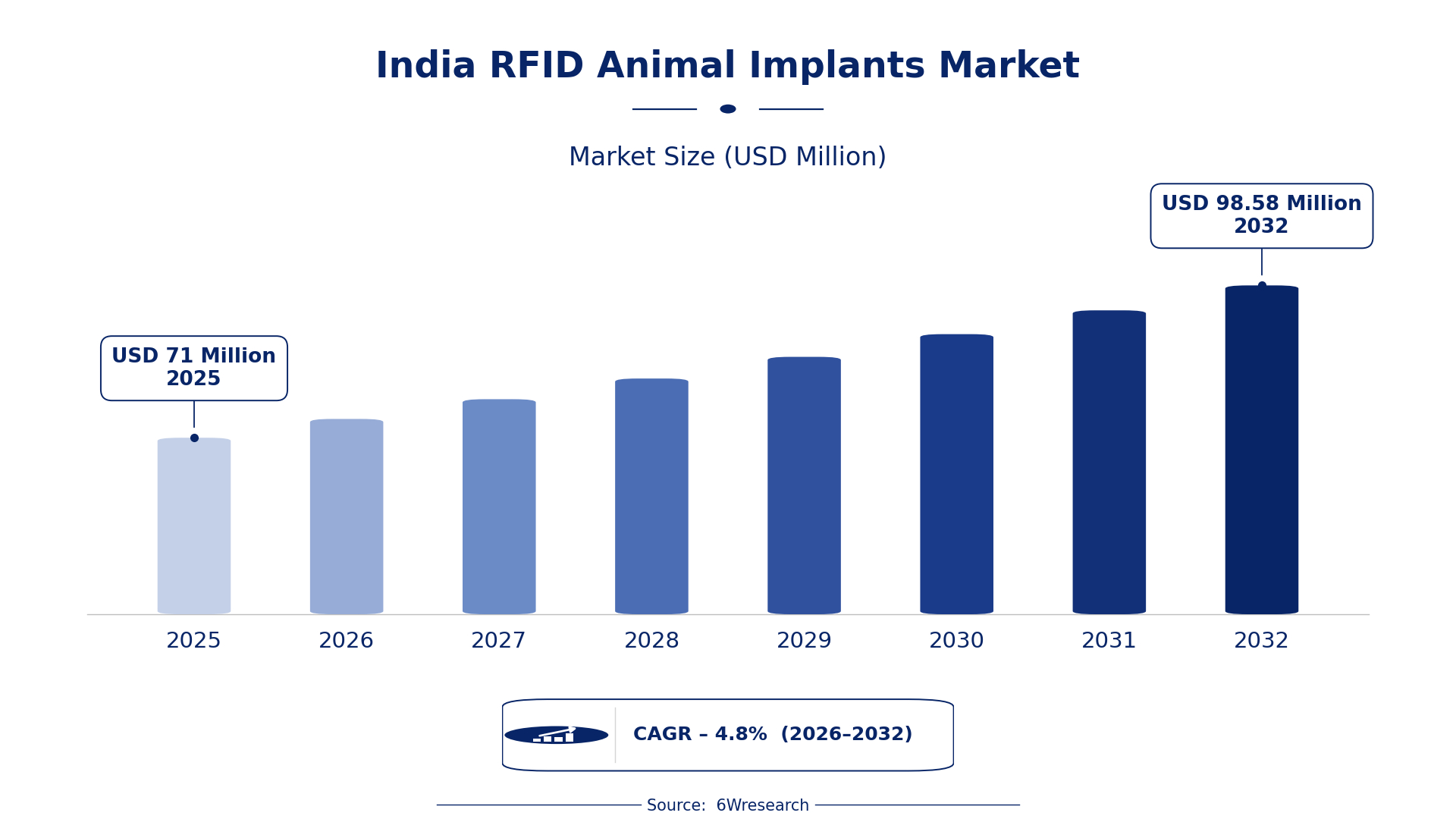
According to 6Wresearch internal database and industry insights, the India RFID Animal Implants Market was valued at USD 71.0 million in 2025 and is projected to reach USD 98.58 million by 2032, growing at a CAGR of approximately 4.8% during 2026–2032.
India RFID Animal Implants Market Highlights
| Report Metric | Details |
| Report Name | India RFID Animal Implants Market |
| Market Size 2025 | USD 71.0 million |
| Market Size 2032 | USD 98.58 million |
| Absolute Growth 2025–2032 | USD 27.58 million |
| CAGR 2026–2032 | 4.8% |
| Peak Annual Growth | 6.4% in 2031 |
| Forecast Period | 2026–2032 |
| Historical Data | 2022–2025 |
| Base Year | 2025 |
| Leading Implant Type, 2025 | FDX-B Ear Implants (40% share) |
| Leading Frequency Band, 2025 | 134 kHz (52% share) |
| Leading Data Stored, 2025 | Animal Identity (42% share) |
| Leading End User, 2025 | Vets & Farms (47% share) |
| Fastest-Growing Implant Type | HDX Implants (5.8% CAGR) |
| Fastest-Growing Frequency Band | 128 kHz (7.6% CAGR) |
| Fastest-Growing Data Stored | ID & Health Data (7.0% CAGR) |
| Fastest-Growing End User | Wildlife Conservation (6.7% CAGR) |
| Growing Sector | Veterinary Services |
| Key End Users | Vets & Farms, Livestock Ranchers, Wildlife Conservationists |
India RFID Animal Implants Market Year-wise Growth Rate and Key Drivers (2022–2032)
This graph illustrates the annual growth rates of the market from 2022 to 2032, highlighting a steady upward trajectory and projected market expansion over the forecast period.
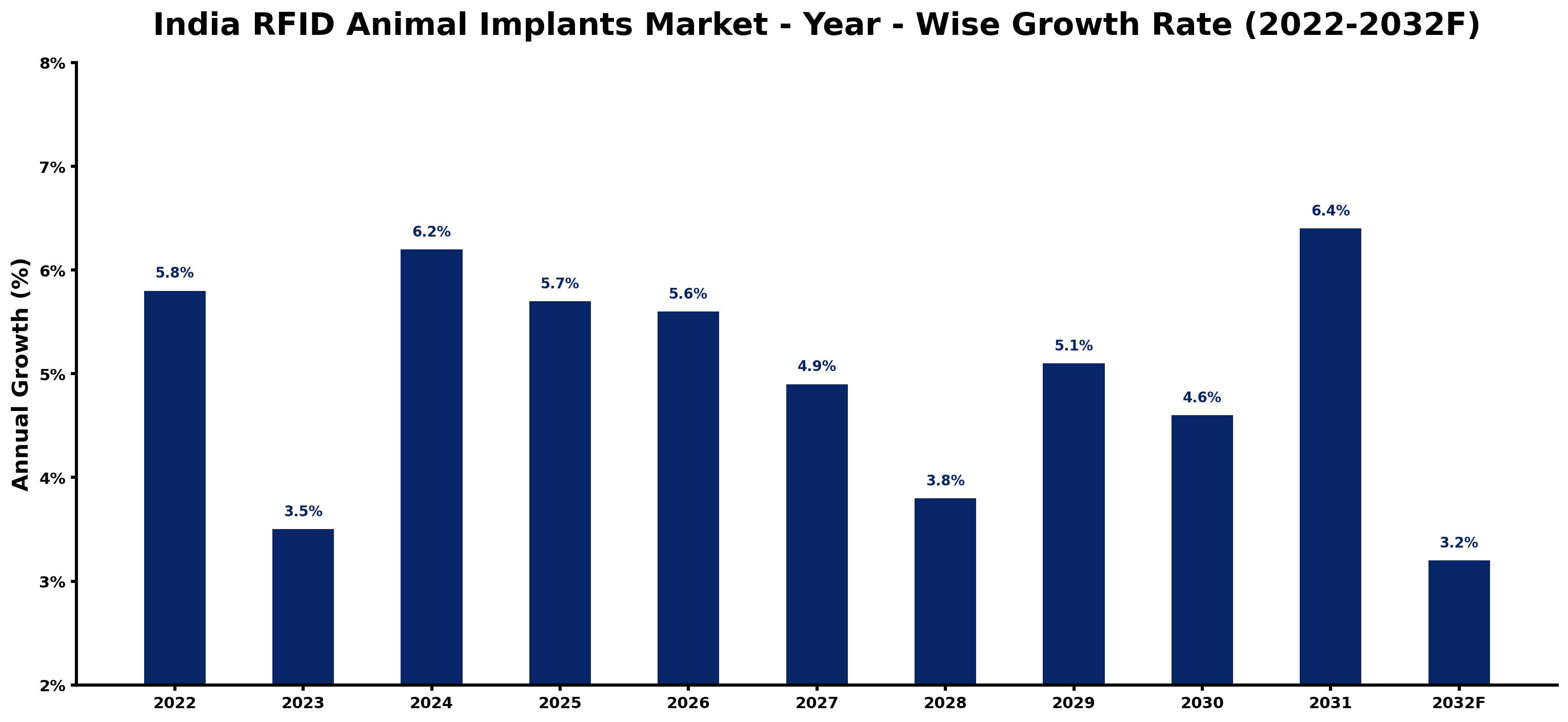
The following table presents the estimated annual growth rate for each year together with the principal factor influencing market performance.
| Year | Estimated Annual Growth (%) | Market Rationale |
| 2022 | 5.8 | The market experienced steady growth due to increased adoption of RFID technology in veterinary practices. |
| 2023 | 3.5 | Demand growth slowed as the veterinary services sector adjusted to the National Animal Disease Control Programme. |
| 2024 | 6.2 | Demand surged as veterinary services expanded, leading to faster adoption of RFID implants. |
| 2025 | 5.7 | Growth decelerated slightly as the market matured and competition intensified among suppliers. |
| 2026 | 5.6 | The market growth rate is expected to slow due to a temporary saturation in adoption among larger farms. |
| 2027 | 4.9 | A continued slowdown is anticipated as the focus shifts to integrating advanced tracking solutions. |
| 2028 | 3.8 | Growth is projected to slow as buyers evaluate long-term technology investments. |
| 2029 | 5.1 | An uptick in growth is expected as wildlife conservation efforts increase demand for tracking solutions. |
| 2030 | 4.6 | The market is projected to slow again as buyers prioritise cost-effective solutions amid economic challenges. |
| 2031 | 6.4 | Growth will peak as government initiatives spur investments in animal health technologies. |
| 2032 | 3.2 | The market growth rate is expected to slow as it reaches a more stable phase of development. |
Note: Market size estimations and growth projections presented in this report are based on 6Wresearch's proprietary forecasting methodology, utilizing the latest available industry data, government publications, and primary research inputs.
India RFID Animal Implants Market Synopsis
RFID Animal Implants Market in India encompasses technology-based devices for tracking and identifying animals through radio frequency identification. These implants are made by embedding microchips in biocompatible materials and are essential in veterinary practices and livestock management. The market is expanding due to the growing livestock population of approximately 512 million and the increasing demand for veterinary services. Initiatives like the National Animal Disease Control Programme are further driving adoption, leading to growth opportunities in the sector.
Market Dynamics Impact Analysis (2026–2032)
| Factor | Type | Impact | Primary Segment Affected |
| Increasing livestock population drives demand for effective tracking solutions. | Driver | High | Vets & Farms |
| Government initiatives promote the adoption of RFID technology in animal health. | Driver | High | Livestock Ranchers |
| The gap in technology adoption presents opportunities for suppliers of RFID solutions. | Opportunity | High | Wildlife Conservation |
| Growing demand for health monitoring in livestock opens new market avenues. | Opportunity | Medium | FDX-B Ear Implants |
| High initial costs of RFID systems may deter small-scale farmers from adoption. | Restraint | High | Vets & Farms |
| Limited awareness of RFID benefits among some livestock owners restricts market growth. | Restraint | Medium | Livestock Ranchers |
| The market still has to solve a few problems, including high costs and limited awareness. | Challenge | High | Wildlife Conservation |
| Integration of RFID technology into existing systems poses technical challenges for users. | Challenge | Medium | FDX-B Ear Implants |
Evaluation of Drivers in India RFID Animal Implants Market (2026–2032)
The factors lifting demand, and the evidence behind each, are summarised below.
| Drivers | Primary Segment Affected | Why It Matters (Evidence) |
| Growing livestock population increases demand for tracking solutions. | Vets & Farms | India's livestock population is approximately 512 million, prompting farms to adopt RFID technology for better management. |
| Government initiatives boost veterinary services and technology adoption. | Livestock Ranchers | The National Animal Disease Control Programme aims to vaccinate livestock, driving demand for tracking solutions. |
| Rising awareness of animal health monitoring boosts RFID adoption. | FDX-B Ear Implants | The veterinary services sector in India is projected to grow, increasing the demand for tracking technology. |
| Technological advancements in RFID systems improve tracking efficiency. | Wildlife Conservation | The use of GPS-Enabled Implants is growing among wildlife conservationists, improving tracking capabilities. |
| Integration of RFID in dairy farms supports herd management. | Livestock Ranchers | The National Dairy Development Board supports RFID integration, vital for managing large herds. |
Growth in the RFID Animal Implants market in India stems from increasing end-use demand, driven by the large livestock population of around 512 million. The expansion of veterinary services is encouraging technology adoption, resulting in more purchases of tracking solutions. The veterinary services sector is expected to grow, further boosting demand for RFID systems. Support from agricultural boards for RFID integration in dairy farms is motivating livestock owners to embrace these technologies. An increased focus on wildlife conservation is also driving the demand for GPS-enabled tracking solutions, improving management practices.
Evaluation of Restraints in India RFID Animal Implants Market
The table below lists the restraints and the evidence behind each.
| Market Restraint | Primary Segment Affected | Why It Matters (Evidence) |
| High initial costs of RFID systems can deter small-scale farmers from adoption. | Vets & Farms | The investment required for RFID technology may exceed the budgets of smaller farms, limiting their participation. |
| Limited awareness of RFID benefits among some livestock owners restricts market growth. | Livestock Ranchers | Many livestock owners are unaware of the advantages of RFID technology, hindering widespread adoption. |
| Technical challenges in integrating RFID technology into existing systems pose barriers for users. | FDX-B Ear Implants | Veterinarians may face difficulties in adapting current practices to incorporate RFID solutions effectively. |
| Regulatory hurdles may slow down the approval process for new RFID technologies. | Wildlife Conservation | Compliance with established standards can delay the introduction of new tracking solutions. |
| Market saturation in certain regions may limit growth opportunities for suppliers. | Vets & Farms | In areas where RFID adoption is already high, new sales may decline as farms reach operational capacity. |
India RFID Animal Implants Market Challenges
Buyers in the India RFID Animal Implants market encounter several challenges, beginning with regulatory compliance. The Bureau of Indian Standards has set guidelines for RFID technology, but navigating these can delay product launches for suppliers by up to six months. Supply chain disruptions also pose a challenge; many producers rely on imported components, causing delivery delays that affect veterinary clinics needing timely access to implants. Cost fluctuations are another concern; the average price of RFID implants can rise by 15% due to volatile raw material prices, straining budgets for farms. Furthermore, technology adoption is slow in rural areas, where only about 30% of small farms have implemented RFID systems, limiting effective livestock tracking.
Trends in the India RFID Animal Implants Market
Below mentioned are some of the trends shaping the India RFID Animal Implants Market growth.
- Shift towards Advanced Tracking Technologies: Veterinary clinics are increasingly adopting advanced RFID solutions for animal health monitoring, with over 50% of large farms in India now utilising these technologies. This shift is set to improve tracking efficiency and management practices.
- Growing Adoption of GPS-Enabled Implants: The use of GPS-Enabled Implants is on the rise among wildlife conservationists in India, enabling better tracking of endangered species. This trend reflects a growing commitment to wildlife management, with notable investments in technology.
- Increased Focus on Health Data Tracking: The veterinary sector is prioritising health data tracking, with ID & Health Data anticipated to grow at a CAGR of 7.0% from 2026 to 2032. This trend is fuelled by the need for improved animal health monitoring and management.
- Expansion of Government Initiatives: The National Animal Disease Control Programme is advocating for the use of RFID technology in livestock management, aiming to vaccinate millions of animals by 2025. This initiative is likely to boost the adoption of RFID solutions.
Investment Opportunities in the India RFID Animal Implants Market
Below are the investment opportunities with the strongest case in the India RFID Animal Implants Market.
- Gap in Technology Adoption: With over 50% of large farms adopting RFID technology, there remains a gap among smaller farms. Suppliers can target this segment, particularly in rural areas, to enhance market penetration.
- Demand for Health Monitoring Solutions: The veterinary services sector is experiencing increased demand for health monitoring solutions, especially in light of recent disease outbreaks. Suppliers can invest in RFID technologies that address this urgent need.
- Rise in Wildlife Conservation Efforts: The growing emphasis on wildlife conservation offers opportunities for suppliers of GPS-Enabled Implants. Collaborating with conservation organisations can improve market access and support biodiversity initiatives.
- Government Support for Infrastructure Development: The Animal Husbandry Infrastructure Development Fund is promoting RFID technology integration in livestock management. Suppliers can partner with local governments to improve infrastructure and expand their market presence.
Government Initiatives in the India RFID Animal Implants Market
The framework governing RFID Animal Implants in India includes the National Animal Disease Control Programme launched in 2021, which aims to vaccinate livestock against diseases by 2025. Additionally, the Pradhan Mantri Matsya Sampada Yojana, initiated in 2020, promotes the use of technology in fisheries and animal husbandry sectors. These measures encourage the adoption of RFID technology by improving livestock health monitoring and management practices.
The Department of Animal Husbandry and Dairying oversees initiatives related to animal health. The Animal Husbandry Infrastructure Development Fund, approved in 2022, focuses on improving infrastructure, including RFID technology, for livestock management. Furthermore, the Ministry of Agriculture and Farmers' Welfare has initiated a scheme for the digitization of livestock records using RFID technology, aiming for completion by 2025. These efforts are designed to streamline operations and improve tracking capabilities.
Future Insight of the India RFID Animal Implants Market
By 2032, buyers and suppliers in the India RFID Animal Implants market can expect significant advancements. The National Animal Disease Control Programme will enhance livestock health monitoring, driving demand for RFID solutions. State governments are digitising livestock records, improving operational efficiency for veterinary clinics and farms. The integration of advanced tracking technologies will increase, particularly in dairy management. As of 2023, over 50% of large farms have adopted RFID technology, and this trend is set to grow, facilitating more efficient livestock management practices.
Market Segmentation Analysis
Each segment group is reviewed below, with the leader by share and the fastest grower by CAGR.
By Implant Type – FDX-B Ear Implants Dominated, HDX Implants Expected to Grow Fastest
According to Ravi Bhandari, Research Head at 6Wresearch, FDX-B Ear Implants held a 40% share of the India RFID Animal Implants Market by implant type in 2025. FDX-B Ear Implants hold the largest market share as they are extensively used for identifying livestock and pets, which is essential for effective agricultural management. With India's livestock population around 512 million, these implants are critical for farmers and veterinarians in managing their herds. The quickest growth will come from HDX Implants, forecast to expand at a CAGR of 5.8% between 2026 and 2032. HDX Implants are witnessing rapid growth due to their increasing adoption for tracking the health and location of animals, particularly in veterinary practices. The rising focus on comprehensive animal health monitoring is significantly driving this sub-segment's expansion. Suppliers should enhance the availability of HDX Implants to align with the growing demands of the veterinary sector.
By Frequency Band – 134 kHz Dominated, 128 kHz Expected to Grow Fastest
The largest frequency band category in 2025 was 134 kHz, with a 52% share of total revenue. The 134 kHz frequency band leads the market as it is recognised as the standard for animal identification, making it the preferred choice among users. This frequency is widely integrated into various livestock management systems across India, ensuring its continued dominance. 128 kHz is projected to grow fastest, at a CAGR of 7.6% during 2026–2032. The 128 kHz frequency band is experiencing the fastest growth as it is utilised in niche applications, appealing to users seeking tailored tracking solutions. Its unique features are increasingly acknowledged in specialised sectors, which is driving its rapid adoption. Buyers should consider exploring options in the 128 kHz segment to enhance their tracking capabilities.
By Data Stored – Animal Identity Dominated, ID & Health Data Expected to Grow Fastest
In 2025, Animal Identity led the data stored split with a 42% share. Animal Identity data storage commands the largest market share as it is crucial for effective livestock management and pet ownership, ensuring accurate identification and traceability. This information is vital for veterinarians and farm operators throughout India, supporting their operational needs. Over 2026–2032, ID & Health Data is expected to post the fastest growth, at a CAGR of 7.0%. ID & Health Data is expanding at the fastest rate, propelled by the growing emphasis on veterinary care and animal health monitoring. As stakeholders increasingly recognise the value of health data, this segment is poised for significant growth. Suppliers should focus on developing solutions that support ID & Health Data to meet the evolving needs of veterinary practices.
By End User – Vets & Farms Dominated, Wildlife Conservation Expected to Grow Fastest
Vets & Farms took a 47% share of end user in 2025, more than any other category. Vets & Farms represent the largest share of the market as primary users of RFID technology for animal management, directly benefiting from improved tracking and identification. Their established practices and operational needs drive the demand for RFID animal implants. Wildlife Conservation is set to record the highest CAGR in this split, 6.7% over 2026–2032. Wildlife Conservation is the fastest-growing end user segment, as tracking endangered species becomes increasingly vital for conservation efforts. The heightened focus on biodiversity and wildlife protection fuels this segment's rapid growth. Suppliers should consider partnerships with wildlife conservation organisations to tap into this expanding market.
Key Attractiveness of the Report
- 10 Years of Market Numbers
- Historical Data Starting from 2022 to 2025
- Base Year 2025
- Forecast Data until 2032
- Key Performance Indicators Impacting the Market
- Major Upcoming Developments and Projects
Key Highlights of the Report:
- India RFID Animal Implants Market Outlook
- Market Size of India RFID Animal Implants Market, 2025
- Forecast of India RFID Animal Implants Market, 2032
- Historical Data and Forecast of India RFID Animal Implants Revenues & Volume for the Period 2022 - 2032F
- India RFID Animal Implants Market Trend Evolution
- India RFID Animal Implants Market Drivers and Challenges
- India RFID Animal Implants Price Trends
- India RFID Animal Implants Porter's Five Forces
- India RFID Animal Implants Industry Life Cycle
- Historical Data and Forecast of India RFID Animal Implants Market Revenues & Volume By Implant Type for the Period 2022 - 2032F
- Historical Data and Forecast of India RFID Animal Implants Market Revenues & Volume By FDX-B Ear Implants for the Period 2022 - 2032F
- Historical Data and Forecast of India RFID Animal Implants Market Revenues & Volume By HDX Implants for the Period 2022 - 2032F
- Historical Data and Forecast of India RFID Animal Implants Market Revenues & Volume By GPS-Enabled Implants for the Period 2022 - 2032F
- Historical Data and Forecast of India RFID Animal Implants Market Revenues & Volume By Frequency Band for the Period 2022 - 2032F
- Historical Data and Forecast of India RFID Animal Implants Market Revenues & Volume By 134 kHz for the Period 2022 - 2032F
- Historical Data and Forecast of India RFID Animal Implants Market Revenues & Volume By 128 kHz for the Period 2022 - 2032F
- Historical Data and Forecast of India RFID Animal Implants Market Revenues & Volume By 2.4 GHz for the Period 2022 - 2032F
- Historical Data and Forecast of India RFID Animal Implants Market Revenues & Volume By Data Stored for the Period 2022 - 2032F
- Historical Data and Forecast of India RFID Animal Implants Market Revenues & Volume By Animal Identity for the Period 2022 - 2032F
- Historical Data and Forecast of India RFID Animal Implants Market Revenues & Volume By ID & Health Data for the Period 2022 - 2032F
- Historical Data and Forecast of India RFID Animal Implants Market Revenues & Volume By Tracking & Diagnostics for the Period 2022 - 2032F
- Historical Data and Forecast of India RFID Animal Implants Market Revenues & Volume By End User for the Period 2022 - 2032F
- Historical Data and Forecast of India RFID Animal Implants Market Revenues & Volume By Vets & Farms for the Period 2022 - 2032F
- Historical Data and Forecast of India RFID Animal Implants Market Revenues & Volume By Wildlife Conservation for the Period 2022 - 2032F
- Historical Data and Forecast of India RFID Animal Implants Market Revenues & Volume By Livestock Ranchers for the Period 2022 - 2032F
- India RFID Animal Implants Import Export Trade Statistics
- Market Opportunity Assessment By Implant Type
- Market Opportunity Assessment By Frequency Band
- Market Opportunity Assessment By Data Stored
- Market Opportunity Assessment By End User
- India RFID Animal Implants Top Companies Market Share
- India RFID Animal Implants Competitive Benchmarking By Technical and Operational Parameters
- India RFID Animal Implants Company Profiles
- India RFID Animal Implants Key Strategic Recommendations
Market Covered
Segments analysed in this report are listed below.
By Implant Type
- FDX-B Ear Implants
- HDX Implants
- GPS-Enabled Implants
By Frequency Band
- 134 kHz
- 128 kHz
- 2.4 GHz
By Data Stored
- Animal Identity
- ID & Health Data
- Tracking & Diagnostics
By End User
- Vets & Farms
- Wildlife Conservation
- Livestock Ranchers































