India RFID Systems Market Size & Growth Rate
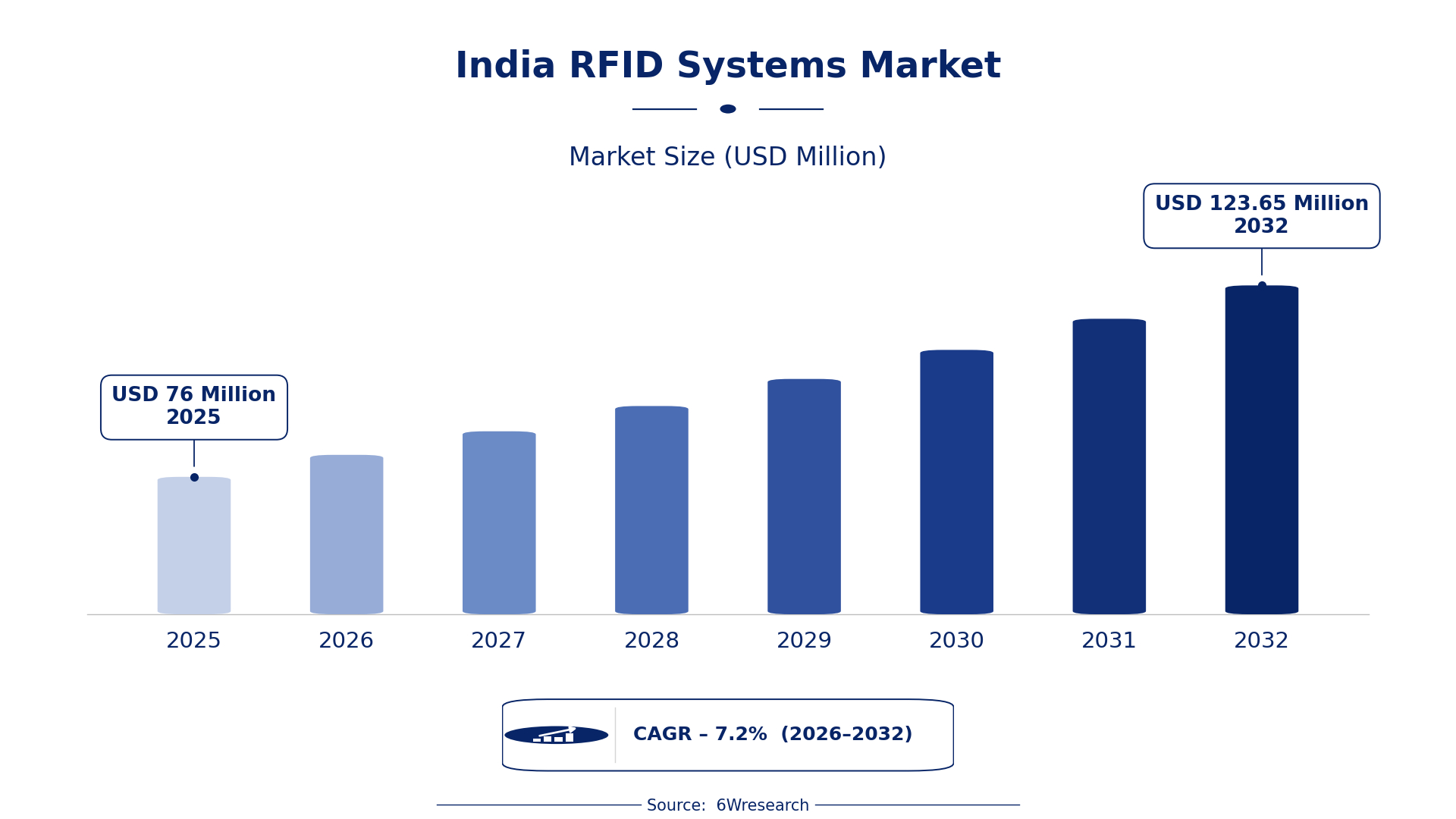
According to 6Wresearch internal database and industry insights, the India RFID Systems Market was valued at USD 76.0 million in 2025 and is projected to reach USD 123.65 million by 2032, growing at a CAGR of approximately 7.2% during 2026–2032.
India RFID Systems Market Highlights
| Report Metric | Details |
| Report Name | India RFID Systems Market |
| Market Size 2025 | USD 76.0 million |
| Market Size 2032 | USD 123.65 million |
| Absolute Growth 2025–2032 | USD 47.65 million |
| CAGR 2026–2032 | 7.2% |
| Peak Annual Growth | 9.4% in 2031 |
| Forecast Period | 2026–2032 |
| Historical Data | 2022–2025 |
| Base Year | 2025 |
| Leading System Type, 2025 | Supply Chain RFID (37% share) |
| Leading Integration Scope, 2025 | Warehouse & Distribution (51% share) |
| Leading Deployment Architecture, 2025 | Enterprise Systems (34% share) |
| Leading End User, 2025 | SCM Departments (40% share) |
| Fastest-Growing System Type | Retail RFID (9.0% CAGR) |
| Fastest-Growing Integration Scope | Store-Infrastructure (9.4% CAGR) |
| Fastest-Growing Deployment Architecture | RFID + POS Integration (8.9% CAGR) |
| Fastest-Growing End User | Retail Chains (9.4% CAGR) |
| Growing Sector | Healthcare |
| Key End Users | Healthcare facilities, Retail chains, Supply chain management departments |
India RFID Systems Market Year-wise Growth Rate and Key Drivers (2022–2032)
This graph illustrates the annual growth rates of the market from 2022 to 2032, highlighting a steady upward trajectory and projected market expansion over the forecast period.
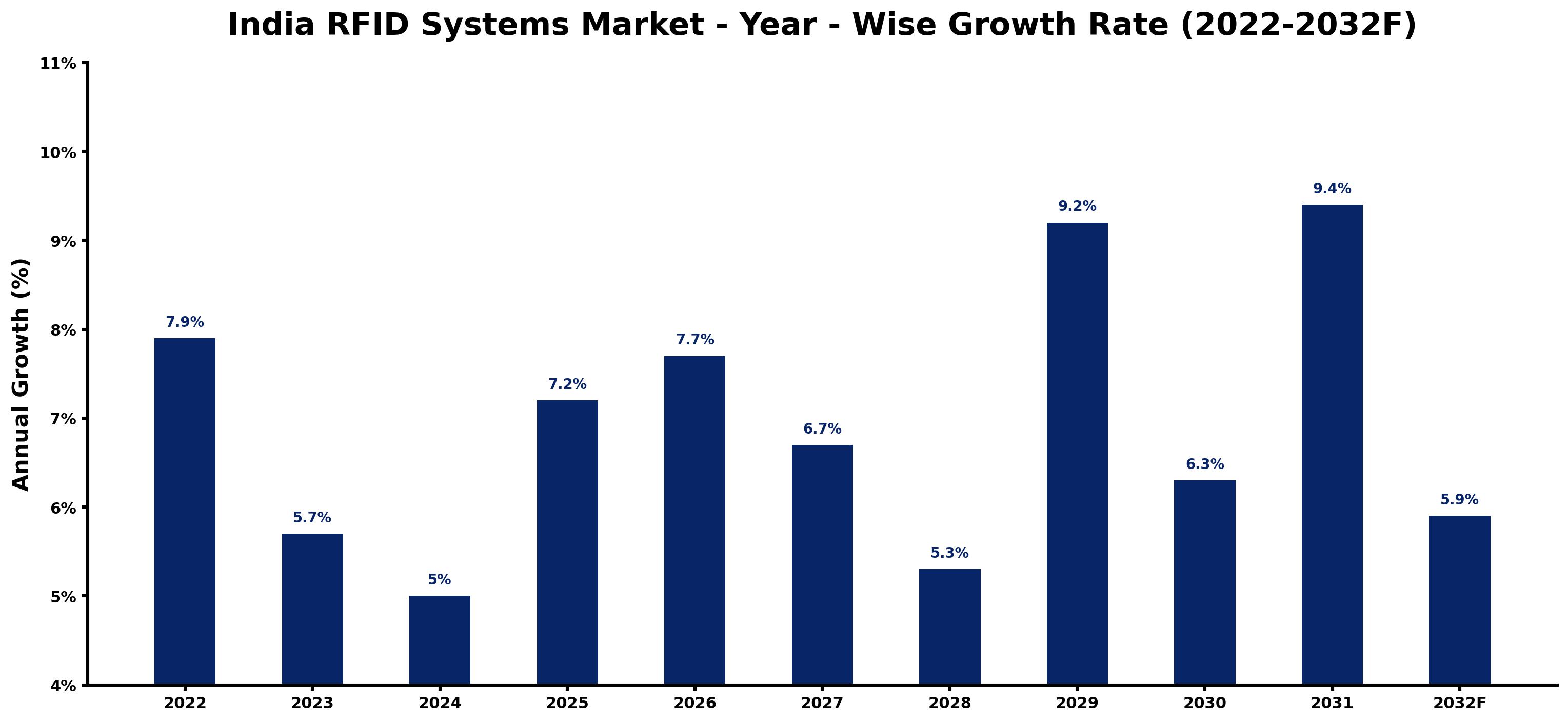
The table below sets out the estimated growth rate for each year and the main factor behind it.
| Year | Estimated Annual Growth (%) | Market Rationale |
| 2022 | 7.9 | The market experienced strong demand from the healthcare sector, with over 70,000 hospitals adopting RFID technology. |
| 2023 | 5.7 | Adoption slowed due to the ongoing impact of the 'Digital India' initiative, yet retail chains continued to implement RFID systems at a steady rate. |
| 2024 | 5.0 | The growth rate decreased as retailers focused on optimising existing RFID systems rather than expanding new implementations. |
| 2025 | 7.2 | Increased investment in technology upgrades led to a resurgence in RFID adoption across various sectors, particularly healthcare. |
| 2026 | 7.7 | The healthcare sector's ongoing upgrades is expected to contribute to a rise in RFID demand, particularly in patient tracking. |
| 2027 | 6.7 | Growth slowed as the market adjusted to previous expansions, but retail chains maintained steady RFID implementation. |
| 2028 | 5.3 | The market is projected to continue growing as supply chain management departments seek efficiency. |
| 2029 | 9.2 | A surge in retail RFID adoption will drive growth, with retailers increasingly recognising the technology's benefits for inventory management. |
| 2030 | 6.3 | The market growth is expected to decelerate as retailers focus on refining processes rather than expanding RFID usage. |
| 2031 | 9.4 | Strong demand from supply chain sectors will spur growth, with investments in RFID technology for logistics. |
| 2032 | 5.9 | The market is projected to grow steadily as healthcare facilities continue to upgrade their RFID systems. |
Note: Market size estimations and growth projections presented in this report are based on 6Wresearch's proprietary forecasting methodology, utilizing the latest available industry data, government publications, and primary research inputs.
India RFID Systems Market Synopsis
RFID Systems in India encompass technology that utilises radio waves for automatic identification and tracking of objects. These systems are crucial for inventory management, asset tracking, and access control across various sectors. The India RFID Systems Market is expanding, driven by strong adoption in healthcare and retail sectors, with retail chains implementing RFID at a rate of 30% annually. Government initiatives, such as the 'Digital India' programme, promote RFID adoption, improving operational efficiency across industries.
Market Dynamics Impact Analysis (2026–2032)
| Factor | Type | Impact | Primary Segment Affected |
| Growing adoption in healthcare facilities for patient tracking and medication management | Driver | High | Healthcare RFID |
| Increasing implementation of RFID in retail chains for inventory management | Driver | High | Retail RFID |
| Expansion of RFID technology in urban infrastructure management | Opportunity | High | Access Control RFID |
| Rising demand for efficient supply chain management solutions | Opportunity | High | Supply Chain RFID |
| High initial investment costs for RFID system implementation | Restraint | Medium | Healthcare RFID |
| Limited awareness and understanding of RFID technology among potential users | Restraint | Medium | Retail RFID |
| Challenges in integrating RFID with existing IT systems | Challenge | High | Enterprise Systems |
| Supply chain disruptions affecting RFID component availability | Challenge | Medium | Warehouse & Distribution |
Evaluation of Drivers in India RFID Systems Market (2026–2032)
Below mentioned are some major drivers and their influence on market dynamics.
| Drivers | Primary Segment Affected | Why It Matters (Evidence) |
| Increased healthcare investments in technology upgrades | Healthcare RFID | The Indian government allocated ₹500 crores for technology upgrades in healthcare facilities, boosting RFID adoption for patient tracking. |
| Retail chains adopting RFID for inventory management | Retail RFID | With over 1,000 retail stores implementing RFID systems, the sector is seeing a 30% annual adoption rate. |
| Government initiatives promoting technology adoption | Supply Chain RFID | The 'Digital India' initiative encourages RFID use in logistics, improving supply chain efficiency with a projected growth of the retail market to $1.3 trillion by 2025. |
| Growing population served by RFID-enabled hospitals | Healthcare RFID | Approximately 100,000 patients are served by each RFID-enabled hospital, increasing demand for technology. |
| Standardisation of RFID applications in logistics | Access Control RFID | The Bureau of Indian Standards set guidelines for RFID applications in logistics, ensuring interoperability. |
The healthcare sector benefits from substantial investments, with over 70,000 hospitals utilising RFID technology for patient tracking. Retail chains are adopting RFID at a rate of 30% annually, improving inventory management. With the average population served by RFID-enabled hospitals around 100,000 patients, there is a strong need for efficient tracking solutions.
Evaluation of Restraints in India RFID Systems Market
The following restraints limit how fast demand can grow.
| Market Restraint | Primary Segment Affected | Why It Matters (Evidence) |
| High initial costs for implementing RFID systems | Healthcare RFID | The average investment required for implementing RFID systems can exceed ₹10 lakhs per facility, deterring some healthcare facilities from adoption. |
| Limited understanding of RFID technology among potential users | Retail RFID | Many retailers lack awareness of RFID benefits, leading to slower adoption rates despite proven advantages. |
| Integration challenges with existing IT systems | Enterprise Systems | Many businesses face difficulties in integrating RFID with their current IT infrastructure, limiting its adoption. |
| Supply chain disruptions affecting component availability | Warehouse & Distribution | Ongoing global supply chain issues have led to delays in obtaining necessary RFID components, hindering implementation. |
| Regulatory hurdles in technology adoption | Access Control RFID | Complex regulations surrounding technology implementation can slow down the adoption of RFID systems in various sectors. |
India RFID Systems Market Challenges
Buyers in the India RFID Systems market still face several pressing issues, starting with high costs. The initial investment for RFID systems can exceed ₹10 lakhs per facility, which discourages smaller hospitals from adopting this technology. Regulatory challenges also hinder progress; the Bureau of Indian Standards has established complex guidelines that can delay implementation by up to six months for healthcare providers. Technology integration poses another hurdle, as many facilities lack the necessary infrastructure, leading to an average downtime of 20% during system upgrades. Lastly, supply chain disruptions arise from inconsistent availability of RFID components, causing delays in project timelines for producers.
Trends in the India RFID Systems Market
Buyers and suppliers in the India RFID Systems Market are adjusting to the following trends.
- Shift from Traditional to Smart Inventory Management: In 2022, retail chains began adopting smart inventory management solutions using RFID technology, improving operational efficiency. Over 1,000 retail stores have implemented RFID systems, reflecting this trend.
- Transition to RFID in Urban Infrastructure: The 'Smart Cities Mission' aims to integrate RFID technology in urban infrastructure management by 2025. This initiative is projected to improve city operations and services.
- Emergence of RFID in Healthcare Operations: Since 2023, healthcare facilities have increasingly implemented RFID systems for patient tracking and medication management. Over 70,000 hospitals in India are now utilising this technology.
- Rise in RFID Standards for Logistics: The Bureau of Indian Standards established RFID application standards in logistics in 2021. This standardisation is vital for ensuring interoperability and efficiency in supply chain operations.
Investment Opportunities in the India RFID Systems Market
Some of the investment opportunities in the India RFID Systems Market are mentioned below.
- Investment in Healthcare Facilities: Healthcare facilities are increasingly adopting RFID systems, with the Indian government allocating ₹500 crores for technology upgrades. Investing in RFID solutions can improve operational efficiency in hospitals.
- Supply Chain Innovations in Retail: Retail chains are rapidly adopting RFID for inventory management, with a 30% annual growth rate. Suppliers can enter this market by partnering with local retailers to provide RFID solutions.
- Enhancing Urban Infrastructure with RFID: The 'Smart Cities Mission' aims to integrate RFID technology in urban infrastructure by 2025. Suppliers can collaborate with municipalities to implement RFID solutions for improved city management.
- Local Manufacturing of RFID Systems: The 'Make in India' initiative encourages local manufacturing of RFID systems, creating opportunities for investment. Collaborating with local partners can facilitate market entry and compliance.
Government Initiatives in the India RFID Systems Market
The 'Digital India Programme' launched in 2020 promotes the adoption of RFID technology across various sectors, improving efficiency and operational capabilities. This initiative supports local manufacturers and encourages investment in RFID systems, building on earlier policies like the 'Make in India' initiative, which focuses on technology development and innovation. The 'National Logistics Policy' introduced in 2021 enhances supply chain efficiency, approving RFID integration in logistics operations, which is expected to boost overall productivity.
The Bureau of Indian Standards oversees the implementation of RFID standards, funding projects that ensure interoperability and efficiency. Additionally, the 'National Logistics Policy' introduced in 2021 enhances supply chain efficiency, approving RFID integration in logistics operations, which allows producers to streamline their processes and improve service delivery.
Future Insight of the India RFID Systems Market
By 2032, buyers and suppliers in the India RFID Systems market can expect transformative changes driven by several key initiatives. The 'Digital India' initiative will enhance technology adoption, promoting seamless integration of RFID systems across sectors. With the retail market projected to grow to $1.3 trillion by 2025, demand for efficient inventory management will surge, pushing suppliers to innovate. The 'Smart Cities Mission' aims to embed RFID technology into urban infrastructure, creating new avenues for growth. These factors will contribute to a more robust and efficient RFID market in India.
Market Segmentation Analysis
The analysis below covers each segmentation, its leading category in 2025 and its fastest-growing category through 2032.
By System Type – Supply Chain RFID Dominated, Retail RFID Expected to Grow Fastest
According to Ravi Bhandari, Research Head at 6Wresearch, Supply Chain RFID accounted for a 37% market share by system type in 2025. Supply Chain RFID commands the largest market share due to its critical role in tracking goods within logistics. The extensive implementation across over 1,000 retail stores highlights the necessity for efficient supply chain management in India. Over 2026–2032, Retail RFID is expected to post the fastest growth, at a CAGR of 9.0%. Retail RFID is growing rapidly, propelled by the Indian retail market's projected growth to $1.3 trillion by 2025. This increasing retail activity will further strengthen the dominance of Supply Chain RFID in the market. Suppliers should prioritise developing RFID solutions specifically designed for supply chain applications to cater to the rising demand.
By Integration Scope – Warehouse & Distribution Dominated, Store-Infrastructure Expected to Grow Fastest
Warehouse & Distribution took a 51% share of integration scope in 2025, more than any other category. Warehouse & Distribution holds the largest share due to its critical role in effective inventory management within logistics operations. The average installed base of approximately 5,000 RFID readers per warehouse exemplifies the reliance on this technology for operational efficiency. Store-Infrastructure is set to record the highest CAGR in this split, 9.4% over 2026–2032. Store-Infrastructure is experiencing the fastest growth, propelled by the increasing demand for operational efficiency in retail environments. As more retailers adopt RFID for inventory management, this segment is set for rapid development. Suppliers should focus on providing RFID solutions tailored for warehouse and distribution needs to capture this growing market.
By Deployment Architecture – Enterprise Systems Dominated, RFID + POS Integration Expected to Grow Fastest
The largest deployment architecture category in 2025 was Enterprise Systems, with a 34% share of total revenue. Enterprise Systems lead in market share as they are essential for supporting broader IT infrastructure, enabling the integration of RFID technology across various applications. This widespread adoption is reflected in the growing number of facilities upgrading their systems to incorporate RFID capabilities. The quickest growth will come from RFID + POS Integration, forecast to expand at a CAGR of 8.9% between 2026 and 2032. RFID + POS Integration is the fastest-growing segment, driven by its ability to enhance point-of-sale systems and improve transaction efficiency. Retailers are increasingly recognising the importance of this integration for streamlining operations and enhancing customer experiences. Suppliers must develop RFID solutions that seamlessly integrate with existing POS systems to capitalise on this growth opportunity.
By End User – SCM Departments Dominated, Retail Chains Expected to Grow Fastest
In 2025, SCM Departments led the end user split with a 40% share. SCM Departments command the largest market share, as they are vital for supply chain management and directly utilise RFID technology for tracking and inventory control. The extensive application of RFID in logistics highlights its importance in this sector. Retail Chains are projected to grow fastest, at a CAGR of 9.4% during 2026–2032. Retail Chains represent the fastest-growing end-user segment, as they increasingly adopt RFID for inventory tracking to boost operational efficiency. This trend is expected to continue as the retail market expands significantly. Suppliers should tailor RFID solutions to meet the specific inventory management needs of retail chains to leverage this growth.
Key Attractiveness of the Report
- 10 Years of Market Numbers
- Historical Data Starting from 2022 to 2025
- Base Year 2025
- Forecast Data until 2032
- Key Performance Indicators Impacting the Market
- Major Upcoming Developments and Projects
Key Highlights of the Report:
- India RFID Systems Market Outlook
- Market Size of India RFID Systems Market, 2025
- Forecast of India RFID Systems Market, 2032
- Historical Data and Forecast of India RFID Systems Revenues & Volume for the Period 2022 - 2032F
- India RFID Systems Market Trend Evolution
- India RFID Systems Market Drivers and Challenges
- India RFID Systems Price Trends
- India RFID Systems Porter's Five Forces
- India RFID Systems Industry Life Cycle
- Historical Data and Forecast of India RFID Systems Market Revenues & Volume By System Type for the Period 2022 - 2032F
- Historical Data and Forecast of India RFID Systems Market Revenues & Volume By Supply Chain RFID for the Period 2022 - 2032F
- Historical Data and Forecast of India RFID Systems Market Revenues & Volume By Retail RFID for the Period 2022 - 2032F
- Historical Data and Forecast of India RFID Systems Market Revenues & Volume By Healthcare RFID for the Period 2022 - 2032F
- Historical Data and Forecast of India RFID Systems Market Revenues & Volume By Access Control RFID for the Period 2022 - 2032F
- Historical Data and Forecast of India RFID Systems Market Revenues & Volume By Integration Scope for the Period 2022 - 2032F
- Historical Data and Forecast of India RFID Systems Market Revenues & Volume By Warehouse & Distribution for the Period 2022 - 2032F
- Historical Data and Forecast of India RFID Systems Market Revenues & Volume By Store-Infrastructure for the Period 2022 - 2032F
- Historical Data and Forecast of India RFID Systems Market Revenues & Volume By Asset & Patient Tracking for the Period 2022 - 2032F
- Historical Data and Forecast of India RFID Systems Market Revenues & Volume By Secure Entry Systems for the Period 2022 - 2032F
- Historical Data and Forecast of India RFID Systems Market Revenues & Volume By Deployment Architecture for the Period 2022 - 2032F
- Historical Data and Forecast of India RFID Systems Market Revenues & Volume By Enterprise Systems for the Period 2022 - 2032F
- Historical Data and Forecast of India RFID Systems Market Revenues & Volume By RFID + POS Integration for the Period 2022 - 2032F
- Historical Data and Forecast of India RFID Systems Market Revenues & Volume By Hospital IT Systems for the Period 2022 - 2032F
- Historical Data and Forecast of India RFID Systems Market Revenues & Volume By Campus Deployment for the Period 2022 - 2032F
- Historical Data and Forecast of India RFID Systems Market Revenues & Volume By End User for the Period 2022 - 2032F
- Historical Data and Forecast of India RFID Systems Market Revenues & Volume By SCM Departments for the Period 2022 - 2032F
- Historical Data and Forecast of India RFID Systems Market Revenues & Volume By Retail Chains for the Period 2022 - 2032F
- Historical Data and Forecast of India RFID Systems Market Revenues & Volume By Healthcare Facilities for the Period 2022 - 2032F
- Historical Data and Forecast of India RFID Systems Market Revenues & Volume By Office Complexes for the Period 2022 - 2032F
- India RFID Systems Import Export Trade Statistics
- Market Opportunity Assessment By System Type
- Market Opportunity Assessment By Integration Scope
- Market Opportunity Assessment By Deployment Architecture
- Market Opportunity Assessment By End User
- India RFID Systems Top Companies Market Share
- India RFID Systems Competitive Benchmarking By Technical and Operational Parameters
- India RFID Systems Company Profiles
- India RFID Systems Key Strategic Recommendations
Market Covered
Segments analysed in this report are listed below.
By System Type
- Supply Chain RFID
- Retail RFID
- Healthcare RFID
- Access Control RFID
By Integration Scope
- Warehouse & Distribution
- Store-Infrastructure
- Asset & Patient Tracking
- Secure Entry Systems
By Deployment Architecture
- Enterprise Systems
- RFID + POS Integration
- Hospital IT Systems
- Campus Deployment
By End User
- SCM Departments
- Retail Chains
- Healthcare Facilities
- Office Complexes































