India Robotics and Control Systems Market Size & Growth Rate
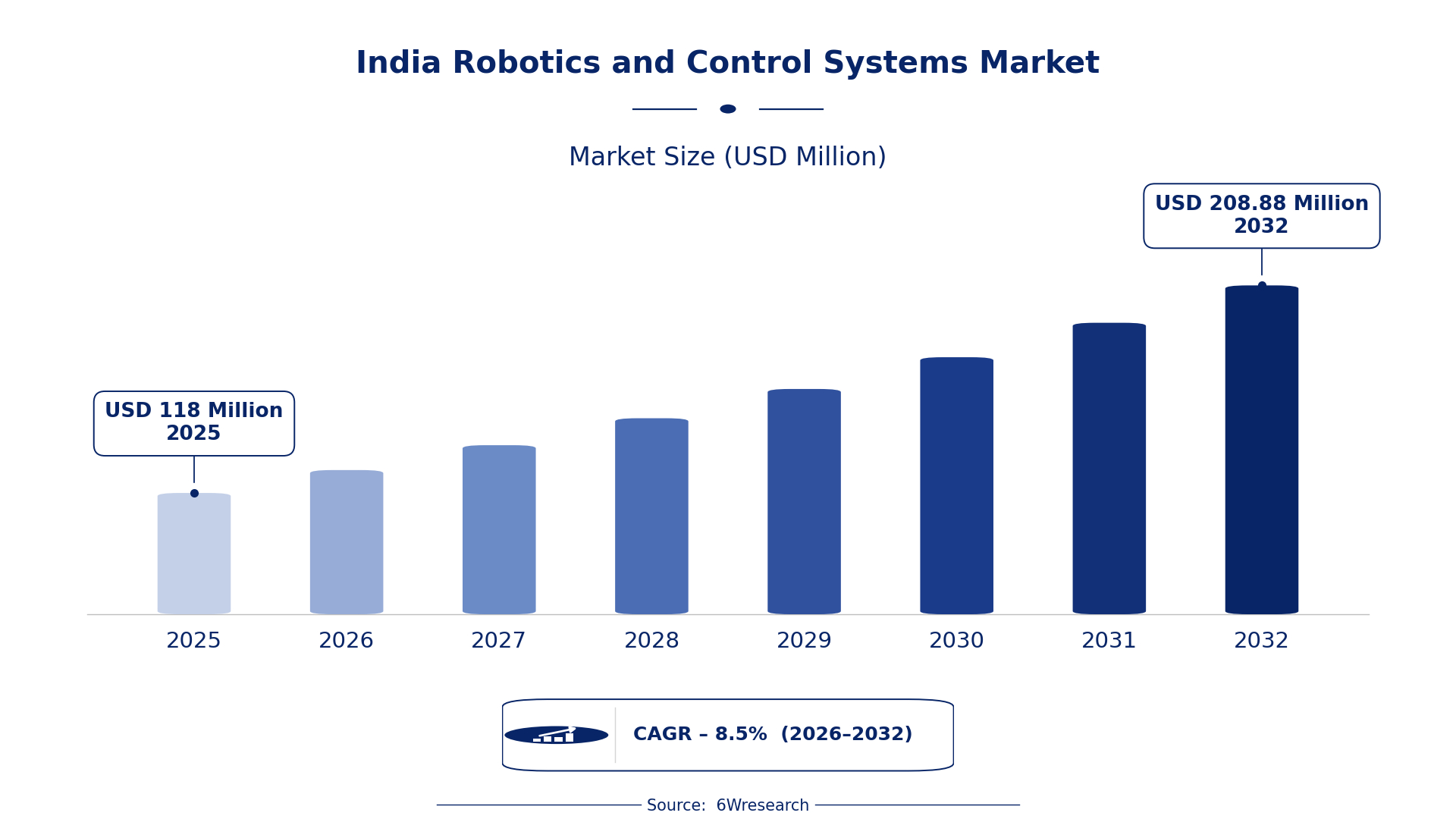
According to 6Wresearch internal database and industry insights, the India Robotics and Control Systems Market was valued at USD 118.0 million in 2025 and is projected to reach USD 208.88 million by 2032, growing at a CAGR of approximately 8.5% during 2026–2032.
India Robotics and Control Systems Market Highlights
| Report Metric | Details |
| Report Name | India Robotics and Control Systems Market |
| Market Size 2025 | USD 118.0 million |
| Market Size 2032 | USD 208.88 million |
| Absolute Growth 2025–2032 | USD 90.88 million |
| CAGR 2026–2032 | 8.5% |
| Peak Annual Growth | 10.4% in 2031 |
| Forecast Period | 2026–2032 |
| Historical Data | 2022–2025 |
| Base Year | 2025 |
| Leading Control Type, 2025 | Real-Time Control (35% share) |
| Leading Robot Integration, 2025 | Assembly Line Robots (41% share) |
| Leading Feedback System, 2025 | Encoder-Based (43% share) |
| Leading End User, 2025 | Manufacturing Units (36% share) |
| Fastest-Growing Control Type | Decentralized AI Control (11.3% CAGR) |
| Fastest-Growing Robot Integration | AGVs & Drones (10.1% CAGR) |
| Fastest-Growing Feedback System | Sensor Fusion (9.6% CAGR) |
| Fastest-Growing End User | Smart Warehouses (10.6% CAGR) |
| Growing Sector | Smart Warehouses |
| Key End Users | Manufacturing Units, Electronics Factories, Smart Warehouses, R&D Labs |
India Robotics and Control Systems Market Year-wise Growth Rate and Key Drivers (2022–2032)
This graph illustrates the annual growth rates of the market from 2022 to 2032, highlighting a steady upward trajectory and projected market expansion over the forecast period.
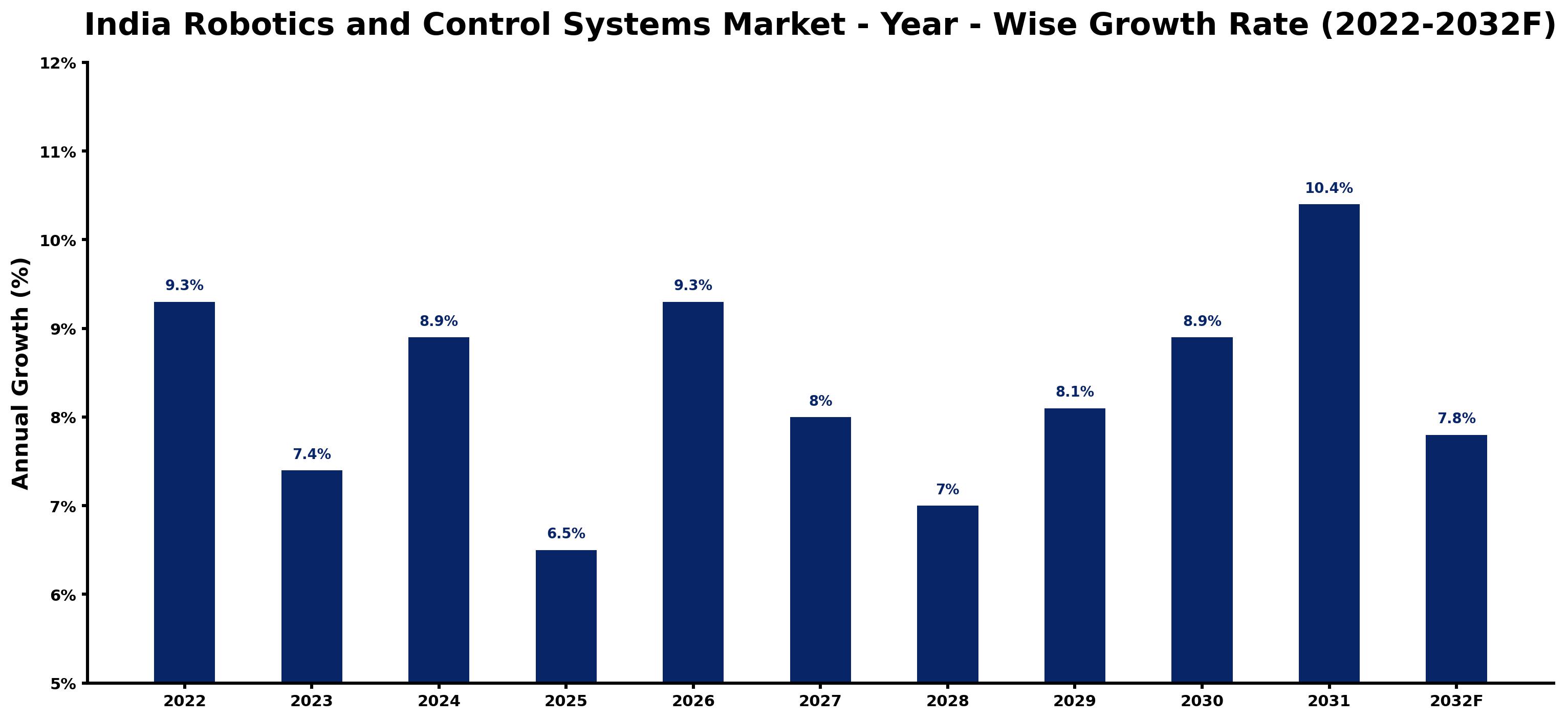
The table below sets out the estimated growth rate for each year and the main factor behind it.
| Year | Estimated Annual Growth (%) | Market Rationale |
| 2022 | 9.3 | The market experienced strong demand due to increased automation in manufacturing sectors. |
| 2023 | 7.4 | Growth slowed as manufacturers adjusted to supply chain challenges affecting robotics components. |
| 2024 | 8.9 | Demand rebounded with rising investments in robotics from the automotive industry. |
| 2025 | 6.5 | Regulatory hurdles in automation adoption affected growth in manufacturing. |
| 2026 | 9.3 | Increased funding for robotics innovation is expected to spur demand across manufacturing units. |
| 2027 | 8.0 | Growth will slow as the market adapts to new technological standards in robotics. |
| 2028 | 7.0 | Demand is projected to stabilise as manufacturers focus on integrating advanced robotics into existing systems. |
| 2029 | 8.1 | Growth is expected to accelerate with more manufacturers adopting AGVs for logistics operations. |
| 2030 | 8.9 | Demand will continue to rise as smart warehouses increasingly utilise robotic systems. |
| 2031 | 10.4 | The market is projected to peak due to substantial investments in robotics from the electronics sector. |
| 2032 | 7.8 | Growth will slow as the market matures, with established players dominating. |
Note: Market size estimations and growth projections presented in this report are based on 6Wresearch's proprietary forecasting methodology, utilizing the latest available industry data, government publications, and primary research inputs.
India Robotics and Control Systems Market Synopsis
Robotics and Control Systems in India encompass technologies that automate tasks through programmable machines and systems, primarily made through advanced manufacturing techniques. Initiatives like 'Make in India' and the National Robotics Mission are promoting investments and innovation in robotics, further expanding market potential.
Market Dynamics Impact Analysis (2026–2032)
| Factor | Type | Impact | Primary Segment Affected |
| Increasing automation in manufacturing units drives demand for robotics. | Driver | High | Assembly Line Robots |
| Growing adoption of AGVs in logistics creates new opportunities. | Opportunity | High | AGVs & Drones |
| High initial investment costs can deter smaller manufacturers from adopting robotics. | Restraint | High | Manufacturing Units |
| Limited availability of skilled workforce hampers robotics implementation. | Restraint | High | Manufacturing Units |
| Technological advancements in robotics create new market entrants. | Driver | Medium | Decentralized AI Control |
| The automotive sector's increasing reliance on robotics opens new avenues. | Opportunity | Medium | Manufacturing Units |
| Regulatory hurdles can delay robotics adoption in manufacturing processes. | Challenge | High | Assembly Line Robots |
| Supply chain disruptions affect the availability of robotics components. | Challenge | Medium | AGVs & Drones |
Evaluation of Drivers in India Robotics and Control Systems Market (2026–2032)
The main growth drivers and the segments they affect most are set out below.
| Drivers | Primary Segment Affected | Why It Matters (Evidence) |
| Increased investment in robotics innovation drives demand. | AGVs & Drones | The $1 billion fund announced in 2022 for robotics innovation encourages manufacturers to adopt AGVs. |
| Rising demand for automation in manufacturing units boosts robotics sales. | Assembly Line Robots | The electronics manufacturing sector is expected to grow to $300 billion by 2025, increasing demand for automation. |
| Technological advancements improve the capabilities of robotics. | Decentralized AI Control | The National Robotics Mission promotes R&D, leading to improved robotics technologies. |
| Growing focus on logistics efficiency drives AGV adoption. | AGVs & Drones | Smart warehouses are increasingly utilising robotics for inventory management, improving operational efficiency. |
| The automotive industry's reliance on robotics increases market size. | Assembly Line Robots | Over 50% of automotive manufacturers in India use automation, driving demand for robotics. |
Market growth for Robotics and Control Systems in India is underpinned by increased investment in robotics innovation, a surge in automation across manufacturing units, and technological advancements that improve capabilities. The $1 billion fund announced in 2022 for robotics innovation is encouraging manufacturers to adopt new technologies. The electronics manufacturing sector is expected to grow to $300 billion by 2025, which drives demand for robotics solutions. Over 50% of automotive manufacturers in India are utilising automation, further boosting demand for robotics. These factors contribute to enhanced operational efficiency and productivity across industries.
Evaluation of Restraints in India Robotics and Control Systems Market
The following restraints limit how fast demand can grow.
| Market Restraint | Primary Segment Affected | Why It Matters (Evidence) |
| High initial investment costs deter smaller manufacturers from adopting robotics. | Manufacturing Units | Many smaller manufacturers find it challenging to invest in robotics due to high costs, limiting their competitiveness. |
| Limited availability of skilled workforce hampers robotics implementation. | Manufacturing Units | The shortage of trained personnel in robotics affects the ability of manufacturers to fully implement automation. |
| Regulatory hurdles can delay robotics adoption in manufacturing processes. | Assembly Line Robots | Manufacturers face complex regulations that can slow down the integration of robotics into production lines. |
| Supply chain disruptions affect the availability of robotics components. | AGVs & Drones | Recent global supply chain issues have led to delays in acquiring essential robotics parts, impacting production timelines. |
| Technological complexities can hinder the adoption of advanced robotics. | Decentralized AI Control | The integration of advanced technologies requires significant expertise, which many firms lack. |
India Robotics and Control Systems Market Challenges
The Robotics and Control Systems market in India encounters significant supply chain issues, primarily due to reliance on imported components, which can delay projects by up to six months for manufacturers. Rising costs of advanced robotics technology pose another challenge, with initial investments often exceeding $1 million, restricting access for startups. Local firms face difficulties in adopting new technologies, leading to a 30% gap in competitive capabilities compared to global players. Regulatory challenges remain, as compliance with international standards can extend project timelines by 20%, impacting overall market growth for both suppliers and buyers.
Trends in the India Robotics and Control Systems Market
Below mentioned are some of the trends shaping the India Robotics and Control Systems Market growth.
- Shift towards Smart Warehouses: Smart warehouses in India are increasingly adopting robotics for inventory management and logistics. In 2022, the sector saw a 10.6% growth in robotics adoption, improving operational efficiency.
- Transition from Traditional to Automated Manufacturing: Since 2020, the automotive industry has shifted towards automation, with over 50% of manufacturers adopting robotics. This transition is expected to drive further demand for assembly line robots.
- Emergence of Robotics Startups: India has seen a surge in robotics startups, with over 1,000 currently operating. This growth reflects a 15% increase in innovation and application development in the robotics sector.
- Prioritisation of Robotics in R&D: The National Robotics Mission has prioritised R&D funding, with a budget of $100 million over five years. This initiative aims to improve robotics capabilities across various sectors.
Investment Opportunities in the India Robotics and Control Systems Market
The following opportunities in the India Robotics and Control Systems Market pair current demand with a clear way in.
- Investment in Smart Warehouse Technologies: Smart warehouses in India are rapidly adopting robotics for inventory management, with a projected 10.6% growth rate. Investing in robotics solutions for this sector can yield substantial returns.
- Collaborative Ventures for Robotics Development: Engaging with local startups in robotics can provide access to innovative solutions. The current surge in robotics startups presents opportunities for joint ventures and partnerships.
- Demand for Robotics Training Programs: With the Skill India Mission aiming to train 1 million people in robotics by 2025, there is a growing need for training programs. Investing in educational initiatives can meet this demand effectively.
- Expansion in Electronics Manufacturing: The electronics manufacturing sector is set to grow to $300 billion by 2025, creating opportunities for robotics suppliers. Engaging with manufacturers can facilitate market entry.
Government Initiatives in the India Robotics and Control Systems Market
The Production Linked Incentive (PLI) Scheme for Electronics, introduced in 2020, encourages manufacturers to adopt robotics in production processes, targeting an increase in local production. This initiative aims to reduce reliance on imports and strengthen domestic capabilities. Additionally, the Skill India Mission, launched in 2015, includes training programs aimed at improving workforce skills in robotics, ensuring a skilled workforce for the growing industry. The National Robotics Mission, launched in 2020, promotes R&D in robotics with a budget of $100 million over five years, fostering innovation and development in robotics technologies.
The Atal Innovation Mission supports startups in robotics with funding and mentorship, nurturing talent and promoting entrepreneurship in the robotics sector. Moreover, the Ministry of Electronics and Information Technology oversees the National Robotics Mission, which funds research and development projects in robotics. These measures enable manufacturers and researchers to access resources and support for advancing their robotics capabilities.
Future Insight of the India Robotics and Control Systems Market
The Robotics and Control Systems market in India is set for transformative changes by 2032, driven by multiple key factors. The government's 'Make in India' initiative aims to enhance local manufacturing capabilities, while the National Robotics Mission will boost funding for research and development initiatives. Advances from institutions like the Indian Institute of Technology will lead to innovative applications across various sectors. Additionally, the Electronics Sector Skills Council of India plans to skill 1 million people in robotics by 2025, ensuring a robust workforce for future demands.
Market Segmentation Analysis
The analysis below covers each segmentation, its leading category in 2025 and its fastest-growing category through 2032.
By Control Type – Real-Time Control Dominated, Decentralized AI Control Expected to Grow Fastest
According to Shubham Padhi, Research Analyst at 6Wresearch, with a 35% revenue share in 2025, Real-Time Control was the largest control type category. Real-Time Control holds the largest share due to its necessity for immediate responses in automation processes, especially in manufacturing where timely actions are crucial. Its pivotal role in sectors like automotive production illustrates its dominance in the robotics and control systems market. Decentralized AI Control is set to record the highest CAGR in this split, 11.3% over 2026–2032. Decentralized Control is growing rapidly as it enables independent decision-making in robotic systems, which is increasingly preferred in modern manufacturing setups. The transition towards smart factories, where decentralised systems are essential, significantly contributes to this segment's growth. Suppliers should prioritise developing real-time and decentralised control solutions to meet the increasing demands of the robotics market.
By Robot Integration – Assembly Line Robots Dominated, AGVs & Drones Expected to Grow Fastest
Assembly Line Robots took a 41% share of robot integration in 2025, more than any other category. Assembly Line Robots command the largest market share as they are essential for efficient production in manufacturing, with widespread implementation across various facilities. Their extensive use in sectors like automotive manufacturing underscores their importance in optimising production processes. Over 2026–2032, AGVs & Drones are expected to post the fastest growth, at a CAGR of 10.1%. AGVs & Drones are the fastest-growing segment, driven by their direct applications in material handling and delivery, particularly in logistics. The rise of e-commerce has notably increased the demand for these technologies, accelerating their adoption. Buyers in manufacturing and logistics should consider investing in AGVs and drones to enhance operational efficiency and address rising demands.
By Feedback System – Encoder-Based Dominated, Sensor Fusion Expected to Grow Fastest
Encoder-Based accounted for a 43% market share by feedback system in 2025. Encoder-Based systems lead the market due to their vital role in providing precise position feedback in robotic applications, essential for maintaining accuracy in automation tasks. Their reliability is especially valued in industries that require high precision, such as manufacturing. Sensor Fusion is projected to grow fastest, at a CAGR of 9.6% during 2026–2032. Sensor Fusion is experiencing rapid growth as it combines data from multiple sensors to improve accuracy, reflecting the industry's shift towards more adaptable robotics. The increasing complexity of automation tasks significantly drives this demand. Suppliers should focus on advancing feedback systems that incorporate sensor fusion to align with the evolving requirements of robotics applications.
By End User – Manufacturing Units Dominated, Smart Warehouses Expected to Grow Fastest
The largest end user category in 2025 was Manufacturing Units, with a 36% share of total revenue. Manufacturing Units capture the largest market share as they invest heavily in robotics for automation, significantly boosting productivity and efficiency in production lines. This sector's commitment to integrating robotics is evident in its substantial presence within the market. The quickest growth will come from Smart Warehouses, forecast to expand at a CAGR of 10.6% between 2026 and 2032. Smart Warehouses represent the fastest-growing end user segment, utilising robotics for inventory management and logistics, which is increasingly vital in the e-commerce era. The demand for efficient supply chain solutions is propelling this growth. Investors should target solutions designed for smart warehouses to capitalise on the growing trend of automation in logistics.
Key Attractiveness of the Report
- 10 Years of Market Numbers
- Historical Data Starting from 2022 to 2025
- Base Year 2025
- Forecast Data until 2032
- Key Performance Indicators Impacting the Market
- Major Upcoming Developments and Projects
Key Highlights of the Report:
- India Robotics and Control Systems Market Outlook
- Market Size of India Robotics and Control Systems Market, 2025
- Forecast of India Robotics and Control Systems Market, 2032
- Historical Data and Forecast of India Robotics and Control Systems Revenues & Volume for the Period 2022 - 2032F
- India Robotics and Control Systems Market Trend Evolution
- India Robotics and Control Systems Market Drivers and Challenges
- India Robotics and Control Systems Price Trends
- India Robotics and Control Systems Porter's Five Forces
- India Robotics and Control Systems Industry Life Cycle
- Historical Data and Forecast of India Robotics and Control Systems Market Revenues & Volume By Control Type for the Period 2022 - 2032F
- Historical Data and Forecast of India Robotics and Control Systems Market Revenues & Volume By Real-Time Control for the Period 2022 - 2032F
- Historical Data and Forecast of India Robotics and Control Systems Market Revenues & Volume By Wireless Control for the Period 2022 - 2032F
- Historical Data and Forecast of India Robotics and Control Systems Market Revenues & Volume By Centralized Control for the Period 2022 - 2032F
- Historical Data and Forecast of India Robotics and Control Systems Market Revenues & Volume By Decentralized AI Control for the Period 2022 - 2032F
- Historical Data and Forecast of India Robotics and Control Systems Market Revenues & Volume By Robot Integration for the Period 2022 - 2032F
- Historical Data and Forecast of India Robotics and Control Systems Market Revenues & Volume By Assembly Line Robots for the Period 2022 - 2032F
- Historical Data and Forecast of India Robotics and Control Systems Market Revenues & Volume By AGVs & Drones for the Period 2022 - 2032F
- Historical Data and Forecast of India Robotics and Control Systems Market Revenues & Volume By Multi-Robot Systems for the Period 2022 - 2032F
- Historical Data and Forecast of India Robotics and Control Systems Market Revenues & Volume By Swarm Robotics for the Period 2022 - 2032F
- Historical Data and Forecast of India Robotics and Control Systems Market Revenues & Volume By Feedback System for the Period 2022 - 2032F
- Historical Data and Forecast of India Robotics and Control Systems Market Revenues & Volume By Encoder-Based for the Period 2022 - 2032F
- Historical Data and Forecast of India Robotics and Control Systems Market Revenues & Volume By Edge Communication for the Period 2022 - 2032F
- Historical Data and Forecast of India Robotics and Control Systems Market Revenues & Volume By SCADA/PLC Interface for the Period 2022 - 2032F
- Historical Data and Forecast of India Robotics and Control Systems Market Revenues & Volume By Sensor Fusion for the Period 2022 - 2032F
- Historical Data and Forecast of India Robotics and Control Systems Market Revenues & Volume By End User for the Period 2022 - 2032F
- Historical Data and Forecast of India Robotics and Control Systems Market Revenues & Volume By Electronics Factories for the Period 2022 - 2032F
- Historical Data and Forecast of India Robotics and Control Systems Market Revenues & Volume By Smart Warehouses for the Period 2022 - 2032F
- Historical Data and Forecast of India Robotics and Control Systems Market Revenues & Volume By Manufacturing Units for the Period 2022 - 2032F
- Historical Data and Forecast of India Robotics and Control Systems Market Revenues & Volume By R&D Labs for the Period 2022 - 2032F
- India Robotics and Control Systems Import Export Trade Statistics
- Market Opportunity Assessment By Control Type
- Market Opportunity Assessment By Robot Integration
- Market Opportunity Assessment By Feedback System
- Market Opportunity Assessment By End User
- India Robotics and Control Systems Top Companies Market Share
- India Robotics and Control Systems Competitive Benchmarking By Technical and Operational Parameters
- India Robotics and Control Systems Company Profiles
- India Robotics and Control Systems Key Strategic Recommendations
Market Covered
Segments analysed in this report are listed below.
By Control Type
- Real-Time Control
- Wireless Control
- Centralized Control
- Decentralized AI Control
By Robot Integration
- Assembly Line Robots
- AGVs & Drones
- Multi-Robot Systems
- Swarm Robotics
By Feedback System
- Encoder-Based
- Edge Communication
- SCADA/PLC Interface
- Sensor Fusion
By End User
- Electronics Factories
- Smart Warehouses
- Manufacturing Units
- R&D Labs































