India Rocket-Assisted Ejection Seat Market Size & Growth Rate
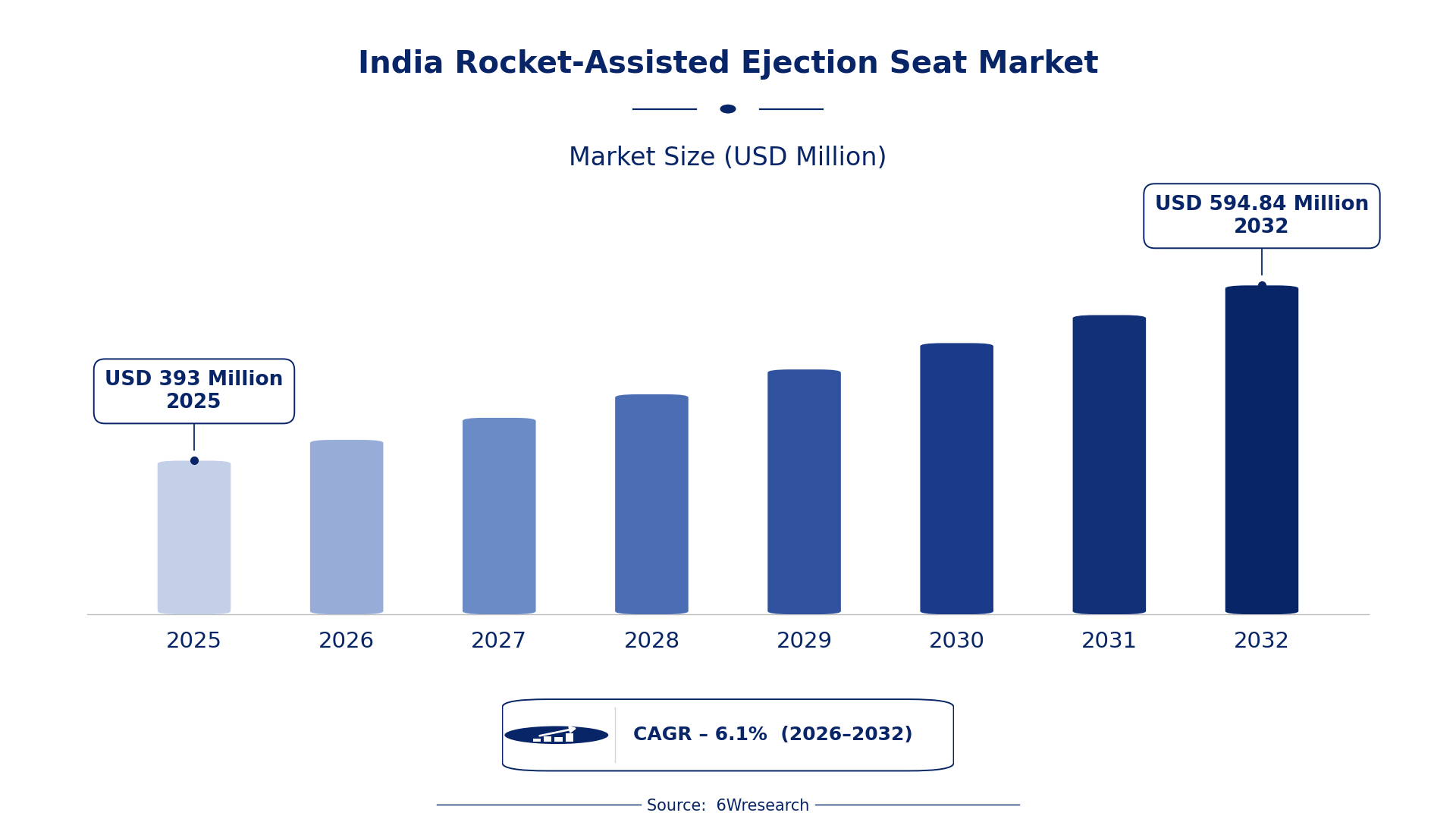
According to 6Wresearch internal database and industry insights, the India Rocket-Assisted Ejection Seat Market was valued at USD 393.0 million in 2025 and is projected to reach USD 594.84 million by 2032, growing at a CAGR of approximately 6.1% during 2026–2032.
India Rocket-Assisted Ejection Seat Market Highlights
| Report Metric | Details |
| Report Name | India Rocket-Assisted Ejection Seat Market |
| Market Size 2025 | USD 393.0 million |
| Market Size 2032 | USD 594.84 million |
| Absolute Growth 2025–2032 | USD 201.84 million |
| CAGR 2026–2032 | 6.1% |
| Peak Annual Growth | 8.5% in 2029 |
| Forecast Period | 2026–2032 |
| Historical Data | 2022–2025 |
| Base Year | 2025 |
| Leading Seat Type, 2025 | Single-Stage Rocket (52% share) |
| Leading Deployment Mechanism, 2025 | Integrated Rocket Motor (45% share) |
| Leading Ejection Altitude, 2025 | Low/High Altitude (36% share) |
| Leading End User, 2025 | Military Fighter Aircraft (48% share) |
| Fastest-Growing Seat Type | Two‑Stage Rocket (8.6% CAGR) |
| Fastest-Growing Deployment Mechanism | Staged Rocket System (7.7% CAGR) |
| Fastest-Growing Ejection Altitude | Extreme Altitude (8.6% CAGR) |
| Fastest-Growing End User | Advanced Military Aircraft (8.5% CAGR) |
| Growing Sector | military aviation |
| Key End Users | military, defense contractors, aerospace manufacturers |
India Rocket-Assisted Ejection Seat Market Year-wise Growth Rate and Key Drivers (2022–2032)
This graph illustrates the annual growth rates of the market from 2022 to 2032, highlighting a steady upward trajectory and projected market expansion over the forecast period.
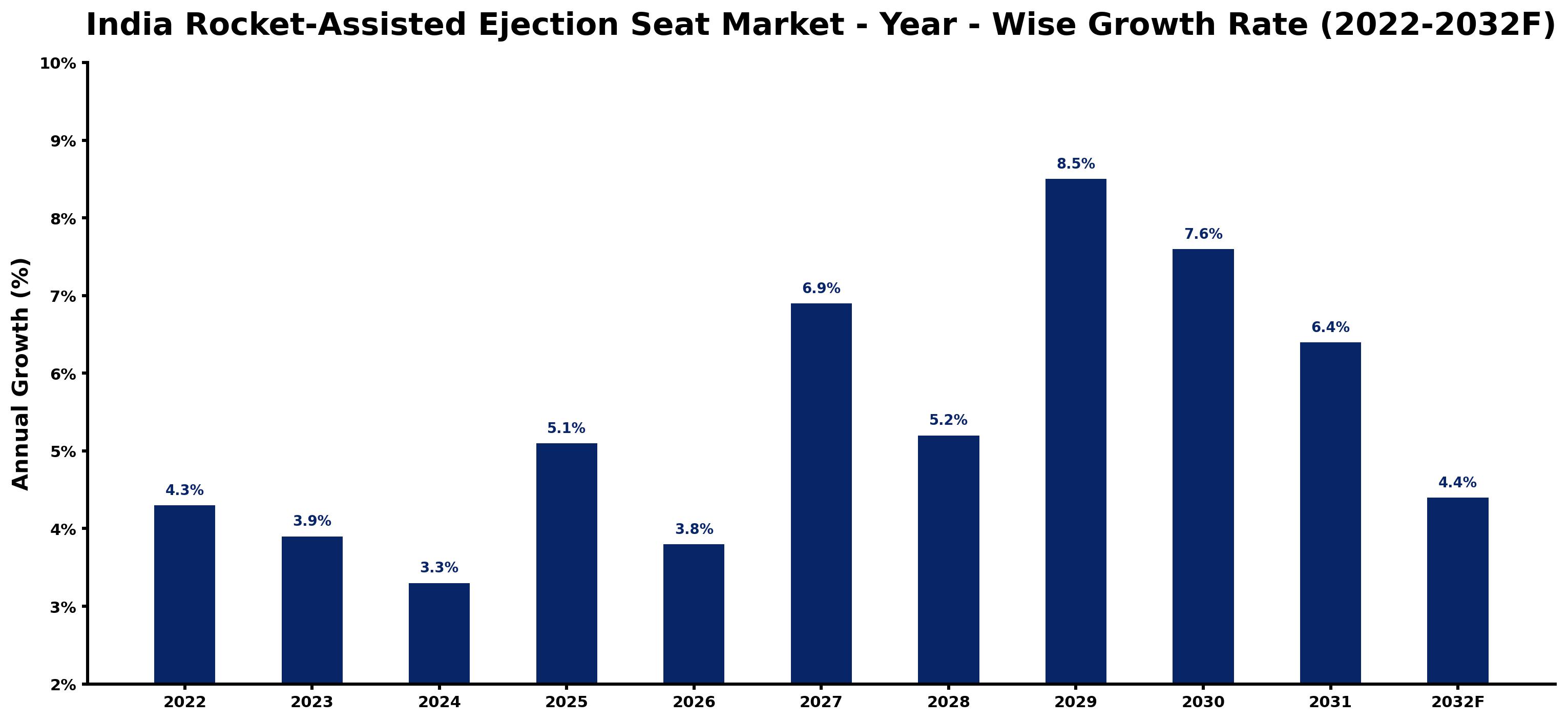
Annual growth estimates for each year appear below with the principal reason behind them, explaining the shifts that set the pace of the market.
| Year | Estimated Annual Growth (%) | Market Rationale |
| 2022 | 4.3 | The market exhibited steady growth due to ongoing military modernization efforts. |
| 2023 | 3.9 | Demand growth slowed as the Indian Air Force focused on upgrading existing fighter aircraft models. |
| 2024 | 3.3 | The market continued to slow as procurement processes faced delays in approvals for new systems. |
| 2025 | 5.1 | Growth accelerated with increased funding for defense modernization initiatives like 'Make in India'. |
| 2026 | 3.8 | Demand growth slowed again as the market adjusted to new procurement standards and regulations. |
| 2027 | 6.9 | The market rebounded with heightened investments in advanced military aircraft and safety technologies. |
| 2028 | 5.2 | Growth decelerated as the focus shifted to operational readiness and pilot training programs. |
| 2029 | 8.5 | A peak in growth occurred due to military exercises showcasing ejection seat capabilities and performance. |
| 2030 | 7.6 | Demand growth slowed as the market stabilised after the peak in military procurement activities. |
| 2031 | 6.4 | The market continued to slow as the Indian Air Force refined its procurement strategies and standards. |
| 2032 | 4.4 | Growth slowed as the focus shifted to enhancing indigenous production capabilities and local partnerships. |
Note: Market size estimations and growth projections presented in this report are based on 6Wresearch's proprietary forecasting methodology, utilizing the latest available industry data, government publications, and primary research inputs.
India Rocket-Assisted Ejection Seat Market Synopsis
The Rocket-Assisted Ejection Seat Market in India includes advanced safety devices designed for pilot escape during emergencies in military aviation. These seats utilise high-strength materials and rocket propulsion systems, primarily intended for military fighter aircraft. Growth in this market is driven by rising demand from the Indian Air Force, which operates over 1,400 military aircraft and engages in extensive pilot training. The allocation of ₹20,000 crores for defence modernisation in 2023, along with initiatives like 'Make in India' that support local development, fuels this expansion.
Market Dynamics Impact Analysis (2026–2032)
| Factor | Type | Impact | Primary Segment Affected |
| Increased funding for defense modernization initiatives drives demand for advanced safety systems. | Driver | High | Tactical Fighter Seats |
| Growing number of military fighter aircraft in operation increases the need for ejection seats. | Driver | High | Military Fighter Aircraft |
| The modernization of existing aircraft presents opportunities for upgrading ejection systems. | Opportunity | High | Integrated Rocket Motor |
| The need for indigenous production capabilities is creating new investment opportunities. | Opportunity | High | Single-Stage Rocket |
| Delays in procurement processes can hinder timely upgrades to existing systems. | Restraint | Medium | Two‑Stage Rocket |
| Compliance with national standards can slow down the introduction of new technologies. | Restraint | Medium | Single-Stage Rocket |
| High costs of advanced materials can limit the affordability of new systems for buyers. | Challenge | Medium | Combined Propulsion |
| Supply chain disruptions can delay the delivery of critical components for ejection systems. | Challenge | Medium | Staged Rocket System |
Evaluation of Drivers in India Rocket-Assisted Ejection Seat Market (2026–2032)
The main growth drivers and the segments they affect most are set out below.
| Drivers | Primary Segment Affected | Why It Matters (Evidence) |
| Increased funding for defense modernization initiatives drives demand for advanced safety systems. | Tactical Fighter Seats | The Indian government allocated ₹20,000 crores for defense modernization in 2023, increasing procurement of ejection seats. |
| Growing number of military fighter aircraft in operation increases the need for ejection seats. | Military Fighter Aircraft | The Indian Air Force operates over 1,400 military aircraft, necessitating the deployment of ejection seats. |
| Indigenous development of ejection systems improves local production capabilities. | Integrated Rocket Motor | The Defence Procurement Procedure encourages local production, leading to increased demand for indigenous ejection systems. |
| Joint military exercises showcase the capabilities of ejection seats, boosting demand. | Zero-Zero Ejection | The Indian Air Force's participation in joint exercises demonstrates the importance of ejection systems for pilot safety. |
| Advancements in aerospace safety technologies improve ejection seat performance. | Extreme Altitude | Research in aerospace safety technologies supports the development of next-gen ejection systems, ensuring pilot safety. |
Growth in the Rocket-Assisted Ejection Seat market in India comes from increased funding for defense modernization, with ₹20,000 crores allocated in 2023. The Indian Air Force operates over 1,400 military aircraft, creating a consistent demand for ejection seats. Military exercises highlight the capabilities of these systems, further driving demand. Ongoing research in aerospace safety technologies supports the development of advanced ejection systems, ensuring pilot safety during emergencies.
Evaluation of Restraints in India Rocket-Assisted Ejection Seat Market
The key brakes on demand, and where they bite hardest, are shown below.
| Market Restraint | Primary Segment Affected | Why It Matters (Evidence) |
| Delays in procurement processes can hinder timely upgrades to existing systems. | Two‑Stage Rocket | The Indian Air Force's procurement processes can take longer than expected, delaying necessary upgrades. |
| Compliance with national standards can slow down the introduction of new technologies. | Single-Stage Rocket | Ejection systems must meet stringent Bureau of Indian Standards, which can prolong development timelines. |
| High costs of advanced materials can limit the affordability of new systems for buyers. | Combined Propulsion | The use of high-strength materials increases production costs, impacting affordability for military budgets. |
| Supply chain disruptions can delay the delivery of critical components for ejection systems. | Staged Rocket System | Global supply chain issues have affected the availability of essential parts, hindering production schedules. |
| Limited local expertise in advanced aerospace technologies can slow innovation. | Tactical Fighter Seats | The need for skilled personnel in aerospace technology remains high, affecting development timelines. |
India Rocket-Assisted Ejection Seat Market Challenges
Producers in the India Rocket-Assisted Ejection Seat market encounter supply chain disruptions due to reliance on imported components, which can delay production timelines for military aircraft by up to six months. This delay compromises the Indian Air Force's ability to maintain operational readiness. Rising raw material costs, driven by global market fluctuations, have inflated production expenses by approximately 15%, forcing manufacturers to pass these costs onto buyers. Budget constraints from the Indian government, which allocated ₹20,000 crores for defense modernization, restrict investments in advanced ejection seat technologies, stalling progress in safety enhancements.
Trends in the India Rocket-Assisted Ejection Seat Market
Several trends are reshaping the India Rocket-Assisted Ejection Seat Market; the most important are set out below.
- Shift Towards Indigenous Development: Since 2020, the Indian government has prioritised indigenous production of defense technologies. With ₹20,000 crores allocated for modernization, local manufacturers are increasingly involved in developing ejection systems, strengthening national capabilities.
- Increased Focus on Safety Standards: In 2023, the Indian Air Force implemented stricter safety protocols for ejection seats. This shift ensures compliance with national standards, resulting in improved safety during military operations.
- Adoption of Advanced Ejection Technologies: Since 2021, there has been a notable increase in the use of two-stage rocket systems for ejection seats. This trend improves performance for higher altitudes, addressing operational needs of military fighter aircraft.
- Expansion of Training Programs: In 2022, the Indian Air Force trained over 1,000 pilots annually using ejection seats. This focus on training ensures pilots are well-prepared for emergency situations, reinforcing the importance of ejection systems.
Investment Opportunities in the India Rocket-Assisted Ejection Seat Market
Some of the investment opportunities in the India Rocket-Assisted Ejection Seat Market are mentioned below.
- Growing Demand for Indigenous Production: With the Indian government allocating ₹20,000 crores for modernisation, there is a strong push for local manufacturing of ejection systems. This creates opportunities for partnerships with local manufacturers to enhance production capabilities.
- Investment in Advanced Ejection Technologies: The market gap for high-performance ejection systems is considerable, with a projected growth of 6.1% from 2026 to 2032. Investing in advanced technologies like two-stage rocket systems can meet military requirements.
- Focus on Safety Enhancements: The Indian Air Force's emphasis on safety opens doors for suppliers of innovative ejection seat technologies. Engaging with military training facilities can facilitate entry into this expanding market.
- Collaboration with Research Institutions: The need for advanced aerospace technologies presents opportunities for collaboration with research institutions. Engaging in joint ventures can support the development of next-generation ejection systems.
Government Initiatives in the India Rocket-Assisted Ejection Seat Market
The Ministry of Defence oversees the approval and funding of defence projects, including ejection seat systems. The Defence Research and Development Organisation (DRDO) is responsible for developing indigenous ejection systems and testing them at facilities in Karnataka and Maharashtra. The DRDO allocates funding for research in aerospace safety technologies, ensuring that new systems meet national standards. Additionally, the Indian Air Force conducts regular safety drills and training exercises to validate ejection seat performance, reinforcing the importance of these systems in operational readiness. The collaboration between the Ministry of Defence and DRDO supports the development of next-generation ejection systems.
The Defence Procurement Procedure encourages local production of ejection seats, facilitating approvals for indigenous projects. The Indian Air Force actively engages with local manufacturers to enhance production capabilities and ensure timely deliveries of ejection systems.
Future Insight of the India Rocket-Assisted Ejection Seat Market
The India Rocket-Assisted Ejection Seat market will undergo transformative changes by 2032, primarily due to the 'Make in India' initiative that promotes local production. This shift will empower manufacturers to innovate and improve ejection systems, boosting pilot safety in military aviation. The Defence Research and Development Organisation plans to develop next-gen ejection systems, elevating performance standards. With the Indian Air Force training over 1,000 pilots annually, the demand for advanced ejection seats is set to increase, ensuring that safety in military operations remains a top priority.
Market Segmentation Analysis
The analysis below covers each segmentation, its leading category in 2025 and its fastest-growing category through 2032.
By Seat Type – Single-Stage Rocket Dominated, Two‑Stage Rocket Expected to Grow Fastest
According to Shubham Padhi, Research Analyst at 6Wresearch, Single-Stage Rocket held a 52% share of the India Rocket-Assisted Ejection Seat Market by seat type in 2025. The Single-Stage Rocket commands the largest market share due to its extensive application in military ejection systems, ensuring dependable performance during emergencies. With over 1,400 military aircraft in India requiring ejection seats, this type plays a critical role in maintaining pilot safety. The quickest growth will come from Two‑Stage Rocket, forecast to expand at a CAGR of 8.6% between 2026 and 2032. The Two-Stage Rocket is witnessing rapid growth as it offers enhanced performance for higher altitudes, which is essential for contemporary military operations. As the Indian Air Force modernises its fleet, the demand for these advanced ejection systems will likely surge, widening the lead of the Single-Stage Rocket. Suppliers should focus on developing Two-Stage Rocket systems to meet the increasing demands of the Indian military.
By Deployment Mechanism – Integrated Rocket Motor Dominated, Staged Rocket System Expected to Grow Fastest
Integrated Rocket Motor took a 45% share of deployment mechanism in 2025, more than any other category. The Integrated Rocket Motor leads the market as it is a crucial component in various military aircraft ejection systems, ensuring effective pilot escape during emergencies. Its reliability and performance have established it as a standard in the Indian defence sector, contributing to its substantial market share. Over 2026–2032, Staged Rocket System is expected to post the fastest growth, at a CAGR of 7.7%. The Staged Rocket System is rapidly gaining traction as it significantly improves ejection efficiency, making it a preferred choice for new aircraft models. With the Indian Air Force upgrading its fleet, the adoption of this mechanism is expected to rise sharply, further solidifying the position of the Integrated Rocket Motor. Buyers should consider the advantages of Staged Rocket Systems to enhance the safety and operational effectiveness of their aircraft.
By Ejection Altitude – Low/High Altitude Dominated, Extreme Altitude Expected to Grow Fastest
The largest ejection altitude category in 2025 was Low/High Altitude, with a 36% share of total revenue. Low/High Altitude ejection systems dominate the market as they are essential for various flight conditions faced by military aircraft. The versatility of these systems ensures they meet the operational requirements of the Indian Air Force effectively. Extreme Altitude is set to record the highest CAGR in this split, 8.6% over 2026–2032. Extreme Altitude systems are rapidly gaining traction as they are necessary for high-altitude missions, which are becoming more common in modern warfare. The push for advanced capabilities in the Indian military will drive this segment's growth. Suppliers must invest in developing Extreme Altitude systems to cater to the evolving demands of military aviation.
By End User – Military Fighter Aircraft Dominated, Advanced Military Aircraft Expected to Grow Fastest
With a 48% revenue share in 2025, Military Fighter Aircraft was the largest end user category. Military Fighter Aircraft dominate the market as they are the primary users of ejection seat systems, ensuring pilot safety during critical operations. The extensive fleet of fighter jets operated by the Indian Air Force reinforces this segment's leading position. Advanced Military Aircraft is projected to grow fastest, at a CAGR of 8.5% during 2026–2032. Advanced Military Aircraft are experiencing the fastest growth as they are increasingly adopted for new models, reflecting the Indian military's commitment to modernisation. This trend suggests a shift towards more sophisticated ejection systems in the near future. Manufacturers should focus on Advanced Military Aircraft to align with the Indian Air Force's ongoing modernisation initiatives.
Key Attractiveness of the Report
- 10 Years of Market Numbers
- Historical Data Starting from 2022 to 2025
- Base Year 2025
- Forecast Data until 2032
- Key Performance Indicators Impacting the Market
- Major Upcoming Developments and Projects
Key Highlights of the Report:
- India Rocket-Assisted Ejection Seat Market Outlook
- Market Size of India Rocket-Assisted Ejection Seat Market, 2025
- Forecast of India Rocket-Assisted Ejection Seat Market, 2032
- Historical Data and Forecast of India Rocket-Assisted Ejection Seat Revenues & Volume for the Period 2022 - 2032F
- India Rocket-Assisted Ejection Seat Market Trend Evolution
- India Rocket-Assisted Ejection Seat Market Drivers and Challenges
- India Rocket-Assisted Ejection Seat Price Trends
- India Rocket-Assisted Ejection Seat Porter's Five Forces
- India Rocket-Assisted Ejection Seat Industry Life Cycle
- Historical Data and Forecast of India Rocket-Assisted Ejection Seat Market Revenues & Volume By Seat Type for the Period 2022 - 2032F
- Historical Data and Forecast of India Rocket-Assisted Ejection Seat Market Revenues & Volume By Single-Stage Rocket for the Period 2022 - 2032F
- Historical Data and Forecast of India Rocket-Assisted Ejection Seat Market Revenues & Volume By Two Stage Rocket for the Period 2022 - 2032F
- Historical Data and Forecast of India Rocket-Assisted Ejection Seat Market Revenues & Volume By Zero-Zero Ejection for the Period 2022 - 2032F
- Historical Data and Forecast of India Rocket-Assisted Ejection Seat Market Revenues & Volume By Tactical Fighter Seats for the Period 2022 - 2032F
- Historical Data and Forecast of India Rocket-Assisted Ejection Seat Market Revenues & Volume By Deployment Mechanism for the Period 2022 - 2032F
- Historical Data and Forecast of India Rocket-Assisted Ejection Seat Market Revenues & Volume By Integrated Rocket Motor for the Period 2022 - 2032F
- Historical Data and Forecast of India Rocket-Assisted Ejection Seat Market Revenues & Volume By Staged Rocket System for the Period 2022 - 2032F
- Historical Data and Forecast of India Rocket-Assisted Ejection Seat Market Revenues & Volume By Combined Propulsion for the Period 2022 - 2032F
- Historical Data and Forecast of India Rocket-Assisted Ejection Seat Market Revenues & Volume By Thrust-Aided System for the Period 2022 - 2032F
- Historical Data and Forecast of India Rocket-Assisted Ejection Seat Market Revenues & Volume By Ejection Altitude for the Period 2022 - 2032F
- Historical Data and Forecast of India Rocket-Assisted Ejection Seat Market Revenues & Volume By Low/High Altitude for the Period 2022 - 2032F
- Historical Data and Forecast of India Rocket-Assisted Ejection Seat Market Revenues & Volume By Extreme Altitude for the Period 2022 - 2032F
- Historical Data and Forecast of India Rocket-Assisted Ejection Seat Market Revenues & Volume By Ground Level for the Period 2022 - 2032F
- Historical Data and Forecast of India Rocket-Assisted Ejection Seat Market Revenues & Volume By Supersonic Speed for the Period 2022 - 2032F
- Historical Data and Forecast of India Rocket-Assisted Ejection Seat Market Revenues & Volume By End User for the Period 2022 - 2032F
- Historical Data and Forecast of India Rocket-Assisted Ejection Seat Market Revenues & Volume By Military Fighter Aircraft for the Period 2022 - 2032F
- Historical Data and Forecast of India Rocket-Assisted Ejection Seat Market Revenues & Volume By Advanced Military Aircraft for the Period 2022 - 2032F
- Historical Data and Forecast of India Rocket-Assisted Ejection Seat Market Revenues & Volume By Trainer Jets for the Period 2022 - 2032F
- Historical Data and Forecast of India Rocket-Assisted Ejection Seat Market Revenues & Volume By Air Force Installations for the Period 2022 - 2032F
- India Rocket-Assisted Ejection Seat Import Export Trade Statistics
- Market Opportunity Assessment By Seat Type
- Market Opportunity Assessment By Deployment Mechanism
- Market Opportunity Assessment By Ejection Altitude
- Market Opportunity Assessment By End User
- India Rocket-Assisted Ejection Seat Top Companies Market Share
- India Rocket-Assisted Ejection Seat Competitive Benchmarking By Technical and Operational Parameters
- India Rocket-Assisted Ejection Seat Company Profiles
- India Rocket-Assisted Ejection Seat Key Strategic Recommendations
Market Covered
Segments analysed in this report are listed below.
By Seat Type
- Single-Stage Rocket
- Two‑Stage Rocket
- Zero-Zero Ejection
- Tactical Fighter Seats
By Deployment Mechanism
- Integrated Rocket Motor
- Staged Rocket System
- Combined Propulsion
- Thrust-Aided System
By Ejection Altitude
- Low/High Altitude
- Extreme Altitude
- Ground Level
- Supersonic Speed
By End User
- Military Fighter Aircraft
- Advanced Military Aircraft
- Trainer Jets
- Air Force Installations






































