India Satellite Navigation Timing Market Size & Growth Rate
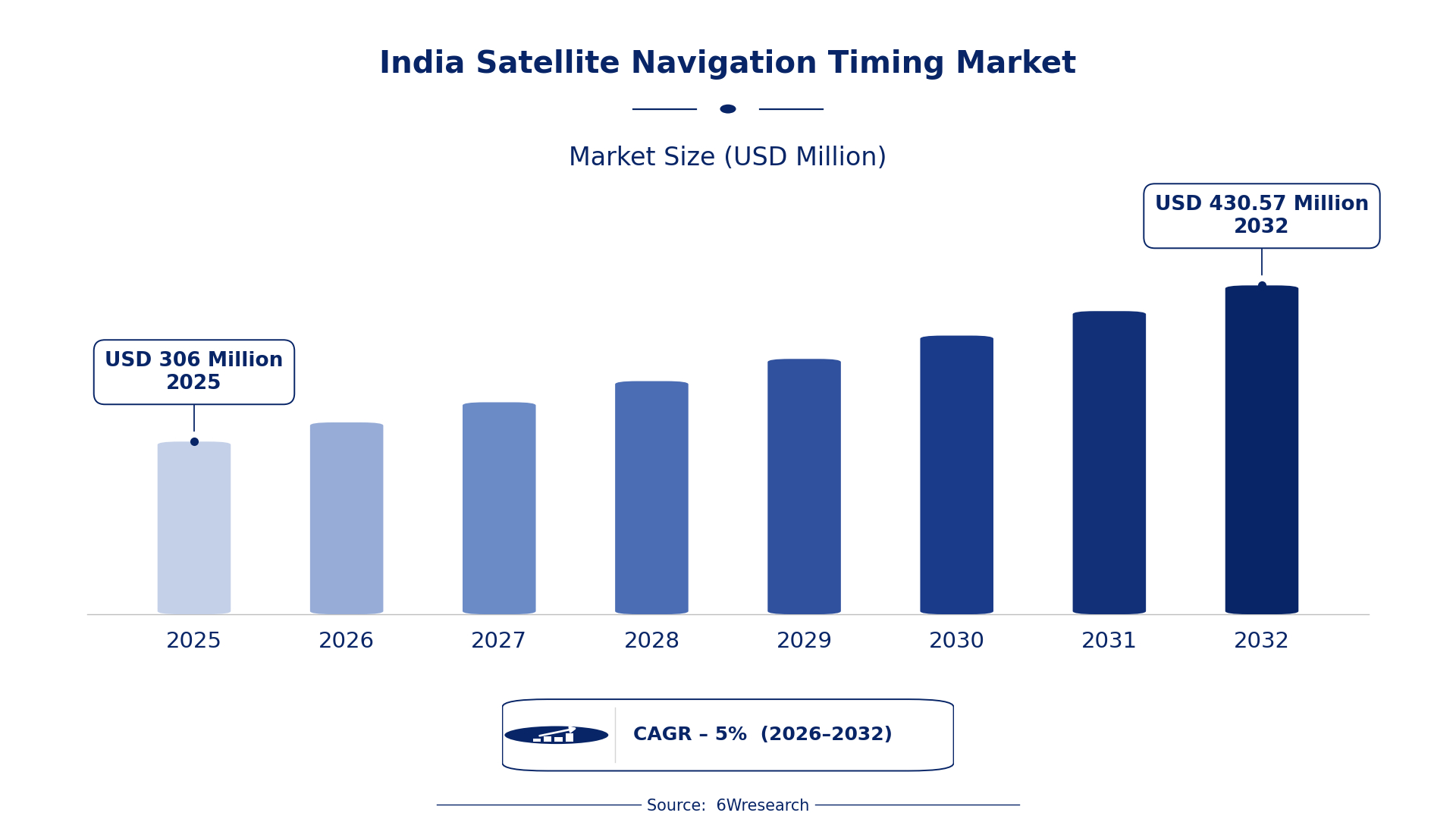
According to 6Wresearch internal database and industry insights, the India Satellite Navigation Timing Market was valued at USD 306.0 million in 2025 and is projected to reach USD 430.57 million by 2032, growing at a CAGR of approximately 5% during 2026–2032.
India Satellite Navigation Timing Market Highlights
| Report Metric | Details |
| Report Name | India Satellite Navigation Timing Market |
| Market Size 2025 | USD 306.0 million |
| Market Size 2032 | USD 430.57 million |
| Absolute Growth 2025–2032 | USD 124.57 million |
| CAGR 2026–2032 | 5% |
| Peak Annual Growth | 7.5% in 2029 |
| Forecast Period | 2026–2032 |
| Historical Data | 2022–2025 |
| Base Year | 2025 |
| Leading Service Type, 2025 | GNSS Timing (41% share) |
| Leading Timing Accuracy, 2025 | Nano to Microsecond (41% share) |
| Leading Application Type, 2025 | Telecom Synchronization (38% share) |
| Leading End User, 2025 | 5G Infrastructure Providers (40% share) |
| Fastest-Growing Service Type | Precise Point Positioning (PPP) (6.9% CAGR) |
| Fastest-Growing Application Type | Geolocation (7.6% CAGR) |
| Fastest-Growing End User | Aerospace Navigation (6.6% CAGR) |
| Growing Sector | Telecommunications |
| Key End Users | Telecom Providers, Military Agencies, Aerospace Companies, Civilian Users |
India Satellite Navigation Timing Market Year-wise Growth Rate and Key Drivers (2022–2032)
This graph illustrates the annual growth rates of the market from 2022 to 2032, highlighting a steady upward trajectory and projected market expansion over the forecast period.
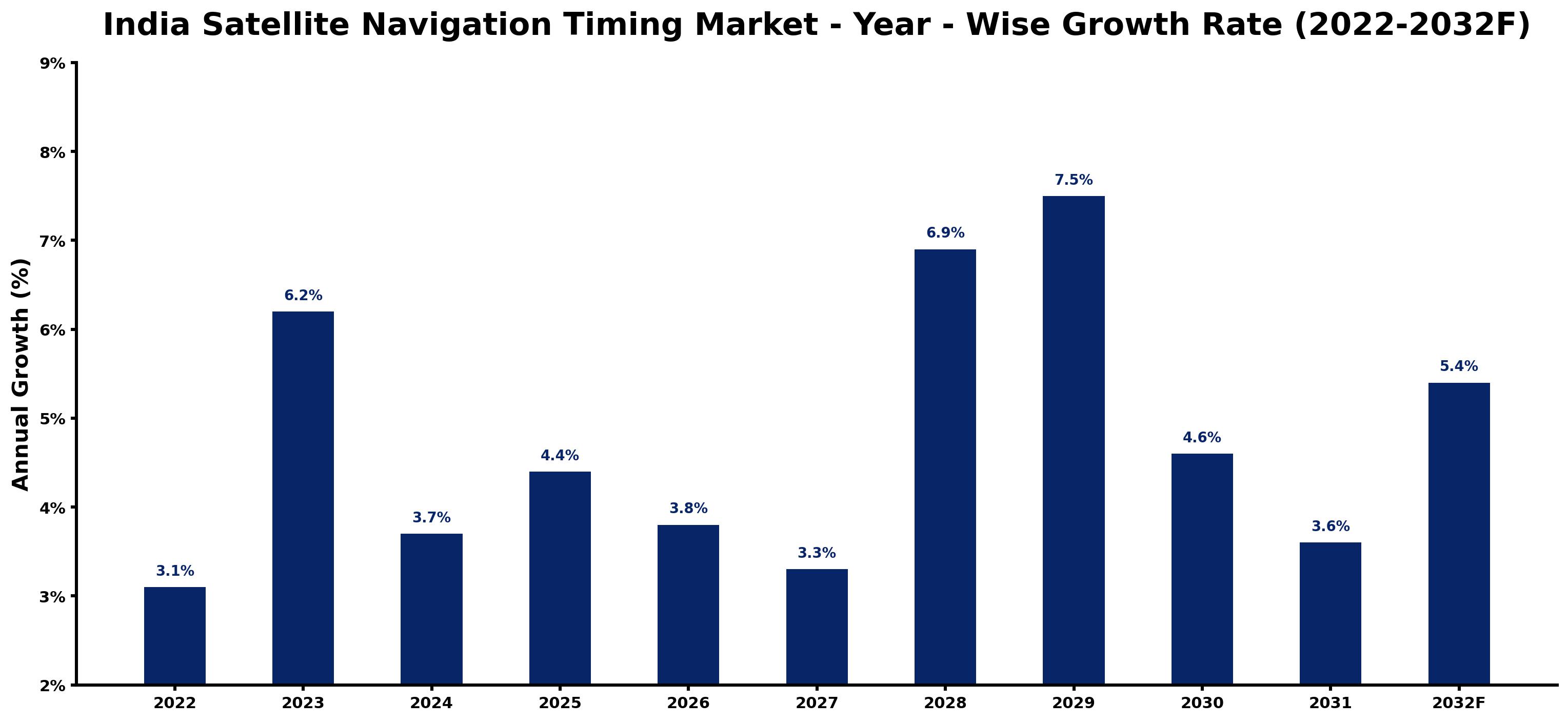
The table below sets out the estimated growth rate for each year and the main factor behind it.
| Year | Estimated Annual Growth (%) | Market Rationale |
| 2022 | 3.1 | The market showed steady demand for satellite navigation timing services across various sectors. |
| 2023 | 6.2 | Growth was driven by increased mobile subscriber numbers and demand for accurate timing services. |
| 2024 | 3.7 | The market experienced a slowdown due to temporary adjustments in telecom synchronization standards. |
| 2025 | 4.4 | Demand surged as the National Digital Communications Policy 2020 promoted improvements in telecom infrastructure. |
| 2026 | 3.8 | A slowdown occurred as the market is expected to adjust to new technological integrations in satellite systems. |
| 2027 | 3.3 | Continued investment in military timing systems is projected to contribute to sustained growth in the sector. |
| 2028 | 6.9 | Growth is expected to accelerate as the aerospace sector expands, increasing demand for navigation systems. |
| 2029 | 7.5 | The peak growth year will be marked by advancements in 5G infrastructure requirements. |
| 2030 | 4.6 | A slowdown is projected as the market stabilises after rapid technological advancements. |
| 2031 | 3.6 | The market will continue to grow, driven by ongoing demand from 5G infrastructure providers. |
| 2032 | 5.4 | Growth is expected to rise as the aerospace sector demands more precise navigation solutions. |
Note: Market size estimations and growth projections presented in this report are based on 6Wresearch's proprietary forecasting methodology, utilizing the latest available industry data, government publications, and primary research inputs.
India Satellite Navigation Timing Market Synopsis
The India Satellite Navigation Timing Market involves technologies such as GNSS and PPP, providing essential time and location data for various applications. Its primary uses include telecommunications synchronization and military applications. Demand is driven by over 1.3 billion mobile subscribers and investments in advanced military timing systems. The National Digital Communications Policy 2020 promotes improvements in telecom infrastructure, further increasing demand for precise timing solutions. Additionally, the aerospace sector's growth is expected to further fuel this market.
Market Dynamics Impact Analysis (2026–2032)
| Factor | Type | Impact | Primary Segment Affected |
| Increased mobile subscriber base drives demand for accurate timing services. | Driver | High | Telecom Synchronization |
| Investment in military timing systems enhances operational capabilities. | Driver | High | Military Timing Systems |
| Growing aerospace sector presents opportunities for navigation system suppliers. | Opportunity | High | Aerospace Navigation |
| Expansion of 5G infrastructure requires precise timing solutions. | Opportunity | High | 5G Infrastructure Providers |
| Temporary adjustments in telecom synchronization standards may slow growth. | Restraint | Medium | Telecom Synchronization |
| High costs associated with advanced military timing systems may limit investment. | Restraint | Medium | Military Timing Systems |
| Approval delays for new satellite navigation projects can hinder market entry. | Challenge | High | GNSS Timing |
| Technological integration challenges may slow down market expansion. | Challenge | Medium | Precise Point Positioning (PPP) |
Evaluation of Drivers in India Satellite Navigation Timing Market (2026–2032)
Below mentioned are some major drivers and their influence on market dynamics.
| Drivers | Primary Segment Affected | Why It Matters (Evidence) |
| Rising mobile subscriber numbers increase demand for accurate timing services. | Telecom Synchronization | With over 1.3 billion mobile subscribers, the need for precise timing in telecommunications is critical. |
| Investment in military timing systems improves operational capabilities. | Military Timing Systems | The Ministry of Defense has allocated funds to upgrade military navigation systems for strategic operations. |
| Expansion of the aerospace sector increases demand for navigation systems. | Aerospace Navigation | India's aviation sector is projected to handle over 1 billion passengers by 2030, necessitating precise navigation solutions. |
| The National Digital Communications Policy 2020 promotes telecom infrastructure improvements. | Telecom Synchronization | This policy aims to improve the telecom sector, driving demand for satellite navigation technologies. |
| The growth of 5G infrastructure necessitates precise timing solutions. | 5G Infrastructure Providers | With a 40% share in 2025, these providers require advanced timing systems for network synchronization. |
Market growth in India for Satellite Navigation Timing hinges on increasing mobile subscriber numbers, heightened investment in military timing systems, and the expansion of the aerospace sector. The demand for precise timing services is critical for telecommunications, particularly with over 1.3 billion mobile subscribers. Investment in military timing systems is expected to significantly improve operational capabilities. India's aviation sector is projected to manage over 1 billion passengers by 2030, creating a need for accurate navigation solutions. The development of 5G infrastructure also requires advanced timing solutions to ensure network synchronisation.
Evaluation of Restraints in India Satellite Navigation Timing Market
The table below lists the restraints and the evidence behind each.
| Market Restraint | Primary Segment Affected | Why It Matters (Evidence) |
| Temporary adjustments in telecom synchronization standards may slow growth. | Telecom Synchronization | These adjustments can lead to delays in the implementation of new technologies, affecting service providers. |
| High costs associated with advanced military timing systems may limit investment. | Military Timing Systems | Budget constraints can hinder the procurement of necessary systems for defense operations. |
| Approval delays for new satellite navigation projects can hinder market entry. | GNSS Timing | Lengthy approval processes can slow down the introduction of new solutions in the market. |
| Technological integration challenges may slow down market expansion. | Precise Point Positioning (PPP) | Complexity in integrating new technologies can deter investment and slow growth. |
| Limited awareness of satellite navigation benefits among potential users. | Civilian Use | This lack of awareness can restrict the adoption of advanced navigation solutions in everyday applications. |
India Satellite Navigation Timing Market Challenges
India's satellite navigation timing market faces a skills shortage, with only 30% of professionals trained in advanced technologies, which delays project timelines for producers. This lack of expertise limits local innovation, compelling buyers to depend on imports for advanced systems and potentially raising costs by 20%. Domestic producers encounter fierce competition from foreign providers, resulting in a 15% decline in market share for local firms as they struggle to offer competitive pricing. Supply chain disruptions stem from reliance on imported components, leading to service delivery delays that particularly affect telecommunications and defence buyers who require timely solutions.
Trends in the India Satellite Navigation Timing Market
Several trends are reshaping the India Satellite Navigation Timing Market; the most important are set out below.
- Shift towards Improved 5G Infrastructure Requirements: The National Digital Communications Policy 2020 has initiated a shift towards improved telecom infrastructure, necessitating precise timing solutions. This is evident as demand for 5G infrastructure providers grows, with the market expected to reach USD 306.0 million by 2025.
- Transition from Traditional to Advanced Military Timing Systems: The Ministry of Defense's 2023 strategy emphasizes upgrading military navigation systems, transitioning from traditional methods to advanced technologies. This shift is important for improving operational efficiency and security in defense operations.
- Emergence of Precise Point Positioning Technologies: The growing demand for high-accuracy positioning in surveying and mapping has led to the emergence of Precise Point Positioning technologies. This sector is expected to grow at a CAGR of 6.9% from 2026 to 2032, reflecting its increasing importance.
- Focus on Civilian Applications of Satellite Navigation: The Indian government is promoting the use of satellite navigation in civilian applications, improving everyday logistics and navigation services. This focus aligns with the projected growth of the civilian use sector, driven by technological advancements.
Investment Opportunities in the India Satellite Navigation Timing Market
Several openings in the India Satellite Navigation Timing Market merit attention from investors.
- Collaborating with Telecom Providers: With over 1.3 billion mobile subscribers, there is a strong demand for accurate timing services. Collaborating with telecom providers can help tap into this market, especially in urban areas, where demand is high.
- Investment in Military Navigation Systems: The Ministry of Defense's budget for 2023 includes allocations for advanced navigation systems. Suppliers can enter this market by establishing joint ventures with local defense contractors to meet military needs.
- Expansion of Aerospace Navigation Services: The projected growth of India's aviation sector, expected to handle over 1 billion passengers by 2030, presents opportunities for navigation system suppliers. Focusing on airports and airlines can yield substantial returns in this expanding market.
- Development of Civilian Navigation Solutions: The growing awareness of satellite navigation benefits among civilians creates opportunities for developing user-friendly navigation solutions. Targeting logistics companies can lead to successful market entry and increased adoption.
Government Initiatives in the India Satellite Navigation Timing Market
The National Digital Communications Policy 2020 aims to improve the telecom sector, including satellite navigation technologies, with a focus on 5G infrastructure. This policy promotes the adoption of advanced timing solutions, ensuring that the telecommunications industry meets modern demands effectively. By aligning with global standards, the policy encourages investments in satellite navigation systems, paving the way for growth in this sector. Additionally, the National Aerospace Policy 2021 emphasizes the importance of satellite navigation for the growth of the aerospace sector in India, further supporting the industry's development.
The Indian National Space Promotion and Authorization Center (IN-SPACe) facilitates satellite navigation projects. This agency approves various initiatives aimed at improving satellite navigation capabilities, providing essential support for both civilian and defense applications. The Ministry of Electronics and Information Technology also funds projects that promote the use of satellite navigation in various sectors, ensuring that advancements align with national objectives.
Future Insight of the India Satellite Navigation Timing Market
By 2032, buyers and suppliers in the India satellite navigation timing market can anticipate substantial advancements due to the National Space Policy 2023 and the National Digital Communications Policy 2020. The Indian Space Research Organisation plans to improve the NavIC system, enhancing regional services and accuracy. With the defence budget allocating considerable resources for advanced navigation systems, military applications will experience notable improvements. The growth of the aviation sector, projected to manage over 1 billion passengers by 2030, will further elevate the demand for reliable timing services.
Market Segmentation Analysis
Each segment group is reviewed below, with the leader by share and the fastest grower by CAGR.
By Service Type – GNSS Timing Dominated, Precise Point Positioning (PPP) Expected to Grow Fastest
According to Shubham Padhi, Research Analyst at 6Wresearch, GNSS Timing held a 41% share of the India Satellite Navigation Timing Market by service type in 2025. GNSS Timing commands the largest share due to its critical role in ensuring accurate timekeeping for telecommunications and military operations. The extensive user base, including over 1.3 billion mobile subscribers in India, significantly fuels the demand for GNSS Timing solutions. Precise Point Positioning (PPP) is set to record the highest CAGR in this split, 6.9% over 2026–2032. Precise Point Positioning (PPP) is experiencing rapid growth as it becomes essential for high-accuracy surveying and mapping, crucial for infrastructure projects. With India's aerospace sector on the rise, the need for precise positioning will continue to drive this segment's expansion. Suppliers should prioritise the enhancement of GNSS Timing solutions to cater to the growing demand across various sectors.
By Timing Accuracy – Nano to Microsecond Dominated and Is Expected to Record the Fastest Growth
Nano to Microsecond accounted for a 41% market share by timing accuracy in 2025. The Nano to Microsecond timing accuracy segment leads the market as it is essential for applications requiring extremely precise timing, such as telecommunications and military operations. This high level of accuracy is increasingly demanded across various sectors in India. The same category is also set to grow fastest, at a CAGR of 7.2% during 2026–2032. The Nano to Microsecond segment is also the fastest-growing due to its critical importance in emerging technologies like 5G and advanced military systems. As these technologies proliferate, the demand for this level of timing accuracy will continue to rise. Buyers will need to invest in technologies that ensure Nano to Microsecond accuracy to stay competitive in their respective fields.
By Application Type – Telecom Synchronization Dominated, Geolocation Expected to Grow Fastest
In 2025, Telecom Synchronization led the application type split with a 38% share. Telecom Synchronization leads the application type segment, being vital for the seamless operation of 5G networks and mobile communications. The regulatory oversight by the Telecom Regulatory Authority of India ensures that this segment remains robust and integral to the market. Geolocation is projected to grow fastest, at a CAGR of 7.6% during 2026–2032. Geolocation is the fastest-growing application type, spurred by the increasing reliance on navigation systems and location-based services in everyday life. As consumer and business adoption of these technologies rises, the demand for geolocation services is set to surge significantly. Suppliers should concentrate on developing geolocation solutions to address the rising needs of consumers and businesses.
By End User – 5G Infrastructure Providers Dominated, Aerospace Navigation Expected to Grow Fastest
With a 40% revenue share in 2025, 5G Infrastructure Providers was the largest end user category. 5G Infrastructure Providers dominate the end-user segment, as they depend on precise timing for effective network synchronisation. The rapid rollout of 5G technology in India generates substantial demand for accurate timing solutions within this sector. Over 2026–2032, Aerospace Navigation is expected to post the fastest growth, at a CAGR of 6.6%. Aerospace Navigation is the fastest-growing end-user segment, driven by the heightened need for accurate timing in flight operations and the expected expansion of the aviation industry. This demand is projected to escalate as air travel continues to grow significantly in the coming years. Suppliers must align their offerings with the specific requirements of aerospace navigation to capitalise on this growth opportunity.
Key Attractiveness of the Report
- 10 Years of Market Numbers
- Historical Data Starting from 2022 to 2025
- Base Year 2025
- Forecast Data until 2032
- Key Performance Indicators Impacting the Market
- Major Upcoming Developments and Projects
Key Highlights of the Report:
- India Satellite Navigation Timing Market Outlook
- Market Size of India Satellite Navigation Timing Market, 2025
- Forecast of India Satellite Navigation Timing Market, 2032
- Historical Data and Forecast of India Satellite Navigation Timing Revenues & Volume for the Period 2022 - 2032F
- India Satellite Navigation Timing Market Trend Evolution
- India Satellite Navigation Timing Market Drivers and Challenges
- India Satellite Navigation Timing Price Trends
- India Satellite Navigation Timing Porter's Five Forces
- India Satellite Navigation Timing Industry Life Cycle
- Historical Data and Forecast of India Satellite Navigation Timing Market Revenues & Volume By Service Type for the Period 2022 - 2032F
- Historical Data and Forecast of India Satellite Navigation Timing Market Revenues & Volume By GNSS Timing for the Period 2022 - 2032F
- Historical Data and Forecast of India Satellite Navigation Timing Market Revenues & Volume By Precise Point Positioning (PPP) for the Period 2022 - 2032F
- Historical Data and Forecast of India Satellite Navigation Timing Market Revenues & Volume By Time Transfer Service for the Period 2022 - 2032F
- Historical Data and Forecast of India Satellite Navigation Timing Market Revenues & Volume By Satellite-Based Augmentation for the Period 2022 - 2032F
- Historical Data and Forecast of India Satellite Navigation Timing Market Revenues & Volume By Timing Accuracy for the Period 2022 - 2032F
- Historical Data and Forecast of India Satellite Navigation Timing Market Revenues & Volume By Nano to Microsecond for the Period 2022 - 2032F
- Historical Data and Forecast of India Satellite Navigation Timing Market Revenues & Volume By High Precision for the Period 2022 - 2032F
- Historical Data and Forecast of India Satellite Navigation Timing Market Revenues & Volume By UTC Synchronization for the Period 2022 - 2032F
- Historical Data and Forecast of India Satellite Navigation Timing Market Revenues & Volume By Sub-Microsecond for the Period 2022 - 2032F
- Historical Data and Forecast of India Satellite Navigation Timing Market Revenues & Volume By Application Type for the Period 2022 - 2032F
- Historical Data and Forecast of India Satellite Navigation Timing Market Revenues & Volume By Telecom Synchronization for the Period 2022 - 2032F
- Historical Data and Forecast of India Satellite Navigation Timing Market Revenues & Volume By Geolocation for the Period 2022 - 2032F
- Historical Data and Forecast of India Satellite Navigation Timing Market Revenues & Volume By Military Timing Systems for the Period 2022 - 2032F
- Historical Data and Forecast of India Satellite Navigation Timing Market Revenues & Volume By Civilian Use for the Period 2022 - 2032F
- Historical Data and Forecast of India Satellite Navigation Timing Market Revenues & Volume By End User for the Period 2022 - 2032F
- Historical Data and Forecast of India Satellite Navigation Timing Market Revenues & Volume By 5G Infrastructure Providers for the Period 2022 - 2032F
- Historical Data and Forecast of India Satellite Navigation Timing Market Revenues & Volume By Aerospace Navigation for the Period 2022 - 2032F
- Historical Data and Forecast of India Satellite Navigation Timing Market Revenues & Volume By Defense Communications for the Period 2022 - 2032F
- Historical Data and Forecast of India Satellite Navigation Timing Market Revenues & Volume By Aviation Navigation for the Period 2022 - 2032F
- India Satellite Navigation Timing Import Export Trade Statistics
- Market Opportunity Assessment By Service Type
- Market Opportunity Assessment By Timing Accuracy
- Market Opportunity Assessment By Application Type
- Market Opportunity Assessment By End User
- India Satellite Navigation Timing Top Companies Market Share
- India Satellite Navigation Timing Competitive Benchmarking By Technical and Operational Parameters
- India Satellite Navigation Timing Company Profiles
- India Satellite Navigation Timing Key Strategic Recommendations
Market Covered
Segments analysed in this report are listed below.
By Service Type
- GNSS Timing
- Precise Point Positioning (PPP)
- Time Transfer Service
- Satellite-Based Augmentation
By Timing Accuracy
- Nano to Microsecond
- High Precision
- UTC Synchronization
- Sub-Microsecond
By Application Type
- Telecom Synchronization
- Geolocation
- Military Timing Systems
- Civilian Use
By End User
- 5G Infrastructure Providers
- Aerospace Navigation
- Defense Communications
- Aviation Navigation































