India Self-Operating Data Management Market Size & Growth Rate
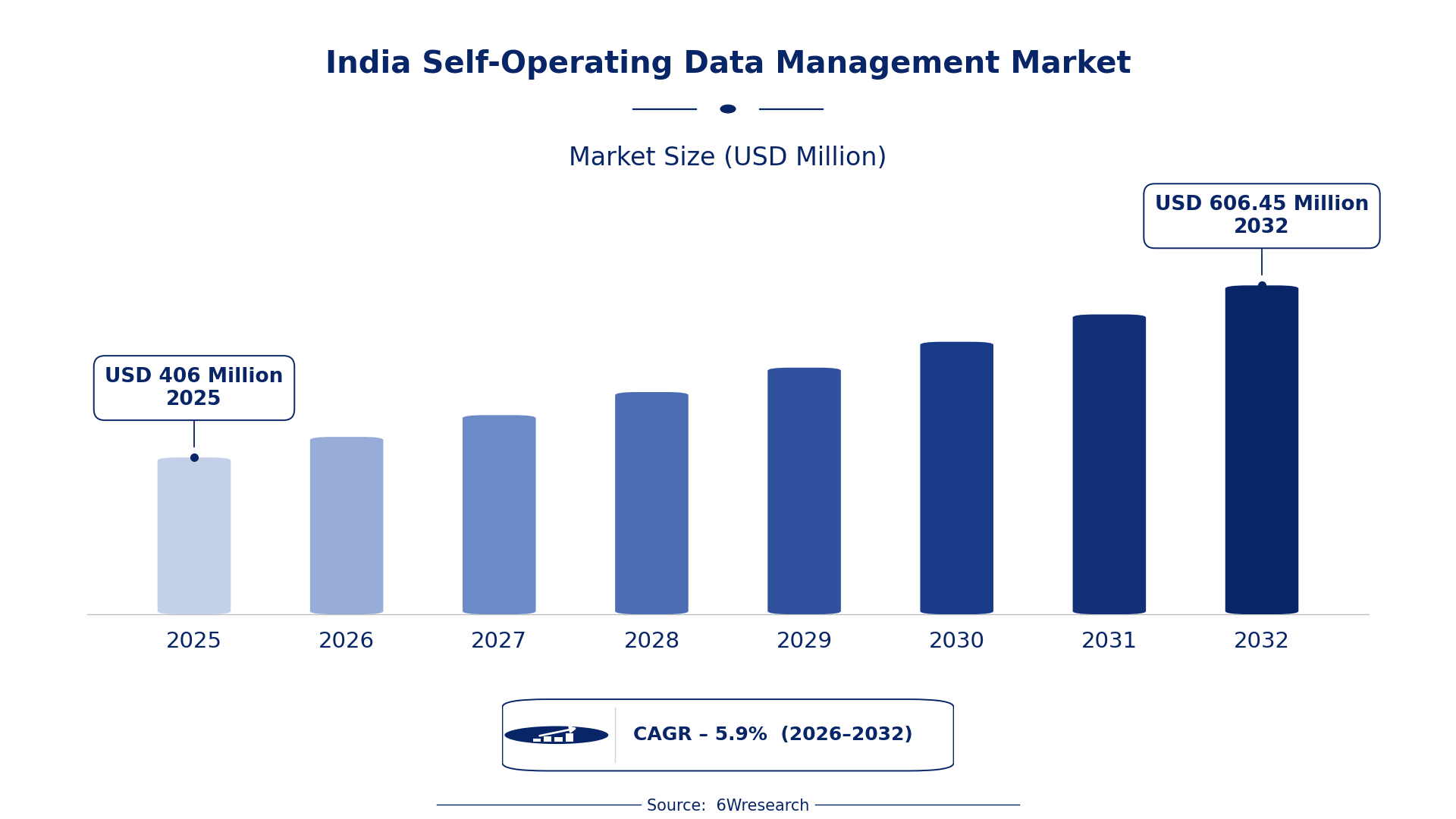
According to 6Wresearch internal database and industry insights, the India Self-Operating Data Management Market was valued at USD 406.0 million in 2025 and is projected to reach USD 606.45 million by 2032, growing at a CAGR of approximately 5.9% during 2026–2032.
India Self-Operating Data Management Market Highlights
| Report Metric | Details |
| Report Name | India Self-Operating Data Management Market |
| Market Size 2025 | USD 406.0 million |
| Market Size 2032 | USD 606.45 million |
| Absolute Growth 2025–2032 | USD 200.45 million |
| CAGR 2026–2032 | 5.9% |
| Peak Annual Growth | 7.8% in 2028 |
| Forecast Period | 2026–2032 |
| Historical Data | 2022–2025 |
| Base Year | 2025 |
| Leading Function Type, 2025 | Real-Time Analytics (51% share) |
| Leading Data Type, 2025 | Structured Data (45% share) |
| Leading Deployment Mode, 2025 | Cloud-Based (45% share) |
| Leading End User, 2025 | Enterprise IT (50% share) |
| Fastest-Growing Function Type | AI-Powered Governance (8.6% CAGR) |
| Fastest-Growing Data Type | Unstructured Data (8.6% CAGR) |
| Fastest-Growing Deployment Mode | Hybrid (7.4% CAGR) |
| Fastest-Growing End User | Big Data Firms (8.1% CAGR) |
| Growing Sector | IT and Data Management |
| Key End Users | Enterprise IT, Financial Institutions, Compliance Teams, Big Data Firms |
India Self-Operating Data Management Market Year-wise Growth Rate and Key Drivers (2022–2032)
This graph illustrates the annual growth rates of the market from 2022 to 2032, highlighting a steady upward trajectory and projected market expansion over the forecast period.
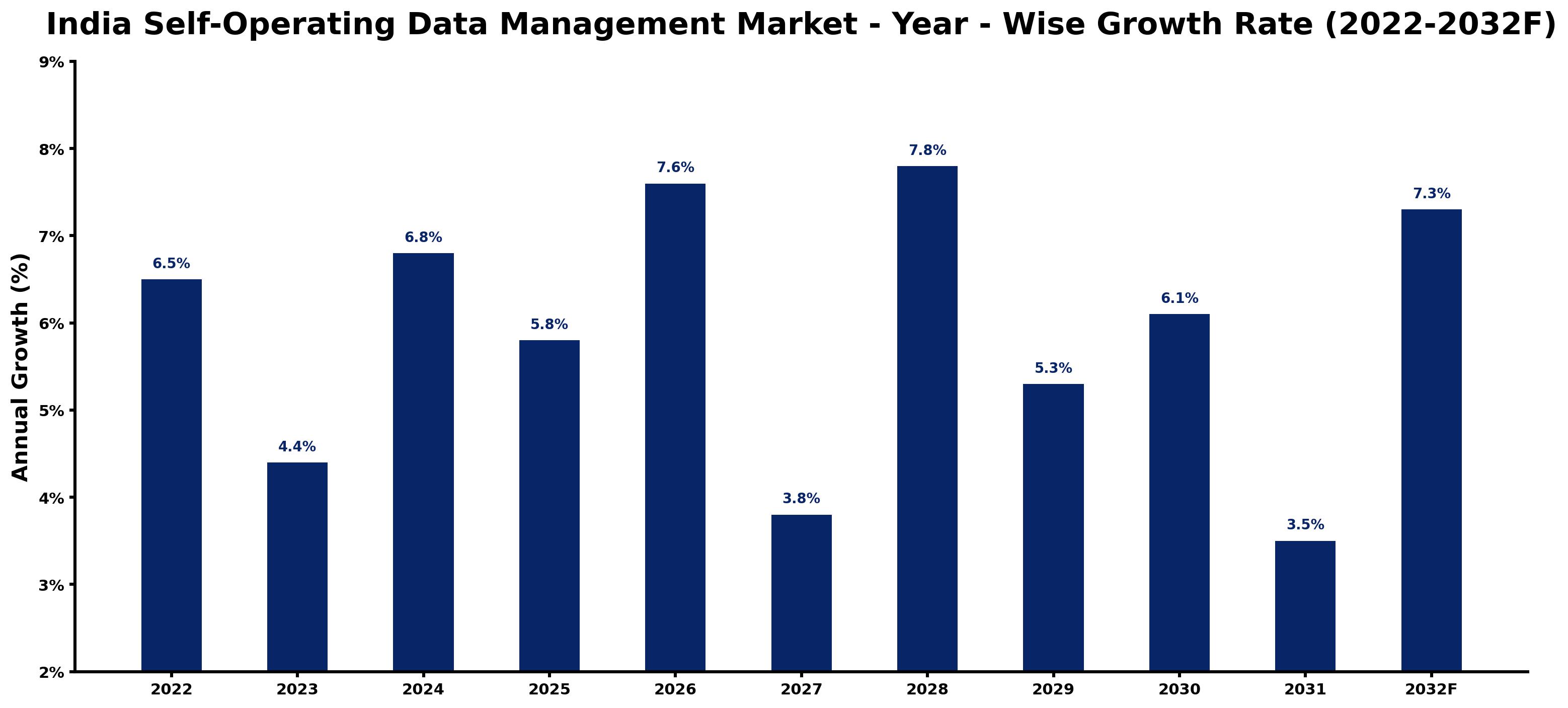
The following table presents the estimated annual growth rate for each year together with the principal factor influencing market performance.
| Year | Estimated Annual Growth (%) | Market Rationale |
| 2022 | 6.5 | The market experienced solid growth due to increasing cloud adoption among enterprises. |
| 2023 | 4.4 | Growth slowed as enterprises reassessed their data management strategies amidst economic uncertainty. |
| 2024 | 6.8 | Demand accelerated with the implementation of new data governance standards by financial institutions. |
| 2025 | 5.8 | A slight slowdown occurred as enterprises balanced investments in technology and operational costs. |
| 2026 | 7.6 | Growth regained momentum with rising adoption of AI-driven data management solutions. |
| 2027 | 3.8 | A slowdown in growth was noted as market maturity began to set in. |
| 2028 | 7.8 | The market peaked with heightened investments in real-time analytics capabilities. |
| 2029 | 5.3 | Growth slowed as enterprises focused on optimising existing data management systems. |
| 2030 | 6.1 | Demand increased again as data management became critical for business decision-making. |
| 2031 | 3.5 | A slowdown was observed as market saturation began to impact growth rates. |
| 2032 | 7.3 | Growth accelerated again with the emergence of new data management technologies. |
Note: Market size estimations and growth projections presented in this report are based on 6Wresearch's proprietary forecasting methodology, utilizing the latest available industry data, government publications, and primary research inputs.
India Self-Operating Data Management Market Synopsis
Self-Operating Data Management in India includes systems that automate data management processes through advanced technologies like AI and machine learning. These systems maintain data integrity, ensure compliance, and provide real-time analytics for informed decision-making. The India Self-Operating Data Management Market is growing due to increased cloud adoption and regulatory demands. More than 70% of enterprises are now embracing cloud-based solutions, driven by the necessity for efficient data management. The Digital India initiative further propels this growth by strengthening digital infrastructure nationwide.
Market Dynamics Impact Analysis (2026–2032)
| Factor | Type | Impact | Primary Segment Affected |
| Increasing cloud adoption among enterprises drives demand for efficient data management solutions. | Driver | High | Cloud-Based |
| The rise in data governance regulations creates a need for compliance solutions. | Driver | High | AI-Powered Governance |
| The growing focus on real-time analytics presents opportunities for innovative data management solutions. | Opportunity | High | Real-Time Analytics |
| Investment in smart city projects necessitates advanced data management systems. | Opportunity | Medium | Autonomous Data Lakes |
| High implementation costs can limit access to advanced data management technologies. | Restraint | High | Structured Data |
| Lack of skilled professionals may hinder the adoption of new data management practices. | Restraint | Medium | Enterprise IT |
| Economic fluctuations can delay investments in data management solutions. | Challenge | High | Financial Institutions |
| Regulatory changes may require rapid adjustments in data management practices. | Challenge | Medium | Compliance Teams |
Evaluation of Drivers in India Self-Operating Data Management Market (2026–2032)
The main growth drivers and the segments they affect most are set out below.
| Drivers | Primary Segment Affected | Why It Matters (Evidence) |
| Rising cloud adoption among enterprises increases demand for cloud-based data management solutions. | Cloud-Based | Over 70% of enterprises in India are adopting cloud-based data management solutions, leading to higher purchases. |
| The implementation of stringent data governance regulations drives demand for compliance solutions. | AI-Powered Governance | The Reserve Bank of India mandates data governance standards, prompting financial institutions to invest more in compliance solutions. |
| Growing demand for real-time analytics encourages businesses to adopt advanced data management systems. | Real-Time Analytics | The average data growth rate in enterprises is estimated at 30% annually, necessitating better analytics systems. |
| Investment in smart city projects boosts the need for efficient data management systems. | Autonomous Data Lakes | The Indian government has allocated substantial funds to improve urban data management systems through smart city initiatives. |
| The increasing integration of AI and machine learning into data management processes improves system capabilities. | AI-Optimized Storage | AI and machine learning are increasingly integrated into data management processes, enhancing operational efficiency and effectiveness. |
More than 70% of enterprises are adopting cloud-based solutions, which improves their data management capabilities. The average data growth rate in enterprises is estimated at 30% annually, necessitating better analytics systems. Investment in smart city projects is also increasing the need for effective data management solutions. The integration of AI and machine learning into data management processes is improving system capabilities, resulting in increased purchases.
Evaluation of Restraints in India Self-Operating Data Management Market
The key brakes on demand, and where they bite hardest, are shown below.
| Market Restraint | Primary Segment Affected | Why It Matters (Evidence) |
| High implementation costs can limit access to advanced data management technologies. | Structured Data | The average cost of implementing cloud-based solutions can exceed 20% of IT budgets for smaller enterprises. |
| Lack of skilled professionals may hinder the adoption of new data management practices. | Enterprise IT | While India has over 500,000 IT professionals, the demand for advanced skills exceeds supply, causing delays in projects. |
| Economic fluctuations can delay investments in data management solutions. | Financial Institutions | Financial institutions are cautious with spending due to market volatility, affecting their data management budgets. |
| Regulatory changes may require rapid adjustments in data management practices. | Compliance Teams | The introduction of new regulations can lead to unexpected compliance costs for organizations, impacting their budgets. |
| Limited awareness of advanced data management technologies restricts market growth. | AI-Powered Governance | Many enterprises are still unfamiliar with the benefits of AI-driven data governance solutions, slowing their adoption. |
India Self-Operating Data Management Market Challenges
Over 70% of enterprises in India are adopting cloud-based data management solutions, yet a shortage of skilled IT professionals hampers project execution, delaying implementations for firms by up to six months. High costs associated with advanced systems can consume over 20% of IT budgets, straining financial resources for small and medium enterprises. Intense competition among data management firms leads to price wars, eroding profit margins for suppliers and resulting in diminished service quality for buyers. Navigating the complex regulatory environment, particularly compliance with the Information Technology Act of 2000, can incur legal costs of around 15% of operational expenses for firms.
Trends in the India Self-Operating Data Management Market
The trends below show where the India Self-Operating Data Management Market is heading.
- 30% Annual Data Growth: The average data growth rate in Indian enterprises is estimated at 30% annually, driving the demand for efficient data management solutions. This trend is evident as organizations invest in cloud-based systems to handle increasing data volumes.
- Shift to Cloud-Based Solutions: Maharashtra is becoming a centre for IT and data management firms, with over 70% of enterprises adopting cloud-based solutions. This shift is transforming how organizations manage data, favouring scalable cloud infrastructures.
- Increased Focus on Real-Time Analytics: Financial institutions are prioritising real-time analytics to improve decision-making capabilities. This trend is supported by the growing need for timely data insights in a fast-paced market.
- Growing Demand for Compliance Solutions: The introduction of the Data Protection Bill in 2021 has intensified the focus on compliance solutions among enterprises. Organizations are investing in AI-driven governance systems to meet new regulatory standards.
Investment Opportunities in the India Self-Operating Data Management Market
Investors looking at the India Self-Operating Data Management Market should consider the following areas.
- Now is the Time for Cloud Solutions: With over 70% of enterprises adopting cloud-based solutions, there is an opportunity to provide advanced cloud data management systems. Enterprises across India are making substantial investments in these technologies to boost efficiency.
- Invest in Smart City Projects: The ongoing Smart Cities Mission offers a unique chance for data management firms to deliver solutions. The Indian government has allocated significant funds to enhance urban data management systems, creating demand for effective solutions.
- Partnerships for AI Integration: Forming partnerships with local IT firms to integrate AI into data management solutions presents a timely opportunity. Collaborating with compliance teams can improve product offerings and market reach, tapping into rising demand.
- Focus on Real-Time Analytics Solutions: The increasing need for real-time analytics creates an opportunity to develop cutting-edge solutions. Financial institutions are especially interested in systems that provide timely insights for decision-making, driving investment.
Government Initiatives in the India Self-Operating Data Management Market
The Digital India Programme, launched by the Ministry of Electronics and Information Technology in 2020, aims to enhance digital infrastructure and data management capabilities across the country. This initiative complements existing laws like the Information Technology Act of 2000, which governs data protection regulations. Together, these measures establish a framework for improving data management practices in India, enabling enterprises to adopt more efficient systems.
The National Cyber Security Strategy, approved by the Ministry of Electronics and Information Technology in 2021, focuses on strengthening data security and management practices. The strategy includes funding for projects that enhance data governance across various sectors, ensuring that organizations comply with the latest standards. This funding supports initiatives that assist enterprises in adopting secure data management practices, allowing them to better safeguard sensitive information.
Future Insight of the India Self-Operating Data Management Market
The India Self-Operating Data Management market is projected to evolve by 2032, driven by the integration of AI and machine learning technologies. The Digital India initiative will enhance data management capabilities across various sectors, promoting efficiency and innovation. By 2032, the average data growth rate in Indian enterprises is expected to remain at 30%, driving demand for advanced solutions. Compliance with ISO/IEC 27001 standards will become increasingly important, ensuring better data security and regulatory adherence for both buyers and suppliers.
Market Segmentation Analysis
The report offers a comprehensive study of the following market segments and their leading categories in the market.
By Function Type – Real-Time Analytics Dominated, AI-Powered Governance Expected to Grow Fastest
According to Shubham Padhi, Research Analyst at 6Wresearch, Real-Time Analytics held a 51% share of the India Self-Operating Data Management Market by function type in 2025. Real-Time Analytics commands the largest share as it is crucial for businesses needing to make informed decisions based on current data trends. This is particularly evident in sectors that rely on timely insights for operational efficiency. Over 2026–2032, AI-Powered Governance is expected to post the fastest growth, at a CAGR of 8.6%. AI-Powered Governance is experiencing rapid growth due to the increasing emphasis on compliance with data privacy and security regulations, especially influenced by the guidelines set by the National Institute of Standards and Technology. This segment's growth is likely to continue as organisations prioritise regulatory adherence in their data management practices. Suppliers should enhance real-time analytics capabilities to meet the rising demand from enterprises.
By Data Type – Structured Data Dominated, Unstructured Data Expected to Grow Fastest
Structured Data took a 45% share of data type in 2025, more than any other category. Structured Data holds the largest share as it is vital for managing organised data formats essential for various business operations. This is especially significant in sectors such as finance, where accurate data management is critical for compliance and reporting. Unstructured Data is projected to grow fastest, at a CAGR of 8.6% during 2026–2032. Unstructured Data is the fastest-growing segment, driven by the need to manage diverse data types that lack a predefined structure, particularly as the average data growth rate in Indian enterprises is estimated at 30% annually. This trend indicates a shift towards more flexible data management solutions. Buyers should invest in tools that enhance their ability to manage unstructured data effectively.
By Deployment Mode – Cloud-Based Dominated, Hybrid Expected to Grow Fastest
In 2025, Cloud-Based led the deployment mode split with a 45% share. Cloud-Based solutions dominate the market share due to their scalability and flexibility, enabling enterprises to manage data efficiently in the cloud. The Digital India initiative has significantly accelerated the adoption of these solutions across various sectors, reinforcing their importance. Hybrid is set to record the highest CAGR in this split, 7.4% over 2026–2032. Hybrid deployment is rapidly growing as it caters to scenarios requiring both cloud and on-premise solutions, reflecting the diverse needs of Indian enterprises. This trend suggests that businesses are seeking adaptable data management strategies that integrate both models. Suppliers must develop hybrid solutions to align with the changing preferences of enterprises in data management.
By End User – Enterprise IT Dominated, Big Data Firms Expected to Grow Fastest
The largest end user category in 2025 was Enterprise IT, with a 50% share of total revenue. Enterprise IT holds the largest share as it extensively utilises data management solutions to streamline operations and improve efficiency. The presence of a large workforce of IT professionals in India underscores the strong demand for enterprise-level data management solutions. The quickest growth will come from Big Data Firms, forecast to expand at a CAGR of 8.1% between 2026 and 2032. Big Data Firms represent the fastest-growing segment, as they require advanced tools for managing and analysing large datasets, which is increasingly critical in today's data-driven environment. The growth of big data analytics in India is a key factor propelling this segment's expansion. Suppliers should tailor their offerings to meet the specific needs of big data firms, ensuring they have the necessary tools for effective data analysis.
Key Attractiveness of the Report
- 10 Years of Market Numbers
- Historical Data Starting from 2022 to 2025
- Base Year 2025
- Forecast Data until 2032
- Key Performance Indicators Impacting the Market
- Major Upcoming Developments and Projects
Key Highlights of the Report:
- India Self-Operating Data Management Market Outlook
- Market Size of India Self-Operating Data Management Market, 2025
- Forecast of India Self-Operating Data Management Market, 2032
- Historical Data and Forecast of India Self-Operating Data Management Revenues & Volume for the Period 2022 - 2032F
- India Self-Operating Data Management Market Trend Evolution
- India Self-Operating Data Management Market Drivers and Challenges
- India Self-Operating Data Management Price Trends
- India Self-Operating Data Management Porter's Five Forces
- India Self-Operating Data Management Industry Life Cycle
- Historical Data and Forecast of India Self-Operating Data Management Market Revenues & Volume By Function Type for the Period 2022 - 2032F
- Historical Data and Forecast of India Self-Operating Data Management Market Revenues & Volume By Automated Backup for the Period 2022 - 2032F
- Historical Data and Forecast of India Self-Operating Data Management Market Revenues & Volume By AI-Powered Governance for the Period 2022 - 2032F
- Historical Data and Forecast of India Self-Operating Data Management Market Revenues & Volume By Real-Time Analytics for the Period 2022 - 2032F
- Historical Data and Forecast of India Self-Operating Data Management Market Revenues & Volume By Autonomous Data Lakes for the Period 2022 - 2032F
- Historical Data and Forecast of India Self-Operating Data Management Market Revenues & Volume By Data Type for the Period 2022 - 2032F
- Historical Data and Forecast of India Self-Operating Data Management Market Revenues & Volume By Structured Data for the Period 2022 - 2032F
- Historical Data and Forecast of India Self-Operating Data Management Market Revenues & Volume By Unstructured Data for the Period 2022 - 2032F
- Historical Data and Forecast of India Self-Operating Data Management Market Revenues & Volume By Transactional Data for the Period 2022 - 2032F
- Historical Data and Forecast of India Self-Operating Data Management Market Revenues & Volume By Multi-Source Data for the Period 2022 - 2032F
- Historical Data and Forecast of India Self-Operating Data Management Market Revenues & Volume By Deployment Mode for the Period 2022 - 2032F
- Historical Data and Forecast of India Self-Operating Data Management Market Revenues & Volume By Cloud-Based for the Period 2022 - 2032F
- Historical Data and Forecast of India Self-Operating Data Management Market Revenues & Volume By Hybrid for the Period 2022 - 2032F
- Historical Data and Forecast of India Self-Operating Data Management Market Revenues & Volume By On-Premise for the Period 2022 - 2032F
- Historical Data and Forecast of India Self-Operating Data Management Market Revenues & Volume By AI-Optimized Storage for the Period 2022 - 2032F
- Historical Data and Forecast of India Self-Operating Data Management Market Revenues & Volume By End User for the Period 2022 - 2032F
- Historical Data and Forecast of India Self-Operating Data Management Market Revenues & Volume By Enterprise IT for the Period 2022 - 2032F
- Historical Data and Forecast of India Self-Operating Data Management Market Revenues & Volume By Compliance Teams for the Period 2022 - 2032F
- Historical Data and Forecast of India Self-Operating Data Management Market Revenues & Volume By Financial Institutions for the Period 2022 - 2032F
- Historical Data and Forecast of India Self-Operating Data Management Market Revenues & Volume By Big Data Firms for the Period 2022 - 2032F
- India Self-Operating Data Management Import Export Trade Statistics
- Market Opportunity Assessment By Function Type
- Market Opportunity Assessment By Data Type
- Market Opportunity Assessment By Deployment Mode
- Market Opportunity Assessment By End User
- India Self-Operating Data Management Top Companies Market Share
- India Self-Operating Data Management Competitive Benchmarking By Technical and Operational Parameters
- India Self-Operating Data Management Company Profiles
- India Self-Operating Data Management Key Strategic Recommendations
Market Covered
Segments analysed in this report are listed below.
By Function Type
- Automated Backup
- AI-Powered Governance
- Real-Time Analytics
- Autonomous Data Lakes
By Data Type
- Structured Data
- Unstructured Data
- Transactional Data
- Multi-Source Data
By Deployment Mode
- Cloud-Based
- Hybrid
- On-Premise
- AI-Optimized Storage
By End User
- Enterprise IT
- Compliance Teams
- Financial Institutions
- Big Data Firms































