India Sensor Calibration Equipment Market Size & Growth Rate
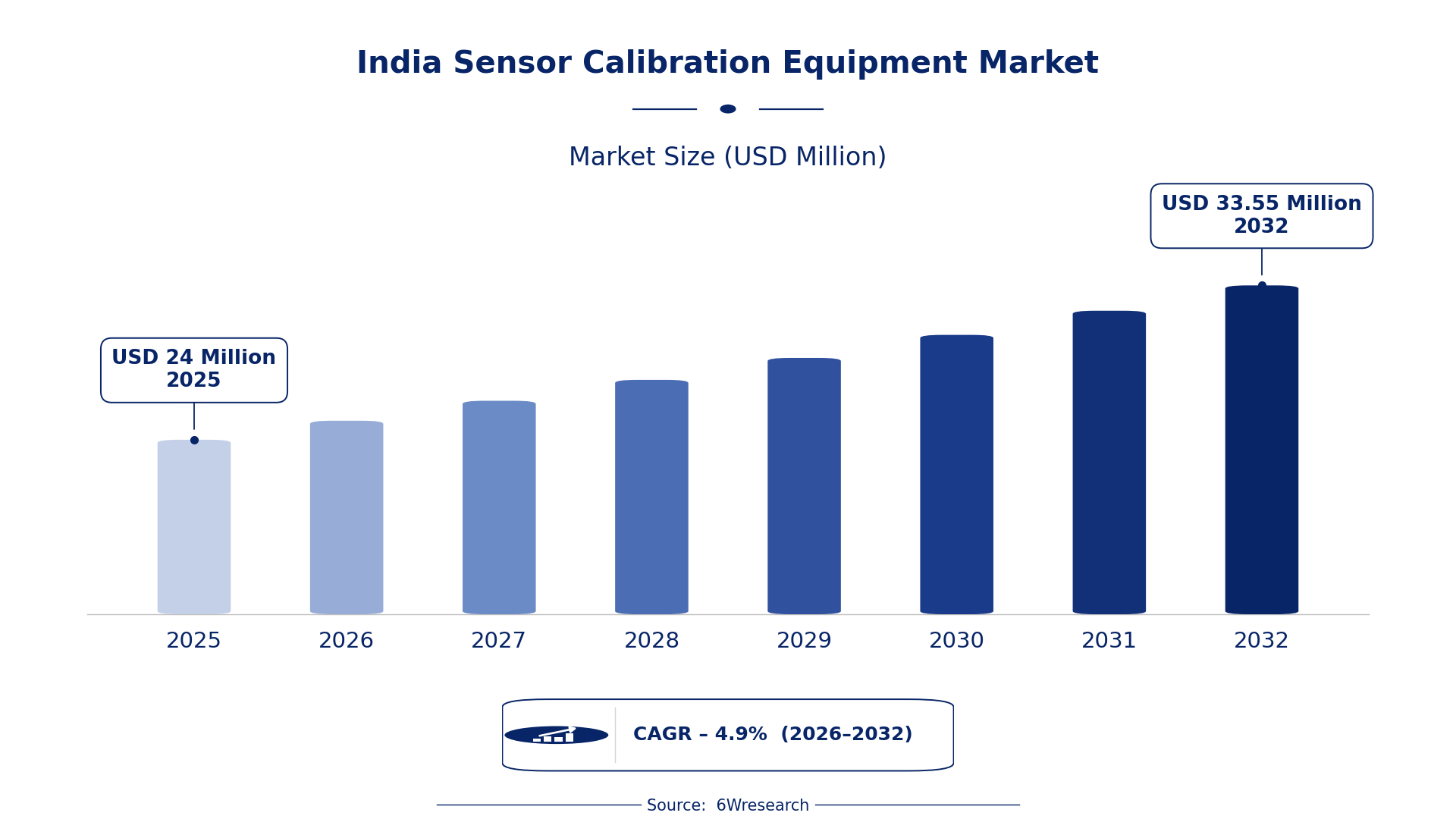
According to 6Wresearch internal database and industry insights, the India Sensor Calibration Equipment Market was valued at USD 24.0 million in 2025 and is projected to reach USD 33.55 million by 2032, growing at a CAGR of approximately 4.9% during 2026–2032.
India Sensor Calibration Equipment Market Highlights
| Report Metric | Details |
| Report Name | India Sensor Calibration Equipment Market |
| Market Size 2025 | USD 24.0 million |
| Market Size 2032 | USD 33.55 million |
| Absolute Growth 2025–2032 | USD 9.55 million |
| CAGR 2026–2032 | 4.9% |
| Peak Annual Growth | 7.5% in 2031 |
| Forecast Period | 2026–2032 |
| Historical Data | 2022–2025 |
| Base Year | 2025 |
| Leading Calibration Type, 2025 | Pressure Sensor Calibrators (43% share) |
| Leading Sensor Category, 2025 | Thermal Sensors (39% share) |
| Leading Accuracy Level, 2025 | High Precision (±0.1%) (43% share) |
| Leading End User, 2025 | R&D Labs (48% share) |
| Fastest-Growing Calibration Type | Temperature Calibration Kits (7.0% CAGR) |
| Fastest-Growing Accuracy Level | ISO Certified Standards (7.4% CAGR) |
| Fastest-Growing End User | Automotive Test Benches (7.6% CAGR) |
| Growing Sector | Aerospace |
| Key End Users | R&D Labs, Aerospace OEMs, Environmental Engineers, Automotive Test Benches |
India Sensor Calibration Equipment Market Year-wise Growth Rate and Key Drivers (2022–2032)
This graph illustrates the annual growth rates of the market from 2022 to 2032, highlighting a steady upward trajectory and projected market expansion over the forecast period.
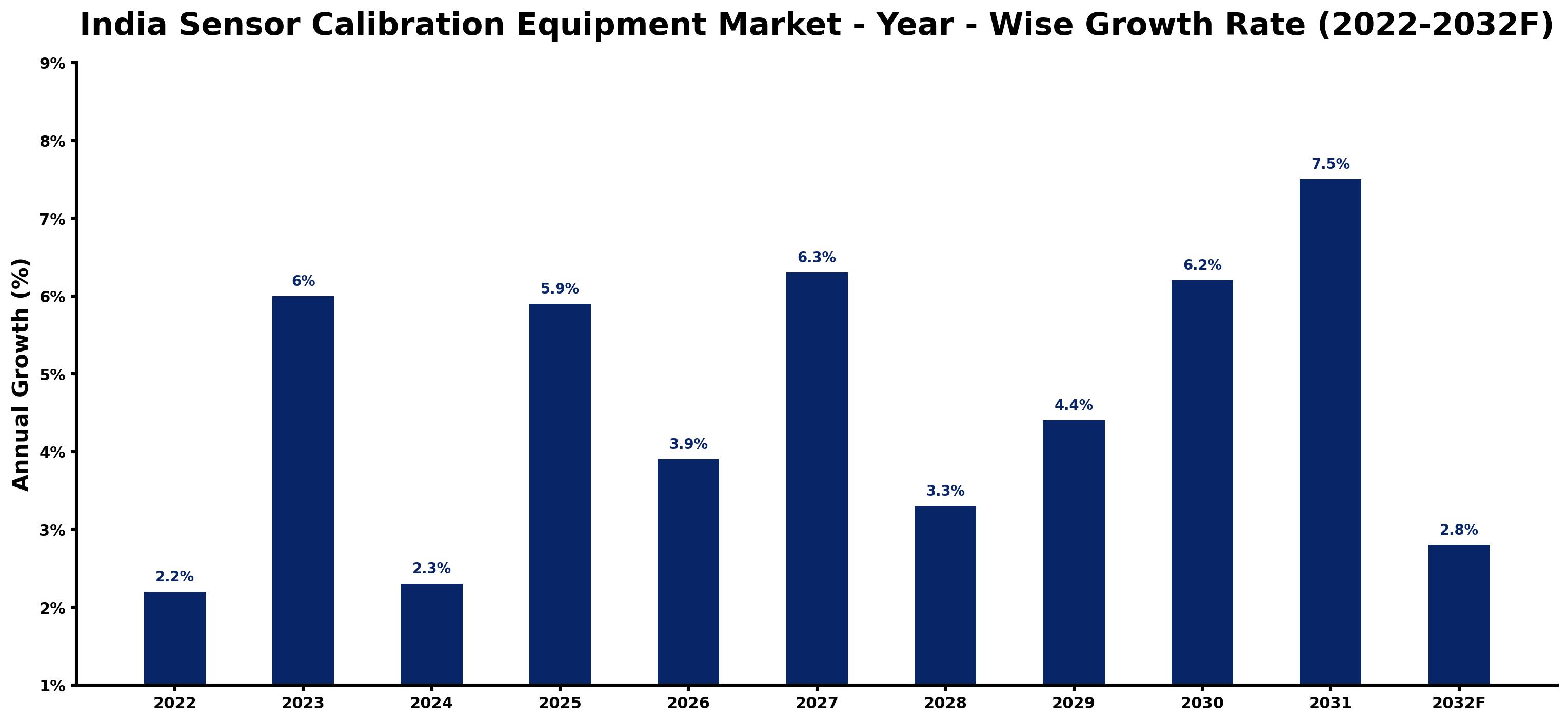
Each row of the following table gives one year's estimated growth and the event or demand shift that explains it.
| Year | Estimated Annual Growth (%) | Market Rationale |
| 2022 | 2.2 | The market experienced steady demand from R&D labs and industrial users, particularly in aerospace applications. |
| 2023 | 6.0 | Growth accelerated due to increased calibration needs in the aerospace sector, driven by rising investments. |
| 2024 | 2.3 | The automotive industry's expansion led to a slowdown in growth rates, affecting calibration demand. |
| 2025 | 5.9 | R&D investments in calibration technologies boosted market performance, particularly in the automotive sector. |
| 2026 | 3.9 | A slight slowdown in growth is expected as calibration standards evolve, impacting traditional sectors. |
| 2027 | 6.3 | Demand is projected to increase as industrial applications for sensors expand, particularly in aerospace. |
| 2028 | 3.3 | The market will see slower growth as calibration technology matures, affecting traditional industries. |
| 2029 | 4.4 | A resurgence in demand is anticipated, driven by environmental monitoring needs and regulations. |
| 2030 | 6.2 | The automotive sector's growth will spur further calibration requirements, particularly for new technologies. |
| 2031 | 7.5 | Peak growth is expected due to heightened demand in aerospace and automotive sectors, driven by R&D. |
| 2032 | 2.8 | Growth will slow as the market stabilises after peak demand, particularly in calibration services. |
Note: Market size estimations and growth projections presented in this report are based on 6Wresearch's proprietary forecasting methodology, utilizing the latest available industry data, government publications, and primary research inputs.
India Sensor Calibration Equipment Market Synopsis
The Sensor Calibration Equipment Market in India includes technologies that ensure sensor accuracy through standard measurements. These devices play a crucial role in industrial applications, research and development, and environmental monitoring. Demand primarily originates from R&D labs, the aerospace sector, and the automotive industry's expected production of 25 million units by 2025. Increased investments in calibration technologies and government initiatives are driving market growth, showcasing the expanding potential of this sector.
Market Dynamics Impact Analysis (2026–2032)
| Factor | Type | Impact | Primary Segment Affected |
| Rising demand from the aerospace sector for precise sensor calibration | Driver | High | Pressure Sensor Calibrators |
| Increasing investments in R&D within the automotive sector | Driver | High | Temperature Calibration Kits |
| Expansion of calibration services in R&D laboratories | Opportunity | Medium | R&D Labs |
| Growing need for accurate environmental monitoring solutions | Opportunity | Medium | Environmental Engineers |
| Limited awareness of calibration standards among smaller manufacturers | Restraint | High | Pressure Sensor Calibrators |
| High costs associated with advanced calibration equipment | Restraint | Medium | Pressure Sensor Calibrators |
| Challenges in meeting international calibration standards | Challenge | High | Pressure Sensor Calibrators |
| Slow adoption of new calibration technologies by traditional sectors | Challenge | Medium | Pressure Sensor Calibrators |
Evaluation of Drivers in India Sensor Calibration Equipment Market (2026–2032)
The factors lifting demand, and the evidence behind each, are summarised below.
| Drivers | Primary Segment Affected | Why It Matters (Evidence) |
| Increased demand for accurate pressure measurements in aerospace | Pressure Sensor Calibrators | The aerospace sector's growth, with an expected investment of $8 billion in R&D by 2025, drives demand for precise calibration. |
| Rising production levels in the automotive sector | Temperature Calibration Kits | The automotive industry in India is projected to reach 25 million units by 2025, increasing the need for calibration. |
| Expansion of R&D labs across various industries | R&D Labs | R&D labs in India are expected to grow by 15% annually, boosting demand for calibration equipment. |
| Growing environmental regulations necessitating accurate measurements | Environmental Engineers | The Indian government aims to reduce emissions by 33-35% by 2030, increasing the need for accurate sensors. |
| Implementation of ISO 17025 standards in calibration laboratories | Pressure Sensor Calibrators | The Bureau of Indian Standards updated calibration standards in 2021, enhancing compliance requirements. |
Market growth in India for Sensor Calibration Equipment rests on increased demand from the aerospace sector, rising production levels in the automotive industry, and the expansion of R&D labs. The aerospace sector's expected investment of $8 billion in R&D by 2025 boosts demand for precise calibration. The automotive industry is projected to reach 25 million units by 2025, driving calibration needs. R&D labs in India are anticipated to grow by 15% annually, increasing the demand for calibration equipment.
Evaluation of Restraints in India Sensor Calibration Equipment Market
Below mentioned are some major restraints and their influence on market dynamics.
| Market Restraint | Primary Segment Affected | Why It Matters (Evidence) |
| Limited awareness of calibration standards among smaller manufacturers | Pressure Sensor Calibrators | Many smaller manufacturers lack knowledge of ISO 17025 standards, hindering their calibration practices. |
| High costs associated with advanced calibration equipment | Pressure Sensor Calibrators | The initial investment for high-precision calibration equipment can be prohibitive for many businesses. |
| Challenges in meeting international calibration standards | Pressure Sensor Calibrators | Producers often struggle to comply with ISO standards, affecting their market competitiveness. |
| Slow adoption of new calibration technologies by traditional sectors | Pressure Sensor Calibrators | Traditional industries are hesitant to invest in new calibration technologies, limiting their operational efficiency. |
| Limited availability of skilled technicians for calibration services | Pressure Sensor Calibrators | A shortage of trained professionals in calibration services affects service delivery and quality. |
India Sensor Calibration Equipment Market Challenges
Buyers in the India Sensor Calibration Equipment market face a skills shortage, as the limited availability of trained technicians hampers the operation of complex calibration systems, delaying projects for R&D labs and increasing costs by up to 20%. Suppliers encounter supply chain disruptions due to inadequate local manufacturing capabilities, which can lead to delays in equipment delivery, impacting production schedules for the automotive and aerospace sectors. High import costs present another challenge for buyers, as specialised calibration equipment often needs to be sourced from abroad, raising expenses by approximately 30%. Regulatory compliance, particularly with standards overseen by the National Accreditation Board for Testing and Calibration Laboratories, requires substantial investment in quality assurance, straining budgets for smaller calibration laboratories.
Trends in the India Sensor Calibration Equipment Market
Below mentioned are some of the trends shaping the India Sensor Calibration Equipment Market growth.
- Shift towards Advanced Calibration Technologies: India is experiencing a shift towards advanced calibration technologies in R&D labs, driven by the need for precision. The 'Atal Innovation Mission' initiated in 2020 supports innovation in calibration, with a projected investment of $1.5 billion.
- Transition to Environmental Monitoring Standards: The focus on environmental monitoring is increasing, with new standards being adopted. The Ministry of Environment, Forest and Climate Change supports initiatives that require precise sensor calibration, reflecting a growing need for accurate measurements.
- Emergence of Smart Calibration Solutions: Smart calibration solutions are emerging in India, improving efficiency in calibration processes. The 'Make in India' initiative launched in 2020 aims to boost manufacturing capabilities, with a target of $1.5 billion allocated for smart cities.
- Prioritisation of ISO Certified Standards: ISO Certified Standards are becoming a priority for calibration laboratories in India. The updated IS 9000 series in 2021 emphasises compliance, ensuring that calibration practices meet international benchmarks.
Investment Opportunities in the India Sensor Calibration Equipment Market
Some of the investment opportunities in the India Sensor Calibration Equipment Market are mentioned below.
- Supply of High Precision Calibration Equipment: There is an opportunity to supply high precision calibration equipment, spurred by the aerospace sector's growth. The Indian market for pressure sensor calibrators is expanding, with a projected value of $24 million by 2025.
- Investment in R&D Facilities: Investment in R&D facilities is essential as the sector grows. The automotive sector's projected $8 billion investment in R&D by 2025 creates a demand for calibration services.
- Partnerships for Calibration Services: Forming partnerships with local calibration service providers can enhance market entry. The growing number of R&D labs presents opportunities for collaboration in calibration.
- Focus on Environmental Calibration Solutions: The need for environmental calibration solutions is rising, supported by government initiatives. The Ministry of Environment's funding for projects requiring precise sensor calibration highlights this opportunity.
Government Initiatives in the India Sensor Calibration Equipment Market
The National Policy on Electronics 2019 promotes the manufacturing of electronic components, including sensor calibration devices, to enhance local capabilities. This policy aims to support domestic manufacturers by providing a framework for compliance and quality assurance. The 'Make in India' initiative, launched by the Ministry of Commerce and Industry in 2020, aims to boost domestic manufacturing of calibration equipment. This initiative encourages local production and reduces reliance on imports, directly benefiting buyers in the calibration market. The Bureau of Indian Standards updated calibration standards in 2021 to ensure compliance with international benchmarks, improving the quality of calibration services.
The Electronics and IT Ministry has set up a program to improve sensor technology in India, allocating significant funding for research and development. This initiative aims to improve the accuracy and reliability of calibration equipment. The Ministry of Science and Technology's 'Atal Innovation Mission' supports innovation in sensor technology and calibration, fostering collaboration between academia and industry. These agencies play a vital role in approving projects that enhance calibration capabilities and ensure standards are met, with a focus on improving service delivery and quality.
Future Insight of the India Sensor Calibration Equipment Market
The India Sensor Calibration Equipment market is set for substantial changes by 2032, driven by key factors that will benefit both buyers and suppliers. The 'Make in India' initiative will strengthen local manufacturing capabilities, reducing reliance on imports. The automotive sector's anticipated investment of $8 billion in R&D will drive demand for precise calibration, particularly in emerging technologies. The establishment of new calibration facilities will support market expansion, while government programs aimed at improving sensor technology will promote innovation and operational efficiency.
Market Segmentation Analysis
The analysis below covers each segmentation, its leading category in 2025 and its fastest-growing category through 2032.
By Calibration Type – Pressure Sensor Calibrators Dominated, Temperature Calibration Kits Expected to Grow Fastest
According to Shubham Padhi, Research Analyst at 6Wresearch, the largest calibration type category in 2025 was Pressure Sensor Calibrators, with a 43% share of total revenue. Pressure sensor calibrators dominate the market share because they are essential for accurate pressure measurements in industries like automotive and aerospace. Their critical role in ensuring precision across various applications solidifies their position as the leading choice among users. Over 2026–2032, Temperature Calibration Kits are expected to post the fastest growth, at a CAGR of 7.0%. Temperature calibration kits are experiencing rapid growth, spurred by the automotive industry's anticipated rise to 25 million units by 2025, which amplifies calibration demands. This segment's expansion is further supported by significant investments in R&D, enhancing the need for precise temperature calibration. Suppliers should focus on developing temperature calibration kits to meet the increasing calibration needs of the automotive sector.
By Sensor Category – Thermal Sensors Dominated and Is Expected to Record the Fastest Growth
Thermal Sensors took a 39% share of sensor category in 2025, more than any other category. Thermal sensors lead the market share due to their vital role in temperature monitoring across diverse applications, including industrial processes and environmental assessments. Their widespread adoption in sectors like automotive and research ensures a robust installed base, reinforcing their market position. The same category are also set to grow fastest, at a CAGR of 6.2% during 2026–2032. Thermal sensors are also the fastest-growing segment, driven by rising investments in R&D and initiatives for environmental monitoring. The Indian government's stricter emission targets will further escalate the demand for accurate thermal sensing technology, solidifying their leadership. Buyers should prioritise high-quality thermal sensors to comply with regulatory standards and improve operational efficiency.
By Accuracy Level – High Precision (±0.1%) Dominated, ISO Certified Standards Expected to Grow Fastest
High Precision (±0.1%) accounted for a 43% market share by accuracy level in 2025. High precision calibration equipment captures the largest market share as it is essential for applications requiring stringent accuracy, particularly in R&D and industrial environments. The increasing complexity of modern sensor technologies underscores the demand for such precise calibration solutions. ISO Certified Standards are set to record the highest CAGR in this split, 7.4% over 2026–2032. ISO certified standards represent the fastest-growing segment, highlighting the industry's focus on compliance with international calibration standards. As more laboratories pursue accreditation, the reliance on ISO certified equipment will accelerate, further emphasising the market's commitment to quality. Suppliers must ensure their products meet ISO certification to address the rising demand for compliance in calibration practices.
By End User – R&D Labs Dominated, Automotive Test Benches Expected to Grow Fastest
R&D Labs held a 48% share of the India Sensor Calibration Equipment Market by end user in 2025. R&D labs hold the largest market share as they are the primary users of sensor calibration equipment for testing and developing new technologies. The expected 15% annual growth in R&D labs significantly boosts this demand, reinforcing their market dominance. The quickest growth will come from Automotive Test Benches, forecast to expand at a CAGR of 7.6% between 2026 and 2032. Automotive test benches are the fastest-growing segment, propelled by the rapid expansion of the automotive industry and the increasing need for thorough testing of sensors and systems. This growth is driven by the projected rise in automotive production, necessitating advanced calibration solutions. Suppliers should strategically target automotive test benches to leverage the booming automotive sector and its calibration requirements.
Key Attractiveness of the Report
- 10 Years of Market Numbers
- Historical Data Starting from 2022 to 2025
- Base Year 2025
- Forecast Data until 2032
- Key Performance Indicators Impacting the Market
- Major Upcoming Developments and Projects
Key Highlights of the Report:
- India Sensor Calibration Equipment Market Outlook
- Market Size of India Sensor Calibration Equipment Market, 2025
- Forecast of India Sensor Calibration Equipment Market, 2032
- Historical Data and Forecast of India Sensor Calibration Equipment Revenues & Volume for the Period 2022 - 2032F
- India Sensor Calibration Equipment Market Trend Evolution
- India Sensor Calibration Equipment Market Drivers and Challenges
- India Sensor Calibration Equipment Price Trends
- India Sensor Calibration Equipment Porter's Five Forces
- India Sensor Calibration Equipment Industry Life Cycle
- Historical Data and Forecast of India Sensor Calibration Equipment Market Revenues & Volume By Calibration Type for the Period 2022 - 2032F
- Historical Data and Forecast of India Sensor Calibration Equipment Market Revenues & Volume By Pressure Sensor Calibrators for the Period 2022 - 2032F
- Historical Data and Forecast of India Sensor Calibration Equipment Market Revenues & Volume By Temperature Calibration Kits for the Period 2022 - 2032F
- Historical Data and Forecast of India Sensor Calibration Equipment Market Revenues & Volume By Vibration Calibration for the Period 2022 - 2032F
- Historical Data and Forecast of India Sensor Calibration Equipment Market Revenues & Volume By Flow Sensor Calibration for the Period 2022 - 2032F
- Historical Data and Forecast of India Sensor Calibration Equipment Market Revenues & Volume By Sensor Category for the Period 2022 - 2032F
- Historical Data and Forecast of India Sensor Calibration Equipment Market Revenues & Volume By Barometric/Fluid for the Period 2022 - 2032F
- Historical Data and Forecast of India Sensor Calibration Equipment Market Revenues & Volume By Thermal Sensors for the Period 2022 - 2032F
- Historical Data and Forecast of India Sensor Calibration Equipment Market Revenues & Volume By Accelerometers for the Period 2022 - 2032F
- Historical Data and Forecast of India Sensor Calibration Equipment Market Revenues & Volume By Gas & Liquid Flow for the Period 2022 - 2032F
- Historical Data and Forecast of India Sensor Calibration Equipment Market Revenues & Volume By Accuracy Level for the Period 2022 - 2032F
- Historical Data and Forecast of India Sensor Calibration Equipment Market Revenues & Volume By High Precision ( 0.1 ) for the Period 2022 - 2032F
- Historical Data and Forecast of India Sensor Calibration Equipment Market Revenues & Volume By Digital or Analog for the Period 2022 - 2032F
- Historical Data and Forecast of India Sensor Calibration Equipment Market Revenues & Volume By Frequency Calibrated for the Period 2022 - 2032F
- Historical Data and Forecast of India Sensor Calibration Equipment Market Revenues & Volume By ISO Certified Standards for the Period 2022 - 2032F
- Historical Data and Forecast of India Sensor Calibration Equipment Market Revenues & Volume By End User for the Period 2022 - 2032F
- Historical Data and Forecast of India Sensor Calibration Equipment Market Revenues & Volume By Aerospace OEMs for the Period 2022 - 2032F
- Historical Data and Forecast of India Sensor Calibration Equipment Market Revenues & Volume By R&D Labs for the Period 2022 - 2032F
- Historical Data and Forecast of India Sensor Calibration Equipment Market Revenues & Volume By Automotive Test Benches for the Period 2022 - 2032F
- Historical Data and Forecast of India Sensor Calibration Equipment Market Revenues & Volume By Environmental Engineers for the Period 2022 - 2032F
- India Sensor Calibration Equipment Import Export Trade Statistics
- Market Opportunity Assessment By Calibration Type
- Market Opportunity Assessment By Sensor Category
- Market Opportunity Assessment By Accuracy Level
- Market Opportunity Assessment By End User
- India Sensor Calibration Equipment Top Companies Market Share
- India Sensor Calibration Equipment Competitive Benchmarking By Technical and Operational Parameters
- India Sensor Calibration Equipment Company Profiles
- India Sensor Calibration Equipment Key Strategic Recommendations
Market Covered
Segments analysed in this report are listed below.
By Calibration Type
- Pressure Sensor Calibrators
- Temperature Calibration Kits
- Vibration Calibration
- Flow Sensor Calibration
By Sensor Category
- Barometric/Fluid
- Thermal Sensors
- Accelerometers
- Gas & Liquid Flow
By Accuracy Level
- High Precision (±0.1%)
- Digital or Analog
- Frequency Calibrated
- ISO Certified Standards
By End User
- Aerospace OEMs
- R&D Labs
- Automotive Test Benches
- Environmental Engineers































