India Sewage Treatment Market Size & Growth Rate
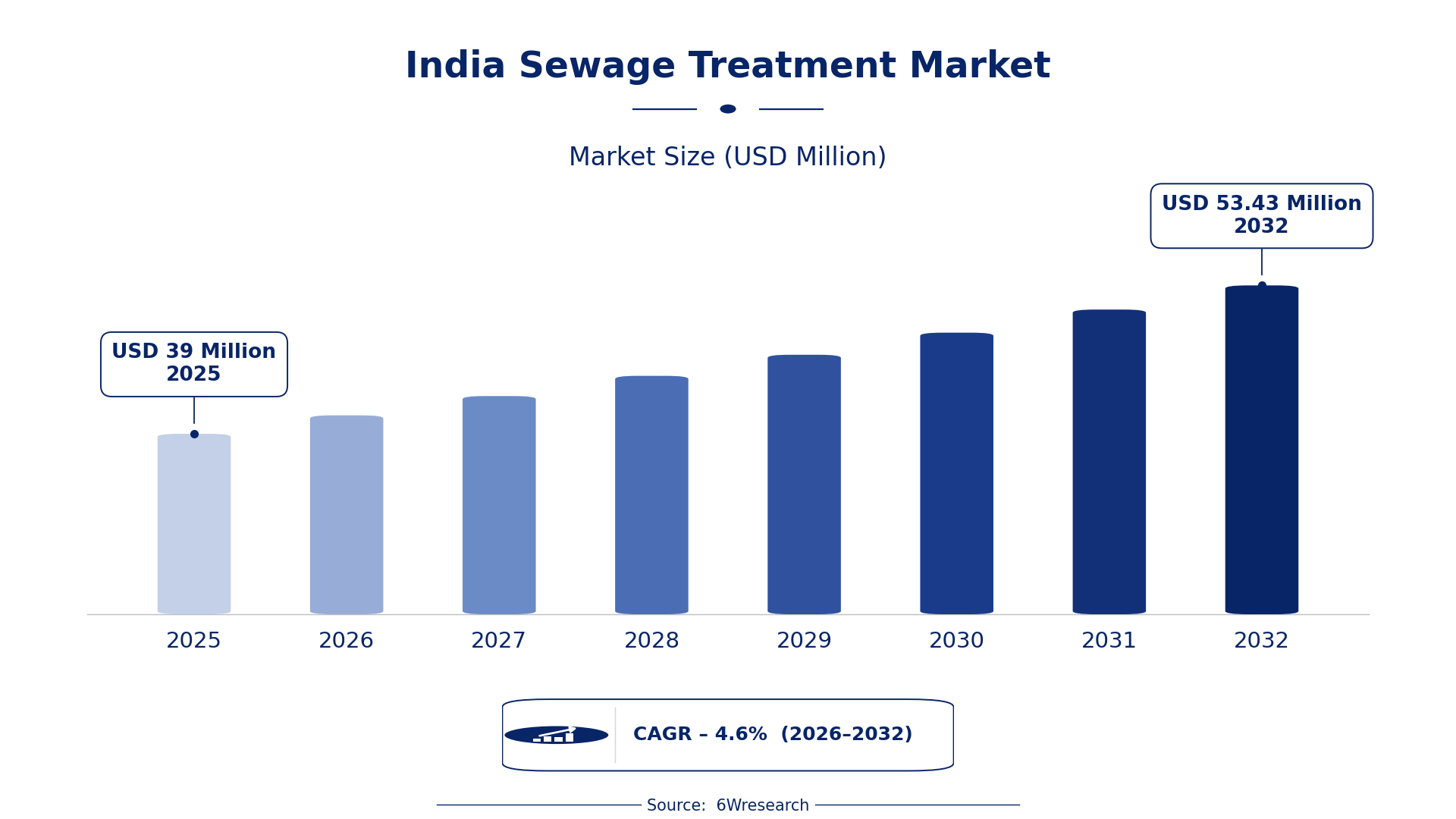
According to 6Wresearch internal database and industry insights, the India Sewage Treatment Market was valued at USD 39.0 million in 2025 and is projected to reach USD 53.43 million by 2032, growing at a CAGR of approximately 4.6% during 2026–2032.
India Sewage Treatment Market Highlights
| Report Metric | Details |
| Report Name | India Sewage Treatment Market |
| Market Size 2025 | USD 39.0 million |
| Market Size 2032 | USD 53.43 million |
| Absolute Growth 2025–2032 | USD 14.43 million |
| CAGR 2026–2032 | 4.6% |
| Peak Annual Growth | 6.7% in 2032 |
| Forecast Period | 2026–2032 |
| Historical Data | 2022–2025 |
| Base Year | 2025 |
| Leading Treatment Type, 2025 | Secondary Treatment (46% share) |
| Leading Process Stage, 2025 | Biological Filtration (43% share) |
| Leading Plant Type, 2025 | Municipal Sewage Plants (39% share) |
| Leading End User, 2025 | Urban Utilities (49% share) |
| Fastest-Growing Treatment Type | Tertiary Treatment (6.8% CAGR) |
| Fastest-Growing Process Stage | UV/RO/Advanced (6.8% CAGR) |
| Fastest-Growing Plant Type | Decentralized Systems (7.4% CAGR) |
| Fastest-Growing End User | Water Reclamation Units (6.5% CAGR) |
| Growing Sector | Water Reclamation Units |
| Key End Users | Urban Utilities, Industrial Waste Managers, Water Reclamation Units, Rural Water Boards |
India Sewage Treatment Market Year-wise Growth Rate and Key Drivers (2022–2032)
This graph illustrates the annual growth rates of the market from 2022 to 2032, highlighting a steady upward trajectory and projected market expansion over the forecast period.
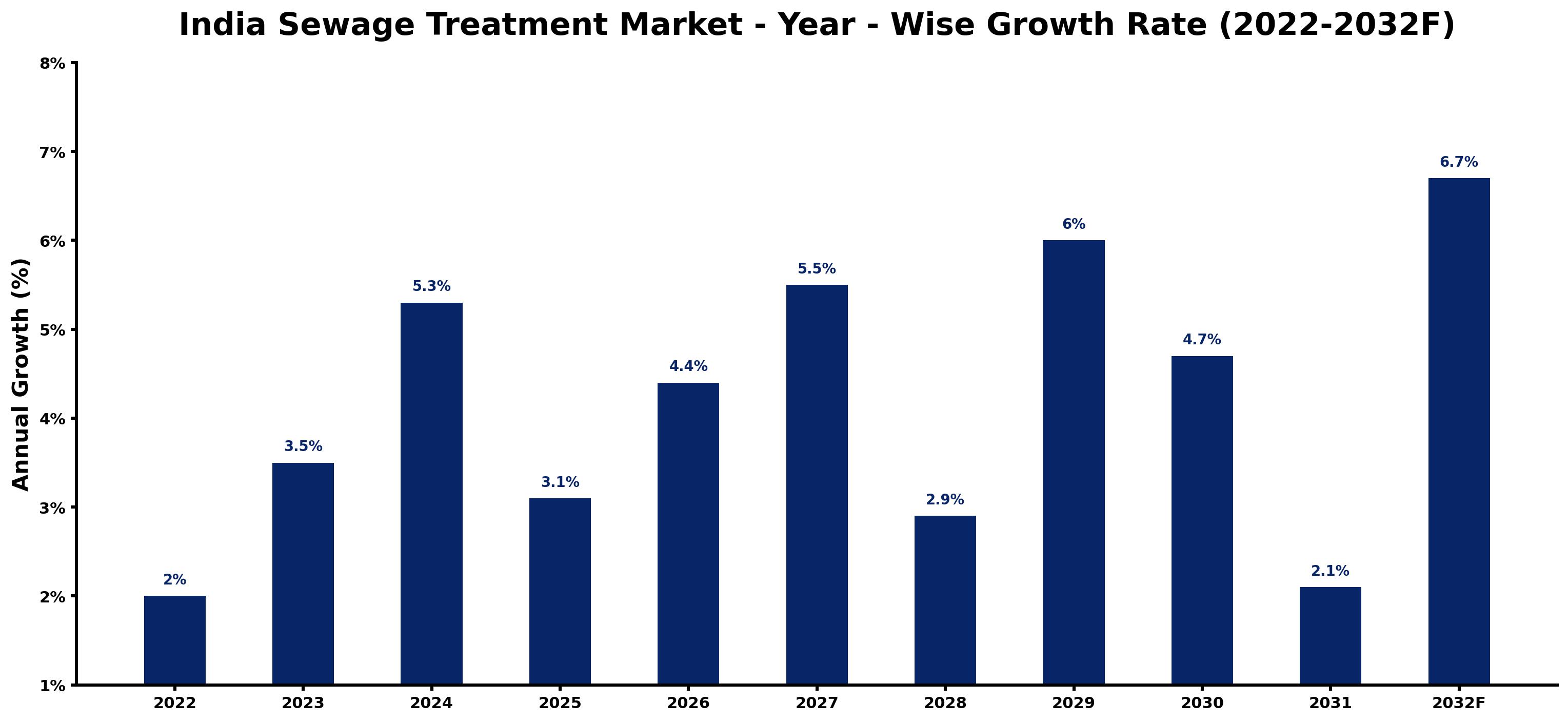
Annual growth estimates for each year appear below with the principal reason behind them, explaining the shifts that set the pace of the market.
| Year | Estimated Annual Growth (%) | Market Rationale |
| 2022 | 2.0 | The market experienced steady demand due to ongoing urbanisation efforts. |
| 2023 | 3.5 | Growth accelerated as urban utilities increased investments in sewage infrastructure. |
| 2024 | 5.3 | Continued expansion was driven by rising awareness of sanitation needs. |
| 2025 | 3.1 | Growth slowed slightly as infrastructure projects faced delays. |
| 2026 | 4.4 | Demand is expected to increase as new regulations promote better sewage management practices. |
| 2027 | 5.5 | Urban utilities will expand their capacities, boosting treatment capabilities. |
| 2028 | 2.9 | Growth is projected to decelerate as competition intensifies among service providers. |
| 2029 | 6.0 | A surge in demand will occur as new projects are initiated nationwide. |
| 2030 | 4.7 | Growth is expected to moderate as existing facilities reach operational limits. |
| 2031 | 2.1 | Demand will continue to grow, albeit at a slower rate due to market saturation. |
| 2032 | 6.7 | The market is projected to peak, driven by significant sewage treatment initiatives. |
Note: Market size estimations and growth projections presented in this report are based on 6Wresearch's proprietary forecasting methodology, utilizing the latest available industry data, government publications, and primary research inputs.
India Sewage Treatment Market Synopsis
Sewage Treatment in India encompasses processes designed to eliminate contaminants from wastewater, focusing on both municipal and industrial sources. This includes biological, chemical, and physical methods aimed at safeguarding public health and the environment. The India Sewage Treatment Market is growing as urban utilities and industrial waste managers seek better sanitation and water quality. With approximately 62 million litres of sewage generated daily, the need for effective treatment solutions is pressing. Ongoing government initiatives and infrastructure investments are further driving market expansion, with major programmes like the Swachh Bharat Mission improving treatment capabilities.
Market Dynamics Impact Analysis (2026–2032)
| Factor | Type | Impact | Primary Segment Affected |
| Increasing urbanisation drives demand for sewage treatment facilities. | Driver | High | Municipal Sewage Plants |
| Growing industrialisation necessitates better wastewater management solutions. | Driver | High | Industrial Waste Managers |
| The National Mission for Clean Ganga targets 100% sewage treatment by 2025. | Opportunity | High | Municipal Sewage Plants |
| Decentralized systems are gaining traction in rural areas for efficient treatment. | Opportunity | Medium | Decentralized Systems |
| Over 70% of urban sewage remains untreated, indicating infrastructure gaps. | Restraint | High | Municipal Sewage Plants |
| Only 30% of treatment plants meet required standards, limiting effectiveness. | Restraint | Medium | Secondary Treatment |
| Buyers face delays in project approvals, impacting timely implementation. | Challenge | High | Urban Utilities |
| Suppliers struggle with inconsistent regulations affecting operational costs. | Challenge | Medium | Secondary Treatment |
Evaluation of Drivers in India Sewage Treatment Market (2026–2032)
Key forces behind demand, with the segment each one moves most, are listed below.
| Drivers | Primary Segment Affected | Why It Matters (Evidence) |
| Increased urbanisation leads to higher sewage generation and treatment needs. | Municipal Sewage Plants | India generates approximately 62 million liters of sewage daily, necessitating expanded treatment facilities. |
| Rising industrial activities create a demand for effective wastewater management. | Industrial Waste Managers | Industrial sectors require efficient sewage treatment to comply with environmental regulations, with over 70% of urban sewage remaining untreated. |
| Government initiatives promote investments in sewage treatment infrastructure. | Municipal Sewage Plants | The Swachh Bharat Mission has increased investments in sanitation facilities, with a budget of ₹1.4 lakh crore since 2014. |
| Technological advancements improve treatment efficiency and reduce costs. | Tertiary Treatment | Innovative methods, such as UV/RO systems, are improving purification processes, with a projected growth rate of 6.8%. |
| Growing public awareness about sanitation drives demand for treatment services. | Urban Utilities | Increased focus on public health and environmental protection fuels investments in sewage treatment. |
Approximately 62 million liters of sewage are generated daily, necessitating expanded treatment capabilities. The Swachh Bharat Mission has increased investments in sanitation infrastructure, with a budget of ₹1.4 lakh crore. Rising public awareness about sanitation is prompting utilities to invest more in sewage management, as only 30% of urban sewage is treated effectively. These factors are creating a strong demand for sewage treatment services across the country.
Evaluation of Restraints in India Sewage Treatment Market
The following restraints limit how fast demand can grow.
| Market Restraint | Primary Segment Affected | Why It Matters (Evidence) |
| Infrastructure gaps hinder effective sewage treatment across urban areas. | Municipal Sewage Plants | Over 70% of urban sewage in India remains untreated, highlighting significant deficiencies. |
| Inadequate funding limits the expansion of sewage treatment facilities. | Secondary Treatment | Only 30% of India's sewage treatment plants meet the required standards, restricting capacity. |
| Regulatory inconsistencies create uncertainty for suppliers and buyers. | Secondary Treatment | Frequent changes in regulations impact operational costs and project timelines. |
| Limited public awareness affects the prioritisation of sewage treatment investments. | Urban Utilities | Public health concerns are often overshadowed by other pressing urban issues. |
| Competition among service providers can lead to price wars, affecting quality. | Secondary Treatment | Intense competition may compromise service quality as providers cut costs. |
India Sewage Treatment Market Challenges
India generates approximately 62 million liters of sewage daily, yet over 70% remains untreated, leading to escalating public health risks for urban populations. Limited access to modern technology in sewage treatment processes hampers efficiency, causing delays in infrastructure upgrades for municipalities. Regulatory compliance presents another hurdle; as of 2023, only 30% of sewage treatment plants meet the required standards, complicating operations for suppliers. Urban utilities encounter rising operational costs due to inadequate sewage management, with around 70% of the urban population lacking proper treatment services.
Trends in the India Sewage Treatment Market
Several trends are reshaping the India Sewage Treatment Market; the most important are set out below.
- Shift towards Decentralized Systems: India is increasingly adopting decentralized sewage treatment systems, especially in rural areas. The Urban Water Supply and Sewage Disposal Policy revised in 2020 promotes these systems, with a projected growth rate of 7.4% for this segment.
- Transition from Traditional to Advanced Treatment Methods: The adoption of advanced treatment methods, such as UV/RO systems, is on the rise. This trend is supported by the National Water Policy 2021, aiming for more efficient sewage management, with a 6.8% growth rate in this treatment type.
- Emergence of Water Reclamation Units: Water Reclamation Units are becoming essential for recycling treated wastewater. The Swachh Bharat Mission has encouraged this shift, with a growth rate of 6.5% projected for this segment.
- Increased Focus on Biogas Recovery: Biogas Recovery Units are gaining traction for renewable energy generation from waste. The PM Gati Shakti initiative includes biogas as part of infrastructure development, supporting growth in this area.
Investment Opportunities in the India Sewage Treatment Market
Investors looking at the India Sewage Treatment Market should consider the following areas.
- Investment in Infrastructure Development: Now is a critical time for investment in sewage treatment infrastructure, with the AMRUT 2.0 scheme allocating ₹60,000 crore for 500 cities. Urban utilities are the primary beneficiaries, creating opportunities for local partnerships.
- Expansion of Decentralized Systems: The growing need for efficient sewage treatment in rural areas presents a unique opportunity. Decentralized systems are increasingly sought after, particularly by rural water boards, allowing for joint ventures with local firms.
- Focus on Advanced Treatment Technologies: With rising demand for advanced treatment solutions, suppliers should invest in UV/RO systems. Urban utilities are actively seeking these technologies to improve treatment efficiency and comply with regulations.
- Development of Water Reclamation Units: The need for water recycling solutions is urgent, as urban utilities look to reclaim treated wastewater. Investing in water reclamation units can meet this demand, with potential for local partnerships.
Government Initiatives in the India Sewage Treatment Market
The National Water Policy 2021, launched by the Ministry of Jal Shakti, aims to improve sewage treatment and management across India, focusing on sustainability and efficiency. This policy sets a framework for enhancing infrastructure and encourages the adoption of advanced treatment technologies. The Swachh Bharat Mission (Gramin), updated in 2020, allocated ₹1.4 lakh crore to improve sewage treatment facilities in rural areas, ensuring better sanitation practices. Additionally, the National Mission for Clean Ganga was reinforced in 2022, targeting 100% sewage treatment in the Ganga basin by 2025, which is crucial for environmental restoration. These measures aim to address the significant gap in sewage treatment capacity across the country.
The Urban Water Supply and Sewage Disposal Policy, revised in 2020, promotes decentralized sewage treatment systems in urban areas, allowing for more efficient management of wastewater. The AMRUT 2.0 scheme, launched in 2023 by the Ministry of Housing and Urban Affairs, focuses on improving sewage treatment infrastructure in 500 cities, with a budget of ₹60,000 crore. This initiative supports urban utilities in upgrading their facilities to meet growing demands. The Central Pollution Control Board oversees the implementation of these policies, ensuring compliance with treatment standards and promoting the safe reuse of treated wastewater in agriculture.
Future Insight of the India Sewage Treatment Market
By 2032, the India sewage treatment market will see substantial advancements driven by the National Mission for Clean Ganga, which aims to treat all sewage in the Ganga river basin. The Atal Mission for Rejuvenation and Urban Transformation will strengthen sewage management efforts in cities, improving overall infrastructure. The PM Gati Shakti initiative will integrate sewage treatment into broader infrastructure development strategies. Increased regulatory oversight from the Central Pollution Control Board will ensure compliance with treatment standards, facilitating safer reuse of treated wastewater in agriculture.
Market Segmentation Analysis
The analysis below covers each segmentation, its leading category in 2025 and its fastest-growing category through 2032.
By Treatment Type – Secondary Treatment Dominated, Tertiary Treatment Expected to Grow Fastest
According to Dhaval Chaurasia, Assistant Manager at 6Wresearch, Secondary Treatment took a 46% share of treatment type in 2025, more than any other category. Secondary Treatment holds the largest share due to its essential role in the biological degradation of organic matter, which is critical for effective urban sewage management. This method is widely implemented across India, particularly in urban areas where over 800 municipal sewage treatment plants are operational. Tertiary Treatment is projected to grow fastest, at a CAGR of 6.8% during 2026–2032. Tertiary Treatment is witnessing rapid growth as it is crucial for advanced purification and nutrient removal, driven by initiatives such as the National Mission for Clean Ganga aiming for comprehensive sewage treatment. The increasing emphasis on enhanced treatment methods will likely widen the lead of Secondary Treatment. Suppliers should focus on advancing Secondary and Tertiary Treatment technologies to meet the rising demands in urban areas.
By Process Stage – Biological Filtration Dominated, UV/RO/Advanced Expected to Grow Fastest
In 2025, Biological Filtration led the process stage split with a 43% share. Biological Filtration commands the largest share as it significantly improves wastewater treatment efficiency, making it a preferred choice for many treatment facilities. Its effectiveness in breaking down organic matter is vital for compliance with regulatory standards set by the Central Pollution Control Board. UV/RO/Advanced is set to record the highest CAGR in this split, 6.8% over 2026–2032. UV/RO/Advanced processes are rapidly growing due to their application in disinfection and advanced treatment, reflecting the heightened focus on water quality and safety. This trend indicates that Biological Filtration will maintain its lead as the foundational treatment method. Buyers should invest in advanced Process Stage technologies to ensure adherence to evolving water quality regulations.
By Plant Type – Municipal Sewage Plants Dominated, Decentralized Systems Expected to Grow Fastest
With a 39% revenue share in 2025, Municipal Sewage Plants was the largest plant type category. Municipal Sewage Plants dominate the market as they serve as the primary facilities for urban wastewater treatment, catering to a significant portion of the urban population. With only 30% of these plants meeting required standards, there is considerable potential for improvement and expansion. The quickest growth will come from Decentralized Systems, forecast to expand at a CAGR of 7.4% between 2026 and 2032. Decentralized Systems are gaining traction, particularly in rural and peri-urban areas, as they provide flexible solutions for sewage management. This growth suggests that Municipal Sewage Plants will continue to lead due to their established infrastructure. Suppliers should explore opportunities in Decentralized Systems to address the growing demand in less urbanised regions.
By End User – Urban Utilities Dominated, Water Reclamation Units Expected to Grow Fastest
Urban Utilities accounted for a 49% market share by end user in 2025. Urban Utilities represent the largest share as they are the main users of sewage treatment services in cities, managing the majority of urban wastewater. Their vital role in public health and environmental protection drives consistent demand for effective treatment solutions. Over 2026–2032, Water Reclamation Units are expected to post the fastest growth, at a CAGR of 6.5%. Water Reclamation Units are expanding quickly as they focus on recycling treated water for reuse, aligning with national policies that promote sustainable water management. This growth reinforces the position of Urban Utilities as the primary end users. Buyers must prioritise partnerships with Urban Utilities to enhance service delivery and achieve sustainability goals.
Key Attractiveness of the Report
- 10 Years of Market Numbers
- Historical Data Starting from 2022 to 2025
- Base Year 2025
- Forecast Data until 2032
- Key Performance Indicators Impacting the Market
- Major Upcoming Developments and Projects
Key Highlights of the Report:
- India Sewage Treatment Market Outlook
- Market Size of India Sewage Treatment Market, 2025
- Forecast of India Sewage Treatment Market, 2032
- Historical Data and Forecast of India Sewage Treatment Revenues & Volume for the Period 2022 - 2032F
- India Sewage Treatment Market Trend Evolution
- India Sewage Treatment Market Drivers and Challenges
- India Sewage Treatment Price Trends
- India Sewage Treatment Porter's Five Forces
- India Sewage Treatment Industry Life Cycle
- Historical Data and Forecast of India Sewage Treatment Market Revenues & Volume By Treatment Type for the Period 2022 - 2032F
- Historical Data and Forecast of India Sewage Treatment Market Revenues & Volume By Primary Treatment for the Period 2022 - 2032F
- Historical Data and Forecast of India Sewage Treatment Market Revenues & Volume By Secondary Treatment for the Period 2022 - 2032F
- Historical Data and Forecast of India Sewage Treatment Market Revenues & Volume By Tertiary Treatment for the Period 2022 - 2032F
- Historical Data and Forecast of India Sewage Treatment Market Revenues & Volume By Sludge Management for the Period 2022 - 2032F
- Historical Data and Forecast of India Sewage Treatment Market Revenues & Volume By Process Stage for the Period 2022 - 2032F
- Historical Data and Forecast of India Sewage Treatment Market Revenues & Volume By Sedimentation for the Period 2022 - 2032F
- Historical Data and Forecast of India Sewage Treatment Market Revenues & Volume By Biological Filtration for the Period 2022 - 2032F
- Historical Data and Forecast of India Sewage Treatment Market Revenues & Volume By UV/RO/Advanced for the Period 2022 - 2032F
- Historical Data and Forecast of India Sewage Treatment Market Revenues & Volume By Anaerobic Digestion for the Period 2022 - 2032F
- Historical Data and Forecast of India Sewage Treatment Market Revenues & Volume By Plant Type for the Period 2022 - 2032F
- Historical Data and Forecast of India Sewage Treatment Market Revenues & Volume By Municipal Sewage Plants for the Period 2022 - 2032F
- Historical Data and Forecast of India Sewage Treatment Market Revenues & Volume By Decentralized Systems for the Period 2022 - 2032F
- Historical Data and Forecast of India Sewage Treatment Market Revenues & Volume By Compact Modular Systems for the Period 2022 - 2032F
- Historical Data and Forecast of India Sewage Treatment Market Revenues & Volume By Biogas Recovery Units for the Period 2022 - 2032F
- Historical Data and Forecast of India Sewage Treatment Market Revenues & Volume By End User for the Period 2022 - 2032F
- Historical Data and Forecast of India Sewage Treatment Market Revenues & Volume By Urban Utilities for the Period 2022 - 2032F
- Historical Data and Forecast of India Sewage Treatment Market Revenues & Volume By Rural Water Boards for the Period 2022 - 2032F
- Historical Data and Forecast of India Sewage Treatment Market Revenues & Volume By Industrial Waste Managers for the Period 2022 - 2032F
- Historical Data and Forecast of India Sewage Treatment Market Revenues & Volume By Water Reclamation Units for the Period 2022 - 2032F
- India Sewage Treatment Import Export Trade Statistics
- Market Opportunity Assessment By Treatment Type
- Market Opportunity Assessment By Process Stage
- Market Opportunity Assessment By Plant Type
- Market Opportunity Assessment By End User
- India Sewage Treatment Top Companies Market Share
- India Sewage Treatment Competitive Benchmarking By Technical and Operational Parameters
- India Sewage Treatment Company Profiles
- India Sewage Treatment Key Strategic Recommendations
Market Covered
This report examines the market across the segments below.
By Treatment Type
- Primary Treatment
- Secondary Treatment
- Tertiary Treatment
- Sludge Management
By Process Stage
- Sedimentation
- Biological Filtration
- UV/RO/Advanced
- Anaerobic Digestion
By Plant Type
- Municipal Sewage Plants
- Decentralized Systems
- Compact Modular Systems
- Biogas Recovery Units
By End User
- Urban Utilities
- Rural Water Boards
- Industrial Waste Managers
- Water Reclamation Units































