India Sheet Metal Automation Market Size & Growth Rate
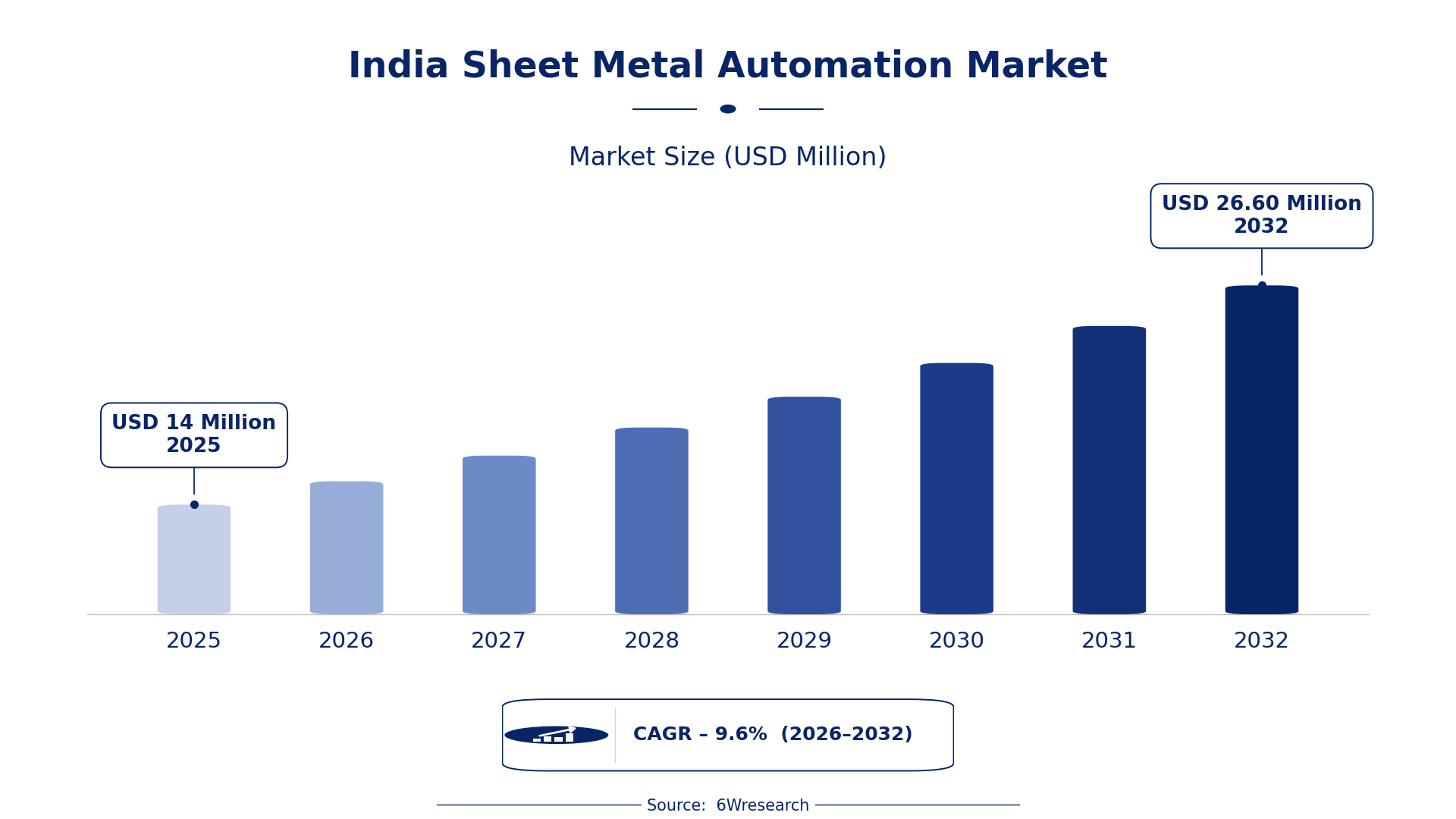
According to 6Wresearch internal database and industry insights, the India Sheet Metal Automation Market was valued at USD 14.0 million in 2025 and is projected to reach USD 26.60 million by 2032, growing at a CAGR of approximately 9.6% during 2026–2032.
India Sheet Metal Automation Market Highlights
| Report Metric | Details |
| Report Name | India Sheet Metal Automation Market |
| Market Size 2025 | USD 14.0 million |
| Market Size 2032 | USD 26.60 million |
| Absolute Growth 2025–2032 | USD 12.60 million |
| CAGR 2026–2032 | 9.6% |
| Peak Annual Growth | 11.5% in 2026 |
| Forecast Period | 2026–2032 |
| Historical Data | 2022–2025 |
| Base Year | 2025 |
| Leading Automation Type, 2025 | Robotic Welding Systems (43% share) |
| Leading Equipment Used, 2025 | CNC + Robots (49% share) |
| Leading Process Step, 2025 | Welding & Joining (36% share) |
| Leading End User, 2025 | Auto Component Makers (53% share) |
| Fastest-Growing Automation Type | Laser Cutting Automation (11.5% CAGR) |
| Fastest-Growing Equipment Used | Fiber Lasers (11.6% CAGR) |
| Fastest-Growing Process Step | Profiling & Cutting (12.3% CAGR) |
| Fastest-Growing End User | Industrial Manufacturers (11.4% CAGR) |
| Growing Sector | automotive |
| Key End Users | Auto Component Makers, Fabrication Shops, Industrial Manufacturers |
India Sheet Metal Automation Market Year-wise Growth Rate and Key Drivers (2022–2032)
This graph illustrates the annual growth rates of the market from 2022 to 2032, highlighting a steady upward trajectory and projected market expansion over the forecast period.
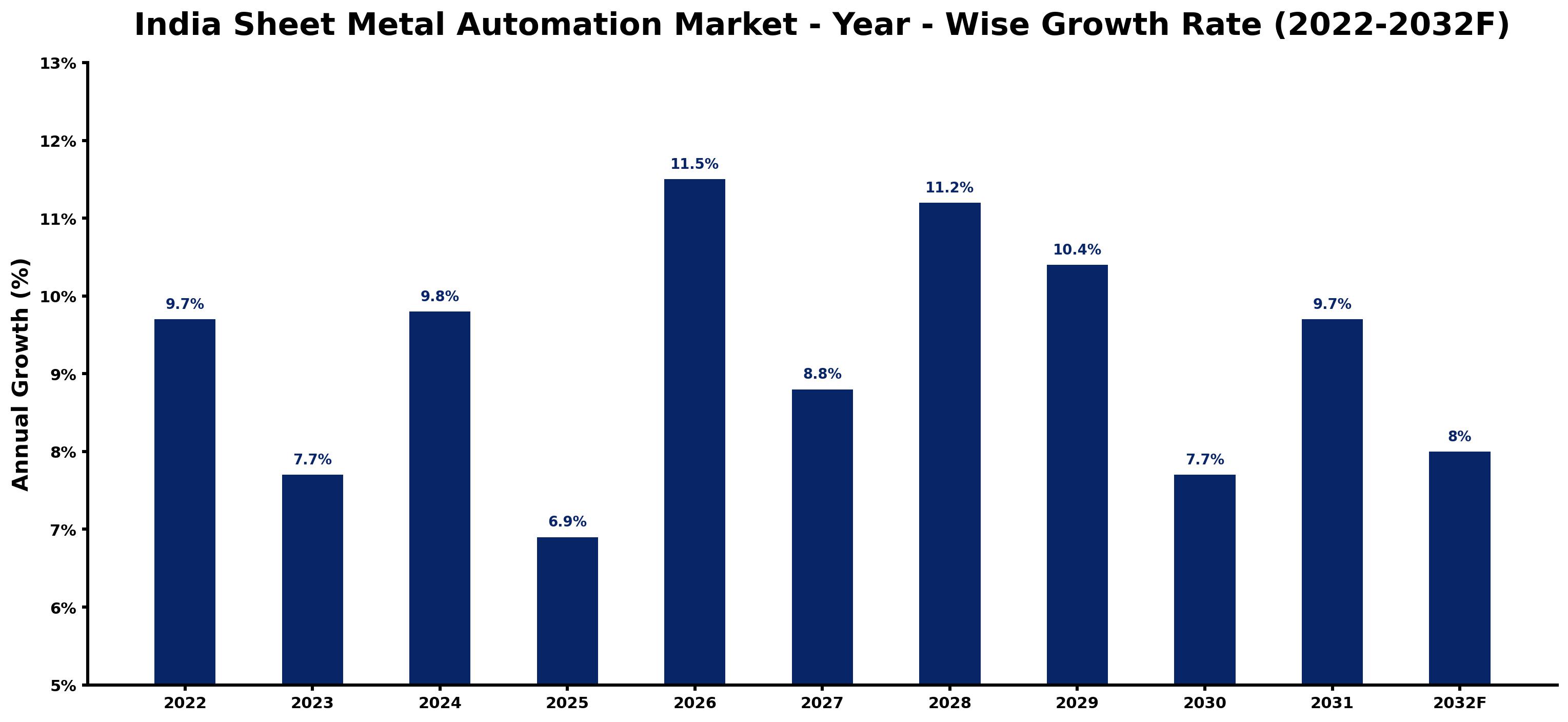
Annual growth estimates for each year appear below with the principal reason behind them, explaining the shifts that set the pace of the market.
| Year | Estimated Annual Growth (%) | Market Rationale |
| 2022 | 9.7 | The market experienced steady growth, driven by increased demand from the automotive sector. |
| 2023 | 7.7 | Growth slowed due to ongoing supply chain disruptions affecting production schedules. |
| 2024 | 9.8 | Demand surged as the automotive sector ramped up production following recovery efforts. |
| 2025 | 6.9 | Growth decelerated as manufacturers adjusted to market fluctuations and demand stabilisation. |
| 2026 | 11.5 | An increase in investments for automation technologies propelled growth in the automotive sector. |
| 2027 | 8.8 | Market growth slowed as manufacturers faced challenges in sourcing advanced components for production. |
| 2028 | 11.2 | Demand accelerated again, driven by the adoption of laser cutting technologies in fabrication. |
| 2029 | 10.4 | Growth slowed slightly as the market adjusted to new technological integrations in manufacturing. |
| 2030 | 7.7 | Demand remained steady, supported by ongoing investments in smart manufacturing technologies. |
| 2031 | 9.7 | Growth picked up due to rising production capacities in the automotive sector. |
| 2032 | 8.0 | The market will experience a slowdown as it stabilises after rapid growth in automation. |
Note: Market size estimations and growth projections presented in this report are based on 6Wresearch's proprietary forecasting methodology, utilizing the latest available industry data, government publications, and primary research inputs.
India Sheet Metal Automation Market Synopsis
The India Sheet Metal Automation Market encompasses cutting-edge technologies for processing sheet metal through automated systems, integrating robotics, CNC machines, and laser technologies. This technology improves production efficiency and precision while lowering labour costs, primarily catering to the automotive and fabrication industries. The market is expanding due to rising demand from the automotive sector, projected to reach $300 billion by 2026, alongside initiatives like the Make in India programme that promote local manufacturing and automation.
Market Dynamics Impact Analysis (2026–2032)
| Factor | Type | Impact | Primary Segment Affected |
| Growing adoption of CNC machines in fabrication shops boosts demand for automation solutions. | Driver | High | CNC + Robots |
| The automotive sector's expansion drives the need for efficient sheet metal processing technologies. | Driver | High | Auto Component Makers |
| Investment in smart manufacturing technologies presents opportunities for suppliers in the automation sector. | Opportunity | High | Industrial Manufacturers |
| The demand for advanced laser cutting technology is rising due to its precision and efficiency. | Opportunity | Medium | Laser Cutting Automation |
| High initial investment costs for automation systems can deter smaller manufacturers from adopting new technologies. | Restraint | High | Robotic Welding Systems |
| Supply chain disruptions can limit the availability of essential components for automation systems. | Restraint | Medium | CNC + Robots |
| Limited skilled workforce in advanced manufacturing technologies affects production capabilities. | Challenge | High | Fabrication Shops |
| Technological integration challenges can delay the adoption of new automation systems. | Challenge | Medium | Automated Bending Units |
Evaluation of Drivers in India Sheet Metal Automation Market (2026–2032)
The factors lifting demand, and the evidence behind each, are summarised below.
| Drivers | Primary Segment Affected | Why It Matters (Evidence) |
| Increased demand for precision manufacturing drives the adoption of CNC machines. | CNC + Robots | Over 60% of modern fabrication shops in India have adopted CNC technology, leading to more efficient production processes. |
| The automotive sector's growth necessitates advanced automation solutions for sheet metal processing. | Auto Component Makers | India's automotive sector is projected to reach $300 billion by 2026, increasing demand for automation solutions. |
| The Make in India initiative encourages local manufacturers to invest in automation technologies. | Industrial Manufacturers | The initiative has led to a surge in local manufacturing, increasing the need for efficient automation. |
| Rising adoption of laser cutting technology improves production capabilities in fabrication shops. | Laser Cutting Automation | Over 30% of fabricators have adopted laser cutting technology, improving precision and efficiency. |
| Government incentives for automation support manufacturers in upgrading their processes. | Robotic Welding Systems | The Production-Linked Incentive Scheme encourages investments in automation technologies for manufacturing. |
Market growth in India for Sheet Metal Automation is driven by increasing demand from the automotive sector and investments in smart manufacturing technologies. More than 60% of modern fabrication shops have adopted CNC machines, greatly enhancing production capabilities. In addition, over 30% of fabricators are now utilising laser cutting technology, which improves precision and efficiency in manufacturing processes.
Evaluation of Restraints in India Sheet Metal Automation Market
Below mentioned are some major restraints and their influence on market dynamics.
| Market Restraint | Primary Segment Affected | Why It Matters (Evidence) |
| High initial investment costs for automation systems can deter smaller manufacturers from adopting new technologies. | Robotic Welding Systems | Many smaller firms struggle to afford the upfront costs of advanced automation systems, limiting their competitiveness. |
| Supply chain disruptions can limit the availability of essential components for automation systems. | CNC + Robots | Ongoing global supply chain issues have delayed the procurement of critical components, affecting production timelines. |
| Limited skilled workforce in advanced manufacturing technologies affects production capabilities. | Fabrication Shops | The shortage of skilled workers in advanced manufacturing technologies can hinder operational efficiency and growth. |
| Technological integration challenges can delay the adoption of new automation systems. | Automated Bending Units | Manufacturers often face difficulties in integrating new technologies with existing systems, slowing down upgrades. |
| Regulatory compliance requirements can complicate the implementation of automation technologies. | Laser Cutting Automation | Manufacturers must navigate complex regulations, which can delay the adoption of advanced technologies. |
India Sheet Metal Automation Market Challenges
Buyers in the India sheet metal automation market encounter rising costs from fluctuating raw material prices, potentially inflating project budgets by up to 20%. Producers face intense competition, as local manufacturers upgrade their capabilities, leading to tighter profit margins. Regulatory compliance presents another hurdle, with standards from the Bureau of Indian Standards necessitating investments that can consume up to 15% of operational budgets for producers. Skills shortages are apparent, with the Automotive Skill Development Council highlighting a lack of trained professionals, which can delay project timelines and increase costs by approximately ₹500 crores each year.
Trends in the India Sheet Metal Automation Market
Several trends are reshaping the India Sheet Metal Automation Market; the most important are set out below.
- Shift towards Laser Cutting Technology in Maharashtra: Maharashtra is increasingly adopting laser cutting technology for sheet metal processing, with over 30% of fabricators implementing it recently. This shift improves precision and efficiency, essential for meeting demand in the automotive sector.
- Growth of CNC Machines in Tamil Nadu: In Tamil Nadu, the adoption of CNC machines has surpassed 60% in modern fabrication shops, reflecting a trend towards automation in manufacturing. This increase is vital for improving production efficiency and reducing labor costs.
- Expansion of Robotic Welding Systems in Auto Component Manufacturing: The automotive sector is experiencing a rise in the use of robotic welding systems, with a projected growth rate of 11.5% by 2026. This trend is driven by the need for precision and efficiency in manufacturing processes.
- Increased Investment in Smart Manufacturing Technologies: The Indian government allocated ₹1,000 crores for developing smart manufacturing technologies in 2023. This investment aims to improve automation capabilities across various sectors, including sheet metal manufacturing.
Investment Opportunities in the India Sheet Metal Automation Market
Some of the investment opportunities in the India Sheet Metal Automation Market are mentioned below.
- Investment Gap in Automation Technologies: With the automotive sector expected to reach $300 billion by 2026, there exists a gap in automation technologies. Suppliers can target auto component makers to provide advanced solutions, entering through local partnerships.
- Demand from Industrial Manufacturers: Industrial manufacturers are increasingly seeking automation solutions to boost efficiency. With a projected growth rate of 11.4% for this segment, suppliers can penetrate the market by forming joint ventures with local firms.
- Timing for Advanced Laser Cutting Solutions: As over 30% of fabricators adopt laser cutting technology, there is a timely opportunity for suppliers to invest in this area. Targeting fabrication shops in Maharashtra can facilitate market entry through strategic partnerships.
- Entry through Skill Development Initiatives: The Skill India Mission focuses on enhancing skills in manufacturing sectors, including sheet metal automation. Suppliers can collaborate with training institutes to develop local expertise and support market growth.
Government Initiatives in the India Sheet Metal Automation Market
The National Policy on Electronics 2020 aims to boost domestic manufacturing of electronic components, including sheet metal parts, by providing incentives for automation. This policy encourages manufacturers to invest in advanced technologies, improving production capabilities and efficiency. Additionally, the Make in India initiative promotes local manufacturing and automation across various sectors, further supporting the growth of the sheet metal automation market. These measures aim to increase the share of manufacturing in India's GDP, driving demand for automation solutions.
In 2023, the Indian government allocated ₹1,000 crores for the development of smart manufacturing technologies, administered by the Ministry of Electronics and Information Technology. This funding supports the adoption of advanced automation solutions in manufacturing sectors, including sheet metal. Furthermore, the Production-Linked Incentive (PLI) Scheme for the automobile sector encourages investments in automation technologies, facilitating the growth of the sheet metal automation market.
Future Insight of the India Sheet Metal Automation Market
The India sheet metal automation market will undergo substantial changes by 2032, driven by the widespread adoption of smart manufacturing technologies. The government's commitment to allocate ₹1,000 crores for these advancements will streamline production processes and reduce operational costs. As the automotive sector aims to reach a valuation of $300 billion by 2026, the demand for automation solutions will rise, leading to increased integration of CNC machines and laser cutting systems. The Make in India initiative will further strengthen local manufacturing capabilities, providing advantages for both buyers and suppliers.
Market Segmentation Analysis
The analysis below covers each segmentation, its leading category in 2025 and its fastest-growing category through 2032.
By Automation Type – Robotic Welding Systems Dominated, Laser Cutting Automation Expected to Grow Fastest
According to Dhaval Chaurasia, Assistant Manager at 6Wresearch, Robotic Welding Systems held a 43% share of the India Sheet Metal Automation Market by automation type in 2025. Robotic Welding Systems hold the largest share in India due to their crucial role in the automotive sector, which is expected to reach $300 billion by 2026. Their ability to enhance production efficiency and precision makes them indispensable for manufacturers. Laser Cutting Automation is projected to grow fastest, at a CAGR of 11.5% during 2026–2032. Laser Cutting Automation is experiencing rapid growth, with over 30% of fabricators adopting this technology recently, driven by the increasing demand for precision in sheet metal processing. As Robotic Welding Systems maintain their lead, their advantages will further solidify their market position. Suppliers should focus on advancing robotic solutions to meet the rising demand for automation in the automotive sector.
By Equipment Used – CNC + Robots Dominated, Fiber Lasers Expected to Grow Fastest
With a 49% revenue share in 2025, CNC + Robots was the largest equipment used category. CNC + Robots dominate the market share as they are integral for precision machining and automation in over 60% of modern fabrication shops. This combination significantly enhances operational efficiency and reduces labor costs across various manufacturing sectors. Fiber Lasers are set to record the highest CAGR in this split, 11.6% over 2026–2032. Fiber Lasers are the fastest-growing technology, playing a key role in high-speed cutting applications increasingly required by manufacturers. As CNC + Robots maintain their lead, their integration with Fiber Lasers will likely strengthen their market presence. Buyers should consider investing in CNC and robotic technologies to improve their production capabilities and remain competitive.
By Process Step – Welding & Joining Dominated, Profiling & Cutting Expected to Grow Fastest
In 2025, Welding & Joining led the process step split with a 36% share. Welding & Joining processes capture the largest share as they are essential for assembling metal components in the automotive and fabrication industries. Established standards from the Bureau of Indian Standards further support the widespread adoption of these processes. Over 2026–2032, Profiling & Cutting is expected to post the fastest growth, at a CAGR of 12.3%. Profiling & Cutting is the fastest-growing process step, driven by the essential need for shaping and cutting metal sheets across various applications. As Welding & Joining continues to lead, advancements in this area will likely enhance overall metal processing efficiency. Manufacturers need to prioritise investment in profiling and cutting technologies to keep pace with market demands.
By End User – Auto Component Makers Dominated, Industrial Manufacturers Expected to Grow Fastest
Auto Component Makers took a 53% share of end user in 2025, more than any other category. Auto Component Makers represent the largest share as they are primary users in the automotive supply chain, significantly driving the sheet metal automation market. Their increasing production requirements further solidify this segment's dominance. The quickest growth will come from Industrial Manufacturers, forecast to expand at a CAGR of 11.4% between 2026 and 2032. Industrial Manufacturers are the fastest-growing end user group, reflecting the expanding demand for sheet metal automation across diverse sectors. As Auto Component Makers continue to lead, the growth of Industrial Manufacturers will complement their market position. Suppliers should tailor their offerings to meet the diverse needs of industrial manufacturers to capture emerging opportunities.
Key Attractiveness of the Report
- 10 Years of Market Numbers
- Historical Data Starting from 2022 to 2025
- Base Year 2025
- Forecast Data until 2032
- Key Performance Indicators Impacting the Market
- Major Upcoming Developments and Projects
Key Highlights of the Report:
- India Sheet Metal Automation Market Outlook
- Market Size of India Sheet Metal Automation Market, 2025
- Forecast of India Sheet Metal Automation Market, 2032
- Historical Data and Forecast of India Sheet Metal Automation Revenues & Volume for the Period 2022 - 2032F
- India Sheet Metal Automation Market Trend Evolution
- India Sheet Metal Automation Market Drivers and Challenges
- India Sheet Metal Automation Price Trends
- India Sheet Metal Automation Porter's Five Forces
- India Sheet Metal Automation Industry Life Cycle
- Historical Data and Forecast of India Sheet Metal Automation Market Revenues & Volume By Automation Type for the Period 2022 - 2032F
- Historical Data and Forecast of India Sheet Metal Automation Market Revenues & Volume By Robotic Welding Systems for the Period 2022 - 2032F
- Historical Data and Forecast of India Sheet Metal Automation Market Revenues & Volume By Laser Cutting Automation for the Period 2022 - 2032F
- Historical Data and Forecast of India Sheet Metal Automation Market Revenues & Volume By Punching Systems for the Period 2022 - 2032F
- Historical Data and Forecast of India Sheet Metal Automation Market Revenues & Volume By Automated Bending Units for the Period 2022 - 2032F
- Historical Data and Forecast of India Sheet Metal Automation Market Revenues & Volume By Equipment Used for the Period 2022 - 2032F
- Historical Data and Forecast of India Sheet Metal Automation Market Revenues & Volume By CNC + Robots for the Period 2022 - 2032F
- Historical Data and Forecast of India Sheet Metal Automation Market Revenues & Volume By Fiber Lasers for the Period 2022 - 2032F
- Historical Data and Forecast of India Sheet Metal Automation Market Revenues & Volume By Servo + CNC Presses for the Period 2022 - 2032F
- Historical Data and Forecast of India Sheet Metal Automation Market Revenues & Volume By Press Brakes for the Period 2022 - 2032F
- Historical Data and Forecast of India Sheet Metal Automation Market Revenues & Volume By Process Step for the Period 2022 - 2032F
- Historical Data and Forecast of India Sheet Metal Automation Market Revenues & Volume By Welding & Joining for the Period 2022 - 2032F
- Historical Data and Forecast of India Sheet Metal Automation Market Revenues & Volume By Profiling & Cutting for the Period 2022 - 2032F
- Historical Data and Forecast of India Sheet Metal Automation Market Revenues & Volume By Hole Making for the Period 2022 - 2032F
- Historical Data and Forecast of India Sheet Metal Automation Market Revenues & Volume By Folding/Forming for the Period 2022 - 2032F
- Historical Data and Forecast of India Sheet Metal Automation Market Revenues & Volume By End User for the Period 2022 - 2032F
- Historical Data and Forecast of India Sheet Metal Automation Market Revenues & Volume By Auto Component Makers for the Period 2022 - 2032F
- Historical Data and Forecast of India Sheet Metal Automation Market Revenues & Volume By Fabrication Shops for the Period 2022 - 2032F
- Historical Data and Forecast of India Sheet Metal Automation Market Revenues & Volume By Industrial Manufacturers for the Period 2022 - 2032F
- Historical Data and Forecast of India Sheet Metal Automation Market Revenues & Volume By Furniture & Appliances Firms for the Period 2022 - 2032F
- India Sheet Metal Automation Import Export Trade Statistics
- Market Opportunity Assessment By Automation Type
- Market Opportunity Assessment By Equipment Used
- Market Opportunity Assessment By Process Step
- Market Opportunity Assessment By End User
- India Sheet Metal Automation Top Companies Market Share
- India Sheet Metal Automation Competitive Benchmarking By Technical and Operational Parameters
- India Sheet Metal Automation Company Profiles
- India Sheet Metal Automation Key Strategic Recommendations
Market Covered
This report examines the market across the segments below.
By Automation Type
- Robotic Welding Systems
- Laser Cutting Automation
- Punching Systems
- Automated Bending Units
By Equipment Used
- CNC + Robots
- Fiber Lasers
- Servo + CNC Presses
- Press Brakes
By Process Step
- Welding & Joining
- Profiling & Cutting
- Hole Making
- Folding/Forming
By End User
- Auto Component Makers
- Fabrication Shops
- Industrial Manufacturers
- Furniture & Appliances Firms































