India Shipboard Environmental Systems Market Size & Growth Rate
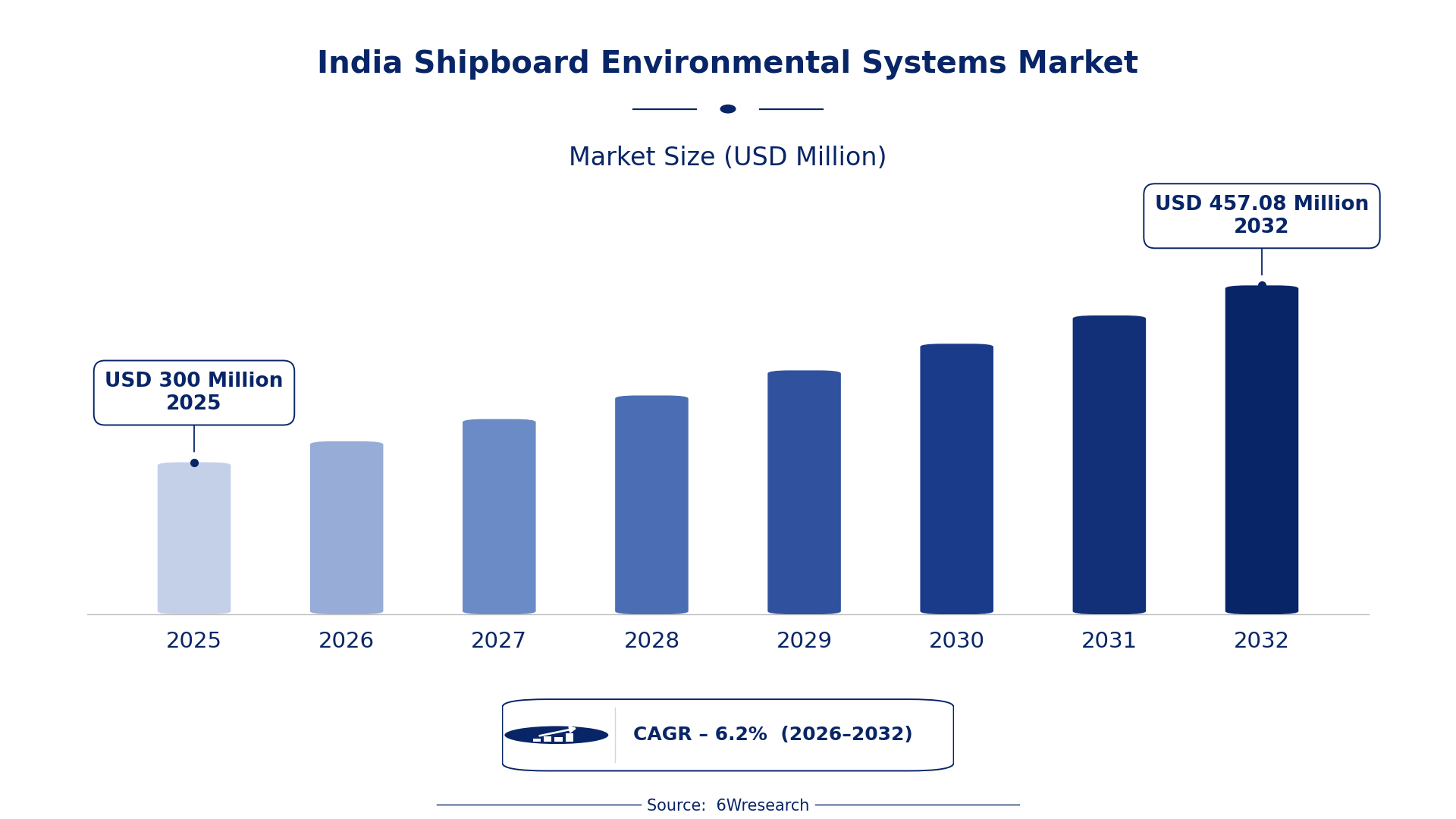
According to 6Wresearch internal database and industry insights, the India Shipboard Environmental Systems Market was valued at USD 300.0 million in 2025 and is projected to reach USD 457.08 million by 2032, growing at a CAGR of approximately 6.2% during 2026–2032.
India Shipboard Environmental Systems Market Highlights
| Report Metric | Details |
| Report Name | India Shipboard Environmental Systems Market |
| Market Size 2025 | USD 300.0 million |
| Market Size 2032 | USD 457.08 million |
| Absolute Growth 2025–2032 | USD 157.08 million |
| CAGR 2026–2032 | 6.2% |
| Peak Annual Growth | 7.6% in 2031 |
| Forecast Period | 2026–2032 |
| Historical Data | 2022–2025 |
| Base Year | 2025 |
| Leading System Type, 2025 | Ballast Water Treatment (40% share) |
| Leading Environmental Function, 2025 | SOx/NOx Reduction (41% share) |
| Leading Compliance Standard, 2025 | MARPOL Annex VI (46% share) |
| Leading End User, 2025 | Cargo Ship Operators (39% share) |
| Fastest-Growing System Type | Waste Heat Recovery (7.7% CAGR) |
| Fastest-Growing Environmental Function | Energy Optimization (8.4% CAGR) |
| Fastest-Growing Compliance Standard | Efficiency Regulation (7.2% CAGR) |
| Fastest-Growing End User | Green Shipping Companies (8.5% CAGR) |
| Growing Sector | Cargo Shipping |
| Key End Users | Cargo Ship Operators, Cruise Lines, Green Shipping Companies, Marine Waste Managers |
India Shipboard Environmental Systems Market Year-wise Growth Rate and Key Drivers (2022–2032)
This graph illustrates the annual growth rates of the market from 2022 to 2032, highlighting a steady upward trajectory and projected market expansion over the forecast period.
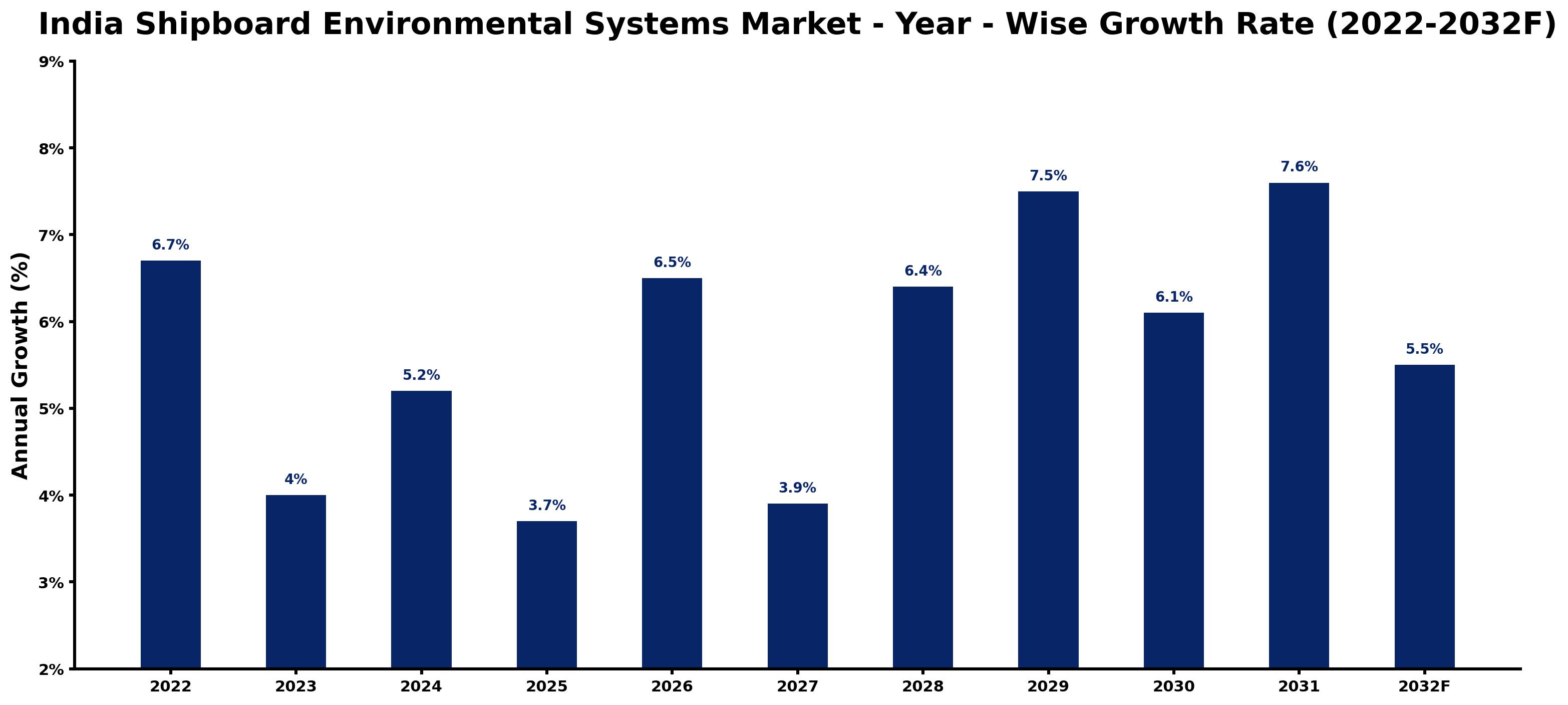
Year by year, the estimates below pair each growth rate with the development that shaped it.
| Year | Estimated Annual Growth (%) | Market Rationale |
| 2022 | 6.7 | The market experienced solid growth due to heightened compliance requirements from international maritime standards. |
| 2023 | 4.0 | Growth slowed as cargo ship operators adjusted to new environmental regulations and technologies. |
| 2024 | 5.2 | Demand increased as more cargo ship operators adopted SOx/NOx reduction systems for compliance. |
| 2025 | 3.7 | The market saw a slowdown as operators faced challenges in implementing waste heat recovery systems. |
| 2026 | 6.5 | Growth accelerated as the Indian Navy invested in energy efficiency technologies for its fleet. |
| 2027 | 3.9 | A slowdown occurred as the adoption of air emission control technologies faced logistical hurdles. |
| 2028 | 6.4 | Demand rose again as green shipping initiatives gained traction among cargo operators. |
| 2029 | 7.5 | Growth surged as more cruise lines implemented advanced environmental systems for compliance. |
| 2030 | 6.1 | The market slowed as regulatory inspections increased, impacting operational efficiencies. |
| 2031 | 7.6 | Demand peaked as the adoption of MARPOL Annex VI compliance technologies reached new heights. |
| 2032 | 5.5 | Growth slowed as compliance with the Green Shipping Initiative became widespread. |
Note: Market size estimations and growth projections presented in this report are based on 6Wresearch's proprietary forecasting methodology, utilizing the latest available industry data, government publications, and primary research inputs.
India Shipboard Environmental Systems Market Synopsis
Shipboard Environmental Systems in India are technologies designed to minimise ships' environmental impact. They include systems for treating ballast water, controlling air emissions, and managing onboard waste. The India Shipboard Environmental Systems Market is expanding due to increasing compliance with international maritime regulations and initiatives like the Green Shipping Initiative. With over 200 registered cargo ships, demand is driven by domestic shipping companies focusing on sustainability.
Market Dynamics Impact Analysis (2026–2032)
| Factor | Type | Impact | Primary Segment Affected |
| Increasing compliance with MARPOL Annex VI regulations | Driver | High | Air Emission Control |
| Rising adoption of waste heat recovery systems by the Indian Navy | Driver | Medium | Waste Heat Recovery |
| Investment in SOx/NOx reduction technologies by cargo ship operators | Opportunity | High | SOx/NOx Reduction |
| Growing demand for energy-efficient systems among green shipping companies | Opportunity | Medium | Energy Optimization |
| High costs associated with retrofitting older vessels | Restraint | High | Ballast Water Treatment |
| Limited availability of skilled technicians for system installation | Restraint | Medium | Air Emission Control |
| Regulatory compliance challenges for smaller operators | Challenge | High | Solid Waste Disposal |
| Technological complexities in integrating new systems | Challenge | Medium | Waste Heat Recovery |
Evaluation of Drivers in India Shipboard Environmental Systems Market (2026–2032)
The table below links each growth driver to the segment it affects and the evidence for it.
| Drivers | Primary Segment Affected | Why It Matters (Evidence) |
| Compliance with MARPOL Annex VI | Air Emission Control | This regulation mandates air emission control systems, driving demand among cargo ship operators in India. |
| Investment in waste heat recovery technologies | Waste Heat Recovery | The Indian Navy's implementation of these systems improves energy efficiency, prompting wider adoption in the commercial sector. |
| Adoption of SOx/NOx reduction systems | SOx/NOx Reduction | Cargo ship operators are increasingly investing in these systems to meet stringent emission standards. |
| Growth of the Green Shipping Initiative | Energy Optimization | This initiative encourages sustainable practices, leading to higher demand for energy-efficient shipboard systems. |
| Regular inspections by Port State Control | Ballast Water Treatment | These inspections enforce compliance, compelling operators to invest in effective ballast water treatment systems. |
In 2023, 30% of Indian cruise lines adopted air emission control technologies, boosting demand. The focus on waste heat recovery systems by the Indian Navy prompts cargo ship operators to follow suit. With over 200 registered cargo ships, the need for effective ballast water treatment systems is critical for compliance with international standards.
Evaluation of Restraints in India Shipboard Environmental Systems Market
The table below lists the restraints and the evidence behind each.
| Market Restraint | Primary Segment Affected | Why It Matters (Evidence) |
| High retrofitting costs for older vessels | Ballast Water Treatment | Many operators face financial burdens when upgrading to comply with new environmental standards, with costs exceeding 20% of annual budgets. |
| Shortage of skilled technicians | Air Emission Control | The lack of qualified personnel delays the installation of necessary systems on ships, extending project timelines by up to six months. |
| Regulatory compliance challenges for smaller operators | Solid Waste Disposal | Smaller shipping companies struggle to meet stringent regulations, limiting their operational capabilities and increasing costs. |
| Technological complexities in system integration | Waste Heat Recovery | Operators encounter difficulties in integrating new technologies, resulting in project delays that impact overall efficiency. |
| Limited availability of eco-friendly materials | SOx/NOx Reduction | The scarcity of sustainable materials hampers the production of compliant systems, affecting supply chain reliability. |
India Shipboard Environmental Systems Market Challenges
In India, compliance with MARPOL regulations presents a challenge for buyers and suppliers in the shipboard environmental systems market, as over 200 registered cargo ships must meet these standards. This requirement raises operational costs, forcing shipping companies to allocate up to 20% of their annual budgets to compliance technologies. Advanced engineering skills shortages limit the availability of qualified personnel, causing project delays for ship operators that can extend timelines by six months. Additionally, competition escalates among domestic shipping companies, where those failing to adopt green technologies risk losing contracts to compliant rivals, threatening their market viability.
Trends in the India Shipboard Environmental Systems Market
Buyers and suppliers in the India Shipboard Environmental Systems Market are adjusting to the following trends.
- Shift towards Sustainable Practices: Cargo ship operators are increasingly adopting eco-friendly technologies, driven by the Green Shipping Initiative. In 2022, this initiative led to a 30% rise in the adoption of air emission control technologies.
- Transition from Traditional to Advanced Systems: The shipping industry is moving towards advanced waste heat recovery systems, with the Indian Navy implementing these technologies in 2023. This shift is expected to improve energy efficiency across the sector.
- Emergence of Green Shipping Companies: Green shipping companies are prioritising sustainable practices, reflecting a broader commitment to environmental responsibility. This trend has led to an increase in demand for energy optimisation systems, with a projected growth rate of 8.5%.
- Increased Regulatory Inspections: Port State Control is conducting more frequent inspections, ensuring compliance with environmental regulations. This has resulted in a rise in the adoption of ballast water treatment systems among operators, with compliance rates reaching 100%.
Investment Opportunities in the India Shipboard Environmental Systems Market
Below are the investment opportunities with the strongest case in the India Shipboard Environmental Systems Market.
- Supply of Air Emission Control Technologies: With 30% of cruise lines adopting these systems, there is a strong opportunity for suppliers to meet growing demand. Collaborating with green shipping companies can facilitate market entry.
- Investment in Waste Heat Recovery Systems: The Indian Navy's focus on energy efficiency creates opportunities for suppliers of waste heat recovery technologies. Partnering with government agencies can streamline market access, enhancing adoption rates.
- Development of Eco-Friendly Materials: The need for sustainable materials is rising, with a target to reduce greenhouse gas emissions by 30% by 2030. Suppliers can enter the market by obtaining necessary certifications and aligning with regulatory standards.
- Expansion of Ballast Water Treatment Solutions: With over 200 cargo ships requiring compliance, there is a pressing need for effective ballast water treatment systems. Collaborating with local partners can streamline market entry and enhance distribution.
Government Initiatives in the India Shipboard Environmental Systems Market
The 'Green Shipping Initiative' launched by the Ministry of Shipping in 2021 aims to promote eco-friendly technologies in the maritime sector. This initiative encourages ship operators to adopt sustainable practices, improving compliance with international standards. Additionally, the 'National Maritime Development Programme' (2020) supports the adoption of sustainable shipping practices across Indian ports, further driving demand for shipboard environmental systems. The 'Coastal Regulation Zone Notification' (2021) mandates the use of approved environmental systems for all vessels operating in coastal areas, ensuring adherence to environmental regulations. The 'National Policy on Biofuels' (2022) encourages the use of biofuels in shipping, providing funding opportunities for eco-friendly initiatives.
The Port State Control conducts regular inspections to ensure compliance with environmental regulations, significantly impacting operational practices. Furthermore, the Indian government has set a target to reduce greenhouse gas emissions from shipping by 30% by 2030, promoting the adoption of green technologies. The National Policy on Biofuels (2022) encourages the use of biofuels in shipping, providing funding opportunities for eco-friendly initiatives. The Ministry of Shipping oversees compliance with the IMO D-2 Standard in India, ensuring that ship operators meet international environmental standards.
Future Insight of the India Shipboard Environmental Systems Market
The shipboard environmental systems market in India is expected to evolve significantly by 2032, driven by several pivotal factors. The Green Shipping Initiative, launched in 2022, will facilitate the adoption of sustainable practices throughout the sector. The Indian government's target to reduce greenhouse gas emissions from shipping by 30% will stimulate investments in advanced technologies. Furthermore, the Indian Navy's adoption of waste heat recovery systems will inspire private operators to upgrade their environmental systems, ultimately enhancing operational efficiency and compliance across the industry.
Market Segmentation Analysis
The report offers a comprehensive study of the following market segments and their leading categories in the market.
By System Type – Ballast Water Treatment Dominated, Waste Heat Recovery Expected to Grow Fastest
According to Dhaval Chaurasia, Assistant Manager at 6Wresearch, Ballast Water Treatment held a 40% share of the India Shipboard Environmental Systems Market by system type in 2025. Ballast Water Treatment holds the largest share due to its critical role in ensuring compliance with MARPOL regulations for over 200 registered cargo ships in India. This system is indispensable for preventing the introduction of invasive species, making it a top priority for ship operators across the country. Waste Heat Recovery is projected to grow fastest, at a CAGR of 7.7% during 2026–2032. Waste Heat Recovery is experiencing rapid growth as vessels increasingly seek to enhance energy efficiency, with the Indian Navy implementing these systems to improve fleet performance. This trend signals a wider industry shift towards sustainable practices, thereby boosting demand for waste heat recovery solutions. Suppliers should focus on advancing ballast water treatment technologies while exploring opportunities in waste heat recovery to align with growing market demands.
By Environmental Function – SOx/NOx Reduction Dominated, Energy Optimization Expected to Grow Fastest
SOx/NOx Reduction took a 41% share of environmental function in 2025, more than any other category. SOx/NOx Reduction leads the segment as it is directly mandated for compliance with stringent emission standards established by international regulations. This necessity makes it a crucial investment for ship operators who aim to avoid penalties and ensure operational continuity. Over 2026–2032, Energy Optimization is expected to post the fastest growth, at a CAGR of 8.4%. Energy Optimization is the fastest-growing segment, driven by the pressing need for ship operators to reduce fuel consumption and lower operational costs. As the industry increasingly prioritises sustainability, the demand for energy-efficient technologies is projected to rise significantly. Buyers should prioritise investments in SOx/NOx reduction technologies while also considering energy optimization solutions to enhance overall operational efficiency.
By Compliance Standard – MARPOL Annex VI Dominated, Efficiency Regulation Expected to Grow Fastest
In 2025, MARPOL Annex VI led the compliance standard split with a 46% share. MARPOL Annex VI leads the compliance standard segment, as it is essential for air emission control compliance across all vessels operating in Indian waters. This regulation is a fundamental requirement for ship operators, ensuring environmental protection and adherence to international standards. Efficiency Regulation is set to record the highest CAGR in this split, 7.2% over 2026–2032. Efficiency Regulation is growing rapidly as it encourages the adoption of energy-efficient technologies, aligning with the Indian government's push for greener shipping practices. This regulatory focus will likely accelerate the integration of efficiency measures across the fleet. Suppliers must ensure their products meet MARPOL Annex VI standards while also aligning with efficiency regulations to capture emerging market opportunities.
By End User – Cargo Ship Operators Dominated, Green Shipping Companies Expected to Grow Fastest
With a 39% revenue share in 2025, Cargo Ship Operators was the largest end user category. Cargo Ship Operators dominate the end user segment as the primary users of shipboard environmental systems, motivated by compliance and operational efficiency needs. Their substantial presence underscores the critical importance of these systems within the Indian shipping industry. The quickest growth will come from Green Shipping Companies, forecast to expand at a CAGR of 8.5% between 2026 and 2032. Green Shipping Companies represent the fastest-growing end user group, reflecting the industry's shift towards sustainable practices and technologies. With governmental support for green initiatives, this segment is poised for significant growth in the coming years. Suppliers should tailor their offerings to meet the specific requirements of cargo ship operators while also developing solutions that cater to the expanding segment of green shipping companies.
Key Attractiveness of the Report
- 10 Years of Market Numbers
- Historical Data Starting from 2022 to 2025
- Base Year 2025
- Forecast Data until 2032
- Key Performance Indicators Impacting the Market
- Major Upcoming Developments and Projects
Key Highlights of the Report:
- India Shipboard Environmental Systems Market Outlook
- Market Size of India Shipboard Environmental Systems Market, 2025
- Forecast of India Shipboard Environmental Systems Market, 2032
- Historical Data and Forecast of India Shipboard Environmental Systems Revenues & Volume for the Period 2022 - 2032F
- India Shipboard Environmental Systems Market Trend Evolution
- India Shipboard Environmental Systems Market Drivers and Challenges
- India Shipboard Environmental Systems Price Trends
- India Shipboard Environmental Systems Porter's Five Forces
- India Shipboard Environmental Systems Industry Life Cycle
- Historical Data and Forecast of India Shipboard Environmental Systems Market Revenues & Volume By System Type for the Period 2022 - 2032F
- Historical Data and Forecast of India Shipboard Environmental Systems Market Revenues & Volume By Ballast Water Treatment for the Period 2022 - 2032F
- Historical Data and Forecast of India Shipboard Environmental Systems Market Revenues & Volume By Air Emission Control for the Period 2022 - 2032F
- Historical Data and Forecast of India Shipboard Environmental Systems Market Revenues & Volume By Waste Heat Recovery for the Period 2022 - 2032F
- Historical Data and Forecast of India Shipboard Environmental Systems Market Revenues & Volume By Incineration Systems for the Period 2022 - 2032F
- Historical Data and Forecast of India Shipboard Environmental Systems Market Revenues & Volume By Environmental Function for the Period 2022 - 2032F
- Historical Data and Forecast of India Shipboard Environmental Systems Market Revenues & Volume By Bio-Contaminant Removal for the Period 2022 - 2032F
- Historical Data and Forecast of India Shipboard Environmental Systems Market Revenues & Volume By SOx/NOx Reduction for the Period 2022 - 2032F
- Historical Data and Forecast of India Shipboard Environmental Systems Market Revenues & Volume By Energy Optimization for the Period 2022 - 2032F
- Historical Data and Forecast of India Shipboard Environmental Systems Market Revenues & Volume By Solid Waste Disposal for the Period 2022 - 2032F
- Historical Data and Forecast of India Shipboard Environmental Systems Market Revenues & Volume By Compliance Standard for the Period 2022 - 2032F
- Historical Data and Forecast of India Shipboard Environmental Systems Market Revenues & Volume By IMO D-2 Standard for the Period 2022 - 2032F
- Historical Data and Forecast of India Shipboard Environmental Systems Market Revenues & Volume By MARPOL Annex VI for the Period 2022 - 2032F
- Historical Data and Forecast of India Shipboard Environmental Systems Market Revenues & Volume By Efficiency Regulation for the Period 2022 - 2032F
- Historical Data and Forecast of India Shipboard Environmental Systems Market Revenues & Volume By Port State Controls for the Period 2022 - 2032F
- Historical Data and Forecast of India Shipboard Environmental Systems Market Revenues & Volume By End User for the Period 2022 - 2032F
- Historical Data and Forecast of India Shipboard Environmental Systems Market Revenues & Volume By Cargo Ship Operators for the Period 2022 - 2032F
- Historical Data and Forecast of India Shipboard Environmental Systems Market Revenues & Volume By Cruise Lines for the Period 2022 - 2032F
- Historical Data and Forecast of India Shipboard Environmental Systems Market Revenues & Volume By Green Shipping Companies for the Period 2022 - 2032F
- Historical Data and Forecast of India Shipboard Environmental Systems Market Revenues & Volume By Marine Waste Managers for the Period 2022 - 2032F
- India Shipboard Environmental Systems Import Export Trade Statistics
- Market Opportunity Assessment By System Type
- Market Opportunity Assessment By Environmental Function
- Market Opportunity Assessment By Compliance Standard
- Market Opportunity Assessment By End User
- India Shipboard Environmental Systems Top Companies Market Share
- India Shipboard Environmental Systems Competitive Benchmarking By Technical and Operational Parameters
- India Shipboard Environmental Systems Company Profiles
- India Shipboard Environmental Systems Key Strategic Recommendations
Market Covered
The report offers an extensive study of the following market segments.
By System Type
- Ballast Water Treatment
- Air Emission Control
- Waste Heat Recovery
- Incineration Systems
By Environmental Function
- Bio-Contaminant Removal
- SOx/NOx Reduction
- Energy Optimization
- Solid Waste Disposal
By Compliance Standard
- IMO D-2 Standard
- MARPOL Annex VI
- Efficiency Regulation
- Port State Controls
By End User
- Cargo Ship Operators
- Cruise Lines
- Green Shipping Companies
- Marine Waste Managers































