India Signal Amplification Components Market Size & Growth Rate
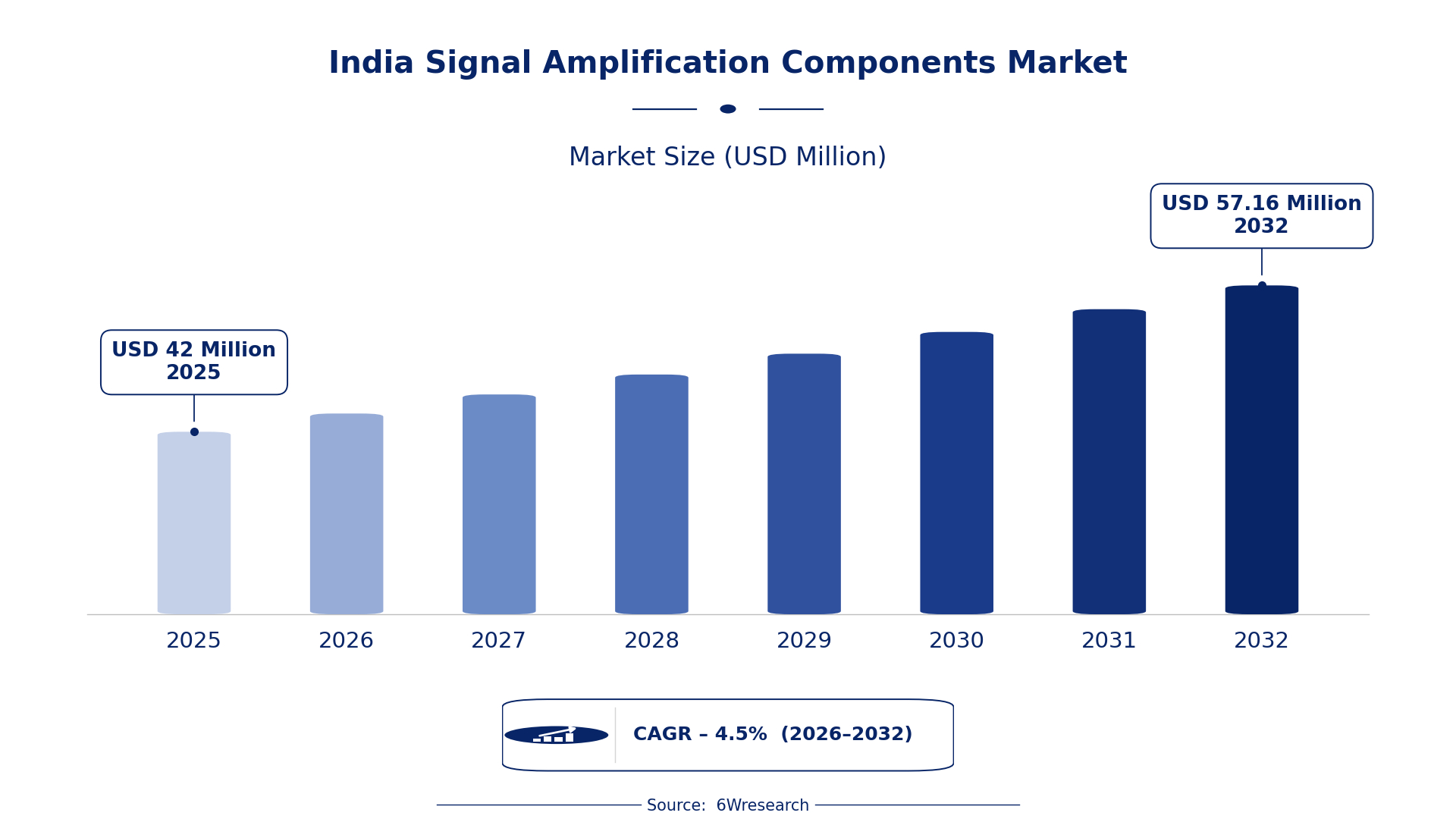
According to 6Wresearch internal database and industry insights, the India Signal Amplification Components Market was valued at USD 42.0 million in 2025 and is projected to reach USD 57.16 million by 2032, growing at a CAGR of approximately 4.5% during 2026–2032.
India Signal Amplification Components Market Highlights
| Report Metric | Details |
| Report Name | India Signal Amplification Components Market |
| Market Size 2025 | USD 42.0 million |
| Market Size 2032 | USD 57.16 million |
| Absolute Growth 2025–2032 | USD 15.16 million |
| CAGR 2026–2032 | 4.5% |
| Peak Annual Growth | 6.2% in 2031 |
| Forecast Period | 2026–2032 |
| Historical Data | 2022–2025 |
| Base Year | 2025 |
| Leading Component Type, 2025 | RF Amplifiers (41% share) |
| Leading Signal Type, 2025 | Analog/Radio Frequency (44% share) |
| Leading Frequency Range, 2025 | MHz–GHz (42% share) |
| Leading End User, 2025 | Telecom Equipment Makers (36% share) |
| Fastest-Growing Component Type | Audio Amplifiers (5.6% CAGR) |
| Fastest-Growing Signal Type | Analog/Digital (5.9% CAGR) |
| Fastest-Growing Frequency Range | Low-Noise (7.3% CAGR) |
| Fastest-Growing End User | Consumer Electronics (6.1% CAGR) |
| Growing Sector | Telecommunications |
| Key End Users | Telecom Equipment Makers, Consumer Electronics, Fiber Optic Companies |
India Signal Amplification Components Market Year-wise Growth Rate and Key Drivers (2022–2032)
This graph illustrates the annual growth rates of the market from 2022 to 2032, highlighting a steady upward trajectory and projected market expansion over the forecast period.
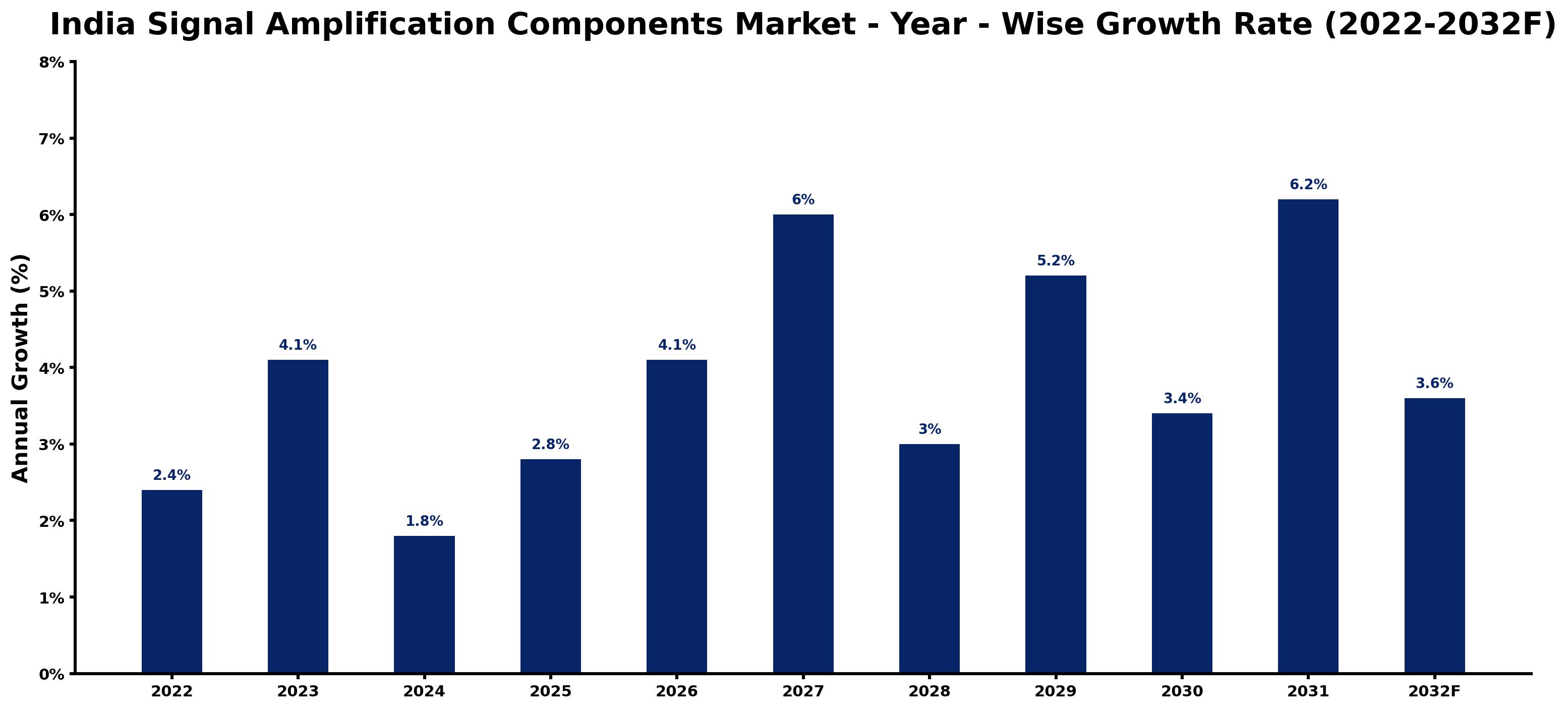
Annual growth estimates for each year appear below with the principal reason behind them, explaining the shifts that set the pace of the market.
| Year | Estimated Annual Growth (%) | Market Rationale |
| 2022 | 2.4 | The market experienced steady activity with established demand from domestic users. |
| 2023 | 4.1 | Growth accelerated due to increased mobile subscribers driving demand for RF amplifiers. |
| 2024 | 1.8 | The market saw a slowdown as demand stabilised after the previous year's surge in mobile subscriptions. |
| 2025 | 2.8 | Growth picked up again, supported by rising expectations in the consumer electronics market. |
| 2026 | 4.1 | Demand is projected to rise as the production-linked incentive scheme boosts local manufacturing capacity. |
| 2027 | 6.0 | The market is expected to grow as telecom infrastructure improves nationwide, enhancing signal quality. |
| 2028 | 3.0 | A slowdown is anticipated as market conditions normalise after rapid growth phases in telecommunications. |
| 2029 | 5.2 | Growth is expected to recover as consumer electronics adoption continues to rise, particularly in smart devices. |
| 2030 | 3.4 | The market will experience a slowdown as the growth rate stabilises in response to demand for RF amplifiers. |
| 2031 | 6.2 | A peak in growth is anticipated as new technologies are adopted in telecommunications and consumer electronics. |
| 2032 | 3.6 | The market is expected to grow at a slower rate as it adjusts to new demand levels from local manufacturing. |
Note: Market size estimations and growth projections presented in this report are based on 6Wresearch's proprietary forecasting methodology, utilizing the latest available industry data, government publications, and primary research inputs.
India Signal Amplification Components Market Synopsis
Signal Amplification Components in India are electronic devices that enhance signal strength for telecommunications, medical devices, and consumer electronics. These components are made using semiconductor materials and integrated circuit technology. The India Signal Amplification Components Market is growing due to rising mobile subscriptions and the expansion of the consumer electronics sector. With over 1.3 billion mobile subscribers, demand for RF amplifiers is strong. The Ministry of Electronics and Information Technology's production-linked incentive scheme is driving local manufacturing, ensuring better availability of these components.
Market Dynamics Impact Analysis (2026–2032)
| Factor | Type | Impact | Primary Segment Affected |
| Increased mobile subscriptions create a strong demand for RF amplifiers. | Driver | High | RF Amplifiers |
| Growth in the consumer electronics market boosts demand for audio amplifiers. | Driver | High | Audio Amplifiers |
| The rise of smart home devices creates opportunities for audio amplifier suppliers. | Opportunity | High | Audio Amplifiers |
| The push for 100% fiber optic connectivity opens new markets for optical amplifiers. | Opportunity | High | Optical Amplifiers |
| High import dependency can limit local production capabilities. | Restraint | Medium | RF Amplifiers |
| The need for skilled labour in electronics manufacturing can hinder growth. | Restraint | Medium | Audio Amplifiers |
| Challenges in supply chain logistics can delay product availability. | Challenge | High | Optical Amplifiers |
| Technological advancements require continuous investment to stay competitive. | Challenge | High | RF Amplifiers |
Evaluation of Drivers in India Signal Amplification Components Market (2026–2032)
The table below links each growth driver to the segment it affects and the evidence for it.
| Drivers | Primary Segment Affected | Why It Matters (Evidence) |
| Growing mobile subscriptions drive demand for RF amplifiers. | RF Amplifiers | India has over 1.3 billion mobile subscribers, increasing the need for signal amplification components. |
| Rising consumer electronics sales boost audio amplifier demand. | Audio Amplifiers | The consumer electronics market in India is expected to reach USD 21 billion by 2025, driving audio amplifier sales. |
| The expansion of fiber optic networks increases optical amplifier demand. | Optical Amplifiers | The Indian government's aim for 100% fiber optic connectivity by 2025 drives this growth in optical amplifiers. |
| Increased adoption of smart home devices fuels audio amplifier sales. | Audio Amplifiers | Smart home devices are becoming more common, leading to higher audio amplifier usage in consumer electronics. |
| The production-linked incentive scheme boosts local manufacturing capacity. | RF Amplifiers | The scheme aims to increase domestic production, making RF amplifiers more accessible to buyers. |
Expansion of the Signal Amplification Components market in India is supported by increasing end-use demand in telecommunications and consumer electronics. With over 1.3 billion mobile subscribers, demand for RF amplifiers continues to grow significantly. The production-linked incentive scheme is enhancing local manufacturing capabilities, stimulating market growth. As fibre optic connectivity expands, the demand for optical amplifiers is also rising, creating opportunities for suppliers in this segment.
Evaluation of Restraints in India Signal Amplification Components Market
The following restraints limit how fast demand can grow.
| Market Restraint | Primary Segment Affected | Why It Matters (Evidence) |
| High import dependency limits local production capabilities. | RF Amplifiers | Dependence on imports can disrupt supply chains and affect availability of RF amplifiers, impacting local manufacturers. |
| Shortage of skilled labour in electronics manufacturing hinders growth. | Audio Amplifiers | Limited skilled workforce affects production efficiency and quality in audio amplifier manufacturing, delaying product launches. |
| Supply chain logistics challenges can delay product availability. | Optical Amplifiers | Logistical issues can lead to longer lead times for optical amplifier deliveries, affecting customer satisfaction. |
| Technological advancements require continuous investment to stay competitive. | RF Amplifiers | Ongoing investment is necessary to keep pace with rapid technological changes in signal amplification. |
| Regulatory hurdles can complicate market entry for new players. | Audio Amplifiers | Complex regulations can slow down the approval process for new audio amplifier products, deterring potential entrants. |
India Signal Amplification Components Market Challenges
The cost of regulatory compliance for buyers in the India Signal Amplification Components market can reach up to 15% of total expenses, creating financial strain for manufacturers. This stems from the Bureau of Indian Standards enforcing stringent guidelines, which delays product launches and increases operational costs for suppliers. Skills shortages in electronics manufacturing remain a concern, as the Electronics Sector Skills Council's 2021 programme has yet to fully address the workforce gap, resulting in project delays for producers. Supply chain disruptions due to global semiconductor shortages have forced some manufacturers to face lead times extending beyond six months, impacting delivery schedules for buyers. Technology adoption also lags, as many producers struggle to integrate advanced semiconductor materials, limiting their competitiveness in a rapidly evolving market.
Trends in the India Signal Amplification Components Market
Four trends stand out in the India Signal Amplification Components Market.
- Expansion of Fiber Optic Networks: The Indian government aims for 100% fibre optic connectivity in rural areas by 2025. This initiative is driving demand for optical amplifiers, particularly in underserved regions, improving signal quality and accessibility.
- Increased Focus on Local Manufacturing: The Atmanirbhar Bharat initiative encourages local manufacturing of electronics, including signal amplification components. This policy aims to reduce import dependency and boost domestic production capabilities, promoting economic growth.
- Rising Adoption of Audio Amplifiers in Smart Devices: The integration of audio amplifiers in smart home devices is growing rapidly, with increasing demand for improved sound quality. This trend is clear as the consumer electronics market expands, particularly in IoT applications.
- Current Demand for RF Amplifiers: With over 1.3 billion mobile subscribers, there is a strong opportunity to supply RF amplifiers. Telecom Equipment Makers are looking for reliable suppliers to meet this growing demand.
Investment Opportunities in the India Signal Amplification Components Market
Investors looking at the India Signal Amplification Components Market should consider the following areas.
- Investment in Audio Amplifiers: The consumer electronics sector is expanding, creating a need for high-quality audio amplifiers. Local partners can help navigate the market and establish a foothold in this segment, ensuring better access to consumers.
- Expansion of Optical Amplifiers: The push for 100% fibre optic connectivity presents an opportunity for suppliers of optical amplifiers. Fibre Optic Companies are actively seeking reliable sources to enhance their infrastructure, driving demand for quality products.
- Growing Demand for Smart Home Devices: The increasing adoption of smart home technology creates a need for advanced audio amplifiers. Suppliers can enter this market by partnering with technology firms focused on smart home solutions, enhancing their product offerings.
- Current Demand for RF Amplifiers: With over 1.3 billion mobile subscribers, there is a strong opportunity to supply RF amplifiers. Telecom Equipment Makers are looking for reliable suppliers to meet this growing demand.
Government Initiatives in the India Signal Amplification Components Market
The National Policy on Electronics (NPE) 2019 aims to enhance domestic manufacturing and attract investments in the electronics sector, implemented by the Ministry of Electronics and Information Technology. This policy targets an increase in electronics manufacturing output to 400 billion USD by 2025, promoting local production of signal amplification components. The Production Linked Incentive (PLI) Scheme for Large Scale Electronics Manufacturing, launched in 2020 with a budget of 40,000 crore INR, incentivises manufacturers to increase output and improve quality. Additionally, the Telecom Infrastructure Policy 2022 focuses on upgrading telecom connectivity across India, which directly benefits signal amplification component producers by expanding their market. The Atmanirbhar Bharat initiative encourages local manufacturing to reduce reliance on imports, fostering growth in the signal amplification components market.
The Department of Telecommunications oversees the Telecom Infrastructure Policy 2022, which funds improvements in telecom infrastructure nationwide. This initiative supports the installation of advanced signal amplification components, enhancing connectivity for consumers and businesses alike. The Bureau of Indian Standards (BIS) enforces quality standards for electronic components, ensuring that producers meet necessary compliance requirements. The Electronics Sector Skills Council of India (ESSCI) also plays a vital role by funding training programs aimed at upskilling the workforce in electronics manufacturing, addressing the skills gap in the industry. These measures collectively enhance the operational capabilities of manufacturers and improve the availability of high-quality signal amplification components in the market.
Future Insight of the India Signal Amplification Components Market
Several forward-looking factors should support the India Signal Amplification Components market in the coming years. The Ministry of Electronics and Information Technology's production-linked incentive scheme aims to boost local manufacturing, with potential output reaching 400 billion USD by 2025. Telecom infrastructure guidelines from the Telecom Regulatory Authority of India will drive demand for signal amplification components, particularly among mobile service providers. The government's target of achieving 100% fibre optic connectivity in rural areas by 2025 will create new opportunities for applications in telecommunications.
Market Segmentation Analysis
Each segment group is reviewed below, with the leader by share and the fastest grower by CAGR.
By Component Type – RF Amplifiers Dominated, Audio Amplifiers Expected to Grow Fastest
According to Dhaval Chaurasia, Assistant Manager at 6Wresearch, RF Amplifiers took a 41% share of component type in 2025, more than any other category. RF amplifiers lead the market share in India as they are vital for enhancing signal strength in telecommunications, which serves over 1.3 billion mobile subscribers. The trust established through standards set by the Bureau of Indian Standards further solidifies their dominance among users. Audio Amplifiers are projected to grow fastest, at a CAGR of 5.6% during 2026–2032. Audio amplifiers are experiencing rapid growth, propelled by the increasing demand for superior sound quality in smart home devices and IoT applications. The consumer electronics market's projected growth to 21 billion USD by 2025 is a significant factor driving this trend. Suppliers should focus on developing advanced audio amplification solutions to capitalise on the expanding consumer electronics market.
By Signal Type – Analog/Radio Frequency Dominated, Analog/Digital Expected to Grow Fastest
Analog/Radio Frequency held a 44% share of the India Signal Amplification Components Market by signal type in 2025. The analog/radio frequency segment commands the largest market share, being essential for transmitting signals in communication systems, particularly in the telecom sector. The guidelines from the Telecom Regulatory Authority of India underscore its critical role in enhancing telecom infrastructure. Over 2026–2032, Analog/Digital is expected to post the fastest growth, at a CAGR of 5.9%. The analog/digital signal type is witnessing rapid growth, driven by increasing demand for signal conversion across various electronic devices, reflecting a broader trend towards digitalisation. Government initiatives aimed at boosting electronics manufacturing capabilities further support this segment's expansion. Buyers should prioritise acquiring analog/digital components to ensure compatibility with modern electronic devices.
By Frequency Range – MHz–GHz Dominated, Low-Noise Expected to Grow Fastest
MHz–GHz accounted for a 42% market share by frequency range in 2025. The MHz–GHz frequency range holds the largest market share due to its importance in high-frequency applications within telecommunications, which are critical for telecom equipment makers. Ongoing efforts to enhance telecom infrastructure reinforce this segment's leading position. Low-Noise is set to record the highest CAGR in this split, 7.3% over 2026–2032. Low-noise frequency range components are growing rapidly, driven by the necessity to maintain signal integrity in sensitive applications like medical devices and high-fidelity audio systems. This trend highlights an increasing focus on quality in electronic designs. Suppliers must invest in low-noise technologies to meet the rising demand for high-quality signal amplification.
By End User – Telecom Equipment Makers Dominated, Consumer Electronics Expected to Grow Fastest
The largest end user category in 2025 was Telecom Equipment Makers, with a 36% share of total revenue. Telecom equipment makers represent the largest share of the market, as they are the primary consumers of signal amplification components in India, supported by a vast mobile subscriber base. The government's commitment to improving telecom infrastructure strengthens this segment's position. The quickest growth will come from Consumer Electronics, forecast to expand at a CAGR of 6.1% between 2026 and 2032. Consumer electronics is the fastest-growing end-user segment, fuelled by the rising adoption of audio amplifiers in smart home devices and IoT applications. This growth aligns with the overall expansion of the consumer electronics market, projected to reach 21 billion USD by 2025. Manufacturers should tailor their products to meet the specific needs of the consumer electronics sector to seize emerging opportunities.
Key Attractiveness of the Report
- 10 Years of Market Numbers
- Historical Data Starting from 2022 to 2025
- Base Year 2025
- Forecast Data until 2032
- Key Performance Indicators Impacting the Market
- Major Upcoming Developments and Projects
Key Highlights of the Report:
- India Signal Amplification Components Market Outlook
- Market Size of India Signal Amplification Components Market, 2025
- Forecast of India Signal Amplification Components Market, 2032
- Historical Data and Forecast of India Signal Amplification Components Revenues & Volume for the Period 2022 - 2032F
- India Signal Amplification Components Market Trend Evolution
- India Signal Amplification Components Market Drivers and Challenges
- India Signal Amplification Components Price Trends
- India Signal Amplification Components Porter's Five Forces
- India Signal Amplification Components Industry Life Cycle
- Historical Data and Forecast of India Signal Amplification Components Market Revenues & Volume By Component Type for the Period 2022 - 2032F
- Historical Data and Forecast of India Signal Amplification Components Market Revenues & Volume By RF Amplifiers for the Period 2022 - 2032F
- Historical Data and Forecast of India Signal Amplification Components Market Revenues & Volume By Optical Amplifiers for the Period 2022 - 2032F
- Historical Data and Forecast of India Signal Amplification Components Market Revenues & Volume By Instrumentation Amplifiers for the Period 2022 - 2032F
- Historical Data and Forecast of India Signal Amplification Components Market Revenues & Volume By Audio Amplifiers for the Period 2022 - 2032F
- Historical Data and Forecast of India Signal Amplification Components Market Revenues & Volume By Signal Type for the Period 2022 - 2032F
- Historical Data and Forecast of India Signal Amplification Components Market Revenues & Volume By Analog/Radio Frequency for the Period 2022 - 2032F
- Historical Data and Forecast of India Signal Amplification Components Market Revenues & Volume By Light/Waveform for the Period 2022 - 2032F
- Historical Data and Forecast of India Signal Amplification Components Market Revenues & Volume By Voltage Signals for the Period 2022 - 2032F
- Historical Data and Forecast of India Signal Amplification Components Market Revenues & Volume By Analog/Digital for the Period 2022 - 2032F
- Historical Data and Forecast of India Signal Amplification Components Market Revenues & Volume By Frequency Range for the Period 2022 - 2032F
- Historical Data and Forecast of India Signal Amplification Components Market Revenues & Volume By MHz GHz for the Period 2022 - 2032F
- Historical Data and Forecast of India Signal Amplification Components Market Revenues & Volume By Optical Frequencies for the Period 2022 - 2032F
- Historical Data and Forecast of India Signal Amplification Components Market Revenues & Volume By Low-Noise for the Period 2022 - 2032F
- Historical Data and Forecast of India Signal Amplification Components Market Revenues & Volume By 20 Hz 20 kHz for the Period 2022 - 2032F
- Historical Data and Forecast of India Signal Amplification Components Market Revenues & Volume By End User for the Period 2022 - 2032F
- Historical Data and Forecast of India Signal Amplification Components Market Revenues & Volume By Telecom Equipment Makers for the Period 2022 - 2032F
- Historical Data and Forecast of India Signal Amplification Components Market Revenues & Volume By Fiber Optic Companies for the Period 2022 - 2032F
- Historical Data and Forecast of India Signal Amplification Components Market Revenues & Volume By Medical Device OEMs for the Period 2022 - 2032F
- Historical Data and Forecast of India Signal Amplification Components Market Revenues & Volume By Consumer Electronics for the Period 2022 - 2032F
- India Signal Amplification Components Import Export Trade Statistics
- Market Opportunity Assessment By Component Type
- Market Opportunity Assessment By Signal Type
- Market Opportunity Assessment By Frequency Range
- Market Opportunity Assessment By End User
- India Signal Amplification Components Top Companies Market Share
- India Signal Amplification Components Competitive Benchmarking By Technical and Operational Parameters
- India Signal Amplification Components Company Profiles
- India Signal Amplification Components Key Strategic Recommendations
Market Covered
The report offers an extensive study of the following market segments.
By Component Type
- RF Amplifiers
- Optical Amplifiers
- Instrumentation Amplifiers
- Audio Amplifiers
By Signal Type
- Analog/Radio Frequency
- Light/Waveform
- Voltage Signals
- Analog/Digital
By Frequency Range
- MHz–GHz
- Optical Frequencies
- Low-Noise
- 20 Hz – 20 kHz
By End User
- Telecom Equipment Makers
- Fiber Optic Companies
- Medical Device OEMs
- Consumer Electronics































