India Silage Handling Equipment Market Size & Growth Rate
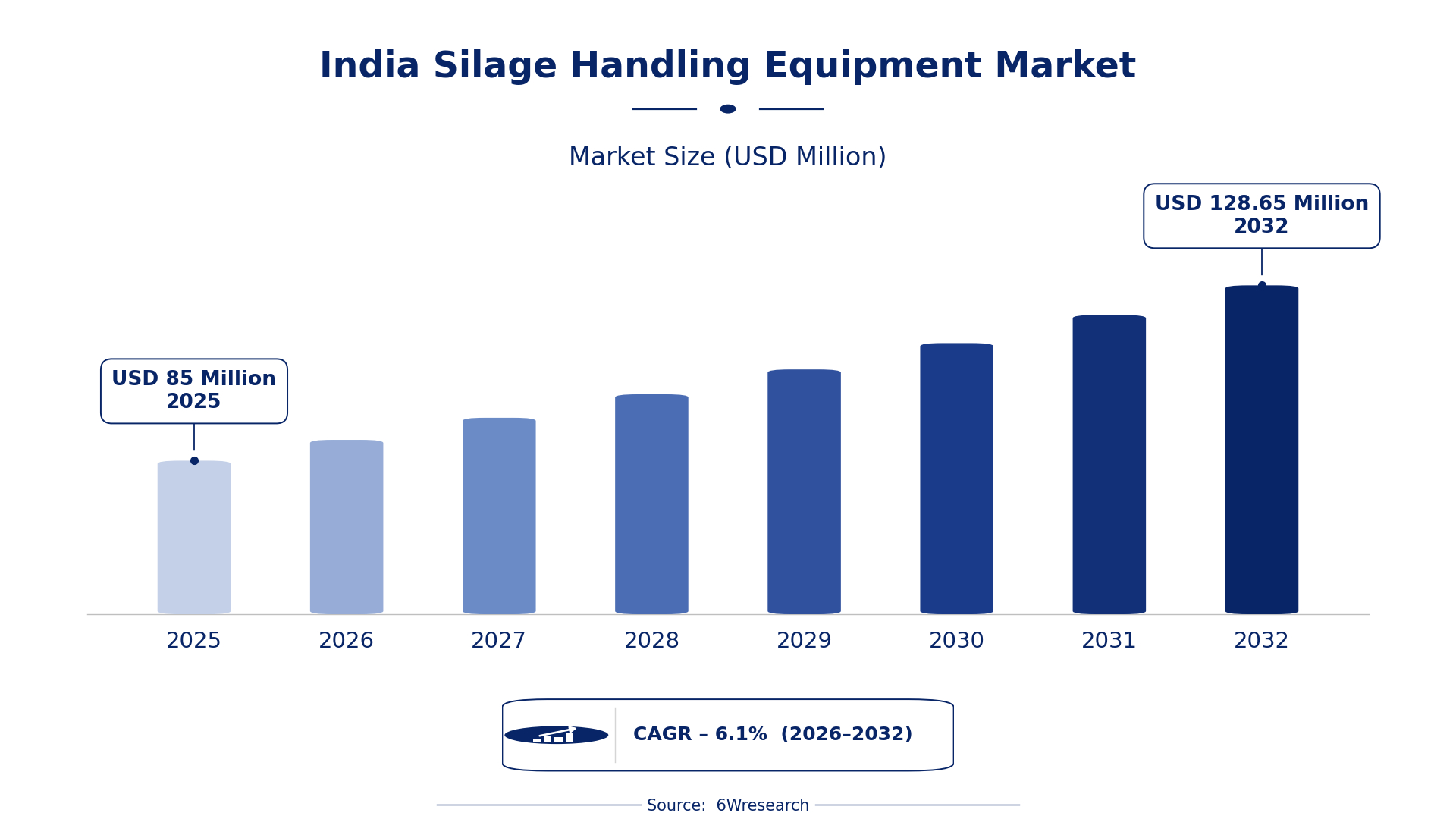
According to 6Wresearch internal database and industry insights, the India Silage Handling Equipment Market was valued at USD 85.0 million in 2025 and is projected to reach USD 128.65 million by 2032, growing at a CAGR of approximately 6.1% during 2026–2032.
India Silage Handling Equipment Market Highlights
| Report Metric | Details |
| Report Name | India Silage Handling Equipment Market |
| Market Size 2025 | USD 85.0 million |
| Market Size 2032 | USD 128.65 million |
| Absolute Growth 2025–2032 | USD 43.65 million |
| CAGR 2026–2032 | 6.1% |
| Peak Annual Growth | 8.6% in 2028 |
| Forecast Period | 2026–2032 |
| Historical Data | 2022–2025 |
| Base Year | 2025 |
| Leading Equipment Type, 2025 | Front Loaders (43% share) |
| Leading Operation Type, 2025 | Tractor-Attached (43% share) |
| Leading Loading Capacity, 2025 | High Volume (47% share) |
| Leading End User, 2025 | Agri Co-operatives (36% share) |
| Fastest-Growing Equipment Type | Bale Grabs (8.2% CAGR) |
| Fastest-Growing Operation Type | Motorized Belt (8.2% CAGR) |
| Fastest-Growing End User | Livestock Farm Owners (7.7% CAGR) |
| Growing Sector | Dairy Farming |
| Key End Users | Agri Co-operatives, Livestock Farm Owners, Smallholder Farmers |
India Silage Handling Equipment Market Year-wise Growth Rate and Key Drivers (2022–2032)
This graph illustrates the annual growth rates of the market from 2022 to 2032, highlighting a steady upward trajectory and projected market expansion over the forecast period.

Each row of the following table gives one year's estimated growth and the event or demand shift that explains it.
| Year | Estimated Annual Growth (%) | Market Rationale |
| 2022 | 4.3 | The market experienced steady growth due to increased livestock farming activities. |
| 2023 | 6.5 | Demand surged as dairy production expanded, particularly in Punjab and Haryana. |
| 2024 | 5.6 | Growth slowed as equipment adoption faced challenges in smaller farms. |
| 2025 | 4.6 | A slight slowdown in growth occurred as new standards were integrated into the market. |
| 2026 | 4.3 | Demand is expected to continue slowing as farmers face financial constraints in equipment purchases. |
| 2027 | 6.5 | Growth is projected to accelerate again as livestock farming trends improve across the country. |
| 2028 | 8.6 | The market is expected to peak with significant investments in dairy infrastructure and technology. |
| 2029 | 4.9 | A slowdown is anticipated as the market adjusts to the previous year's peak growth. |
| 2030 | 8.5 | Growth is projected to rebound as dairy production initiatives gain momentum again. |
| 2031 | 6.6 | The market is expected to slow as equipment purchases stabilise after rapid growth. |
| 2032 | 3.4 | Growth will continue to decelerate as the market reaches a more mature phase. |
Note: Market size estimations and growth projections presented in this report are based on 6Wresearch's proprietary forecasting methodology, utilizing the latest available industry data, government publications, and primary research inputs.
India Silage Handling Equipment Market Synopsis
Silage Handling Equipment Market in India includes machinery designed for the management of silage, crucial for preserving livestock feed. This equipment, constructed from robust materials, enhances the efficiency of feed storage. The market is expanding due to an increase in livestock populations and initiatives like the National Dairy Plan, which targets a 25% rise in milk production by 2025. Growing demand from agri-cooperatives and smallholder farmers further propels market growth, underscoring the significance of this equipment in contemporary agriculture.
Market Dynamics Impact Analysis (2026–2032)
| Factor | Type | Impact | Primary Segment Affected |
| Rising livestock numbers are driving demand for efficient silage management. | Driver | High | Silage Forks |
| Increased dairy production initiatives are boosting equipment purchases. | Driver | High | Tractor-Attached |
| Growing membership in agri-cooperatives presents opportunities for bulk purchases. | Opportunity | High | Agri Co-operatives |
| The Dairy Processing and Infrastructure Development Fund supports modernisation efforts. | Opportunity | High | Livestock Farm Owners |
| Financial constraints limit smallholder farmers' ability to invest in new equipment. | Restraint | Medium | Manual/Hydraulic |
| The average age of farmers affects adoption rates of modern equipment. | Restraint | Medium | Front Loaders |
| Technological integration challenges hinder market growth for suppliers. | Challenge | High | Conveyor Systems |
| Competition from low-cost alternatives affects pricing strategies. | Challenge | Medium | Bale Grabs |
Evaluation of Drivers in India Silage Handling Equipment Market (2026–2032)
Below mentioned are some major drivers and their influence on market dynamics.
| Drivers | Primary Segment Affected | Why It Matters (Evidence) |
| Increased dairy production drives demand for efficient silage handling solutions. | Silage Forks | The dairy sector contributes approximately 4.6% to the national GDP, prompting higher equipment purchases to meet rising demand. |
| Growing livestock numbers necessitate improved silage management practices. | Tractor-Attached | India has over 300 million cattle, increasing the demand for silage handling equipment to support efficient livestock farming. |
| Investment in dairy infrastructure boosts equipment needs. | High Volume | The National Dairy Plan aims to increase milk production by 25% by 2025, boosting equipment requirements for effective silage management. |
| Agri-cooperatives are expanding their operations, increasing collective purchases. | Agri Co-operatives | Membership in agri-cooperatives in India has increased by 15%, driving demand for silage handling equipment among collective buyers. |
| Modern farming practices are promoted by government initiatives. | Livestock Farm Owners | The Ministry of Agriculture promotes modern farming practices, including silage management, enhancing the demand for appropriate equipment. |
Growth in the Silage Handling Equipment market in India is rooted in rising livestock numbers, increased dairy production, and investments in dairy infrastructure. The dairy sector accounts for about 4.6% of the national GDP, leading to heightened equipment purchases to satisfy growing demand. With over 300 million cattle in India, the need for silage handling equipment is escalating. The National Dairy Plan aims for a 25% boost in milk production by 2025, further driving equipment requirements. The increase in agri-cooperative memberships is promoting collective purchases of silage handling solutions, contributing to overall market growth.
Evaluation of Restraints in India Silage Handling Equipment Market
The table below lists the restraints and the evidence behind each.
| Market Restraint | Primary Segment Affected | Why It Matters (Evidence) |
| Financial constraints limit smallholder farmers' ability to invest in new equipment. | Manual/Hydraulic | The average age of farmers in India is around 50 years, affecting their purchasing power and willingness to invest. |
| The average age of farmers affects adoption rates of modern equipment. | Front Loaders | Older farmers may be less inclined to adopt new technologies, impacting sales and market growth. |
| Competition from low-cost alternatives affects pricing strategies. | Bale Grabs | Low-cost equipment options can deter investment in higher-quality silage handling solutions, limiting market potential. |
| Technological integration challenges hinder market growth for suppliers. | Conveyor Systems | Suppliers face difficulties in integrating advanced technologies into traditional farming practices, affecting efficiency. |
| Market saturation in certain regions limits growth potential. | Silage Forks | In regions with established dairy farms, demand for new equipment may plateau, reducing sales opportunities. |
India Silage Handling Equipment Market Challenges
The India silage handling equipment market encounters several practical issues, starting with high costs. Prices for silage handling equipment range from ₹50,000 to ₹2,00,000, which strains local farmers' budgets and limits their purchasing ability. Regulatory challenges arise, as compliance with ISO 9001:2015 standards can delay product availability for suppliers, hindering their capacity to meet rising demand. Skills shortages are also a concern, with the average age of farmers around 50 years, leading to slower adoption of modern machinery. Finally, technology limitations are apparent, as outdated equipment can reduce the average yield of silage per hectare, currently at 20 tons, adversely affecting livestock productivity for farmers.
Trends in the India Silage Handling Equipment Market
Below mentioned are some of the trends shaping the India Silage Handling Equipment Market growth.
- Shift from Manual to Mechanised Handling: Since 2021, many farmers have shifted from manual to mechanised silage handling methods. This transition is driven by the need for efficiency, with an estimated 20% increase in mechanised equipment adoption in Punjab.
- Emergence of High Volume Equipment: The trend towards high volume silage handling equipment began in 2022, as larger farms seek greater efficiency. High Volume equipment now captures a 47% market share, reflecting the increasing demand for bulk silage management.
- Increased Adoption of Modern Practices: In 2023, initiatives from the Ministry of Agriculture led to a rise in modern silage management practices. This has resulted in a 10% increase in livestock farming efficiency across key dairy-producing states.
- Growing Role of Agri-Cooperatives: Agri-cooperatives have gained importance since 2022, enhancing collective purchasing power. With a 15% increase in membership, these cooperatives are now prominent buyers of silage handling equipment.
Investment Opportunities in the India Silage Handling Equipment Market
Below are the investment opportunities with the strongest case in the India Silage Handling Equipment Market.
- Agri-Cooperatives Seeking Bulk Purchases: Agri-cooperatives are increasingly interested in investing in silage handling equipment due to a 15% rise in membership. Suppliers can enter this market by forming partnerships with local cooperatives to address collective purchasing needs.
- Investment in Dairy Infrastructure: With the National Dairy Plan targeting a 25% increase in milk production, there is a growing requirement for silage handling equipment. Suppliers should explore joint ventures with local dairy farms to effectively meet this demand.
- Demand from Smallholder Farmers: As smallholder farmers increasingly adopt silage handling solutions, there is an opportunity to provide affordable equipment. Focusing on regions with high smallholder populations can yield substantial returns for suppliers.
- Focus on Sustainable Practices: The updated National Livestock Policy promotes sustainable livestock management, creating a demand for efficient silage handling equipment. Suppliers can gain an advantage by aligning their products with sustainability standards to attract environmentally conscious buyers.
Government Initiatives in the India Silage Handling Equipment Market
The Dairy Processing and Infrastructure Development Fund, launched in 2022, allocated ₹10,000 crores to improve dairy processing capabilities. This initiative supports investments in silage handling equipment, enabling producers to upgrade their machinery and enhance efficiency. Additionally, the National Dairy Plan Phase II, initiated in 2021, aims to increase milk production and improve infrastructure, impacting the silage handling equipment market by boosting demand for efficient solutions.
The Department of Animal Husbandry and Dairying oversees the Dairy Processing and Infrastructure Development Fund, which finances projects aimed at enhancing dairy processing capabilities. This fund allows producers to invest in modern equipment, improving their operational efficiency. Furthermore, the Animal Husbandry Infrastructure Development Fund, established in 2020, supports investments in dairy infrastructure, including silage management, facilitating better practices in the sector.
Future Insight of the India Silage Handling Equipment Market
The India silage handling equipment market is set for transformation by 2032, driven by several key factors. The National Dairy Plan aims for a 25% increase in milk production by 2025, necessitating improved silage management solutions. Livestock farming is projected to grow by 10% annually, raising the demand for advanced machinery. Government initiatives, like the Pradhan Mantri Kisan Samman Nidhi, are expected to provide financial support to farmers, indirectly stimulating equipment sales. With a substantial allocation of ₹10,000 crores for agricultural modernisation, the market is likely to see significant advancements in technology and efficiency.
Market Segmentation Analysis
Each segment group is reviewed below, with the leader by share and the fastest grower by CAGR.
By Equipment Type – Front Loaders Dominated, Bale Grabs Expected to Grow Fastest
According to Dhaval Chaurasia, Assistant Manager at 6Wresearch, Front Loaders accounted for a 43% market share by equipment type in 2025. Front Loaders hold the largest share of the India Silage Handling Equipment Market because they are essential for efficiently moving silage, particularly in dairy-rich states like Punjab and Haryana. Their widespread use in these regions underscores their importance in supporting the agricultural sector's needs. Bale Grabs are projected to grow fastest, at a CAGR of 8.2% during 2026–2032. Bale Grabs are experiencing rapid growth due to their critical role in handling silage bales, especially in operations that prioritise efficiency. The increasing number of dairy farms, averaging 4-5 milking cows, is driving the need for effective bale handling solutions. Suppliers should consider expanding the availability and features of Bale Grabs to meet the rising demand in the silage handling equipment market.
By Operation Type – Tractor-Attached Dominated, Motorized Belt Expected to Grow Fastest
The largest operation type category in 2025 was Tractor-Attached, with a 43% share of total revenue. Tractor-Attached systems dominate the market as they are commonly used for various silage handling tasks across different agricultural setups. Their versatility makes them a preferred choice among farmers, particularly in regions with a high concentration of dairy operations. Motorized Belt is set to record the highest CAGR in this split, 8.2% over 2026–2032. Motorized Belt systems are witnessing the fastest growth due to their specific applications in modern farming setups that require efficient silage management. As the agricultural sector embraces modernisation, the demand for such equipment is expected to rise, particularly among larger operations. Buyers may find value in exploring Motorized Belt options to improve their silage handling efficiency as the market continues to progress.
By Loading Capacity – High Volume Dominated and Is Expected to Record the Fastest Growth
High Volume held a 47% share of the India Silage Handling Equipment Market by loading capacity in 2025. High Volume equipment leads the market as it is essential for large-scale silage handling, catering to the needs of extensive dairy operations. The average yield of 20 tons of silage per hectare necessitates equipment capable of managing substantial quantities effectively. The same category is also set to grow fastest, at a CAGR of 7.7% during 2026–2032. High Volume equipment is also the fastest-growing segment, as its capabilities align with the increasing scale of dairy farming operations. The ongoing growth in livestock farming, projected at 10% annually, will further drive the demand for such high-capacity solutions. Suppliers should prioritise the development of High Volume equipment to capitalise on the expanding dairy sector and meet the needs of larger farms.
By End User – Agri Co-operatives Dominated, Livestock Farm Owners Expected to Grow Fastest
Agri Co-operatives took a 36% share of end user in 2025, more than any other category. Agri Co-operatives account for the largest segment of silage handling equipment users, driven by their collective purchasing power and the need for efficient silage management. With approximately 1,500 registered co-operatives, their demand significantly influences the overall market share. Over 2026–2032, Livestock Farm Owners are expected to post the fastest growth, at a CAGR of 7.7%. Livestock Farm Owners are experiencing the fastest growth in demand for silage handling equipment as they seek to optimise their operations. The average size of dairy farms, typically around 5-10 cows, necessitates effective equipment solutions tailored to their specific needs. Suppliers should aim to provide customised solutions for Livestock Farm Owners to capitalise on the growing interest in efficient silage management.
Key Attractiveness of the Report
- 10 Years of Market Numbers
- Historical Data Starting from 2022 to 2025
- Base Year 2025
- Forecast Data until 2032
- Key Performance Indicators Impacting the Market
- Major Upcoming Developments and Projects
Key Highlights of the Report:
- India Silage Handling Equipment Market Outlook
- Market Size of India Silage Handling Equipment Market, 2025
- Forecast of India Silage Handling Equipment Market, 2032
- Historical Data and Forecast of India Silage Handling Equipment Revenues & Volume for the Period 2022 - 2032F
- India Silage Handling Equipment Market Trend Evolution
- India Silage Handling Equipment Market Drivers and Challenges
- India Silage Handling Equipment Price Trends
- India Silage Handling Equipment Porter's Five Forces
- India Silage Handling Equipment Industry Life Cycle
- Historical Data and Forecast of India Silage Handling Equipment Market Revenues & Volume By Equipment Type for the Period 2022 - 2032F
- Historical Data and Forecast of India Silage Handling Equipment Market Revenues & Volume By Front Loaders for the Period 2022 - 2032F
- Historical Data and Forecast of India Silage Handling Equipment Market Revenues & Volume By Silage Forks for the Period 2022 - 2032F
- Historical Data and Forecast of India Silage Handling Equipment Market Revenues & Volume By Conveyor Systems for the Period 2022 - 2032F
- Historical Data and Forecast of India Silage Handling Equipment Market Revenues & Volume By Bale Grabs for the Period 2022 - 2032F
- Historical Data and Forecast of India Silage Handling Equipment Market Revenues & Volume By Operation Type for the Period 2022 - 2032F
- Historical Data and Forecast of India Silage Handling Equipment Market Revenues & Volume By Tractor-Attached for the Period 2022 - 2032F
- Historical Data and Forecast of India Silage Handling Equipment Market Revenues & Volume By Manual/Hydraulic for the Period 2022 - 2032F
- Historical Data and Forecast of India Silage Handling Equipment Market Revenues & Volume By Motorized Belt for the Period 2022 - 2032F
- Historical Data and Forecast of India Silage Handling Equipment Market Revenues & Volume By Hydraulic Clamp for the Period 2022 - 2032F
- Historical Data and Forecast of India Silage Handling Equipment Market Revenues & Volume By Loading Capacity for the Period 2022 - 2032F
- Historical Data and Forecast of India Silage Handling Equipment Market Revenues & Volume By Medium/Heavy Duty for the Period 2022 - 2032F
- Historical Data and Forecast of India Silage Handling Equipment Market Revenues & Volume By Low/Medium for the Period 2022 - 2032F
- Historical Data and Forecast of India Silage Handling Equipment Market Revenues & Volume By High Volume for the Period 2022 - 2032F
- Historical Data and Forecast of India Silage Handling Equipment Market Revenues & Volume By Round/Square Bale for the Period 2022 - 2032F
- Historical Data and Forecast of India Silage Handling Equipment Market Revenues & Volume By End User for the Period 2022 - 2032F
- Historical Data and Forecast of India Silage Handling Equipment Market Revenues & Volume By Agri Co-operatives for the Period 2022 - 2032F
- Historical Data and Forecast of India Silage Handling Equipment Market Revenues & Volume By Smallholder Farmers for the Period 2022 - 2032F
- Historical Data and Forecast of India Silage Handling Equipment Market Revenues & Volume By Silage Storage Units for the Period 2022 - 2032F
- Historical Data and Forecast of India Silage Handling Equipment Market Revenues & Volume By Livestock Farm Owners for the Period 2022 - 2032F
- India Silage Handling Equipment Import Export Trade Statistics
- Market Opportunity Assessment By Equipment Type
- Market Opportunity Assessment By Operation Type
- Market Opportunity Assessment By Loading Capacity
- Market Opportunity Assessment By End User
- India Silage Handling Equipment Top Companies Market Share
- India Silage Handling Equipment Competitive Benchmarking By Technical and Operational Parameters
- India Silage Handling Equipment Company Profiles
- India Silage Handling Equipment Key Strategic Recommendations
Market Covered
Segments analysed in this report are listed below.
By Equipment Type
- Front Loaders
- Silage Forks
- Conveyor Systems
- Bale Grabs
By Operation Type
- Tractor-Attached
- Manual/Hydraulic
- Motorized Belt
- Hydraulic Clamp
By Loading Capacity
- Medium/Heavy Duty
- Low/Medium
- High Volume
- Round/Square Bale
By End User
- Agri Co-operatives
- Smallholder Farmers
- Silage Storage Units
- Livestock Farm Owners































