India Skincare Airless Packaging Market Size & Growth Rate
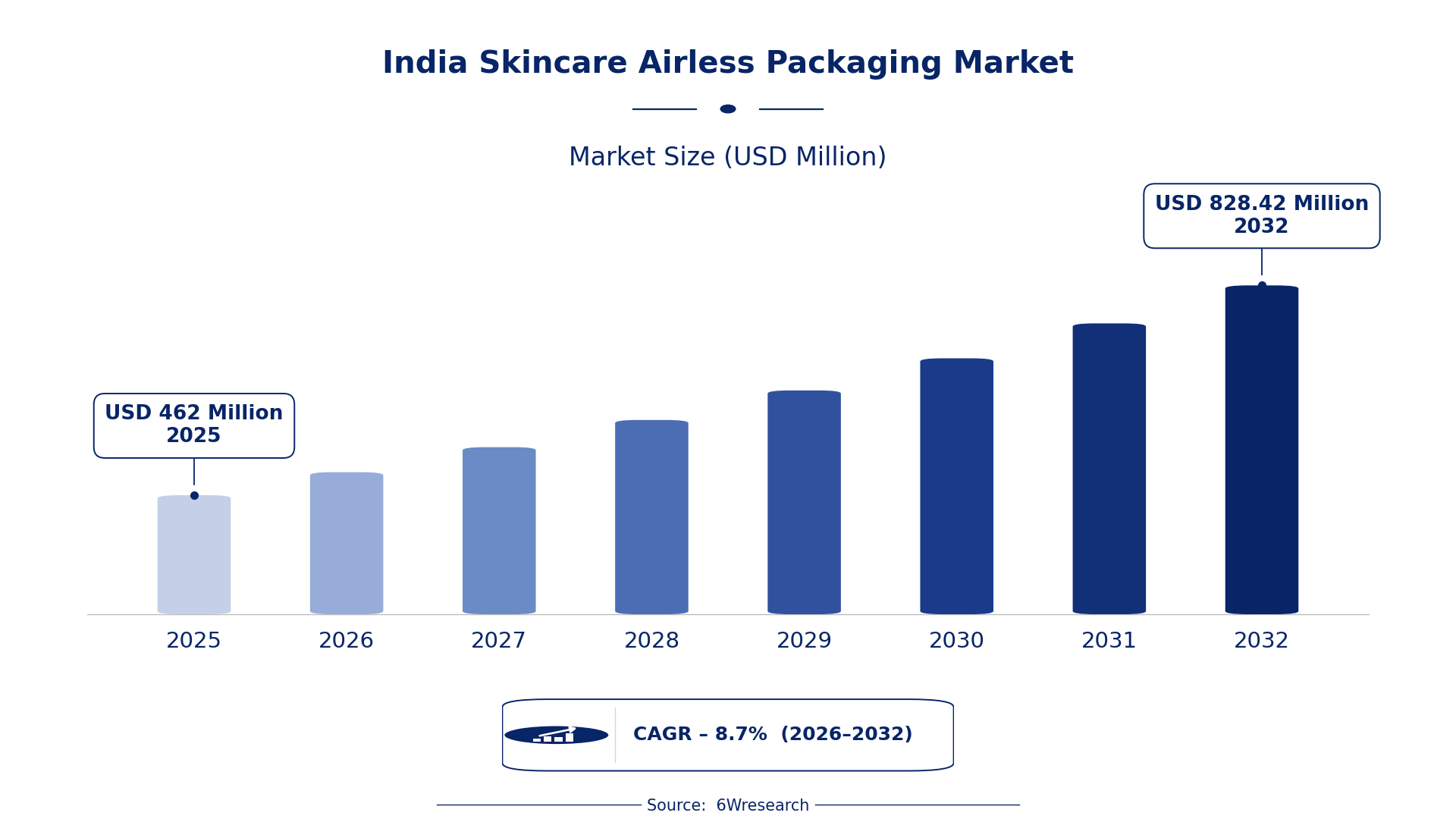
According to 6Wresearch internal database and industry insights, the India Skincare Airless Packaging Market was valued at USD 462.0 million in 2025 and is projected to reach USD 828.42 million by 2032, growing at a CAGR of approximately 8.7% during 2026–2032.
India Skincare Airless Packaging Market Highlights
| Report Metric | Details |
| Report Name | India Skincare Airless Packaging Market |
| Market Size 2025 | USD 462.0 million |
| Market Size 2032 | USD 828.42 million |
| Absolute Growth 2025–2032 | USD 366.42 million |
| CAGR 2026–2032 | 8.7% |
| Peak Annual Growth | 11.1% in 2029 |
| Forecast Period | 2026–2032 |
| Historical Data | 2022–2025 |
| Base Year | 2025 |
| Leading Packaging Type, 2025 | Airless Pump Bottles (39% share) |
| Leading Material Used, 2025 | PET/PP/Glass (54% share) |
| Leading Application Form, 2025 | Creams/Serums (55% share) |
| Leading End User, 2025 | Skincare Brands (39% share) |
| Fastest-Growing Packaging Type | Airless Jars (11.2% CAGR) |
| Fastest-Growing Material Used | Acrylic/Plastic (10.8% CAGR) |
| Fastest-Growing Application Form | Moisturizers/Masks (10.4% CAGR) |
| Fastest-Growing End User | Cosmetics Manufacturers (9.9% CAGR) |
| Growing Sector | Skincare |
| Key End Users | Skincare Brands, Cosmetics Manufacturers, Personal Care Companies |
India Skincare Airless Packaging Market Year-wise Growth Rate and Key Drivers (2022–2032)
This graph illustrates the annual growth rates of the market from 2022 to 2032, highlighting a steady upward trajectory and projected market expansion over the forecast period.
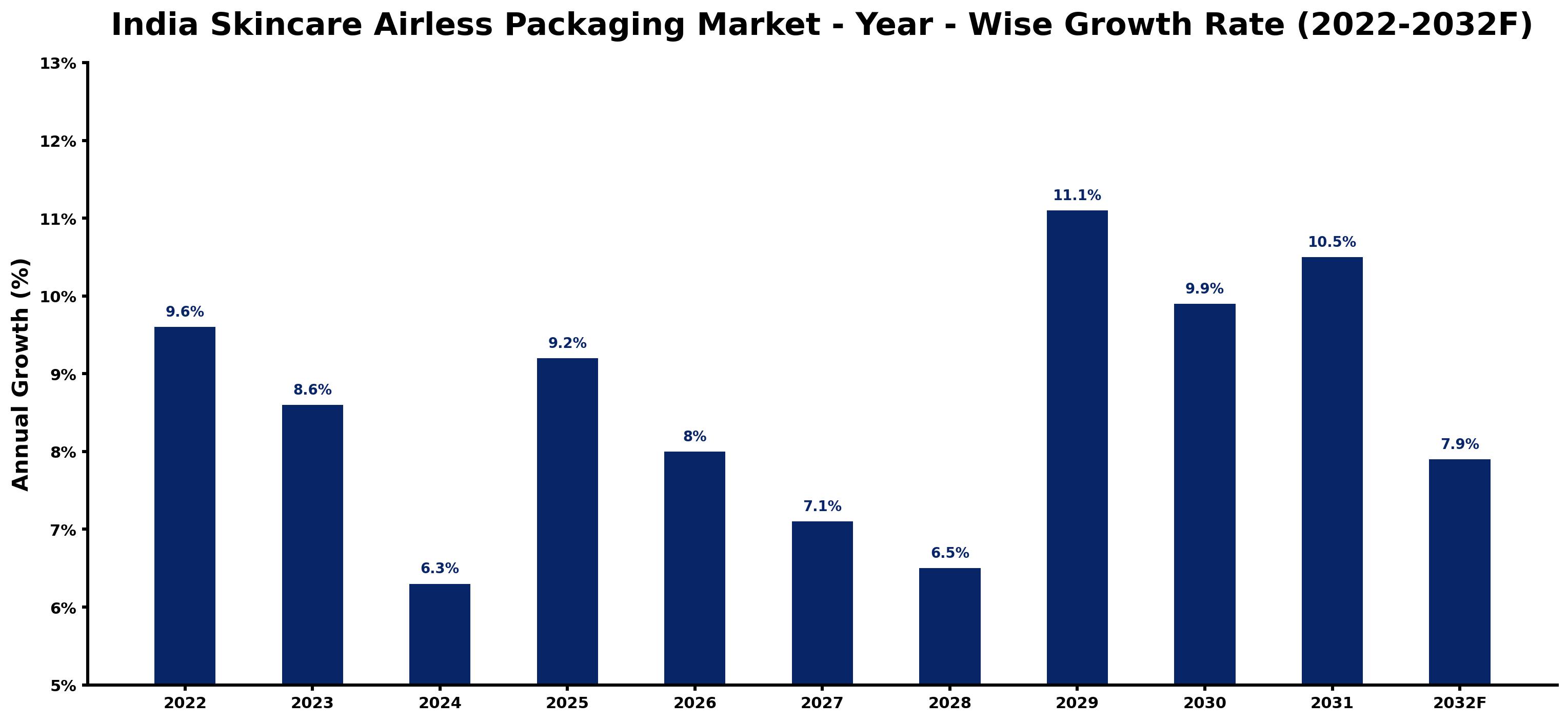
Annual growth estimates for each year appear below with the principal reason behind them, explaining the shifts that set the pace of the market.
| Year | Estimated Annual Growth (%) | Market Rationale |
| 2022 | 9.6 | The market experienced strong demand due to rising consumer interest in premium skincare products. |
| 2023 | 8.6 | Growth slowed as brands adjusted to changing consumer preferences and economic conditions. |
| 2024 | 6.3 | Market expansion continued, albeit at a slower pace as competition intensified among brands. |
| 2025 | 9.2 | Demand increased as consumers shifted towards more sustainable packaging solutions. |
| 2026 | 8.0 | Growth is expected to decelerate as manufacturers face challenges in sourcing materials sustainably. |
| 2027 | 7.1 | Market growth is projected to slow further as brands focus on product innovation and differentiation. |
| 2028 | 6.5 | The trend towards eco-friendly packaging is expected to continue, impacting growth rates. |
| 2029 | 11.1 | A surge in demand for airless packaging is anticipated as consumers prioritise product efficacy. |
| 2030 | 9.9 | Growth is projected to slow slightly as the 'Make in India' programme encourages local production. |
| 2031 | 10.5 | Demand is expected to rise again as brands expand their product lines with unique packaging designs. |
| 2032 | 7.9 | Growth is anticipated to slow as the National Packaging Policy begins to influence market dynamics. |
Note: Market size estimations and growth projections presented in this report are based on 6Wresearch's proprietary forecasting methodology, utilizing the latest available industry data, government publications, and primary research inputs.
India Skincare Airless Packaging Market Synopsis
The Skincare Airless Packaging Market in India includes packaging solutions that maintain product integrity. This technology dispenses creams, serums, and lotions without air exposure, using materials such as PET and glass. The market is expanding due to a 15% annual growth rate in the premium segment, with over 60% of skincare brands opting for airless packaging. Initiatives like the 'Make in India' programme are enhancing local manufacturing capabilities and driving demand for new solutions.
Market Dynamics Impact Analysis (2026–2032)
| Factor | Type | Impact | Primary Segment Affected |
| Rising consumer preference for premium skincare products drives demand for airless packaging solutions. | Driver | High | Airless Pump Bottles |
| The growth of sustainable packaging initiatives encourages brands to adopt airless solutions. | Driver | High | Airless Jars |
| The increasing focus on product efficacy creates opportunities for innovative packaging solutions. | Opportunity | High | Dual-Chamber Airless |
| The expansion of skincare brands in the southern region of India presents a growing market for suppliers. | Opportunity | High | Airless Tubes |
| Challenges in sourcing sustainable materials can limit production capabilities for manufacturers. | Restraint | High | PET/PP/Glass |
| High competition among brands may lead to price wars, affecting profit margins. | Restraint | Medium | Acrylic/Plastic |
| The Skincare Airless Packaging market in India faces significant regulatory hurdles that slow down product approvals. | Challenge | High | Airless Pump Bottles |
| Limited awareness of airless packaging benefits among smaller brands can hinder market growth. | Challenge | Medium | Airless Jars |
Evaluation of Drivers in India Skincare Airless Packaging Market (2026–2032)
Key forces behind demand, with the segment each one moves most, are listed below.
| Drivers | Primary Segment Affected | Why It Matters (Evidence) |
| Growing consumer demand for premium skincare products fuels the need for airless packaging. | Airless Pump Bottles | The premium segment is experiencing a 15% annual growth rate, prompting brands to invest in airless solutions. |
| Sustainable packaging initiatives drive brands to adopt airless technology for better product preservation. | Airless Jars | More than 60% of skincare brands prefer airless packaging to maintain product integrity. |
| The rise of eco-friendly consumer trends encourages brands to innovate in packaging design. | Dual-Chamber Airless | The National Packaging Policy promotes sustainable practices in the cosmetics sector. |
| The southern region of India is emerging as a manufacturing hub for skincare products. | Airless Tubes | This region holds over 30% market share, attracting new brands to invest in airless packaging. |
| Increased focus on product efficacy drives demand for airless packaging solutions. | PET/PP/Glass | Brands are prioritising packaging that maintains ingredient integrity and effectiveness. |
Expansion of the Skincare Airless Packaging market in India is backed by rising consumer preference for premium products, alongside a shift towards sustainable packaging solutions. The premium segment is experiencing a 15% annual growth rate, prompting brands to invest in airless technology. The southern region of India, holding over 30% of the market share, is becoming a manufacturing hub, attracting new brands. Additionally, the increasing focus on product efficacy is encouraging brands to adopt airless packaging to preserve ingredient integrity.
Evaluation of Restraints in India Skincare Airless Packaging Market
Below mentioned are some major restraints and their influence on market dynamics.
| Market Restraint | Primary Segment Affected | Why It Matters (Evidence) |
| Challenges in sourcing sustainable materials can limit production capabilities for manufacturers. | PET/PP/Glass | Manufacturers face difficulties in obtaining eco-friendly materials, impacting their ability to produce airless packaging. |
| High competition among brands may lead to price wars, affecting profit margins. | Acrylic/Plastic | Intense rivalry in the market forces brands to lower prices, squeezing profitability. |
| Regulatory hurdles slow down product approvals, impacting market entry for new brands. | Airless Pump Bottles | Strict compliance with packaging standards delays the introduction of new airless products. |
| Limited awareness of airless packaging benefits among smaller brands can hinder market growth. | Airless Jars | Many smaller brands lack knowledge about the advantages of airless solutions, restricting their adoption. |
| Economic fluctuations can affect consumer spending on premium skincare products. | Dual-Chamber Airless | Economic downturns may lead consumers to prioritise essential purchases over premium skincare. |
India Skincare Airless Packaging Market Challenges
In the India Skincare Airless Packaging Market, producers face intense competition, with over 60% of skincare brands selecting airless packaging, which pressures many to reduce prices and lower profit margins. Regulatory challenges arise as the Bureau of Indian Standards implemented new guidelines in 2021, compelling producers to adapt quickly, potentially delaying product launches by up to six months. Importers encounter supply chain disruptions due to reliance on specific materials like PET and glass, leading to shortages that can halt production for several weeks. Buyers are facing rising costs; the premium segment's 15% annual growth rate makes airless packaging increasingly costly for smaller brands entering the market.
Trends in the India Skincare Airless Packaging Market
Four trends stand out in the India Skincare Airless Packaging Market.
- Shift Towards Eco-Friendly Packaging Solutions: The skincare industry is increasingly adopting eco-friendly packaging solutions, as seen in the National Packaging Policy promoting sustainable practices. This trend is supported by a growing consumer base prioritising sustainability, with over 60% of brands opting for airless packaging.
- Rise of Dual-Chamber Airless Packaging: Dual-chamber airless packaging is gaining traction, allowing consumers to mix products before use. This innovation is driven by a 10.4% CAGR in the moisturisers and masks segment, reflecting the demand for multifunctional skincare solutions.
- Increased Focus on Product Efficacy: Brands are prioritising packaging that preserves product integrity, leading to a rise in airless packaging adoption. The market for airless pump bottles, accounting for 40% of the market, illustrates this shift towards maintaining ingredient effectiveness.
- Growth in Premium Skincare Segment: The premium skincare segment is expanding rapidly, with a 15% annual growth rate. This growth is attracting new brands to invest in airless packaging solutions that cater to discerning consumers.
Investment Opportunities in the India Skincare Airless Packaging Market
Below are the investment opportunities with the strongest case in the India Skincare Airless Packaging Market.
- Investment in Sustainable Packaging Solutions: With the growing emphasis on sustainability, there is an opportunity to supply eco-friendly airless packaging solutions. The National Packaging Policy supports initiatives that promote sustainable practices, with a market gap in eco-friendly options.
- Expansion in Southern India: The southern region of India, holding over 30% of the skincare market share, presents a lucrative opportunity for suppliers of airless packaging. Collaborating with local manufacturers can facilitate market entry and growth.
- Focus on Innovative Designs: The demand for innovative packaging designs is rising, driven by collaborations between the National Institute of Fashion Technology and packaging firms. This presents an opportunity to supply creative airless packaging solutions to emerging skincare brands.
- Growth in Cosmetics Manufacturers: The cosmetics manufacturing sector is expected to grow at a 9% rate from 2023 to 2028, creating demand for airless packaging solutions. Engaging with cosmetics manufacturers can provide a pathway to capture this expanding market.
Government Initiatives in the India Skincare Airless Packaging Market
The National Packaging Policy was introduced in 2023 by the Ministry of Consumer Affairs to encourage sustainable practices in packaging. This policy complements previous measures like the Bureau of Indian Standards' updated packaging standards in 2021, which ensure quality and safety for consumers. Together, these initiatives aim to improve the overall packaging environment in India, particularly for airless solutions. The 'Make in India' initiative, launched in 2020, further supports local manufacturing capabilities for airless packaging, enhancing the market's growth potential.
The Ministry of Environment, Forest and Climate Change oversees the implementation of eco-friendly packaging initiatives, funding projects that promote sustainable practices. This includes support for brands adopting airless packaging solutions, ensuring compliance with the latest standards and fostering innovation in the sector. The Bureau of Indian Standards also plays a role in approving new packaging designs, facilitating the introduction of environmentally responsible solutions in the skincare industry.
Future Insight of the India Skincare Airless Packaging Market
The India Skincare Airless Packaging Market will evolve positively by 2032, driven by a growing consumer base prioritising personal care. The Indian cosmetics industry is expected to grow at a CAGR of 9% from 2023 to 2028, prompting producers to adopt advanced materials for better product offerings. The Ministry of Chemicals and Fertilizers' 2023 initiative to promote sustainable packaging solutions will attract environmentally aware buyers. Collaborations between the National Institute of Fashion Technology and packaging firms will lead to innovative designs, appealing to consumers seeking unique skincare experiences.
Market Segmentation Analysis
Each segment group is reviewed below, with the leader by share and the fastest grower by CAGR.
By Packaging Type – Airless Pump Bottles Dominated, Airless Jars Expected to Grow Fastest
According to Dhaval Chaurasia, Assistant Manager at 6Wresearch, Airless Pump Bottles accounted for a 39% market share by packaging type in 2025. Airless pump bottles dominate the market because they effectively dispense creams without contamination, making them the choice of over 60% of skincare brands in India. Their design is crucial for maintaining product integrity, appealing to manufacturers focused on high-quality skincare solutions. The quickest growth will come from Airless Jars, forecast to expand at a CAGR of 11.2% between 2026 and 2032. Airless jars are growing rapidly due to their suitability for thicker formulations like creams, which are increasingly popular among consumers. This trend aligns with the rising demand for premium skincare products that require advanced packaging solutions. Suppliers should enhance their offerings in airless jars to meet the increasing demand from brands aiming for premium positioning.
By Material Used – PET/PP/Glass Dominated, Acrylic/Plastic Expected to Grow Fastest
The largest material used category in 2025 was PET/PP/Glass, with a 54% share of total revenue. PET, PP, and glass are the leading materials in airless packaging, offering durability and protection for sensitive skincare formulations. Their widespread acceptance among manufacturers is clear, as these materials are commonly used in a large portion of skincare products. Acrylic/Plastic is set to record the highest CAGR in this split, 10.8% over 2026–2032. Acrylic and plastic materials are gaining traction due to their lightweight nature and design versatility, appealing to brands seeking modern packaging solutions. This shift is bolstered by collaborations between design institutes and packaging firms for innovative product presentations. Manufacturers should consider investing in acrylic and plastic options to cater to the evolving preferences of skincare brands seeking contemporary packaging.
By Application Form – Creams/Serums Dominated, Moisturizers/Masks Expected to Grow Fastest
With a 55% revenue share in 2025, Creams/Serums was the largest application form category. Creams and serums represent the largest application form for airless packaging, as they are primary products that require protection from oxidation. Their significant market share is driven by consumer demand for high-efficacy skincare solutions that maintain product quality. Over 2026–2032, Moisturizers/Masks are expected to post the fastest growth, at a CAGR of 10.4%. Moisturizers and masks are rapidly becoming the fastest-growing application forms, as consumers increasingly seek products that offer hydration and nourishment. This trend reflects the rising popularity of comprehensive skincare routines that incorporate multiple product types for enhanced results. Brands should expand their airless packaging offerings to include moisturizers and masks to align with consumer trends towards holistic skincare regimens.
By End User – Skincare Brands Dominated, Cosmetics Manufacturers Expected to Grow Fastest
Skincare Brands took a 39% share of end user in 2025, more than any other category. Skincare brands are the primary users of airless packaging, holding a substantial market share as they prioritise product integrity and consumer safety. Their preference for airless solutions is evident in the growing adoption among a significant number of brands in the industry. Cosmetics Manufacturers are projected to grow fastest, at a CAGR of 9.9% during 2026–2032. Cosmetics manufacturers are experiencing the fastest growth in adopting airless packaging, as they expand their product lines to include skincare items. This trend is propelled by the increasing consumer focus on personal care and the need for effective preservation of product quality. Suppliers should target cosmetics manufacturers with tailored airless packaging solutions to capitalise on the expanding market for skincare products.
Key Attractiveness of the Report
- 10 Years of Market Numbers
- Historical Data Starting from 2022 to 2025
- Base Year 2025
- Forecast Data until 2032
- Key Performance Indicators Impacting the Market
- Major Upcoming Developments and Projects
Key Highlights of the Report:
- India Skincare Airless Packaging Market Outlook
- Market Size of India Skincare Airless Packaging Market, 2025
- Forecast of India Skincare Airless Packaging Market, 2032
- Historical Data and Forecast of India Skincare Airless Packaging Revenues & Volume for the Period 2022 - 2032F
- India Skincare Airless Packaging Market Trend Evolution
- India Skincare Airless Packaging Market Drivers and Challenges
- India Skincare Airless Packaging Price Trends
- India Skincare Airless Packaging Porter's Five Forces
- India Skincare Airless Packaging Industry Life Cycle
- Historical Data and Forecast of India Skincare Airless Packaging Market Revenues & Volume By Packaging Type for the Period 2022 - 2032F
- Historical Data and Forecast of India Skincare Airless Packaging Market Revenues & Volume By Airless Pump Bottles for the Period 2022 - 2032F
- Historical Data and Forecast of India Skincare Airless Packaging Market Revenues & Volume By Airless Jars for the Period 2022 - 2032F
- Historical Data and Forecast of India Skincare Airless Packaging Market Revenues & Volume By Airless Tubes for the Period 2022 - 2032F
- Historical Data and Forecast of India Skincare Airless Packaging Market Revenues & Volume By Dual-Chamber Airless for the Period 2022 - 2032F
- Historical Data and Forecast of India Skincare Airless Packaging Market Revenues & Volume By Material Used for the Period 2022 - 2032F
- Historical Data and Forecast of India Skincare Airless Packaging Market Revenues & Volume By PET/PP/Glass for the Period 2022 - 2032F
- Historical Data and Forecast of India Skincare Airless Packaging Market Revenues & Volume By Acrylic/Plastic for the Period 2022 - 2032F
- Historical Data and Forecast of India Skincare Airless Packaging Market Revenues & Volume By HDPE for the Period 2022 - 2032F
- Historical Data and Forecast of India Skincare Airless Packaging Market Revenues & Volume By Co-Formulated Products for the Period 2022 - 2032F
- Historical Data and Forecast of India Skincare Airless Packaging Market Revenues & Volume By Application Form for the Period 2022 - 2032F
- Historical Data and Forecast of India Skincare Airless Packaging Market Revenues & Volume By Creams/Serums for the Period 2022 - 2032F
- Historical Data and Forecast of India Skincare Airless Packaging Market Revenues & Volume By Moisturizers/Masks for the Period 2022 - 2032F
- Historical Data and Forecast of India Skincare Airless Packaging Market Revenues & Volume By Lotions/Sunscreens for the Period 2022 - 2032F
- Historical Data and Forecast of India Skincare Airless Packaging Market Revenues & Volume By Anti-aging & Actives for the Period 2022 - 2032F
- Historical Data and Forecast of India Skincare Airless Packaging Market Revenues & Volume By End User for the Period 2022 - 2032F
- Historical Data and Forecast of India Skincare Airless Packaging Market Revenues & Volume By Skincare Brands for the Period 2022 - 2032F
- Historical Data and Forecast of India Skincare Airless Packaging Market Revenues & Volume By Cosmetics Manufacturers for the Period 2022 - 2032F
- Historical Data and Forecast of India Skincare Airless Packaging Market Revenues & Volume By Personal Care Companies for the Period 2022 - 2032F
- Historical Data and Forecast of India Skincare Airless Packaging Market Revenues & Volume By Premium Skincare Lines for the Period 2022 - 2032F
- India Skincare Airless Packaging Import Export Trade Statistics
- Market Opportunity Assessment By Packaging Type
- Market Opportunity Assessment By Material Used
- Market Opportunity Assessment By Application Form
- Market Opportunity Assessment By End User
- India Skincare Airless Packaging Top Companies Market Share
- India Skincare Airless Packaging Competitive Benchmarking By Technical and Operational Parameters
- India Skincare Airless Packaging Company Profiles
- India Skincare Airless Packaging Key Strategic Recommendations
Market Covered
The report offers an extensive study of the following market segments.
By Packaging Type
- Airless Pump Bottles
- Airless Jars
- Airless Tubes
- Dual-Chamber Airless
By Material Used
- PET/PP/Glass
- Acrylic/Plastic
- HDPE
- Co-Formulated Products
By Application Form
- Creams/Serums
- Moisturizers/Masks
- Lotions/Sunscreens
- Anti-aging & Actives
By End User
- Skincare Brands
- Cosmetics Manufacturers
- Personal Care Companies
- Premium Skincare Lines































