India Skincare Oil Market Size & Growth Rate
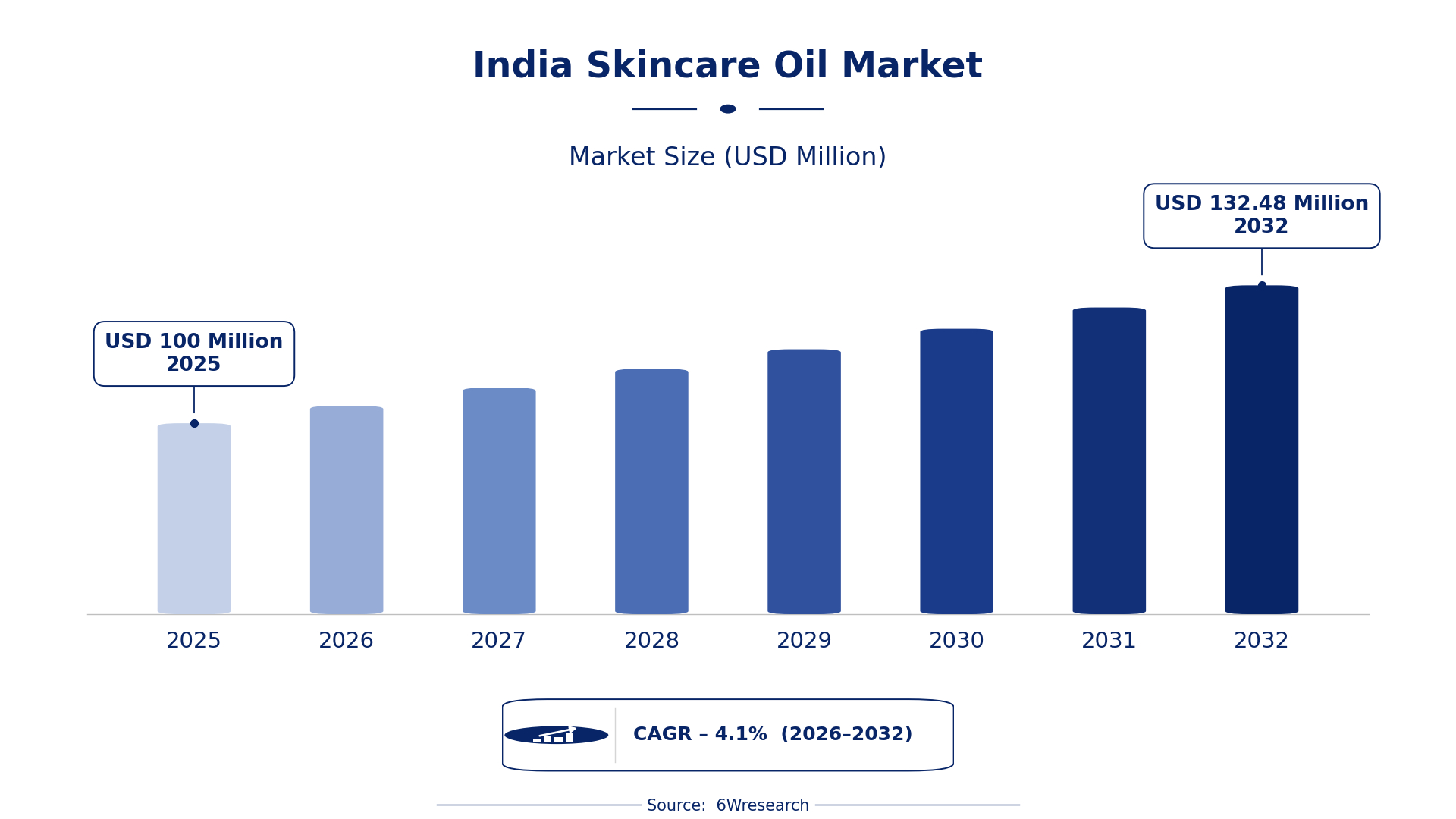
According to 6Wresearch internal database and industry insights, the India Skincare Oil Market was valued at USD 100.0 million in 2025 and is projected to reach USD 132.48 million by 2032, growing at a CAGR of approximately 4.1% during 2026–2032.
India Skincare Oil Market Highlights
| Report Metric | Details |
| Report Name | India Skincare Oil Market |
| Market Size 2025 | USD 100.0 million |
| Market Size 2032 | USD 132.48 million |
| Absolute Growth 2025–2032 | USD 32.48 million |
| CAGR 2026–2032 | 4.1% |
| Peak Annual Growth | 6.6% in 2031 |
| Forecast Period | 2026–2032 |
| Historical Data | 2022–2025 |
| Base Year | 2025 |
| Leading Oil Type, 2025 | Jojoba Oil (48% share) |
| Leading Source Ingredient, 2025 | Plant Seed (50% share) |
| Leading Functionality, 2025 | Balancing/Hydrating (35% share) |
| Leading End User, 2025 | Clean Beauty Brands (49% share) |
| Fastest-Growing Oil Type | Marula Oil (6.6% CAGR) |
| Fastest-Growing Functionality | Anti-aging/Nourishing (5.6% CAGR) |
| Fastest-Growing End User | Natural Skincare Lines (6.3% CAGR) |
| Growing Sector | Natural Skincare |
| Key End Users | Clean Beauty Brands, Natural Skincare Lines, Prestige Skincare Labels |
India Skincare Oil Market Year-wise Growth Rate and Key Drivers (2022–2032)
This graph illustrates the annual growth rates of the market from 2022 to 2032, highlighting a steady upward trajectory and projected market expansion over the forecast period.
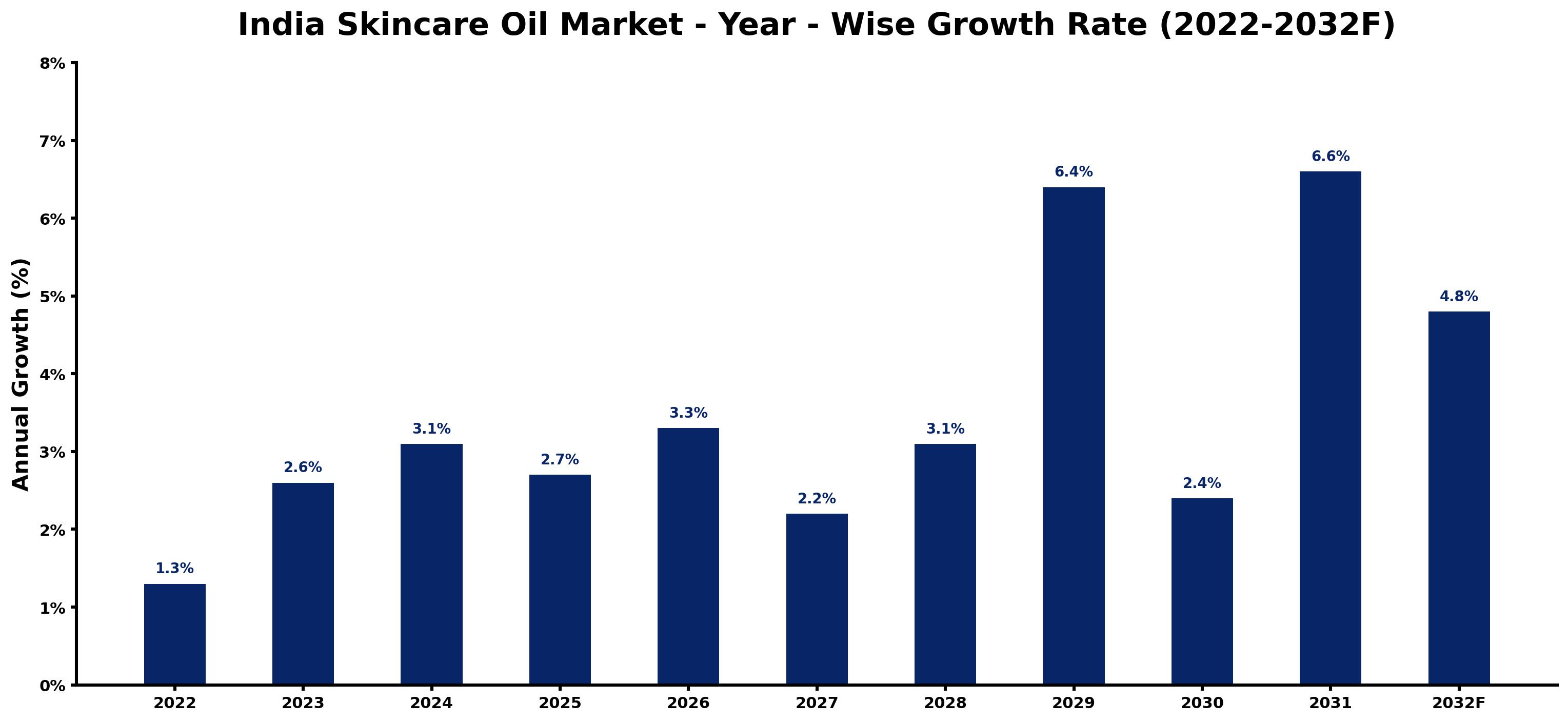
Below, each year's estimated growth is shown next to the factor that most influenced it.
| Year | Estimated Annual Growth (%) | Market Rationale |
| 2022 | 1.3 | The market experienced steady growth as urban consumers increasingly sought natural skincare options. |
| 2023 | 2.6 | Demand for organic products rose, reflecting a shift towards healthier skincare choices driven by consumer preferences. |
| 2024 | 3.1 | The Clean Beauty movement gained momentum, attracting more consumers to chemical-free options and influencing purchasing decisions. |
| 2025 | 2.7 | Growth slowed slightly as the market adjusted following previous rapid expansion and increased competition. |
| 2026 | 3.3 | The 'Atmanirbhar Bharat' initiative promoted local brands, boosting interest in hydrating oils among urban consumers. |
| 2027 | 2.2 | A focus on anti-aging products led to a rise in interest for premium oils like Marula, enhancing market dynamics. |
| 2028 | 3.1 | The popularity of natural oils continued to grow, appealing to various brands and consumers seeking unique benefits. |
| 2029 | 6.4 | Demand surged as consumers increasingly preferred products with unique skincare benefits, particularly in urban areas. |
| 2030 | 2.4 | Growth slowed as market maturity set in, but interest in new formulations remained high among consumers. |
| 2031 | 6.6 | The market peaked with heightened consumer focus on sustainability and natural ingredients, driving purchasing behaviour. |
| 2032 | 4.8 | Growth moderated as consumers became more discerning about product efficacy and sourcing, impacting buying patterns. |
Note: Market size estimations and growth projections presented in this report are based on 6Wresearch's proprietary forecasting methodology, utilizing the latest available industry data, government publications, and primary research inputs.
India Skincare Oil Market Synopsis
Skincare oil in India includes a variety of natural oils primarily used for moisturising and nourishing the skin. These oils come from plant sources and are produced using methods that maintain their beneficial properties. The India Skincare Oil Market is growing due to a population exceeding 1.4 billion and a rising preference for organic products, with 30% of consumers choosing them. The Clean Beauty movement is gaining momentum, as 40% of consumers seek chemical-free skincare solutions, driving the demand for natural oils such as Jojoba and Marula.
Market Dynamics Impact Analysis (2026–2032)
| Factor | Type | Impact | Primary Segment Affected |
| Growing consumer preference for organic products. | Driver | High | Plant Seed |
| Increasing demand for anti-aging skincare solutions. | Driver | High | Anti-aging/Nourishing |
| A significant gap in high-quality local skincare products. | Opportunity | High | Natural Skincare Lines |
| Rising interest in sustainable and eco-friendly packaging. | Opportunity | Medium | Clean Beauty Brands |
| Regulatory challenges in product formulation and safety standards. | Restraint | High | Jojoba Oil |
| Competition from imported skincare oils affecting local brands. | Restraint | Medium | Jojoba Oil |
| The Skincare Oil Market in India faces regulatory hurdles that complicate product approval. | Challenge | High | Jojoba Oil |
| Consumer skepticism about product claims can hinder market growth. | Challenge | Medium | Jojoba Oil |
Evaluation of Drivers in India Skincare Oil Market (2026–2032)
The factors lifting demand, and the evidence behind each, are summarised below.
| Drivers | Primary Segment Affected | Why It Matters (Evidence) |
| Rising urban population | Plant Seed | The growing urban population of over 1.4 billion is increasing demand for skincare oils, particularly among urban consumers seeking hydration. |
| Popularity of Jojoba oil | Jojoba Oil | Jojoba oil is widely used in over 50% of natural skincare formulations, reflecting its high demand among consumers. |
| Interest in anti-aging products | Anti-aging/Nourishing | The rise in demand for anti-aging products is leading to increased purchases of nourishing oils like Marula. |
| Government initiatives promoting local brands | Natural Skincare Lines | The 'Atmanirbhar Bharat' initiative supports local skincare brands, boosting the market for domestic oils. |
| Clean Beauty movement | Balancing/Hydrating | The Clean Beauty movement, with 40% of consumers preferring chemical-free products, drives demand for hydrating oils. |
Market growth in India for Skincare Oil rests on rising urban population, increasing interest in organic products, and support for domestic brands. The urban population exceeding 1.4 billion is driving demand for hydrating oils, particularly among consumers in metropolitan areas. The popularity of oils like Marula and Tamanu is growing, indicating a shift towards unique skincare benefits. Furthermore, the demand for anti-aging products is leading to increased purchases of nourishing oils, reflecting changing consumer preferences.
Evaluation of Restraints in India Skincare Oil Market
The following restraints limit how fast demand can grow.
| Market Restraint | Primary Segment Affected | Why It Matters (Evidence) |
| Regulatory hurdles in product formulation. | Jojoba Oil | The FSSAI's regulations on ingredient use complicate compliance for local producers, affecting product availability. |
| High production costs for natural oils. | Plant Seed | The costs associated with sourcing and processing natural oils can limit profit margins for local manufacturers. |
| Limited awareness of local brands. | Natural Skincare Lines | Many consumers remain unaware of local skincare brands, hindering their market penetration and growth. |
| Consumer skepticism about product efficacy. | Jojoba Oil | Skepticism regarding the claims of natural skincare products can deter potential buyers from making purchases. |
| Competition from imported products. | Jojoba Oil | Imported skincare oils often dominate the market, creating challenges for local brands in gaining market share. |
India Skincare Oil Market Challenges
The India skincare oil market faces high consumer expectations for quality, complicating sourcing for buyers. Many consumers demand organic certifications, yet only 30% of products currently meet these standards, leading to potential dissatisfaction. Skills shortages in formulation and production techniques hinder suppliers from effectively addressing these demands, resulting in delays and increased costs for manufacturers. Regulatory compliance is another hurdle, as the FSSAI enforces strict safety guidelines that can extend product launch timelines and inflate costs for producers navigating these requirements.
Trends in the India Skincare Oil Market
Several trends are reshaping the India Skincare Oil Market; the most important are set out below.
- Rise of Clean Beauty Standards: The Clean Beauty movement has gained traction in India, with 40% of consumers seeking chemical-free products. This trend is prompting brands to reformulate their offerings to align with new consumer expectations, thus increasing market demand for natural oils.
- Shift towards Sustainable Packaging: The Indian Institute of Packaging has established standards for cosmetic packaging to promote sustainability. This initiative encourages brands to adopt eco-friendly packaging solutions, appealing to environmentally conscious consumers.
- Surge in Anti-aging Product Demand: The demand for anti-aging skincare solutions has surged, with consumers increasingly seeking oils like Marula for their nourishing properties. This shift began in 2023, reflecting a broader trend towards maintaining youthful skin.
- Increased Focus on Local Ingredients: The 'Atmanirbhar Bharat' initiative promotes the use of local ingredients in skincare formulations. This movement encourages brands to highlight indigenous oils, catering to the growing preference for locally sourced products.
Investment Opportunities in the India Skincare Oil Market
Below are the investment opportunities with the strongest case in the India Skincare Oil Market.
- Growing Demand for Organic Products: With 30% of consumers preferring organic products, there is a gap for local skincare brands to fill. Targeting urban consumers through local partnerships can improve market presence.
- Expansion of E-commerce Platforms: The Indian skincare market is expected to grow significantly, with e-commerce becoming a vital sales channel. Brands should consider investing in online platforms to reach a broader audience.
- Market Gap for Local Brands: As consumer preferences shift towards natural ingredients, local brands can capitalize on this trend. Collaborating with Clean Beauty Brands can enhance their visibility and market share.
- Demand for Sustainable Products: As 40% of consumers seek chemical-free products, there is an opportunity for brands to invest in sustainable and natural formulations. Clean Beauty Brands can capitalize on this trend to attract more customers.
Government Initiatives in the India Skincare Oil Market
The 'Make in India' campaign, launched in 2021, encourages domestic production of skincare oils, providing subsidies for local manufacturers. This initiative aims to reduce reliance on imports and promote local brands. Additionally, the 'National Ayush Mission', introduced in 2020, supports the development of traditional skincare products using herbal ingredients. This mission has allocated funding for research and development, benefiting local producers and improving product quality. Compliance with the FSSAI's 'Food Safety and Standards (Cosmetics) Regulations, 2021' ensures that skincare products meet safety and quality standards, protecting consumers and promoting trust in local brands.
The Bureau of Indian Standards oversees the implementation of updated guidelines for natural cosmetics, ensuring quality and safety for consumers. This includes approvals for local manufacturers to enhance their product offerings. The FSSAI's regulations ensure that skincare products meet safety and quality standards, protecting consumers and promoting trust in local brands. Compliance with these regulations is essential for manufacturers seeking to enter the market. The 'Atmanirbhar Bharat' initiative also provides funding for local brands to enhance their visibility and competitiveness.
Future Insight of the India Skincare Oil Market
The India skincare oil market is poised for considerable changes by 2032, driven by urbanisation and evolving consumer preferences. The Clean Beauty movement will influence product offerings, with 40% of consumers seeking chemical-free options. Initiatives like 'Atmanirbhar Bharat' will enhance local brand visibility, while ISO 16128 will guide the formulation of natural products. Consequently, suppliers will need to adjust their strategies to meet the rising demand for effective and sustainable skincare solutions.
Market Segmentation Analysis
The analysis below covers each segmentation, its leading category in 2025 and its fastest-growing category through 2032.
By Oil Type – Jojoba Oil Dominated, Marula Oil Expected to Grow Fastest
According to Dhaval Chaurasia, Assistant Manager at 6Wresearch, the largest oil type category in 2025 was Jojoba Oil, with a 48% share of total revenue. Jojoba oil holds the largest share in India's skincare oil market due to its widespread use in over 50% of natural skincare formulations. Its effectiveness in hydration and balancing skin moisture levels makes it a preferred choice among consumers and manufacturers alike. The quickest growth will come from Marula Oil, forecast to expand at a CAGR of 6.6% between 2026 and 2032. Marula oil is experiencing rapid growth as consumers increasingly seek its anti-aging properties and nourishing effects. The rising interest in unique natural oils is propelling its popularity in the skincare sector. Suppliers should focus on promoting the benefits of Marula oil to capitalise on its growing demand in the market.
By Source Ingredient – Plant Seed Dominated and Is Expected to Record the Fastest Growth
Plant Seed accounted for a 50% market share by source ingredient in 2025. Plant seed oils dominate the market as they serve as the primary source of various oils with skincare benefits. This segment's extensive application in natural formulations drives its substantial market share. The same category is also set to grow fastest, at a CAGR of 5.3% during 2026–2032. The plant seed segment is also the fastest-growing due to its alignment with consumer preferences for natural ingredients. The increasing focus on organic products ensures continued demand for plant-based oils. Suppliers must emphasise the natural origins of their products to attract health-conscious consumers.
By Functionality – Balancing/Hydrating Dominated, Anti-aging/Nourishing Expected to Grow Fastest
In 2025, Balancing/Hydrating led the functionality split with a 35% share. Balancing and hydrating oils hold the largest share in the India skincare oil market as they are essential for maintaining skin moisture, a primary concern for many consumers. Their widespread use in formulations, particularly in urban areas, reinforces their strong market position. Over 2026–2032, Anti-aging/Nourishing is expected to post the fastest growth, at a CAGR of 5.6%. The anti-aging and nourishing segment is growing rapidly as consumers increasingly seek products that promote a youthful appearance, reflecting a shift in skincare priorities. This trend is likely to continue, as awareness of the benefits of these oils becomes more prevalent among buyers. Suppliers should prioritise the development of anti-aging skincare oils to meet the rising consumer demand in this segment.
By End User – Clean Beauty Brands Dominated, Natural Skincare Lines Expected to Grow Fastest
Clean Beauty Brands took a 49% share of end user in 2025, more than any other category. Clean beauty brands command the largest share as they focus on natural and organic ingredients, resonating well with the health-conscious consumer base. Their commitment to transparency and sustainability drives their popularity. Natural Skincare Lines are set to record the highest CAGR in this split, 6.3% over 2026–2032. Natural skincare lines are the fastest-growing segment, reflecting a shift towards plant-based formulations that cater to consumer preferences for clean ingredients. This trend is likely to expand as the clean beauty movement gains momentum. Suppliers should align their product development with the clean beauty trend to capture the growing market segment.
Key Attractiveness of the Report
- 10 Years of Market Numbers
- Historical Data Starting from 2022 to 2025
- Base Year 2025
- Forecast Data until 2032
- Key Performance Indicators Impacting the Market
- Major Upcoming Developments and Projects
Key Highlights of the Report:
- India Skincare Oil Market Outlook
- Market Size of India Skincare Oil Market, 2025
- Forecast of India Skincare Oil Market, 2032
- Historical Data and Forecast of India Skincare Oil Revenues & Volume for the Period 2022 - 2032F
- India Skincare Oil Market Trend Evolution
- India Skincare Oil Market Drivers and Challenges
- India Skincare Oil Price Trends
- India Skincare Oil Porter's Five Forces
- India Skincare Oil Industry Life Cycle
- Historical Data and Forecast of India Skincare Oil Market Revenues & Volume By Oil Type for the Period 2022 - 2032F
- Historical Data and Forecast of India Skincare Oil Market Revenues & Volume By Jojoba Oil for the Period 2022 - 2032F
- Historical Data and Forecast of India Skincare Oil Market Revenues & Volume By Marula Oil for the Period 2022 - 2032F
- Historical Data and Forecast of India Skincare Oil Market Revenues & Volume By Tamanu Oil for the Period 2022 - 2032F
- Historical Data and Forecast of India Skincare Oil Market Revenues & Volume By Calendula Oil for the Period 2022 - 2032F
- Historical Data and Forecast of India Skincare Oil Market Revenues & Volume By Source Ingredient for the Period 2022 - 2032F
- Historical Data and Forecast of India Skincare Oil Market Revenues & Volume By Plant Seed for the Period 2022 - 2032F
- Historical Data and Forecast of India Skincare Oil Market Revenues & Volume By Tree Nut for the Period 2022 - 2032F
- Historical Data and Forecast of India Skincare Oil Market Revenues & Volume By Nut-Based for the Period 2022 - 2032F
- Historical Data and Forecast of India Skincare Oil Market Revenues & Volume By Flower Extract for the Period 2022 - 2032F
- Historical Data and Forecast of India Skincare Oil Market Revenues & Volume By Functionality for the Period 2022 - 2032F
- Historical Data and Forecast of India Skincare Oil Market Revenues & Volume By Balancing/Hydrating for the Period 2022 - 2032F
- Historical Data and Forecast of India Skincare Oil Market Revenues & Volume By Anti-aging/Nourishing for the Period 2022 - 2032F
- Historical Data and Forecast of India Skincare Oil Market Revenues & Volume By Wound Healing for the Period 2022 - 2032F
- Historical Data and Forecast of India Skincare Oil Market Revenues & Volume By Calming/Soothing for the Period 2022 - 2032F
- Historical Data and Forecast of India Skincare Oil Market Revenues & Volume By End User for the Period 2022 - 2032F
- Historical Data and Forecast of India Skincare Oil Market Revenues & Volume By Clean Beauty Brands for the Period 2022 - 2032F
- Historical Data and Forecast of India Skincare Oil Market Revenues & Volume By Prestige Skincare Labels for the Period 2022 - 2032F
- Historical Data and Forecast of India Skincare Oil Market Revenues & Volume By Natural Skincare Lines for the Period 2022 - 2032F
- Historical Data and Forecast of India Skincare Oil Market Revenues & Volume By Baby & Sensitive Skin Brands for the Period 2022 - 2032F
- India Skincare Oil Import Export Trade Statistics
- Market Opportunity Assessment By Oil Type
- Market Opportunity Assessment By Source Ingredient
- Market Opportunity Assessment By Functionality
- Market Opportunity Assessment By End User
- India Skincare Oil Top Companies Market Share
- India Skincare Oil Competitive Benchmarking By Technical and Operational Parameters
- India Skincare Oil Company Profiles
- India Skincare Oil Key Strategic Recommendations
Market Covered
This report examines the market across the segments below.
By Oil Type
- Jojoba Oil
- Marula Oil
- Tamanu Oil
- Calendula Oil
By Source Ingredient
- Plant Seed
- Tree Nut
- Nut-Based
- Flower Extract
By Functionality
- Balancing/Hydrating
- Anti-aging/Nourishing
- Wound Healing
- Calming/Soothing
By End User
- Clean Beauty Brands
- Prestige Skincare Labels
- Natural Skincare Lines
- Baby & Sensitive Skin Brands































