India Smart Actuator Market Size & Growth Rate
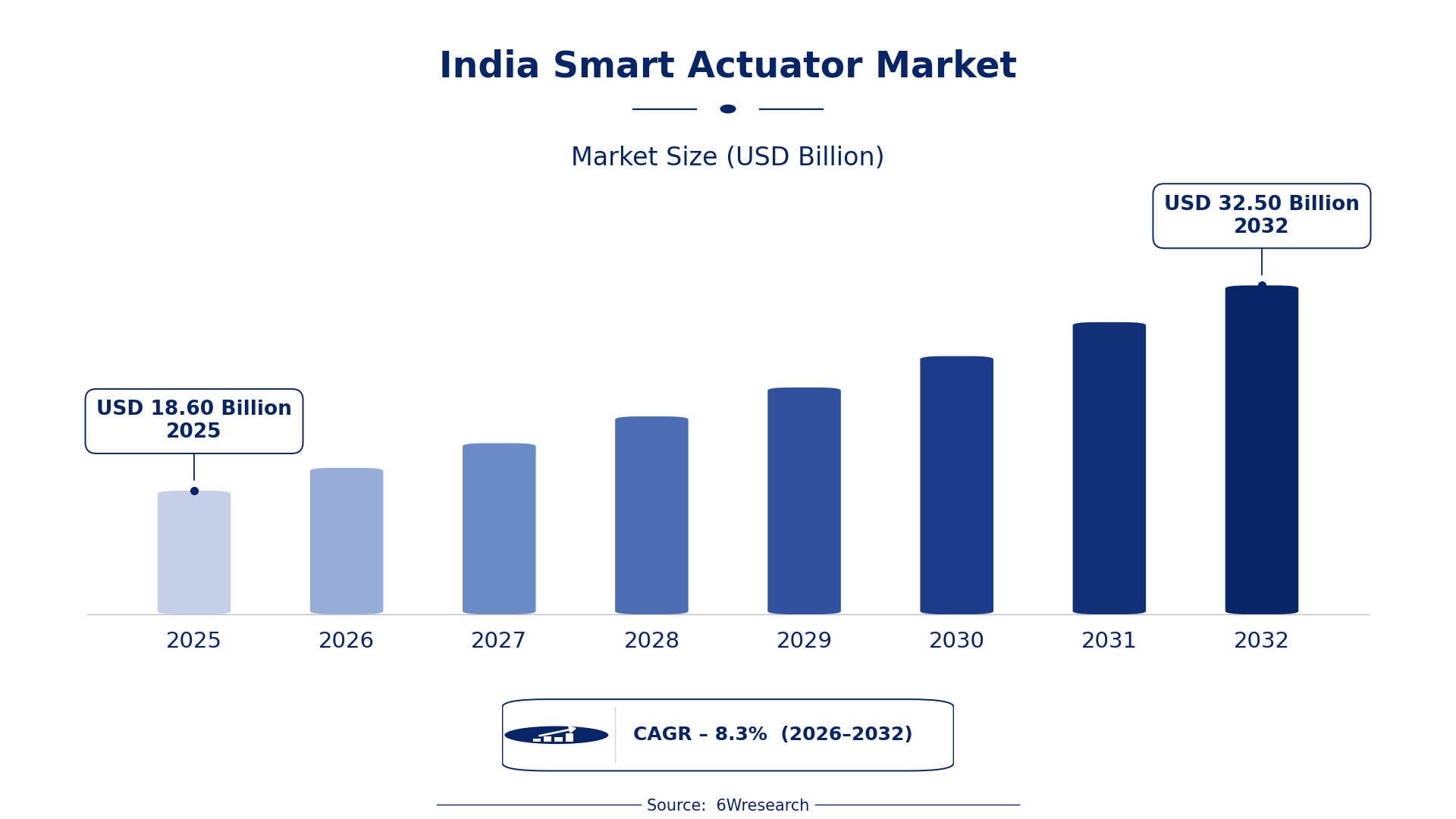
According to 6Wresearch internal database and industry insights, the India Smart Actuator Market was valued at USD 18.6 billion in 2025 and is projected to reach USD 32.50 billion by 2032, growing at a CAGR of approximately 8.3% during 2026–2032.
India Smart Actuator Market Highlights
| Report Metric | Details |
| Report Name | India Smart Actuator Market |
| Market Size 2025 | USD 18.6 billion |
| Market Size 2032 | USD 32.50 billion |
| Absolute Growth 2025–2032 | USD 13.90 billion |
| CAGR 2026–2032 | 8.3% |
| Peak Annual Growth | 11.0% in 2032 |
| Forecast Period | 2026–2032 |
| Historical Data | 2022–2025 |
| Base Year | 2025 |
| Leading Actuator Type, 2025 | Electric Smart Actuators (36% share) |
| Leading Motion Type, 2025 | Linear/Rotary (49% share) |
| Leading Control Mechanism, 2025 | Embedded Electronics (45% share) |
| Leading End User, 2025 | Industrial Automation (47% share) |
| Fastest-Growing Actuator Type | Pneumatic Smart Actuators (10.0% CAGR) |
| Fastest-Growing Motion Type | Linear (9.6% CAGR) |
| Fastest-Growing Control Mechanism | Pressure Sensors + Logic (11.0% CAGR) |
| Fastest-Growing End User | Robotics Manufacturers (9.5% CAGR) |
| Growing Sector | Industrial Automation |
| Key End Users | Industrial Automation, Robotics Manufacturers, Smart Building Integrators |
India Smart Actuator Market Year-wise Growth Rate and Key Drivers (2022–2032)
This graph illustrates the annual growth rates of the market from 2022 to 2032, highlighting a steady upward trajectory and projected market expansion over the forecast period.
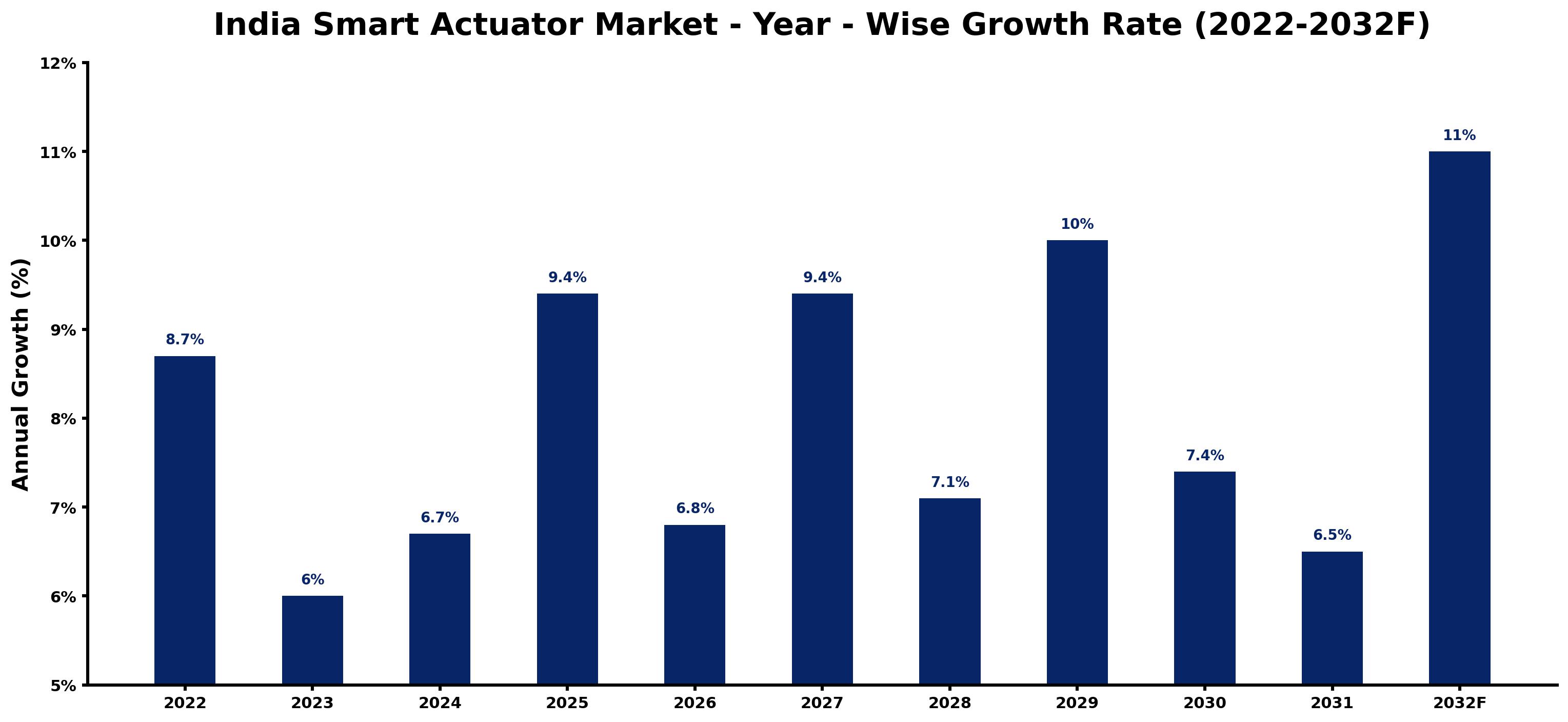
The table below sets out the estimated growth rate for each year and the main factor behind it.
| Year | Estimated Annual Growth (%) | Market Rationale |
| 2022 | 8.7 | The market experienced solid demand from industrial automation applications. |
| 2023 | 6.0 | Growth slowed due to temporary supply chain disruptions affecting production. |
| 2024 | 6.7 | Increased investments in manufacturing technologies spurred demand for smart actuators. |
| 2025 | 9.4 | The launch of new automation projects significantly boosted market growth. |
| 2026 | 6.8 | Growth slowed as the market adjusted to previous rapid expansions. |
| 2027 | 9.4 | Renewed interest in robotics applications led to a resurgence in demand. |
| 2028 | 7.1 | Market growth moderated as companies consolidated gains from earlier years. |
| 2029 | 10.0 | A surge in smart building projects drove demand for IoT-enabled actuators. |
| 2030 | 7.4 | Growth slowed as market saturation began to impact new investments. |
| 2031 | 6.5 | Demand stabilised as manufacturers adapted to evolving automation needs. |
| 2032 | 11.0 | The market peaked with significant demand from the automotive sector. |
Note: Market size estimations and growth projections presented in this report are based on 6Wresearch's proprietary forecasting methodology, utilizing the latest available industry data, government publications, and primary research inputs.
India Smart Actuator Market Synopsis
India Smart Actuator Market includes advanced devices that transform electrical signals into mechanical motion, incorporating IoT technology for use in industrial automation, robotics, and smart buildings. These smart actuators are crafted through precision engineering and electronic components. The market is poised for substantial growth driven by increasing automation demand and the 'Make in India' initiative, which supports domestic manufacturing. The National Policy on Electronics aims to elevate electronics manufacturing to $400 billion by 2025, further propelling investments in smart technologies. The automotive sector plays a crucial role, significantly contributing to market growth.
Market Dynamics Impact Analysis (2026–2032)
| Factor | Type | Impact | Primary Segment Affected |
| Rising demand for automation in industrial applications | Driver | High | Industrial Automation |
| Increasing integration of IoT technology in smart actuators | Driver | High | IoT-Enabled Actuators |
| Growing need for smart building solutions | Opportunity | High | Smart Building Integrators |
| Expansion of the automotive sector requiring advanced manufacturing technologies | Opportunity | High | Robotics Manufacturers |
| Supply chain disruptions affecting component availability | Restraint | Medium | Electric Smart Actuators |
| Challenges in meeting quality standards for new entrants | Restraint | Medium | Pneumatic Smart Actuators |
| High initial investment costs for advanced automation systems | Challenge | High | Industrial Automation |
| Limited skilled workforce in automation technologies | Challenge | Medium | Robotics Manufacturers |
Evaluation of Drivers in India Smart Actuator Market (2026–2032)
The table below links each growth driver to the segment it affects and the evidence for it.
| Drivers | Primary Segment Affected | Why It Matters (Evidence) |
| Increased automation in manufacturing processes | Industrial Automation | This trend drives demand for smart actuators, with the manufacturing sector employing over 50 million people. |
| Adoption of IoT-enabled smart technologies | IoT-Enabled Actuators | Growing smart building projects, projected to grow by 30% by 2026, boost actuator demand. |
| Support from the 'Make in India' initiative | Electric Smart Actuators | This initiative promotes domestic manufacturing, boosting local actuator production capabilities. |
| Investment in advanced manufacturing technologies | Robotics Manufacturers | The automotive sector's demand for smart actuators drives investments in robotics and automation. |
| Rising focus on quality standards | Pneumatic Smart Actuators | The Bureau of Indian Standards has established standards for smart actuators, ensuring quality assurance. |
Market growth for Smart Actuator in India is underpinned by rising end-use demand in industrial automation, which has resulted in substantial investments. The manufacturing sector employs over 50 million people, driving actuator demand. The adoption of IoT-enabled technologies is increasing, particularly in smart building projects projected to grow by 30% by 2026. Investment in advanced manufacturing technologies within the automotive sector is driving demand for smart actuators, particularly in robotics applications.
Evaluation of Restraints in India Smart Actuator Market
The table below lists the restraints and the evidence behind each.
| Market Restraint | Primary Segment Affected | Why It Matters (Evidence) |
| Supply chain disruptions affecting component availability | Electric Smart Actuators | These disruptions have led to delays in production schedules, impacting delivery timelines. |
| Challenges in meeting quality standards for new entrants | Pneumatic Smart Actuators | New entrants face difficulties in adhering to established quality benchmarks, limiting their market access. |
| High initial investment costs for advanced automation systems | Industrial Automation | The substantial capital required for implementing smart actuator systems can deter smaller manufacturers. |
| Limited skilled workforce in automation technologies | Robotics Manufacturers | A shortage of trained personnel in automation hampers the adoption of smart actuators. |
| Regulatory compliance costs for new technologies | IoT-Enabled Actuators | Compliance with evolving standards increases operational costs for manufacturers. |
India Smart Actuator Market Challenges
Buyers in the India Smart Actuator Market face regulatory hurdles as the Bureau of Indian Standards has imposed strict quality assurance standards, leading to product approval delays that can extend lead times by 20%. Technology gaps exist, as many manufacturers lack access to advanced IoT integration, which can reduce operational efficiency by 15% for those unable to modernise their systems. Rising costs impact buyers significantly due to the high price of imported components, inflating production expenses by ₹5,000 per unit. Supply chain disruptions are common, with local suppliers struggling to meet demand, causing potential project delays for manufacturers.
Trends in the India Smart Actuator Market
Four trends stand out in the India Smart Actuator Market.
- Shift towards IoT Integration in Smart Buildings: Smart Building Integrators are increasingly adopting IoT-enabled actuators, improving automation capabilities. The market for smart buildings is projected to grow by 30% by 2026, driving actuator demand.
- Growing Adoption of Robotics in Manufacturing: The automotive sector is increasingly integrating robotics, with a projected CAGR of 9.5% for Robotics Manufacturers. This trend is driving demand for smart actuators in production lines.
- Increased Focus on Quality Standards: The Bureau of Indian Standards has updated regulations for smart actuators, ensuring quality and safety. This focus is projected to boost consumer confidence and drive sales.
- Expansion of the 'Make in India' Initiative: The 'Make in India' initiative promotes local manufacturing, impacting the actuator market. The government has allocated ₹10,000 crore to enhance local manufacturing capabilities.
Investment Opportunities in the India Smart Actuator Market
Some of the investment opportunities in the India Smart Actuator Market are mentioned below.
- Growing Demand for Smart Building Solutions: With smart buildings projected to grow by 30% by 2026, there is an opportunity for suppliers of IoT-enabled actuators. Smart Building Integrators are key buyers in this sector.
- Investment in Advanced Manufacturing Technologies: The automotive sector's focus on advanced manufacturing creates opportunities for smart actuator suppliers. Collaborating with local automotive manufacturers can facilitate market entry.
- Rising Need for Automation in Industrial Processes: As industries seek to improve productivity, the demand for smart actuators will increase. Industrial Automation sectors are actively seeking suppliers to meet this demand.
- Support from Government Initiatives: The 'Make in India' initiative encourages investment in local manufacturing of smart actuators. Partnering with local manufacturers can provide a strategic entry route.
Government Initiatives in the India Smart Actuator Market
The 'Digital India' programme, initiated by the Ministry of Electronics and Information Technology in 2020, promotes the adoption of smart technologies, including IoT-enabled actuators. This initiative complements the 'Make in India' programme, launched by the Ministry of Commerce, which focuses on enhancing domestic manufacturing capabilities in smart technologies. Together, these measures aim to improve the quality and availability of smart actuators in the market. The National Policy on Electronics, announced in 2020, targets an increase in electronics manufacturing to $400 billion by 2025, further supporting the local actuator industry. These frameworks create an environment conducive to producers innovating and meeting growing demand.
The Ministry of Heavy Industries and Public Enterprises oversees the 'Automotive Mission Plan 2026', which promotes advanced manufacturing technologies, including smart actuators, in the automotive sector. This plan allocates funding to improve production capabilities and encourage innovation in smart actuator technology. Additionally, the Bureau of Indian Standards establishes quality and safety standards for smart actuators, ensuring that products meet regulatory requirements. This agency's role is crucial in certifying new products, which helps streamline the approval process for manufacturers and boosts consumer confidence in the market. The ongoing support from these agencies is crucial for sustaining growth in the smart actuator sector.
Future Insight of the India Smart Actuator Market
The India Smart Actuator Market will undergo significant changes by 2032, driven by the 'Make in India' initiative which aims to boost local manufacturing capabilities. The Digital India programme will support the integration of smart technologies across sectors, facilitating smoother operations. The automotive sector's increasing reliance on smart actuators will stimulate demand, while the government's ₹10,000 crore investment in the Atmanirbhar Bharat initiative will strengthen local production, benefiting both buyers and suppliers.
Market Segmentation Analysis
Each segment group is reviewed below, with the leader by share and the fastest grower by CAGR.
By Actuator Type – Electric Smart Actuators Dominated, Pneumatic Smart Actuators Expected to Grow Fastest
According to Dhaval Chaurasia, Assistant Manager at 6Wresearch, with a 36% revenue share in 2025, Electric Smart Actuators was the largest actuator type category. Electric Smart Actuators dominate the market share due to their widespread use in automation across various sectors. Their precision and reliability are essential in manufacturing environments, where efficiency is critical for operational success. Over 2026–2032, Pneumatic Smart Actuators are expected to post the fastest growth, at a CAGR of 10.0%. Pneumatic Smart Actuators are experiencing robust growth, particularly in manufacturing settings that require rapid and efficient operations. Their adaptability in assembly lines and other applications is a key factor in this increasing demand. Suppliers should focus on enhancing the production of pneumatic actuators to meet the rising needs of the manufacturing industry.
By Motion Type – Linear/Rotary Dominated, Linear Expected to Grow Fastest
Linear/Rotary took a 49% share of motion type in 2025, more than any other category. Linear/Rotary motion types hold a significant market share as they are crucial for a variety of automation tasks, including material handling and assembly. Their versatility across multiple sectors ensures a steady demand for these motion types. The quickest growth will come from Linear, forecast to expand at a CAGR of 9.6% between 2026 and 2032. Linear motion types are witnessing accelerated growth, particularly in robotics where precision and quick response times are vital. The expanding integration of robotics in various industries is a major contributor to this trend. Buyers should consider investing in linear motion technologies to stay competitive in the rapidly advancing automation landscape.
By Control Mechanism – Embedded Electronics Dominated, Pressure Sensors + Logic Expected to Grow Fastest
In 2025, Embedded Electronics led the control mechanism split with a 45% share. Embedded Electronics lead the control mechanism segment, as they are vital for the effective functioning of smart actuators, providing essential control and feedback. Their reliability is crucial in industrial automation, ensuring optimal performance in various applications. Pressure Sensors + Logic is projected to grow fastest, at a CAGR of 11.0% during 2026–2032. Pressure Sensors + Logic are gaining traction due to their significant role in enhancing automation system performance. The rising demand for sophisticated control mechanisms across diverse applications is driving this growth. Suppliers must prioritise advancements in sensor technologies to cater to the increasing demand for improved control solutions.
By End User – Industrial Automation Dominated, Robotics Manufacturers Expected to Grow Fastest
Industrial Automation held a 47% share of the India Smart Actuator Market by end user in 2025. Industrial Automation is the largest end user of smart actuators, utilising them extensively for process control and efficiency improvements. The sector's ongoing push towards automation guarantees a consistent demand for these devices. Robotics Manufacturers are set to record the highest CAGR in this split, 9.5% over 2026–2032. Robotics Manufacturers represent the fastest-growing end user group, integrating smart actuators to enhance system performance and capabilities. The surge in automation across manufacturing sectors is a major driver of this growth. Buyers in the robotics sector should prioritise smart actuators to enhance their product offerings and effectively respond to market needs.
Key Attractiveness of the Report
- 10 Years of Market Numbers
- Historical Data Starting from 2022 to 2025
- Base Year 2025
- Forecast Data until 2032
- Key Performance Indicators Impacting the Market
- Major Upcoming Developments and Projects
Key Highlights of the Report:
- India Smart Actuator Market Outlook
- Market Size of India Smart Actuator Market, 2025
- Forecast of India Smart Actuator Market, 2032
- Historical Data and Forecast of India Smart Actuator Revenues & Volume for the Period 2022 - 2032F
- India Smart Actuator Market Trend Evolution
- India Smart Actuator Market Drivers and Challenges
- India Smart Actuator Price Trends
- India Smart Actuator Porter's Five Forces
- India Smart Actuator Industry Life Cycle
- Historical Data and Forecast of India Smart Actuator Market Revenues & Volume By Actuator Type for the Period 2022 - 2032F
- Historical Data and Forecast of India Smart Actuator Market Revenues & Volume By Electric Smart Actuators for the Period 2022 - 2032F
- Historical Data and Forecast of India Smart Actuator Market Revenues & Volume By Pneumatic Smart Actuators for the Period 2022 - 2032F
- Historical Data and Forecast of India Smart Actuator Market Revenues & Volume By Hydraulic Smart Actuators for the Period 2022 - 2032F
- Historical Data and Forecast of India Smart Actuator Market Revenues & Volume By IoT-Enabled Actuators for the Period 2022 - 2032F
- Historical Data and Forecast of India Smart Actuator Market Revenues & Volume By Motion Type for the Period 2022 - 2032F
- Historical Data and Forecast of India Smart Actuator Market Revenues & Volume By Linear/Rotary for the Period 2022 - 2032F
- Historical Data and Forecast of India Smart Actuator Market Revenues & Volume By Linear for the Period 2022 - 2032F
- Historical Data and Forecast of India Smart Actuator Market Revenues & Volume By High Force Motion for the Period 2022 - 2032F
- Historical Data and Forecast of India Smart Actuator Market Revenues & Volume By Configurable for the Period 2022 - 2032F
- Historical Data and Forecast of India Smart Actuator Market Revenues & Volume By Control Mechanism for the Period 2022 - 2032F
- Historical Data and Forecast of India Smart Actuator Market Revenues & Volume By Embedded Electronics for the Period 2022 - 2032F
- Historical Data and Forecast of India Smart Actuator Market Revenues & Volume By Pressure Sensors + Logic for the Period 2022 - 2032F
- Historical Data and Forecast of India Smart Actuator Market Revenues & Volume By Flow & Pressure Control for the Period 2022 - 2032F
- Historical Data and Forecast of India Smart Actuator Market Revenues & Volume By Remote Monitoring for the Period 2022 - 2032F
- Historical Data and Forecast of India Smart Actuator Market Revenues & Volume By End User for the Period 2022 - 2032F
- Historical Data and Forecast of India Smart Actuator Market Revenues & Volume By Industrial Automation for the Period 2022 - 2032F
- Historical Data and Forecast of India Smart Actuator Market Revenues & Volume By Robotics Manufacturers for the Period 2022 - 2032F
- Historical Data and Forecast of India Smart Actuator Market Revenues & Volume By Heavy Machinery OEMs for the Period 2022 - 2032F
- Historical Data and Forecast of India Smart Actuator Market Revenues & Volume By Smart Building Integrators for the Period 2022 - 2032F
- India Smart Actuator Import Export Trade Statistics
- Market Opportunity Assessment By Actuator Type
- Market Opportunity Assessment By Motion Type
- Market Opportunity Assessment By Control Mechanism
- Market Opportunity Assessment By End User
- India Smart Actuator Top Companies Market Share
- India Smart Actuator Competitive Benchmarking By Technical and Operational Parameters
- India Smart Actuator Company Profiles
- India Smart Actuator Key Strategic Recommendations
Market Covered
Segments analysed in this report are listed below.
By Actuator Type
- Electric Smart Actuators
- Pneumatic Smart Actuators
- Hydraulic Smart Actuators
- IoT-Enabled Actuators
By Motion Type
- Linear/Rotary
- Linear
- High Force Motion
- Configurable
By Control Mechanism
- Embedded Electronics
- Pressure Sensors + Logic
- Flow & Pressure Control
- Remote Monitoring
By End User
- Industrial Automation
- Robotics Manufacturers
- Heavy Machinery OEMs
- Smart Building Integrators































