India Smart Battery Sensing Technologies Market Size & Growth Rate
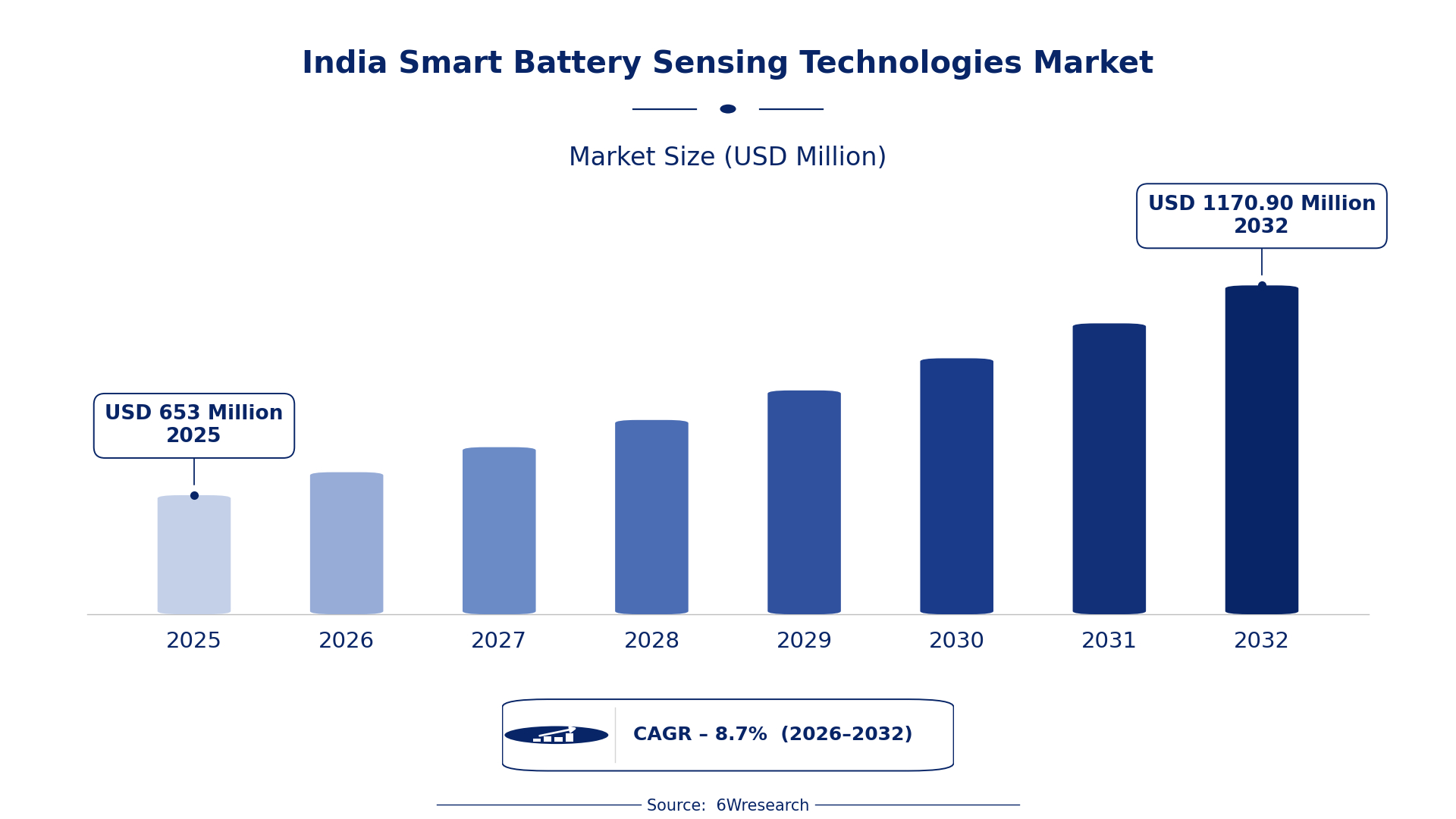
According to 6Wresearch internal database and industry insights, the India Smart Battery Sensing Technologies Market was valued at USD 653.0 million in 2025 and is projected to reach USD 1,170.90 million by 2032, growing at a CAGR of approximately 8.7% during 2026–2032.
India Smart Battery Sensing Technologies Market Highlights
| Report Metric | Details |
| Report Name | India Smart Battery Sensing Technologies Market |
| Market Size 2025 | USD 653.0 million |
| Market Size 2032 | USD 1,170.90 million |
| Absolute Growth 2025–2032 | USD 517.90 million |
| CAGR 2026–2032 | 8.7% |
| Peak Annual Growth | 10.8% in 2030 |
| Forecast Period | 2026–2032 |
| Historical Data | 2022–2025 |
| Base Year | 2025 |
| Leading Sensor Type, 2025 | Current Sensors (41% share) |
| Leading Measured Variable, 2025 | Real-Time Load (49% share) |
| Leading Output Interface, 2025 | Analog/Digital (34% share) |
| Leading End User, 2025 | EV Battery System Vendors (49% share) |
| Fastest-Growing Sensor Type | Voltage Sensors (10.2% CAGR) |
| Fastest-Growing Output Interface | CAN/I²C/SPI (10.9% CAGR) |
| Fastest-Growing End User | Battery Management Firms (11.2% CAGR) |
| Growing Sector | Battery Management Firms |
| Key End Users | EV Battery System Vendors, Battery Management Firms, Industrial UPS Providers, Consumer Device Makers |
India Smart Battery Sensing Technologies Market Year-wise Growth Rate and Key Drivers (2022–2032)
This graph illustrates the annual growth rates of the market from 2022 to 2032, highlighting a steady upward trajectory and projected market expansion over the forecast period.
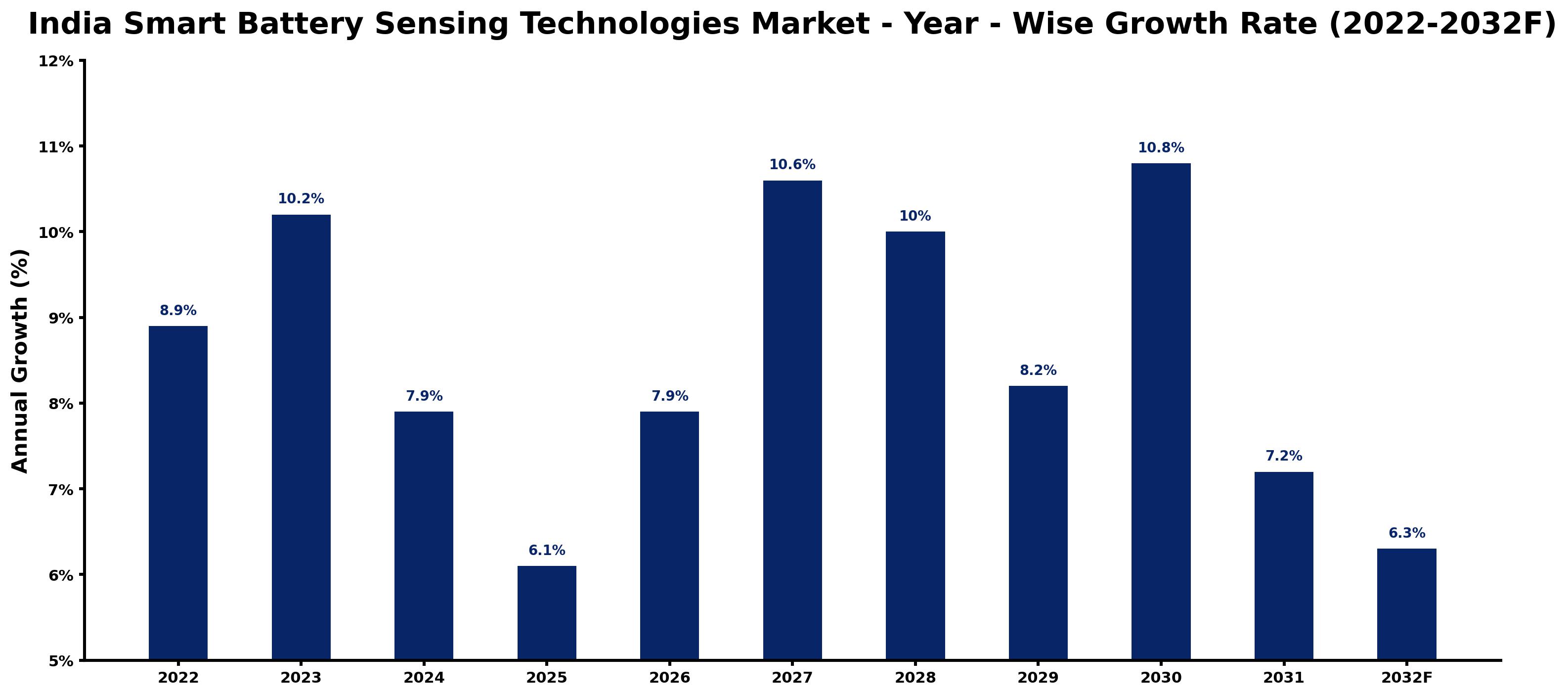
The following table presents the estimated annual growth rate for each year together with the principal factor influencing market performance.
| Year | Estimated Annual Growth (%) | Market Rationale |
| 2022 | 8.9 | The market experienced steady growth due to rising electric vehicle adoption driven by the National Electric Mobility Mission Plan. |
| 2023 | 10.2 | Demand surged as the National Electric Mobility Mission Plan promoted battery technologies and electric vehicle integration. |
| 2024 | 7.9 | Growth slowed as manufacturers adjusted to new safety standards established by the Bureau of Indian Standards. |
| 2025 | 6.1 | Market growth decelerated as competition intensified among battery technology providers, impacting pricing strategies. |
| 2026 | 7.9 | Demand is expected to rise with increased investment in battery management systems supported by the Make in India initiative. |
| 2027 | 10.6 | Growth is anticipated to accelerate as battery recycling initiatives gain traction following the Ministry of Heavy Industries' program. |
| 2028 | 10.0 | Market expansion is projected to slow as the industry matures and the installed base of technologies stabilises. |
| 2029 | 8.2 | Demand is expected to moderate as technology integration becomes standard across various applications. |
| 2030 | 10.8 | A notable rise in growth is projected as electric vehicle penetration reaches 30% by 2030, enhancing battery technology demand. |
| 2031 | 7.2 | Market growth is expected to slow as the focus shifts to efficiency and sustainability in battery management. |
| 2032 | 6.3 | Growth is anticipated to stabilise as the market reaches maturity with established standards. |
Note: Market size estimations and growth projections presented in this report are based on 6Wresearch's proprietary forecasting methodology, utilizing the latest available industry data, government publications, and primary research inputs.
India Smart Battery Sensing Technologies Market Synopsis
Smart Battery Sensing Technologies Market in India includes advanced sensors that monitor battery health and performance, ensuring safety and optimising efficiency in electric vehicles. Demand is driven by the increasing adoption of electric vehicles and supportive government initiatives. The National Electric Mobility Mission Plan aims to improve battery technologies, stimulating further growth. Additionally, the Production Linked Incentive Scheme encourages local manufacturing, contributing to market expansion.
Market Dynamics Impact Analysis (2026–2032)
| Factor | Type | Impact | Primary Segment Affected |
| Rising electric vehicle adoption drives demand for battery monitoring solutions. | Driver | High | Real-Time Load |
| Increased focus on battery safety standards enhances the need for monitoring technologies. | Driver | High | Voltage Sensors |
| The growing installed base of UPS systems creates demand for battery management technologies. | Opportunity | High | Current Sensors |
| The expansion of battery recycling initiatives opens new markets for smart battery technologies. | Opportunity | Medium | Temperature Sensors |
| High competition among manufacturers may lead to pricing pressures. | Restraint | Medium | Safety Monitoring Units |
| The complexity of integrating new technologies can slow adoption rates. | Restraint | High | Analog/Digital |
| The Smart Battery Sensing Technologies Market in India faces challenges from regulatory compliance. | Challenge | High | Gas Sensors |
| Limited consumer awareness about battery management systems may hinder growth. | Challenge | Medium | Battery Swelling Gases |
Evaluation of Drivers in India Smart Battery Sensing Technologies Market (2026–2032)
The table below links each growth driver to the segment it affects and the evidence for it.
| Drivers | Primary Segment Affected | Why It Matters (Evidence) |
| Increased electric vehicle production boosts demand for battery monitoring technologies. | Real-Time Load | The surge in electric vehicle production, projected to reach 30% penetration by 2030, leads to higher demand for effective battery management solutions. |
| Government initiatives promote battery safety standards, driving market demand. | Voltage Sensors | The Bureau of Indian Standards established guidelines in 2021, prompting manufacturers to adopt advanced safety technologies. |
| The installed base of UPS systems drives demand for smart battery technologies. | Current Sensors | With over 1 million UPS systems in India, users increasingly seek technologies to monitor battery performance effectively. |
| Growing battery recycling initiatives create new opportunities for monitoring technologies. | Temperature Sensors | The Ministry of Heavy Industries launched a battery recycling program in 2023, increasing demand for safety monitoring systems. |
| The Make in India initiative supports local manufacturing of smart battery technologies. | Analog/Digital | The initiative encourages domestic production, leading to increased availability of advanced battery management solutions. |
The installed base of UPS systems, exceeding 1 million units, drives demand for effective battery monitoring technologies. The National Electric Mobility Mission Plan promotes electric vehicle adoption, projected to reach 30% by 2030, further boosting demand for smart battery solutions. The Production Linked Incentive Scheme will stimulate local manufacturing, improving the availability of advanced technologies. Consequently, battery management firms are likely to invest more in these solutions to optimise performance and safety.
Evaluation of Restraints in India Smart Battery Sensing Technologies Market
The main factors holding the market back are set out below.
| Market Restraint | Primary Segment Affected | Why It Matters (Evidence) |
| High compliance costs for safety standards | Safety Monitoring Units | Compliance with the Bureau of Indian Standards can increase production costs by up to 15%, affecting pricing strategies. |
| Limited skilled workforce for advanced technologies | Battery Management Firms | The rapid pace of semiconductor technology advancements exceeds current workforce training, delaying product development. |
| Intense competition from international suppliers | EV Battery System Vendors | Fierce competition drives down prices, which can reduce profit margins and hinder investment in innovation. |
| Regulatory uncertainties regarding subsidies | Battery Management Firms | Changes in subsidy schemes create planning challenges, complicating long-term investment strategies. |
| Market dependency on imported components | Voltage Sensors | High reliance on imports for critical components can disrupt supply chains and inflate costs. |
India Smart Battery Sensing Technologies Market Challenges
Buyers in the India Smart Battery Sensing Technologies market face a significant skills gap, as the rapid pace of semiconductor advancements outstrips the current workforce training, delaying product development timelines. Producers encounter fierce competition from international suppliers, which drives down prices and squeezes profit margins, making it difficult to invest in innovation. Importers grapple with rising costs associated with compliance to the Bureau of Indian Standards, where safety feature upgrades can inflate prices by as much as 15%, impacting affordability for consumers. Regulatory changes, such as the recent subsidy scheme for battery manufacturers, create uncertainty, complicating long-term planning for producers and importers alike.
Trends in the India Smart Battery Sensing Technologies Market
Buyers and suppliers in the India Smart Battery Sensing Technologies Market are adjusting to the following trends.
- Shift towards Enhanced Battery Safety Standards: The Bureau of Indian Standards established new guidelines in 2021, promoting advanced safety technologies in battery management. This shift is prompting manufacturers to adopt smarter solutions, with the market expected to grow substantially in the coming years.
- Transition from Traditional to Smart Battery Management: The National Electric Mobility Mission Plan, launched in 2020, is encouraging manufacturers to integrate smart battery technologies. This transition is expected to improve safety and performance, with the market anticipated to expand as a result.
- Emerging Focus on Battery Recycling Initiatives: In 2023, the Ministry of Heavy Industries launched a program to support battery recycling. This initiative is expected to create new demand for smart battery technologies, contributing to market growth over the next few years.
- Prioritisation of Local Manufacturing: The Make in India initiative is promoting domestic production of smart battery technologies. This focus is expected to reduce import dependency and strengthen local supply chains, with notable growth anticipated by 2032.
Investment Opportunities in the India Smart Battery Sensing Technologies Market
The following opportunities in the India Smart Battery Sensing Technologies Market pair current demand with a clear way in.
- Smart Battery Monitoring Solutions: With the electric vehicle market projected to grow significantly, there is a demand for advanced monitoring solutions. EV Battery System Vendors in Maharashtra are seeking technologies to improve battery performance, creating investment opportunities in this region.
- Battery Management Systems for UPS Providers: The installed base of over 1 million UPS systems in India presents a need for advanced battery management systems. Industrial UPS Providers are looking for innovative solutions to enhance reliability, creating a market gap worth exploring.
- Safety Monitoring Units for Consumer Electronics: As battery management systems integrate into consumer electronics, the demand for safety monitoring units is rising. Consumer Device Makers are investing in these technologies, highlighting opportunities for suppliers to meet this growing need.
- Temperature Sensors for Enhanced Performance: With increasing focus on battery safety, the demand for temperature sensors is expected to rise. Battery Management Firms are seeking reliable solutions, presenting a promising opportunity for suppliers in this segment.
Government Initiatives in the India Smart Battery Sensing Technologies Market
The National Electric Mobility Mission Plan 2020 aims to boost electric vehicle adoption and battery technology development, led by the Ministry of Heavy Industries. This initiative encourages manufacturers to innovate and invest in smart battery technologies, supporting growth in the sector. The Production Linked Incentive Scheme for Advanced Chemistry Cell Battery Storage, launched in 2021, has a budget of ₹18,100 crores to promote domestic manufacturing, further aiding the smart battery sensing technologies market.
The Ministry of Environment enforces the Battery Waste Management Rules 2022, promoting safe disposal and recycling of batteries. This regulation impacts producers by requiring compliance with safety standards, which can enhance market credibility. The Automotive Research Association of India is involved in setting battery technology standards, ensuring that manufacturers meet regulatory requirements and promoting industry growth.
Future Insight of the India Smart Battery Sensing Technologies Market
Several forward-looking factors should support the India Smart Battery Sensing Technologies market in the coming years. The National Electric Mobility Mission Plan will drive demand for smart battery solutions as electric vehicle adoption accelerates. By 2025, the Indian government plans to invest ₹10,000 crores in electric vehicle infrastructure, creating new opportunities for suppliers. The integration of advanced battery management systems into consumer electronics will improve overall safety and performance, benefiting both producers and buyers.
Market Segmentation Analysis
The report offers a comprehensive study of the following market segments and their leading categories in the market.
By Sensor Type – Current Sensors Dominated, Voltage Sensors Expected to Grow Fastest
According to Dhaval Chaurasia, Assistant Manager at 6Wresearch, in 2025, Current Sensors led the sensor type split with a 41% share. Current Sensors hold the largest share of the India Smart Battery Sensing Technologies Market due to their critical role in monitoring battery load and performance. Their significance is highlighted by the growing electric vehicle sector, particularly in Maharashtra, which serves as a manufacturing hub. Over 2026–2032, Voltage Sensors are expected to post the fastest growth, at a CAGR of 10.2%. Voltage Sensors are experiencing the fastest growth as they are vital for ensuring safe battery voltage levels, especially within electric vehicles. The rapid increase in electric vehicle adoption, supported by government initiatives, is significantly driving demand for these sensors. Suppliers should focus on enhancing voltage sensing technologies to meet the rising requirements of electric vehicle manufacturers.
By Measured Variable – Real-Time Load Dominated and Is Expected to Record the Fastest Growth
With a 49% revenue share in 2025, Real-Time Load was the largest measured variable category. Real-Time Load is the leading measured variable in this market due to its critical role in managing battery usage effectively. The rising dependence on battery systems in electric vehicles and UPS applications has cemented its significance. Real-Time Load is also forecast to expand faster than any other category, at a CAGR of 10.9% over 2026–2032. Real-Time Load is also the fastest-growing variable, as its role in optimising battery performance gains recognition. The emphasis on efficient energy management in electric vehicles will further drive the expansion of this segment. Buyers should invest in technologies that provide real-time load data to improve battery efficiency and lifespan.
By Output Interface – Analog/Digital Dominated, CAN/I²C/SPI Expected to Grow Fastest
Analog/Digital took a 34% share of output interface in 2025, more than any other category. Analog/Digital interfaces dominate the market as they are fundamental for signal processing in battery systems. Their widespread use in various applications, including electric vehicles, ensures their continued relevance and market share. CAN/I²C/SPI is set to record the highest CAGR in this split, 10.9% over 2026–2032. CAN/I²C/SPI interfaces are growing rapidly, driven by their necessity for communication between battery components in complex systems. As battery management systems become more integrated, the demand for these interfaces will continue to rise. Suppliers should prioritise the development of CAN/I²C/SPI interfaces to cater to the evolving needs of battery management systems.
By End User – EV Battery System Vendors Dominated, Battery Management Firms Expected to Grow Fastest
EV Battery System Vendors accounted for a 49% market share by end user in 2025. EV Battery System Vendors represent the largest share of end users in the market, being the main consumers of smart battery sensing technologies in electric vehicles. The surge in electric vehicle production across India has directly increased their demand for advanced battery monitoring solutions. Battery Management Firms are projected to grow fastest, at a CAGR of 11.2% during 2026–2032. Battery Management Firms are the fastest-growing end user segment, as their role in optimising battery performance becomes increasingly important. The emphasis on improving battery safety and longevity in electric vehicles is propelling this rapid growth. Suppliers should consider forming partnerships with battery management firms to leverage their expertise in optimising battery technologies.
Key Attractiveness of the Report
- 10 Years of Market Numbers
- Historical Data Starting from 2022 to 2025
- Base Year 2025
- Forecast Data until 2032
- Key Performance Indicators Impacting the Market
- Major Upcoming Developments and Projects
Key Highlights of the Report:
- India Smart Battery Sensing Technologies Market Outlook
- Market Size of India Smart Battery Sensing Technologies Market, 2025
- Forecast of India Smart Battery Sensing Technologies Market, 2032
- Historical Data and Forecast of India Smart Battery Sensing Technologies Revenues & Volume for the Period 2022 - 2032F
- India Smart Battery Sensing Technologies Market Trend Evolution
- India Smart Battery Sensing Technologies Market Drivers and Challenges
- India Smart Battery Sensing Technologies Price Trends
- India Smart Battery Sensing Technologies Porter's Five Forces
- India Smart Battery Sensing Technologies Industry Life Cycle
- Historical Data and Forecast of India Smart Battery Sensing Technologies Market Revenues & Volume By Sensor Type for the Period 2022 - 2032F
- Historical Data and Forecast of India Smart Battery Sensing Technologies Market Revenues & Volume By Current Sensors for the Period 2022 - 2032F
- Historical Data and Forecast of India Smart Battery Sensing Technologies Market Revenues & Volume By Voltage Sensors for the Period 2022 - 2032F
- Historical Data and Forecast of India Smart Battery Sensing Technologies Market Revenues & Volume By Temperature Sensors for the Period 2022 - 2032F
- Historical Data and Forecast of India Smart Battery Sensing Technologies Market Revenues & Volume By Gas Sensors for the Period 2022 - 2032F
- Historical Data and Forecast of India Smart Battery Sensing Technologies Market Revenues & Volume By Measured Variable for the Period 2022 - 2032F
- Historical Data and Forecast of India Smart Battery Sensing Technologies Market Revenues & Volume By Real-Time Load for the Period 2022 - 2032F
- Historical Data and Forecast of India Smart Battery Sensing Technologies Market Revenues & Volume By Overcharge Detection for the Period 2022 - 2032F
- Historical Data and Forecast of India Smart Battery Sensing Technologies Market Revenues & Volume By Thermal Runaway Alerts for the Period 2022 - 2032F
- Historical Data and Forecast of India Smart Battery Sensing Technologies Market Revenues & Volume By Battery Swelling Gases for the Period 2022 - 2032F
- Historical Data and Forecast of India Smart Battery Sensing Technologies Market Revenues & Volume By Output Interface for the Period 2022 - 2032F
- Historical Data and Forecast of India Smart Battery Sensing Technologies Market Revenues & Volume By Analog/Digital for the Period 2022 - 2032F
- Historical Data and Forecast of India Smart Battery Sensing Technologies Market Revenues & Volume By CAN/I C/SPI for the Period 2022 - 2032F
- Historical Data and Forecast of India Smart Battery Sensing Technologies Market Revenues & Volume By Thermistor/RTD for the Period 2022 - 2032F
- Historical Data and Forecast of India Smart Battery Sensing Technologies Market Revenues & Volume By Safety Monitoring Units for the Period 2022 - 2032F
- Historical Data and Forecast of India Smart Battery Sensing Technologies Market Revenues & Volume By End User for the Period 2022 - 2032F
- Historical Data and Forecast of India Smart Battery Sensing Technologies Market Revenues & Volume By EV Battery System Vendors for the Period 2022 - 2032F
- Historical Data and Forecast of India Smart Battery Sensing Technologies Market Revenues & Volume By Battery Management Firms for the Period 2022 - 2032F
- Historical Data and Forecast of India Smart Battery Sensing Technologies Market Revenues & Volume By Consumer Device Makers for the Period 2022 - 2032F
- Historical Data and Forecast of India Smart Battery Sensing Technologies Market Revenues & Volume By Industrial UPS Providers for the Period 2022 - 2032F
- India Smart Battery Sensing Technologies Import Export Trade Statistics
- Market Opportunity Assessment By Sensor Type
- Market Opportunity Assessment By Measured Variable
- Market Opportunity Assessment By Output Interface
- Market Opportunity Assessment By End User
- India Smart Battery Sensing Technologies Top Companies Market Share
- India Smart Battery Sensing Technologies Competitive Benchmarking By Technical and Operational Parameters
- India Smart Battery Sensing Technologies Company Profiles
- India Smart Battery Sensing Technologies Key Strategic Recommendations
Market Covered
This report examines the market across the segments below.
By Sensor Type
- Current Sensors
- Voltage Sensors
- Temperature Sensors
- Gas Sensors
By Measured Variable
- Real-Time Load
- Overcharge Detection
- Thermal Runaway Alerts
- Battery Swelling Gases
By Output Interface
- Analog/Digital
- CAN/I²C/SPI
- Thermistor/RTD
- Safety Monitoring Units
By End User
- EV Battery System Vendors
- Battery Management Firms
- Consumer Device Makers
- Industrial UPS Providers































