India Smart Card Reader Market Size & Growth Rate
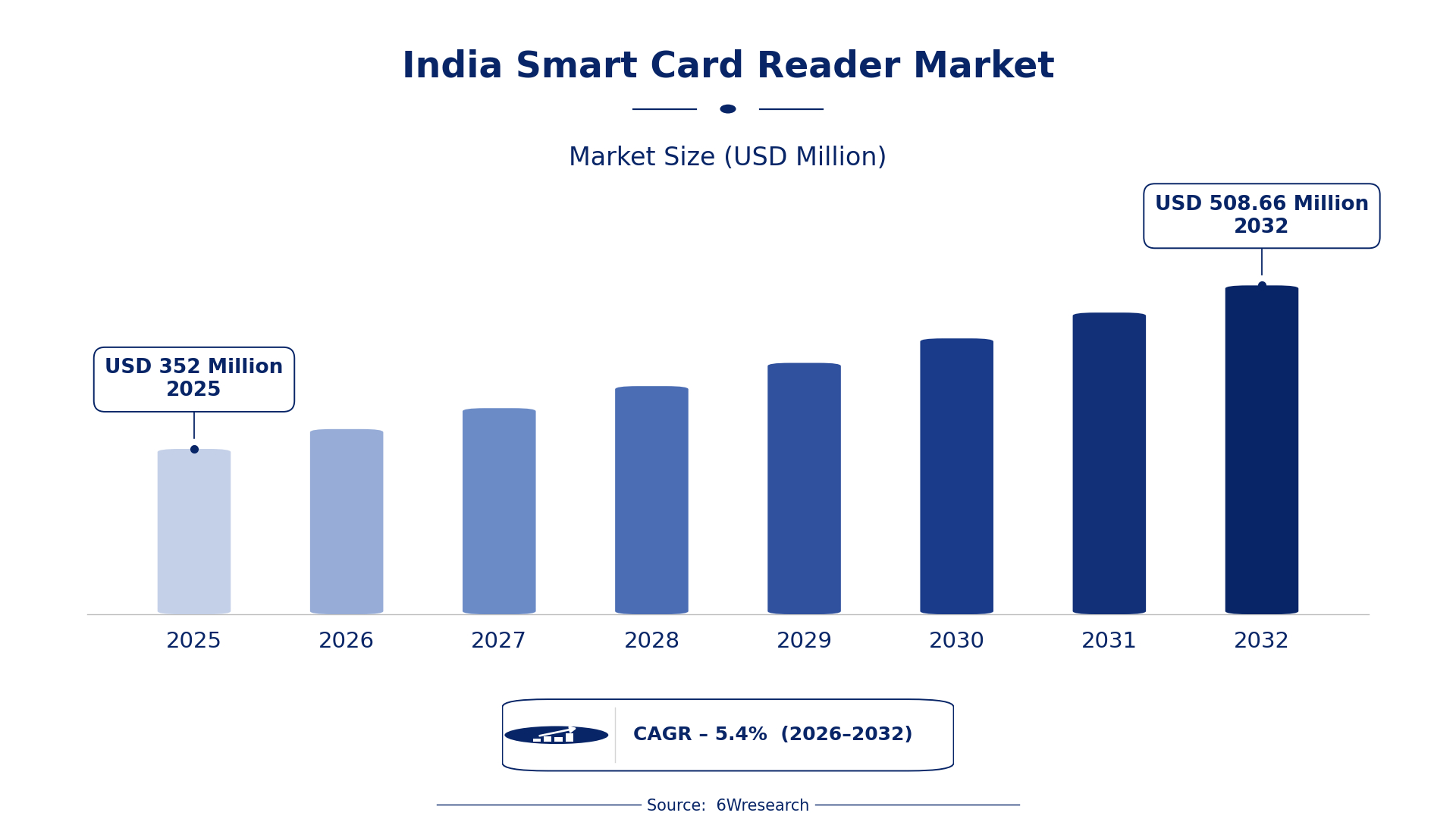
According to 6Wresearch internal database and industry insights, the India Smart Card Reader Market was valued at USD 352.0 million in 2025 and is projected to reach USD 508.66 million by 2032, growing at a CAGR of approximately 5.4% during 2026–2032.
India Smart Card Reader Market Highlights
| Report Metric | Details |
| Report Name | India Smart Card Reader Market |
| Market Size 2025 | USD 352.0 million |
| Market Size 2032 | USD 508.66 million |
| Absolute Growth 2025–2032 | USD 156.66 million |
| CAGR 2026–2032 | 5.4% |
| Peak Annual Growth | 7.5% in 2030 |
| Forecast Period | 2026–2032 |
| Historical Data | 2022–2025 |
| Base Year | 2025 |
| Leading Reader Type, 2025 | Contactless Readers (48% share) |
| Leading Interface Type, 2025 | RFID/NFC (36% share) |
| Leading Application Sector, 2025 | Banking Authentication (51% share) |
| Leading End User, 2025 | FinTech Providers (43% share) |
| Fastest-Growing Reader Type | Dual Interface Readers (7.5% CAGR) |
| Fastest-Growing Interface Type | Bluetooth/USB-C (8.0% CAGR) |
| Fastest-Growing Application Sector | Mobile Payments (7.5% CAGR) |
| Growing Sector | Banking and Finance |
| Key End Users | Banks, Government Agencies, Public Transport Operators, FinTech Providers |
India Smart Card Reader Market Year-wise Growth Rate and Key Drivers (2022–2032)
This graph illustrates the annual growth rates of the market from 2022 to 2032, highlighting a steady upward trajectory and projected market expansion over the forecast period.
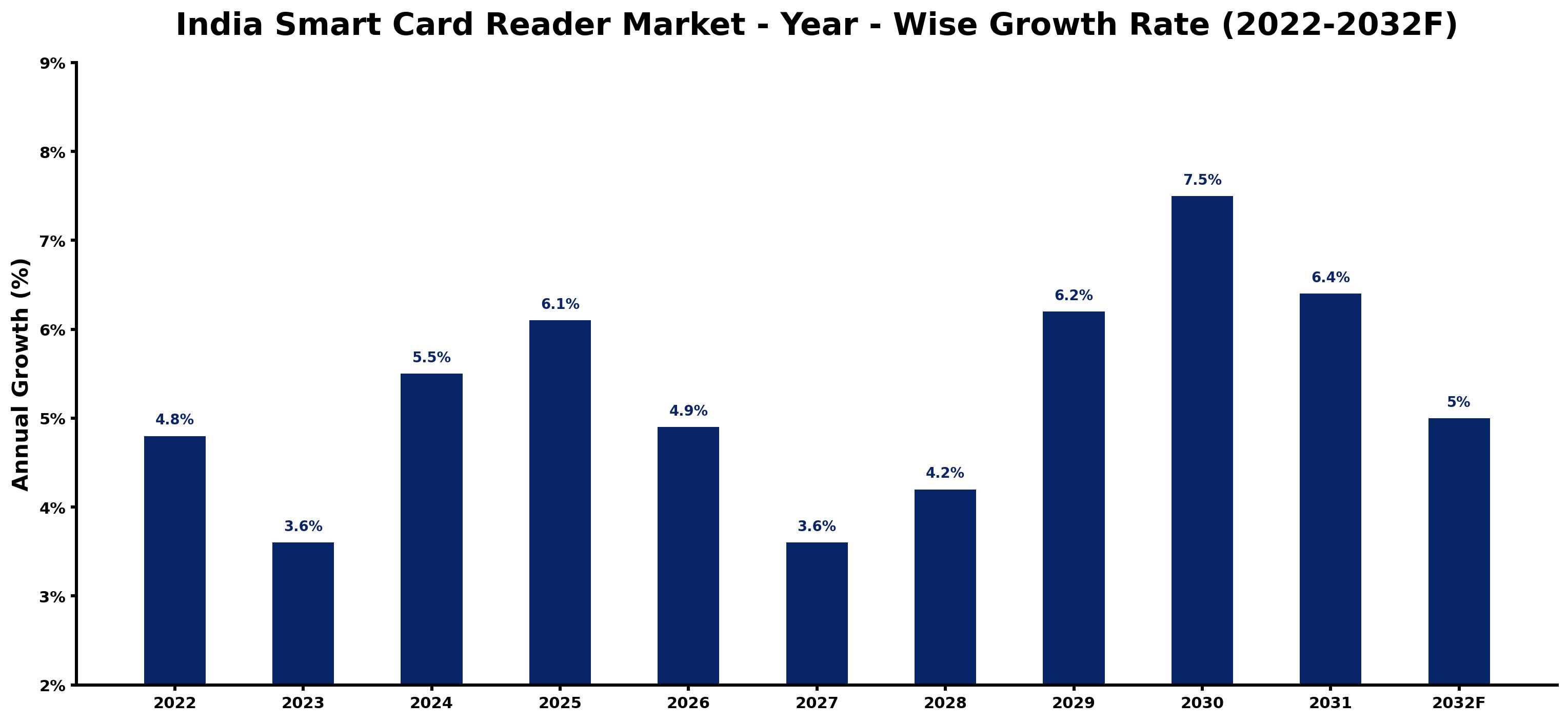
Annual growth estimates for each year appear below with the principal reason behind them, explaining the shifts that set the pace of the market.
| Year | Estimated Annual Growth (%) | Market Rationale |
| 2022 | 4.8 | The market experienced steady growth due to the rising adoption of digital payment solutions. |
| 2023 | 3.6 | Growth slowed as the market adjusted to new standards set by the Reserve Bank of India. |
| 2024 | 5.5 | Increased demand for secure transactions in banking boosted market growth significantly. |
| 2025 | 6.1 | The introduction of new smart card technologies further accelerated growth in the sector. |
| 2026 | 4.9 | Growth slowed as the market faced challenges in regulatory approvals for new devices. |
| 2027 | 3.6 | Demand remained stable, driven by the ongoing expansion of digital payment infrastructure. |
| 2028 | 4.2 | A resurgence in mobile payment solutions led to faster growth in the market. |
| 2029 | 6.2 | The market grew rapidly as more public transit systems adopted smart card technology. |
| 2030 | 7.5 | Peak growth was driven by the government's push for digital identity verification systems. |
| 2031 | 6.4 | Growth slowed slightly as the market began to stabilise after peak demand. |
| 2032 | 5.0 | The market continues to grow, supported by ongoing investments in digital infrastructure. |
Note: Market size estimations and growth projections presented in this report are based on 6Wresearch's proprietary forecasting methodology, utilizing the latest available industry data, government publications, and primary research inputs.
India Smart Card Reader Market Synopsis
The Smart Card Reader Market in India encompasses electronic devices that read data from smart cards embedded with microchips. These devices are essential for secure banking transactions, access control systems, and identification verification. The market is growing due to the increasing reliance on digital payment solutions and government initiatives like the Digital India programme. With over 200 million debit and credit cards in circulation, demand is driven by both domestic users and public transport systems adopting smart card technology.
Market Dynamics Impact Analysis (2026–2032)
| Factor | Type | Impact | Primary Segment Affected |
| Rising adoption of digital payment solutions drives demand for secure transactions. | Driver | High | Banking Authentication |
| Expansion of public transit systems adopting smart card technology creates new opportunities. | Opportunity | High | Transport/Access Control |
| Regulatory challenges in device approvals slow down market growth. | Restraint | High | Contact Card Readers |
| Limited awareness of smart card technology in rural areas restrains market expansion. | Restraint | Medium | Mobile Smart Readers |
| Growing number of FinTech providers increases demand for secure authentication solutions. | Driver | High | FinTech Providers |
| The shift towards mobile payments presents significant opportunities for investment. | Opportunity | High | Mobile Payments |
| Supply chain disruptions affect the availability of smart card readers. | Challenge | Medium | Dual Interface Readers |
| High costs associated with compliance to new standards impact profitability. | Challenge | High | Contactless Readers |
Evaluation of Drivers in India Smart Card Reader Market (2026–2032)
The table below links each growth driver to the segment it affects and the evidence for it.
| Drivers | Primary Segment Affected | Why It Matters (Evidence) |
| Increased debit and credit card circulation boosts demand for smart card readers. | Banking Authentication | With over 200 million cards in circulation, banks require more readers for secure transactions. |
| The Digital India initiative promotes digital infrastructure, driving reader demand. | Transport/Access Control | The initiative encourages smart card usage in public transit systems, increasing reader installations. |
| The rise of mobile payments creates demand for versatile smart card readers. | Mobile Payments | As mobile payment solutions grow, more readers are needed for secure transactions. |
| Expansion of public transit systems adopting smart card technology increases demand. | Public Transit Systems | Over 50% of major cities use smart card technology, necessitating more readers for ticketing. |
| Government mandates for identity verification drive smart card reader usage. | National ID/Corporate Use | The Aadhaar Act requires smart card readers for identity verification in government services. |
Growth in the Smart Card Reader market in India comes from rising debit and credit card circulation, which has surpassed 200 million, necessitating more secure transaction devices. The increasing popularity of mobile payments drives demand for versatile smart card readers, as more consumers seek secure transaction methods. Public transit systems are adopting smart card technology, with over 50% of major cities implementing these solutions.
Evaluation of Restraints in India Smart Card Reader Market
The key brakes on demand, and where they bite hardest, are shown below.
| Market Restraint | Primary Segment Affected | Why It Matters (Evidence) |
| Regulatory challenges in device approvals slow down market growth. | Contact Card Readers | Compliance with new standards set by the Reserve Bank of India delays reader availability. |
| Limited awareness of smart card technology in rural areas restrains market expansion. | Mobile Smart Readers | Many rural users remain unaware of the benefits of smart card readers, limiting adoption. |
| Supply chain disruptions affect the availability of smart card readers. | Dual Interface Readers | Global supply chain issues have led to delays in the production of essential components. |
| High costs associated with compliance to new standards impact profitability. | Contactless Readers | Manufacturers face increased expenses to meet the Reserve Bank of India's security standards. |
| Competition from alternative payment solutions limits market share for smart card readers. | FinTech Providers | Emerging technologies like biometric payments offer alternatives that may reduce reader demand. |
India Smart Card Reader Market Challenges
A shortage of skilled technicians in India hampers the smart card reader market, causing installation delays for banks and transport operators that rely on these devices. High sourcing costs for electronic components inflate prices for suppliers, which limits their competitiveness and reduces profit margins. Regulatory compliance with guidelines from the Bureau of Indian Standards results in lengthy approval processes, frustrating buyers who need timely access to new technologies. Rapid advancements in technology lead to frequent obsolescence of existing smart card readers, increasing replacement costs for end users and pushing them to seek more affordable alternatives.
Trends in the India Smart Card Reader Market
Several trends are reshaping the India Smart Card Reader Market; the most important are set out below.
- Shift from Contact to Contactless Technology: Since 2020, there has been a shift towards contactless smart card readers, driven by the demand for quicker transactions. The Smart Cities Mission has facilitated this transition, with over 50% of public transit systems adopting contactless technology.
- Emergence of Mobile Payment Solutions: The rise of mobile payment solutions has transformed the smart card reader market. In 2023, the government allocated funds to improve digital payment infrastructure, resulting in a surge in mobile smart reader adoption.
- Increased Focus on Digital Identity Verification: Updates to the Aadhaar Act in 2021 have intensified the emphasis on digital identity verification. This shift has led to a growing demand for smart card readers in government services, impacting over 1.3 billion citizens.
- Expansion of Smart Card Use in Corporate Sectors: Since 2020, corporate sectors have increasingly embraced smart card technology for employee identification. The Bureau of Indian Standards has laid out guidelines, resulting in a rise in smart card reader installations.
Investment Opportunities in the India Smart Card Reader Market
Some of the investment opportunities in the India Smart Card Reader Market are mentioned below.
- Investment in Mobile Payment Infrastructure: With over 1.3 billion mobile subscribers, there is a notable gap in mobile payment solutions. Investing in mobile smart readers can attract FinTech providers looking to broaden their offerings.
- Partnerships for Smart Card Technology Implementation: The Smart Cities Mission offers opportunities for partnerships in urban transport systems. Collaborating with local governments can streamline the deployment of smart card technology.
- Expansion in Rural Areas: The government's initiative to enhance digital infrastructure in rural areas creates a demand for smart card readers. Targeting rural banks and local transport systems can yield substantial returns.
- Development of Hybrid Smart Card Readers: The growing need for versatile payment solutions highlights the demand for hybrid smart card readers. Focusing on development can capture interest from banking and corporate sectors.
Government Initiatives in the India Smart Card Reader Market
The Digital India Programme, launched by the Ministry of Electronics and Information Technology in 2020, aims to enhance digital infrastructure nationwide. This initiative encourages the adoption of smart card technology across various sectors, ensuring secure transactions and identity verification. The UIDAI's Aadhaar Act, updated in 2021, mandates the use of smart card readers for identity verification in government services, thereby increasing their demand. The Reserve Bank of India's standards for secure banking transactions further support market growth by ensuring compliance and security in financial operations.
In 2023, the government allocated USD 1 billion to improve digital payment infrastructure in rural areas, overseen by the Ministry of Electronics and Information Technology. This funding aims to enhance accessibility and promote the adoption of smart card technology in underserved regions, benefiting local banks and transport systems. The National Digital Payment Mission, initiated by the Reserve Bank of India in 2021, focuses on advancing digital payment systems, including smart card usage, to improve financial inclusion.
Future Insight of the India Smart Card Reader Market
By 2032, buyers and suppliers in the India smart card reader market can anticipate notable advancements driven by government initiatives such as Digital India and increased funding for digital infrastructure. The introduction of biometric authentication standards will improve security for banking transactions, making smart card readers more dependable. With over 200 million debit and credit cards in circulation, demand for smart card readers will continue to rise, prompting suppliers to innovate their offerings. The expansion of smart card technology into rural areas will enhance accessibility and convenience for users.
Market Segmentation Analysis
Each segment group is reviewed below, with the leader by share and the fastest grower by CAGR.
By Reader Type – Contactless Readers Dominated, Dual Interface Readers Expected to Grow Fastest
According to Dhaval Chaurasia, Assistant Manager at 6Wresearch, Contactless Readers held a 48% share of the India Smart Card Reader Market by reader type in 2025. Contactless readers dominate the market share in India, primarily due to their efficiency in facilitating quick transactions. With over 50% of public transit systems utilising smart card technology, they cater to a vast user base in both retail and transport sectors. Dual Interface Readers are set to record the highest CAGR in this split, 7.5% over 2026–2032. The rapid growth of dual interface readers is attributed to their unique ability to combine contact and contactless technologies, appealing to a wide range of applications. As sectors increasingly demand flexible payment solutions, this versatility will drive further adoption. Suppliers should focus on enhancing dual interface reader capabilities to capture the expanding market share.
By Interface Type – RFID/NFC Dominated, Bluetooth/USB-C Expected to Grow Fastest
In 2025, RFID/NFC led the interface type split with a 36% share. RFID/NFC technology leads the market share due to its extensive use in access control and payment systems across diverse industries. Its established role in secure banking transactions further solidifies its position in the Indian smart card reader market. Over 2026–2032, Bluetooth/USB-C is expected to post the fastest growth, at a CAGR of 8.0%. Bluetooth/USB-C is emerging as a fast-growing segment, particularly for mobile applications, as users increasingly seek convenient contactless transaction solutions. This shift towards mobile technology is likely to accelerate adoption rates in the near future. Buyers should consider integrating Bluetooth/USB-C solutions to stay competitive in the evolving digital landscape.
By Application Sector – Banking Authentication Dominated, Mobile Payments Expected to Grow Fastest
Banking Authentication took a 51% share of application sector in 2025, more than any other category. Banking authentication is the leading application sector, essential for secure banking operations and transactions in India. With over 200 million debit and credit cards in circulation, the demand for smart card readers in this sector is substantial. The quickest growth will come from Mobile Payments, forecast to expand at a CAGR of 7.5% between 2026 and 2032. Mobile payments are rapidly gaining traction as a fast-growing sector, driven by the increasing preference for contactless transactions via smartphones. The government's push for digital payment solutions further accelerates this trend. Suppliers must adapt their offerings to cater to the rising demand for mobile payment solutions.
By End User – FinTech Providers Dominated and Is Expected to Record the Fastest Growth
FinTech Providers accounted for a 43% market share by end user in 2025. FinTech providers hold the largest share in the end user segment, being crucial for secure transactions and customer authentication in the digital economy. Their pivotal role in the financial ecosystem generates significant demand for smart card readers. The same category are also set to grow fastest, at a CAGR of 7.3% during 2026–2032. FinTech providers also represent the fastest-growing end user group, as they adopt advanced technologies to enhance security and user experience. This dual role reinforces their dominant position in the market. Suppliers should prioritise building partnerships with FinTech providers to optimise their market share.
Key Attractiveness of the Report
- 10 Years of Market Numbers
- Historical Data Starting from 2022 to 2025
- Base Year 2025
- Forecast Data until 2032
- Key Performance Indicators Impacting the Market
- Major Upcoming Developments and Projects
Key Highlights of the Report:
- India Smart Card Reader Market Outlook
- Market Size of India Smart Card Reader Market, 2025
- Forecast of India Smart Card Reader Market, 2032
- Historical Data and Forecast of India Smart Card Reader Revenues & Volume for the Period 2022 - 2032F
- India Smart Card Reader Market Trend Evolution
- India Smart Card Reader Market Drivers and Challenges
- India Smart Card Reader Price Trends
- India Smart Card Reader Porter's Five Forces
- India Smart Card Reader Industry Life Cycle
- Historical Data and Forecast of India Smart Card Reader Market Revenues & Volume By Reader Type for the Period 2022 - 2032F
- Historical Data and Forecast of India Smart Card Reader Market Revenues & Volume By Contact Card Readers for the Period 2022 - 2032F
- Historical Data and Forecast of India Smart Card Reader Market Revenues & Volume By Contactless Readers for the Period 2022 - 2032F
- Historical Data and Forecast of India Smart Card Reader Market Revenues & Volume By Dual Interface Readers for the Period 2022 - 2032F
- Historical Data and Forecast of India Smart Card Reader Market Revenues & Volume By Mobile Smart Readers for the Period 2022 - 2032F
- Historical Data and Forecast of India Smart Card Reader Market Revenues & Volume By Interface Type for the Period 2022 - 2032F
- Historical Data and Forecast of India Smart Card Reader Market Revenues & Volume By USB/Serial for the Period 2022 - 2032F
- Historical Data and Forecast of India Smart Card Reader Market Revenues & Volume By RFID/NFC for the Period 2022 - 2032F
- Historical Data and Forecast of India Smart Card Reader Market Revenues & Volume By Hybrid (Contact + NFC) for the Period 2022 - 2032F
- Historical Data and Forecast of India Smart Card Reader Market Revenues & Volume By Bluetooth/USB-C for the Period 2022 - 2032F
- Historical Data and Forecast of India Smart Card Reader Market Revenues & Volume By Application Sector for the Period 2022 - 2032F
- Historical Data and Forecast of India Smart Card Reader Market Revenues & Volume By Banking Authentication for the Period 2022 - 2032F
- Historical Data and Forecast of India Smart Card Reader Market Revenues & Volume By Transport/Access Control for the Period 2022 - 2032F
- Historical Data and Forecast of India Smart Card Reader Market Revenues & Volume By National ID/Corporate Use for the Period 2022 - 2032F
- Historical Data and Forecast of India Smart Card Reader Market Revenues & Volume By Mobile Payments for the Period 2022 - 2032F
- Historical Data and Forecast of India Smart Card Reader Market Revenues & Volume By End User for the Period 2022 - 2032F
- Historical Data and Forecast of India Smart Card Reader Market Revenues & Volume By ATM OEMs for the Period 2022 - 2032F
- Historical Data and Forecast of India Smart Card Reader Market Revenues & Volume By Public Transit Systems for the Period 2022 - 2032F
- Historical Data and Forecast of India Smart Card Reader Market Revenues & Volume By Government Agencies for the Period 2022 - 2032F
- Historical Data and Forecast of India Smart Card Reader Market Revenues & Volume By FinTech Providers for the Period 2022 - 2032F
- India Smart Card Reader Import Export Trade Statistics
- Market Opportunity Assessment By Reader Type
- Market Opportunity Assessment By Interface Type
- Market Opportunity Assessment By Application Sector
- Market Opportunity Assessment By End User
- India Smart Card Reader Top Companies Market Share
- India Smart Card Reader Competitive Benchmarking By Technical and Operational Parameters
- India Smart Card Reader Company Profiles
- India Smart Card Reader Key Strategic Recommendations
Market Covered
The report offers an extensive study of the following market segments.
By Reader Type
- Contact Card Readers
- Contactless Readers
- Dual Interface Readers
- Mobile Smart Readers
By Interface Type
- USB/Serial
- RFID/NFC
- Hybrid (Contact + NFC)
- Bluetooth/USB-C
By Application Sector
- Banking Authentication
- Transport/Access Control
- National ID/Corporate Use
- Mobile Payments
By End User
- ATM OEMs
- Public Transit Systems
- Government Agencies
- FinTech Providers































