India Smart Device AI Market Size & Growth Rate
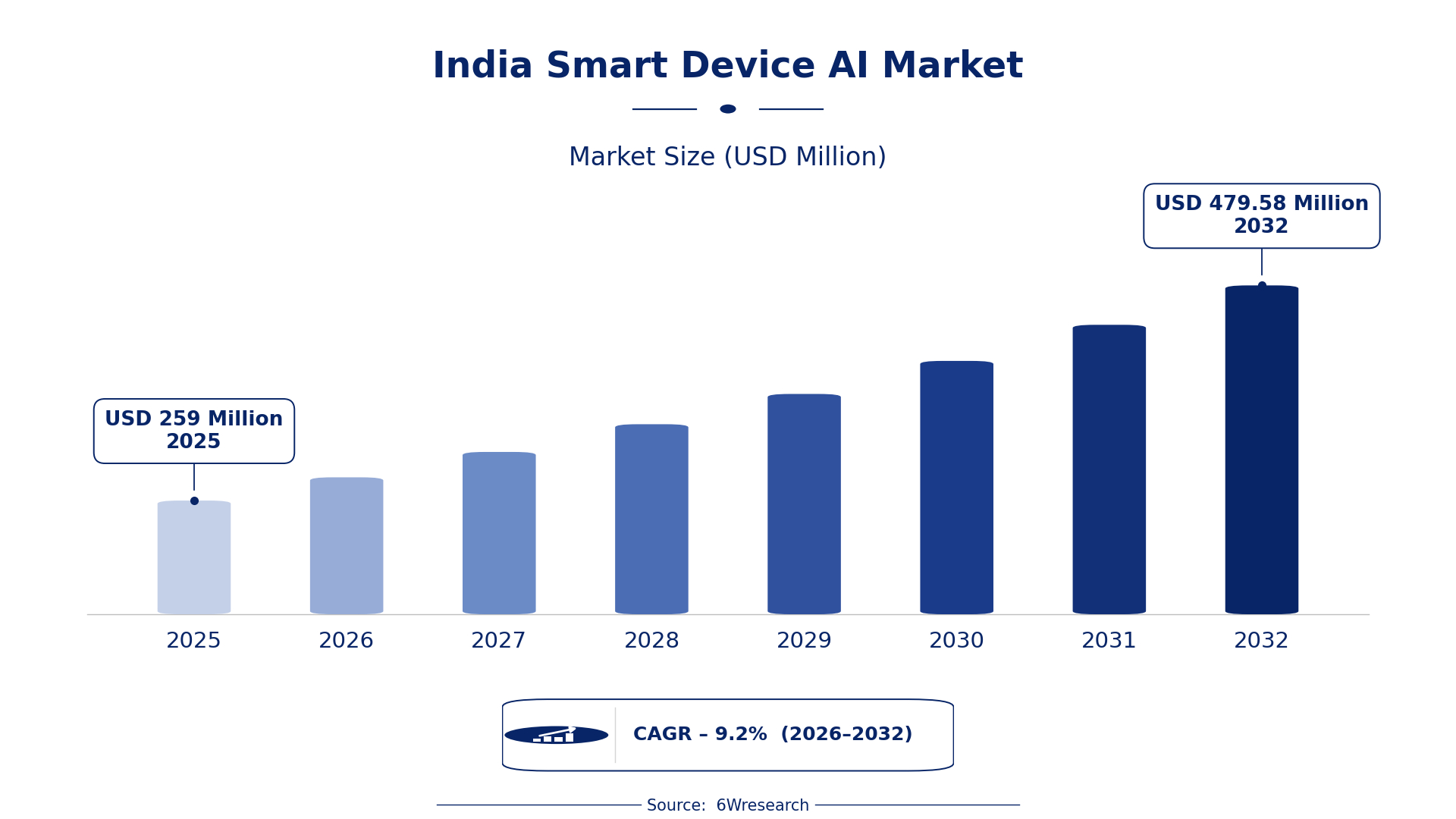
According to 6Wresearch internal database and industry insights, the India Smart Device AI Market was valued at USD 259.0 million in 2025 and is projected to reach USD 479.58 million by 2032, growing at a CAGR of approximately 9.2% during 2026–2032.
India Smart Device AI Market Highlights
| Report Metric | Details |
| Report Name | India Smart Device AI Market |
| Market Size 2025 | USD 259.0 million |
| Market Size 2032 | USD 479.58 million |
| Absolute Growth 2025–2032 | USD 220.58 million |
| CAGR 2026–2032 | 9.2% |
| Peak Annual Growth | 10.5% in 2031 |
| Forecast Period | 2026–2032 |
| Historical Data | 2022–2025 |
| Base Year | 2025 |
| Leading AI Feature Type, 2025 | Voice Recognition AI (49% share) |
| Leading Device Category, 2025 | Smart Speakers (39% share) |
| Leading Integration Mode, 2025 | Cloud-Based AI Engines (39% share) |
| Leading End User, 2025 | Consumer Electronics Brands (53% share) |
| Fastest-Growing AI Feature Type | Predictive AI (11.9% CAGR) |
| Fastest-Growing Device Category | Wearables (10.7% CAGR) |
| Fastest-Growing Integration Mode | Edge AI (11.0% CAGR) |
| Fastest-Growing End User | Fitness Tech Companies (11.7% CAGR) |
| Growing Sector | Consumer Electronics |
| Key End Users | Consumer Electronics Brands, Fitness Tech Companies, Surveillance Firms, Smart Home Developers |
India Smart Device AI Market Year-wise Growth Rate and Key Drivers (2022–2032)
This graph illustrates the annual growth rates of the market from 2022 to 2032, highlighting a steady upward trajectory and projected market expansion over the forecast period.
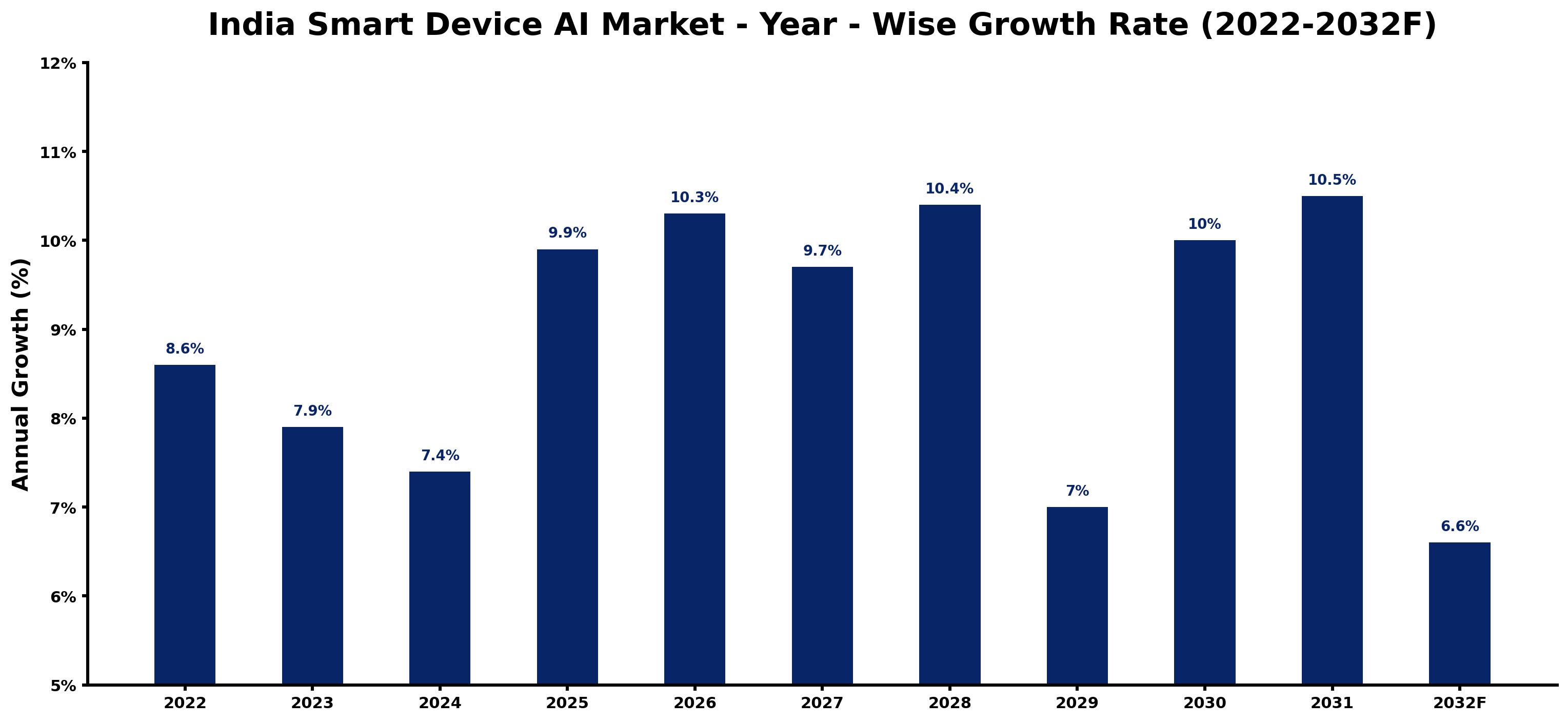
Each row of the following table gives one year's estimated growth and the event or demand shift that explains it.
| Year | Estimated Annual Growth (%) | Market Rationale |
| 2022 | 8.6 | The market experienced steady growth, driven by increased consumer interest in smart devices and the Digital India initiative. |
| 2023 | 7.9 | Demand growth slowed as market maturation began to affect purchasing patterns, particularly in urban areas. |
| 2024 | 7.4 | Consumer electronics brands continued to innovate, but growth rates declined slightly due to saturation in the smart speaker segment. |
| 2025 | 9.9 | The market rebounded with higher sales driven by the popularity of smart speakers and increased urban adoption. |
| 2026 | 10.3 | Growth is likely to accelerate as urban adoption of smart home technologies expands, supported by the National AI Strategy. |
| 2027 | 9.7 | Consumer interest in wearables is projected to moderate, resulting in a slight slowdown in growth due to market saturation. |
| 2028 | 10.4 | Innovations in AI technology are anticipated to spur renewed interest and purchasing activity in smart devices. |
| 2029 | 7.0 | Growth is expected to decelerate as market saturation begins to impact demand for established smart device categories. |
| 2030 | 10.0 | Strong demand for smart devices will be sustained by ongoing technological advancements in AI integration. |
| 2031 | 10.5 | The peak growth year will be marked by increased investment in AI technologies across various sectors. |
| 2032 | 6.6 | Growth is projected to slow as the market stabilises, reflecting a more mature environment for smart devices. |
Note: Market size estimations and growth projections presented in this report are based on 6Wresearch's proprietary forecasting methodology, utilizing the latest available industry data, government publications, and primary research inputs.
India Smart Device AI Market Synopsis
Smart Device AI in India encompasses artificial intelligence technologies integrated into devices to improve functionality. These devices include smart speakers, wearables, and smart cameras, utilising machine learning for applications like voice recognition and predictive analytics. The India Smart Device AI Market is expanding due to the increasing adoption of smart home technologies and consumer electronics brands innovating to meet demand.
Market Dynamics Impact Analysis (2026–2032)
| Factor | Type | Impact | Primary Segment Affected |
| Increasing urbanisation drives demand for smart home technologies and devices. | Driver | High | Smart Speakers |
| Rising consumer interest in health and fitness monitoring boosts wearable sales. | Driver | High | Wearables |
| The expanding smart camera market presents opportunities for surveillance firms. | Opportunity | High | Smart Cameras |
| The AI for All initiative encourages widespread AI adoption among various stakeholders. | Opportunity | High | Consumer Electronics Brands |
| Market saturation limits growth potential for established smart device categories. | Restraint | Medium | Smart Speakers |
| High costs of advanced AI integration may deter smaller manufacturers. | Restraint | Medium | Wearables |
| Limited access to advanced technology can hinder product development. | Challenge | High | Smart Cameras |
| Competition from international brands intensifies pressure on local manufacturers. | Challenge | Medium | Consumer Electronics Brands |
Evaluation of Drivers in India Smart Device AI Market (2026–2032)
The main growth drivers and the segments they affect most are set out below.
| Drivers | Primary Segment Affected | Why It Matters (Evidence) |
| Urbanisation increases demand for smart home devices, boosting sales of smart speakers, which are expected to see millions of units sold annually. | Smart Speakers | The smart speaker market in India is projected to grow with millions of units sold annually. |
| Health consciousness drives wearable technology adoption, resulting in increased purchases of fitness trackers and smartwatches, reflecting a growing consumer focus on health. | Wearables | The wearables segment is set to expand as consumers focus on health monitoring and fitness tracking. |
| Rising security concerns boost demand for smart cameras, increasing sales for surveillance firms as urbanisation progresses. | Smart Cameras | India's smart camera market is expanding due to rising security concerns and urbanisation. |
| Government initiatives promote AI integration in consumer electronics, encouraging manufacturers to innovate and meet consumer demand. | Consumer Electronics Brands | The National AI Strategy aims to position India as a global AI hub by promoting research and innovation. |
| Technological advancements in AI improve device functionality, driving consumer interest and purchases across various segments. | Voice Recognition AI | AI integration in consumer electronics is supported by various industry associations in India. |
Growth in the Smart Device AI market in India stems from rising urbanisation, health awareness, and technological progress. Urbanisation is increasing the demand for smart home devices, with smart speakers projected to see substantial growth, resulting in millions of units sold each year. Health-conscious consumers are propelling the adoption of wearable technology, leading to more purchases of fitness trackers. Concerns about security are driving the demand for smart cameras, which expands the market for surveillance solutions. Technological advancements are improving device functionality, sparking consumer interest and purchases across various segments.
Evaluation of Restraints in India Smart Device AI Market
Below mentioned are some major restraints and their influence on market dynamics.
| Market Restraint | Primary Segment Affected | Why It Matters (Evidence) |
| Market saturation limits growth potential for established smart device categories, particularly in the smart speaker segment. | Smart Speakers | The smart speaker market faces saturation, impacting growth as competition increases. |
| High costs of advanced AI integration may deter smaller manufacturers from entering the market, limiting innovation. | Wearables | Smaller manufacturers struggle with the costs associated with advanced AI technology integration. |
| Limited access to advanced technology can hinder product development for local manufacturers, affecting competitiveness. | Smart Cameras | Local manufacturers may face challenges in obtaining the latest AI technologies for product development. |
| Regulatory hurdles can slow down the introduction of new AI-enabled devices, impacting time-to-market for manufacturers. | Consumer Electronics Brands | Compliance with standards like ISO/IEC 30170:2012 can delay product launches. |
| Consumer preferences may shift rapidly, making it difficult for brands to keep pace with trends, affecting sales. | Voice Recognition AI | Rapid changes in consumer preferences can lead to mismatched product offerings. |
India Smart Device AI Market Challenges
Buyers in the India Smart Device AI market face a skills shortage, as local talent often lacks the necessary expertise in advanced AI technologies, which delays product development and raises costs for manufacturers. Suppliers encounter supply chain disruptions due to reliance on imported components, resulting in product launch delays and higher prices for consumers. Regulatory hurdles arise from compliance with standards like ISO/IEC 30170:2012, which can stifle innovation and slow the introduction of new products. Increased competition from international firms intensifies pricing pressures, compelling local producers to lower profit margins and potentially compromise product quality.
Trends in the India Smart Device AI Market
Below mentioned are some of the trends shaping the India Smart Device AI Market growth.
- Shift towards Cloud-Based AI Engines: The Digital India initiative has accelerated the adoption of cloud-based AI engines in smart devices, capturing 39% of the market share in 2025. This trend is reshaping how manufacturers develop AI-enabled products.
- Emergence of Edge AI: Edge AI is gaining traction in India, with a projected CAGR of 11.0% from 2026 to 2032. This shift allows devices to process data locally, improving performance and response times.
- Growing Integration of AI in Home Assistants: Smart home developers are increasingly integrating AI into home assistants, making them central control units for smart devices. This trend is expected to drive further adoption in urban areas, enhancing user experience.
- Rise of Predictive AI in Wearables: Predictive AI is becoming a key feature in wearables, with a CAGR of 11.9% anticipated from 2026 to 2032. This trend reflects the increasing consumer focus on health monitoring and fitness tracking.
Investment Opportunities in the India Smart Device AI Market
Several openings in the India Smart Device AI Market merit attention from investors.
- Investment in Smart Home Technology: Urban areas present a significant opportunity for investment in smart home technologies, with millions of units sold annually. Partnering with local developers can facilitate market entry and expansion.
- Expansion of AI in Consumer Electronics: With a projected market size of USD 259.0 million in 2025, there is a gap in AI-enabled consumer electronics. Collaborating with consumer electronics brands can enhance market presence and drive sales.
- Growth in Fitness Tech: The wearables market is expanding, driven by health-conscious consumers. Investing in fitness tech companies can provide access to a growing customer base and innovative solutions.
- Development of Smart Cameras: The smart camera market is expanding due to rising security concerns. Establishing joint ventures with surveillance firms can enhance product offerings and market reach.
Government Initiatives in the India Smart Device AI Market
The National AI Strategy, introduced by the Ministry of Electronics and Information Technology in 2020, aims to position India as a global AI hub by promoting research and innovation in AI technologies. This strategy encourages local manufacturers to invest in AI development and integration, improving their competitiveness in the market. Additionally, the Digital India programme, launched in 2020, focuses on enhancing digital infrastructure and fostering AI development across various sectors, providing a supportive environment for smart device manufacturers.
The AI Research, Development and Deployment Programme, managed by the Ministry of Electronics and Information Technology, allocates INR 8,000 crore to support AI projects and startups in India. This funding is essential for developers seeking to innovate in the smart device AI space. Furthermore, the National Policy on Electronics, introduced in 2021, promotes the manufacturing of AI-enabled devices, ensuring that local producers can meet the growing demand for smart technologies.
Future Insight of the India Smart Device AI Market
By 2032, buyers and suppliers in the India Smart Device AI market can anticipate significant advancements driven by the Digital India initiative, which will enhance AI adoption across sectors. The AI and Robotics Technology Park will foster innovation, creating new opportunities for local manufacturers. Urbanisation will further boost demand for smart home technologies, contributing to millions of additional smart device sales annually. The Indian government's substantial budget allocation for AI initiatives will support research and development, improving the competitive landscape for domestic players.
Market Segmentation Analysis
The report offers a comprehensive study of the following market segments and their leading categories in the market.
By AI Feature Type – Voice Recognition AI Dominated, Predictive AI Expected to Grow Fastest
According to Dhaval Chaurasia, Assistant Manager at 6Wresearch, Voice Recognition AI took a 49% share of ai feature type in 2025, more than any other category. Voice recognition technology holds the largest share as it is extensively integrated into smart speakers and home assistants, which are now commonplace in Indian households. The millions of units sold annually underscore its critical role in facilitating user interaction with smart devices. Over 2026–2032, Predictive AI is expected to post the fastest growth, at a CAGR of 11.9%. Predictive technology is rapidly gaining traction, particularly in wearables for health monitoring and fitness tracking, catering to an increasingly health-conscious consumer demographic. The growing demand for personal health management solutions is a significant factor driving this segment's swift growth. Suppliers should prioritise enhancing voice recognition capabilities while also investing in predictive technologies to align with evolving consumer preferences.
By Device Category – Smart Speakers Dominated, Wearables Expected to Grow Fastest
The largest device category category in 2025 was Smart Speakers, with a 39% share of total revenue. Smart Speakers hold the largest market share as they are widely used in homes for entertainment and smart home control, reflecting the increasing trend towards connected living. Their popularity is further supported by the growing number of households embracing smart home technologies. Wearables are projected to grow fastest, at a CAGR of 10.7% during 2026–2032. Wearables are the fastest-growing category, fuelled by the rising consumer interest in devices for health and fitness tracking. This segment's growth is driven by the integration of AI to provide more personalised health insights. Suppliers should prioritise advancements in smart speakers while also exploring opportunities in the wearables market to meet emerging consumer demands.
By Integration Mode – Cloud-Based AI Engines Dominated, Edge AI Expected to Grow Fastest
In 2025, Cloud-Based AI Engines led the integration mode split with a 39% share. Cloud-based solutions command the largest market share due to their ability to provide substantial processing power and storage, essential for managing extensive datasets. This capability is becoming increasingly vital as the adoption of smart devices continues to rise across various sectors in India. Edge AI is set to record the highest CAGR in this split, 11.0% over 2026–2032. Edge processing is witnessing rapid growth as it allows for local data processing, resulting in quicker response times in devices, which is crucial for real-time applications. The increasing need for immediate data processing in smart devices is driving the expansion of this segment. This trend indicates that suppliers should enhance their cloud-based offerings while also investing in edge processing technologies to meet the demand for faster, more efficient smart devices.
By End User – Consumer Electronics Brands Dominated, Fitness Tech Companies Expected to Grow Fastest
Consumer Electronics Brands held a 53% share of the India Smart Device AI Market by end user in 2025. Consumer electronics brands dominate the market share as they are responsible for developing and marketing AI-enabled devices that appeal to a broad consumer base. Their established market presence and ongoing innovation in technology solidify their leadership position in the industry. The quickest growth will come from Fitness Tech Companies, forecast to expand at a CAGR of 11.7% between 2026 and 2032. Fitness technology companies are the fastest-growing end users, leveraging AI for cutting-edge health and fitness solutions that resonate with health-conscious consumers. The increasing emphasis on personal health management is propelling this segment's rapid growth. This suggests that suppliers should strengthen partnerships with consumer electronics brands while also targeting fitness technology companies to capitalise on the expanding health and wellness market.
Key Attractiveness of the Report
- 10 Years of Market Numbers
- Historical Data Starting from 2022 to 2025
- Base Year 2025
- Forecast Data until 2032
- Key Performance Indicators Impacting the Market
- Major Upcoming Developments and Projects
Key Highlights of the Report:
- India Smart Device AI Market Outlook
- Market Size of India Smart Device AI Market, 2025
- Forecast of India Smart Device AI Market, 2032
- Historical Data and Forecast of India Smart Device AI Revenues & Volume for the Period 2022 - 2032F
- India Smart Device AI Market Trend Evolution
- India Smart Device AI Market Drivers and Challenges
- India Smart Device AI Price Trends
- India Smart Device AI Porter's Five Forces
- India Smart Device AI Industry Life Cycle
- Historical Data and Forecast of India Smart Device AI Market Revenues & Volume By AI Feature Type for the Period 2022 - 2032F
- Historical Data and Forecast of India Smart Device AI Market Revenues & Volume By Voice Recognition AI for the Period 2022 - 2032F
- Historical Data and Forecast of India Smart Device AI Market Revenues & Volume By Predictive AI for the Period 2022 - 2032F
- Historical Data and Forecast of India Smart Device AI Market Revenues & Volume By Visual Recognition AI for the Period 2022 - 2032F
- Historical Data and Forecast of India Smart Device AI Market Revenues & Volume By Natural Language AI for the Period 2022 - 2032F
- Historical Data and Forecast of India Smart Device AI Market Revenues & Volume By Device Category for the Period 2022 - 2032F
- Historical Data and Forecast of India Smart Device AI Market Revenues & Volume By Smart Speakers for the Period 2022 - 2032F
- Historical Data and Forecast of India Smart Device AI Market Revenues & Volume By Wearables for the Period 2022 - 2032F
- Historical Data and Forecast of India Smart Device AI Market Revenues & Volume By Smart Cameras for the Period 2022 - 2032F
- Historical Data and Forecast of India Smart Device AI Market Revenues & Volume By Home Assistants for the Period 2022 - 2032F
- Historical Data and Forecast of India Smart Device AI Market Revenues & Volume By Integration Mode for the Period 2022 - 2032F
- Historical Data and Forecast of India Smart Device AI Market Revenues & Volume By On-Device + Cloud for the Period 2022 - 2032F
- Historical Data and Forecast of India Smart Device AI Market Revenues & Volume By Embedded AI Chipsets for the Period 2022 - 2032F
- Historical Data and Forecast of India Smart Device AI Market Revenues & Volume By Edge AI for the Period 2022 - 2032F
- Historical Data and Forecast of India Smart Device AI Market Revenues & Volume By Cloud-Based AI Engines for the Period 2022 - 2032F
- Historical Data and Forecast of India Smart Device AI Market Revenues & Volume By End User for the Period 2022 - 2032F
- Historical Data and Forecast of India Smart Device AI Market Revenues & Volume By Consumer Electronics Brands for the Period 2022 - 2032F
- Historical Data and Forecast of India Smart Device AI Market Revenues & Volume By Fitness Tech Companies for the Period 2022 - 2032F
- Historical Data and Forecast of India Smart Device AI Market Revenues & Volume By Surveillance Firms for the Period 2022 - 2032F
- Historical Data and Forecast of India Smart Device AI Market Revenues & Volume By Smart Home Developers for the Period 2022 - 2032F
- India Smart Device AI Import Export Trade Statistics
- Market Opportunity Assessment By AI Feature Type
- Market Opportunity Assessment By Device Category
- Market Opportunity Assessment By Integration Mode
- Market Opportunity Assessment By End User
- India Smart Device AI Top Companies Market Share
- India Smart Device AI Competitive Benchmarking By Technical and Operational Parameters
- India Smart Device AI Company Profiles
- India Smart Device AI Key Strategic Recommendations
Market Covered
This report examines the market across the segments below.
By AI Feature Type
- Voice Recognition AI
- Predictive AI
- Visual Recognition AI
- Natural Language AI
By Device Category
- Smart Speakers
- Wearables
- Smart Cameras
- Home Assistants
By Integration Mode
- On-Device + Cloud
- Embedded AI Chipsets
- Edge AI
- Cloud-Based AI Engines
By End User
- Consumer Electronics Brands
- Fitness Tech Companies
- Surveillance Firms
- Smart Home Developers































