India Smart Ducting System Market Size & Growth Rate
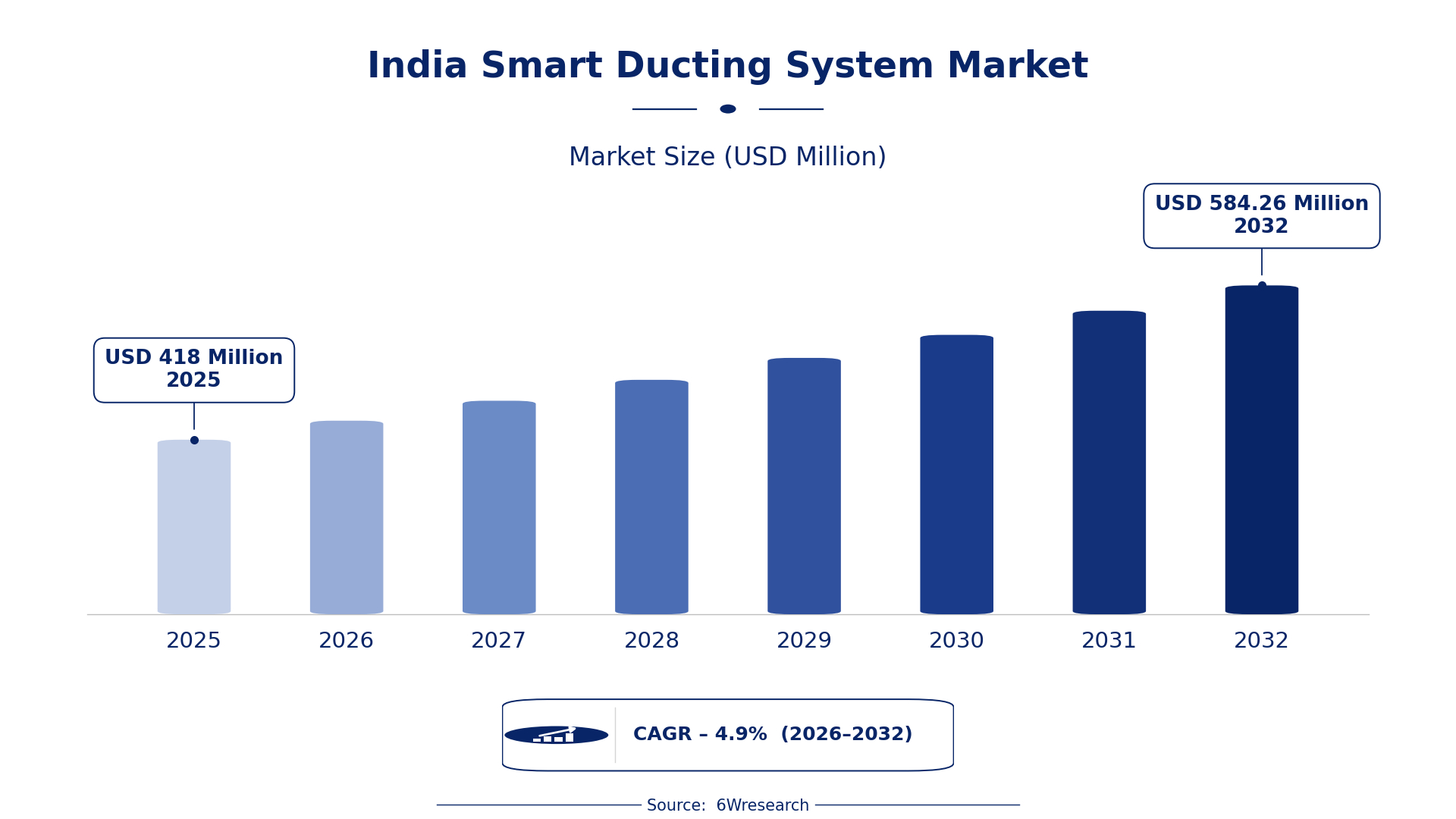
According to 6Wresearch internal database and industry insights, the India Smart Ducting System Market was valued at USD 418.0 million in 2025 and is projected to reach USD 584.26 million by 2032, growing at a CAGR of approximately 4.9% during 2026–2032.
India Smart Ducting System Market Highlights
| Report Metric | Details |
| Report Name | India Smart Ducting System Market |
| Market Size 2025 | USD 418.0 million |
| Market Size 2032 | USD 584.26 million |
| Absolute Growth 2025–2032 | USD 166.26 million |
| CAGR 2026–2032 | 4.9% |
| Peak Annual Growth | 7.4% in 2027 |
| Forecast Period | 2026–2032 |
| Historical Data | 2022–2025 |
| Base Year | 2025 |
| Leading Ducting Type, 2025 | HVAC Smart Ducts (36% share) |
| Leading Smart Control Feature, 2025 | Airflow Regulation (37% share) |
| Leading Application Area, 2025 | Office & Homes (44% share) |
| Leading End User, 2025 | HVAC Contractors (56% share) |
| Fastest-Growing Ducting Type | Sensor-Integrated Ducts (6.6% CAGR) |
| Fastest-Growing Smart Control Feature | Temp + Humidity Control (7.4% CAGR) |
| Fastest-Growing Application Area | Industrial Cooling (7.4% CAGR) |
| Fastest-Growing End User | Data Centers (7.0% CAGR) |
| Growing Sector | HVAC |
| Key End Users | HVAC Contractors, Hospitals, Building Automation Firms |
India Smart Ducting System Market Year-wise Growth Rate and Key Drivers (2022–2032)
This graph illustrates the annual growth rates of the market from 2022 to 2032, highlighting a steady upward trajectory and projected market expansion over the forecast period.
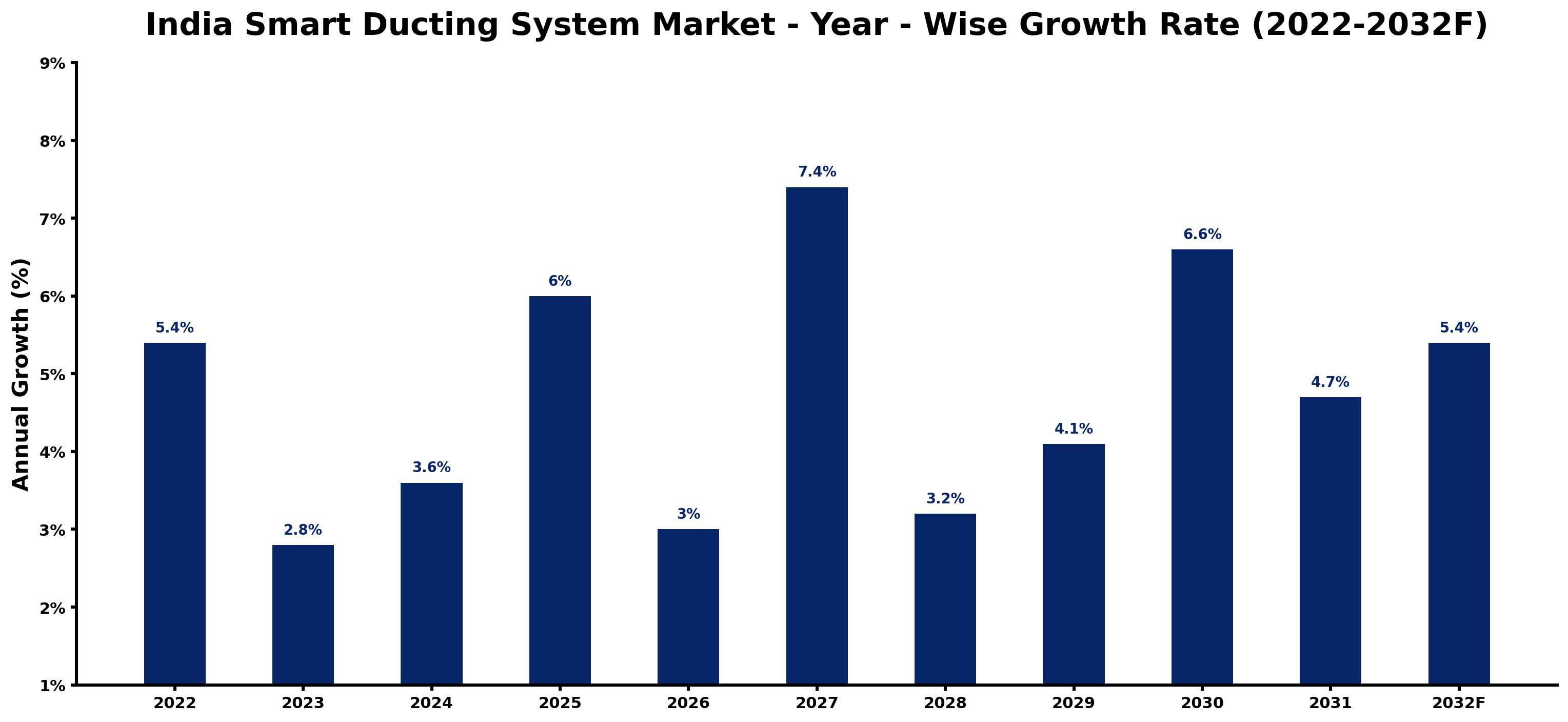
Annual growth estimates for each year appear below with the principal reason behind them, explaining the shifts that set the pace of the market.
| Year | Estimated Annual Growth (%) | Market Rationale |
| 2022 | 5.4 | The market exhibited solid growth, driven by increasing urbanisation and demand for improved indoor air quality solutions. |
| 2023 | 2.8 | Growth slowed due to rising material costs impacting project budgets and timelines for HVAC installations. |
| 2024 | 3.6 | Demand rebounded as more commercial buildings adopted energy-efficient HVAC solutions under the National Building Code. |
| 2025 | 6.0 | The market reached a historical peak, fuelled by the Smart Cities Mission enhancing urban infrastructure developments. |
| 2026 | 3.0 | Growth slowed again as the market adjusted to new energy standards and regulations set by the Energy Conservation Building Code. |
| 2027 | 7.4 | A significant surge in demand occurred as hospitals upgraded to advanced HVAC systems for better air quality and compliance. |
| 2028 | 3.2 | Growth slowed as the market stabilised after rapid expansions in the previous years, particularly in urban areas. |
| 2029 | 4.1 | Demand increased as industrial cooling applications expanded in urban areas, driven by new construction projects. |
| 2030 | 6.6 | The market saw a rebound as energy-efficient solutions gained traction in residential sectors, supported by government initiatives. |
| 2031 | 4.7 | Growth slowed as the market faced challenges in supply chain disruptions and regulatory compliance affecting project timelines. |
| 2032 | 5.4 | Demand is expected to rise as more commercial buildings adopt smart HVAC solutions to meet energy efficiency standards. |
Note: Market size estimations and growth projections presented in this report are based on 6Wresearch's proprietary forecasting methodology, utilizing the latest available industry data, government publications, and primary research inputs.
India Smart Ducting System Market Synopsis
The India Smart Ducting System Market includes advanced HVAC technologies that optimise airflow and energy efficiency across various applications. These systems utilise sensors and smart controls to enhance indoor air quality and reduce energy consumption. The market is expanding due to increasing urbanisation and the growing preference for energy-efficient HVAC solutions, with more than 30% of new commercial buildings incorporating smart systems as of 2023. Initiatives like the Smart Cities Mission and guidelines from the Bureau of Energy Efficiency are further propelling demand for these technologies.
Market Dynamics Impact Analysis (2026–2032)
| Factor | Type | Impact | Primary Segment Affected |
| Increasing urbanisation and population density drive demand for improved indoor air quality solutions. | Driver | High | HVAC Smart Ducts |
| Growing awareness of energy efficiency among consumers boosts the adoption of smart ducting systems. | Driver | High | Sensor-Integrated Ducts |
| Expansion of urban infrastructure projects creates opportunities for smart ducting system installations. | Opportunity | High | Office & Homes |
| Rising demand for energy-efficient solutions in hospitals presents a significant market opportunity. | Opportunity | High | Hospitals |
| High initial investment costs for smart ducting systems can deter potential buyers. | Restraint | High | HVAC Smart Ducts |
| Limited awareness and understanding of smart ducting technology among consumers restrict market growth. | Restraint | Medium | Sensor-Integrated Ducts |
| Supply chain disruptions caused by global events can delay project timelines. | Challenge | High | HVAC Contractors |
| Regulatory compliance with energy efficiency standards can complicate product approvals. | Challenge | Medium | Building Automation Firms |
Evaluation of Drivers in India Smart Ducting System Market (2026–2032)
The factors lifting demand, and the evidence behind each, are summarised below.
| Drivers | Primary Segment Affected | Why It Matters (Evidence) |
| Urbanisation increases demand for efficient air distribution in residential and commercial spaces. | HVAC Smart Ducts | As urban areas expand, over 1.4 billion people require improved indoor air quality solutions. |
| Government initiatives promote energy efficiency, pushing consumers towards smart ducting systems. | Sensor-Integrated Ducts | The Perform, Achieve and Trade scheme encourages the adoption of advanced HVAC technologies. |
| Growing healthcare sector investments drive demand for advanced HVAC systems in hospitals. | Hospitals | Over 50% of hospitals in urban India are upgrading to advanced HVAC systems for better air quality. |
| Increasing construction of commercial buildings necessitates efficient HVAC solutions. | Office & Homes | As of 2023, over 30% of new commercial buildings are adopting smart HVAC solutions. |
| Rising energy costs motivate consumers to seek energy-efficient HVAC technologies. | Industrial Cooling | The Energy Conservation Building Code sets standards that encourage the adoption of smart ducting. |
Urbanisation has led to a demand for improved indoor air quality solutions, with over 1.4 billion people driving this need. The Perform, Achieve and Trade scheme encourages energy-efficient HVAC systems, resulting in over 30% of new commercial buildings adopting smart technologies. The healthcare sector is investing heavily in advanced HVAC systems, with over 50% of hospitals upgrading for better air quality. These factors enhance purchasing behaviour among HVAC contractors and building automation firms.
Evaluation of Restraints in India Smart Ducting System Market
The main factors holding the market back are set out below.
| Market Restraint | Primary Segment Affected | Why It Matters (Evidence) |
| High initial costs deter many consumers from adopting smart ducting systems. | HVAC Smart Ducts | The upfront investment can be a barrier for budget-conscious buyers, especially in residential markets. |
| Limited consumer awareness of smart ducting technology restricts market penetration. | Sensor-Integrated Ducts | Many potential buyers lack understanding of the benefits and functionalities of smart systems. |
| Supply chain disruptions can delay the availability of components for smart ducting systems. | HVAC Contractors | Global supply chain issues have led to longer lead times for essential materials. |
| Regulatory compliance challenges can complicate the installation process for HVAC systems. | Building Automation Firms | Navigating the Energy Conservation Building Code can be complex and time-consuming. |
| Market competition from traditional HVAC systems limits the growth of smart ducting solutions. | Office & Homes | Established systems often have lower upfront costs, making them more appealing to some buyers. |
India Smart Ducting System Market Challenges
The India Smart Ducting System market encounters high initial costs that deter many buyers from adopting advanced HVAC technologies. This cost barrier stems from the premium materials and engineering required, leading to project approval delays for construction firms, which can extend timelines by several months. A shortage of skilled professionals hampers market growth, as over 200,000 workers are needed to implement these systems effectively, but training programmes are insufficient. Outdated technology in existing buildings complicates integration, causing delays for suppliers attempting to modernise infrastructure, which can result in increased project costs. Intense competition from traditional ducting systems pressures prices, limiting margins for producers and reducing their incentive to innovate.
Trends in the India Smart Ducting System Market
The trends below show where the India Smart Ducting System Market is heading.
- Shift from Traditional to Smart HVAC Solutions: Since 2022, urban areas like Delhi and Mumbai have experienced a shift towards smart HVAC solutions, with over 30% of new commercial buildings adopting these technologies. This trend reflects a growing preference for energy efficiency among building developers.
- Emergence of Sensor-Integrated Ducts: In 2023, HVAC contractors are increasingly incorporating sensor technology into ducting systems, which enhances real-time monitoring capabilities. This shift is marked by the rising adoption of sensor-integrated ducts, projected to grow at a CAGR of 6.6%.
- Focus on Indoor Air Quality: As of 2023, hospitals are prioritising advanced HVAC systems to enhance indoor air quality, with over 50% upgrading their systems. This trend highlights a broader awareness of health impacts linked to air quality in healthcare settings.
- Growth in Energy-Efficient Building Practices: The Indian Green Building Council has advocated for sustainable building practices, including smart ducting, since 2022. This initiative aligns with the Energy Conservation Building Code, which establishes standards for HVAC efficiency.
Investment Opportunities in the India Smart Ducting System Market
Several openings in the India Smart Ducting System Market merit attention from investors.
- Urban Infrastructure Development: In urban areas like Delhi, there is an increasing demand for smart ducting systems due to ongoing infrastructure development. As new commercial projects emerge, HVAC contractors can collaborate with local developers to supply advanced systems, tapping into a market projected to reach USD 418 million by 2025.
- Healthcare Sector Upgrades: Hospitals across urban India are actively seeking advanced HVAC solutions to improve air quality. With over 50% upgrading their systems, suppliers can enter this market by partnering with healthcare providers to offer tailored solutions.
- Energy Efficiency Initiatives: The Bureau of Energy Efficiency's initiatives are generating demand for energy-efficient HVAC solutions. Suppliers can engage with building automation firms to integrate smart ducting systems into new projects, capitalising on the growing trend towards sustainability.
- Commercial Building Upgrades: With more than 30% of new commercial buildings adopting smart HVAC solutions, there is a prime opportunity for HVAC contractors to supply these systems. Collaborating with developers can facilitate entry into this expanding market.
Government Initiatives in the India Smart Ducting System Market
The National Building Code of India (NBC), established in 2016, includes guidelines for energy-efficient HVAC systems, ensuring compliance with energy efficiency standards. Additionally, the Energy Conservation Building Code (ECBC), introduced in 2020, sets standards for HVAC efficiency in commercial buildings, promoting the adoption of advanced technologies. These regulations encourage the use of smart ducting systems in various applications, facilitating market growth.
The Bureau of Energy Efficiency (BEE) promotes energy-efficient HVAC systems through various initiatives. Under the Perform, Achieve and Trade (PAT) scheme, the BEE funds projects aimed at improving energy efficiency in buildings. Furthermore, the Smart Cities Mission launched in 2022 supports urban infrastructure development, including the integration of smart ducting systems into new constructions, ensuring compliance with energy efficiency standards.
Future Insight of the India Smart Ducting System Market
The India Smart Ducting System market is set to undergo substantial changes by 2032, driven by urbanisation and strategic government initiatives. The Smart Cities Mission will enhance urban infrastructure, encouraging the adoption of advanced HVAC systems. By 2027, over 30% of new commercial buildings are expected to incorporate these systems, boosting energy efficiency. The guidelines from the National Building Code will standardise practices, ensuring compliance and promoting growth. As hospitals upgrade their HVAC systems, the demand for improved air quality solutions will increase, benefiting both suppliers and buyers.
Market Segmentation Analysis
Each segment group is reviewed below, with the leader by share and the fastest grower by CAGR.
By Ducting Type – HVAC Smart Ducts Dominated, Sensor-Integrated Ducts Expected to Grow Fastest
According to Dhaval Chaurasia, Assistant Manager at 6Wresearch, HVAC Smart Ducts accounted for a 36% market share by ducting type in 2025. HVAC Smart Ducts hold the largest market share as they are essential for effective air distribution in residential and commercial HVAC systems. Their widespread adoption in over 30% of new commercial buildings in urban areas like Delhi and Mumbai demonstrates their critical importance in modern infrastructure. The quickest growth will come from Sensor-Integrated Ducts, forecast to expand at a CAGR of 6.6% between 2026 and 2032. Sensor-Integrated Ducts are experiencing rapid growth due to their ability to provide real-time monitoring and control of air quality, which is increasingly demanded in contemporary buildings. Government initiatives such as the Smart Cities Mission are further accelerating this trend towards energy-efficient HVAC solutions. Suppliers should focus on enhancing sensor technologies to meet the growing demand for smart ducting systems in urban developments.
By Smart Control Feature – Airflow Regulation Dominated, Temp + Humidity Control Expected to Grow Fastest
Airflow Regulation took a 37% share of smart control feature in 2025, more than any other category. Airflow Regulation is the leading feature in the market, crucial for maintaining optimal indoor climates across various settings. Its significance is highlighted by the increasing need for energy efficiency and comfort in HVAC systems, making it a fundamental requirement. Over 2026–2032, Temp + Humidity Control is expected to post the fastest growth, at a CAGR of 7.4%. Temp + Humidity Control is the fastest growing feature, driven by its essential role in improving comfort and energy efficiency within HVAC applications. The heightened focus on healthier indoor environments is propelling demand for this feature, especially in residential and commercial sectors. Suppliers should prioritise the development of advanced temperature and humidity control solutions to meet the rising expectations for indoor air quality.
By Application Area – Office & Homes Dominated, Industrial Cooling Expected to Grow Fastest
Office & Homes held a 44% share of the India Smart Ducting System Market by application area in 2025. Office & Homes represent the largest application area for smart ducting systems, as these environments require efficient air distribution for comfort and energy savings. The increasing awareness of indoor air quality among consumers drives significant demand in these sectors. Industrial Cooling is projected to grow fastest, at a CAGR of 7.4% during 2026–2032. Industrial Cooling is the fastest growing application area, propelled by the need for efficient cooling solutions in large facilities. The expansion of industrial activities and the necessity for optimal climate control in manufacturing processes are key contributors to this growth. This indicates that suppliers should customise their offerings to cater to the specific cooling requirements of industrial clients.
By End User – HVAC Contractors Dominated, Data Centers Expected to Grow Fastest
With a 56% revenue share in 2025, HVAC Contractors was the largest end user category. HVAC Contractors are the primary end users in the market, responsible for the installation and maintenance of smart ducting systems. Their pivotal role in the HVAC sector ensures a consistent demand for these advanced solutions across various industries. Data Centers are set to record the highest CAGR in this split, 7.0% over 2026–2032. Data Centers are witnessing the fastest growth among end users, as they require effective management of heat load and airflow for operational efficiency. The increasing reliance on data processing and storage facilities is driving this demand. This underscores the need for suppliers to develop specialised solutions that address the unique cooling and airflow challenges faced by data centres.
Key Attractiveness of the Report
- 10 Years of Market Numbers
- Historical Data Starting from 2022 to 2025
- Base Year 2025
- Forecast Data until 2032
- Key Performance Indicators Impacting the Market
- Major Upcoming Developments and Projects
Key Highlights of the Report:
- India Smart Ducting System Market Outlook
- Market Size of India Smart Ducting System Market, 2025
- Forecast of India Smart Ducting System Market, 2032
- Historical Data and Forecast of India Smart Ducting System Revenues & Volume for the Period 2022 - 2032F
- India Smart Ducting System Market Trend Evolution
- India Smart Ducting System Market Drivers and Challenges
- India Smart Ducting System Price Trends
- India Smart Ducting System Porter's Five Forces
- India Smart Ducting System Industry Life Cycle
- Historical Data and Forecast of India Smart Ducting System Market Revenues & Volume By Ducting Type for the Period 2022 - 2032F
- Historical Data and Forecast of India Smart Ducting System Market Revenues & Volume By HVAC Smart Ducts for the Period 2022 - 2032F
- Historical Data and Forecast of India Smart Ducting System Market Revenues & Volume By Sensor-Integrated Ducts for the Period 2022 - 2032F
- Historical Data and Forecast of India Smart Ducting System Market Revenues & Volume By Self-Cleaning Ducts for the Period 2022 - 2032F
- Historical Data and Forecast of India Smart Ducting System Market Revenues & Volume By AI Duct Flow Systems for the Period 2022 - 2032F
- Historical Data and Forecast of India Smart Ducting System Market Revenues & Volume By Smart Control Feature for the Period 2022 - 2032F
- Historical Data and Forecast of India Smart Ducting System Market Revenues & Volume By Airflow Regulation for the Period 2022 - 2032F
- Historical Data and Forecast of India Smart Ducting System Market Revenues & Volume By Temp + Humidity Control for the Period 2022 - 2032F
- Historical Data and Forecast of India Smart Ducting System Market Revenues & Volume By Dust Accumulation Alert for the Period 2022 - 2032F
- Historical Data and Forecast of India Smart Ducting System Market Revenues & Volume By Predictive Air Efficiency for the Period 2022 - 2032F
- Historical Data and Forecast of India Smart Ducting System Market Revenues & Volume By Application Area for the Period 2022 - 2032F
- Historical Data and Forecast of India Smart Ducting System Market Revenues & Volume By Office & Homes for the Period 2022 - 2032F
- Historical Data and Forecast of India Smart Ducting System Market Revenues & Volume By Industrial Cooling for the Period 2022 - 2032F
- Historical Data and Forecast of India Smart Ducting System Market Revenues & Volume By Hospitals for the Period 2022 - 2032F
- Historical Data and Forecast of India Smart Ducting System Market Revenues & Volume By Commercial Spaces for the Period 2022 - 2032F
- Historical Data and Forecast of India Smart Ducting System Market Revenues & Volume By End User for the Period 2022 - 2032F
- Historical Data and Forecast of India Smart Ducting System Market Revenues & Volume By HVAC Contractors for the Period 2022 - 2032F
- Historical Data and Forecast of India Smart Ducting System Market Revenues & Volume By Data Centers for the Period 2022 - 2032F
- Historical Data and Forecast of India Smart Ducting System Market Revenues & Volume By Medical Infrastructure for the Period 2022 - 2032F
- Historical Data and Forecast of India Smart Ducting System Market Revenues & Volume By Building Automation Firms for the Period 2022 - 2032F
- India Smart Ducting System Import Export Trade Statistics
- Market Opportunity Assessment By Ducting Type
- Market Opportunity Assessment By Smart Control Feature
- Market Opportunity Assessment By Application Area
- Market Opportunity Assessment By End User
- India Smart Ducting System Top Companies Market Share
- India Smart Ducting System Competitive Benchmarking By Technical and Operational Parameters
- India Smart Ducting System Company Profiles
- India Smart Ducting System Key Strategic Recommendations
Market Covered
This report examines the market across the segments below.
By Ducting Type
- HVAC Smart Ducts
- Sensor-Integrated Ducts
- Self-Cleaning Ducts
- AI Duct Flow Systems
By Smart Control Feature
- Airflow Regulation
- Temp + Humidity Control
- Dust Accumulation Alert
- Predictive Air Efficiency
By Application Area
- Office & Homes
- Industrial Cooling
- Hospitals
- Commercial Spaces
By End User
- HVAC Contractors
- Data Centers
- Medical Infrastructure
- Building Automation Firms































