India Smart Home AI Market Size & Growth Rate
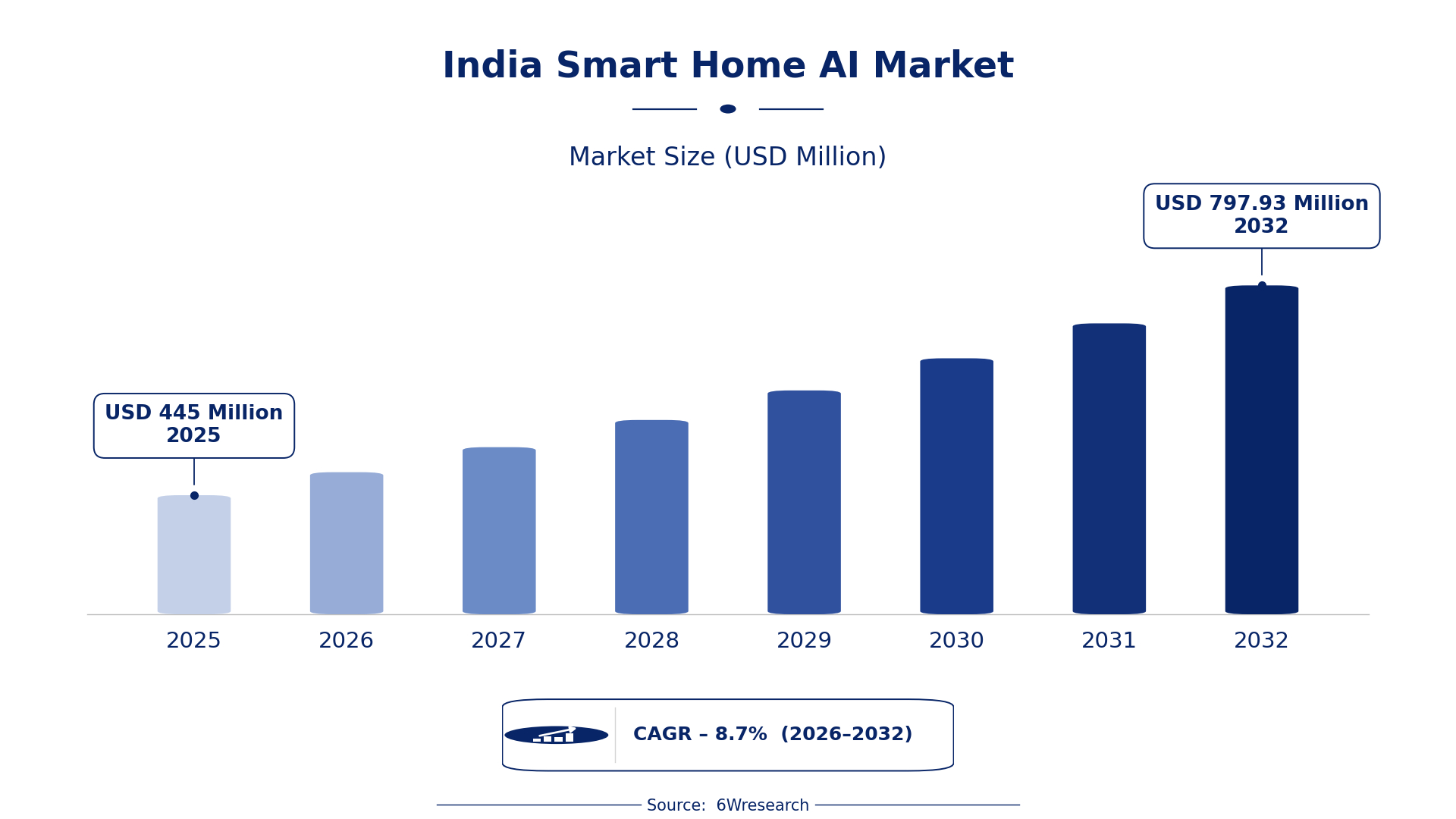
According to 6Wresearch internal database and industry insights, the India Smart Home AI Market was valued at USD 445.0 million in 2025 and is projected to reach USD 797.93 million by 2032, growing at a CAGR of approximately 8.7% during 2026–2032.
India Smart Home AI Market Highlights
| Report Metric | Details |
| Report Name | India Smart Home AI Market |
| Market Size 2025 | USD 445.0 million |
| Market Size 2032 | USD 797.93 million |
| Absolute Growth 2025–2032 | USD 352.93 million |
| CAGR 2026–2032 | 8.7% |
| Peak Annual Growth | 10.9% in 2030 |
| Forecast Period | 2026–2032 |
| Historical Data | 2022–2025 |
| Base Year | 2025 |
| Leading AI Application, 2025 | Voice Control AI (45% share) |
| Leading Smart Feature, 2025 | Command Recognition (48% share) |
| Leading Integration Platform, 2025 | Smart Speakers (47% share) |
| Leading End User, 2025 | Homeowners (42% share) |
| Fastest-Growing AI Application | Energy Optimization AI (10.4% CAGR) |
| Fastest-Growing Integration Platform | Smart Cameras (10.0% CAGR) |
| Fastest-Growing End User | Smart Home Users (10.7% CAGR) |
| Growing Sector | Smart Home Technologies |
| Key End Users | Homeowners, Smart Home Users, Device Manufacturers, Security System Makers |
India Smart Home AI Market Year-wise Growth Rate and Key Drivers (2022–2032)
This graph illustrates the annual growth rates of the market from 2022 to 2032, highlighting a steady upward trajectory and projected market expansion over the forecast period.
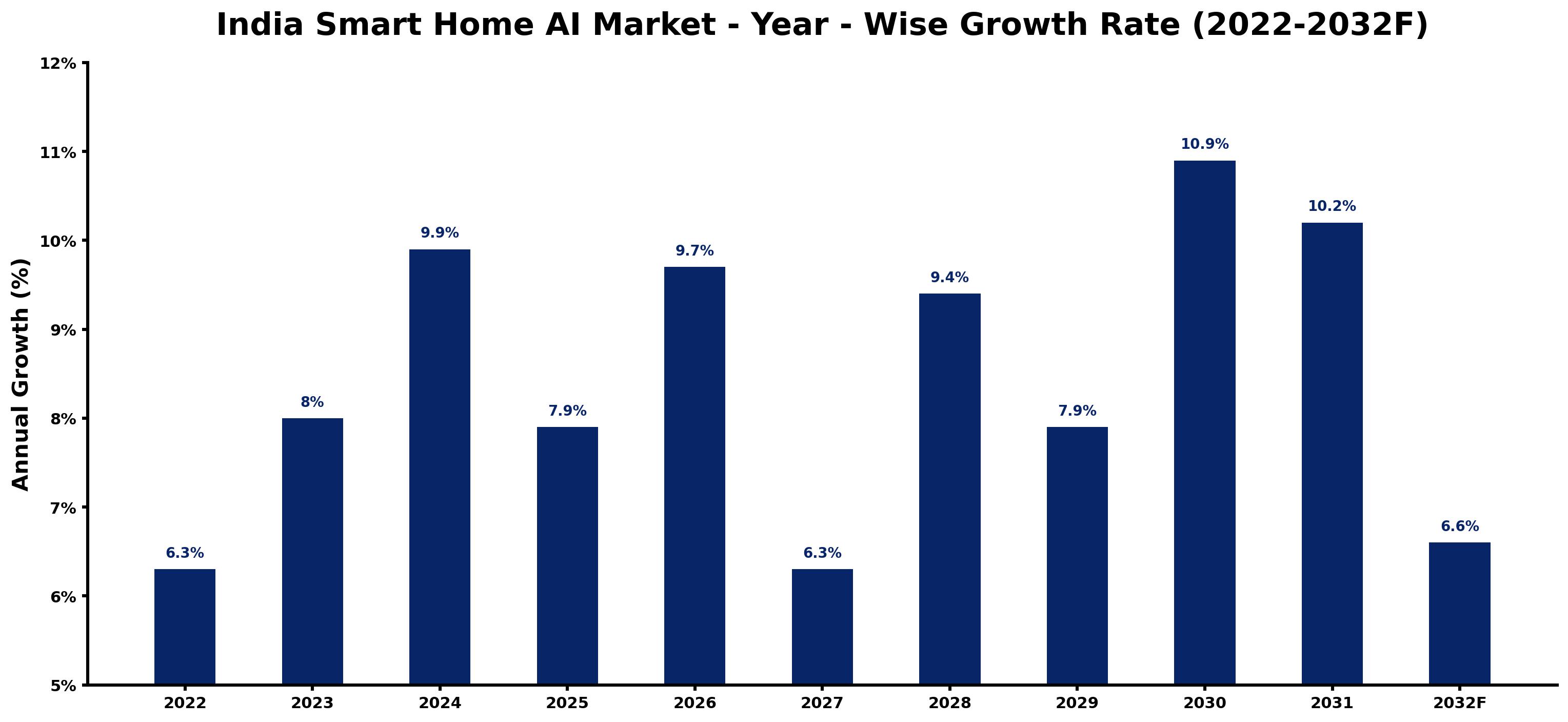
Year by year, the estimates below pair each growth rate with the development that shaped it.
| Year | Estimated Annual Growth (%) | Market Rationale |
| 2022 | 6.3 | The urban population's growth drove initial demand for smart home technologies. |
| 2023 | 8.0 | Increased technology adoption among urban homeowners accelerated market growth. |
| 2024 | 9.9 | The rise of smart speakers contributed to heightened consumer interest in smart homes. |
| 2025 | 7.9 | The market experienced a slowdown due to saturation in early adopters. |
| 2026 | 9.7 | New energy efficiency initiatives spurred demand for smart home solutions. |
| 2027 | 6.3 | Growth slowed as competition intensified among technology providers. |
| 2028 | 9.4 | Innovations in energy optimization technologies revitalized market interest. |
| 2029 | 7.9 | A slowdown occurred as consumers became more selective in their purchases. |
| 2030 | 10.9 | The peak growth was driven by expanding smart home infrastructure initiatives. |
| 2031 | 10.2 | Growth slowed as the market matured and consumer expectations evolved. |
| 2032 | 6.6 | The market continues to grow, albeit at a reduced rate as competition stabilises. |
Note: Market size estimations and growth projections presented in this report are based on 6Wresearch's proprietary forecasting methodology, utilizing the latest available industry data, government publications, and primary research inputs.
India Smart Home AI Market Synopsis
Smart Home AI in India incorporates artificial intelligence technologies into home automation systems, improving convenience, energy management, and security. Homeowners are the main buyers, looking for solutions that enhance energy efficiency and security. The Digital India programme and the National Smart Grid Mission play a crucial role in promoting smart technologies in urban areas, further increasing demand.
Market Dynamics Impact Analysis (2026–2032)
| Factor | Type | Impact | Primary Segment Affected |
| Growing urban population driving demand for smart home solutions | Driver | High | Smart Home Users |
| Increased focus on energy efficiency among homeowners | Driver | High | Energy Optimization AI |
| Rising interest in smart speakers as central control hubs | Opportunity | High | Smart Speakers |
| Integration of IoT devices into home systems | Opportunity | High | IoT Devices |
| High costs of advanced smart home technologies | Restraint | Medium | Voice Control AI |
| Limited awareness about smart home benefits among consumers | Restraint | Medium | Homeowners |
| Fragmentation in technology standards complicates integration | Challenge | High | Voice Control AI |
| Competition among numerous technology providers creates price pressures | Challenge | Medium | Device Manufacturers |
Evaluation of Drivers in India Smart Home AI Market (2026–2032)
The main growth drivers and the segments they affect most are set out below.
| Drivers | Primary Segment Affected | Why It Matters (Evidence) |
| Rising urban population | Smart Home Users | The urban population in India is expected to reach 600 million by 2031, increasing demand for smart home technologies. |
| Focus on energy efficiency | Energy Optimization AI | Over 50% of smart home users report energy savings of 20% or more, driving interest in energy management systems. |
| Growth of smart speakers | Smart Speakers | Smart speakers saw a 30% increase in sales in 2022, indicating rising consumer adoption. |
| Integration of IoT devices | IoT Devices | With over 100 million IoT devices expected by 2025, integration into home systems is accelerating. |
| Government initiatives | Voice Control AI | The Digital India initiative promotes smart technologies, increasing consumer awareness and adoption. |
Market growth for Smart Home AI in India is underpinned by rising urbanisation, increased focus on energy efficiency, and the rapid adoption of smart devices. The urban population is projected to reach 600 million by 2031, boosting demand for smart home solutions. Over 50% of users report energy savings of 20% or more, driving interest in energy management technologies. Smart speakers experienced a 30% sales increase in 2022, reflecting consumer preference for integrated control systems.
Evaluation of Restraints in India Smart Home AI Market
The key brakes on demand, and where they bite hardest, are shown below.
| Market Restraint | Primary Segment Affected | Why It Matters (Evidence) |
| High costs of advanced technologies | Homeowners | The initial investment for smart home systems can exceed INR 1 lakh, limiting accessibility for many homeowners. |
| Limited consumer awareness | Homeowners | Many potential buyers lack understanding of the benefits and functionalities of smart home technologies. |
| Fragmentation in technology standards | Voice Control AI | Diverse standards complicate device interoperability, deterring users from adopting smart home solutions. |
| Slow adoption rates in rural areas | Smart Home Users | Rural populations often lack access to the necessary infrastructure for smart home technologies. |
| Concerns over data privacy | Voice Control AI | Users are increasingly wary of data security issues, impacting their willingness to adopt smart technologies. |
India Smart Home AI Market Challenges
Buyers and suppliers in the India Smart Home AI market face regulatory challenges, as the Bureau of Indian Standards established guidelines in 2021 that can delay product launches by up to six months for producers. Importers deal with high costs, as tariffs on imported smart technologies raise prices by 15%, which reduces affordability for buyers. Competition is fierce, with numerous local and international players vying for market share, leading to profit margin erosion for producers. Buyers often find the overwhelming variety of smart home products confusing, causing decision-making delays that can extend for weeks, hindering overall adoption rates.
Trends in the India Smart Home AI Market
Below mentioned are some of the trends shaping the India Smart Home AI Market growth.
- Shift from Traditional to Smart Home Technologies: The trend towards smart home technologies began in 2020 with the Digital India initiative, promoting smart solutions. This has led to a rise in smart device adoption, with urban households expected to own at least three smart devices by 2025.
- Emergence of Energy Optimization Solutions: Energy Optimization AI is gaining traction, with a projected CAGR of 10.4% from 2026 to 2032. The National Smart Grid Mission aims to enhance energy efficiency, driving demand for these solutions.
- Increased Integration of IoT Devices: Integration of IoT devices into home automation systems is accelerating, with over 100 million expected by 2025. This trend is reshaping how consumers interact with their home environments.
- Growing Popularity of Smart Speakers: Smart speakers are becoming central to smart home ecosystems, with a 30% sales increase in 2022. This growth indicates a shift towards voice-controlled home automation.
Investment Opportunities in the India Smart Home AI Market
Investors looking at the India Smart Home AI Market should consider the following areas.
- Market Gap in Energy Management Solutions: With over 50% of users reporting energy savings, there is an opportunity for energy management solutions. Homeowners in urban areas are particularly interested in these technologies.
- Demand for Smart Home Integration Services: As smart home technologies proliferate, homeowners require integration services to streamline their systems. Urban areas with high smart device adoption present opportunities for service providers.
- Investment in Smart Home Startups: The Atal Innovation Mission supports startups in smart home technologies, creating investment opportunities. Investors can engage with emerging companies focused on innovative solutions.
- Expansion of Smart Home Initiatives in Cities: The Smart Cities Mission includes provisions for smart home solutions, creating opportunities for technology providers. Engaging with municipal projects can facilitate market entry.
Government Initiatives in the India Smart Home AI Market
The Digital India initiative, launched by the Ministry of Electronics and Information Technology in 2020, promotes the adoption of smart home technologies across urban areas. This initiative complements existing frameworks, improving infrastructure and accessibility for smart solutions. The Bureau of Indian Standards published the IS 16444 standard in 2021, ensuring safety and interoperability among devices, which is vital for consumer confidence. These measures collectively support a growing market by establishing clear guidelines and promoting technology adoption.
Homeowners benefit from the Atal Innovation Mission, which supports startups developing smart home technologies with funding and mentorship. This initiative encourages innovation and the development of tailored solutions for consumers. The National Smart Grid Mission, with a budget of 900 crore INR, aims to enhance energy efficiency in smart homes, directly impacting homeowners' energy costs. These government schemes are instrumental in creating a conducive environment for smart home technology adoption.
Future Insight of the India Smart Home AI Market
Several forward-looking factors should support the India Smart Home AI market over the coming years. The urban population is projected to reach 600 million by 2031, expanding the potential customer base for smart home technologies. The Digital India programme will promote the integration of advanced technologies in households, while the National Smart Grid Mission aims to enhance energy efficiency through smart solutions by 2025. By 2025, the average urban household is expected to own at least three smart devices, reflecting a growing trend towards automation.
Market Segmentation Analysis
The report offers a comprehensive study of the following market segments and their leading categories in the market.
By AI Application – Voice Control AI Dominated, Energy Optimization AI Expected to Grow Fastest
According to Dhaval Chaurasia, Assistant Manager at 6Wresearch, the largest ai application category in 2025 was Voice Control AI, with a 45% share of total revenue. Voice Control technology holds the largest share in the India Smart Home AI Market, as it significantly enhances user convenience by enabling hands-free operation of devices. This feature is particularly popular among urban homeowners who seek to simplify their daily routines. Over 2026–2032, Energy Optimization AI is expected to post the fastest growth, at a CAGR of 10.4%. Energy Optimization is witnessing rapid growth as more homeowners focus on reducing energy consumption, with over 50% reporting savings of 20% or more. This trend is likely to accelerate as urban populations increasingly adopt smart home technologies. Suppliers should prioritise energy management features to meet the growing demand for efficient smart home solutions.
By Smart Feature – Command Recognition Dominated and Is Expected to Record the Fastest Growth
Command Recognition accounted for a 48% market share by smart feature in 2025. Command Recognition commands the largest market share due to its essential role in facilitating user commands for device operation, making it a highly sought-after feature. Its widespread application across various smart home devices ensures its continued prominence in the market. Its lead should widen, with a projected CAGR of 9.9% during 2026–2032, the highest in this split. Command Recognition is also the fastest-growing feature, as its importance in enhancing user experience drives demand for more intuitive smart home systems. The integration of this functionality into an increasing number of devices will likely sustain its growth trajectory. This indicates that suppliers must focus on advancing command recognition capabilities to remain competitive in the smart home market.
By Integration Platform – Smart Speakers Dominated, Smart Cameras Expected to Grow Fastest
With a 47% revenue share in 2025, Smart Speakers was the largest integration platform category. Smart Speakers dominate the market share as they serve as central hubs for controlling multiple smart devices, making them essential for seamless home automation. Their popularity is bolstered by the increasing number of smart devices being integrated into households. The quickest growth will come from Smart Cameras, forecast to expand at a CAGR of 10.0% between 2026 and 2032. Smart Cameras are experiencing the fastest growth due to rising security concerns among homeowners, which fuels demand for advanced surveillance solutions. As smart home initiatives expand, this segment is well-positioned for rapid growth. This suggests that suppliers should enhance smart camera features to address the escalating security needs of consumers.
By End User – Homeowners Dominated, Smart Home Users Expected to Grow Fastest
Homeowners held a 42% share of the India Smart Home AI Market by end user in 2025. Homeowners represent the largest share in the market as they are the primary adopters of smart home technologies, motivated by the desire for convenience and efficiency. The expanding urban population further fuels this demand as more households seek smart solutions. Smart Home Users are projected to grow fastest, at a CAGR of 10.7% during 2026–2032. Smart Home Users are the fastest-growing segment, actively engaging with smart home solutions to enrich their living experiences. This engagement is expected to increase as more homeowners become familiar with smart technologies. This highlights the necessity for suppliers to tailor their offerings to meet the changing preferences of smart home users.
Key Attractiveness of the Report
- 10 Years of Market Numbers
- Historical Data Starting from 2022 to 2025
- Base Year 2025
- Forecast Data until 2032
- Key Performance Indicators Impacting the Market
- Major Upcoming Developments and Projects
Key Highlights of the Report:
- India Smart Home AI Market Outlook
- Market Size of India Smart Home AI Market, 2025
- Forecast of India Smart Home AI Market, 2032
- Historical Data and Forecast of India Smart Home AI Revenues & Volume for the Period 2022 - 2032F
- India Smart Home AI Market Trend Evolution
- India Smart Home AI Market Drivers and Challenges
- India Smart Home AI Price Trends
- India Smart Home AI Porter's Five Forces
- India Smart Home AI Industry Life Cycle
- Historical Data and Forecast of India Smart Home AI Market Revenues & Volume By AI Application for the Period 2022 - 2032F
- Historical Data and Forecast of India Smart Home AI Market Revenues & Volume By Voice Control AI for the Period 2022 - 2032F
- Historical Data and Forecast of India Smart Home AI Market Revenues & Volume By Energy Optimization AI for the Period 2022 - 2032F
- Historical Data and Forecast of India Smart Home AI Market Revenues & Volume By Security AI for the Period 2022 - 2032F
- Historical Data and Forecast of India Smart Home AI Market Revenues & Volume By Personal Assistant AI for the Period 2022 - 2032F
- Historical Data and Forecast of India Smart Home AI Market Revenues & Volume By Smart Feature for the Period 2022 - 2032F
- Historical Data and Forecast of India Smart Home AI Market Revenues & Volume By Command Recognition for the Period 2022 - 2032F
- Historical Data and Forecast of India Smart Home AI Market Revenues & Volume By Usage Prediction for the Period 2022 - 2032F
- Historical Data and Forecast of India Smart Home AI Market Revenues & Volume By Face/Object Detection for the Period 2022 - 2032F
- Historical Data and Forecast of India Smart Home AI Market Revenues & Volume By Learning Preferences for the Period 2022 - 2032F
- Historical Data and Forecast of India Smart Home AI Market Revenues & Volume By Integration Platform for the Period 2022 - 2032F
- Historical Data and Forecast of India Smart Home AI Market Revenues & Volume By Smart Speakers for the Period 2022 - 2032F
- Historical Data and Forecast of India Smart Home AI Market Revenues & Volume By HVAC, Lighting for the Period 2022 - 2032F
- Historical Data and Forecast of India Smart Home AI Market Revenues & Volume By Smart Cameras for the Period 2022 - 2032F
- Historical Data and Forecast of India Smart Home AI Market Revenues & Volume By IoT Devices for the Period 2022 - 2032F
- Historical Data and Forecast of India Smart Home AI Market Revenues & Volume By End User for the Period 2022 - 2032F
- Historical Data and Forecast of India Smart Home AI Market Revenues & Volume By Homeowners for the Period 2022 - 2032F
- Historical Data and Forecast of India Smart Home AI Market Revenues & Volume By Smart Home Users for the Period 2022 - 2032F
- Historical Data and Forecast of India Smart Home AI Market Revenues & Volume By Security System Makers for the Period 2022 - 2032F
- Historical Data and Forecast of India Smart Home AI Market Revenues & Volume By Device Manufacturers for the Period 2022 - 2032F
- India Smart Home AI Import Export Trade Statistics
- Market Opportunity Assessment By AI Application
- Market Opportunity Assessment By Smart Feature
- Market Opportunity Assessment By Integration Platform
- Market Opportunity Assessment By End User
- India Smart Home AI Top Companies Market Share
- India Smart Home AI Competitive Benchmarking By Technical and Operational Parameters
- India Smart Home AI Company Profiles
- India Smart Home AI Key Strategic Recommendations
Market Covered
This report examines the market across the segments below.
By AI Application
- Voice Control AI
- Energy Optimization AI
- Security AI
- Personal Assistant AI
By Smart Feature
- Command Recognition
- Usage Prediction
- Face/Object Detection
- Learning Preferences
By Integration Platform
- Smart Speakers
- HVAC
- Lighting
- Smart Cameras
- IoT Devices
By End User
- Homeowners
- Smart Home Users
- Security System Makers
- Device Manufacturers































